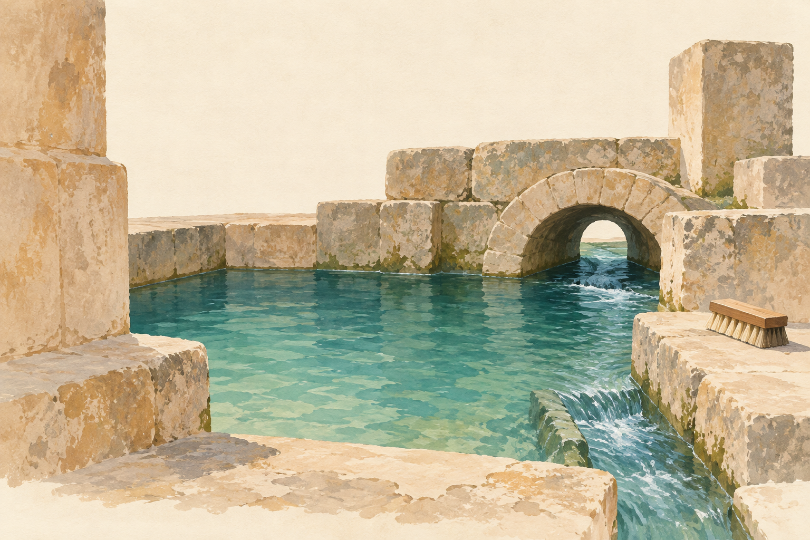
At the Roman Baths in Bath, water supplies a way into the history that a list of emperors cannot. It rises at the Sacred Spring, belongs to a landscape of worship and bathing, and passes through drainage that still carries it away. Following that movement gives the visitor a thread through a site crowded with objects, stonework and different periods of building.
It also offers a subject for a short travel film. Instead of trying to summarize Roman Britain over a procession of attractive views, the film can stay with one question: what have people asked this water to do? The answers lead from religious offerings to communal bathing and, finally, to the work of keeping the monument standing.
The Spring Was More Than A Water Supply
The Roman Baths museum places the Sacred Spring at the heart of the ancient site. Its account, “Roman Sacred Spring,” describes Roman engineers enclosing it in a stone chamber lined with lead. The water supplied the baths, but the Spring also received offerings. Objects thrown into it during the Roman period are now part of the museum collection.
That combination matters. It is tempting to tell an engineering story in which the Spring is simply a resource waiting to be captured. The temple and offerings complicate that version. Water could have a practical destination and religious significance at the same time. A visitor does not have to choose between admiring the plumbing and considering the hopes attached to it.
For a film, the change in attention could be modest: move from water to an object identified by the museum as an offering, then let the narration explain why the two belong together. There is no need to invent the private thoughts of the person who deposited it. The object’s documented context provides a connection without turning an unknown individual into a fictional witness.
A draft in Laper’s AI Screenwriting Software could begin with those two images: the Spring, then an offering. Try a single sentence connecting them before adding more history. Its factual content should come from the museum’s account; the writing assistant’s contribution is a possible way of expressing that connection.
The later history also resists a clean ending with the Romans. The same museum account explains that the medieval King’s Bath used the lower Roman walls as foundations. This is a useful detail to carry into a visit: the buildings around the water belong to successive decisions, not a single moment preserved untouched. Looking for those layers changes what an apparently unified setting means.
The Open Sky Changes How The Pool Reads
The Great Bath is an obvious visual centerpiece, but its current appearance needs a little explanation. The museum’s “Walkthrough” describes a lead-lined pool that once stood inside a large barrel-vaulted hall. The open view seen today should not silently become the setting for an imagined Roman afternoon. The missing enclosure is part of the story.
A short film could allow the present-day view to remain just that: a view of the monument now. Narration can explain the former roof without filling the frame with an invented reconstruction. If an interpretation drawing is included, identify it as such and establish its source. A convincing picture can otherwise erase the distinction between surviving remains and a proposed appearance.
The same museum walkthrough describes the site below modern street level and introduces its temple, Spring, bath house and finds. That is more useful to a visitor than treating the pool as an isolated attraction. It gives the water a setting: a complex whose different spaces supported different activities, with the modern city around and above it.
These are good places to slow the narration. A sentence about the roof needs time beside a view of the open space. A second sentence about the surrounding complex should not arrive before the first relationship is clear. The aim is not to fill every second with history. It is to give a person enough information to look again and notice something different.
When setting out the scene in Laper, put the proposed view beside the exact explanation: present-day pool; former enclosure. Read them together. Does the narration describe the image on screen, or ask the viewer to imagine a different building? That small distinction is easy to lose beneath an expansive sentence about Roman grandeur.
The Drain Leads Into A Living Maintenance Story
The water’s departure deserves attention too. According to the museum’s account of the Sacred Spring, the Roman drain carries water from the Spring and Great Bath toward the River Avon and continues to perform its original function. The museum walkthrough notes that visitors can see the great drain through a glass floor. The infrastructure is not merely a line on a vanished plan.
The museum’s “How the Great Bath is Cleaned” brings that continuity into the present. Staff drain the pool, clean it and inspect its fabric. The account explains that opaque water makes inspection difficult, while the cleaning process still makes use of Roman drainage. The picturesque pool therefore depends on labor that an empty, polished travel image might leave out.
That is a stronger final movement than a generalized claim that history has come alive. A monument is being maintained, water is being managed and surviving material needs attention. A film can acknowledge that work without pretending its maker witnessed a cleaning operation. Attribute the process to the museum’s published account, rather than placing an imagined worker into a scene.
If using an AI screenplay generator to explore this ending, keep the request narrow: connect the documented drain to the museum’s present-day maintenance work without inventing an encounter or quotation. Laper’s drafting assistance can propose wording, but the writer must check that the revision has not turned a researched explanation into an eyewitness claim.
There is something useful about carrying that maintenance story into the visit itself. A cleared channel or an unobstructed view can look as though it simply exists. The museum’s explanation makes it possible to notice the work behind that appearance, even when none of it is happening in front of you. The monument becomes a place being cared for, as well as a place being remembered.

Before You Go With A Camera
Use the Roman Baths’ current visitor information to plan the visit, including admission arrangements, accessibility and any guided tour you want to join. Confirm filming rules directly with the venue before planning a shoot, especially where equipment or commercial use is involved. A proposed sequence is not permission to record it, and other visitors should not become involuntary subjects.
Keep the route flexible. If a particular view cannot be filmed, do not replace it with unrelated footage that appears to show the same feature. An attributed explanation, a different permitted view or a shorter sequence can preserve the thread. The essential preparation is knowing which relationship each image is supposed to explain.
At Bath, that relationship begins with water and keeps returning to it. Look at what people built around the Spring, what they placed within it and what still has to be done to care for the site. A final permitted view of flowing water would be enough to close the film. It would leave the water continuing its journey after the account of it has stopped.



Leave a Reply
You must be logged in to post a comment.