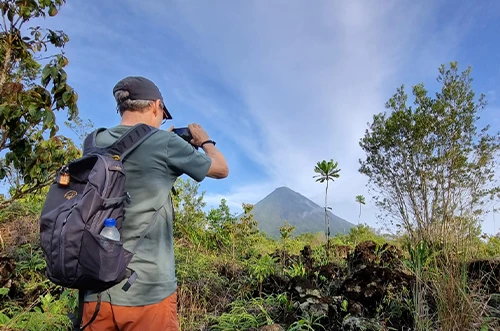
Arenal Volcano is one of Costa Rica’s most recognizable landmarks, rising near the town of La Fortuna in the northern lowlands. Before hiking around Arenal Volcano, know that the weather changes quickly, trails vary in difficulty, and park entry rules apply. Planning for these factors helps you enjoy a safer, smoother, and more rewarding hike.
Arenal Volcano rises 1,657 meters (5,437 feet) above sea level near La Fortuna in northern Costa Rica. It is one of the country’s youngest volcanoes and has remained in a resting phase since its last significant eruptive activity in 2010, with the surrounding national park protecting lava fields and tropical rainforest.
Planning an Arenal Volcano hike in Costa Rica is easier when you know what to expect before you arrive.
From trail choices and changing weather to park access and wildlife, here are seven important things to know:
1. The Volcano’s Summit Is Off Limits
Arenal looks climbable from a distance, but reaching the actual crater is not permitted. Past eruptions and unstable terrain make the upper slopes too dangerous for hikers.
All official trails stay on lower ground, circling the base rather than climbing toward the peak. Even with this restriction, several viewpoints along the trails offer close, direct views of the cone. Guides often point out where lava flows once reached during the volcano’s active decades.
2. Trail Options Range from Easy to Moderate
Arenal Volcano National Park has several marked trails, and not all require the same fitness level. Picking the right one depends on time available and hiking experience.
- Las Coladas Trail: Short, flat, passes through old lava fields
- Los Tucanes Trail: Longer loop through forest with volcano views
- Los Heliconias Trail: Easy walk suited for families or shorter visits
3. Weather Changes Quickly in the Rainforest
La Fortuna sits in a tropical rainforest zone, and rain can appear with little warning, even in the dry season. Trails can become slippery within minutes of a downpour. Mornings tend to offer the clearest skies and the best chance of seeing the volcano without cloud cover.
By afternoon, clouds often roll in and can block the summit from view entirely. Starting hikes early improves both visibility and comfort.
4. Guided Tours vs. Independent Hiking
Both options work for visiting Arenal, but they suit different types of travelers. Many first-time visitors planning an Arenal Volcano hike in Costa Rica choose a guided tour for the added safety and wildlife knowledge.
- Guided tours: Include wildlife spotting, safety knowledge, and transport, usually at a higher cost
- Independent hiking: Lower cost, more flexible pace, but requires arranging your own entry and transport
5. Wildlife You Might Spot Along the Trails
The forest around Arenal supports monkeys, toucans, coatis, and several frog species. While sightings are not guaranteed, early morning hikes increase the chances of spotting wildlife, as many animals are active before the midday heat sets in.
- Howler monkeys, often heard before they are seen
- Keel-billed toucans in the forest canopy
- Sloths resting in higher branches, easy to miss without a guide
6. Entry Fees and Park Hours to Plan Around
Arenal Volcano National Park charges its own entrance fee, separate from nearby attractions like hot springs or hanging bridges. The park generally opens early and closes in the late afternoon. Tickets can be bought at the entrance or arranged in advance through local operators.
7. A Good Follow-Up: La Fortuna’s Hot Springs
La Fortuna is known for hot springs heated naturally by the volcano’s geothermal activity. Options range from simple river-fed pools to resort-style facilities with multiple temperature zones. A common pattern among visitors is a morning hike followed by an afternoon soak.
Packing List for Rainforest Hiking
Heat, humidity, and sudden rain call for gear that holds up outdoors. A lightweight rain jacket and sturdy hiking shoes with excellent grip cover the basics. Insect repellent and a reusable water bottle round out what most hikers need for a half-day trail.
Key Takeaways
- The volcano summit is closed to hikers due to safety risks.
- Trail options range from short, flat walks to longer forest loops.
- Morning hikes offer the clearest views before clouds roll in.
- Guided tours add wildlife knowledge, while independent hiking costs less.
- Wildlife sightings are common, especially early in the day.
- Park entry fees and hours apply separately from other attractions.
- Nearby hot springs make a practical stop after a hike.



Leave a Reply
You must be logged in to post a comment.