The monuments of the Porfiriato still stand on Paseo de la Reforma, long after the regime that built them fell.
By Andrew D. Daily

I live in Roma Norte, a short walk south of Paseo de la Reforma, and I walk this part of the city regularly. The best day to see the avenue as it was meant to be seen is Sunday. From 8 a.m. to 2 p.m. the city closes Reforma to cars. Runners, cyclists, rollerbladers, and families pushing strollers take over the pavement. I run this stretch on Sunday mornings, with the Ángel de la Independencia towering above the traffic circle, a gilded figure on a tall stone column. For a few hours the boulevard feels like the promenade it was designed to be.
The rest of the week, Reforma is one of the busiest streets in Mexico City, a straight corridor of traffic, office towers, and monuments. Walk it with a little history in mind, and the Porfiriato is still easy to see. Porfirio Díaz held power in Mexico from 1876 to 1911 and spent much of that time turning the capital, at least along its grandest streets, into a European city. The avenue, the column, and the palace at the end of this walk were all part of that project. So was the unrest that finally ended it.
A Boulevard for an Empress
Reforma did not begin with Díaz. In the 1860s, during the brief Second Mexican Empire, Emperor Maximilian ordered a European-style boulevard to connect the city center with Chapultepec Castle, then the imperial residence on the edge of town. It was called Paseo de la Emperatriz, in honor of his wife, Carlota. After the empire fell, the restored republic renamed the avenue. In 1872 it became Paseo de la Reforma, after the Liberal Reform.
Díaz took power in 1876 and made the avenue the ceremonial spine of his capital. He added tree-lined medians, stone benches, and a series of glorietas, the roundabouts that still organize the walk. Monuments went up in those circles, including the Monument to Cuauhtémoc, inaugurated in 1887 at the crossing with Avenida de los Insurgentes. Along the flanks, new colonias filled with French-looking mansions. Visitors compared the street to the Champs-Élysées in Paris, which was the idea.
The Ángel of 1910
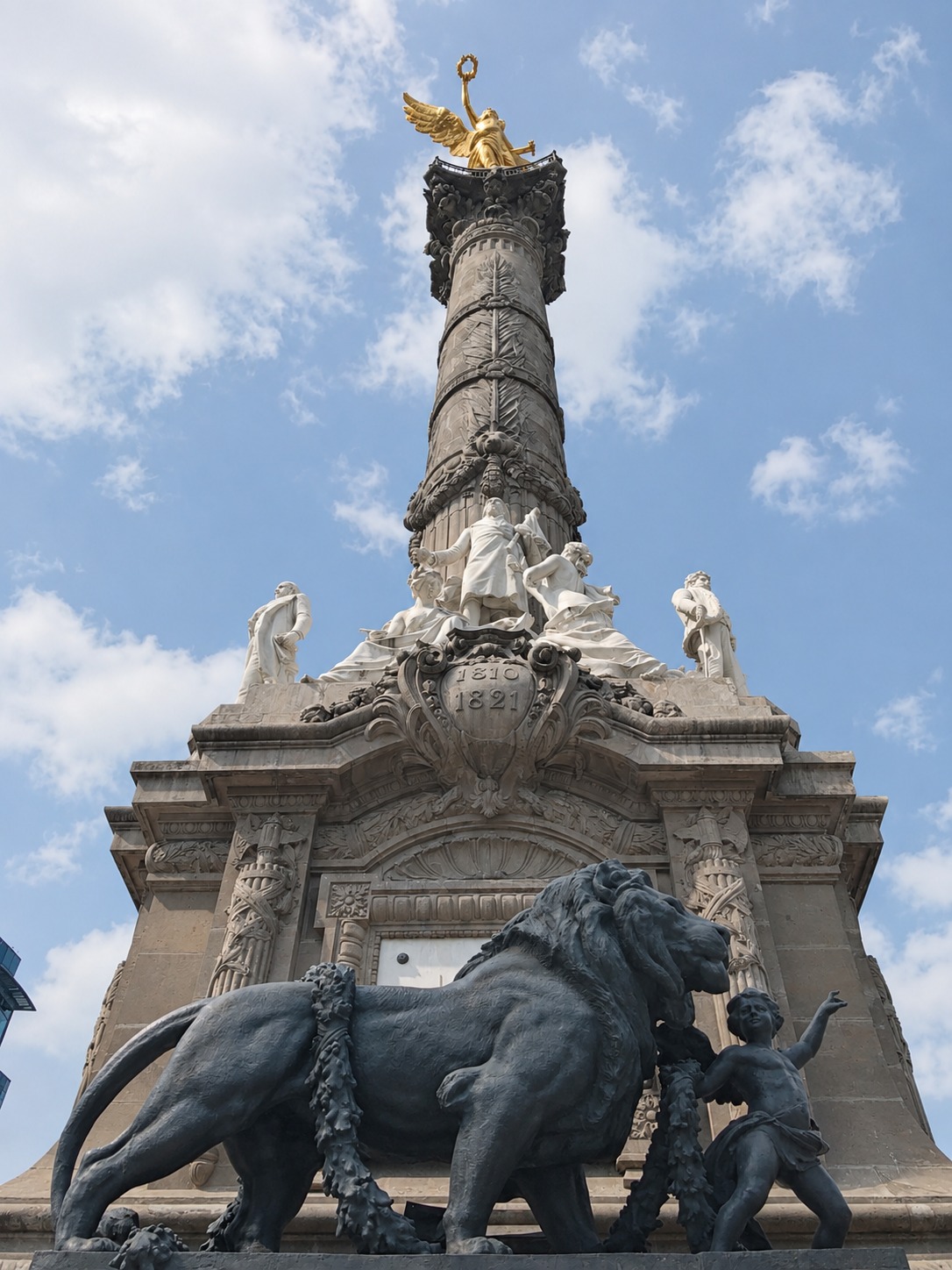
The gold figure on the column is a Winged Victory, a Nike, designed and cast by the Italian sculptor Enrique Alciati. Mexicans have called it the Ángel for so long that the official name, the Monumento a la Independencia, is the one most travelers have to look up. The Mexican architect Antonio Rivas Mercado designed the monument. Díaz laid the first stone in January 1902. The first foundation failed, and the column had to be started again. It was finished in time for the centennial Díaz had been planning for years.
On September 16, 1910, he inaugurated the monument as the centerpiece of the hundredth anniversary of Mexican independence. The column rises 36 meters, and Alciati’s gilded bronze figure, about 6.7 meters tall, stands at the top with a laurel crown and a broken chain. At the base, bronze sculptures represent law, war, justice, and peace. The unveiling was meant to present a modern nation, sure of itself after a century of independence and three decades of order.
The celebration did not travel far beyond the capital. That November the Mexican Revolution began. Díaz resigned on May 25, 1911, and left for exile in Europe. He died in Paris in 1915. The Ángel stayed where he had placed it. On July 28, 1957, an earthquake knocked the statue from the column and shattered it on the pavement. Restoration took more than a year. The original head is now kept in the city’s historical archive. The figure you see today is the one set back in place the following year, still looking down Reforma.
If you walk up to the base, you can see that the monument has more steps than it began with. It was built with nine. As the ground beneath the city has sunk, fourteen more were added in the years that followed, and the column now seems to rise out of a deeper well. You can walk around the monument at any hour. A stairway of 200 steps leads to a lookout inside the column, but it is not open at present.
The Palace That Outlasted the Regime
From the Ángel, walk east along Reforma toward the Historic Center. The avenue is wide and mostly flat, and even on a weekday you can follow the tree-lined medians for much of the way. Office towers and hotels now stand where many of the old mansions were, but the route is still the ceremonial one Díaz used to show off the capital. Pause at the Monument to Cuauhtémoc, then continue toward the trees of the Alameda Central, the old park at the edge of the colonial city.
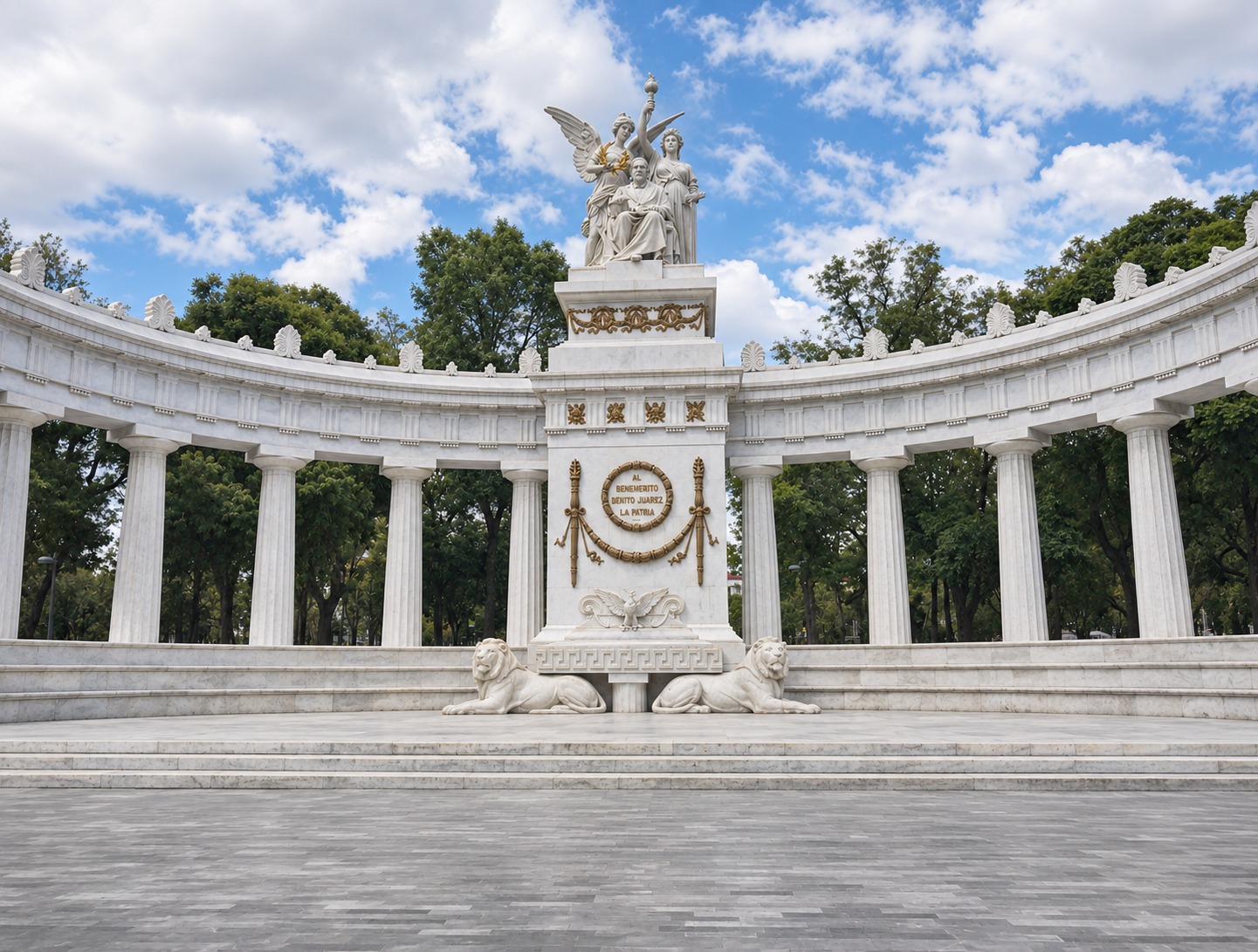
On the south side of the park, facing Avenida Juárez, stands the Hemiciclo a Juárez, a semicircle of Carrara marble columns honoring Benito Juárez. The architect Guillermo Heredia designed it, the Italian sculptor Alessandro Lazzerini carved the figures, and Díaz inaugurated the monument on September 18, 1910, as part of the same centennial celebration that had unveiled the Ángel two days earlier.
Just beyond the park stands the Palacio de Bellas Artes, the other great civic promise of the Porfiriato, and the one Díaz never saw finished.
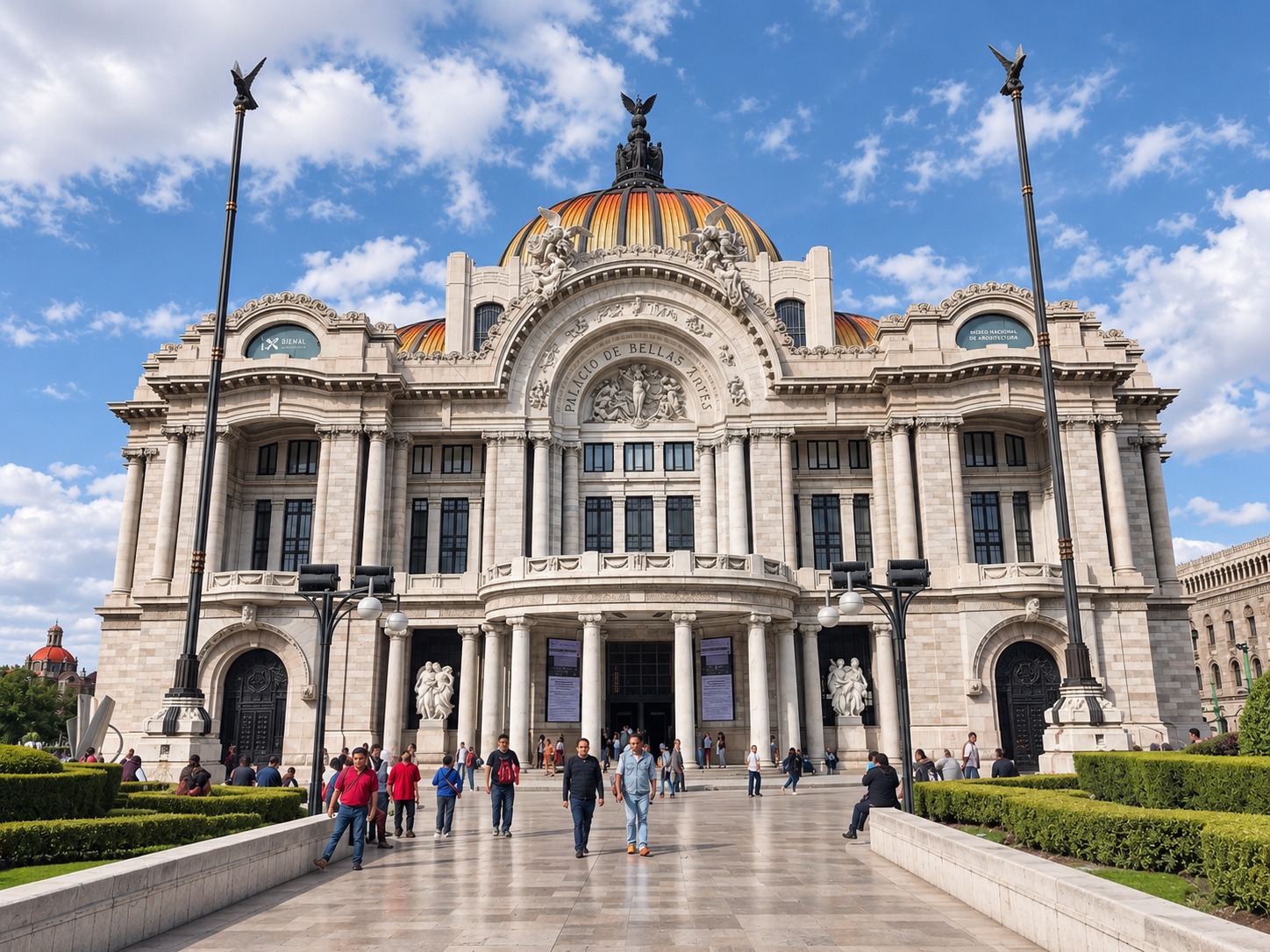
He wanted a new national theater ready for the centennial, a building grand enough for the capital he had remade. The Italian architect Adamo Boari designed it. Work began in 1904, and Díaz laid the first stone on April 2, 1905. The theater was supposed to be completed in four years. Budget trouble, unstable ground, and then the Revolution delayed it. Boari left Mexico in 1916, with most of the exterior done except the covering of the dome.
The building sat unfinished through the fighting and the governments that followed. In the early 1930s the architect Federico E. Mariscal was given the job of completing it, this time not only as a theater but as a national institution for the arts, and under a new name. The Palacio de Bellas Artes opened on September 29, 1934. The exterior is Art Nouveau, pale marble and sculpture, still Boari’s design. The interior, finished by Mariscal, is Art Deco. Inside, the Museo del Palacio de Bellas Artes holds murals by Diego Rivera, José Clemente Orozco, and David Alfaro Siqueiros, the painters of the Mexico that came after Díaz.
The City Underneath
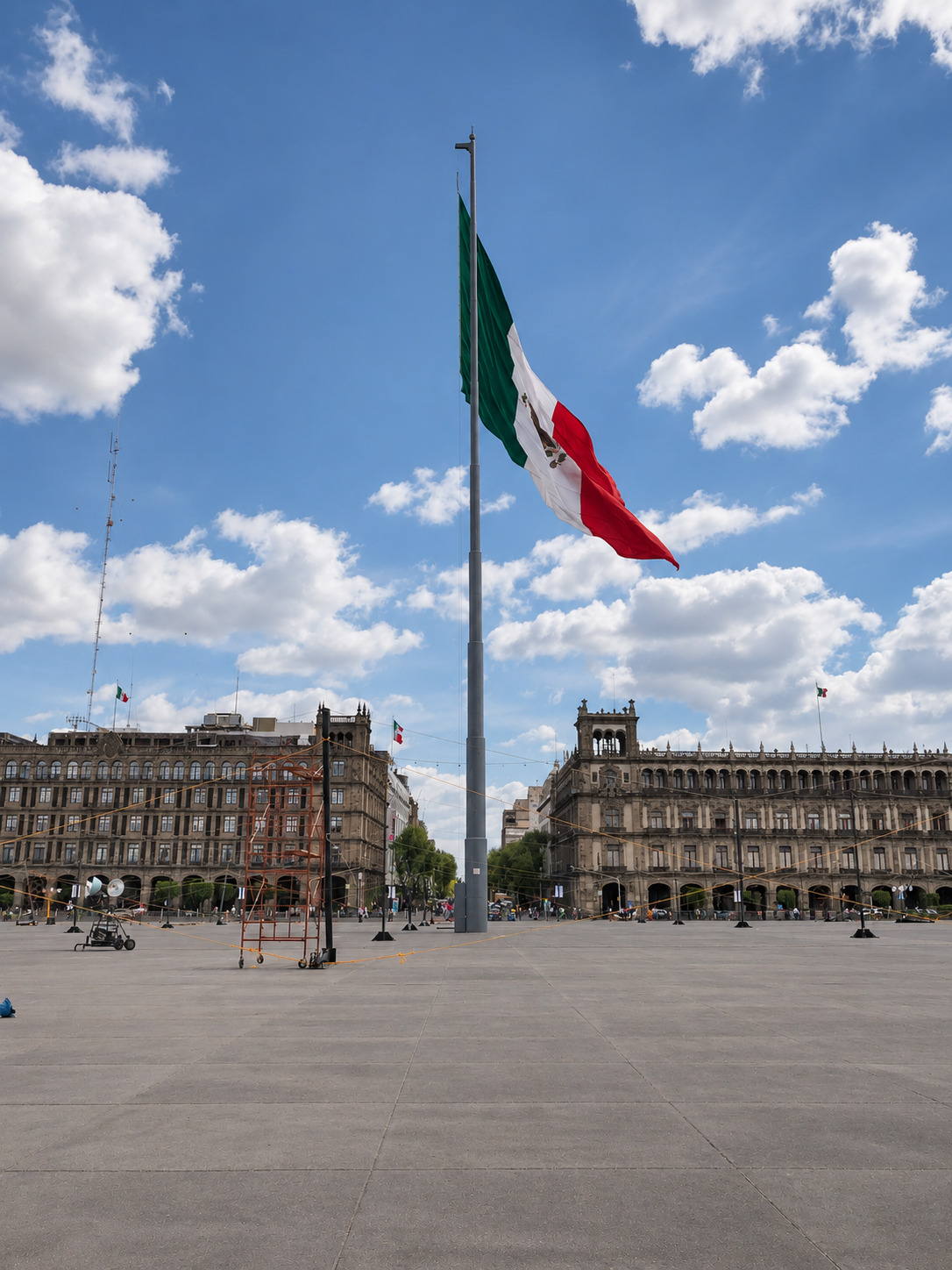
A short walk farther east brings you to the Zócalo, officially the Plaza de la Constitución, the main square laid out after the Spanish conquest over the ceremonial center of Tenochtitlan, with a monumental Mexican flag at the center.
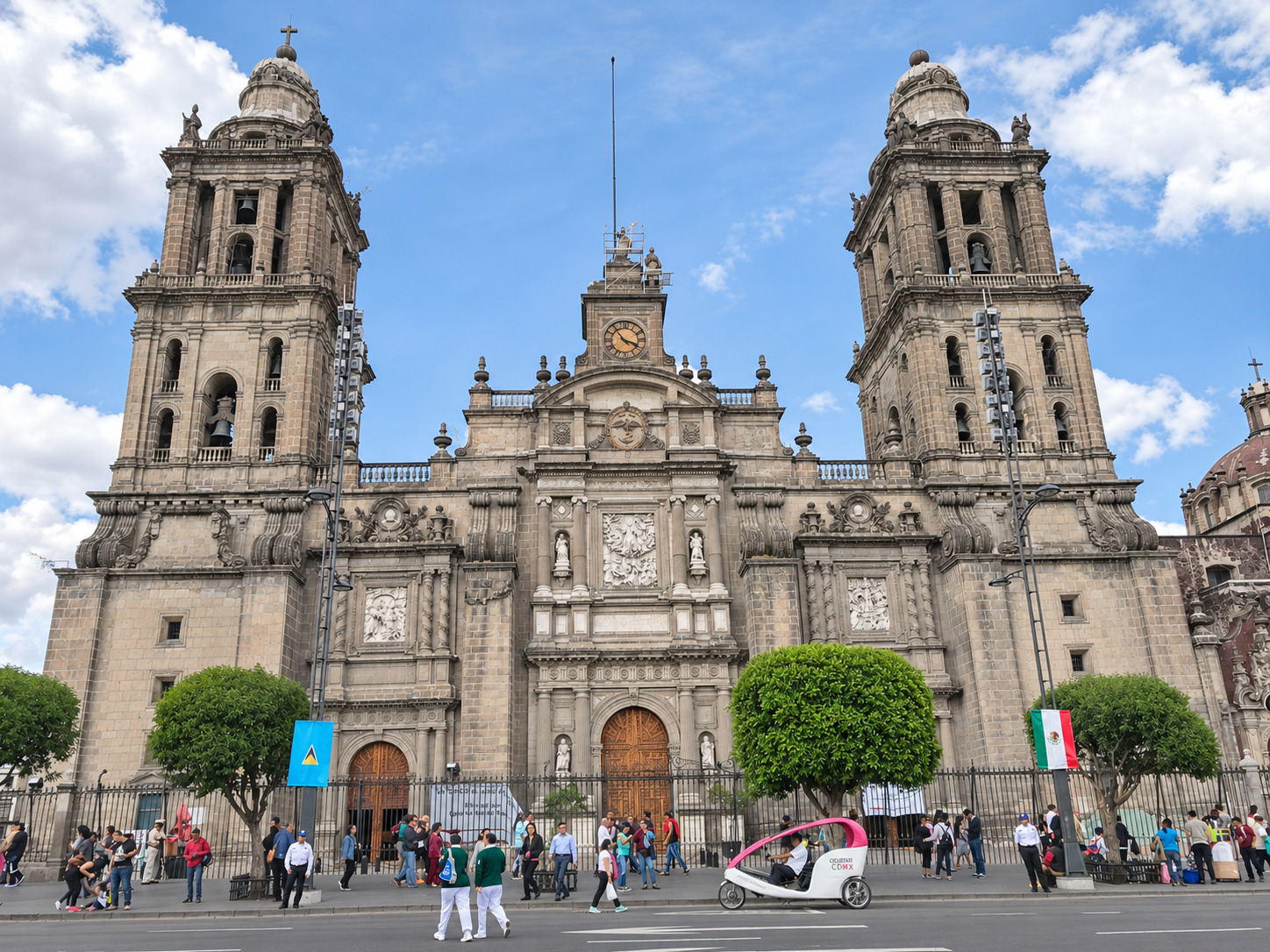
On the north side of the square stands the Metropolitan Cathedral, begun in 1573 and completed in 1813.
From there it is only a short walk to the Templo Mayor, the ceremonial heart of the Mexica capital of Tenochtitlan. For centuries it lay buried under the colonial city the Spanish built over it, and under the European capital Díaz tried to build after that. On February 21, 1978, electrical workers laying cable between the streets of Argentina and Guatemala struck a carved stone: the monolith of the goddess Coyolxauhqui. The find led to a full excavation. The site museum opened on October 12, 1987.
Standing at the edge of the excavation, just a few steps from the cathedral, you can see the layered platforms of the temple. That is the other end of the walk, and the useful contrast. Reforma, the Ángel, and Bellas Artes show you the city Díaz wanted the world to admire. The Templo Mayor shows you what was already here.
If You Go
The walk: Start at the Ángel de la Independencia on Paseo de la Reforma. The monument is a short walk from Metro Sevilla on Line 1, and Metrobús Line 7 runs the length of Reforma. Walk east along the avenue, past the Monument to Cuauhtémoc at Insurgentes, to Avenida Juárez and the Alameda Central. The Hemiciclo a Juárez stands on the south side of the park. Palacio de Bellas Artes stands at the eastern edge. From there it is about a 15-minute walk through the Historic Center to the Zócalo and the Templo Mayor, at Seminario 8.
Sundays on Reforma: The city closes Paseo de la Reforma to cars on Sundays from 8 a.m. to 2 p.m. for runners, cyclists, and pedestrians. It is the easiest time to look up at the monuments without watching for traffic.
The Ángel: The monument can be seen at any time from the traffic circle. There is no ticket to view it from outside. The interior lookout is not currently open.
Palacio de Bellas Artes: The Museo del Palacio de Bellas Artes is open Tuesday through Sunday, 10 a.m. to 6 p.m. The box office closes at 5:30 p.m. Admission was 95 pesos at the time of writing, and entry is free on Sundays. The museum is closed on Mondays. Confirm hours and prices before you go at museopalaciodebellasartes.inba.gob.mx.
Templo Mayor: The museum and archaeological site are open Tuesday through Sunday, 9 a.m. to 5 p.m., and closed on Mondays. At the time of writing, admission was 210 pesos for foreign visitors and 105 pesos for Mexican residents. Sundays are free for Mexican citizens. Children under 13, students, teachers, and seniors enter free with valid identification. Confirm details at templomayor.inah.gob.mx.
When to go: Sunday morning is the best time to walk or run Reforma without cars. For the museums, go Tuesday through Sunday, and go early if you can. Both Bellas Artes and the Templo Mayor close on Mondays.
About the author
Andrew D. Daily is the creator of MexicoCityTravel.com. Stay up to date with his current projects at dailyman.mx.
Photo credits
All photographs by Andrew D. Daily.
Photo key
- diaz1-reforma-angel.jpg (feature image, place at the top): The author and his wife at the base of the Ángel de la Independencia on Paseo de la Reforma. Photo by Andrew D. Daily.
- diaz2-angel-close.jpg: The Ángel de la Independencia, seen from below, with the bronze lion and child in the foreground. Photo by Andrew D. Daily.
- diaz3-hemiciclo-juarez.jpg: The Hemiciclo a Juárez in the Alameda Central, inaugurated on September 18, 1910. Photo by Andrew D. Daily.
- diaz4-bellas-artes.jpg: The Palacio de Bellas Artes, begun in 1904 by Adamo Boari and completed in 1934. Photo by Andrew D. Daily.
- diaz5-zocalo-flag.jpg: The Zócalo, officially the Plaza de la Constitución, with the monumental Mexican flag and Palacio Nacional at right. Photo by Andrew D. Daily.
- diaz6-metropolitan-cathedral.jpg: The facade of the Metropolitan Cathedral, begun in 1573 and completed in 1813, on the north side of the Zócalo. Photo by Andrew D. Daily.



Leave a Reply
You must be logged in to post a comment.