Stand on the Theresienwiese on an ordinary summer day and it is just a wide, open field in the middle of Munich. Yet this meadow ties a royal celebration of 1810 to the vast festival that now fills it with temporary tents and millions of visitors. the rich history of Oktoberfest in Munich is often told as a story of beer, but the beer came later, and what began as a public party for a dynastic wedding has been reshaped many times and has not run without interruption.
This article separates the wedding-era origins from the customs added afterwards, places Oktoberfest famous brewing ordinance in its proper context, and shows where you can meet that heritage in Munich today.
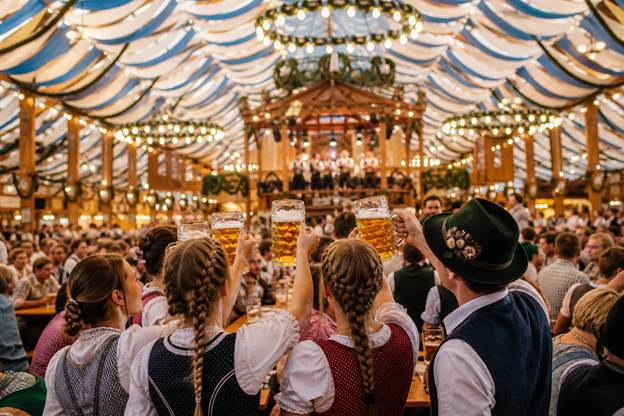
The history of Oktoberfest in Munich begins with a royal wedding
On 12 October 1810, Crown Prince Ludwig of Oktoberfest, later King Ludwig I, married Princess Therese of Saxe-Hildburghausen. Munich’s citizens were invited to share in about five days of celebrations, which were already being called a folk festival at the time. The date people often quote is the wedding itself, but the horse race came later: it was held on 17 October on open ground outside the city gates and closed the public festivities. Children in regional costume paid homage to the royal family, and the race, proposed by a National Guard officer, Andreas Michael Dall’Armi, drew large crowds.
This was not a beer festival, since there were no beer tents and no fairground rides. The meadow was named Theresienwiese, or Therese’s Meadow, in the bride’s honour, and Munich locals still call the festival the Wiesn, a shortened form that preserves that geography.
The pivotal decision came next. The race was so well received that it was repeated in 1811, which turned a one-off dynastic occasion into a recurring public event.
How a recurring celebration became a September beer festival
In 1811 an agricultural show was added to promote Bavarian farming, which gave the festival a broader regional character beyond the racecourse. It was cancelled in 1813 during the Napoleonic wars, and in 1819 Munich’s city council took it over and decreed that it be held annually. That municipal stewardship is why the Wiesn is still a city institution rather than a private enterprise.
During the nineteenth century the opening moved into late September to take advantage of milder weather, so only the final days now fall in October. The name stayed, which is why a festival called Oktoberfest begins in September. It is best seen as a weather-driven adjustment, not a rigid rule fixed in one year.
The beer came gradually. Small wooden stalls were limited to 18 in 1825, and from the 1890s large temporary halls replaced them. Showmen arrived alongside, with the first carousel and two swings recorded in 1818 and the fairground trade booming in the 1880s.
Nor was this an unbroken tradition. Wars, cholera epidemics and economic crises interrupted the festival several times, and the 2020 and 2021 pandemic cancellations are only the most recent gaps.
Bavaria’s brewing heritage predates the Wiesn
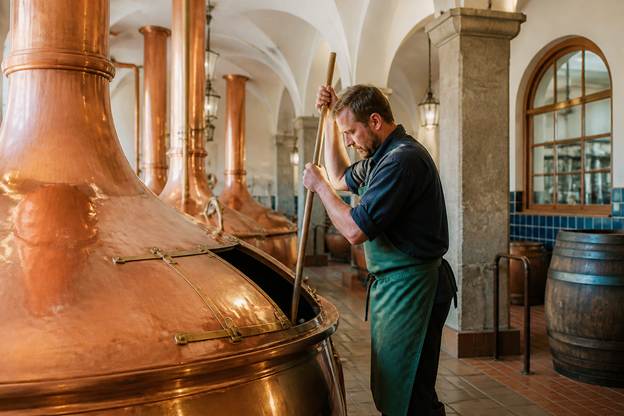
Bavaria’s brewing ordinance of 1516, now associated with the Reinheitsgebot tradition, came almost three centuries before the first wedding race. It is part of the cultural backdrop to Munich’s beer identity, but it did not found the festival, which began as a royal celebration with no beer tents at all.
The original rules named water, barley and hops as permitted ingredients. Yeast is not listed, which reflects how little was understood about fermentation then, not a belief that beer needed none. It is also worth being careful about the later story, because the sixteenth-century text is not the law governing German beer today; subsequent legislation has replaced it.
The tradition still matters on the Wiesn. Only beer brewed within Munich’s city limits, and in line with the applicable purity requirements, may be served at the festival, so the glass in your hand links the modern event to a long Bavarian habit of regulating how beer is made.
Tents, Tracht and ceremonies are traditions that evolved
The giant tents on the Theresienwiese are temporary structures, put up for the festival and taken down afterwards. They share a convivial drinking culture with Munich’s permanent beer halls, but the settings differ: one is a year-round hall in the city, the other a seasonal village of timber and canvas. Inside, communal tables, brass bands, singing and, later in the day, contemporary party music make the festival something people join in with, not a static display of the past. Since 2005 a ‘quiet Wiesn’ has kept the music to traditional brass before 6 p.m.
Tracht, the regional dress that includes dirndls and lederhosen, has changed with fashion and heritage revivals. The sight of so many people in it today should not be read as an unbroken custom from 1810, and promoters of dirndl and lederhosen as everyday fashion were still organising festival parades as late as 1910.
Two dated examples show how much was added later. The first costume procession was held in 1835 for the royal couple’s silver wedding, and in 1950 Munich’s mayor, Thomas Wimmer, first tapped the opening barrel, taking 17 strokes. Since then the mayor has done it himself and announced ‘O’zapft is!’, meaning ‘It’s tapped!’
Follow the festival’s heritage through Munich today
Start at the Theresienwiese itself, the one element that has never changed. Outside festival time it is open ground, which makes it easier to picture the meadow of 1810, though the tents are temporary and cannot be visited year-round. Above it stand the Bavaria statue, unveiled in 1850, and the Ruhmeshalle behind it, finished in 1853. Both are nineteenth-century expressions of regional identity, but check access before planning to go inside.
Next, consider the costume and marksmen’s procession, held on the first Sunday of the festival. Around 8,000 participants, with regional dress, bands and community associations, walk from the Maximilianeum to the Theresienwiese. Don’t confuse it with the festival hosts’ opening procession, which is a separate event, and do check the current programme and viewing arrangements.
The Oide Wiesn, a historical section on the south part of the grounds, began for the 200th anniversary in 2010 and has returned in most years since, pausing when the Bavarian Central Agricultural Fair is held every four years. It offers historic rides, folk music and dancing, but it is a modern celebration of heritage, not an untouched remnant of 1810.
Dates, routes, admission and tent access all change, so rely on the official festival information. For wider trip planning, Thirsty Swagman’s Oktoberfest travel guides are a useful resource, though not a source for the history above.
If you only have limited time, spend part of it on the original grounds and pair it with either the costume procession or the Oide Wiesn. That combination shows both where the festival began and how it keeps reinventing itself.



Leave a Reply
You must be logged in to post a comment.