When international travelers think of Toronto, a few specific images usually come to mind. They picture the needle-like silhouette of the CN Tower piercing the clouds. They think of the roaring mist of Niagara Falls (which is technically a neighbor, but close enough). Or, they imagine the busy intersections of Yonge-Dundas Square, flashing with billboards like a polite version of Times Square.
These icons are famous for a reason, and if it is your first time in Canada’s largest city, you should absolutely see them. But as a local who navigates these streets daily driving everyone from visiting executives to curious tourists I can tell you that the true character of Toronto isn’t found in the guidebooks’ “Top 10” lists.
Toronto is a “city of neighborhoods,” a sprawling metropolis stitched together by deep ravines, Victorian industrial history, and modern design. The real magic happens when you venture outside the downtown core. If you are willing to explore the “outer rim” of the city, you will find Art Deco palaces, architectural graveyards, and serene gardens that feel worlds away from the urban rush.
Here is a guide to three of my favorite hidden spots that will show you a side of Toronto most visitors never see.
1. The “Palace of Purification” (R.C. Harris Water Treatment Plant)
It sounds almost like a joke to recommend a water treatment plant as a “must-see” tourist attraction. In most cities, utility buildings are concrete eyesores hidden behind chain-link fences. But Toronto does things differently.
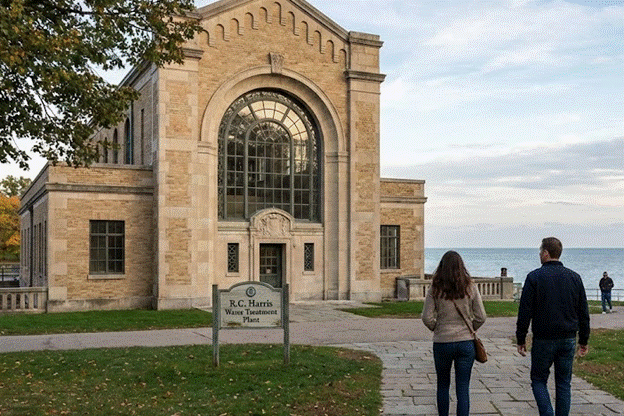
Located in the Beaches neighborhood at the east end of Queen Street, the R.C. Harris Water Treatment Plant is widely considered the most beautiful collection of buildings in the city. Constructed in the 1930s, it is a masterpiece of Art Deco architecture. We are talking about cathedral-like interiors with marble floors, brass railings, and grand arched windows that overlook Lake Ontario.
Locals call it the “Palace of Purification.” It is so visually stunning that it is frequently used as a filming location for movies and TV shows (you might recognize it as a high-security prison or a futuristic headquarters in sci-fi films).
Why Go? The grounds are open to the public and offer one of the most peaceful walks in the city. Because it sits on a hill overlooking the lake, the views of the water are uninterrupted. It is the perfect place to watch the sun go down, casting a golden glow on the buff brick and limestone facade. Unlike the crowded waterfront downtown, this spot is usually quiet, filled only with dog walkers and locals reading on benches.
2. Guild Park and Gardens: The Architectural Graveyard
If you travel further east along the Scarborough Bluffs, you will find one of the most surreal and hauntingly beautiful parks in Canada: Guild Park.
To understand this place, you need to know a bit of Toronto’s history. In the mid-20th century, the city went through a massive modernization boom. Many of its stunning historic buildings—grand stone banks, theaters, and exchanges were demolished to make way for glass skyscrapers.
Normally, this rubble would have been lost forever. However, Rosa and Spencer Clark, two preservationists who owned the Guild Inn, decided to save the pieces. They rescued over 70 architectural fragments, Greek columns, Roman arches, carved stone faces, and entrances and arranged them in their garden.
The Experience Walking through Guild Park feels like stumbling upon ancient ruins in the middle of a Canadian forest. The centerpiece is the “Greek Theatre,” made from eight marble columns that were salvaged from the Bank of Toronto building in 1966. It stands open to the sky, surrounded by towering trees.
For photographers, this place is a dream. The contrast between the ornate, hand-carved stone of the 19th century and the wild, natural growth of the forest creates a visual you won’t find anywhere else. It is a poignant reminder of the city that used to be.
3. The Aga Khan Museum and Park
While the first two spots on this list are historic, this one is a masterpiece of the modern era. Located in the North York district, the Aga Khan Museum is often skipped by tourists who stick strictly to the subway lines downtown and that is a huge mistake.
Designed by Pritzker Prize-winning architect Fumihiko Maki, the building itself is a work of art. It was designed specifically to manipulate light. The white granite walls are angled in such a way that the building seems to change color depending on the position of the sun.
The Hidden Gem: The Formal Gardens While the museum houses an incredible collection of Islamic art and history, the real secret for a relaxing afternoon is the surrounding park, designed by landscape architect Vladimir Djurovic.
The gardens are a modern interpretation of the traditional Islamic “Charbagh” (four-part garden). It features five reflecting pools made of dark black granite. When the water is still, the pools create a perfect, mirror-like reflection of the white museum and the sky. It is arguably the most “Zen” spot in Toronto. If you have had a busy week of travel and need an hour of absolute silence and symmetry to clear your head, this is where you go.
Practical Logistics: How to See Them All
Here is the “local knowledge” part that is crucial for international visitors: Toronto is huge.
Many global travelers assume Toronto is compact like European cities, but it is actually geographically massive. The spots I’ve listed above are spread out across the “outer rim” of the city. The R.C. Harris plant is in the East End; Guild Park is further east in Scarborough; the Aga Khan is north near the Don Valley Parkway.
The Challenge Trying to connect these dots using public transit can turn a fun afternoon into a logistical nightmare. While Toronto’s subway is great for downtown, reaching these specific hidden gems involves transferring from subways to buses and doing a fair amount of walking.
The Solution To see the “Hidden Toronto” efficiently, you need a car. However, driving yourself in an unfamiliar city with aggressive highway traffic can be stressful. This is why many savvy visitors choose to hire a private chauffeur for the day. Having a dedicated driver changes the entire dynamic of the trip. You can start your morning at the Aga Khan, cruise down the Don Valley Parkway to the R.C. Harris plant, and finish the day at Guild Park—all without looking at a GPS.
Final Thoughts
Toronto is a city of layers. The skyline is impressive, but the history and character on the ground level are what truly make it special. Next time you visit, dare to go beyond the CN Tower. Go find the castle by the lake, the ruins in the forest, and the gardens of light. You will see a side of the city that even many locals haven’t discovered yet.
The Author: Rita Ally is a Toronto local and the owner of VVIP Toronto Limo, a private transportation service dedicated to helping visitors explore the city in comfort.


Leave a Reply
You must be logged in to post a comment.