Easter Island’s Collapse Part One outlined the arrival and spread of the islanders’ communities, and the rise of the Moai cult. In Part Two, we will review those twist and turns that brought the collapse of such an uncommon society. As Van Tilburg noted “the Decadent/Restructure Phase of the island’s prehistory (1680-1722) intensified land use, continued deforestation and probable soil depletion that interacted to produce increasing events of crop failure” (1994). To answer their severe environment, concurrent with increasing social strife due to resources depletion and food scarcity, the Rapanui needed to find other ways to deal with reality. However, that implied a shift to new values, as Edwards put it “not as an immediate adoption of new religious concepts, but rather as a rejection of the perceived failed ones” (2013). Again, as in the past, since their environment did not improve despite prayers and pleas to ancestors, ritual behavior was once again given priority over reality.


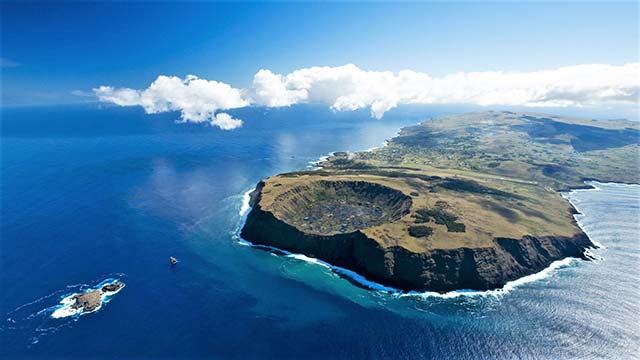
Easter Island is the only landmark in over a million square miles of the South Pacific. The thirty-seven low and small Sala y Gomez Islands group, 243 miles to the northeast is home to frigates and sooty terns among other seabirds; they are no windbreakers. The island subtropical latitude lies twenty-seven degrees south of the Equator. It is a dry and cool climate that did not allow for the type of tropical crops important elsewhere in Polynesia, such as bread fruit and coconuts; the latter, introduced in modern times, grows poorly on Easter Island. In a depleted environment, the forces of the sun and the wind were intensely destructive. The ecological situation was aggravated by a stow away that came with the first group of settlers, the Polynesian rat (Rattus exulans), whose teeth marks were found on baby coconuts. With no natural predator, the rodent found an ideal habitat to proliferate and travel in the extensive underground network of lava tubes.
To meet their worsening environment and concurrent community challenges, as Englert notes, “the Rapanui needed to find other ways to grasp with reality that implied a shift to new values, not as an immediate adoption of new religious concepts, but rather as a rejection of the perceived failed ones” (1973). The Birdman cult stood for such a shift initiated by matato’a leaders, the “men with bloody hands,” that superseded the socio-political and failed spiritual dominance of the long-standing Ariki-led clans. The Birdman cult brought down the Moais to cut off the ancestors’ mana to their living inheritors and assert the warrior’s political power. Studies place the shift away from the Moai cult and the toppling of the giant statues toward the end of the eighteenth century for, by then, the cult had lost most of its political and religious credibility.

On Rano Kau’s crater are seen petroglyphs of the Birdman represented as part man from the neck down, with the head and beak of a frigate bird (Fregata magnificent), a depiction that prevailed before the shift to the sooty tern (Onychoprion fuscatus). Both birds were referred to as manutara. The reason for the shift from the frigate to the sooty tern in the late part of the eighteenth century is that the frigates’ eggs and chicks in their traditional nesting habitats on the slopes of the Poike volcano, were depleted by the islanders. Edwards explain that “birds were very important to Polynesians, especially those of black and white plumage. Migratory birds, however, were most revered for their ability, it was believed, to transit between the worlds of the living and the dead. In seventeenth to eighteenth century Rapa Nui, these beliefs converged to form a religious cult specifically honoring Make’make, known as the Birdman Cult. While the Ancestor Cult deified ancestors represented by statues, the Birdman Cult had a man become the living, breathing medium to communicate with the gods” (2013)
The cult had its seat at Orongo on the crest of Rano Kau’s extinct volcano crater.
Fifty-two semi-buried oval stone-slab structures were dedicated to the clans and were used only once a year for the race. Of the three islets offshore facing Rano Kau are Motu Nui, Motu Iti and Motu Kao Kao. The nine square miles Motu Nui was the focus of the cult’s rituals. For their habitat, the sooty terns were content with a more rugged environment than the frigates. The birds nested on the rocky islet of Motu Nui to protect their eggs and chicks from the islanders.
The contestants for the annual race were tasked with returning the “first” egg of the manutara to their clan chief. In the southern corner of Orongo, at Mata N’garau near the crater’s south rim facing the ocean, below clans’ houses, were hare nui, semi-buried stone houses built for the prophets and the priests known as Tumu Ivi Atua, and for the Tangata Taku, healers and spell casters. Each priest was associated with one of the competing clans. They monitored the race from the volcano’s rim while pleading with Make’make and their beneficent and malevolent deities for the safety of their team or the demise of opponents.

There could be no scramble for so solemn an event. Only those who belonged to the select Ao clans which were in ascendancy at the time of the race, could compete. This selection gave rise, as expected, to anger and conflict that was often settled by war. Ana Kai Tangata translates as the “cave where men are eaten,” it is located near Mataveri on the lower slopes of the volcano. It was the place where contestants from dominant clans were selected for the race together with their support teams. The right to compete, however, was believed to be secured by supernatural means among which were supplications to ancestors and, foremost, to the clans’ own deities and Make’make. Clan chiefs selected men among their servants, known as “hopu manu” or “servants of the birds” to represent them in the race. Each “hopu manu,” however, acted in the name of the four gods associated with the cult. In addition to Make’make and his companion Haua, the two other gods were their wives, Vie Kenatea and Vie Hoa, respectively.

Hopu manus were tasked to go down the 986-foot nearly vertical wall of the crater, wet with sea spray, to the rocky pounding surf below, the swift currents between the islets and the main island, and the no-less swift visitors, sharks. They then swam about a mile, on a pora or totora reed float to the furthest islet, Motu Nui. The totora reeds grow abundantly in Rano Kao’s crater lake. On each float were carried provisions for a week or more on the nine-square-mile islet, where teams holed up for the arrival of the birds, coincident with the rise of the Pleiades and the Austral solstice (Sept/Oct). Meanwhile, the “servants of the birds” lived in a cave whose entrance was concealed by grass. The cries of the approaching of tens of thousands of birds were heard while the flocks were still miles away from the islet.
On arrival, their shrieks covered the pounding surf of the rocks; they then set their nests and hatched within days of their arrival.

The task of the hopu manus was to be first to bring back the one egg of the Sooty Tern to his chief waiting on the volcano’s cliff, unbroken. The going back was as dangerous if not more so than the way in, because the team lead had to beat teams from other clans that may also claim to have collected the “first” egg. The team leader that picked the first egg would run to Puku Rangi Manu, a promontory on the islet, and yell or wave across the channel to men waiting in the Haka Hongo Manu a cave at the base of the cliff, who then would scream the news to the Ariki, “ka varu te puoko” meaning “you can shave your head.” The team leader then tied up the egg into a small reed basket on his forehead and, together with his teammates on their totora read floats, through waves and a pounding surf, swam to the base of the volcano. He then climbed the rocky south wall to the mountain’s rim and handed over the intact egg to his clan chief. The first chief to receive an unbroken egg became tangata manu (tangata = man/people, manu = bird), or Birdman for that year.
Together with the title, the chief was granted sacred status. Treister, Vargas Casanova and Cristino point out that “At that time, the clan chief whose champion had won, shaved his head, brows, and lashes in preparation for the festivities. Then he went down with its retinue dancing and singing to Mataveri on the Path of the Ao. After a few weeks of feasts, he was led in procession to a boat house (hare paenga), located on the southwest exterior slope of Rano Raraku’s volcano, where he remained in seclusion for one year.” Of note is that “through the Birdman cult, the matato’a leaders managed to surpass the traditional authority of the Ariki. Not only did they obtain political power, but they acquired an eminent religious position, generating a new sociopolitical organization that was maintained into the historic period.” (2013). The chief’s hopu manu that brought the egg was also honored and secluded for a year, albeit under lesser constraints.
 The stakes of the competition were high indeed, for the rules granted the winning chief absolute power over all clans and their resources for that year. Not all clans, however, accepted the outcome of the race, and those that did not were “convinced” by force. For some, clashes lasted the whole year of the Tangata Manu’s tenure.
The arguments raised by scholars that the “discovery” of the first egg was sanctioned by Make’make who “guided” the seeker, and who then took precedence over any other call from other hopu manus who would then willingly withdraw from the race, is an untenable argument. It not only is in contradiction with the island violent recent past, but should we forget human nature and the absolute secular and spiritual powers granted to the chief, prize, and pride of his clan?
Was the Birdman cult a substitute to the Moai? The answer is no, for it never pretended to be, and people still worshiped their ancestors, traditional intercessors with the “otherworld.” Even though the Birdman cult was believed to be sanctioned by Make’make, the ancestor factor was missing. The reason is the gap between the Moais, witnesses to lines of descent of a family or a clan, while the Birdman was collective.
As in the past, however, Birdman rituals were a call to the “otherworld” in order to make sense of their environmental collapse perceived to be the consequences of neglect in ritual and binding spiritual duties. By shifting those duties away from the ancestors identified with the Moai, it was believed that Make’make would release its mana directly to Birdman clan chiefs. Again, as with the Moai, the belief that imbalance in the natural world was linked to spiritual failure that could be righted by increasing ritual behavior, persisted and could only result in the same outcome. Predictably, the Birdman cult political influence was in decline because it could not address the dreadful island-wide ecosystem’s collapse that had reached a point of no return. The islanders’ lives were about to change in early-eighteenth century, when the Rapanui saw the arrival of men from an unknown world, who came in huge ships and belonged to an entirely different plane of existence.
 Their first contact with the outside world was with the Dutch explorer Jacob Roggeveen on Easter Sunday 1722. Roggeveen was followed within a few years by inquisitive discoverers and adventurers. In December 1862 Peruvian slave raiders visited the island. The raiders captured over 1,500 men and women, or half the estimated population at the time, while others hid in caves. Persistent public outcry by the bishop of Tahiti, together with the French government, compelled the Peruvian authorities to return about 300 Rapanui to their island. Most of the kidnapped islanders had died of diseases on the continent, and there were only about thirty who landed on the island, for most died in transit. Unbeknown to them, they carried deadly pathogens. In the late nineteenth century, the first European science-driven visitors estimated the island’s population to be a few hundred people. Their observations were supported by field investigations of gardens and the extent of cultures of sweet potatoes, yams, sugar cane and bananas. At the close of the nineteenth century, however, based on William Thompson’s 1889 census, Easter islanders numbered only 114 souls.
Credits: Photos and Illustrations
1 – ©andbeyond.com
2 – ©Duncan Wright USFWS – wikipedia.com, public domain
3 – 6 ©georgefery.com – drawings 5 and 6 were photographed in the MAPSE Museum, Hanga Roa, Easter Island
7 – 19th Century artwork reproduction by ©art-antiques-design.com
Bibliography:
Van Tilburg, Jo Anne, 1994 – Easter Island Archaeology, Ecology, and Culture
Treister, V. Casanova P., & Cristino, 2013 – Easter Island’s Silent Sentinels
Father Englert, S., 1970 – Island at the Center of the World
Thompson, William, J., 1891 – Te Pito Te Henua or Easter Island
Edwards Edmundo & Alexandra, 2013 – When the Universe was an Island
Heyerdahl, T., 1957 – Aku-Aku
Heyerdahl T., 1975 – The Art of Easter Island
Jennings, J. D. – 1979 – The Prehistory of Polynesia
Macmillan Brown, 1924 – The Riddle of the Pacific
Noury A. & Galipaud, J-Ch., 2011 – Les Lapita, Nomades du Pacifique
Routledge, K., 1919 – The Mystery of Easter Island
Sand C., & Connaughton S. P., 2007 – Oceanic Explorations, Lapita, and Western Pacific Settlement
About the author:
Freelance writer, researcher and photographer, Georges Fery (georgefery.com) addresses topics, from history, culture, and beliefs to daily living of ancient and today’s indigenous communities of the Americas. His articles are published online in the U.S. at travelthruhistory.com, popular-archaeology.com and ancient-origins.net, as well as in the quarterly magazine Ancient American (ancientamerican.com). In the U.K. his articles are found in mexicolore.co.uk. The author is a fellow of the Institute of Maya Studies instituteofmayastudies.org Miami, FL and The Royal Geographical Society, London, U.K. rgs.org. As well as member in good standing of the Maya Exploration Center, Austin, TX mayaexploration.org, the Archaeological Institute of America, Boston, MA archaeological.org, NFAA-Non Fiction Authors Association nonfictionauthrosassociation.com and the National Museum of the American Indian, Washington, DC. americanindian.si.edu.
Contact:
Georges Fery – 5200 Keller Springs Road, Apt. 1511, Dallas, Texas 75248,(786) 501 9692 –gfery.43@gmail.com – www.georgefery.com


