Travel Thru History

Historical and cultural travel experiences

  • Home
  • Airfare Deals
  • Get Travel Insurance
  • Writers Guidelines

Games of Antiquity at Olympia, Greece

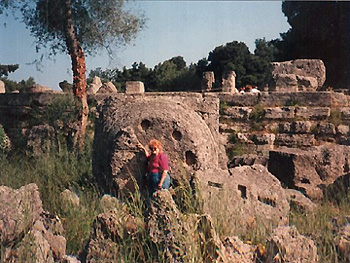
the author at Olympia, Greece

Running Naked for an Olive Crown

by W. Ruth Kozak

This year, the Games of the XXIX Olympiad are being held in Beijing, China. As in the past, athletes from all over the world will compete for the gold medals.

The first competition held at Olympia, was nothing to do with going for the gold. In fact, it was a chariot race that would determine who would win the hand of a beautiful princess, and inherit her father’s kingdom.

King Oionomaos of Elis, had a daughter who he loved very much, so he challenged each of her suitors to a chariot race. Thirteen of them died before a man named Pelops came along and took up the challenge. Pelops bribed the king’s charioteer to put wax in the wheel casing of the king’s chariot. In the race, Oionomaos was killed, and Pelops inherited his princess-bride and the kingdom.

Pelops gave his name to the Peloponnese area of Greece where Olympia is located. The first historically recorded Games began in 776 BC and were funeral celebrations in honor of Pelops who had succeeded King Oionomaos of Elis after the victorious chariot race.

VISITING OLYMPIA
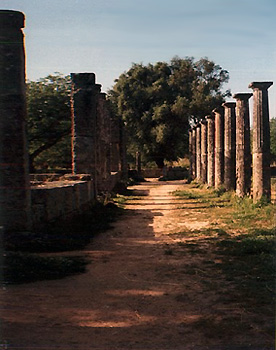
pillars of the Temple of HeraEven as it did in ancient times, Olympia makes an impact on the visitor. As you walk through the lush, tree-lined grove, you can almost imagine seeing the glistening naked bodies of young athletes exercising in the palaestra, the grand processionals making their way to the stadium, the voices cheering as the races were run. This sacred grove, known as the Altis, is associated with cult of Hera, the Earth Mother. Today, the grove, located at the foot of the pine wooded Mt. Kronos in an area of gentle hills, is again planted with cypress and olive trees. If you sit alone for awhile under the trees you will realize what the Olympic Games signified.

There is still something majestic about the ruined temples and buildings that stand in the sacred grove. The most outstanding is the Temple of Zeus, once enhanced by a magnificent ivory and gold statue of Zeus, considered to be one of the seven wonders of the ancient world, a masterpiece of the sculptor Phidias. His workshop was located nearby where later a Byzantine church was built. The Temple must have been immense. Its huge pillars lie like tumbled dominos in the grass, thick as the height of a man. Nearby, the sturdy buff-coloured Doric pillars of the Temple of Hera still stand in splendour amid the oleanders. It was here that Praxiteles’ beautiful rendition of Hermes was found, now on display in the museum, as well as the statue of Victory (Nike) by Paeonios.

King Philip of Macedon erected the impressive Philippeion here after his victory at the battle of Chaeronea in the 4th century BC. It once contained life-size statues of his family, including his illustrious son, Alexander the Great. The site also has the remains of many elaborate treasuries, residences and baths for guests and officials.

Included in the archaeological finds from this period is a column from the palace of Oinomaos. A grave mound identified as Pelops’ was still in existence in the 2nd century AD. In the museum, there are exhibits of sculptures, pediments, sporting equipment and votive offerings. One outstanding pediment shows the celebrated chariot race between Pelops and Oinomaos.

THE OLYMPIADS:
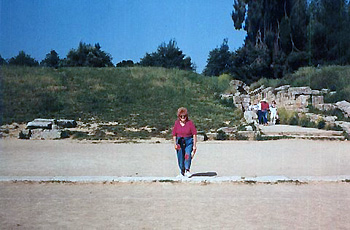
field in OlympiaThe Olympic games were held every four years in July or August according to the full moon. It was customary to call a truce between warring city-states when the summer games were held. All feuds and differences among the Greek city-states ceased so the young men could leave to participate in or attend the games.

From 776 BC lists of the winners were kept engraved on stele at the stadium, and thus began the method of Greek chronological reckoning by Olympiads. Later, other sports were added such as the two-stade (stadium) race, the long-distance race and the pentathion. In the 7th century, boxing, chariot racing and the pankration were included and in the 6th century, a race with weapons. The winners received a branch of the sacred olive tree, but were also rewarded by their home cities. The Games were just for men. Only one woman was allowed to attend the events in the Stadium. She was the priestess of Demeter who sat on her dais by the shrine opposite the tribunal of judges.

The Greeks believed it was Herakles who laid down the regulations for the games and specified the length of the stadion. The stadium, which seated 30,000 people, had no seats. Spectators sat on the grassy slopes around the 183-meter oval. The athletes sole aim was to win an olive crown and the praise of their fellow man. Today, it’s fun to stand at the starting line and dash to the finish. On a hot day, shed a few clothes or, if you’re really brave, run naked like the athletes of old did.

historic remains in OlympiaThe site was excavated from 1875 by German archaeologists. A direct consequence of these excavations, was the revival in 1896 of the Olympic Games, by Baron Pierre de Coubertin. His heart is buried at Olympia in a cairn commemorating him. The first revived Games were held in Athens in 1896 at a stadium built on the site of the stadium of antiquity.

The Museum of the Olympic Games in the town of Olympia exhibits materials and literature about the Games since 1906, and a collection of Olympic stamps. There is also an interesting display of athletic equipment from ancient times including stones used for weight lifting, stragiles (for scraping oil off the athlete’s body), discus and student’s supplies. The International Olympic Academy is located close to the archaeological site, near the memorial for Baron de Coubertin.

It’s easy to get caught up in the media-hype and frenzy that the new Olympic Games create. But when you visit Olympia, you are made aware of the ideals that created the first Games. Olympia speaks to you and transports you back into the past.
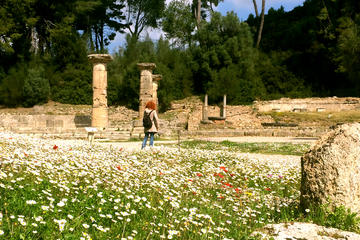

Private Full Day Tour to Ancient Olympia from Athens

If You Go:

Olympic, Greece Online City Guide

The site can be reached by train and bus from Athens via Pirgos.
There are accommodation in hotels and pensions in Olympia and a campsite at Kyllini on the Ionic Coast. There is also a Youth Hostel and two campsites near the town.
The Museum is open 8 am – 7pm Tuesday – Sunday, noon – 7 pm Monday. 3.55 Euro.
The site of Ancient Olympia is open 8 am – 7 pm, 3.55 Euro. Free on Sunday and public holidays.
Museum of the History of the Olympic Games of antiquity (two blocks west of Praxitelous Kndyli) is open 8.30 am – 3.30 pm Monday – Saturday, 9 am – 4 pm, Sun. Admission 1.50 Euro.

Tours of Olympia Now Available:
Olympia – Half day Tour
Olympia – Full day Tour
2-Day Ancient Olympia, Corinth, Mycenae & Nafplion Private Tour from Athens

About the author:
W. Ruth Kozak is both a historical fiction and travel writer who has spent a great many years living in or visiting Greece. Her passion is ancient Greek history so most of her trips there include historical research combined with her travel writing. Her visit to Olympia was a highlight of one of the many trips she’s made around Greece. Her website is www.ruthkozak.com

Photo credits:
All photos are by W. Ruth Kozak .
Tagged With: Greece travel, Olympia tour Filed Under: Europe Travel

What Happened to the Minoans on Crete?

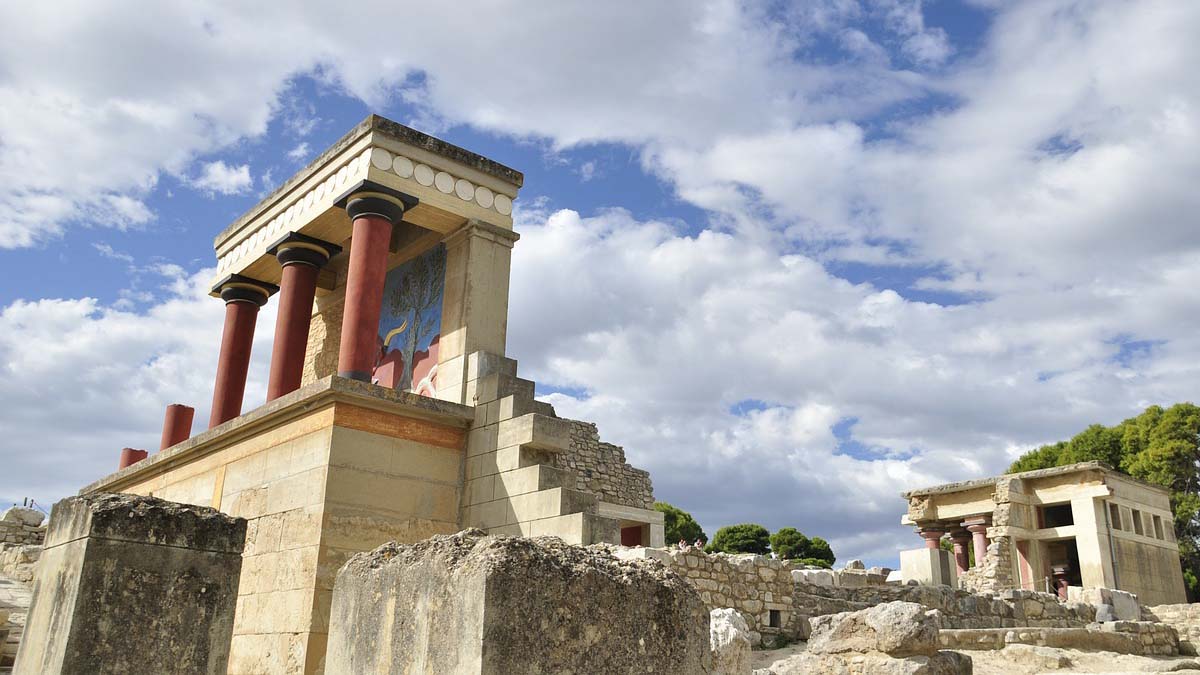
Minoan palace of Knossos

Knossos, Greece: Separating Fact From Fiction

by Keith Kellet

The eruption of the volcano of Santorini, in the Aegean Sea, in 1450 BC, has been the subject of many television documentaries. All propose different theories of what really happened, and nobody can really contradict them, because people had better things to do than make records at the time.

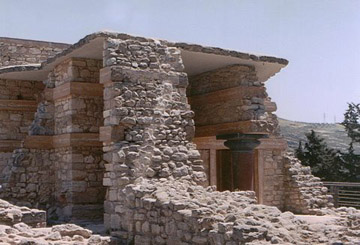
stone remains of Knossos palace, CreteI’ve been curious about the ancient Minoan palace of Knossos, on nearby Crete, ever since I visited Santorini. Was a whole civilisation centred upon Knossos really wiped out at a stroke by the eruption of the volcano and the resultant tsunami in? A guide thought not, although she said it may have been a major contributing factor.

‘We don’t know for sure’ she said ‘but it’s highly likely a series of ‘nuclear winters’ followed the blast, and, possibly, invasion by the Mycenians was the final straw’.

human images in Minoan frescoesMost of the evidence of the Minoan civilisation had been uncovered on the site of Knossos in the late 19th and early 20th Centuries. Before that, only legend remained of the first civilisation in Europe. But, the stories of the Minotaur, the fabled half man, half bull with a taste for human flesh, could now be explained by the frescoes of the sport of ‘bull-leaping’ found at Knossos; the Labyrinth, or maze, where he lived, by the extensive foundations and cellars of the Palace.

So far, though, nothing has been found to explain the story of Daedalus, the legendary designer and builder of Knossos, and his son, Icarus. Imprisoned at Knossos by King Minos, angry at the killing of the Minotaur, they are said to have made their escape with wings made from wax and feathers. Icarus flew too close to the sun, which melted the wax of his wings, thus making him the world’s first aviation fatality!

Legend aside, there was a lot of ‘first in Europe’ at Knossos. The first flushing toilet; what may have been Europe’s first shower: the first multi-storey buildings and the first structure built with regard to light and coolness.

Most of the artifacts found at Knossos are in the Archaeological Museum in Iraklion; much of what’s to be seen on the site are faithful reproductions.

ancient artifacts uncovered at KnossosSir Arthur Evans discovered Knossos about a hundred years ago. He had heard the legends, and wanted to prove that there was some substance to them. However, some people thought that Evans made his discoveries fit his beliefs, rather than the other way around.

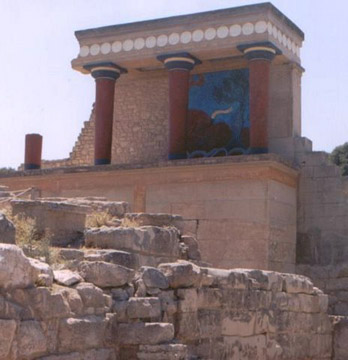
Another thing that split the opinion of the day was Evans’ “reconstruction” of the site. What we see at the palace is not necessarily as it was, but how Evans thought it was. However, many people think that he wasn’t far out, and it does make for a more interesting visit than just an excavated foundation would.

The guides made no secret of the reconstruction, and they emphasised the difference between “genuine” and “authentic.” If it’s concrete or wood, they said, it’s a reconstruction; if it’s stone, it’s original. All the pillars, we were told, were modern ones. The wooden ones the Minoans used were long gone

view from Knossos palace groundsThe Minoans were given their name by Evans, after the legendary King Minos. One theory has it there may have been several kings called Minos. It’s even possible that it may have been their word for ‘ruler’.

What’s hard to believe is that Knossos was a palace, not a city. But, if you can imagine Buckingham Palace, the Houses of Parliament, the Law Courts, Wembley Stadium and the Stock Exchange in one building, maybe the idea isn’t so far-fetched?

So, what happened to the Minoans? Why did only legends survive of what seemed to be a sophisticated and powerful empire?

There aren’t any military fortifications at Knossos, which indicates a prolonged peace. The powerful Navy may have kept any foes well away from Crete.

Minoan columns and platform at KnossosAlthough many people say it was the eruption of Santorini, about 70 miles away, that ‘wiped out’ the Minoan civilisation, they didn’t actually go immediately. They were around for at least another century, but it was the explosion that triggered the decline of their society.

Most of Santorini was pulverised and thrown into the upper atmosphere, where it remained for several years. This would have produced a “nuclear winter.” The temperature would have fallen dramatically, causing crops to fail and cattle to die. And, Crete is close enough to Santorini for much land to be rendered useless by a covering of ash.

It’s possible, too, that the mighty Minoan navy was largely destroyed by the resultant tsunami, rendering the empire almost defenceless.

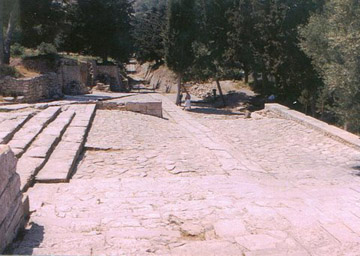
pathway leading to Knossos PalaceThe invasion theory is given credence by the discovery of deliberate burning, about 50 years after the eruption, at some Minoan sites. Around this time, the Myceneans, from what is now the Greek mainland, forerunners of Ancient (and modern) Greeks, began to settle on Crete, displacing what was left of the Minoans.

Concerning events of 4000 years ago, it’s a foolish person, usually, who can state what happened without a lot of ‘probably’, ‘possibly’, ‘may have’ etc. All of this is theory and conjecture, and no two theories, no matter how authoritative, are precisely the same.

So, why not do some reading or watch some TV documentaries about it? Better still, visit Knossos and the Iraklion Museum, and talk to the guides … and maybe form your own theory!

If You Go:

Ferries (including high speed) sail daily from the port of Pireaus. There are also connection ferries from the islands of Naxos and Santorini. Flights are also available to Crete on Olympic Airways.

For More Information:
Ancient Greece: Knossos

Knossos Tours Now Available:
Knossos Palace Guided Walking Tour
Knossos Palace and Heraklion Town Private Half-Day Tour
Knossos – Lassithi visit Zeus Cave
Ancient Palace of Knossos Tour
Private Tour: Ancient Palace of Knossos, Heraklion Archaeological Museum and City Tour

Photo credits:
First Knossos temple photo by bigfoot from Pixabay
All other photos are by Keith Kellet.

About the author:
Having written as a hobby for many years while serving in the Royal Air Force, Keith Kellett saw no reason to discontinue his hobby when he retired. With time on his hands, he produced more work, and found, to his surprise, it ‘grew and grew’ and was good enough to finance his other hobbies; travelling, photography and computers. He is trying hard to prevent it from becoming a full-time job! He has published in many UK and overseas print magazines, and on the Web. He is presently trying to get his head around blogging, podcasting and video.
Contact: keith-kellett@tinyworld.co.uk


Tagged With: Crete attractions, Greece travel Filed Under: Europe Travel

Easter Pilgrimage to Patmos, Greece

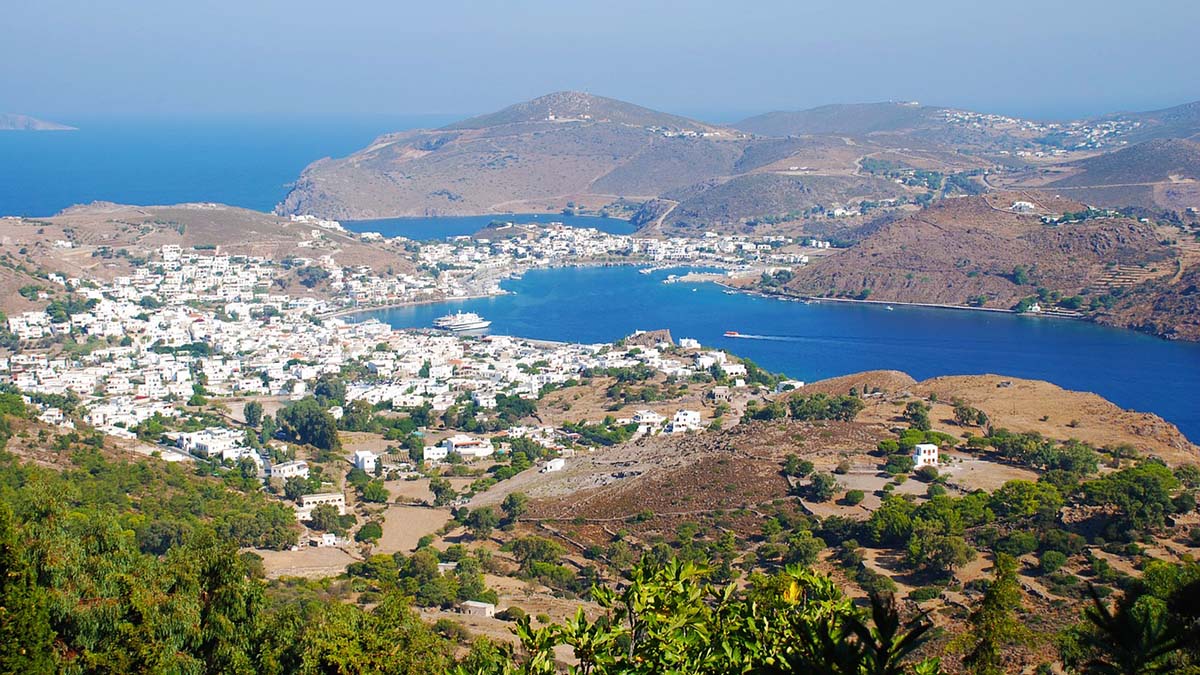
Patmos island, Greece

by W. Ruth Kozak

The funeral bells have been tolling since early morning and the flags are flying at half-staff. It is a day of mourning: Good Friday on the island of Patmos.

As we climb the hill from the port to the Church of the Apocalypse, the sound of fireworks crackles like gunfire, resounding across the pastoral hills. The goats graze among the profusion of wildflowers and stop to stare at us with their curious yellow eyes. Far across the valley, a donkey brays.

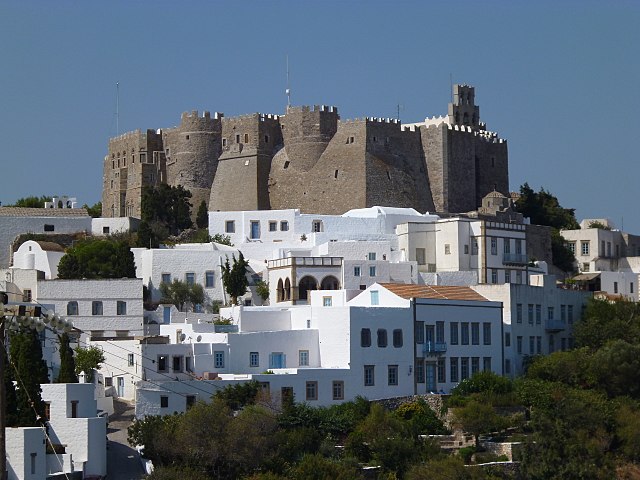
Monastery of St. John, PatmosThis is the island where 2,000 years ago the disciple John, known as St. John the Evangelist, was exiled by the Romans for preaching Christianity in Asia Minor. Just below the tiny white-domed Church of the Apocalypse is the cave where the apostle lived. The cave is sheltered beneath the small chapel and we are reminded, as we enter it, that it is a sacred place. It was here, in this awe-inspiring place, that John received the terrifying visions described in his book of the Apocalypse, known as Revelation. The cave is a place of meditation and is preserved as a reminder of the struggle between good and evil.

Patmos, a small island with about 2,000 residents, is one of the Greek Dodecanese Islands near the Turkish coast. It was once noted for its shipbuilding and trade and many of the traditional mansions have been restored. Today Patmos is known mainly for the Monastery of St. John the Theologian and for the pilgrimage at Easter, which attracts visitors from all over the world.

Back at the port village of Skala, the funeral processional has just begun. The epitafios, a small casket decorated with red and white carnations and icons of Christ, is borne by men of the village. This casket symbolizes the body of Christ. The processional is led by the priests, resplendent in rich ceremonial robes. They are followed by solemn young altar boys holding candles and crucifixes. As the casket is carried through the village, a Byzantine icon depicting the crucifixion is held aloft on a wooden cross wreathed with flowers. The narrow streets are lit by candlelight and the glittering gold of the relics. The heady fragrance of incense wafts from the censers, fanning out over the throng. As the priest begins to chant the litanies, a men’s choir harmonizes the story of the crucifixion. This is the beginning of the religious holiday that in Greece is celebrated with more pageantry than Christmas.
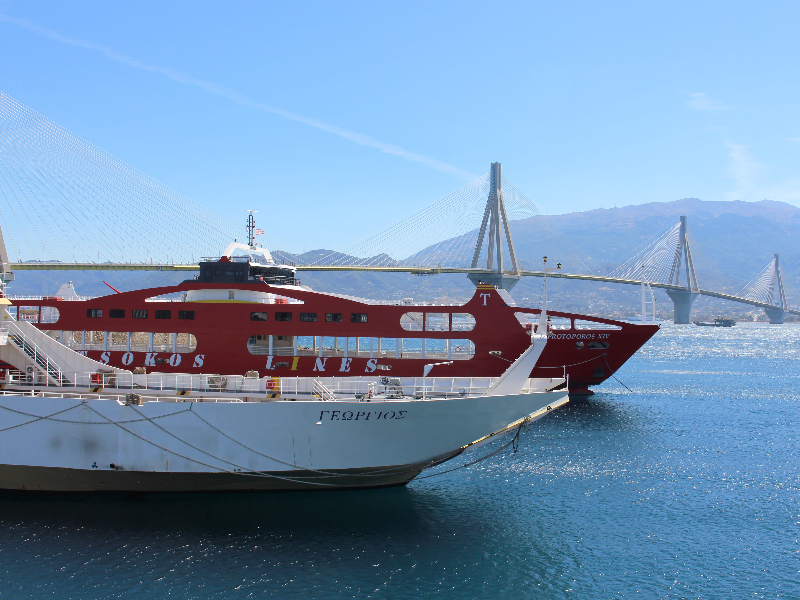
boat in Patmos harborThe crack of fireworks and the chiming of church bells awaken us the next morning. We walk along the quay. In the harbor, the fishermen are setting out in their turquoise and red caiques. The calm sea is a luminous, dark blue. From the green hills behind Skala drifts the fragrance of wild roses and herbs. There is a serenity on Patmos that you will see reflected on the faces and in the attitudes of the Patmians who have preserved the dignity of this “holy island”.

Looming above the village of Chora and the port of Skala is the Monastery of the Theologian. The monastery was founded 900 years ago. Some of the richest treasures of Greece are kept here including priceless icons, vestments and parchment manuscripts.

In the monastery chapel, a crowd has gathered, spilling out into the courtyard. The cobblestones are strewn with branches of hyssop. Its purifying fragrance mingles with the scent of incense and beeswax candles. A monk begins a rhythmic hammering on a long wooden beam suspended in the entrance of the chapel. This beating of the talanton symbolizes the risen Christ and heralds the beginning of the Easter mass.

At midnight, as the bells begin to peal, the monks and priests file out of the chapel to join the throng of worshipers. As the pappas announces the joyous proclamation: “Christos Anesti! Christ is Risen!” his words are echoed in unison by the worshipers. He touches the flame of his altar candle to the wicks of the slender tapers held by each celebrant. One by one the flame is passed on, until all the candles are lit and the courtyard blazes with light.

For the children it’s time to collect the brightly colored eggs distributed by the priest. These red eggs, polished with oil until they shine with a wax-like finish, are symbols of the blood of Christ. The children play a game, tapping the ends of the eggs together to see whose is the last to break.

Greek Easter foodsNow the celebration is over and we follow the celebrants through the streets of the village as they carry their lighted candles home. Each flame is carefully protected until it scorches a cross above the lintel of the doorway. This will ensure good fortune and God’s blessing for the year.

At a taverna in Chora, we dine on roast lamb and mageritsa, the traditional soup made of lamb’s innards eaten by the Greeks at Easter. The meal is followed by lambropsomo, a sweet Easter bread decorated with red eggs placed in the centre to form the tips of a cross.

We walk the four kilometres down the dark road through the cypress groves to the port. On the edge of the bay someone has set off a red flare which fans out over the harbor, illuminating the fish boats in their moorage. Down on the beach, one last rocket hisses and whines. Then all is quiet. The trace of gunpowder smoke lingers in the air. But there is a spirit of peace on Patmos.

Editor’s note: In 2021 Greek Orthodox Easter is Sunday, May 2nd.

If You Go:

Ferries leave daily from the port of Pireaus.
More Information: Patmos Island 
Greek National Tourism Organisation

About the author:
W. Ruth Kozak has spent many years living in and visiting Greece. One of her favorite times of year there is Easter time. The celebrations, rich in tradition, are an unforgettable experience for the traveler to Greece. Her website is www.ruthkozak.com

Photo Credits:
Patmos Island by EzPzPics from Pixabay
Patmos Monastery of St John by Valeria Casali / CC BY-SA
Traditional Greek Orthodox Easter Food by ΙΣΧΣΝΙΚΑ-888 / CC BY-SA

Tagged With: Greece travel, Greek Easter, Patmos Filed Under: Europe Travel

Greece: Pilgrimage to Delphi

the author on pilgrimage at Delphi

by W. Ruth Kozak

I set off from Athens on a morning when Zeus was tossing about his thunder bolts and a torrential rain filled the gutters with gushing streams ankle deep. I didn’t let that deter me and boarded the bus for Delphi, a three hour trip north into the mountains.

Delphi, located on the slopes of Mt. Parnassus, was the most important sacred sanctuary of ancient Greece, home of Apollo, god of light. No important decisions were made politically or personally in antiquity without first consulting the Delphic Oracle in Apollo’s sanctuary. The earliest finds date to the Neolithic times (4000 BC) when the first rituals took place in a cave on Parnassus.

Just as the ancient Greeks sought the oracle’s advice, each time I am in Greece I visit Delphi before I set off on any new adventures.

The rain had subsided by the time I arrived. My first goal was to hike down the mountain to the Castalian Spring. The spring is located several hundred metres downhill near the outskirts of the town in a gorge between the towering Phaidriades. It’s close to the goddess Ge’s sacred grove where once a sacred spring gushed from a cleft in the rocks. Pilgrims to Delphi bathed in the spring before proceeding to the Temple of Apollo.

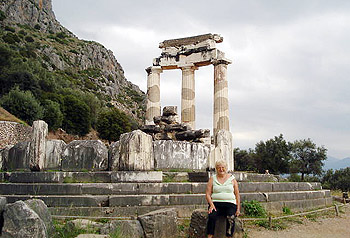
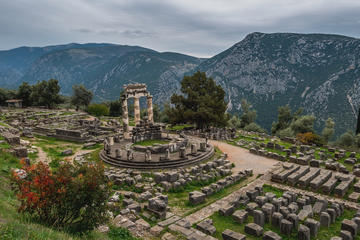
entrance to Sanctuary of Athena PronaiaDue to the danger of falling rocks and restorations, the sacred grove is barred by a fence, but there’s a spring by the roadside burbling with fresh, cold water. Like past supplicants, I take a purifying wash and fill my canteen with drinking water for the hike down the hill. Across from the sacred grove a path leads to the gymnasium with its 189 meter running track, palaistra (training area) and baths. New excavations are in progress and the track has been restored. Farther down the road is the entrance to the Sanctuary of Athena Pronaia with its impressive circular Tholos (photo right). Then I proceed back uphill. The rain had refreshed and cooled the air so it was a pleasant though energetic hike back up the mountainside.

I enter the site, and follow the Sacred Way about 500 metres up the incline toward the entrance of the Temple of Apollo. In antiquity the Sacred Way was lined with splendid monuments erected by the city states of Greece, many of them dedicated in honour of victorious battles. Votive offerings donated by pilgrims brought Delphi great wealth. Once there were over 3,000 such structures within the sanctuary.

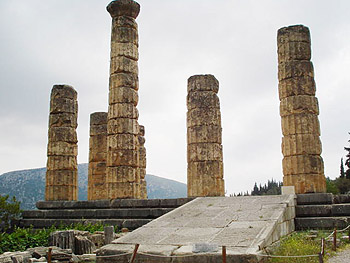
Temple of Apollo, DelphiYou sense the presence of the gods at Delphi. As I approach the great temple of Apollo, I imagine how majestic it must have been in ancient times. Just as I reached it, the sun breaks through the clouds, bathing the majestic Doric pillars in golden light (photo at left). It is here where the fabled Pythia sat on a tripod inhaling hallucinogenic vapours and interpreted the fates of the supplicants. I’m sure if the Pythia had been present that day she’d have portended good fortune.

Continuing uphill, I climb a flight of steps and stop to catch my breath and quench my thirst in the shade near the curve of marble seats of the theatre. Here’s where the dramas of Euripides, Aeschylus and Sophocles were performed. Farther up the hill I reach the stadium with its well-preserved tiers of seats and a long oval running track. A thrill for dedicated joggers is to run a few laps around this ancient course.

As I trace my steps back down to the sacred precinct, just before the stout ochre pillars of the Sun God’s temple, I stop to place my hands on a curious carved stone called the omphalos. According to myth, two eagles met at this spot after being sent out by Zeus from the ends of the earth, thus accounting for the belief that Delphi is the “navel” of the world.

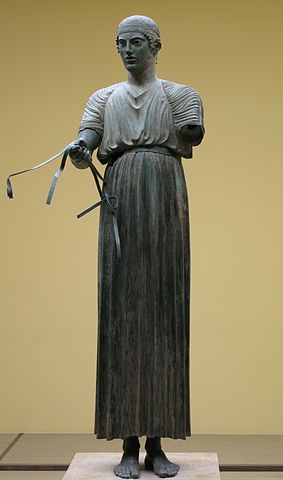
Delphi charioteer statueA trip to Delphi is never complete until I’ve visited the Charioteer, a bronze figure that once stood on the slope above the Temple of Apollo (photo at right). Commemorating a victorious race at the Pythian Games held in 478 BC, the statue is of a life-sized youth in a stance that appears to breathe with life, his life-like agate eyes are fringed with bronze threads for lashes, every muscle is taut as he holds his reins. The Charioteer survived a fourth century earthquake and is lodged in the museum, along with fragments of his chariot and horses.

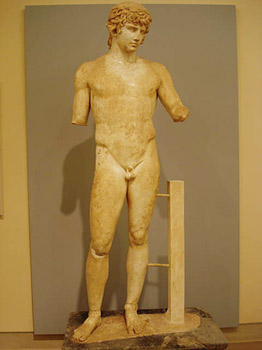
sculpture of Antinous in Delphi museumThe new museum at Delphi is a wonder. It’s artistically constructed, the treasures tastefully displayed. It is one of the most important museums in Greece. Another of my favorites is the remarkably life-like sculpture of Antinous, beloved of Hadrian, who drowned in the Nile and was later deified (photo left). Here you will find the famous Hermes of Praxiteles.There is also copy of the omphalos and an impressive marble sphinx dating from 500 B.C., a gift from the Naxians. Also on display is the helmet of Miltiades, inscribed with “Miltiades dedicates to Zeus” It’s the same helmet worn by the famous general in the battle of Marathon where he defeated the Persians, and was offered to Zeus as a sign of gratitude.

The town of Delphi itself is charming. It’s built on the edge of a deep, wide gorge with splendid scenery and a glimpse of the Gulf of Corinth in the distance. The remains of ancient Delphi are located within its boundaries.

That night I camped near the town. The moon was full, meteorites blazed across the sky, and I felt touched by magic. To me, Delphi is still a sacred sanctuary, a place to contemplate the mysteries of life, to appreciate the beauty of nature and marvel at human accomplishments. I can’t help but feel I have been in touch with the gods at Delphi, and I return to the bustle of Athens feeling blessed.

If You Go:

The sanctuary of Delphi is subsidized by the modest admission fees which include entry to the museum. It’s free on Sundays, closed on Mondays. Because it’s still considered a sacred site, no bathing suits, radios, recording equipment, refreshments or loud noises are allowed.

You can make it a day trip from Athens by bus. There are a number of hotels in Delphi but reservations are recommended in peak season.

Apollo Camping is located just at the outskirts of the town on the road to Itea. It’s equipped for caravans and tents and provides spaces under reed awnings for those who just want to roll out a sleeping bag. There’s a store on site and a swimming pool where you can refresh yourself after a hot day exploring the archaeological digs and museum. It’s walking distance from all the attractions and the bus stops nearby. Ask the bus driver to let you off at the campground, instead of in the town.

Tours to Delphi Now Available:

Delphi Full-Day Tour from Athens

Delphi Guided Walking Tour and Admission Ticket

Ancient Delphi Full-Day Tour from Athens


Delphi Out of The Ordinary Full Day Tour with Lunch

More Information:

Online City Guide: Olympia, Greece

About the author:
W. Ruth Kozak has been a historical fiction writer since her teens and a travel journalist for more than 15 years. What began as a personal journey to visit, then live in Greece, motivated by her life-long interest in ancient history, has now emerged into this travel ‘zine where other writers can share their experience of travel and life abroad. She also instructs classes on travel writing, creative and novel writing and memoirs. She has traveled extensively, often solo and always on a budget. Her website is www.ruthkozak.com

Photo credits:
Delphi Charioteer by RaminusFalcon / CC BY
All other photos are by W. Ruth Kozak

Tagged With: Delphi pilgrimage, Greece travel Filed Under: Europe Travel

  • « Previous Page
  • 1
  • …
  • 5
  • 6
  • 7

MORE TRAVEL STORIES:

Pennsylvania: Pittsburgh’s Positively Offbeat Gems

BC First Nation History in Alert Bay

Significant Monuments Celebrating Icelandic Past

What to buy in Lakshadweep

Luxury on the Water: Why Private Catamaran Rentals in Cabo Are the Ultimate Escape

Pauline Johnson, Vancouver’s Mohawk Princess Poet

Top Reasons to Visit the Manaslu Circuit Trek:

The Conquest of Peru – Part Two


SEARCH

DESTINATIONS

  • Africa Travel
  • Antarctica travel
  • Asia Travel
  • Australia travel
  • Caribbean Travel
  • Central America Travel
  • Europe Travel
  • Middle East Travel
  • North America Travel
  • Oceania Travel
  • South America Travel
  • Travel History
  • Travel News
  • UK Travel
  • Uncategorized
  • World Travel
facebook
Best Travel Blogs - OnToplist.com

Copyright © 2025 Cedar Cottage Marketing | About Us | Contact | Privacy Policy | Terms & Conditions | Copyright Notice | Log in