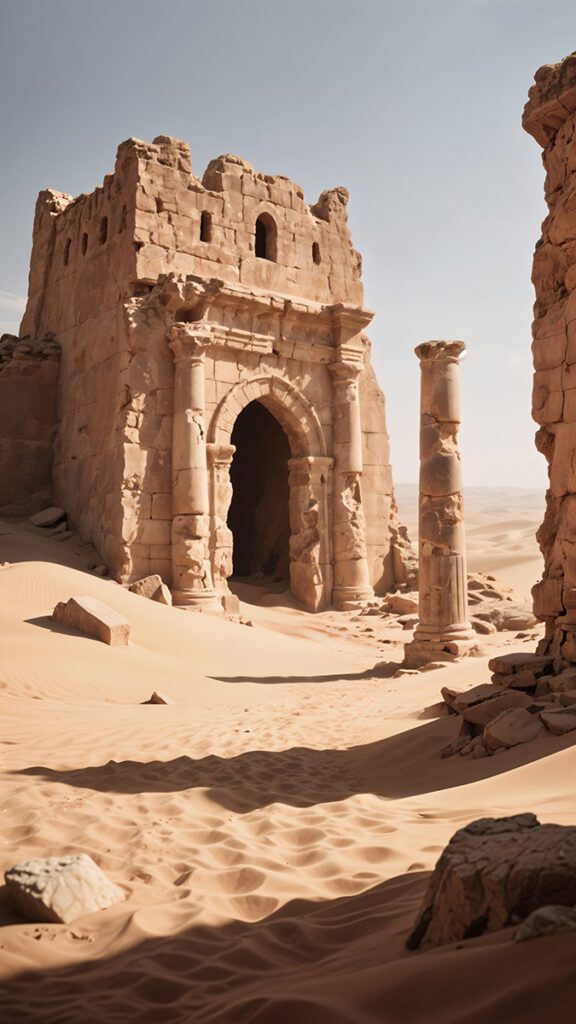
The road out of the city feels normal for a while. Petrol stations. Low buildings. A few trucks that look like they have been awake since dawn. Then the land opens up.
The desert in Mleiha does not shout. It does not try to impress you with drama. It just stays. Wide sand. A pale sky. Rock shapes that look like they have been waiting for you to notice them.
When I step out of the car, the first thing I hear is my own shoes on gravel. The second thing is wind. Not strong, not angry. Just steady, like it has a job to do.
I came here because I wanted a place that feels older than my calendar. A place where time is not measured in meetings and messages. In Mleiha, you do not have to pretend. The land itself tells you, quietly, that human life is recent.
A place where the past still sits on the surface
Mleiha sits in Sharjah’s Central Region, near Jebel Faya, and the wider area has evidence of human life and activity across many periods. It is the kind of landscape where a small shift in light can make the ground look like a page you can read. Inside the Mleiha story, there is not one “era.” There are layers.
Stone Age traces. Then later communities. Then the late pre-Islamic period that made Mleiha a real hub in the region. UNESCO’s description of the area speaks about a long sequence, including Neolithic and Bronze Age occupation and strong Iron Age evidence, with the falaj water system showing how people learned to live with a climate that was already tough.
That sentence about water stays with me. Because in the desert, water is never a side detail. It is the main plot.
Fossils in the sand
At first, “fossil” sounds like a museum word. A school word. Something behind glass. Then you see it out here, where sand meets rock. Fossil Rock is a limestone outcrop in the Sharjah desert, and it carries evidence that this area was once a sea bed, around 70 million years ago.
That is hard to hold in your head. The mind tries to shrink it into something easier. But the desert does not let you. You look at the rock and you imagine water where sand is now. You imagine marine life in a place where today even shade feels rare.
I run my fingers along the surface of a stone and stop myself. Not because I am scared, but because it feels wrong to treat it like a toy. These are not props. These are witnesses. There is a strange comfort in fossils. They are proof that the world changes completely, and still continues.
Walking the open ground
Walking in Mleiha is not like walking in a park. The ground keeps asking for attention. Sand gives. Rock bites back. The wind pushes a little, then stops, then returns. The light shifts fast, and suddenly every small ridge has a shadow.
A family walks a few meters away from me. The kids are excited, then quiet, then excited again. One of them points at a rock that looks like an animal. A parent says something soft, half warning, half wonder. That’s how Mleiha works. It turns adults into calm people. It turns children into careful observers.
A staff member nearby tells someone to stay on the marked path. Not in a harsh way. More like a reminder that this place is fragile, even when it looks tough. This is what I like about heritage places when they are done well. They do not turn history into entertainment. They keep it human.
Forts, tombs, and old stones
The late pre-Islamic period is one of Mleiha’s strongest chapters. UNESCO describes Mleiha as a late pre-Islamic center in the region, with an archaeological record that connects it to wider trade and settlement life over time.
And then there is the fort.
Mleiha’s mud-brick fort is often highlighted as a key landmark from around the 3rd century BCE, tied to that late pre-Islamic story of community and trade routes. When you stand near the remains of a fort, you stop thinking in clean textbook lines. You start thinking in need.
Protection. Storage. Water. Distance. Watchpoints.
The fort is not just a “historic site.” It is a reminder that people here were not living a simple life. They were managing survival and movement and trade, in a land that does not forgive laziness.
Then come the tomb stories.
One of the most striking discoveries linked to Mleiha is the camel and horse tomb, reconstructed and displayed at the Mleiha Archaeological Center.
Even reading those words feels heavy. Camel and horse. Not just animals in a landscape photo, but animals in a burial context, tied to how people once showed status, belief, and memory. You do not need to romanticize it. You just need to stand still long enough to feel how serious it is.
People in the picture
It is easy to describe deserts as empty. But that is the lazy way. Mleiha is full of people doing quiet work.
A guide explains a site to a small group. A visitor asks a question that sounds simple but is actually important: How do you know how old this is? The guide answers with patience. No big drama. Just a calm explanation about evidence, layers, and careful study.
This matters. Because these places only stay alive if someone keeps translating them for the rest of us. And there is another kind of person you meet here too. The visitor who came for photos but ends up listening. The teenager who gets bored, then suddenly gets curious. The couple who speak in whispers without being told. The desert changes your behavior without asking permission.
The adventure layer
This is not the Himalayas. Nobody needs to train for months. But Mleiha still asks something from your body. You will walk on uneven ground. You will deal with the open sun. You will feel the dry air in your throat if you do not drink water often. If you choose to hike near Fossil Rock or explore deeper desert spots, you need steady shoes and basic fitness.
A practical list, the kind you only respect after you forget one item:
- Water you can actually finish, not one small bottle
- Covered shoes with grip
- Sun cover (cap or scarf)
- A light layer for late afternoon wind
- Patience, because rushing ruins the whole place
Some visitors choose guided experiences or desert activities, and the area is known for options like stargazing experiences as part of the wider Mleiha desert offering. But even without an “activity,” Mleiha feels like an adventure when you give it time. The real thrill is not speed. It is a discovery.
What the silence does to you
In cities, silence is rare. When it appears, it is usually accidental. In Mleiha, silence feels intentional. I catch myself lowering my voice, even when I am alone. It feels strange to speak loudly in a place that has held history for so long. The mind starts moving differently. Slower. Cleaner.
And then the biggest lesson arrives, without effort. Human life is loud. Not because people are bad. Just because we are busy surviving in our own modern world.
But out here, with fossil rock and old fort stones and burial stories, you remember something simple. We are not the first chapter. We are not the final chapter. We are one page in a long book. That thought is not depressing. It is calming.
Leaving with sand on my shoes
When I leave, the light is different from when I arrived. The desert looks softer. The road back feels slightly unreal, like someone turned the volume up again. I check my shoes and there it is. Sand stuck in the grooves. A small souvenir, the kind you do not buy.
Mleiha stays with you in small ways. A sense of scale. A respect for time. A quiet feeling that history is not only in famous cities and big museums. Sometimes it is right here, sitting under the open sky, waiting for you to slow down and notice.
If you go (Sidebar)
Best time
- Cooler months are easier, and early morning or late afternoon gives better light and easier walking.
Getting there
- Mleiha is in Sharjah’s Central Region. A car is the simplest way. Go for Car Inspection before you head deep into the desert.
How much time you need
- Quick visit: 2–3 hours for a simple look and one main stop
- Half day: enough time to walk, pause, and properly take in the sites
- Sunset plus sky time: if you want the desert mood at its best
What to bring
- Water, covered shoes, sun cover, and a light layer for later in the day
- If you plan any hike, bring snacks and do not rely on “I will manage”
Respect the site
- Do not take rocks or fossils
- Do not climb on ruins
- Stay on marked areas when signs ask you to
Good add-ons
- Pair the visit with a short hike near Fossil Rock (only if the weather is friendly)
- If you like night skies, look for organised stargazing experiences in the area (Platinumlist Sharjah)
Before you drive
- Desert runs can expose weak tyres, batteries, or AC. If you want the drive to stay smooth, we can do a quick pre-trip check, provide you the Best Car AC Services in UAE and a post-trip dust check when you are back.
Author bio
Muhammad writes travel stories that focus on history, culture, and the small details that make a place feel real. He looks for destinations where the past is still visible, not as a display, but as part of the land and the people.

