Travel Thru History

Historical and cultural travel experiences

  • Home
  • Airfare Deals
  • Get Travel Insurance
  • Writers Guidelines

Conflicting Stories Touring Belfast, Northern Ireland

Street art Belfast

By Lee P. Ruddin

“He’s talkin’ sh*t!” mouths a short, skinny man thirty-odd yards away.
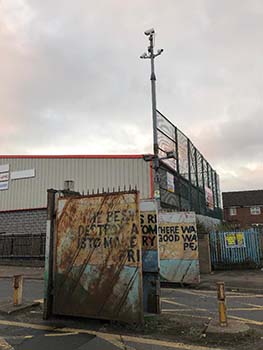
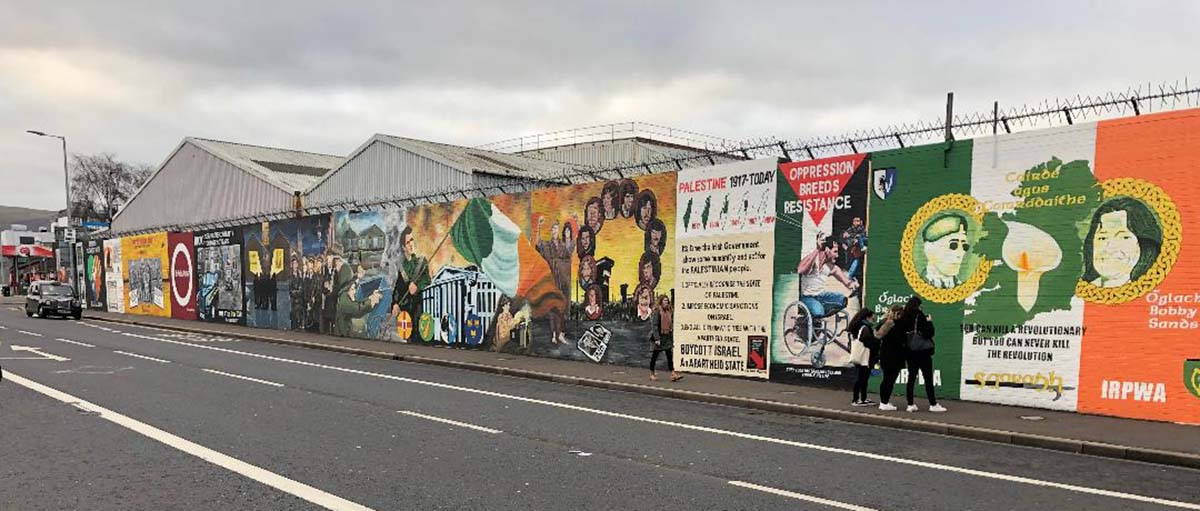
Lanark Way BelfastI’d noticed this bespectacled figure with a Peaky Blinders-like cap walking towards us when standing at the rear of our twenty-strong group at “Checkpoint Charlie” on Lanark Way in Belfast, Northern Ireland.

I feared this passer-by was going to be more vocal than the individual who interrupted a Jack the Ripper walk in London given this was the location where Republican guides handed over to their Loyalist counterparts between the (predominantly) Catholic Falls and Protestant Shankill Roads.

There’s been Black Taxi tours of the peace walls constructed during “The Troubles” (a thirty-year conflict that’s claimed over 3,500 lives notwithstanding it sounding like a Victorian euphemism for venereal disease) for years yet the unashamedly subjective nature of the Conflicting Stories tour by former combatants proved too tempting to miss.

Victims’ campaigners describe the advertising of the tours as ‘warped’, something I’d echo albeit to a lesser extent: specifically my paying £18 for a place when booking on The Belfast Free Walking Tour website.

My wallet-watcher misgivings were rapidly dispelled when meeting Robert, though, a stocky, beanie-wearing sexagenarian who was formerly a member of the Irish Republican Army (IRA) and who’s now a Sinn Féin activist after moving from the ‘trenches to the benches’. Whether it’s because it was an ice-cold day, I couldn’t say, but I was instantaneously drawn in by his warmth (something staff at the Titanic Hotel, who are as frosty as the iceberg that struck the vessel in 1912, could learn from) despite the fact my uncle served in the British Army and was stationed in what Robert calls the ‘occupied six counties’.
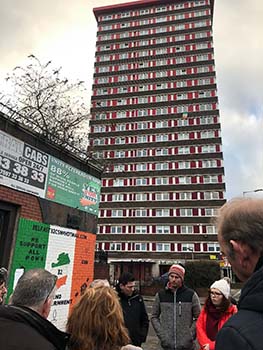
Belfast street sceneStarting at Divis Tower, he transported us back to August 1969 and the push for civil rights. Catholics were discriminated against by the Unionist-dominated administration (which was loyal to the British Crown and fearful of plots to join the twenty-six-county-Republic to the south) who presided over what was effectively a pogrom against the nationalist minority. Although Robert’s black-and-white photos are amateur compared with professional ones displayed in Titanic Belfast museum, the latter’s interactive galleries come a distant second to the interaction afforded with an ex-prisoner who was taught Irish by hunger-striker Bobby Sands.

While imprisoned for planting bombs (1976-1988) Robert went on “blanket” and “no-wash” protests, protests he vividly describes as we huddle into our parka jackets and periodically tilt heads like curious dogs. The murders of his friend and grandfather proved sufficiently traumatising – indeed radicalising – that he joined the youth wing of the IRA before the organisation proper in 1974, aged seventeen.

As our multinational group (resembling a dream team of U.N. peace envoys with tourists from the Basque region, South Africa and Indonesia) continued to make its way westwards towards Falls Road, Scouse-sounding me is singled out when eyes are directed to the International Wall and a mural depicting Liverpudlian Joe Gleeson raising the Irish tricolour during the Easter Rising.

Robert doesn’t dwell on the past and 1916, surprisingly, but moves onto the “2023 Project” and the successes in extending opening hours of security gates. That Brexit (Britain leaving the E.U.) could jeopardise the E.U.-funded “Barriers and Mindsets” scheme leaves all demoralised however.
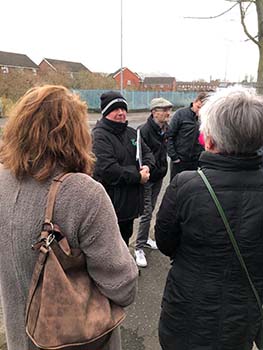
street scene BelfastThe spontaneous handshake between Robert and Noel soon lifts spirits (despite lifting thereof evidently the last thing on peoples’ minds on New Year’s Day) for here, in the present, are members respectively of Coiste and EPIC working side-by-side, literally hand-in-hand.

Back on Bombay Street, Robert said he’d taken tours on the ‘other’ side to better understand ‘their’ story, something which I desperately wished was happening today since – to quote Socrates, or was it Shania? – Noel didn’t ‘Impress Me Much’: while I’d not expected a guide as polished as, say, Terry at Crumlin Road Gaol, he appeared rusty in spite of tours being eighteen-months old.

A self-described former ‘sectarian bigot’ released under the terms of the Good Friday Agreement, Noel is candid if not charismatic: he’s the type of fella you wouldn’t need to pay a penny to for his thoughts; indeed he’s the sort, regardless of being an armed robber for the Ulster Volunteer Force (UVF), who’d give you his last.
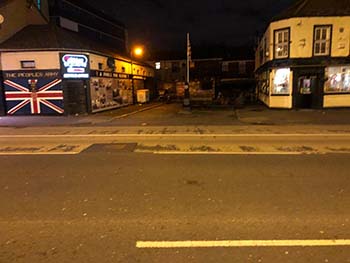
Belfast streetThe history of Loyalism is little known compared with that of Republicanism, which is often romanticised, yet remains an important thread in the tapestry of the conflict – a thread told under fluttering Union flags and beside gable-wall murals honouring the dead of WWI. I’m ashamed to admit I thought Noel an ignoramus when referring to Bloody “Friday” – that occurred six months after the much-chronicled Bloody Sunday in 1972 – which claimed his friend’s life and proved a turning point in his. Ten others died after 26 bombs were detonated in 80 minutes.

Walking westwards on Shankill Noel reminds us to ‘watch our backs’ (which had a different meaning ‘back in the day’, he jokes) as locals go about their business. With the lightened mood turning dark through the tragic details concerning the bombing of a fish shop in 1993, I thought the tour ought to be renamed Conflicting Emotions. Standing at Shankill Memorial Park I observed that there wasn’t the hushed reverence of the Garden of Remembrance on Falls, although this was arguably because many were simply concentrating on maintaining blood circulation by stamping their feet.

Shattered but still standing after a three-and-a-half-hour, five-kilometre walk I wet my whistle in the Europa, once the most bombed hotel in the world. Here I mulled over Noel’s concluding remarks that peace is a ‘desire’ for Loyalists/Unionists whereas it’s a ‘strategy’ for Republicans/Nationalists. If so, a “hard” border after Brexit may cause dissident Republicans to blow the dust off their guns thereby ensuring there’ll not only be KFC but possibly UVF, even RHC (Red Hand Commando), presence on the Shankill.

That said, HM Government’s £300m peace-building, post-Brexit pledge should guarantee (together, not insignificantly, with monies from tours) the soft-power work conducted by Robert and Noel – who persuade rather than pressurize (hard equivalent) youths to coexist peacefully – continues to prevent recrimination replacing reconciliation.

If You Go:

Belfast History Walking Tour The Ultimate Belfast experience

Three nights is more than enough to see the main sights in Belfast, although it’s a good base from which to visit Giant’s Causeway in the north and/or Dublin to the south (in the Republic). Fans of the epic HBO series Games of Thrones can join coach tours in either Belfast or Dublin.

Titanic Belfast, the world’s largest Titanic visitor experience, is a must-see on any tourist’s itinerary. While booking online doesn’t necessarily save you money, it enables you to jump the queue after selecting a specific time slot (earlier the better given crowds seriously depreciate the experience). English-speakers should also consider renting an audio guide.

Choose to stay in accommodation more centrally-located than the Titanic Hotel, which involves a 20-minute walk along the Lagan River (and over a bridge) to reach the centre of town. There’s a possibility of rain all year round throughout the British Isles, but for high probability of dry weather look to book between the months of May and September.

Belfast Mural Political Black Cab Tour

 About the author:

A frequent ‘Letter of the Month’ winner in UK travel newspapers/magazines, Lee P. Ruddin’s entry in Senior Travel Expert’s 2018 (Heritage) Writing Competition was shortlisted as Highly Commended by judges. His articles feature in Robert Fear’s Travel Stories and Highlights: 2019 Edition and at TravelMag. Born in Birkenhead on the Wirral in North West England, he currently resides in Birmingham, where he works in the security industry.

All photos by Lee P. Ruddin

Tagged With: Belfast tours, Northern Ireland travel Filed Under: Europe Travel

Belfast, Northern Ireland: Back to the Future

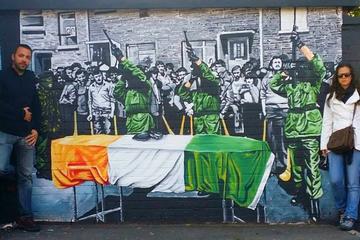
Republican mural
by Helen Moat

I was back on the train to Belfast after decades, the new stock state-of-the-art shiny, clean, comfortable, smooth and fast. Rolling neon lights flashed up the destinations along the line. A soothing English voice told us our next stop. Automatic doors slid open effortlessly. The female voice recited the remaining destinations. Surely I was in the English Home Counties, not in my homeland?

Back in the 1980s the train to Belfast shuddered and creaked its way to the city. The seats were blighted with cigarette holes and knife slits, the floors covered in litter, the walls plastered with graffiti. Disaffected youths smoked in the no smoking compartments and no one dared challenge them. This was Northern Ireland at the height of the troubles: troubled, angry, defiant.

I breathed out slowly, and soaked in the past and the present. Across the way, a couple were speaking in the tongue of my childhood. A language half forgotten. Every sentence was punctuated with a verbal full stop.

“I’ve just got back from Australia – so I have.”
“I didn’t know that – I didn’t.”
“Loved it out there – aye.”
“You’re still in Finaghy – are you?”
“I am – aye.”

I smiled to myself. When did my birthplace become a foreign country?

I reached the city, the views of Belfast, strangely familiar: The Belfast Hills on one side, clouds scudding across the hillsides, the sky overhead a mixture of threatening black and baby blue; then the city in front of me with the bright yellow Harland and Wolff cranes towering over it.

Off the train, I met a friend at the City Hall. We dodged the ‘tour-of-the-troubles’ operators, touting for business and headed to Donegal Square, the main shopping area. Back in the 80s, you entered it through a gated terrapin, to be given a thorough body search – repeated in every store you entered. Shopping in the city wasn’t for the faint hearted. People in Derry refused to go to Belfast because they felt it was too dangerous. Belfast citizens wouldn’t go to Derry for the very same reason. But now, there was such an air of freedom and optimism, I felt dizzy. We continued on to Victoria Square and the new shopping mall, with its glass dome offering 360 degree views: of the city, the river Lagan, the Lough, the sea beyond, and the Black Mountain on the skyline.

Ring of ThanksgivingWe walked on to the waterside. I had no idea it was so close to the city centre. During the troubles it was a forgotten wasteland. By the Lagan, we gazed up at the Ring of Thanksgiving, a monument to peace and reconciliation. The locals prefer to call it ‘The Thing with the Ring,’ ‘Nuala with the Hula’ or ‘The Doll on the Ball’. They have a way with words here. Just a stone’s throw away is the handsome Customs House and the Albert Tower, Belfast’s very own Leaning Tower of Pisa. Once again, that infamous Belfast humour kicks in, with the locals describing it as having the time and the inclination.

A few months later, I took one of the open-top buses with my son, feeling odd for playing the tourist in my own home city. But I wanted to show him Belfast – and to see the Republican Falls Road that had been a no-go area for me as a young Protestant girl.

Titanic museumThe bus took us along familiar streets: Donegal Square with its handsome Baroque-styled City Hall and Donegal place, the main shopping drag, now lined with 16 metre high sculptural masts, homage to 8 ambitious ships (including the Titanic) built by Harland and Wolff in its heyday. We skirted the Lagan again and the newly regenerated waterside and along city streets that were so familiar and yet so different. Gone were the grey police jeeps, the wary soldiers, the turnpikes and terrapins, and the beefy security guards on each and every shop door. Gone was the smell of subdued fear. And in its place there was art and sculpture and new innovative architecture. There was vitality and a joie de vivre in Belfast.

We drove down Bedford Street and onto Great Victoria Street past Queen’s University: streets I knew well. We passed the canary yellow City Hospital. Our guide laughed and told us Prince Charles taken one look at it on a visit to the city and claimed it was one of the ugliest buildings in Europe. Now we call the hospital ‘Camilla!’ he said. Then we were driving over the West link and onto the Falls Road, a stone’s throw from the modern, cosmopolitan city centre and yet another world. I looked at the so-called peace lines, in places 25 foot high walls, reinforced with iron, brick and steel. We passed gates, closed each evening and at weekends. It was a sobering reminder of a society that is still damaged and wounded.

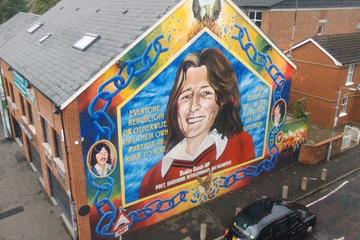
The bus hovered outside the Bobby Sands Memorial Garden, a hunger striker who had starved himself to death in his attempt to gain political prisoner status. On his death, Republican supporters heralded him a hero.

The commentator on the bus spoke in hushed, reverential tones. It wasn’t difficult to guess his politics.

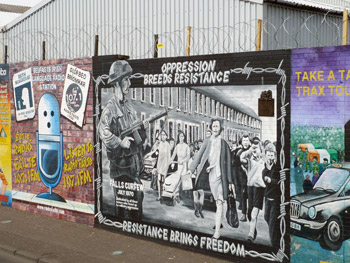
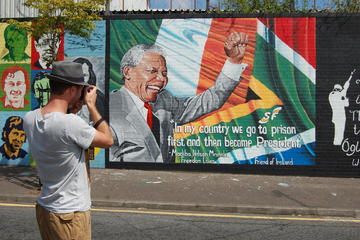
We reached the political murals. ‘Oppression breeds resistance, resistance brings freedom’. The mural commemorated the Falls curfew of 1970. There was a painting of Che Guevara and murals supporting Cuba and the Basque Separatists. There were condemnations of Israel and the US. Most of the murals focused on the wider politics of the world and Marxist communism. There was also a mural of Bobby Sands.

Protestant muralWe continued on past the remaining infamous Divis Flat, once an IRA stronghold. During the Troubles, the army had occupied the top two floors and could only access the building from the air. The flat occupants were subjected to searches night and day, their homes torn apart. Most, if not all of them, were involved in terrorist activity- or at least supported it. The residents hated the army occupation. The animosity was mutual. A nine year old child was killed by the RUC (the police) who claimed they had been under sniper attack at the time.

In Protestant Shankill and East Belfast, the loyalists had their own murals: ‘You are now entering Sandy Row Heartland and ‘No surrender’. There were memorials and shrines to Rangers, the Protestant Scottish football club, to the soldiers who had died in two World Wars and the UDA (the Unionist terrorist equivalent to the Republican IRA.) There were paintings of men in balaclavas with guns cocked that sent a chill down my spine.

It occurred to me that the two communities had more in common with each other than they would ever acknowledge, with their shrines and monuments, their murals and mafia-type communities. And yes, there was warmth and generosity and community and support.

The people of Belfast are full of contradictions: they are passionate, fierce, loyal, resourceful, sharp, intelligent, vengeful, quick to anger and slow to forgive and forget (some of them are still remembering 1690 and beyond!). At the same time, they are among the kindest and friendliest people on the planet. When you’re in Belfast, it’s easy to forget that you are in Northern Ireland’s capital city and not in a village. Then there’s that wonderful, Belfast wicked sense of humour.

Samson and Goliath cranesThe bus continued on to the Titanic Quarter past the Samson and Goliath cranes that are monuments to a once wealthy and successful Belfast. The old ship-building and linen industries had faded away and unemployment and poverty had taken its place – and with it the seeds of discontent started to sprout.

From the bus, the Titanic museum, an iconic aluminium-clad building, rose out of the dock wastelands like an ice-clad ship from the sea. Here in Belfast, the Titanic has been, in a sense, resurrected a century later: with the building of the Titanic Visitor Centre. Back in 1912, the city launched the mighty Titanic, designed and built in Belfast’s docks. At this time, the city was buzzing with success. Then the Titanic sank and the shipyards closed down. It was the prologue to ‘The Troubles’. By the 70s, Belfast had become a dark, strife-torn city. Fast-forward 40 years and Belfast is reclaiming its place in the world. No longer ashamed of its past (and happy to take ownership of its infamous ship again), Titanic Belfast is the largest Titanic attraction in the world and hugely popular.

Apart from Titanic Belfast, it’s worth visiting the Drawing Offices, the Pump House and the Dry Dock. Climb down the 44 feet to the bottom of the dry dock and you’ll begin to get a sense of the sheer scale of the Titanic. Inside Titanic Belfast, you can walk through the history of Belfast. As your silhouette mingles with the Victorian figures that hurry across huge projected images of Victorian Belfast, you’d be forgiven for thinking you’ve stepped back through history and are walking with ghosts.

This new, state-of-the-art museum is a symbol of hope and optimism, just like the Ring of Thanksgiving. Belfast is lifting its head, no longer ashamed of its past and looking to the future. Maybe this optimism, pride and positive energy will spread to the Falls and the Shankill and to the other working class areas of West Belfast, and the wounds will heal. I hope so.


Belfast History Walking Tour The Ultimate Belfast experience

If You Go:

WALK THE CITY
♦ Grab a free map from the information centre and create your own route. You don’t really need a guide as there are information boards across the city
♦ Belfast i-tours: Download a guide to your mobile, available from Belfast Welcome Centre
♦ Follow the Titanic Trail along the River Lagan. It’s well sign-posted with explanation boards along the way.
♦ Follow the sign-posted Merchant Trail. Belfast was a thriving, successful shipping and merchant city at the height of its powers when the Titanic was built.
♦ Join a guided walking tour. Choose your interest. There are Ghost Walks, Political Tours, Titanic Tours and walks uncovering ‘Hidden Belfast’.


Belfast Famous Black Taxi Political Mural Peace Wall Tour

BY BIKE
♦ Hire a bike or join a guided bike tour from the University or the Titanic Quarter

BY SEGWAY
♦ A guided tour of the Titanic Quarter by a more unusual method of transport

BY BOAT
♦ Tour Belfast Harbour and the Titanic area

BY BUS
♦ Buy a metro ticket or take one of the guided open-top buses

BY TAXI
♦ Take a taxi tour of the Troubles


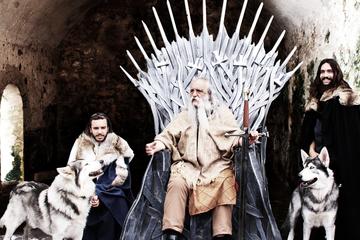
Full-Day Trip from Belfast: The Ultimate Game of Thrones Experience including Winterfell, Direwolves and Replica Throne

GETTING THERE
♦ There are scheduled flights into Belfast International and Dublin airport from all over Europe and world-wide destinations. Dublin is only two hours away from Belfast by train.
♦ There are a number of no-frill flights fly to Belfast City Airport from other parts of Ireland and the UK. There are sailings from Liverpool to Belfas,t and from Scotland (with a connecting train service).

WHERE TO EAT AND SLEEP
♦ McHugh’s bar and restaurant is Belfast’s oldest surviving building (1711). Situated in Queen’s Square, the historical commercial centre of the city, McHugh’s serves traditional Irish food with a modern twist. Try the massive Flintstone-esque “on the rock” steaks (served on slabs of slate) – or if meat is your poison, there are tasty vegetarian options such as champ (Creamed potatoes with scallions).
♦ There’s a wide selection of eateries in the Victoria Shopping Centre off Donegall Square.
♦ You mustn’t miss the Crown Liquor Saloon, one of the most beautiful historical pubs in Europe.

WHERE TO SLEEP
♦ There’s a range of hotels, Bed and Breakfast accommodation, and self-catering options in the city to suit all budgets.

All photos by Helen Moat:
Republican mural on the Peace Line
Ring of Thanksgiving
Titanic Museum from the marina
Protestant Shankill and East Belfast loyalist mural
Samson and Goliath cranes

About the author:
After decades, Helen Moat returns to her home city, Belfast, to find it had changed beyond all recognition. Helen Moat spent her childhood squished between siblings in her Dad’s Morris Minor, travelling the length and breadth of Ireland. She’s still wandering. Helen was runner-up in 2011 British Guild of Travel Writers Competition and was highly commended in the BBC Wildlife Travel Writing Competition this year. Her writing has been published in The Guardian, Telegraph and Wanderlust magazine as well as online. She blogs at: moathouse-moathouseblogspotcom.blogspot.co.uk

Tagged With: Belfast attractions, Northern Ireland travel Filed Under: UK Travel

Secrets of Cave Hill Revealed

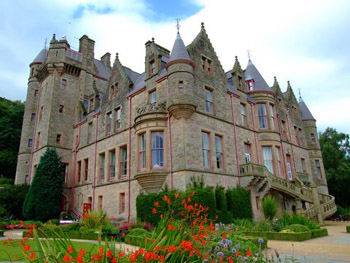
Belfast Castle exterior

Historic Belfast, Northern Ireland

by John Rooney

When the first rays of sunlight break through the cold early morning mist, to reveal the uppermost peaks of Belfast’s Cave Hill, it’s easy for me to see why it’s said to have inspired Jonathan Swift to write his most well known novel, Gulliver’s Travels.

Cave Hill, BelfastSilhouetted against the palest blue sky, the craggy basalt summit forms the outline of a man staring upwards and into heavens. Known locally as ‘Napoleon’s Nose’ it not only bears an uncanny resemblance to the famous emperor, but is also reminiscent of the sleeping giant in the classic tale.

Rising to over 1200 feet above sea level, the Cave Hill is Belfast’s most prominent feature and despite being only a few miles from the city centre it is perhaps one of Northern Ireland’s best kept secrets. Originally known in Gaelic as Beann Mheadagáin (the Hill of Madigan), named after an ancient king, the hill now takes its name from a number of caves which are thought to be early iron mines, dug into its steep rock face.

As well as providing the perfect hunting ground for peregrines, kestrels and ravens, the hill is home to Belfast Castle, Zoological gardens and some of the finest woodland trails to be found anywhere. The summit provides panoramic views of Belfast Lough and is also the site of several primordial raths (forts), dating back to between 400 – 1200 AD.

In Victorian times Limestone was mined on the hill’s southern flanks, then transported to Belfast Docks by a horse-drawn railway system and two hamlets, ‘Mammystown and Daddystown,’ were built on either side of the track to accommodate quarry workers. The railway was abandoned in the 1890s and the two villages are nothing more than references on survey maps of the time. But many streets and avenues close to the hill bear the name ‘Waterloo,’ in reference to their geological origins.

During the Second World War Belfast’s shipbuilding industry was heavily bombed by the German Luftwaffe and on one such raid a bomb was dropped on the Cave Hill, causing a huge crater close to Belfast Castle. And sadly on 1st June 1944, while flying through thick fog, an American B-17 bomber crashed into the Cave Hill, killing all ten crew members instantly. The site of the unfortunate incident is marked with a plaque in the grounds of the Zoological Gardens.

Being a native of Belfast I’ve walked these hills many times and usually approach via the Hightown Road entrance. There’s a small car-park marked with two stone pillars. On my left is thick woodland which occasionally gives way to reveal the underlying basalt, while on my right the hillside descends into a vista of vibrant green valleys and dense vegetation.

The hardcore path makes my ascent relatively straightforward (if somewhat breathless due to the sometimes steep incline), and it isn’t long before I’m making my way through a patchwork of yellowish-brown heathers and bog cotton. Meadow Pipits and Skylarks provide a pleasant chorus over the open moor-land and there’s a strong westerly breeze that swirls around my legs, threatening to throw me of the rugged cliffs should I venture too close to the edge.

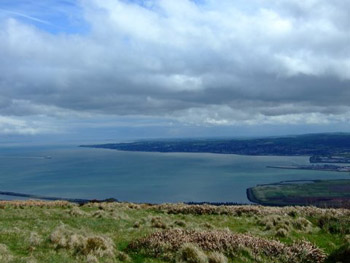
looking down toward Belfast LoughBelow me, Belfast Lough reflects the bluish-grey tones of the sky, as it makes its way past Carrickfergus and into the Irish Sea, where I can just make out the ashen outline of the Isle of Man.

Straight ahead and some five miles across the lough, the small costal towns of Bangor, Hollywood and Newcastle, nestle beneath the safety of the cornflower-blue Mourne Mountains. On my right Harland and Wolfe’s two colossal yellow cranes, mark not only the birth place of the Titanic, but are reminder that during the late 19th century Belfast was the industrial capital of Europe.

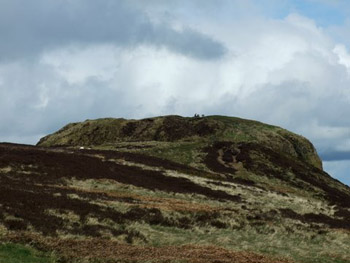
McArts FortFurther along the track and McArts Fort comes into view. The huge grass covered mound measuring 150 feet by 180 feet, is the remains of an ancient circular fort and balances somewhat precariously on an almost vertical slab of rock. It’s hardly surprising that the United Irishmen, Wolfe Tone and Henry Joy McCracken, chose this exact spot to plot the Irish rebellion of 1798. With its inaccessible cliffs and views of the surrounding area, it’s the perfect place to conspire treason.

On passing the fort I begin my descent along the narrow track past the Devil’s Punchbowl (an area of boulders, where it’s believed ancient Celtic farmers corralled their cattle), to enter the castle estate. The air is heavy with the pungent aroma of wild Garlic and the overhead trees grant me respite from the mid-day sun. The trees provide the perfect habitat for a variety of woodland birds and if I’m lucky I might catch a fleeting glimpse of a grey squirrel, or towards dusk a hedgehog or badger.

tree-lined path leads to Belfast CastleAfter crossing a narrow stream, no wider than an average persons step, I make my way along the tree lined avenue that leads to Belfast Castle. The castle is a large sandstone building, built in the Scottish Baronial style and was designed by John Lanyon in 1867, as home to the 3rd Marquis of Donegall. Construction was completed in 1870 and following the Marquis’ death in 1884, it became home to Shaftesbury’s.

The Shaftesbury’s were well known for supporting local charities and held fetes within the castle grounds, and in 1907 the 9th Earl of Shaftesbury was appointed Lord Mayor of Belfast. The castle bears witness to both families; the Donegall coat of arms can be seen above the front door and on the building’s north wall, whilst a section of the Shaftesbury crest appears on the exterior Italian style, serpentine staircase.

Belfast City Council took control in 1934, when the family presented the castle and surrounding estate to the city. Then following a major refurbishment program instigated by the council in 1978 and costing £2 million, the castle is now a popular venue for wedding receptions and conferences.

cat statue in Belfast Castle gardenAdjacent to the castle is the ‘cat garden.’ Legend has it that the castle has always had a resident white cat and that those visiting the castle will have good luck, provided the tradition is maintained. It’s thought that the custom began when a sociable feline befriended the castle’s gardeners and as I make my way down the stone steps leading to the garden, I feel certain that some good fortune will come my way.

The garden’s centre piece is a small decorative fountain where a bronze feline slumbers in the summer sun. On either side of the water feature set in red brick paving, two mosaic felines welcome me to their home, whilst below me a feline carefully sculpted from the semi-evergreen ‘Privet’ soaks up the tranquil atmosphere. There are nine cats for nine lives depicted in the garden’s furniture and paving. My favorite is a statuesque mouser who sits elegantly in a bed of Roseglow (above).

The castle has a bar, restaurant and an antique shop. But before I enter for some much needed refreshment, I’ll take a seat on one of the wooden benches and just like those who first inhabited the hill over 1200 years ago, I’ll watch the sun setting over Belfast Lough.

If You Go:

The Cave Hill is susceptible to extreme weather conditions, whilst some of its cliffs are hazardous and are not suitable for amateurs. Sturdy footwear and waterproof clothing is advisable. For full details on how to get there and to download a PDF map of the advised route please visit:
www.belfastcity.gov.uk To learn about Jonathan Swift and Gulliver’s Travels: www.incompetech.com

Belfast Tours Now Available:

Belfast History Walking Tour The Ultimate Belfast experience

Belfast Mural Political Black Cab Tour

Titanic Walking Tour in Belfast

Guided Tour of Crumlin Road Gaol in Belfast

Full-Day Trip from Belfast: The Ultimate Game of Thrones Experience including Winterfell, Direwolves and Replica Throne

About the author:
John Rooney is a freelance writer and photographer working and living in County Antrim, Northern Ireland. His work has appeared in a variety of magazines and features regularly in ‘Ireland’s Own’. John’s website is www.freewebs.com/johnrooney1 His blog is at http://jon1words.blogspot.com Email: wordwelder58@yahoo.com

All photos are by John Rooney.

Tagged With: Belfast, Northern Ireland travel Filed Under: UK Travel

MORE TRAVEL STORIES:

Greece: Venetian Castles of the Peloponnese

Exploring the Enchanting Beauty of Kizhi Island

Top 5 Must-Visit National Parks in the USA

Kodungallur, Dilapidated Glory of an Ancient Port

Essential Tips for Exploring Dingle Peninsula, Ireland

Upper Mustang Trek: A Complete Guide:

Italy: The Venice-Munich Road

Exploring Iceland in May: Weather, Travel Tips, and Must-See Attractions


SEARCH

DESTINATIONS

  • Africa Travel
  • Antarctica travel
  • Asia Travel
  • Australia travel
  • Caribbean Travel
  • Central America Travel
  • Europe Travel
  • Middle East Travel
  • North America Travel
  • Oceania Travel
  • South America Travel
  • Travel History
  • Travel News
  • UK Travel
  • Uncategorized
  • World Travel
facebook
Best Travel Blogs - OnToplist.com

Copyright © 2026 Cedar Cottage Marketing | About Us | Contact | Privacy Policy | Terms & Conditions | Copyright Notice | Log in