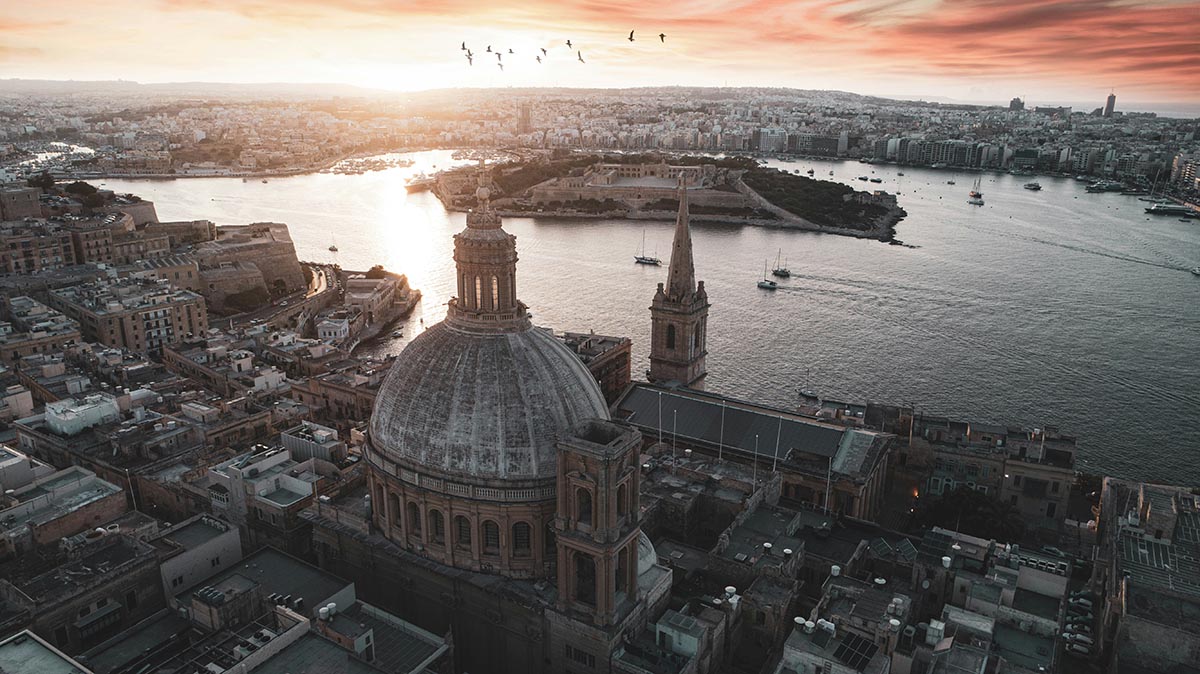
A Baroque Jewel Built by Crusader Knights on a Rocky Peninsula
There are cities that grow organically over centuries, layer upon layer of stone and story. And then there is Valletta — a city that was conceived on a single afternoon in 1566, sketched into the bedrock of Malta by a Grandmaster of the Knights of St. John, and built with the urgent fury of men who had barely survived a siege.
I arrived on a bright October morning, stepping off the ferry from Sliema into the Grand Harbour as sailors have done for five hundred years. The bastions rose above me in honey-coloured limestone, impossibly dramatic, the walls still bearing the scars of cannon fire and, more recently, the Luftwaffe. Malta was bombed more heavily per square mile than anywhere else during World War II, and Valletta absorbed much of that punishment. Yet it stands, absurdly intact, a UNESCO World Heritage city of 320 acres that somehow contains more churches per square kilometre than Rome.
Built by a Knight for Knights
The story of Valletta begins with fire and blood. In 1565, the Ottoman Empire launched the Great Siege of Malta, sending an armada of some 40,000 men to crush the Knights Hospitaller once and for all. The Knights, numbering fewer than 700, held out for four months in a defence so ferocious it became legendary across Christian Europe. When Ottoman forces finally withdrew, Grandmaster Jean de Valette resolved that the knights would never again be caught in such a vulnerable position. He would build a new city — a fortified capital from which no enemy could dislodge them.
He commissioned the Italian military architect Francesco Laparelli, who drew up a rational Renaissance grid plan on the Sciberras Peninsula. Building began in 1566. Jean de Valette himself laid the first stone. He died before the city was complete, but it was named in his honour, and his tomb lies inside the Co-Cathedral of St. John, the city’s most spectacular monument.
Inside St. John’s Co-Cathedral
Nothing quite prepares you for St. John’s. From the outside, it is deliberately austere — a military fortress of a façade that gives away nothing. Step inside and the effect is staggering. Every inch of the interior is encrusted with gilded carvings, marble inlay, and Baroque excess. The nave floor is an enormous mosaic of 400 marble tombstones — the graves of the Knights themselves, each decorated with heraldic symbols and grim memento mori imagery. You are literally walking over the dead.
In a side chapel hangs The Beheading of Saint John the Baptist by Caravaggio — the only painting the master ever signed, a signature he placed, unusually, in the blood pooling beneath the saint’s severed head. Caravaggio fled to Malta in 1607 as a fugitive after committing murder in Rome. The Knights, impressed by his genius, made him a Knight of Grace. He repaid them with two masterpieces before a further scandal forced his flight. The painting is immense, perhaps nine feet tall, and in the dim light of the oratory, it is genuinely unsettling. A crowd of tourists shuffles past in near silence.
The Streets of the Knights
From St. John’s, I walked up Triq il-Merkanti — Merchant Street — and into the heart of the auberges, the grand lodging houses built by each of the eight Langues, or national divisions, of the Knights. France, Aragon, Castile, England, Germany, Italy, Provence, Auvergne — each built their own palace, competing in architectural ambition. The Auberge de Castille, now the office of the Prime Minister, commands the highest point of the city in gold-washed Baroque magnificence. The Auberge d’Italie houses the Malta Tourism Authority. History has been repurposed, as it tends to be.
The city’s street plan, laid out in that rational Renaissance grid, makes it unusually navigable for such a richly layered place. Valletta’s spine is Republic Street, a pedestrianised thoroughfare lined with cafés, bookshops, and the remarkable National Museum of Archaeology, where I spent an absorbing hour with Malta’s prehistoric artefacts — figurines and ceramics from the Ħaġar Qim and Mnajdra temples, structures older than Stonehenge and older than the Pyramids.
The Upper Barrakka Gardens and the War Beneath
No visit to Valletta is complete without the Upper Barrakka Gardens, perched atop the bastions with a panorama across the Grand Harbour that has been painted and photographed a thousand times without ever losing its power. The three cities — Vittoriosa, Senglea, and Cospicua — huddle on the far shore, their own fortifications bristling. At noon, the Saluting Battery fires its daily cannon — a thunderclap that rolls across the water and sends pigeons spiralling into the sky.
Beneath the gardens, carved into the very rock of the bastions, is the Lascaris War Rooms — the Allied Forces’ underground headquarters during World War II, where Eisenhower and Churchill planned the Allied invasion of Sicily in 1943. The rooms have been meticulously restored; uniformed mannequins bend over plotting tables, and the original communications equipment is still in place. It is one of those spaces where the past feels suddenly, uncomfortably close.
Evening in Valletta
As the day trippers departed, the city exhaled. Valletta in the evening belongs to its 6,000 or so residents, to the restaurants filling with Maltese families, to the bars around St. George’s Square where cats lounge on sun-warmed limestone. I ate grilled lampuki — Malta’s beloved dolphinfish, landed that morning — at a terrace table with the Grandmaster’s Palace lit up behind me. The wine was Maltese, dry and mineral. The night was warm. Five centuries of history pressed in from every wall.
It struck me that Valletta is, in the most literal sense, the product of a single will — one man’s refusal to be defeated again. That is a strange thing to feel in a city. Most places accumulate meaning slowly, without intention. Valletta was willed into existence, and you can feel it still.
If You Go
Getting There: Malta’s international airport is served by numerous European carriers. Travellers from further afield will typically connect through London, Rome, or Frankfurt. Booking early through aggregator sites — including cheap flights from Kiwi — can significantly reduce transatlantic connection costs, especially outside peak summer season.
Getting Around: Valletta is tiny and entirely walkable. Ferries run regularly across the Grand Harbour to the Three Cities (highly recommended for an afternoon excursion). The Hop-On Hop-Off bus connects Valletta with major sights around the island.
When to Go: Spring (April–May) and autumn (October–November) offer ideal temperatures and manageable crowds. July and August are intensely hot and very busy.
Don’t Miss:
- John’s Co-Cathedral and its Caravaggio oratory (book online in advance)
- The National Museum of Archaeology
- The Lascaris War Rooms
- The Upper Barrakka Gardens at noon for the cannon salute
- A ferry trip to Vittoriosa (Birgu) to walk the streets where the Knights lived before Valletta existed
Where to Stay: The Iniala Harbour House and Rosselli are both excellent boutique hotels housed in restored palazzos. Mid-range travellers will find comfortable options along the Sliema waterfront, a short ferry ride away.
Practical Notes: Entrance to St. John’s Co-Cathedral costs €15 (includes audio guide). The Lascaris War Rooms charge €10. The Archaeological Museum is €5. Many of Valletta’s street-facing churches are free to enter.
About the Author:
A travel writer and historian based in Europe, the author focuses on the intersections of military history, art, and place. Their work has appeared in print travel publications across the continent. They travel with a notebook, a camera, and an unreasonable number of guide books.


Leave a Reply
You must be logged in to post a comment.