By Andrew Infantino and Melody Guzman, Travel Your Best
We have taken a lot of tours in a lot of countries, and we will say this plainly: the three-day drive from Marrakesh to the Sahara at Merzouga was the best three-day tour we have ever taken. Not because it was comfortable or because we planned it well, but because Morocco kept changing around us every few hours, and by the time we climbed off a camel in front of the great dunes of Erg Chebbi, it felt like we had crossed three countries instead of driving across one.
It started, as so many Moroccan trips do, in the red city. We arrived in Marrakesh in May, when the city is at its most golden. The city is intense in the best way: a whirl of color, pattern and noise inside those famous ochre ramparts.
The first thing we looked at, like everyone, was blue. The Majorelle Garden is small and impossibly lush, bamboo and cacti and towering palms threaded with walls and fountains in that electric cobalt they call Majorelle Blue, created by the painter Jacques Majorelle and later saved and restored by Yves Saint Laurent. Then the palaces, Bahia Palace and the Ben Youssef Madrasa, wrapped floor to ceiling in carved cedar, sculpted plaster and zellij, the geometric mosaic tilework Morocco is famous for. Every doorway is a photo. Go slowly and look up.
Our favorite Marrakesh afternoon was the goofy one: a camel ride through the Palmeraie, the huge palm grove just outside the city, where they dress you up in a blue Berber robe and turban and you amble out among the date palms. Corny? A little. Did we love it? Completely. It turned out to be the perfect warm-up for the real camel trek days later.
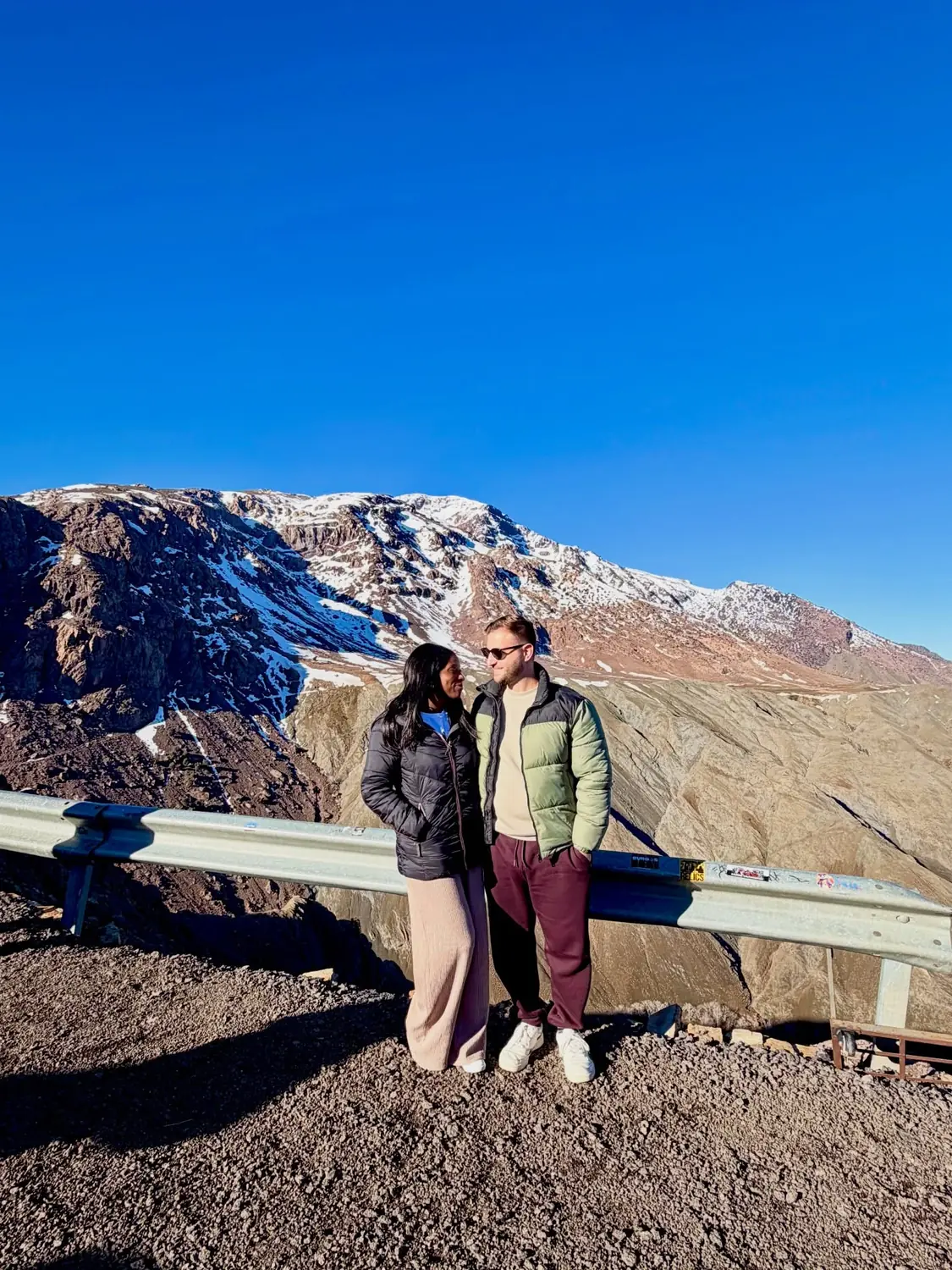
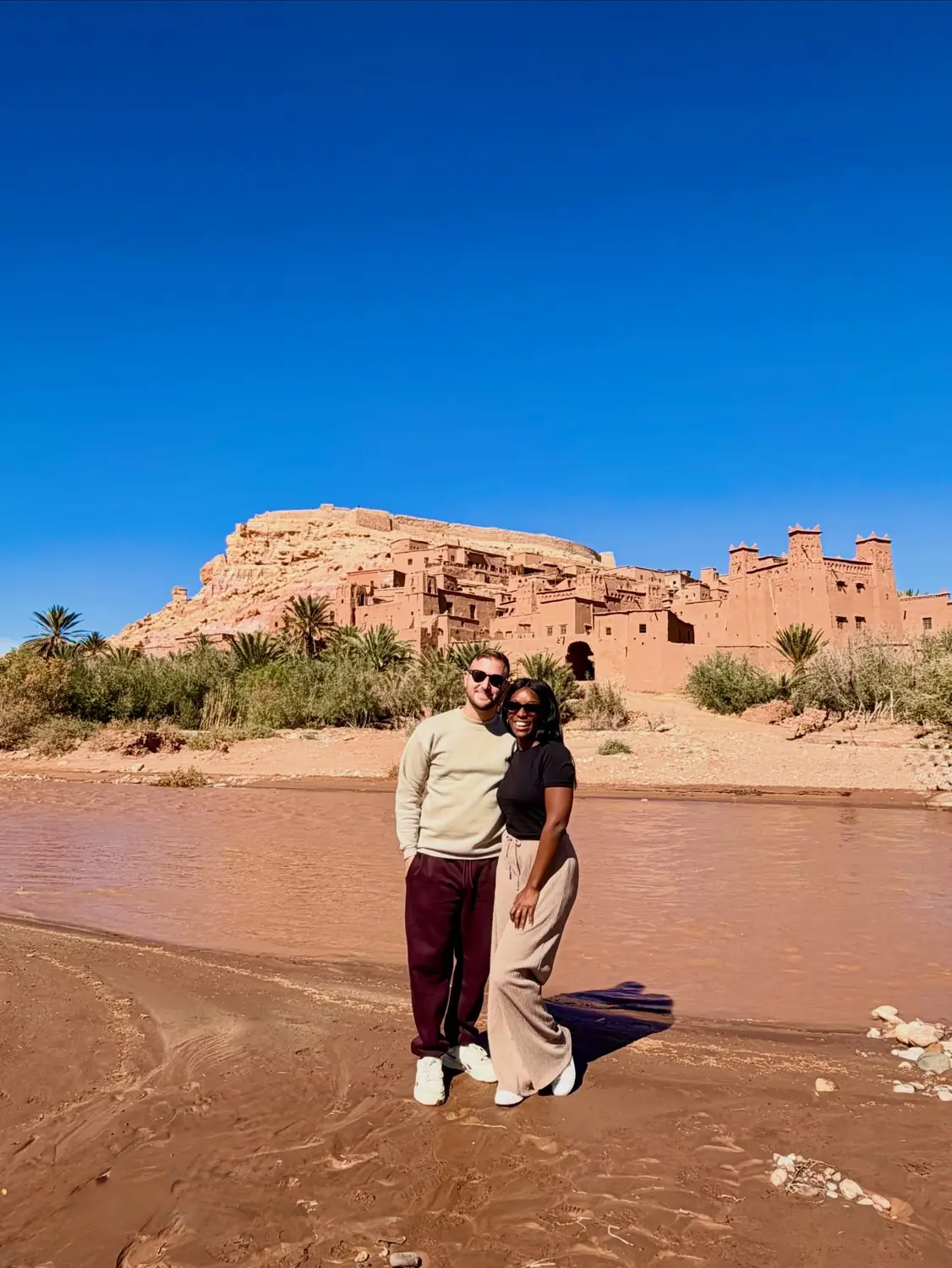
Day one of the three-day tour was a spectacular drive: up and over the High Atlas mountains, across the snow-dusted Tizi n’Tichka pass, and down into the red pre-Sahara. The showpiece stop is Ait Ben Haddou, a honey-colored fortified village of stacked earthen towers climbing a hillside, and you will recognize it from about a hundred films. Here is the thing nobody tells you about the film stuff: Ait Ben Haddou is not a set. It is a real ksar, built by hand from mud and straw in a style that has been sheltering caravans on the trans-Saharan trade routes for centuries. You wander up through its narrow lanes to the top for the view back over the palm-lined river. Pure magic, and our first real taste of the south.
The road kept delivering. The Todra Gorge is where sheer canyon walls rise hundreds of meters straight up on either side of a little river, and you feel tiny walking through it in the best possible way. We stopped for mint tea on a rug laid out right by the water. Mint tea is not a drink in Morocco, it is a ritual: poured from a height into small glasses, sweet and scalding, and you will drink it a dozen times a day if you let people keep offering, which you should. Then the great green oasis of Tinghir spilling along the valley, lush palms against red rock so unreal it looks photoshopped.
All along the Dades and Ounila valleys, the road is one long string of postcards: earthen kasbahs perched above rivers and ribbons of green oasis. Some of our favorite photos came from unplanned pull-overs. Keep your camera close the whole drive.
The drive builds in a few craft stops, and we are glad it does. At a Berber carpet cooperative they roll out rug after handwoven rug in a riot of color and pattern, mint tea usually included, and a lovely window into a craft that is still alive and being passed down. No pressure to buy, and if a rug does catch your eye, haggle warmly.
The overnight stops were part of the joy. Traditional kasbah-style guesthouses with tiled courtyards, carved wooden doors, patterned rugs and a lantern-lit pool to cool off in after a long day on the road. Dinner was usually a big shared tagine with the group, steam rising off the conical lid, the meat falling apart into preserved lemon and olives or sweet caramelized onions, mopped up with bread because of course.
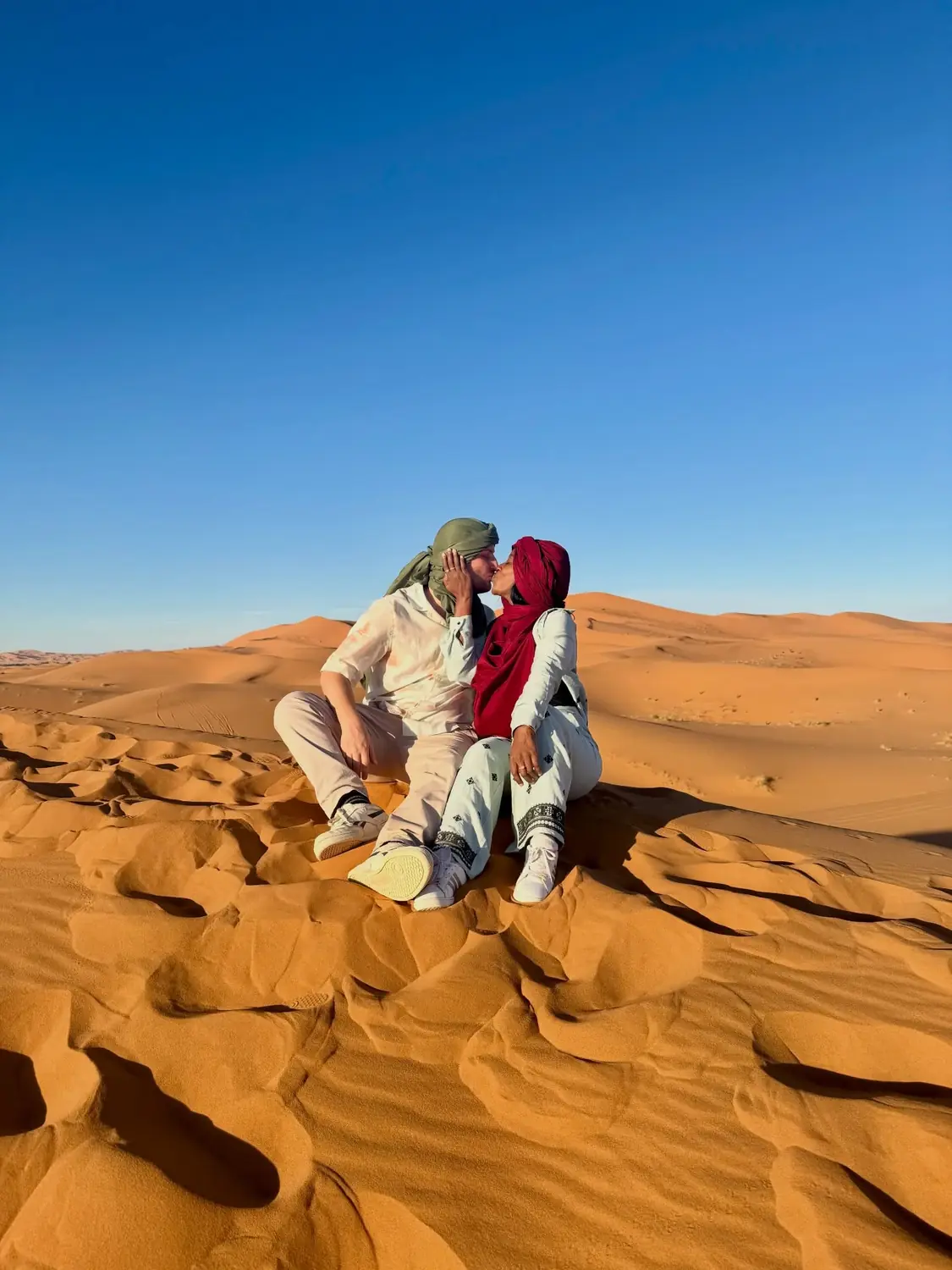
And then Merzouga. This is the moment the whole tour builds to. You climb aboard a camel at the edge of town and trek in a caravan up into Erg Chebbi, the towering, wind-sculpted orange dunes of the real Sahara, as the light turns gold. It is every desert daydream at once, and it delivered completely.
Once you are out in the dunes, climb a high ridge for sunset and again for sunrise. The sand shifts through pink and amber to deep orange as the sun moves, and the silence is total. Some of the most peaceful moments of our whole trip happened barefoot on a dune crest, watching the light do its work.
The night is the part that changed us. We stayed in a desert camp among the dunes, and with no city lights for miles the Sahara night sky is staggering: thousands of stars and the faint band of the Milky Way overhead. We sat out with mint tea and drums, watching the sky for hours. If you do one overnight in Morocco, make it this one.
We have been back to Morocco since, up to the blue lanes of Chefchaouen and the coast at Tangier, and we would go again tomorrow. But there is a version of this country that lives only on that road south of Marrakesh: the passes, the gorges, the kasbahs, the drums at night under a drowning sky of stars. It is not a history you read about. It is one you ride through, one ridge at a time, with sand in your shoes and tea in your hand.
You can see the full journey with all our photos in our Morocco travel guide: https://travelyourbest.com/morocco.html



Leave a Reply
You must be logged in to post a comment.