by Ron Ellege
What do some of Italy’s finest artists of the day, Nicola and Giovanni Pisano, Donatello, Pinturicchio, Lorenzo Ghiberti, and Bernini, have in common? They all contributed to one of the finest displays of Gothic architecture in Italy. Siena’s Cathedral of Santa Maria Assunta is filled with treasures by Pisano, Donatello and Michelangelo, as well as frescoes by Pinturicchio.
The Beginning
Begun in 1229, and the dome completed in 1264, Siena’s Cathedral is a spectacular edifice inside and out. With a vision of hosting the largest cathedral in Europe, the existing structure was to become the transept of a new cathedral more than 100 meters long. Tragically, their dream of an imposing cathedral died in 1348 when, within a few months, 60 percent of Siena’s inhabitants were struck down by the Black Plague.
The remnants of the outer walls remain today and bring perspective to the vision they had undertaken.
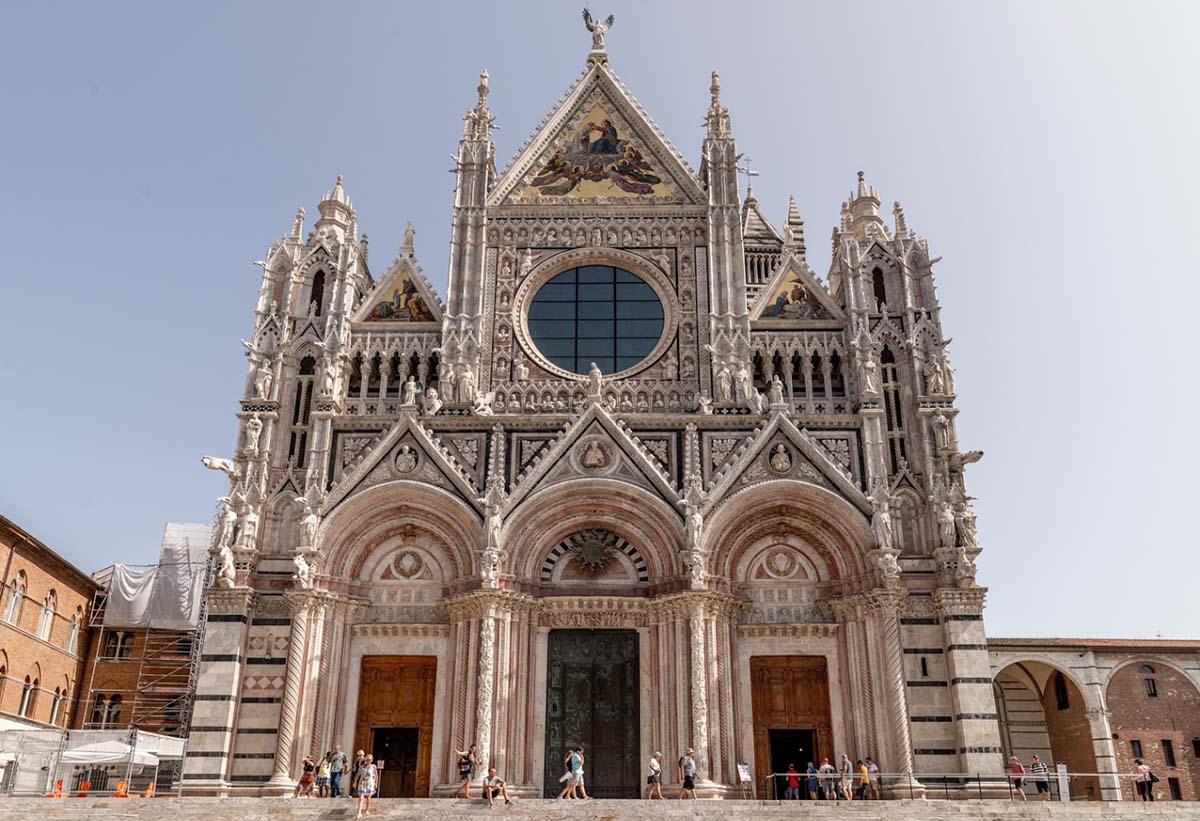
 The west facade was begun in 1285 under the watchful eye of Giovanni Pisano. In 1296 Pisano hastily left the city over a creative dispute with the governing council and his work was completed 100 years later by Giovanni di Cecco.
In the 19th century, the Cathedral was extensively restored and the golden mosaics in the upper gables were made by Venetian artists in the late 1870’s. The large central mosaic, the Coronation of the Virgin, is the work of Luigi Mussini. The Nativity of Jesus and Presentation of Mary in the Temple, were made by Alessandro Franchi. The large rose window is surrounded by busts of 36 patriarchs and a statue of the Madonna and Child.


Inside The Cathedral
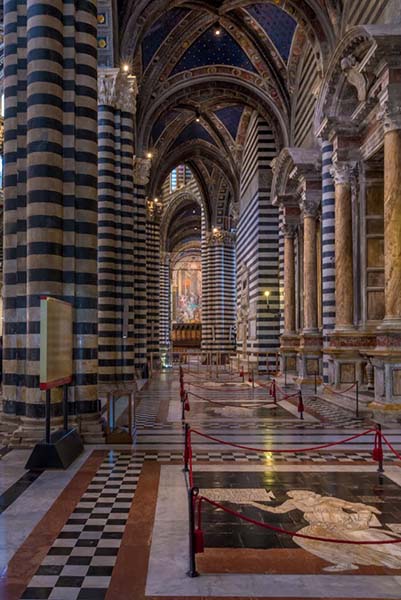 Prepare to be amazed as the Wow Factor will captivate your senses the moment you enter the doors of this historic Gothic Cathedral. The black and white marble stripes on the walls and columns immediately captivate the eye. Black and white is seen throughout Siena and are the city’s symbolic colors.
Stop at the visitor’s desk directly across from the entrance where you can pick up an audio tour which will take you on an informational journey through the highlights of the Cathedral.
While standing in the short line for your tour radio, glance up at the cornice that runs the length of the nave. It is decorated with busts of popes fashioned in the workshop of Giovanni di Stefano who began his work in 1495. Below are 36 busts of Roman and Byzantine emperors from Constantine to Theodosiu.
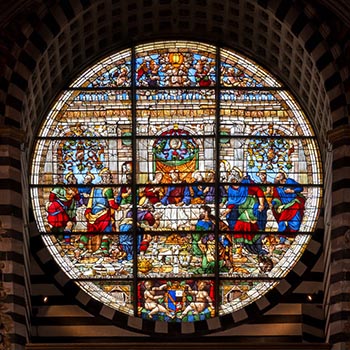
Located over the main doors in the west façade is one of two rose windows not to be missed. This beautiful oculus depicts the Last Supper and was created by Pastorino de’ Pastorini in 1549.
The Central Nave
Venturing into the Cathedral we observe the central nave.
Here we view the high altar flanked by columns topped by our first glimpse of the hexagonal dome which is topped with Bernini’s gilded lantern.
Under the dome are gold-plated stucco statues of Patron Saints of Siena sculpted by Ventura di Giuliano and Bastiano di Francesco in 1490.
 The Duccio Oculus, the round stained-glass window over the apse is one of the earliest existing examples of Italian stained glass.
It depicts the assumption, burial and coronation of the Virgin Mary and was crafted by Duccio di Buoninsegna in 1288.
The Floors
As you stroll through this art filled Cathedral with astonishing sculptures, frescos, and relics on display in every quadrant, pay close attention to the floors. This composite of marble inlays which were crafted over six centuries (from the fourteenth to the nineteenth century), are covered for protection during much of the year. Plan on arriving between mid-August and late October if you wish to view them.
Of all the mosaic marble panels, I have two favorites. The large panel in the transept “The Slaughter of the Innocents”.
This is thought to be the work of Matteo di Giovanni in 1481. It is the only story coming from a Gospel, Matthew 2:13-23, all the other illustrations are based on the Old Testament and classical sources.
The earliest floor panel in the Cathedral is the Wheel of Fortune and the Sienese Wolf.
This panel, located close to the entrance, dates to sometime between 1369 and 1373.


Self-Portraits
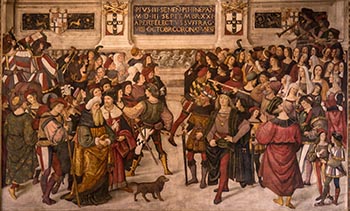 Above the entrance to the Piccolomini Library is this fresco of the papal coronation of Pius III by Bernardino di Betto (Pinturicchio).
I love this fresco as it captures the nature of many of the artists of the time. Pinturicchio, as he often did during this period in his career, included a portrait of himself. Pinturicchio is standing facing us, he is the one in front of the crowd on your right while viewing this fresco.
Another self-portrait is an addition by Michelangelo to the Piccolomini Altarpiece.
This complex altarpiece was commissioned by cardinal Francesco Todeschini Piccolomini and built between 1481 and 1485 by Andrea Bregno. However, its prominence is more for the four sculptures in the lower niches. Saint Peter, Saint Paul, Saint Gregory, and Saint Pius were sculpted by Michelangelo between 1501 and 1504. The statue of St. Paul is a self-portrait of the young Michelangelo.
The Last Glimpse
As you proceed from the cathedral, south toward Piazza del Campo, be sure to look back for a view of the dome and bell tower through the arch in the south wall of Duomo Nuovo.
The dome rises from a hexagonal base with supporting columns. The lantern atop the dome was later added by Gian Lorenzo Bernini.
If You Go:
You can drive, but it may not be the best choice.
By Car:
Siena is one of Italy’s prominent hilltop-towns and is located a mere 76 kilometers south of the beautiful city of Florence. The drive takes only 45 minutes via the Autostrada, however, once you arrive in Siena you will find that you cannot enter the old town unless you are booked in a local hotel. Parking is difficult to find and will often be located beyond any reasonable walking distance.
Our favorite car rental in much of Europe and the world. www.rentalcars.com.
Train or bus may be your best option if you are not taking one of the many tours offered in Florence.
Our favorite tour company is Walks of Italy.
By Train:
Siena is about 90 minutes by train, and they are scheduled frequently throughout the day. The train station is located close to Siena’s many tourist attractions and is about one-and-a-half kilometers from the Cathedral.
When traveling by rail I have two sites I check with: Trainline and Vacations By Rail.
The SITA Bus provides numerous links from the city of Florence to Chianti, and is the best way to get easily to Siena. Using the Rapide (express) Bus it will take about an hour from Florence, and you gain the added advantage of being taken to the historic center of town, close to the Cathedral.
Be Aware:
As is the case in all of Italy, to enter a place of worship you must dress accordingly (women’s shoulders should be covered, shorts are not appropriate, and men must wear shirts). Food and drink is not allowed in the Cathedral so take advantage of one of the many cafes and restaurants located a few steps away.
The public is welcome and encouraged to attend weekday and Sunday masses, but no sightseeing is permitted during these events.
Cost and Hours:
Tickets are €6 per person while the marble pavement is uncovered, usually from mid-August to late October. The rest of the year, entrance is €3 per person.
Siena Cathedral (Santa Maria Assunta, or Most Holy Mary of the Assumption) is open from 10:30 a.m. to 7 p.m. on weekdays, and from 9:30 p.m. to 6 p.m. on Sundays and holidays.


About the author:
Ron Elledge is a Freelance Photographer/Writer who splits his time between Phoenix, Arizona and Albuquerque, New Mexico when not on a photo shoot or world adventure. Ron’s photography can be viewed at www.RonElledgePhotography.com. His love of travel is shared by his wife, Shelli, with whom he travels the globe and together they document their journeys.
All photos by Ron Elledge

 Crime and Punishment Locations
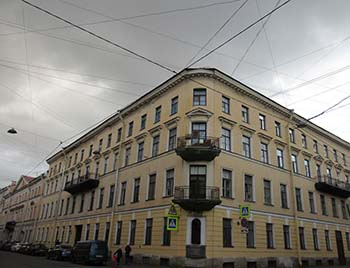 I found Raskolnikov’s house, a big yellow apartment building, on the corner of Stolyarny Lane, 5, and Grazhdanskaya Street, 19. This rectangular structure with an inner yard has been built according to a typical architectural design of the 19th century: since the land was expensive, architects had to create the biggest possible house to occupy the lot. In 1970s, after remodeling, this “high, five-storied house” described by Dostoyevsky was turned into a four-storied one. [5] However, there is still the loft where Raskolnikov rented a room: “It was a tiny cupboard of a room about six paces in length … and it was so low-pitched that a man of more than average height … felt every moment that he would knock his head against the ceiling.” [6] The entrance to the house is locked to prevent tourists and literary journeys’ lovers, like myself, from disturbing the tenants.
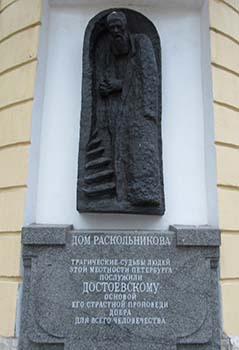 As I walked around the house, I saw the commemorative high relief of Dostoyevsky and the plaque with the inscription: “Raskolnikov’s House. The tragic lives of people of this neighborhood of Petersburg served for Dostoyevsky as a foundation of his passionate sermon of goodness for the entire humanity.” [7] There is an interesting tradition in St. Petersburg: on the first Saturday of July (events described in Crime and Punishment happened in the beginning of July), Dostoyevsky’s enthusiasts gather in this neighborhood to celebrate Dostoyevsky Day. Many bring flowers to place at the bottom of this relief, but some put here … axes, because Raskolnikov used an axe as his murder weapon. (Another reason for tenants of this house to keep the entrance door locked!)
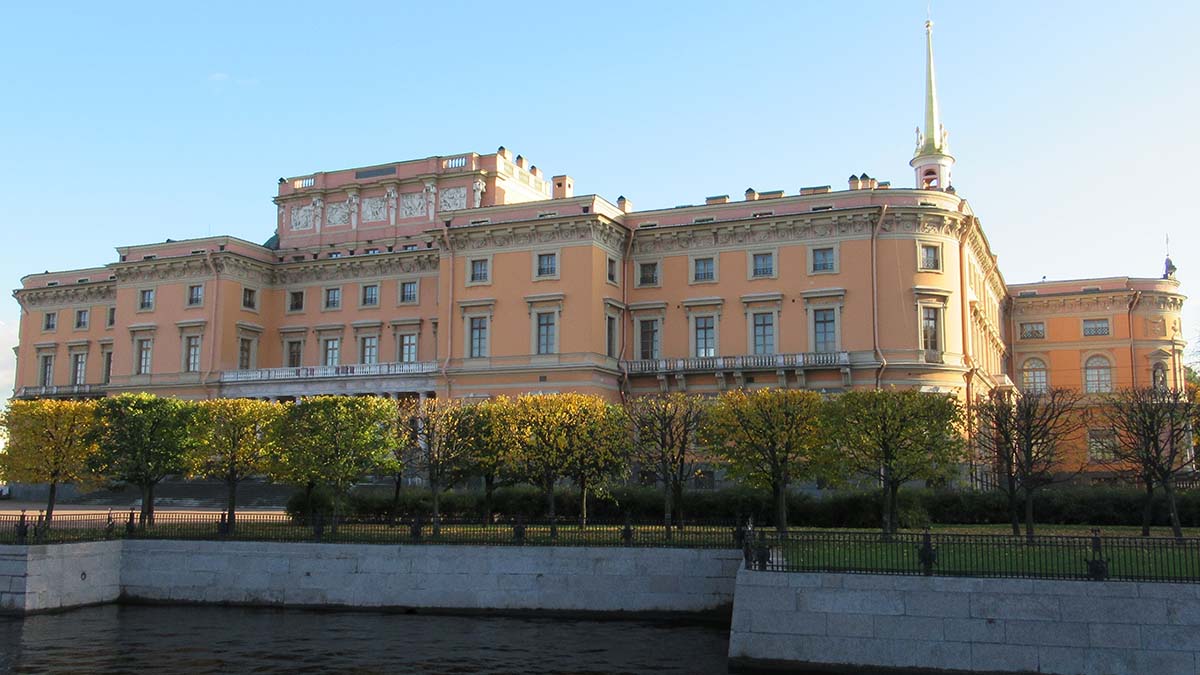
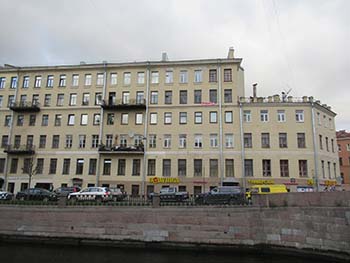 After having found the house of the murderer, I need to find the house of his victim, an old woman, a notorious pawnbroker Alyona Ivanovna. The book presented her dwelling place as “a huge house which on one side looked on to the canal, and on the other into the street.” [8] The building fitting this description is located on the Griboedov Canal Quay, 104: one long side stretches along the Griboedov Canal, another – along Srednyaya Podyacheskaya Street, and the short side looks into Rimsky-Korsakov Street. Dostoyevsky gave another key for locating the old woman’s house – the number of steps that Raskolnikov made while walking there: “He had not far to go; he knew indeed how many steps it was from the gate of his lodging house: exactly seven hundred and thirty.” [9] Dostoyevsky, as a military engineer, was used to measuring distances in steps, and, knowing his obsession with precise details, we can presume that the writer gave us the correct number of steps.
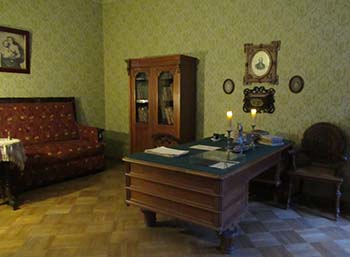 Now I had to take the subway to reach the Dostoyevsky Museum located on Kuznechny Lane, 5. Dostoyevsky rented twice apartments in this building: in 1846, at the beginning of his literary career, and in 1878, three years before his death. The main attraction of the museum is Dostoyevsky’s cabinet where he had written his novel Karamazov Brothers. On the massive desk there is an issue of the magazine, Russky Vestnik, with an extract from Karamazov Brothers, Dostoyevsky’s letters, and one of his favorite novels, Eugene Onegin by Alexander Pushkin. Everything on the table is at the particular place because the writer “paid a great attention to this pedantic order” [13]. There are two candlesticks with candles because Dostoyevsky disliked table lamps and preferred to write by candlelight. Since the writer worked a lot, being constantly in dire need for money because of his gambling problem, he often slept in his cabinet on the sofa. Above the sofa there is a reproduction of Dostoyevsky’s favorite picture, “The Sistine Madonna” by Raphael, presented by Sofia Tolstoy (Leo Tolstoy’s wife). Anna, Dostoyevsky’s widow, wrote: “How many times, during the last year of Fyodor Mikhailovich’s life, I found him standing in front of this great picture in such a deep adoration that he did not hear how I had entered.” [14] On February 9, 1881, Dostoyevsky died on the sofa in his cabinet.
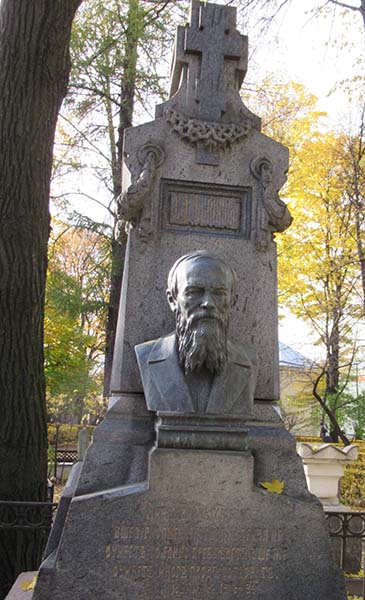 Dostoyevsky was buried at one of the most famous cemeteries of St. Petersburg – the Tikhvin Cemetery at the Alexander Nevsky Monastery. The tombstone consists of the Orthodox cross and Dostoyevsky’s bust placed on two books. The cross is adorned by a garland of thorns symbolizing the writer’s sacrifices and hardships. The bust bears a resemblance to the writer because Dostoyevsky’s death mask was used for its creation. Two books, representing two parts of the Bible, symbolize his devotion to the Russian Orthodox Church; additionally, books symbolize his literary career. The tombstone’s inscription in Old Church Slavonic language is a quote from John 12:24: “…unless a grain of wheat falls into the ground and dies, it remains alone; but if it dies, it produces much grain.” This tomb is one of the most visited, and it is often adorned with fresh flowers.
 Footnotes:

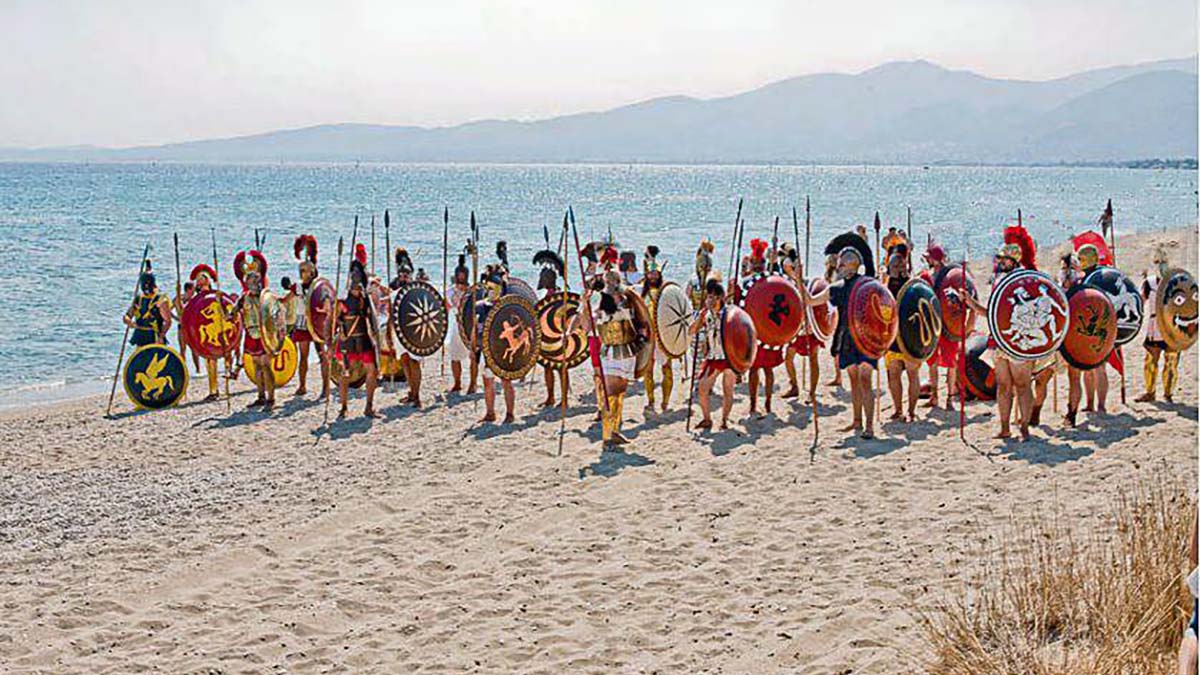


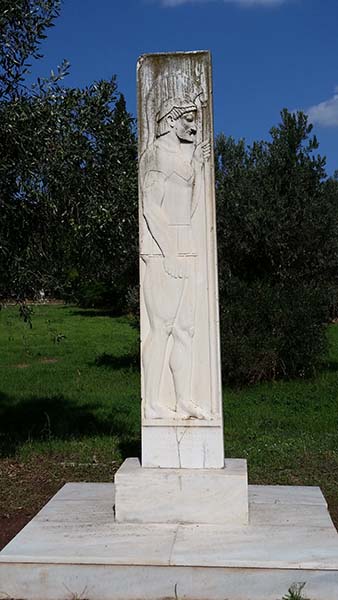 A short walk from the beach, in a pastoral setting surrounded by a grove of trees, 190 young men of Attica are buried where they fell, heaped in a common grave mound, guarded by a marble relief of the Warrior of Marathon. The tumulus is located five kms from Marathon village. The high mound is blanketed with a carpet of grass, surrounded by what was once the battlefield that covered the swampy ground between the beach and Mt. Pentilikon. Several miles inland there is an archaeological museum devoted to artifacts found in the area. Nearby is the grave mound of the eleven Plataeans who died in the battle, including that of a ten year old boy, the youngest fatality of that fateful day
 Shortly before the battle took place, the Athenians knowing they were vastly outnumbered, had sent Pheidippides, a soldier and experienced runner, to Sparta to ask for help. The 140 mile course from Athens to Sparta was rugged and mountainous. Pheidippides ran the course in only 36 hours, but the Spartans agreed to help only once the moon was full, due to religious laws. So Pheidippides ran back to Athens to deliver the disappointing news and immediately afterwards join the small Athenian army to march to the plains of Marathon.
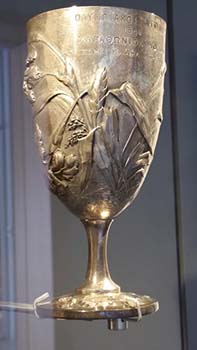 There is a gallery of women runners too. The first woman to run a marathon was from Syros. She was known as “Melpomene” and she ran 40 kilometres of the 1896 marathon the day after it was officially run. She had been denied permission to run in the official race so she decided to run alone. She asked a priest to pray for her protection but he refused, saying he would only bless official athletes. Her finishing time was 5.30 hrs. Today hundreds of women participate in marathons which are held not only in Greece but world-wide.

 tell the story of the fall of Alexander the Great’s dynasty.
 Photo Credits: