Travel Thru History

Historical and cultural travel experiences

  • Home
  • Airfare Deals
  • Get Travel Insurance
  • Writers Guidelines

Exploring Alberta’s Badlands

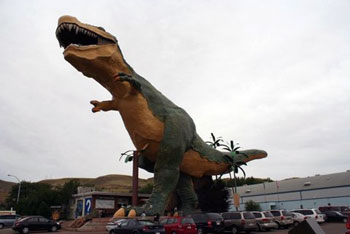
Dinosaur model in Drumleller Alberta

by Robin Konstabaris

It was late in August when my friends and I decided to visit the Badlands of Alberta, Canada. Most of Alberta is flat, and there was no real direct route, so we just drove down various prairie highways and roads to get there.
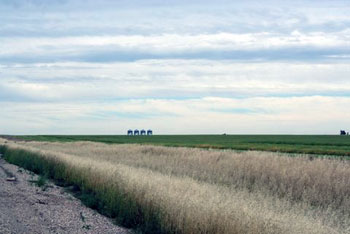
tall prairie grass in AlbertaThe grasses were high, it was hot but not sunny, the huge domed sky blanketed with a thin layer of clouds. We were not beset by any pesky bugs like mosquitoes, but there was a fair share of crickets which seemed the only wildlife we could detect. The roads were lined with wire fences, and every now and then we would see a row of modern silos, which are metal and tubular rather than wooden like the classic grain elevators that are almost nearly extinct on the Canadian prairies. We came to a row of four which appeared to us to be very far away, but as we approached them, we found they were near and tiny. Our eyes had been fooled! The flatness of the land and the lack of any defined shadows had really played a number on our depth perception.

The Badlands are valleys which are surrounded by hills that have eroded to show the geological strips of the ages. The valley floors are lush enough near the rivers, but the hills and non-irrigated plains are barren. Some scraggly bushes might grow here and there, and yellow tracks of grass, but mainly they are bald and prehistoric, with the occasional jutting hard rock formations that have resisted the ravages of time. It was oddly quiet but I couldn’t help imagining the sound of saloon doors flapping open and closed. We were not expecting such exposed vastness, and would not have been surprised to see the coyote chasing the roadrunner, although we only saw a tumbleweed or two. It was hot and dry but not dusty like you might think. The dust had blown away long ago.
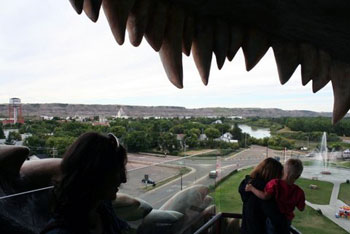
view of Drumheller through teeth of dinosaurDrumheller is the heart of the Badlands and the dinosaur fossil capital of the world. Its main industry is dinosaurs and the town lets you know it. Look, there is Fred and Barney’s All You Can Eat Chinese and Western Buffet! Many businesses had fiberglass dinosaurs in front. The fire hall had one painted like a dalmatian, and another one had been painted all steampunk and metal. Well, no one knows what a dinosaur’s skin really looked like, do they? A lot of kids like dinosaurs so many of the town’s visitors were families with children. The downtown is small with no structures over two stories, with little cafes that serve grilled cheese sandwiches and chicken fingers and not very good coffee. We felt like no real living was done there, as if the town only existed so the children and their parents had some infrastructure to meet their needs after they were done looking at dinosaur bones.
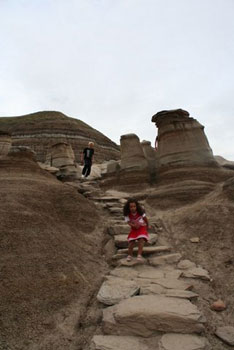
walking near hoodosIn front of the Dinosaur Museum there was a T-Rex so large we could climb steps inside and six or seven people could gaze out of it’s mouth for a sweeping view of the town with the Badlands behind it.

“This is the last thing you would see if eaten by the giant T-Rex of Drumheller,” I said to Step and Linda.

The insides of the giant T-Rex were painted in what I suppose was a representation of its digestive tract interspersed with prehistoric landscape but it was so poorly done it just looked like preteen vandals had been let loose with spray paint cans and electrician tape.

Many tourist guides and official Badlands media had representations of the monolithic hoodoos, which were only sixteen kilometres from the giant T-Rex. Hoodoos are rock formations that have hard flat tops that have prevented the rock below them from eroding away. We had seen beautiful pictures of the towering hoodoos with the sun setting behind them, and pictures of them dominating the sweeping, arid landscape around them. Such a phenomenon of nature!
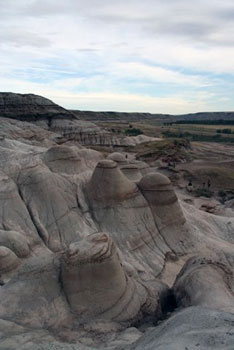
hoodoos in Alberta badlandsThe road to the Hoodoos, although along a river, was not verdant at all. The dry, golden road with its walls of striped history really did make us feel like we were in the wild west, heading for the canyons. We were prepared for Nature’s majesty! But upon arrival at these Hoodoos, we discovered them to be few and only four feet tall.

The site was crowded and little kids were able to climb upon them with no trouble at all. Over the years, people had scratched their names into the hoodoos, and the whole site was sad and diminutive and desperate.

We laughed at how Alberta, with it’s flatness and vastness and lack of shadows, had fooled us for the second time that day, and I set about taking my own photos of the hoodoos which showed them without people and reaching for the summits of the desert sky, therefore doing my part to perpetuate the myth of their mystery and silent grandeur. Because sometimes, especially when we’re out seeking adventure, if life refuses to amaze us with its reality, we have to let a little fiction in to sweeten our day and our memories.


Drumheller and Badlands Full-Day Tour with a Small Group


If You Go:

Travel Drumheller
Drumheller Hoodoos
Royal Tyrrell Museum

Fall/Winter 2012/13

September 1 – May 14
♦ 10:00 a.m. – 5:00 p.m. Tuesday through Sunday
♦ Note: Closed Mondays, except for public holidays
♦ Open Remembrance Day (November 11) and Monday, November 12
♦ Closed Christmas Eve – Monday, December 24 & Christmas Day – Tuesday, December 25
♦ Closed New Years Day – Tuesday, January 1

Spring/Summer 2013
♦ May 15 – August 31
♦ 9:00 a.m. – 9:00 p.m.
♦ Open seven days a week, including holidays.

Allow 2 to 3 hours for a thorough visit of the Museum galleries.
Royal Tyrrell Museum Gift Shop is open during regular Museum hours.


Canadian Badlands Day Trip from Calgary

About the author:
Robin Konstabaris is a visual artist and cartoonist best known for her former weekly comic strip “Clip ‘n’ Save”. She is currently honing her creative writing skills.

All photos are by Robin Konstabaris.
Tagged With: Alberta travel, canada travel, Drumheller attractions Filed Under: North America Travel

Historic Canadian Lighthouses

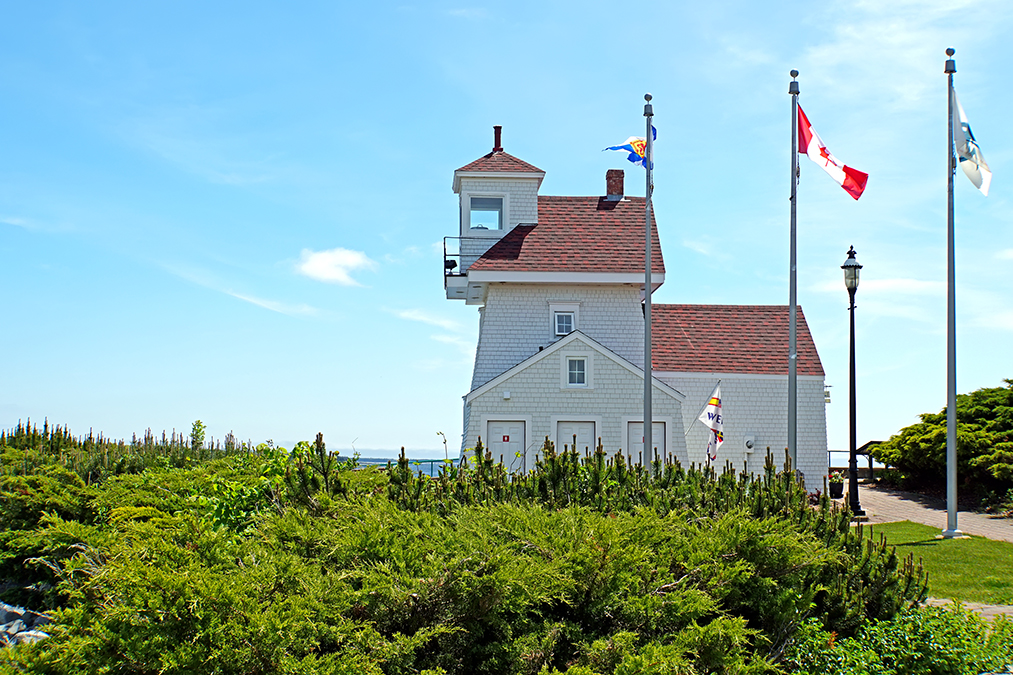
fort point lighthouse

by Norman Rubin

Visiting and photographing lighthouses, even collecting replicas of them are popular hobbies for many enthusiasts. In some locations, lighthouses have become popular travel destinations in themselves and the buildings are maintained as tourist attractions. Canada with its long rugged shore is an excellent country for enthusiasts to visit and photograph its historic lighthouses, the national heritages of the land.

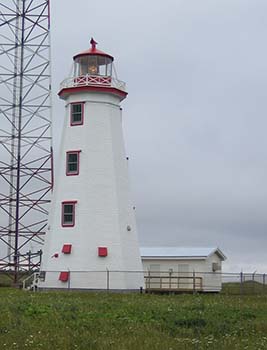
North Cape lighthouseLighthouses as we know are beacons built on towers with a system of lamps and searchlights at various dangerous coastal sites, hazardous shoals, and for a safe entry to ports. The earliest lighthouses in history were simply bonfires built on hillsides to guide ships. The most famous lighthouse in history is the Lighthouse of Alexandria in ancient Egypt at the port city of Alexandria, built in 285 B.C.. The first lighthouse on the North American continent was built at Boston Harbor in 1716.

The second-oldest lighthouse on the continent, and the first Canadian one, went into service at the French fortress of Louisbourg on Cape Breton Island in 1734. Now to our tour of the historical Canadian lighthouses under the auspices of Parks Canada, the official guardians of the national parks, the national historic sites and the national marine conservation areas of Canada.

‘Cape Spear Lighthouse’ has guided mariners approaching St. John’s safely with its beaming light. Historically recognized today and due to its age and architecture, the lighthouse has been restored to its original appearance and portrays the life of 19th century light keepers and their families. Visitors today can visit the restored lighthouse and see how a 19th-century light keeper lived and worked. At the Visitor’s Center and the Heritage shop one can view light keeping exhibits. One point to remember when visiting the site is that it is a hazardous coastline and one should keep to the marked trail to the lighthouse.

‘Mississauga Point Lighthouse’, the site of first lighthouse on the Great Lakes, a Canadian heritage site was built on Niagara-on-the-Lake, Ontario in 1804.

‘Port Clark Lighthouse’ located on lake Huron built between 1855 and 1859 is located on Lake Huron, thirty-five kilometers north of the town of Goderich played a vital role in the navigation of the Great lakes. The eighty-seven foot limestone structure is topped by a twelve-sided lantern. The light keeper’s house acts as a museum.

Fisgard lighthouse Victoria BCThe ‘Fisgard Lighthouse’, the first lighthouse on the Canadian west coast, built in 1860, provides a guide for seafarers to the Royal Roads anchorage, Esquimalt harbor and its naval base, and directs the way to Victoria harbor. The Fisgard lighthouse commemorates an important symbol for the sovereignty of Canada. Visitors to lighthouse can enter the former keeper’s house, which now contains exhibits and a video station for an interesting tour. The harbor seals and the occasional sea lion frequent the waters around the site and put on an aquatic display of their natural talents.

The Bois Blanc Historic Lighthouse, constructed in 1839 played an important role in the navigation of the Detroit River. During border raids by Canadian rebel sympathizers it was strategically important for the defense of Fort Malden near the town of Amherstburg, Ontario. The Bois Blanc Island lighthouse served the navigational needs of the area until the late 1950s, when it was rendered redundant by new navigational aids. It was transferred to Parks Canada in 1961 for a tourist site. (At present the entrance to this site is unavailable due to vandalism.)

One interesting lighthouse is the ‘Lobster Cove Head Lighthouse’ built in 1897 at the entrance to Rocky Harbor and then to Rocky Harbor and the entrance of Bonne Bay, as it is still in service by Canadian Coast Guard. Yet the light keeper’s house is open as a park interpretive exhibit center detailing how people lived along this part of coast for more the than 4000 years. Original artifacts, historical documents and photographs are there to see which make the history come alive.

‘Pointe-au-Pere Lighthouse’ played an important role in safely guiding ships with its welcoming beams of light on the St. Lawrence River. The existing lighthouse, the third built on this site (1909) is the second highest in Canada. Managed together with ‘Musee de la Mer’, this historical site is a remarkable witness to the Canadian Maritime Past.

And the Port-la-Joye lighthouse – Fort Amherst, Prince Edward Island, S.S. Klondike National Historic (S.S. Keno) Site, etc.
Whether you are a lighthouse enthusiast or not, a visit to a Canadian lighthouse can offer you an insight, an interesting point of the history of Canada, its kinship to the sea and the service the lighthouses maintained in guiding ships to a safe harbor.

Notes:

1. There are literally hundreds lighthouses on Nova Scotia and Prince Edward Island alone that are highly recommend for enthusiasts for their interest and service to the shipping. www.nightcoaster.com/light/lhcanada.htm

2. Eight of ten Canadian provinces have a lighthouse, more than four hundred in all. Canadian lighthouses are set in a great variety of environments, along the rugged shoreline, entrance to harbors, in the rain forests of the Pacific coast; in the middle of a downtown park, etc.

Parks Canada National Office
25 Eddy Street, Gatineau, Quebec
Canada K1A 0M5

Email: information@pc.gc.ca – Web: www.pc.gc.ca

Editor’s note: It was recently announced that most of these historic lighthouses will be closed down.


Photo credits:

1. Fort Point Lighthouse Built 1855 – Oldest surviving lighthouse – Nova Scotia by Dennis Jarvis from Halifax, Canada / CC BY-SA
2. North Cape Lighthouse – Prince Edward Island by Share Bear~commonswiki / Public domain
3. Fisgard Lighthouse – 1860 Esquimalt Harbor, Victoria, British Columbia by Gorgo / Public domain


About the author:
Norman A. Rubin is a former correspondent for the Continental News Service (USA), now retired and busy writing articles and stories for Net sites and magazines worldwide – see ‘Google.com’ under the author’s name for a review of his written work.

Tagged With: canada travel, Victoria attractions Filed Under: North America Travel

A Mountain Adventure: Hot Rocks

Halcyon Hot Springs lodge

British Columbia and Alberta, Canada

by Glen Cowley

There are not enough “a’s” in “aaaaaaaaah” to impart the soothing sensation of slow immersion into a mountain hung hot springs pool.

The Kootenay Rockies of British Columbia 800 kilometre Hot Springs Circle Tour affords travelers a week-long, hot-springs-per-day experience. From the luxurious to the rustic are offerings of international acclaim.

Day One

We slipped off the Trans-Canada Highway onto Highway 23, just west of Revelstoke, and were soon at the tiny Shelter Bay ferry terminal for the free, 25 minute jaunt across the Arrow Lakes to Galena Bay. 15 minutes later we were twisting down the drive to Halcyon Hot Springs lodge.

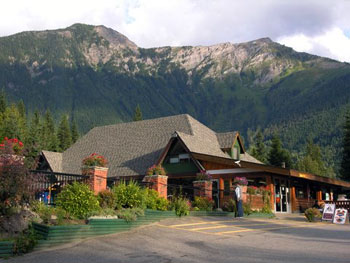
Saddled beside the Arrow lakes, under the shadow of the Monashee Mountains, the new lodge, dated 1998, rises upon the memory of the original; which began life in 1894 under the hand of Captain Sanderson, a river steam boat captain whose remains are buried on site. The rich history of the old lodge, from halcyon days to fiery demise in 1955, are recounted in a book available on loan at the front desk. Few original buildings survived the fire and flooding caused by the damming of the Columbia; save for the poignant presence of the 1945-built chapel where owner Dr. Frederick Burnham buried wife Anna and sister in law, Elizabeth. Dr. Burnham himself perished 10 years later in the lodge’s flaming end.

pool at hot springsPresent day lodge amenities, from chalets to rooms to fine dining and soothing pools, did not disappoint. A serene wilderness surrounds this warm luxury like a single heavenly star. Heavens, free of city glare, as clear as nature created them.

A dip in the 100 degree warm pool contrasted sharply with the steamy intensity of the hot pool at 107 degrees. A quick 55 degree cold pool plunge had me thinking Vienna Boys Choir. We settled in the warm pool, lazing at length and drinking in the mountain-lake vista. Above us restaurant patrons dined at the Kingfisher restaurant, soft music perfumed the air and the sun slowly set, lavender hued, behind the Monashees. Patio lights lent calming luster to the three upper pools.

Day Two

After a quick morning dip we regained the highway for the short drive to Nakusp, passing the gravel road to St. Leon Hot Springs; a rather daunting wild hot springs side trip for more daring souls.

Nakusp’s community-owned pools nestle within a secluded, wooded river valley 12 paved miles off the highway just north of town. Accommodations include six chalets and campsites strung close by a circular pool complex surrounded by steamed plexiglas walls. Services include a small novelty store and basic restaurant facilities. If less imposing than Halcyon it is no less charming and friendly. The circular pool has an apportioned hot pool cooking at 105 degrees and soothing warm pool at 98 degrees.

Day Three

The journey to Ainsworth wound through narrow valleys which brought us to historic mining town New Denver and its well kept edifices recalling heady days near the turn of the 20th century. We grabbed a quick picnic near the shores of Slocan Lake under the towering Valhalla Mountain Range and close by the local museum housed within the old Bank of Montreal building dating from 1893. Cruising through wooded walls on winding road we passed crumbling ruins of old mining sites on the way to equally historic Kaslo. Here the carefully restored stern wheeler S.S. Moyie sits upon shore as a museum; its last 1957 run but a memory. Immense Kootenay Lake exploded into view; its horizon fading far, far to the south. Like New Denver Kaslo has cherished and cared for its historic buildings and architectural aficionados could easily spend a holiday weekend just exploring the two old towns’ offerings.

Another 20 minutes south landed us in cliff-faced Ainsworth, clocking 2 hours driving time from Nakusp. The Ainsworth Hot Springs Hotel, restaurant and pool dominates the old town; a pale reflection of the busy lake port that began life in 1882 at the start of the Kootenay mining boom. The fine-dining restaurant overlooks the pools and the renowned circular hot pool caves, originally carved out of the rock by early miners. They are a unique attraction complimenting the large warm pool, comfy hot pool and the bone chilling cold dip pool. Busy year round, the pools are within reach of nearby Nelson and reflect popularity with a broad demographic.

The panoramic splendor of mountain and lake dimmed to the warming comfort of night lit pools and a feeling of serenity wafted over us as the evening drew dark. Food and lodging options are limited at Ainsworth but Kaslo, Balfour and even Nelson are close enough to consider their facilities.

Day Four

A long travel day began well as we caught the 8:30 am ferry, the Osprey 2000, pulling out from Balfour on its 35 minute scenic free ride across Kootenay Lake. The large capacity ferry is equipped with a coffee/snack bar and extensive viewing venues.

From Kootenay Bay we cruised to Creston then west for the headwaters of the Columbia River. This time we we not making for a resort. This time we taking a wee side trip off the beaten track. Lussier Hot Springs is a bumpy 18 kilometres off the main highway just shy of the headwaters of the Columbia River at Columbia Lake. At points the road narrowed along the steep sided valley with the river rushing far below but this is a well traveled route despite its heart fluttering exposure. When we reached the parking lot just inside Top of the World Provincial Park it was a teem with cars, trucks and motor homes.

Lussier Hot SpringsA winding dirt track led sharply down to the dancing Lussier River where rustic boulder-framed pools were awash with bathers. German and French accents wafted upwards as people of all ages scrambled about and lounged in the gravel-bottomed pools. The hot pool stood around 105 degrees as we eased in. Personal sized nooks and crannies housed singular soakers. Friendly chatter warbled like a flock of song birds. Lussier is unlike its more developed kin, a little harder to get to, a lot closer to the wilderness and thus its unique attraction. A bit of adventure increased its allure.

A short drive got us to Fairmont Hot Springs and a fine B&B. Fairmont provides a host of accommodations and is the ideal setting for a couple nights to take in area hot springs.

Day Five

calcified knoll at Fairmont Hot SpringsFairmont’s hot springs fame has seeped through time with singular acclaim as the Smoking Waters of First Nations legend. On a hill overlooking the pools at the lodge, natural hot waters seep and stream over a calcified knoll, its sulphurous aroma wafting close to the ground and housing a few warm, bathtub-size pools carved within for those inclined to experience a more natural setting. A series of stone rooms with bathtub pools recall the early years of commercial exploitation.

The lodge pools were the biggest of all we had experienced and are enjoyed by people of all ages. This is Alberta’s playground, in particular Calgary’s.

Day Six

Radium Hot Springs hides behind the cloistered red walls of Sinclair Canyon in Kootenay National Park on highway 93 to Alberta. Known to the white man since the days of the fur trade when Hudson Bay Company governor Sir George Simpson enjoyed the waters; its history is ancient and carries an aura of being B.C. hot springs royalty. Long has it been associated with the world famous magnificence of the Rocky Mountain National Parks of Canada.

Its appeal is year round and nearby Radium Hot Springs is chock full of accommodations hinged upon the soothing allure of its waters. Expansive facilities include a large warm pool and small hot pool but also a full sized pool; making this as much a family destination as that of Fairmont. Here you are within the bowels of the mountains. If fortune favours, you may witness deft-footed mountain sheep on the overlooking rock face cavorting indifferent to the human presence below.

Day Seven

This was a long drive day to Golden then on through the rugged Selkirks, but hardly boring. Topping the Rogers Pass under the towering gaze of Mt Tupper and the wrinkled rock face beneath Illicilliwaet Glacier we fell away into insignificance amid the immensity of an alpine world.

Canyon Hot Springs was our last stop and perhaps the least formative of them all. Yet this unassuming resort with a few chalets, campgrounds and its simple hot and warm pools had a comfortable family appeal. Just off the Trans Canada, under the shadow of imposing peaks, it is a soothing break from the busy traffic rush.

As the mountains faded into our rear view mirror the next day we cruised on as relaxed as meditative monks; our senses peacefully assailed amid the powerful beauty of nature.

If You Go:

Hot Rocks – Traveling the shoulder seasons (May/June and September/October) when fewer tourists are sharing the winding roads and scenic settings allows you time and circumstance to leisurely drink in the experience. You can check ferry schedules and road construction using the BC Ministry of Transportation site. Water socks are handy for walking about the rocks at Lussier Hot Springs.

♦ Hot Springs in BC – provides information on all of the Kootenay hot springs in one handy site.
♦ www.th.gov.bc.ca/highwaytravellers.htm – provides updated information on ferry schedules, road construction and conditions.
♦ www.kootenays-bc.com – provides information on accommodations and activities in the Kootenays
♦ www.bcgasprices.com – provides an updated breakdown of best gas prices in B.C.


About the author:
Since 1994 Glen Cowley has parlayed his interest in sports, travel and history into both books and articles. The author of two books on hockey and over fifty published articles (including sports, biographies and travel) he continues to explore perspectives in time and place wherever his travels take him. From the varied landscapes of British Columbia to Eastern Canada and the USA, the British Isles, Germany, Switzerland, the Netherlands, Greece and France he has found ample fodder for features.
See Glen Cowley’s website at: http://www.windandice.shawwebspace.ca

All photos are by Glen Cowley.

Tagged With: canada travel Filed Under: North America Travel

Ghosts of Southern Saskatchewan

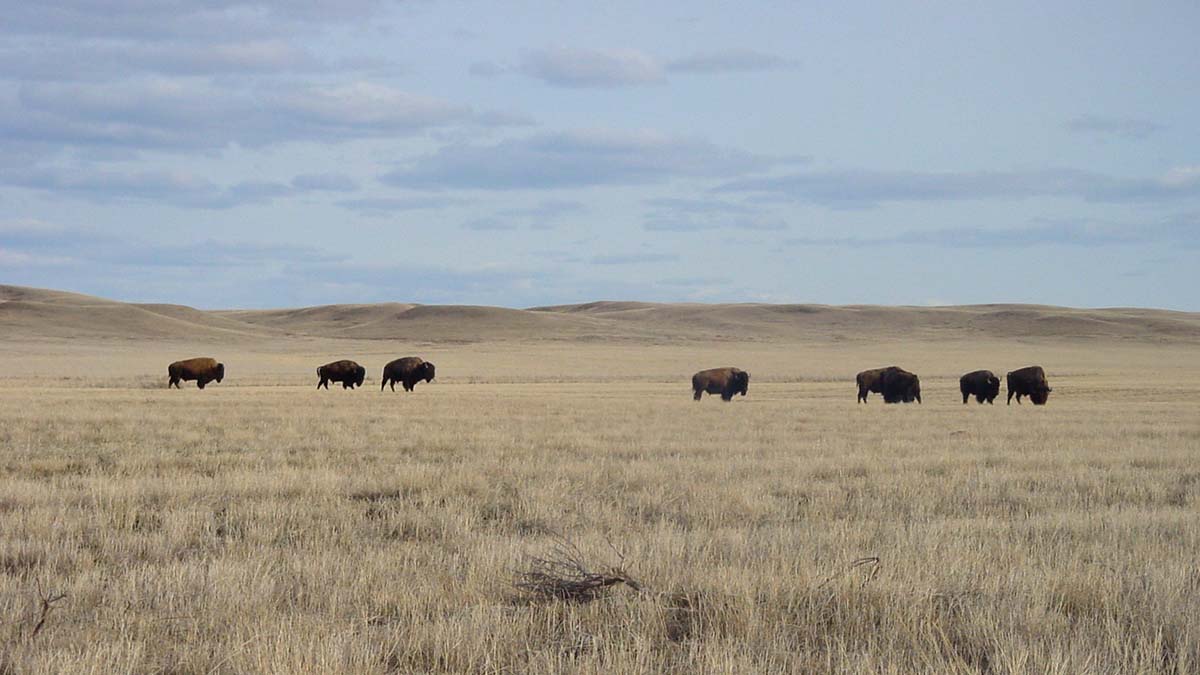
Bison in Grasslands National Park, Saskatchewan
From Blackfoot Hills to Outlaw Caves

by Bev Lundahl

“Let’s take the route through Old Wives” I said to my friend as we prepared to leave Regina for a trip through southern Saskatchewan. Saskatchewan is crisscrossed with a myriad of highways so the choice of routes seemed endless. Old Wives appealed to me because of the legend I had heard surrounding its name. Many years ago there was an encampment of Cree at this site. Further away in the hills the Blackfoot were waiting to attack. The old Cree women, so the story goes, said they would keep the fires burning while the others sneaked away during the night. At sunrise the Blackfoot swooped down to find to their surprise a bunch of old women. The name, “Old Wives” was born. Drawn by this romantic story we headed west on the Trans-Canada highway to Moose Jaw then southwest on Highway 363 which would take us through this village of Old Wives just north of the lake by the same name. But Old Wives, like many small towns in Saskatchewan was elusive and it seemed to have disappeared like the wisps of the smoke from the campfires of the people that pre-dated the inhabitants of that village. This is Saskatchewan – one is often surprised by what is there as well as what is not there.

A large world class art gallery, therefore, is not what one would expect in rural Saskatchewan. As we approached Assiniboia at the junction of Highway 13 and 2, I recalled having heard about this gallery, an endowment by a local man made good. We watched for a sign on the highway but saw none. Driving through Assiniboia though we found it. After viewing the art we sat down to a drink in an elegant lounge.

Convent Country Inn, Val Marie, SaskatchewanLater that evening at the Convent Country Inn at Val Marie, further southwest at the junction of highway 18 and 4 one of the owners responded to our tale of looking for the art gallery. She said with a smile, “This is Saskatchewan, You are supposed to know where things are.” Expecting a signpost is not part of the mystique.

Val Marie, in ranch country is at the site of the Grasslands National Park. Catholic sisters living in this former convent in a barren land a century ago is hard to fathom. The bunk beds in the small sparse rooms at this bed and breakfast give an idea of the severity of their lives there. The loneliness of the wind, which blew harshly all night, was all consuming. The wind piano sitting on the prairie grass out in the yard played its own eerie tune.

Our hike with a parks guide the next morning took us up as high as Seventy Mile Butte. We learned about the plants and animals and the history of the area. I wondered how the tipi-dwellers had dealt with the now extinct prairie grizzly bears. Seventy- Mile Butte is a high spot between Fort Walsh to the west and Wood Mountain to the east and marks the halfway point between these two posts of the Northwest Mounted Police.

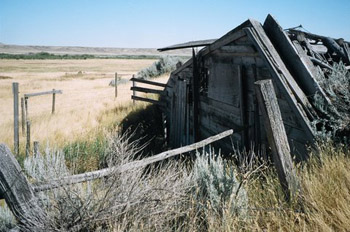
crumbling Saskatchewan farm buildingDriving that afternoon through the other block of the park we marveled at the vibrant grasses that were being rejuvenated by the introduction of indigenous bison into the area. The contrast with the grasses in the ranch land outside of the park was evident. We wandered in awe through the prairie dog town. One could almost feel how the early explorers must have felt. No one in sight as far as we could see except the busy prairie dogs darting in and out of their mounds separated by the dry cracked earth yelling signals and messages back and forth to each other. In this block we also saw, protruding out of a hill, the ruins of the homestead of Will James the artist, author and cowboy who had once lived there.

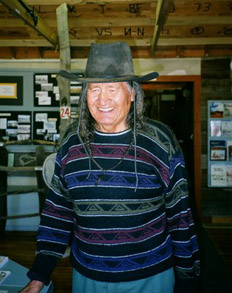
First Nation guide at Wood Mountain interpretive centreWe headed again across the hills and gullies – this time east along Highway 18 to Wood Mountain where we were to meet Sitting Bull. The Interpretive Center there told us about this famous Chief and how he sadly ended up in a rodeo south of the border. A long-braided man from the nearby First Nation added color to the park. He told us that he was the last descendant of Sitting Bull. The skepticism of some of the locals hinted at the difference in the two cultures sharing the land. Learning that Sitting Bull had had four wives seemed to make it quite plausible that he still had descendants in the area.

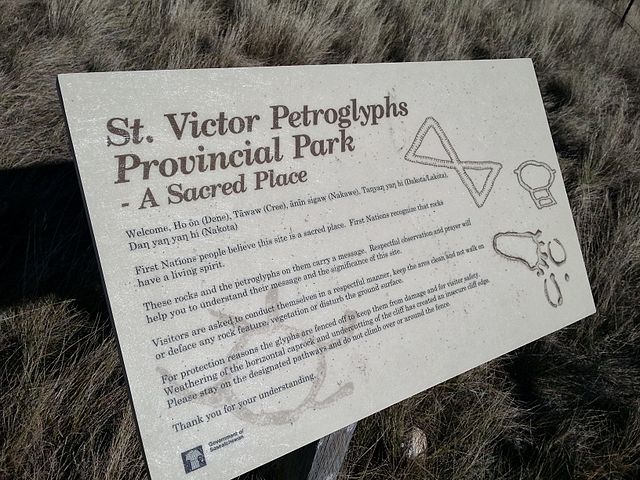
Further east we viewed the petroglyphs at St. Victor before heading out for Willow Bunch. Upon asking directions someone pointed out of town along a gravel road assuring us that was the way to Willow Bunch.. As we drove out my companion said, “I wish there was a sign that said Willow Bunch.” By this time though we were learning the ropes of traveling through Saskatchewan. One never knows what’s coming next and that means adventure.

St. Victor Petroglyphs signageThrough spectacular rolling country we did arrive at Willow Bunch. Willow Bunch was famous for Edouard Beaupre (1881-1904), the Willow Bunch giant – another person in southern Saskatchewan, who, like Sitting Bull had become a spectacle for the curious. He had ended up in a circus. The well-done Willow Bunch museum illustrated much of the local history. “The History of the Metis of Willow Bunch” an award-winning book by Rivard and Littlejohn gives a very good account of the history of this community.

The final leg of our trip was to Coronach where we had booked a room at a bed and breakfast out in the country. To our surprise when we arrived at the bed and breakfast there was a note on the door saying to make ourselves at home. Mom and Dad would be home later. This seemed very unusual but we did just that. Found our rooms upstairs in the farmhouse; deposited our luggage there, then decided to sit outside in the long-shadowed prairie evening. The spectacular sunset drew us out the lane and down the road. We watched the sun descend at the end of the straight gravel road thinking all the time how fast the earth was spinning beneath our feet. It was not the sun that was moving.

The sudden chill sent us indoors where we spent time reading the Western Producer, watching TV, doing yoga while we waited for the owners to come home. The moon rose, shone in the window, the dogs barked, it got darker and darker and we began to feel uncomfortable. We were in a strange house, late at night, seemingly now in the middle of nowhere. Suddenly we decided we had to leave and we drove into town where we doubled over with uproarious laughter as we collapsed into the motel room. Another adventure while traveling in Saskatchewan.

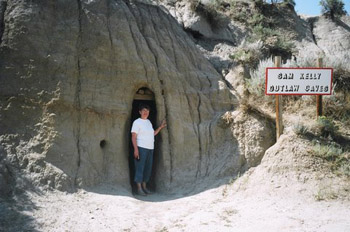
Sam Kelley Outlaw CavesOur last day was an all-day tour in an air-conditioned van of the district known as the Big Muddy. Everything to see from spectacular natural wonders like Castle Butte to the Sam Kelley Outlaw Caves, just over the hill from Montana. Lunch spent in the art gallery of a ranch where the artist rancher regaled us with the stories of the outlaws of the Canadian West. There was the buffalo effigy, the only one in Canada and the prayer pole tied with colored cloths at the top of a hill where First Nations came for sacred ceremonies. The lady from Scotland on the tour referred to the tipi rings and stone effigies as Saskatchewan’s Stonehenge and she did a double take when we stopped at a one-room school named Paisley, the same name as her school in Scotland. The museum at Big Beaver, near the American border told yet another version of the Sitting Bull story.

Our trip had come to an end. We had brushed with the ghosts of the past that are still hovering around today – ghosts of the original nomadic inhabitants and those of the small towns belonging to another era that used to dot the grid of Saskatchewan highways. We learned that traveling in Saskatchewan is unique and exciting.

If You Go:

Tourism Saskatchewan

Museums Association of Saskatchewan

Town of Willow Bunch

Welcome to Assiniboia

Virtual Saskatchewan: Grasslands National Park

Virtual Saskatchewan: The Infamous Sam Kelley

Sitting Bull, Hunkpapa Lakota Sioux holy man


About the author:
Bev Lundahl is a genealogist by nature thus most of her writing is historical, based on her research. She has been published in The Beaver magazine, Folklore Saskatchewan, The Heritage Gazette of Trent Valley (Ontario), Lifestyles (Estevan, SK) and some of her research has been used on CBC Radio as well as in various Canadian newspapers. Bev lives in Regina Saskatchewan.

Photo credits:
Bison in Grasslands National Park by 1brettsnyder / Public domain
St. Victor Petroglyphs signage by: Jeremy Simes / CC BY-SA
All other photos are by Bev Lundahl and Susan Zuckerman.

Tagged With: canada travel, Saskatchewan travel Filed Under: North America Travel

  • « Previous Page
  • 1
  • 2
  • 3

MORE TRAVEL STORIES:

Discovering La Virgen de la Yemanja

Dancing to a Different Drum

Hotel Chain Announces “Collectable Experiences”

Mexico: The Lost City At Cancún

Remember The Maine

England: A Literary Stay in London

Explore the hidden gems of Malaysia – Start your journey here

The Petrie Museum: Everyday Life of Ancient Egypt


SEARCH

DESTINATIONS

  • Africa Travel
  • Antarctica travel
  • Asia Travel
  • Australia travel
  • Caribbean Travel
  • Central America Travel
  • Europe Travel
  • Middle East Travel
  • North America Travel
  • Oceania Travel
  • South America Travel
  • Travel History
  • Travel News
  • UK Travel
  • Uncategorized
  • World Travel
facebook
Best Travel Blogs - OnToplist.com

Copyright © 2025 Cedar Cottage Marketing | About Us | Contact | Privacy Policy | Terms & Conditions | Copyright Notice | Log in