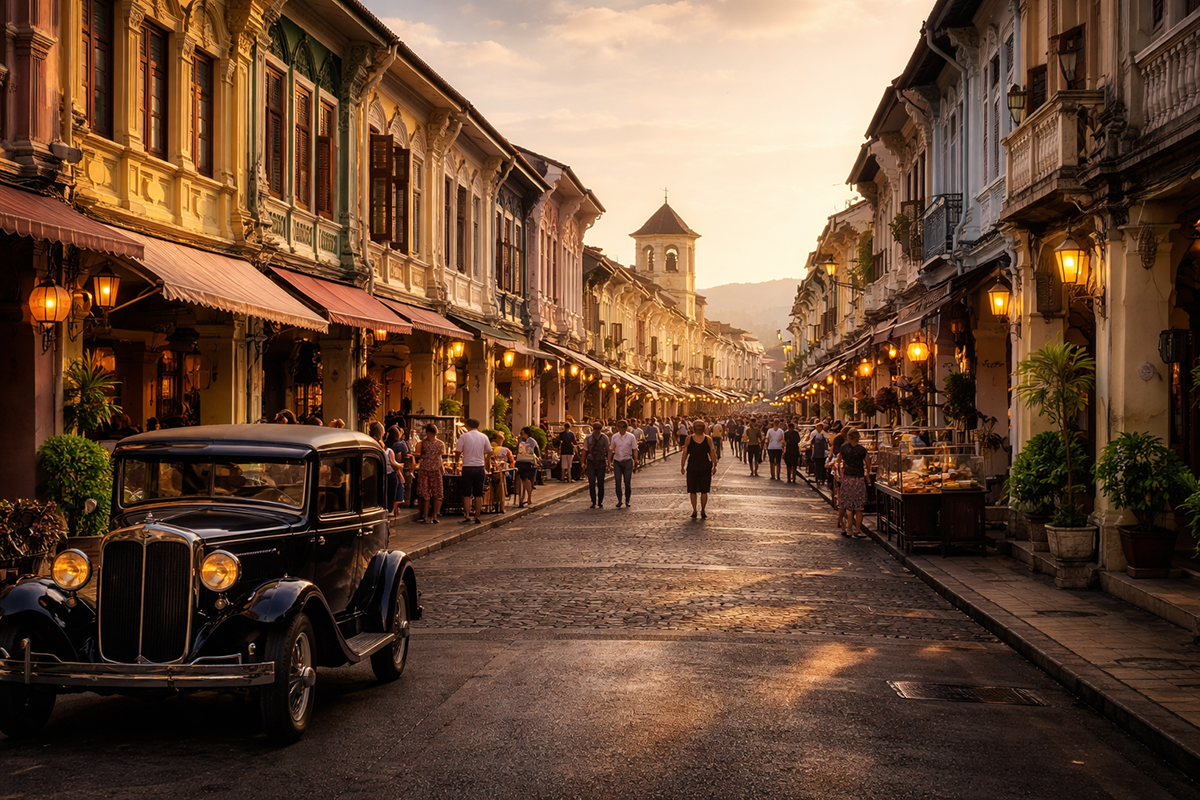
When strolling through the pastel-colored streets of Phuket’s Old Town, it’s easy to get lost in the beauty of it all. The closed windows and ornate archways look like something out of a movie set, but have you ever wondered who actually built these lavish mansions? While there’s beauty to the island of Phuket, there’s also a gritty and glittering past of Black Gold, the tin that made this island the richest province in Thailand.
Let’s give you a brief sneak peek into the history of Phuket’s Old Town.
The Men Who Built an Empire from Mud
Phuket, in the mid-19th century, was no beach destination. In fact, it was a rugged frontier. The arrival of massive tin deposits saw thousands of Hokkien Chinese migrate to Phuket, braving the treacherous frontier to get rich. Among them were the Tin Barons, men such as Phraya Ratsadanupradit Mahitsaraphakdi, also known as Khaw Sim Bee Na Ranong. They weren’t just businessmen; they were visionaries who transformed a muddy mining outpost into a cosmopolitan hub.
They didn’t just dig for ore; they built legacies. One can still witness the legacy of the past in the Ang Mor Lao, or the Grand Mansions, like the Baan Chinpracha, built in 1903. As you walk through the Italian tile floors and the open-air courtyards, you can’t help but think that it was never about the money; it was about creating a home that would combine their Chinese heritage with European flair.
A Fusion of Two Worlds: The Sino-Portuguese Legacy
Why does Phuket differ from the rest of Thailand? It’s all because of the trade routes. As the tin industry grew, the island became a melting pot of Chinese craftsmanship and Portuguese flair. It was not a forced colonial style but a practical and beautiful combination.
The famous shophouses were built with a five-foot way (arcade) that protects pedestrians from the tropical sun and rain. If you’ve spent any time Thailand island hopping, you know how quickly the weather can turn! However, while most people use Phuket merely as a stepping-stone for island-hopping, visitors who linger in Old Town soon realize that these structures were the hub of a community that helped fund the infrastructure that the island uses today.
Spirits and Shrines: The Hidden Guardians
It was not just the barons who shaped the town; it was the spirits they brought along. To conquer the perils of deep shaft mining, the Chinese settlers relied on their faith. This gave birth to the colorful shrines hidden in the narrow alleys of the town, such as the Shrine of the Serene Light.
This shrine, built in 1891 by a family in the area, was concealed behind a plain-looking store for over a century. It was a spiritual sanctuary for the tin miners, where they could pray for protection from the spirits of the earth they were digging out. Even today, the aroma of incense and the bright murals of Taoist gods remind us that the pulse of Old Town is still very much connected to its roots.
The End of the Boom and the Birth of a Museum
By the 1980s, however, the tin reserves had run out, and a shift towards other materials occurred. The dredgers were no longer used, and the mines were left to deteriorate, eventually being filled with rainwater and becoming lagoons such as those found in Laguna Phuket.
However, the history doesn’t end. If you go a little off the beaten track to the Kathu Tin Mining Museum, you can get a sense of the scale of the operation. It’s a sobering reminder of the cost of the beauty surrounding the tin-mining heritage of the lovely shophouses along Thalang Road. The spirits of the tin days may be gone, but they’re not forgotten. They’re just relocated from the tin mines to the museums and the lovingly restored cafes in the old town.
Why This History Still Matters
Phuket’s Old Town is not just a backdrop for tourists to take photos in front of. It is a testament to an era when tin was king, and Phuket was the crossroads of the world. The Barons may be gone, and the mines may be silent, but the Sino-Portuguese spirit remains.
Next time you’re passing through, take a moment to look past the souvenir shops. Can you hear the echo of the tin dredgers in the distance? Or perhaps smell the scent of history in a 100-year-old pharmacy? Phuket’s past is right there, waiting for those who care to look.
Have you been to Phuket’s Old Town? How was your experience? Share your thoughts in the comments below. You can also share the attractions and activities that you think are a must for anyone visiting Phuket’s Old Town.


Leave a Reply
You must be logged in to post a comment.