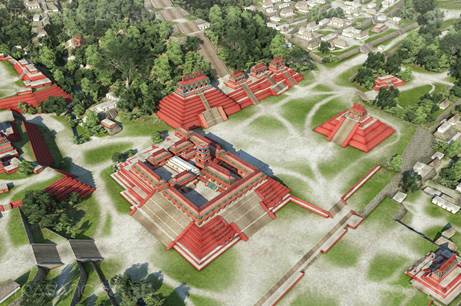
 by Georges Fery
Young Tzak B’u’ was playing with her friends when lords and ladies from a great city arrived in 599 at Ux te Kuh’, the town of her birth and that of her forefathers. She could not think that one of the slender young boys in the visiting party, Janaab’ Pakal, would be her companion for most of her life; how could she? The royal party fled their kingdom’s capital, Lakamhá (now Palenque), which was burned by proxies of the K’an (serpent) kingdom. The refugees were led by Ixik Yohl Ik’nal Ahaw, who is the first woman to lead Palenque’s destiny in her own right, with the full title of K’uhul Ba’akal Ahaw or “Holy Lord of the Ba’akal Kingdom.” Ux Te Kuh’ was an important ally that backed Palenque’s western flank. It is tentatively identified near El Retiro in today’s state of Tabasco, Mexico. Because of ongoing regional conflicts driven by Calakmul’s K’an kingdom and its allied factions, the city’s nobility moved to Ux Te Kuh in 611 CE. It was there, during his adolescence, that Pakal met Ix Tzak-b’u, who would later become his wife. Palenque is the name the Spaniards gave to the ancient city, which meant “stockade.” Lakamha’ in Ch’ol-Maya means “big waters,” for the 56 springs and 9 small rivers that come out from the upper slopes of the Yemal K’uk’ Lakam Witz, the “great mountain of the descending quetzal” that overlooks the city. Its tropical forest was home to jaguars, howler monkeys, deer, colorful parrots, and other birds. Numerous falls and eddies, falling through ravines and over significant natural stair steps, underline the city’s importance as a sacred place. Water is revered in most world mythologies, for it is essential to life and the birthplace of all life-forms. From the sixth to the mid-tenth century, Palenque was an important metropolis and a major regional player in politics, architecture, and trade. Ixik (lady) Yohl Ik’nal received her regal powers as K’uhul Ba’akal Ahaw, or Holy Lord of the Ba’akal Kingdom, on 21 December 583. She was the first of a few women rulers in Maya history to have held the full royal title. Palenque’s history is tumultuous, marked by frequent wars and great and not-so-great ahaws, or lords.
From the fifth century onward, conflicts escalated, driven in part by a growing population and the need to expand the cultivation of maize and other food crops. The heads of kingdoms were in constant search of more land, water, and allies to face encroaching, more powerful competitors. Trade in salt, cocoa beans, cotton, and jade, among other products, traveled through natural choke points in the landscape, such as rivers and mountain passes guarded by local lords, demanding alliances to avoid disputes over payment for the right of way that would otherwise escalate into warfare. The aggressiveness of the K’an, or serpent, kingdom of Calakmul in controlling such choke points and its attendant political dominance was persistent and is well-documented historically. Pakal did not forget the burnings in 599 and again in 611, by Calakmul’s regional proxies, when the city’s nobility had to flee to Ux Te K’uh.
During her reign (583-604), Palenque’s then lord Ixik Yohl Ik’nal A’hau was plagued with hostility from within and without. Regional antagonism was fueled by two enemies for different but complementary reasons. In Tabasco’s northern plains, Tortuguero leaders also claimed the city’s K’uhul B’aakal Ahaw, for its prestigious name, “Sacred Lord of the B’aakal Kingdom,” traditionally associated with Palenque’s historic right grounded in its founding place. B’aak translates as bone in the Ch’ol language, where chu’lel, together with blood, the “soul stuff of the universe,” as Schele and Parker (1993:14) point out, are the perpetual anchor of life; blood in life and bones in death. Claims and counterclaims to the city’s name fed a deep-seated enmity between the two kingdoms for generations. The second woman to lead the kingdom, Ikix Zac’K’uk, was Pakal’s mother, who ascended to K’uhul B’aakal Ahaw and led Palenque (612-615). A year earlier, in 611, four years before Pakal acceded to the crown, his family and the lords of the realm fled once more to Ux Te Kuh. Little did young Tzak-b’u, now a young woman, realize that her parents rescued her future in-laws and husband-to-be. It is during this second exile that Tzak B’u’ and Janaab’ Pakal, then in their early teens, fell in love.
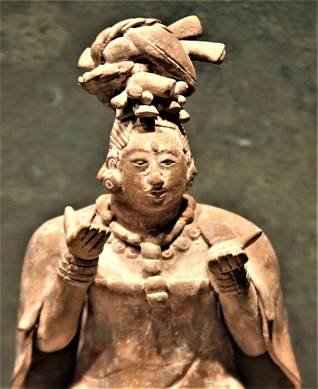 Pakal was twelve years old when he inherited the kingdom on July 26, 615. Political pressure to delegitimize her son was a key driver in the antagonism Ix Zac’K’uk had to contend with domestic and regional factions. The relentless antagonism she faced was due in part to the discontinuation of the Maya traditional male line of descent, which regarded her as illegitimate. History, however, is foggy, for it seems that Yohl Ik’nal’s father, K’an B’ahlam.I had no choice but to shift to the female line of descent due to the lack of a male heir. At that time, there were indeed lords of the realm who could legitimately pretend to the title for their sons but were denied their claim.
As Linda Schele remarks, a faction of the nobles of the realm “…followed the traditional practice of other Maya dynasties, which also claimed descent from a founding king…they were declaring the dynastic succession to be a force transcending patrilineality.” However, “…each time women inherited the kingship and passed it on to their children, the throne automatically descended through another patriline. K’an Bahlam.I jumped the link between lineage and dynasty in the succession.” (1990:220-223). Tortuguero may have supported repeated attacks on Palenque by the K’an kingdom, which backed regional proxies, a move justified by the Lakamha’s ruler, who was perceived as illegitimate. This volatile political situation and the uncertainty of wavering allies forced Ix Zac’K’uk to abdicate in favor of her twelve-year-old son, Janaab’ Pakal. She remained regent until 628, when Pakal turned 25; she died in 647. Pakal’s father, K’an Ix ‘Mo, was not elevated to lordship status because he was from Ux Te K’u’s nobility. Their daughter Ix Tzak B’u’ married Pakal in Palenque on March 19, 626. At that time, the title Ahaw (holy) was added to her name as Ixik (lady) Tzak-b’u’Ahaw. The couple had three sons: Kan Bahlam (635), Kan H’oy Chitam (644), and Tiwohl Chan Mat (648), ensuring a male line of descent.
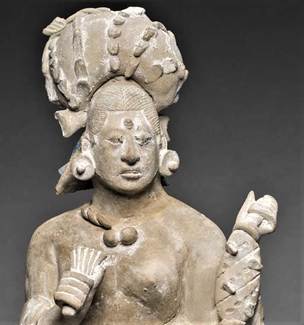
The underreported influence of women in the archaeological record has only recently been addressed. During the Classic period (250-950), spouses of lords and officials appear on stelas, lintels, and ceramics, highlighting their important roles in state affairs and religious rituals. On the stelae of several sites of the period, women of the nobility are depicted in ceremonial dress in distinct ritual contexts. Pakal’s consort was no exception, for he sought Ix Tzak B’u’s counsel on important aspects of women’s lives that were essential to the kingdom’s social order. From early to middle age, women’s tasks centered on daily family chores such as raising children, caring for elderly or sick family members, the all-important weaving of common and sacred garments, preparing food, and tending small gardens attached to the house, and domestic animals, among other tasks. They were also active in weaver groups and in secular and spiritual ceremonies. After menopause, women are more frequently represented in the archaeological record as participating in rituals and collective events. At that stage in their lives, women were influential contributors to the social and spiritual orders and to the well-being of their communities. Their significant contributions included their roles as midwives and physicians, their accountability for the cranial deformation of the nobility’s babies, the filing of adult teeth, and the curing of diseases, among other essential social functions. As well as mediators in the middle world between female deities of the “otherworld” (the world “above”) and those of the “underworld” (the world “below”), as priestesses and shamans.
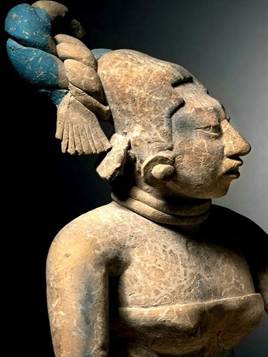
Gods and deities were associated with their respective earthly gender as complementary opposites, perceived as two holy worlds. Within this dual spiritual context, men and women answered to their respective gender deities. That is why, to this day, male and female shamans must at times join forces during trances when they come into the presence of hostile deities or ancestors of either gender in the “underworld.” Life’s problems mainly arise from the living world, but also from a departed ancestor of a close or extended family who may still hold grudges at the time of his/her passing. In their trances, priest-shamans called on ancestors for help to resolve conflicts that had not been resolved at the time of the participant’s demise; antagonism still lingered beyond the grave. Of note is that the Yucatec-Maya word for shaman, ajmen, means “he/she who understands.”
Women were effective in public administration, but historical data indicate that they held, among other titles, the title of na ha k’ul un, or “ladies of the sacred books,” in which were recorded important community events as well as the administration of payment of tribute by allied polities or local levies. Furthermore, the spouses of merchants were respected for their ability to work alongside their husbands as traders under the auspices of Ek Chua, the Maya god of merchants. They led spiritual dances, such as during planting and harvesting events, as recorded in today’s Coras and Huichol communities. During solstice ceremonies, a couple danced together clockwise for planting and counterclockwise for harvesting, while calling to their respective ancestors and to the community’s gods for blessings, to provide the heat of the sun, rain, and plant growth; for gods cannot cultivate nor harvest, only humans can. Women in mid-level segments of society, such as the wives of sahals, rulers of subsidiary cities, and nakom military commanders or war chiefs, also held social functions and responsibilities towards the communities under their care, as did the ladies of the realm. The extended family and the community helped war widows raise children, who were provided with food, occupations, and social support.
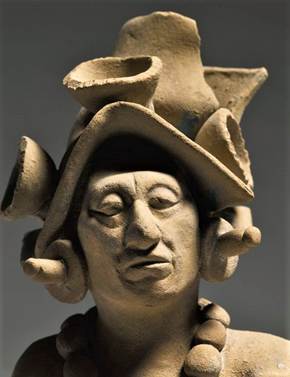
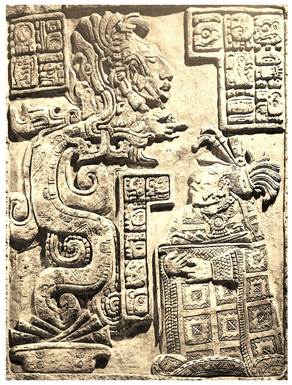
Ladies of high segments of the realm, like their spouses, sought help from their ancestors in the “otherworld” to resolve personal conflicts or community issues. Appeals to the other side of life by ladies of the realm, the high priestess, and shamans during ceremonies during which self-inflicted wounds took place. The shedding of blood, carrier of chu’lel, the “soul stuff of the universe” that never dies, was essential for calling on ancestors for help in resolving situations or conflicts. Bloodletting ceremonies by both men and women are found on stelae in the archaeological record. Among many lintels in Yaxilán, Chiapas, on Lintel 15, noblewoman Ix Wak Tuun, lady of Ik’ (today Motul de San José), the wife of lord Yaxuum Bahlam.IV, conjured the Yax Chiit Naah Kaan, where the K’awiil’s wahy or spirit is seen emerging from the mouth of a snake. Her spilled blood fell onto thin paper strips placed in a ceramic bowl, which were then burned. The heat and smoke rose and assumed the shape of a snake, from whose mouth a deity or ancestor emerged to receive the penitent supplications. Sacrifices were to overcome one’s own, family, or community challenges or for petition, restitution, or compensation at dedicated times. Of note is that the snake, shedding its skin as it grew and removing worn-out skin, epitomized the undeniable proof of life’s eternal return.
 The call to ancestors and deities by individuals and priest-shamans is still practiced today, as in the past, in traditional communities, albeit not to the same extremes, for the religion imposed on indigenous societies by the Spaniards foremost aimed to eradicate ancient beliefs. However, they could not uproot those beliefs that spanned tens of thousands of generations. The “dialogue” of the living with ancestors in the otherworld in Maya and other traditional communities is as essential spiritually today as it was in the past. For instance, K’iche’ or Tzutuhil Maya women weave a bodice for personal use, which is worn with no other garment between the bodice and the skin. This bodice is lovingly handwoven and features remarkably complex, brilliant patterns of lightning, floral lines, and other figurative and abstract designs in intense colors. The bodice is worn for special occasions, hidden beneath outerwear that only gods and ancestors can see. The Red Queen was the patron of weavers in her community, for she was related to Sak Ixik, the White Lady, associated with the young, rising moon, Ixik, who is often portrayed with T’ul, the rabbit, in her arms.
Another important task exclusive to women was the preparation of koyem, a traditional food for the deceased. Koyem was a cooked maize gruel placed in the mouth of the departed before burial, whose function was to feed the departed chu’lel, the immortal “soul stuff of the universe,” on its long voyage through the nine levels of Xibalba, the “underworld.” For high nobles, a fine jade pebble was also added or substituted to pay Xibalba’s black jaguar to allow the departed to buy and keep his/her heart while crossing the rivers of the underworld.
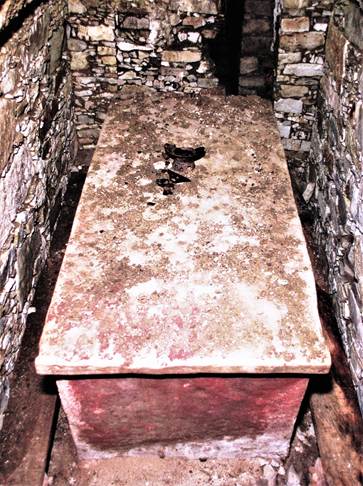
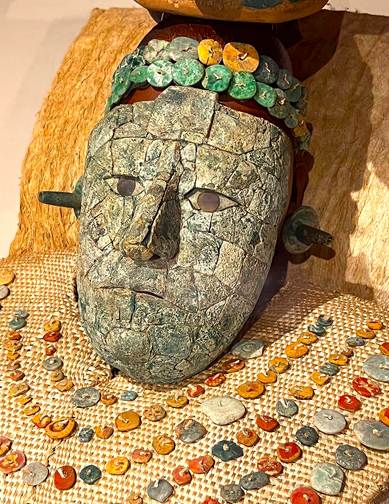
Once placed in her sarcophagus in the Temple.XIII and before putting the most essential part of her garment, the death mask made of 110 tiles of malachite, koyem was introduced into the queen’s mouth to sustain her chu’lel on its ultimate voyage. Of note is that the Classic Maya called their kings chu’l’ahaw or “lords of the life force” for the power vested in them by the gods. In traditional communities, chu’lel is believed to enter a baby at birth from Ol, meaning “the heart of” or a portal to the “otherworld,” and then settle in the heart and blood. Ol is also referred to as the “white flower” soul and, like chu’lel is immortal and will return in a newborn. According to traditional spiritual leaders, upon death, once blood turns to dust, chu’lel remains in bones for a period equal to the departed’s lifetime. After this period, it will join the ancestors and be granted to a descendant, a time factor that varies across cultures. The concept of eternal return, however, is present in most cultures of the Americas and others beyond. Ancient Mayas believed that individual souls took the och b’eh, meaning they “entered the road,” a reference to the path the soul follows to the deepest recesses of the sacred mountain (witz). The “white road,” or sac-beh, built of white limestone, refers to the Maya Wakah Kan, the mythic World Tree. In the natural world, the Ceiba tree is often linked to the Milky Way, as it is believed to be a vantage point from which deities and ancestors observe their descendants and flocks.
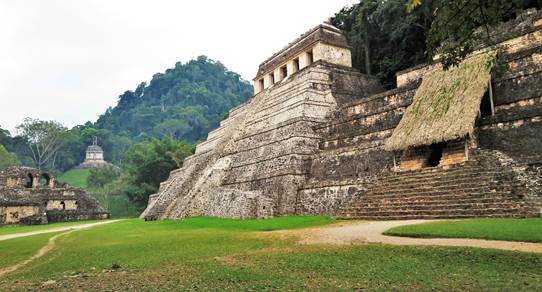
On that road, Ix Tzak B’u’Ahaw did not travel alone, for two individuals were sacrificed: a three-year-old boy who showed cut marks at the bottom of his skull and a young woman in her late twenties or early thirties, who showed knife cuts on her ribs and vertebrae. She also showed cranial deformation and filed teeth, indicating her noble status. They were found lying on each side of the Red Queen sarcophagus, the boy lying on his back and the woman on her face with her hands behind her back; we do not know if they were related. They were sacrificed for their chu’lel to serve that of Ix Tzak-b’u’Ahaw in the afterlife. Temple.XIII was called “Temple of the Red Queen” by Mexican archaeologists Fanny Lopez Jimenez and Arnoldo Gonzalez Cruz, who respectively discovered and opened the tomb in 1994. The temple’s name stems from the large amount of cinnabar, a red pigment of mercury sulfide, found in her sarcophagus, which was believed to preserve the remains and to ward off malevolent forces. Temple.XIII adjoins the massive Temple of the Inscriptions, the resting place of the queen’s husband K’inich Janaab’ Pakal Ahaw, who died on 28 August 683. Ix Tzak-b’u’ Ahaw preceded him by eleven years, on November 13, 672.
Second burials were not exclusive to high segments of society. In the lower segments, remains of prominent family members were found in several households. They were placed either in a grave lined with stone slabs or simply buried by poorer families; in either case, there were often ceramics or small carved stones in the tomb. Burial cysts are frequently found below the floors of the family compound: for males, in the courtyard or patio, and for females, within the complex, below the floors of the main room or access corridors. Of note is that they were visited multiple times over the years, with the skull and long bones temporarily removed for ceremonies, while burnt votive materials were also found. The cranium and long bones of members of close or extended family were added over the years and likely used periodically for ceremonies at designated times.
In many cases, remains of koyem made of cooked corn were introduced into the mouth of the departed to sustain his/her chu’lel on its ultimate voyage. These complex ceremonial rituals, recorded from the Early Preclassic period (1000 BC), underline ancestors’ primary function: to assert the identity and perpetuate the social position of the living family within the community. The grave and its venerated ancestor were at the core of the collective memory of a close and extended family. The dead buried in household complexes were believed to be part of the living daily lives, which were recreated at intervals through rituals. Of note, not all past progenitors qualified as ancestors; only lineage members who made a significant impact on resource acquisition or on lineage alliances were worthy of veneration. For destitutes and slaves, no formal burial took place; their bodies were discarded on common grounds.
Temple.XIII served the same functions as those of common graves, albeit on a higher level. Upon opening the crypt, a spindle whorl and a ceramic tripod incense burner were discovered on the sarcophagus lid, likely damaged by falling masonry from the roof. The spindle whorl attests to the queen’s association with Ix Chel, the moon goddess, while the tripod in which copal incense was burned, perhaps still had the smoke spiraling upward when the crypt was sealed. On the massive limestone sarcophagus’ slab was found a round hole drilled at the level of the queen’s upper chest. It was made to help her soul escape upward through a vertical round duct that reaches straight halfway up through the crypt’s roof to below the temple at the top of the pyramid. This “psychoduct” so called by archaeologist Alberto Ruz Lhuillier, who discovered Pakal’s tomb forty years earlier in the Temple of the Inscriptions, helped her chu’lel escape the confines of the sarcophagus and join the ancestors; similar ducts were also found in the Temple.XVIIIA and Temple.XX at Palenque. In poor households today, a “chu’lel door” is a hole that is quickly opened upon death in the thatched roof above the departed lying on its couch, to help the soul join the ancestors.
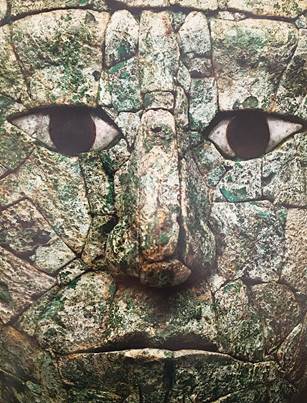
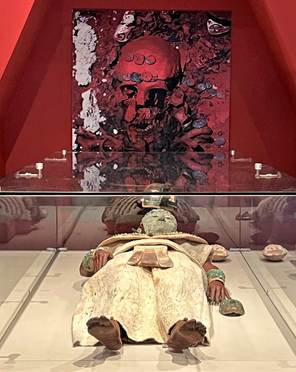
Upon opening the coffin, archaeologist Arnoldo Gonzalez Cruz found the queen’s remains covered with a thick coat of cinnabar or red mercury sulfide powder. On-site discovery and research, reported in his notable 2011 book “The Red Queen,” details his investigation of the crypt and the opening of the sarcophagus, whose remains occupied most of the space. His analysis led him to remark that “the position of the skeleton indicated a secondary burial, not a primary, because the bones did not strictly correspond to their natural anatomical positions; “they were placed correctly but not naturally” (2011:194). The Red Queen was found lying on her back, head slightly tilted forward, indicating she had been resting on a pillow, now gone. She was fully dressed at the time of burial. Her head was slightly turned northward, and her arms were naturally extended at her sides; her height was recorded at five feet five inches. Her long hair was carefully braided and used as support for the headgear representing Cha’ak, the mighty god of rain and revival, made of jade tiles, conch shells, and polished stones. The coffin is a massive monolith carved from limestone; its exterior and interior walls were covered with cinnabar, while a thick coat of the red powder thoroughly coated the remains. The abundant presence of cinnabar suggests meticulous attention to preserving the remains and safeguarding them from potential harm. In powder form, cinnabar was widely used in burials across Mesoamerican cultures, but seldom in such profusion.
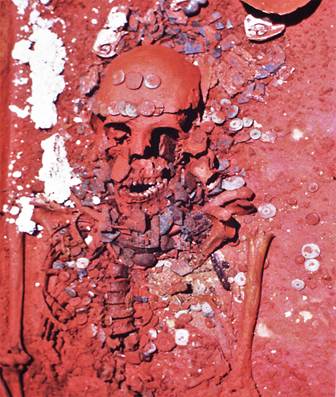
Over and on all sides of the queen’s remains were many shapes and carved green stones from necklaces, bracelets, and other kingly adornments made of malachite, jade, rock crystal, pyrite, amethyst, and other semi-precious minerals, as well as large seashells that stood out for their white mother-of-pearl color. The inventory of the sarcophagus was lengthy and complex because of the coffin’s four-foot depth, the narrow space between the coffin and the crypt walls, and the lid, which could not be entirely removed due to the chamber’s cramped space (2011:195). Furthermore, the opening of the sarcophagus was delayed because of the careful data collection and removal of the queen’s two sacrificed companions’ remains, that of the boy and the young woman lying on each side of the sarcophagus.
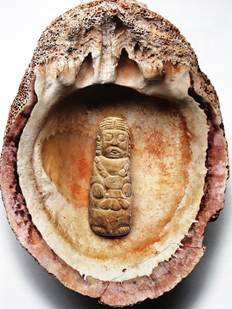
Among numerous royal adornments worn by the queen, two items in particular stand out. Her death mask, made of 110 tiles of malachite, the eyes made of two round dark gray obsidian stones for the pupils and four white triangular-shaped seashell tiles for the iris. Malachite is found in several areas of today’s northern Chiapas and central Tabasco. The malachite from her mask, however, was probably collected from the Santa Fe mine, several miles from the presumed location of Ux Te’Ku, the Red Queen’s birthplace. She was adorned with expensive jewelry: a large jade necklace, a diadem of shell and copper discs in a double row on her head, and large jade earrings and wristlets. The second item is a spondylus half-shell valve, placed on the left side of her head, which contained a miniature, finely carved limestone figurine of a woman. Spondylus princeps are found in the warm waters of the Pacific Ocean and the Caribbean Sea and underline the city’s extensive long-distance trade. Of note, fossils are often found in the limestone surrounding Palenque, confirming the beliefs of the time about the “primordial sea” at the forefront of Maya mythology. But who was the prominently displayed miniature female figurine? The consensus among scholars is that it is that of the Red Queen herself, shown as she wanted to be seen entering the “otherworld” for eternity.
Archaeologist Arnoldo Gonzalez Cruz’s report underlines the uncertainty as to the delay between the Red Queen’s death and the sealing of her sarcophagus. We know that customarily lengthy dedication rituals took place before burial, as evidenced by the epigraphic record and other funerary contexts. The span of time for burial preparation and ceremonies, however, may not have exceeded three to five weeks. Following the removal of organs, but not the heart, her body was bathed and cleansed, then covered with cinnabar for preservation and to ward off malevolent forces. She was then dressed in the trappings of her royal rank. Round the clock, as these processes took place, priests and shamans of the royal household offered constant prayers and invocations. Once preservation ceremonies were completed, she was carried in procession from the Palace to the Temple.XIII, her last resting place, on an open litter across the central plaza, thronged with thousands of people and the deafening sound of hundreds of drums and large conch shells calling for deities and ancestors’ attention. The ceremony was led by her husband, K’inich Janaab’ Pakal, and her three sons, together with her extended family, the High Priest, the High Priestess, the Eldest Shaman of the kingdom, and lords of friendly cities, both near and far. Once her sarcophagus was sealed and the crypt’s entrance blocked with limestone, dedication rituals and pilgrimages were recorded in the city’s ceremonial calendar. From that time forward, Ix Tzak B’u’Ahaw was an ancestor and a deity, guardian of her community’s well-being in the afterlife, to be venerated at designated times.
The Red Queen’s eldest son, K’inich K’an Bahlam.II became Palenque’s ruler on 7 January 684 upon the death of his illustrious father K’inich Janaab’ Pakal Ahaw. The son exceeded the father in the scale of construction programs, expanding the royal palace and building the famous Cross Group complex with the Temple of the Sun, the Temple of the Cross, and the Temple of the Foliated Cross, homes of the triad gods, the powerful guardians of the dynasty and the city. At the entrance of the complex is the Temple.XIV; visitors may climb up its steps to see the remarkable limestone carved panel on the back wall of the sanctuary. Lord K’an Bahlam.II, who died on February 16, 702, is shown ritually dancing over the waters of the primordial sea, while receiving the Manikin Scepter K’awil (God K), the powerful symbol of the Cosmic Monster (Shele, Parker, 1993:46), affirming supreme authority from his mother Ix Tz’ak-b’u Ajaw, who had died twelve years earlier. The panel is known as the “Apotheosis of K’an Bahlam,” depicting a scene that took place in the otherworld. This so-called “resurrection panel” was commissioned by his younger brother and successor K’inich K’an H’oy Chitam, Palenque’s Lord from May 30, 702, as a reminder of his dead brother’s rebirth” (Schele et al., 1993). On the panel is seen their mother, Ix Tz’ak-b’u Ajaw, dressed in the guise of the full Moon Goddess Tik’il Ik’ (K’iche’ – Mam), extending the K’awil manikin scepter to her son, which again reinforces the powerful ascendancy and dominance of deified ancestors over their descendants.
Georges Fery is the author of “The Conquest of Peru.”
References:
Arnoldo Conzalez Cruz, 2011 – La Reina Roja
Alberto Ruz Lhuillier, 2013 – El Templo de las Inscripciones: Palenque
- de la Garza, G. Bernal Romero, M. Cuevas Garcia, 2012 – Palenque-Lakamha’: Una Presencia Inmortal del Pasado Indígena
- Freidel, L. Schele, J. Parker, 1993 – Maya Cosmos
Patricia A. McAnany, 1995 – Living with the Ancestors
Marta Ilia Nájera C., 1987 – El Don de la Sangre en el Equilibrio Cósmico
Vera Tiesler, Andrea Cucina, 2006 – Janaab’ Pakal of Palenque
Diego Reinoso, 1962 – Popol Vuh, Manuscrito Quiché
Schele, P. Mathews, 1998 – The Code of Kings
Alfredo López Austin, 1993 – La Cosmovisión de la Tradición Mesoamericana
Fernando Nuñez, 2012 – Las Sepulturas de Palenque
Photo Credits:
Ph.01 – Central Palenque – AndresArnesto-Alejandro-SorianoCarlosPaz/anxo-mijan-marono.com
Ph.02 – Ixik Yohl Ik’nal Ahau – georgefery.com
Ph.03 – Ixik Tzak-b’u Ahaw – georgefery.com
Ph.04 – She Who Understand – georgefery.com
Ph.05 – He Who Understand – georgefery.com
Ph.06 – Yaxchilán, Lintel.15 – britishmuseum.org
Ph.07 – The Sarcophagus – ArnoldoGonzalezCruz.2011
Ph.08 – Temple of the Inscriptions-L – Temple.XIII-R – georgefery.com
Ph.09 – Ixik Tzak-b’u Ahaw – Arnoldo Gonzalez Cruz.2011
Ph.10 – The Queen’s Remains – Arnoldo Gonzalez Cruz.2011
Ph.11 – La Reina Roja – Arnoldo González Cruz.2011
Ph.12 – The Red Queen – georgefery.com
Ph.13 – Palenque Museum – georgefery.com



Leave a Reply
You must be logged in to post a comment.