Uganda, Africa
by Wayne Gatley
The gears of poverty grind down dreams from generation to generation. Illiteracy is its linchpin.”
– Carl Sagan.
Fine red powder coats the dashboard, floor and seats of the Toyota Ipsum as our team of twelve Vancouverites bounce along the rutted road from the Rwandan border to Kabale. Terraced, fertile fields and banana palms dwarf the one-room, mud houses that cluster at crossroads. They looked charmingly rural.
“Their homes have no electricity, no water, no bathrooms,” My son, Darren, says. “Most people in Kabale are poor and unemployed. They abandon their children if they can’t feed them, or the little guys run away to beg and steal their food. Tyler and Michelle built Humura homes for those boys. You’ll meet them after lunch.”
Darren’s tall frame is tucked under the low ceiling of the van. “Tomorrow,” he says, “training starts and you’ll meet the girls from the Akanyijuka orphanage/school.”
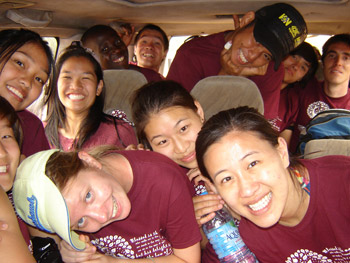 During the two years since Darren’s first trip to Uganda, he has pulled together this disparate team to partner with local youth and run three-day camps for young children. We are a typical Vancouver mix: five Chinese, three Phillipino and three Caucasian. The youngest are fifteen and I am the oldest at 71.
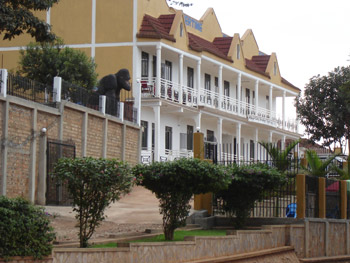 “Here we are,” Darren shouts, as the Ipsum swerves hard right and climbs the short distance to the Albertine Graben Tourist Resort Hotel, where Tyler and Michelle have booked rooms for us. It’s colonial style with white pillared colonnades along both floors. The roof is peaked with ochre dormers.
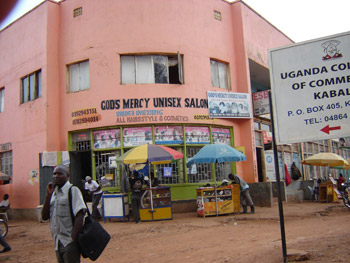
After lunch we drive through Kabale. Pink walls and rainbow patio umbrellas draw my attention to God’s Mercy Unisex Salon and nearby, the Jesus Saves Salon. Christianity is expressed openly and in perplexing ways to my Canadian mind.
 Fields of cabbage, plantain and potatoes blanket the valley. We leave the road at Bubaale, a small village with just a few tin-roofed mud-brick houses and turn onto a narrow, dirt road that winds upward through the terraced hillside. During daylight, people live outdoors. Women in patterned dresses and head wraps walk to the creek or the village spigot for water. Even small children carry a yellow jerry can.
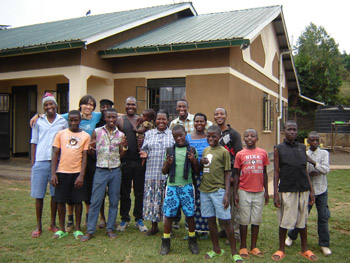
Near the top of the hill, we drive through the open gate to the Humura homes. The vehicle lurches and pounces into the compound. A few boys stand and watch. Older teens shoo goats and chickens out of the way as they approach the minivan. The two handsome residences are concrete-block, painted a red-earth colour with white trim. They overlook the dusty, smoky valley. The site lives up to the meaning of Humura: lifted up and dusted off.
When I step out of the van, a teenager, taller than myself, slim and with a happy smile opens his arms wide and calls out, “Papa Dan!” He reaches his long arms around me and pulls me close. The boys can’t articulate Darren’s name, so they call him Dan. Hence, I am Papa Dan. Arophat spent ten years on the streets of Kabale where he foraged for food from garbage bins and was beaten by police. In his two years at Humura, he has completed Grade Seven and will go to High School next year.
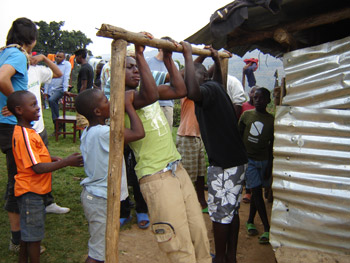 The boys entertain us with African dance, songs and feats of strength: chins, pushups and backflips. They tell me that their tribe, the Bukiga, are strong men and if you hire them, they work hard.
That evening, Michelle takes our Canadian team to dinner at Customer’s Joint off Garage street, the dirt road frequented by homeless boys and drug addicts. “Guys,” Tyler says, “Look after the girls.”
“Yeah,” Jessica says. “When I was in the market in 2012, a man proposed. “Marry me, I can give two cows for you.”
Tyler says, “I told him, ‘I am her guardian. Two cows are not enough.’”
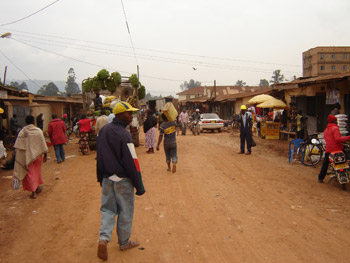 Tyler parks in front of the restaurant beside a hitching post. The server takes us through a room containing four tables and a bar. Behind that, we step down to a sunken floor and crowd around a table with bench seats. A steamy, pasty smell emanates from the courtyard behind the restaurant where a woman stirs a large pot of something sticky and grey-white. The shed behind her is cluttered with cooking implements and sacks of corn meal and potatoes. Another woman washes clothes in a deep metal basin.
The choices are poshoe (mashed corn), Irish (potatoes), Matoke (cooked and mashed, starchy plantain), beans and chicken. For beverages, we choose from Fanta, Stony and Coke. Stony is an African ginger-ale that I find pleasantly spicy and thirst quenching. Michelle orders everything on the menu and we serve ourselves. Not fancy, but filling.
The next day, we meet the Humura boys and Akanyijuka girls at White Horse Inn, high above the city where the air is clear and fresh. It’s a premium accommodation in Kabale, situated next to the local golf course. The Inn and its pyramid-roofed cabins surround a grassy expanse where we’ll do the training.


Our second day of training is at Lake Bunyonyi Eco Resort, on Kyahugye Island. Our driver, Boaz, parks close to a precipice that drops to the lake and the dock where two large, motor driven dugouts wait to take us to the Island, just five minutes away.
Our young leader-trainees laugh and joke as we cross – it’s a race, it’s a carnival ride, it’s great fun.
“There are no fish in this lake,” Boaz says. “Too shallow, but people swim here. It is the only lake in Africa free of Bilharzia. Makes you very itchy.”
On the island, we climb the hill to Lake Bunyonyi Eco resort. The guesthouse, a pavilion partly open on the sides could accommodate a good sized banquet. The massive thatch roof stretches over the entire floor space.
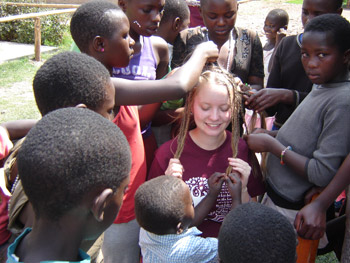 The full-service, island resort accommodates tourists in view bungalows or hotel suites. The open air restaurant and bar provide quality meals and drinks, including local specialties such as Louisiana red swamp crayfish, cooked with organic herbs and spices. They are not imported, but fresh from the lake which was stocked in the Seventies.
After the training, we take the nature trail around the island’s free-range animal park. Just outside the pavilion, we see a De Brazza monkey with its arc shaped brush of top hair, close set brown eyes and white beard. As the only monkey on the island it carries the distinguished title, ‘President of the Island.’ The water bucks, zebras, crested cranes, and Ugandan kob, an antelope emblazoned on the country’s coat of arms, seem tame, but we keep our distance just the same.
The training is so successful that on the third day of camp, when we arrive late, the Bukiga volunteers have started the program. About 250 children sing, make crafts and play games that illustrate the lessons, which I give in English and Bruno, the smallest Humura trainee and part pigmy, translates. At noon, the children devour a hot, filling meal, likely their only food for the day. In the second week, we take the program to a school in the hills and close to 300 children come.
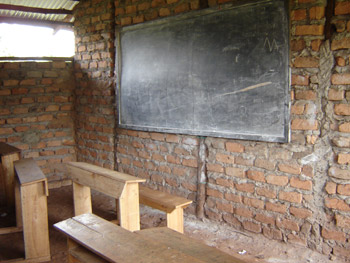 We had invited the village of Bubaale to come to Akanyijuka Primary School for a carnival on the last Saturday. A large, white gazebo is raised and a loud speaker system prepared for speeches. Hundreds line up for poshoe and beans, but just as the last few are served, a torrential storm drives everyone into the buildings or away to their homes, ending the carnival. We crowd into one of the old wood-plank, school classrooms and bid a tearful goodbye to our strong, Buchiga trainees.
The night before leaving, Our Canadian team has dinner at White Horse Inn. In a large room with a towering, pyramidal, thatched roof, we savour a buffet of sautéed vegetables, poshoe, tilapia, roast chicken, rice and French fries.


Literacy is a bridge from misery to hope.”
– Kofi Anan.
If You Go:
Uganda has been a stable country for the twenty-seven years its president, Yowari Museveni has been in power, but it is considered ‘very corrupt’ by Transparency International, losing 286 million dollars every year due to corruption. Its population is 38 million and one Canadian dollar was worth 2285 Ugandan shillings at the time this was written. In Kabale, banks will only exchange U.S. cash that is not older than ten years. The quickest route to Kabale is by Air Amsterdam to Kigale, Rwanda, then by bus or taxi to Kabale.
Documentation:
A Visa to enter Rwanda is required.
Browse Uganda Tours Now Available
About the author:
Wayne Gatley is a retired high school administrator and university instructor. He has taught in Canada, England and Germany. He believes that education is the world’s most powerful tool for change. After this trip, six of the Buchiga volunteers graduated from primary school and went on to further studies.
All photos by Wayne Gatley.
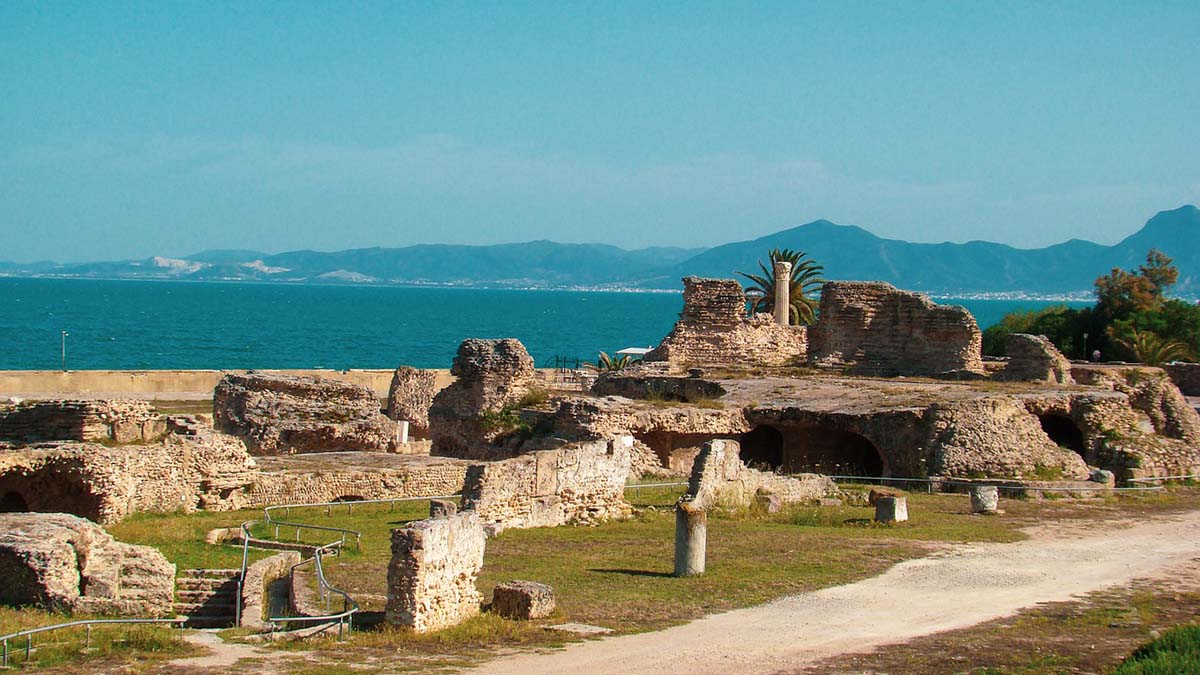
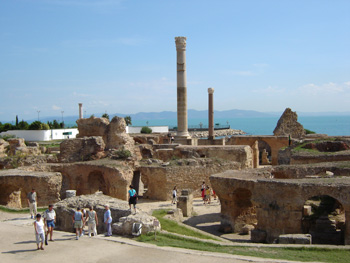 The grip of Roman imperialism was nowhere so dominant in Tunisia as in the city of Carthage – Tunisia’s most famous site of ancient Roman ruins. Although the Romans initially ravaged and destroyed much of the city upon invasion, they subsequently rebuilt it in the style of Rome. Its favourable position and two harbours made it a grand hubbub of expensive, imported goods.
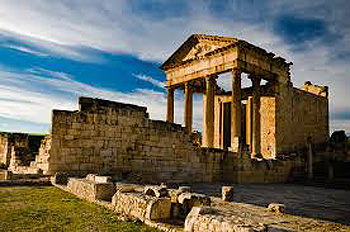 In the North West of Tunisia, the small town of Dougga stands as an impressively intact testimony to the Roman rulers that once dominated here (though the remaining monuments are by no means solely Roman in origin). The town is thought to have been founded during the reign of Julius Caesar, and became a small, prosperous town complete with theatres, baths and roman villas in the style for which they have becomes so famous. For those visiting the country today, this is a must-see area.
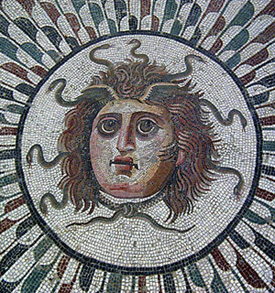 Though not a hotbed of archaeological sites in itself, the coastal town of Sousse hosts an incredible array of Roman mosaics, rescued from the various excavated sites around the country. Displayed in its Archaeological museum, the collection isn’t overwhelmingly large, but is one of the bigger collections of authentic mosaics in Tunisia.

 Emperor Hadrian granted Roman citizenship to the inhabitants of this town, perhaps because of the wealth of grandeur there. The archaeology unearthed is testament to the many wealthy homes and residential areas.
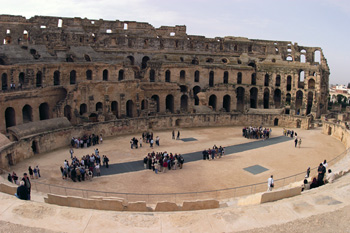 In El Jem sat the centrepiece of the reputable area once known as Thysdrus, the second most important Roman municipality in Africa after Carthage. The magnificent amphitheatre, though now slightly dilapidated, once seated an enormous 43,000 spectators (the 02 arena in London holds under half of that, with 20,000 seats). This makes it the third largest amphitheatre to have existed during Roman rule.
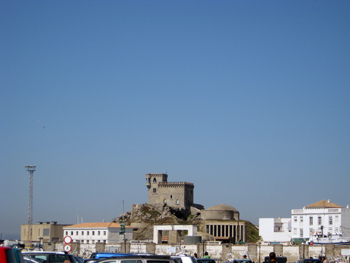
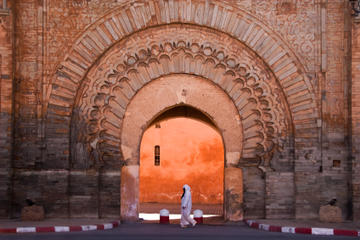
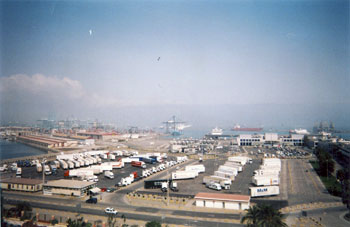 I was delighted to wake up the next morning to a clear view of the Rock of Gibraltar from my window and knowing that I would be spending the day in Morocco. Arriving at the Port of Algeciras just 100 feet across the hotel, I was instructed to wait for my guide as soon as I off-boarded the ferry in Ceuta. Ceuta is one of the two Spanish autonomous communities in North Africa along with Melilla located about 390 further east. Ferries also depart to Melilla on the northern coast of Africa from the ports of Malaga or Almeria that can take over 9 hours across the Alborán Sea.

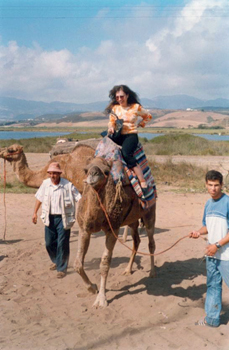 I looked at one of the passengers with a puzzled look that was immediately reciprocated. Moments later the mini bus suddenly pulled off to the side of the road where locals were offering camel rides for one Euro. At first I hesitated, but it took just six words from one of the couples to get me on top of that camel, “You’ll regret it if you don’t!”
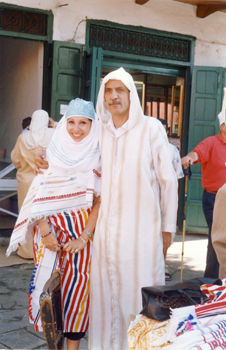 After passing through the chaos of the open air food market, we arrived at the fabric and textile market. On display were hundreds of thick fabrics of the most vivid colors for sale hand woven by local Berber women. Lost in my world I was when suddenly one such woman stopped me and grabbed me by my shoulders.
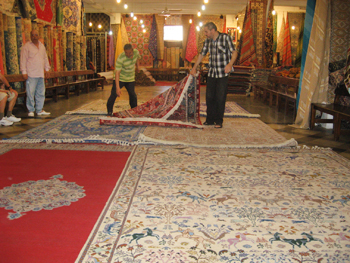 The next stop was the carpet demonstration. Here, we were led into a showroom where traditional mint tea was offered while we waited for the ‘show’ to begin. One by one, they rolled out these works of art, each more exquisite and intricate than the last. By the time the demonstration was over, the prices were greatly reduced. No-one in our group had any intention of purchasing a rug yet the vendor instructed us to individually say ‘yes’ or ‘no’ to every single carpet that they had rolled out. After these very uncomfortable minutes were over, we quickly departed leaving the disgruntled vendors mumbling to themselves while they hastily rolled back the carpets.
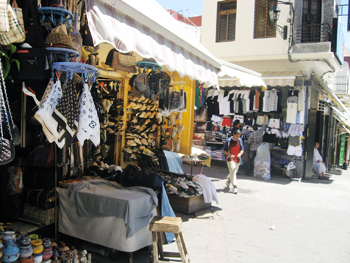 We were now on our way to the spice and pharmacy market; a welcomed relief as the ‘pharmacist’ dressed in a white lab coat was quite the comedian. The small room resembled a medieval apothecary with all sorts of jars and containers of all colors, shapes, and sizes filled with oils, fragrances, creams, herbal remedies, spices, and teas that cured everything from anxiety to hangovers. The pharmacist/comedian demonstrated the wonders of the selected products that we smelled, rubbed on our skin, or whatever we were instructed to do. Each of us bought a few cosmetic and medicinal items as we did not want to offend this vendor as well.
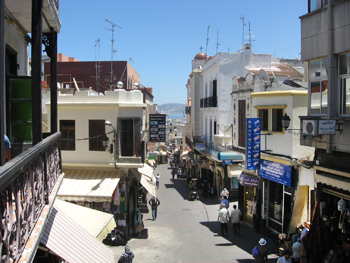 Next on our busy itinerary was a one hour bus ride to Tangier, the “Gateway to Africa” founded in the 5th century BCE. I was especially excited as it was here where my grandparents worked, met and married nearly a century ago. Upon arrival, Mohammed took us through another quick walk through the zigzag alleys and corners of the medina to the Mamounia Palace Restaurant. The restaurant, filled to capacity with other tour groups, was lavishly decorated with crimson and golden tapestries, deep red tablecloths, and plush sofas. I immediately took a photo of the lovely view from the balcony window.
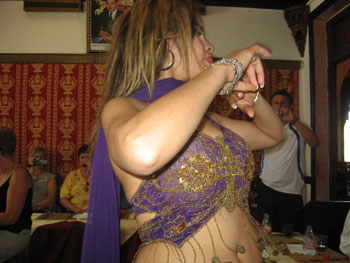
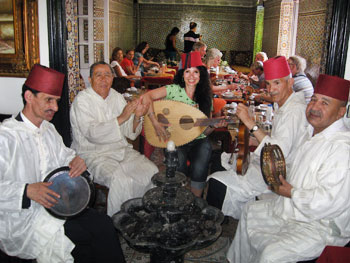 We each took turns posing with the musicians for a small fee and the quartet began to play traditional Moroccan music with such instruments as the hand drum (darbuka), lute (oud), tambourine (riq), and violin (rababa). Moments later, our lunch was served consisting of lentil soup, a briouat or meat-filled pastry, hummus and bread, chicken with couscous and vegetables, followed by a slice of melon with mint tea for dessert. Halfway through the meal, a blonde belly dancer in a purple and gold costume whirled her way into the center of the room and entertained us to the lively music of the band.
 Shortly after our lunch, were once again whisked to the bus and into a department-sized store in the center of Tangier selling the finest Moroccan handicrafts, gifts, furnishings, rugs, leather goods, pottery, clothing, jewelry, and quality souvenirs available. We were told that we had a half hour to shop and encouraged to purchase as much as we could. This would be the last stop on our itinerary and right on schedule, after 30 minutes, we made our way back to the bus.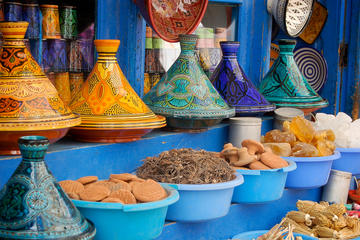
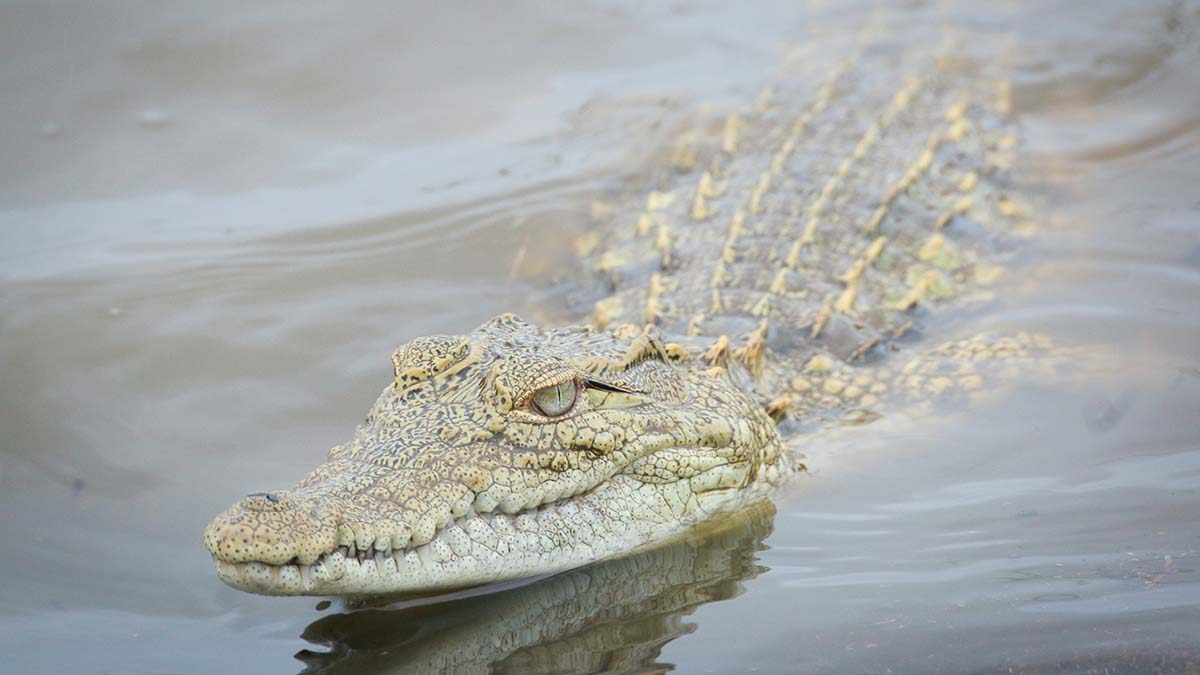
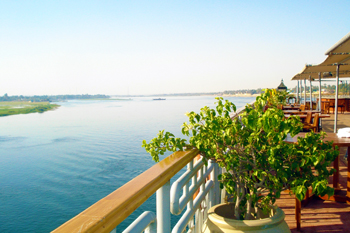 I wonder if there are crocodiles lurking in the river. I peer into the dark green water hoping to spot one. The Nile crocodile is the second largest reptile in the world, after the salt-water crocodile. They grow to up to 5 meters (16 ft) in length and weigh up to 410 kg (900 lbs). The largest on record was 61 meters (20 ft) and weighed 900 Kg (2,000 lbs). Their powerful bite and sharp conical teeth grip so firmly it is almost impossible to loosen. They are aggressive predators and will lay in wait for days waiting for the suitable moment to attack. It isn’t easy to escape. Crocodiles have been known to gallop at speeds of about 50 kilmetres (30 miles) an hour!
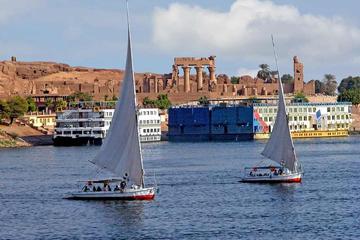
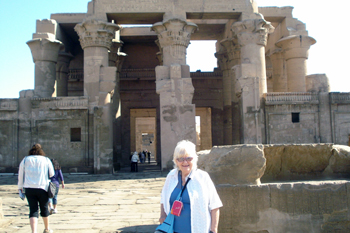 Kom Ombo is a small city once situated at the crossroads between the caravan route from Nubia and the routes from the gold mines in the eastern Sahara. During the reign of Ptolemy VI (180-145 BC) it was a training depot for African war elephants. Today Kom Ombo is the home of many Nubians who were displaced after the Aswan Dam flooded their lands.

 Finally, we enter a large room that, to my surprise, is full of crocodiles! Mummified crocodiles! It is evident from the large number displayed here that the crocodile was held in honor by the people of Kom Ombo. The museum contains crocodile eggs as well as mummified baby and adult crocodiles. Some of the mummies were found with babies in their mouths or on their backs. These ferocious beasts are known to care diligently for their young, often carrying them on their backs. By preserving them by mummification it emphasized the protective and nurturing aspects of Sobek as he protected the Egyptian people just as the crocodile protects its young.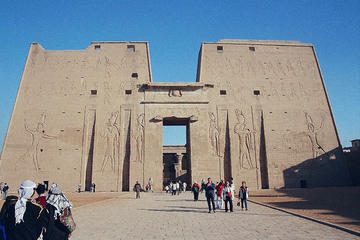
 . Her first novel SHADOW OF THE LION: BLOOD ON THE MOON (volume one of two, a story of the fall of Alexander the Great’s dynasty) was published this summer by www.mediaaria-cdm.com at exactly the same time the fabled tomb at Amphipolis was uncovered. It is available on
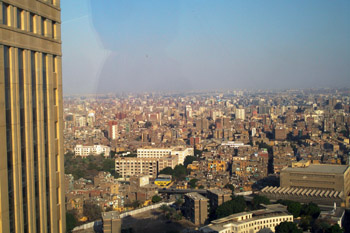 The first thing I noticed as we drove in Cairo from the airport, were the miles and miles of densely built apartment blocks, many of them half-finished stretching out from the Nile as far as you could see. Laundry fluttered from some of the balcony but there were just as many that appeared empty. The Egyptologist with our group of Canadian travel writers explained that this was part of the reasons for the first revolution – the overbuilding on green space, a corruption.
 As a female solo traveler, I would not want to venture alone to Cairo, although I’d certainly not hesitate to return to this marvelous country in the company of a tour group. Did I feel any danger in Cairo? In spite of the two revolutions and the pending elections at the time I was there, and the spate of unfavorable media coverage about Egypt, travel warnings from embassies, that has diminished their tourism by 90%, I felt no sense of danger. In fact, there was good security in place everywhere. And what impressed me so much was the people. I have never met such gracious, generous, friendly people anywhere before. Young, old, men, women and children approached me and my travel companions on the street with smiles. “Welcome! Where are you from? Welcome to Egypt!” These are proud people, open and friendly, who walk with a noble stance, proud of their country and heritage and greet you with welcoming smiles.
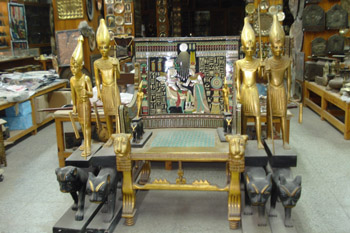
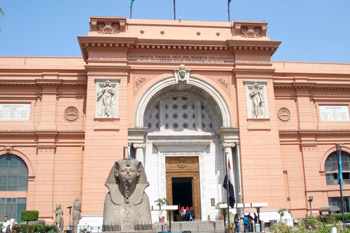 One of the main interest for me was the Egyptian Museum located right near Tahrir Square. The museum contains the world’s most extensive collection of pharanoiac antiquities. I saw the King Tut exhibit when it was in Seattle but those treasures were insignificant compared to what you will see on display here: magnificent golden chariots, precious jewelry, and countless other incredible treasures as well as coffins, mummies and other artifacts from prehistoric through the Roman periods The museum houses approximately 160,00 objects in total. I was told they plan to build a new museum so that more of the treasures can be displayed.
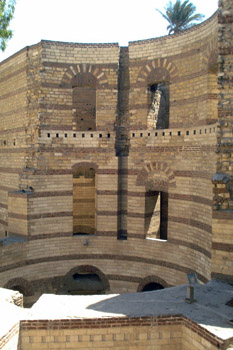 In Old Cairo we visited several churches including the oldest Greek Orthodox Church and the Ben Ezra Synagogue which dates from the 9th century and is the oldest Jewish place of worship in Egypt. We also visited the 4th century Hanging Church which is built on the bastions of the ancient Roman wall and ‘suspended’ above the level of the Nile. In one of the oldest Coptic churches in Egypt we entered the crypt-like area below where there is a small room that is supposed to have been where Mary and Joseph and the baby Jesus found shelter when they fled to Egypt. Old Cairo also had an excellent bazaar for buying souvenirs, some very expensive and others modestly priced including furniture and jewelry.
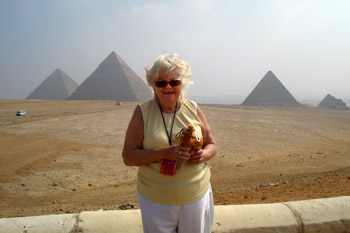 Giza is located to the west of Central Cairo not far from the ancient cities of Memphis and Saqqara. The pyramids include the great pyramid built for the pharaoh Cheops in the 4th dynasty and the slightly smaller Pyramid of Chephren date from around 2500 BC. There are also the Pyramid of Mykerinos and some smaller pyramids built for the kings’ families, The Great Pyramid of Cheops immortalizes the son of Snerferu and Hetpheres. This pyramid is the largest of the three, comprised of 2.3 million stone blocks each weighing an average of 2.5 tons. How on earth did they move these stones to build a monument so high as this? This is definitely one of the ‘wonders’ of the world! In fact, the pyramids of Giza are the last remaining Seven Wonders of the World.
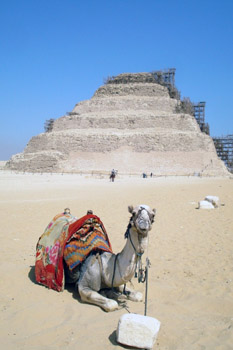 Most of the remnants of ancient Egypt lay scattered on the desert plateau south of Cairo. After visiting the amazing pyramids of Giza we went to see the amazing necropolis at Saqqara and the Step Pyramid of King Djoser. This is the largest necropolis in Egypt, extending for almost five miles. It’s a collection of pyramids, temples and tombs including the Mastaba tombs where the high officials of the Pharaohs were buried.
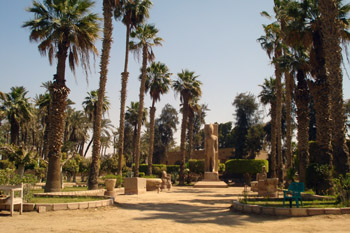 Farther south, is the ancient royal capital of the pharaohs, Memphis. According to legend it was founded by pharaoh Menes around 3000 BC and was the capital of Egypt during the Old Kingdom, remaining an important city throughout history. During the 6th dynasty it was a centre for the worship of Ptah, the god of creation and artworks. There is an alabaster Sphinx guarding the Temple of Ptah that is a memorial of the city’s former power and prestige.
