by Ann Harrison
Well, my window
looked out on the Square where Ogni Santi
meets San Trovaso
things have ends and beginnings
-Ezra Pound Cantos
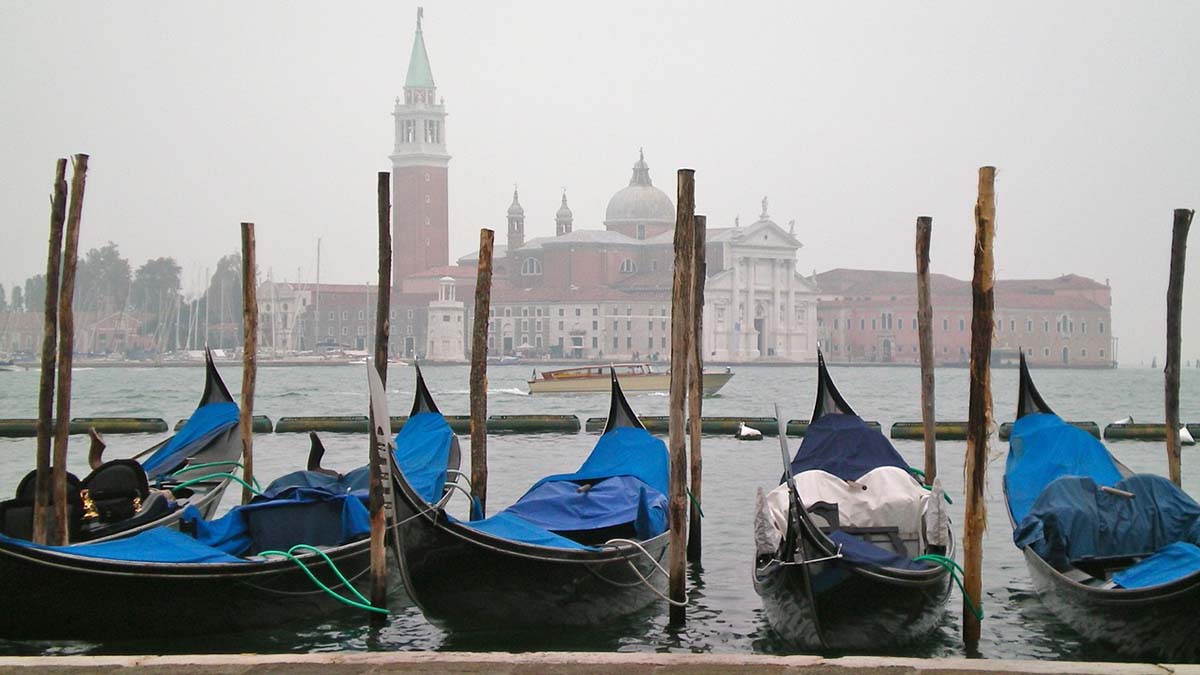
When Ezra Pound arrived in Venice, he took rooms near a walled garden on the Rio San Trovaso, opposite a squero (or gondola building yard). Only a few squeri now remain in Venice, although at the height of her powers some ten thousand gondolas served the city. The gondoliers’ knowledge of the canals is legendary, and legend holds they are born with webbed feet, to help them walk on water.
I crossed the Grand Canal into the area of Venice called the Dorsoduro by the Ponte dell’Accademia. Because of its charm, this wooden bridge remains despite being built as a temporary measure in 1932. It leads to the Accademia, a set of galleries housing the world’s finest collection of Venetian art. As I walked bells chimed the hour from a handful of churches, each sounding a few minutes apart (for churches all over Italy run to their own time).
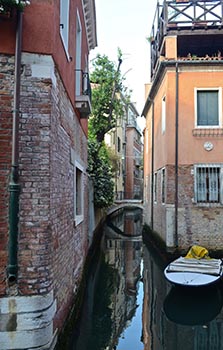
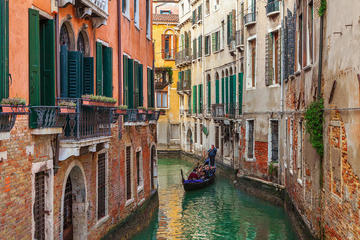
 It took but a few minute to leaves the noise and bustle behind, for I’d entered a maze of alleyways and pretty piazzas where cafes spill onto the streets and picturesque residences stand dotted along the quiet canals. Small shops burst with flowers and vegetable seedlings, supplying courtyards and gardens hidden from view of the passerby. At the top of the Ponte dei Pugni – a small bridge spanning the Rio San Barnaba – are two sets of footprints, marking the starting positions for traditional fist fights. (Ultimately, these became so violent they were banned in 1705.) The Fondamenta Gherardini, which runs beside the Rio San Barnaba, is claimed by many to be the prettiest canal in Venice.
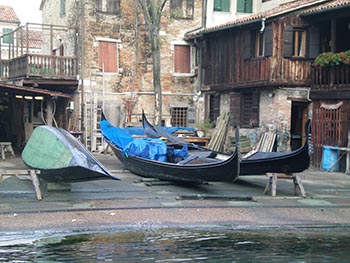
Built in the 17th century, the Squero di San Trovaso is the oldest of the remaining squeri in Venice. It sits beside a small canal, the Rio San Trovaso, allowing easy access for the gondolas. Although closed to the public, as the canal is only a few meters wide all the activity can be easily seen from the far side. On the day I passed some half-dozen gondolas rested upside down in the outside square in various stages of repair. A few were being covered with black lacquer; seven coats are needed to give the boats their famous gloss. Inside the shed another was being built. (Less than a dozen new gondolas are made annually, each taking up to six months to complete.)
Unusual for Venice, the boat-house and adjoining buildings are made of wood, and adorned with geraniums. They are Tyrolean in style, for most squeraroli, (the artisans who work on the gondolas), originally came from this area in the Dolomites, where the best boat-building wood is still to be found. Nine types of wood are used (elm, fir, walnut, oak, mahogany, larch, lime cherry and beech) and in constructing a gondola the squeraroli use some 280 separate pieces, with much of the work still done by hand.


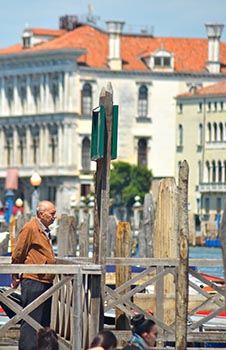 The first record of a gondola is in 1094, when Doge Vito Falier issued a charter allowing Venetian citizens to build their own gondolas. The word is possibly derived from the Latin ‘cuncula’ (shell) or cymbula (little boat). Gondolas appear in paintings of the late 15th and early 16th centuries, in works by Bellini, Carpaccio and Mansueti. Although the design has changed since it first appeared, the manner of steering the gondola is the same: the gondolier faces the bow and propels the boat with a forward stoke, followed by a compensating backward stroke. Originally, some gondolas had two oarsmen; one at the front and one at the stern, and occasionally this method is employed in the backwaters of Venice, as a novice is taught his craft.
The oars, (made of beech), complete with a ribbed blade for greater control, are built by the remeri, (which is derived from the Italian remo, or oar), and are held in place by a rowlock, or focole. The focole’s complicated design allows for up to eight different positions of the oar, depending upon speed and direction the gondolier requires. (Regardless of speed, the gondoliers continue their songs and banter amongst themselves and all they pass.) Unlike a punt, the gondola is never poled, for most of the canals are too deep.
 The only metal used in the construction is the risso of the stern and the ferro at the head of the gondola, which counter-balances the gondolier’s weight. It is made from six metal strips, called pettini, representing the six sestieri (or sections) of Venice. Another strip shaped in the form of a double S represents the Grand Canal, with a doge’s cap at its top, and a lunette representing the Rialto Bridge inscribed below. The only other decoration on the gondola is a brass hippocampus (or sea horse), which adorns either side.
Gondolas were originally made watertight by coatings of black pitch. During the 1500’s, owners decorated their gondolas with fancy ironwork, bright carpets and rich colours. An increasing number boasted a felze; a small cabin complete with louvered windows, allowing privacy for passengers, and protection from the elements. (These remained common until the early 20th century, when tourist demand for better views led to their removal.) Sumptuary laws passed in 1562, however, decreed all gondolas to be black to prevent ostentatious displays of wealth.


From the Squero San Trovaso it is a short walk to the Zattere, a long quayside which looks across the Venetian lagoon to the island of Giudecca. The breeze carries the smell of the sea, the call of gulls fills the air, and once more tourists are everywhere. Outside the Santa Maria della Visitazione there is a bocca di leone, a letterbox where anonymous denunciations were once made to The Great Council.
As I sat sipping a glass of prosecco, I could see all manner of craft plying the waters of Venice, from vegetable barges to garbage trucks and even ambulances. Enormous ocean liners often pass through the lagoon, their wash flooding into the canals. Yet gondolas and their striped-shirted gondoliers remain part of the city’s mythology, having been part of Venetian life for over one thousand years.
If You Go:
Official website of the City of Venice
A useful guide to museums, galleries, hotels etc.
For those who are interested in a convent stay
Vaporetti (water buses) are the public transport of Venice. Vaporetto no.1 travels the length of the Grand Canal, offering spectacular view of this city.

Anne Harrison lives with her husband, two children and numerous pets on the Central Coast, NSW. Her jobs include wife, mother, doctor, farmer and local witch doctor – covering anything from delivering alpacas to treating kids who have fallen head first into the washing machine. Her fiction has been published in Australian literary magazines, and has been placed in regional literary competitions. Her non-fiction has been published in medical and travel journals. Her ambition is to be 80 and happy. Her writings are available at anneharrison.com.au and anneharrison.hubpages.com

All photos are by Anne Harrison
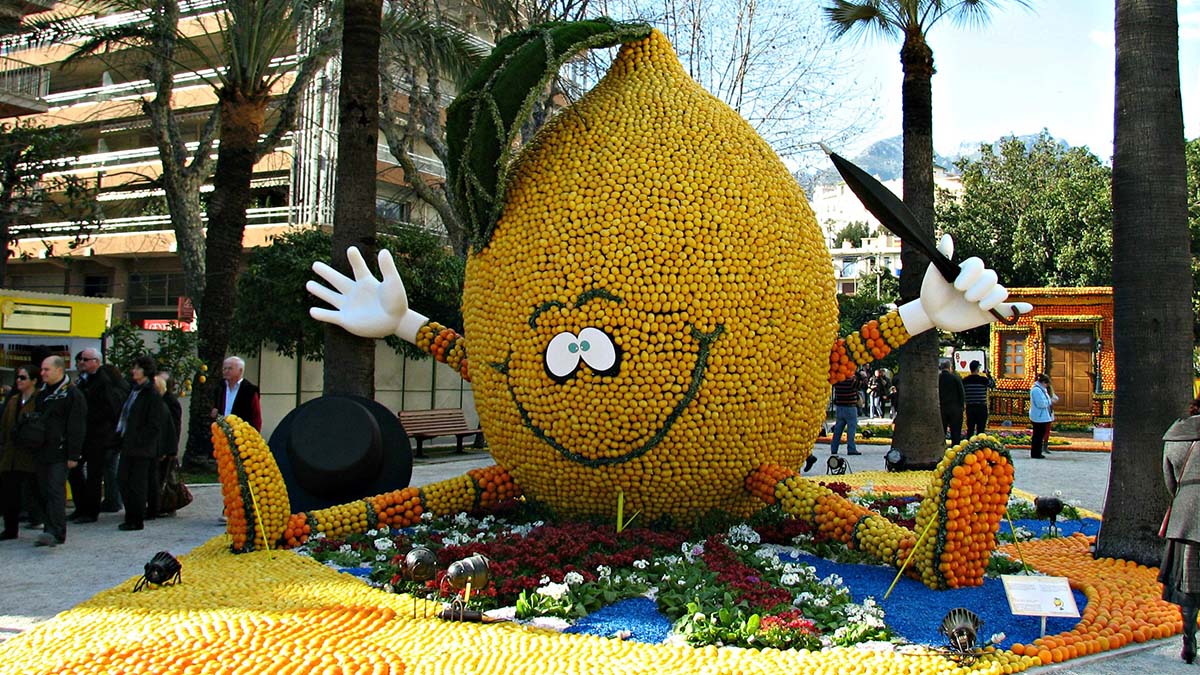
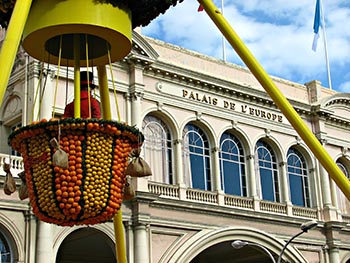
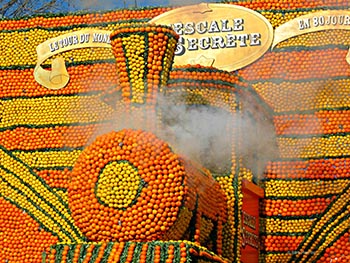

 The fruit is attached to the netting by elastic bands and is checked daily to make sure it looks perfect. If necessary, replacements are close at hand. The displays are lit at night and worth a second look if you have visited during the day.






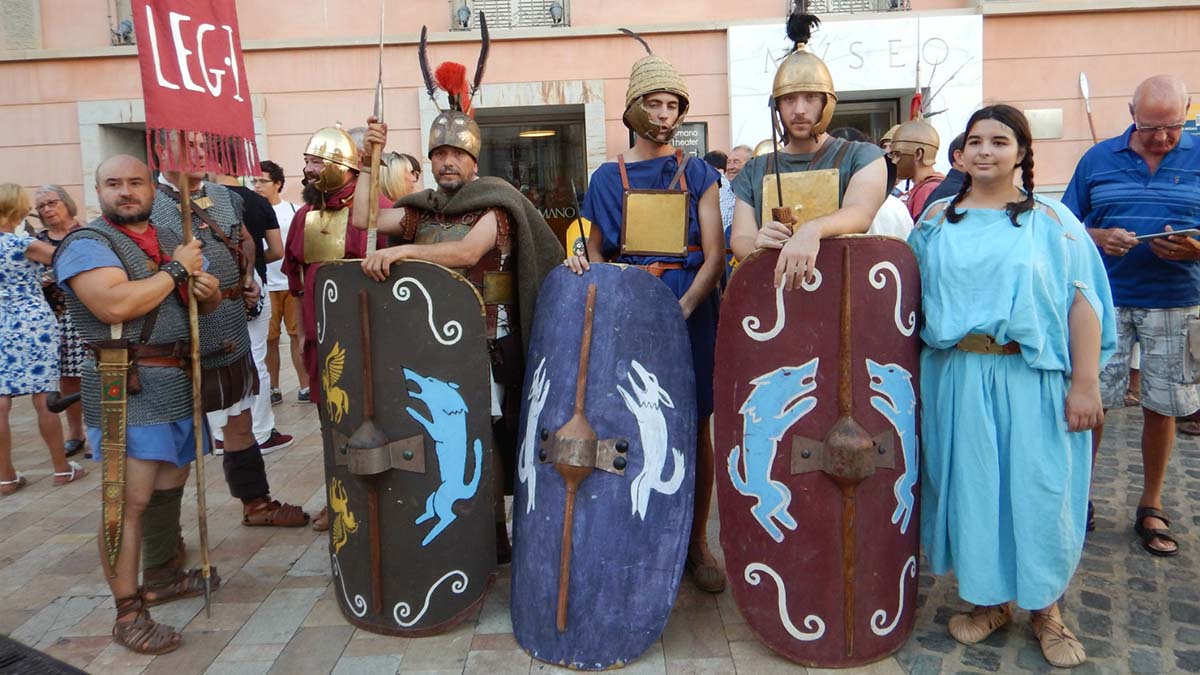
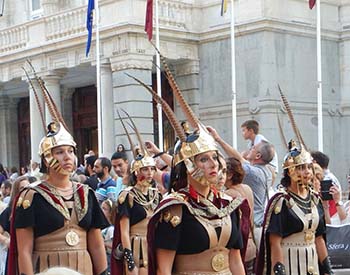

 The costumes and attention to historic detail are amazing. It is as if all the citizens of Cartagena are in costume for the event. And like everything in Spain, the entire family is involved. Men, woman and children take on roles as Roman soldiers and barbarian hordes. The tradesfolk who followed the armies serving their needs are also represented. Bakers, butchers, blacksmiths, potters and entertainers are interspersed between armies following standard bearers. Elaborate floats depicting Roman villas and amphitheatres and even an elephant from Hannibal’s army pass by while we are entertained by a snake handler, a joker, a conjurer and a soothsayer. My excitement grows when monks appear leading massive bulls through the narrow streets lined with onlookers. An ancient high priest rewards me with a huge smile after I take his picture.


 About the author:
 , England, Alberta and Eastern Europe, where she always has an exciting adventure. Darlene divides her time between the west coast of Canada and the Costa Blanca of Spain when she isn’t exploring the world. Visit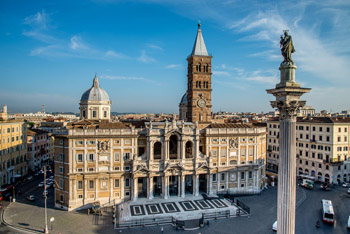
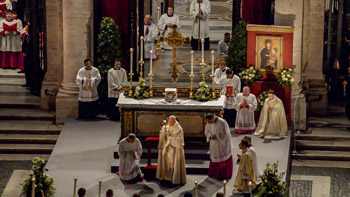 Over the years we have watched groups gather at twilight for the beginning of their pub crawls. Dividing into teams, they guzzle through drinking games in the piazza while preparing for their evening of revelry. We have observed crowds gather for marches, tours, protests and rallies. From blurry eyed, early morning senior groups touring the Basilica, to high-spirited youth groups assembling to sing and dance in the square, this church is a well celebrated gathering point.

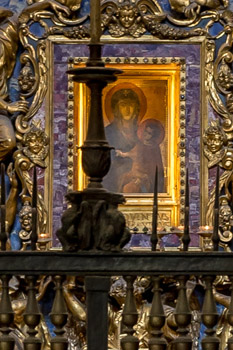 There are over 25 churches in Rome dedicated to Mary, Santa Maria Maggiore is the largest of these Marian churches. This Major Papal Basilica is prominent in the tradition and adulation of the Catholic community worldwide. Many travel blogs rate Santa Maria as one of the ten most beautiful churches in Europe. Walks of Italy tour Major Basilicas of Rome, includes it as one of “the three most important churches in Rome.” Frommer’s rates it #3 in its article; “The Best Churches.” If you are a cathedral buff, Italy is not complete until you have experienced this great lady.
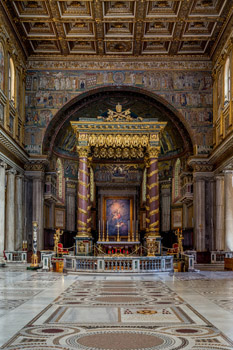 The golden mosaics adorning the triumphal arch date from the 5th century and depict scenes from the early life of Christ and the Virgin Mary. On the left at the top is a panel depicting Christ’s enthronement with a group of angels as his court. Below this is the Epiphany or Adoration of the Magi. The young Christ is seated on a throne with Mary on his right, they are attended by angels.
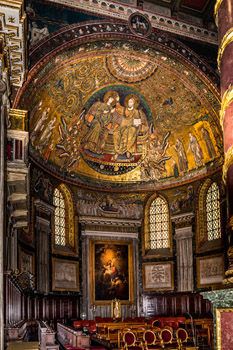 Italian painter and mosaic maker Jacopo Torriti is credited with the adornment of the apse, he crafted it in 1295. The magnificent central work shows the Coronation of the Virgin in which Jesus and Mary are seated on a throne with Jesus placing a jeweled crown on Mary’s head. The sun and moon are under their feet accompanied by a choir of adoring angels. Standing to their left are St. Peter, St. Paul, St. Francis of Assisi and Pope Nicholas IV. Standing on the right is St. John the Baptist, St. John the Evangelist, St. Anthony and Cardinal Colonna. The apse of Santa Maria Maggiore is the most important surviving example of Roman mosaic art from the late middle ages. Descend below the high altar and you enter the burial place of Saint Jerome, this 4th-century saint translated the Bible into the Latin language (the Vulgate). Upstairs, located in the Borghese Chapel, is “Salus Populi Romani,” believed to be the oldest Marian image in Rome. However, on display in this vault is arguably the most important artifact of the Basilica, The Reliquary of the Holy Crib. This crystal shrine, designed by Giuseppe Valadier, is said to contain wood from the Holy Crib of the nativity of Jesus Christ.
 Legend has it that an aristocrat named Giovanni, and his barren wife were without child. Seeking divine intervention they committed to build a church to the Virgin Mary. She appeared to them in a dream on the night of August 4, 352 A.D. and told them that a miracle would show them the location on which they were to build the church. That night, Pope Liberius was troubled by the same dream. On the following morning, he travelled to Esquiline Hill and found it miraculously covered in snow. Liberius then traced an outline for the location of the planned church. Although many feel this legend has little basis in fact, to this day the church on Esquiline Hill is often referred to as Our Lady of the Snow.
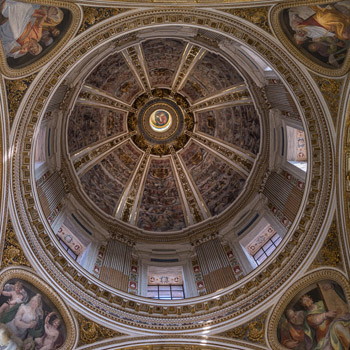 5 Reasons to visit Santa Maria Maggiore