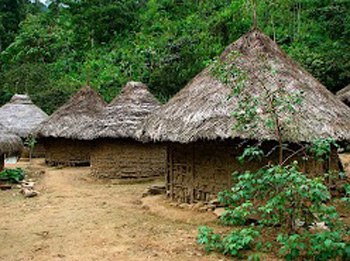
Ciudad Perdida from Santa Marta
by Luke Maguire Armstrong
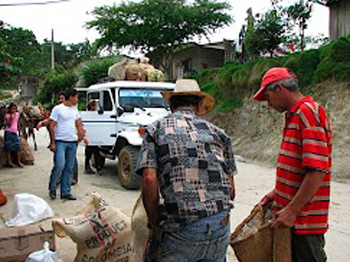
Our group grabs the packs from the top of the Jeep’s rusty roof before we set off for Colombia’s Lost City. We watch the jeep disappear down the muddy road. It’s the last sign of civilization we’ll see for a week. Our guide, Tunyi, begins the six-day trek by telling us about eight tourists who were kidnapped on September 15th, 2003 by the National Liberation Army (ELN) on the same trail we are taking. “Three months they held them captive,” he tells us. “They were lucky to be released.” The three Australians in our group find this funny while the two boisterous Russians become quiet and pensive after I translate this bit of information for them. Perhaps Tunyi should have started by pointing out the names of some native fauna.
After this incident, tourist treks to the city closed until 2005. Though an air of danger still lurks on the forbidding trail, Colombia’s army now patrols the path, and according to our guide, robberies are less frequent than they used to be.
Within the first hour, we pass a small group of soldiers wielding semi-automatic weapons. The Russians seem especially agitated by the troops and they request in broken English that I ask our guide in Spanish what their purpose here is.
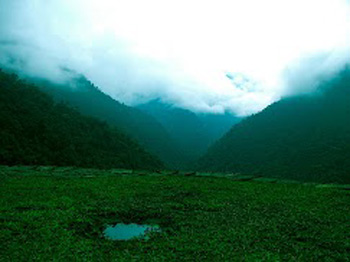 We venture into Colombia’s Sierra Nevada mountain range, along narrow and seemingly impossible trails drenched in saturated air. After a few hours, we have crossed the same river a dozen times, as it snakes along our difficult path.
The jungle canopy offers no relief from the ruthless heat. I am shocked at the volume of sweat pouring from my skin. I realize way too late that I’ve over-packed by about thirty pounds. My eighty-liter pack dwarfs everyone else’s diminutive daypacks. Dave Forester Wallace’s eleven-hundred-page novel, Infinite Jest, ranks at the top of my poor packing decisions. After a one stretch of trail leading forever up an impossible incline, I consider ditching the book.
The trail is exhausting, but it is the exhaustion we have paid for. We came to feel our shoulders ache, our feet blister, and our sweat pour. We came for that little voice in our head that says, “you can do it,” to a skeptical body. Unlike the less strenuous treks to places like Machu Picchu trail, there is no bus option here. Barring helicopters, the only way to get to The Lost City is along an ancient trail once used by Tayrona Indians.
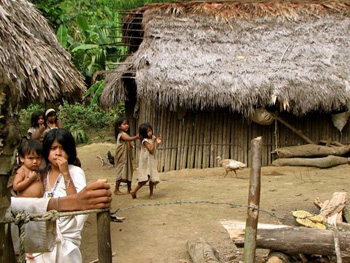
 Teyuna, as the Tayrona originally called the city, was “found” in 1972 by treasure hunters. At the time, its location was already widely known to tribes living in the area. Founded possibly as far back as 800 A.D., at its peak, it is believed to have been home to about 10,000 Tayrona. Unlike many of the magnificent ruins dotting Latin America, The Lost City is not just a story of what once was, but the story of what still is. Along the way, our trail leads us through small villages inhabited by the Kogis, the blood descendants of the city’s founders. They are still living in the same wild, romantic way of their ancestors.
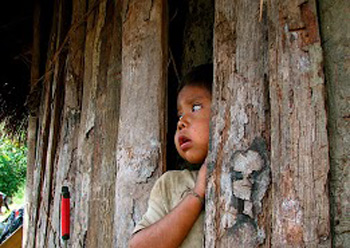
As cautious outsiders, we watch the inhabitants of these villages as they herd their children inside the huts while we pass, commanding them in one of the 100 dialects of their still-intact ancient language—a language they are reluctant to share with the eager anthropologists who come to study their way of life.
After eight hours, we reach the place where we will be spending our first night, under a thatch roof, hanging in hammocks. Our guides serve us a dinner of chicken, rice and fried plantains. But my hunger is such that high-school cafeteria food would have tasted divine.
The Russians, who initially were worried that they might not be able to fall asleep in a hammock, quickly find out that after a day of trekking on trails like this, sleep is inevitable and intensely restful.


 Either the second day is easier than the first, or my body simply has given up on feeling pain. I learn from our guide that all the villages along the way are part of one tribe, and that once a year in February they have a month of celebration in which they meet to drink fermented fruit juices and perform various rituals.
A few hours into the hike, Tunyi stops to show me a coca plant. He points off into the jungle to where he says he knows of a cocaine factory several kilometers off the trail. United States drug aerial fumigation is banned in this area, making it an ideal place for illicit activities. He tells me that on the way back, for twenty-dollars, he knows someone in the factory who will give me a tour. Apparently even the drug business wants tourism dollars these days.
When we pass through another village, he tells me that a Tayrona bride will spend her wedding night with the chief before having relations with her husband so that she can be taught how to love. It sounds like a good gig. I ask jokingly how I can become a Tayrona chief, only to be solemnly informed that because I am a gringo, I would never be allowed into the tribe.
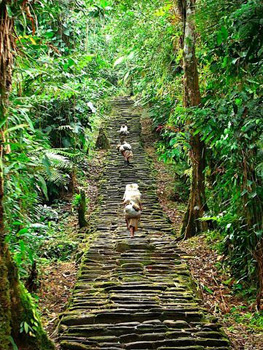
In the afternoon on the third day, we cross the river for the last time and see moss covered stone steps tucked away under the foliage. These are the beginning of a stairway of over 1,200 steep steps leading straight up the mountain to The Lost City. Before my foot falls on the first step, a Kogi, dressed in his traditional white garb, emerges from the steps and ignores me as he disappears into the jungle. I look at the prints his bare feet have left in the mud. My heart jumps and I see meaning spanning a thousands years in those footprints.
 With my pack weighing me down on the slippery stairs, I almost fall several times, a mistake that could have disastrous consequences in this remote area. The stairs are by far the most difficult obstacle yet. Aching legs are being commanded up narrow stairs cutting into the steep mountainside. My cardiovascular system demands rest, but I ignore its plea. This has become my Mecca, and I vow to make it up in one uninterrupted jaunt.
Heaving, I reach the top more exhausted than I remember ever feeling. Surrounded by ancient stonewalls, I have attained the sky—the ancient stomping grounds of the Tayrona. A waterfall can be seen on an adjacent mountainside flowing, it seems, from the clouds. With my mind’s help, I see much more than stones and a stunning view. I imagine answers to questions we may never know.
Where did the inhabitants of The Lost City go? Unlike many other ancient cities, the Spanish never came here. As the conquistadors settled around the Caribbean coast, the people here simply left and were never heard from again. Some speculate that the direct descendants of the city’s inhabitants are still thriving somewhere in a distant, undiscovered jungle haven.


 How the city was built is another mystery. From samples of the rocks, archeologists have concluded that some sort of acid was used to cut perfectly shaped blocks. Because of a potential commercial value, jungle plants have been collected in throngs to find the acid, but it, like the city’s inhabitants, seems to have disappeared into the jungle forever.
Our group spends the night in hammocks atop the city in quiet contemplation. We are alone to pass the night here, something unheard of in similar sites across Latin America. The ancient city seems to have given everyone a lot to think about. For all of us, it is much more than stacked stones on a mountainside. It has made us all nostalgic for a world we have never known.
Despite civilization’s rush to map every corner of the world, this city remained hidden from The West for Centuries. Some speculate that deeper in the jungle are other such cities, hidden from the discovered world. A few people will tell you that there are other cities like this out there that are still inhabited with people living a way of life lost to progress.
Looking out in the jungle I wonder how much of this will prove true, and how much of it is lore created from our hope for the lost, forbidden things that we want to still find.
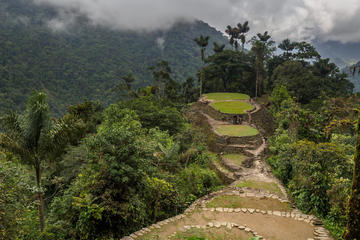
4 Day Lost City Small-Group Tour in Santa Marta
If You Go:
What to Bring:
A good pair of shoes, several pairs of socks, long pants, shorts, a t-shirt, a jacket or sweater, and a water bottle. The guides will carry in the food for you and the river water is safe to drink. Even if it does not rain, expect your perspiration to soak your clothes within minutes. Hammocks are provided for you, but if you are sensitive to the cold, you will want to bring a blanket or sleeping bag.
How to get there:
Going without a guide to the city of Gotsezhy (Ciudad Perdida) is strictly prohibited and you must book a tour with one of the two companies authorized to bring groups: Turcol Travel Agency or Sierra Tours. Both have offices in Santa Marta and Sierra Tours has a second office in the dive town of Taganga. For the six day guided trek, both companies charge about $240.00.
Where to book a tour:
Sierra Tours is more sensitive to making the Trek eco-friendly and respecting the local tribes along the way. In Taganga: Calle 17 1-80. In Santa Marta: Calle 22 16-61. All tours are conducted in Spanish.
About the author:
Luke Maguire Armstrong (www.lukespartacus.com) was a baby, who became a boy, who became a man. After finishing degrees in philosophy and English abroad in Chile, Luke backpacked from Chile to Guatemala, where he spent four years as director of development organization Nuestros Ahijados. His work to battle infant malnutrition was featured on the ABC News Global Health Special: Be the Change, Save a Life. He is the author of “iPoems for the Dolphins to Click Home About” (2010) and “How We Are Human” (2012). Follow @lukespartacus.
All photos are by Luke Maguire Armstrong.
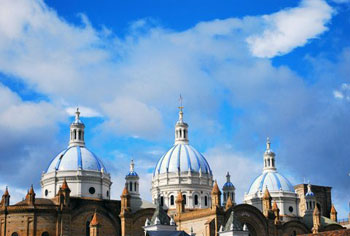
 To celebrate his victory, Túpac Inca Yupanqui (whose name meant ‘noble Inca accountant’) began to build a beautiful city there that would rival Cuzco as the heart of the Inca empire, a city that two generations later would be subjugated by the Spanish in their quest for the mythical land of El Dorado, the city now known as the colonial gem of Ecuador: Cuenca.

 Its namesake is the city in Spain meaning ‘basin made by a confluence of rivers’, where the Viceroy of Peru at the time, Andrés Hurtado de Mendoza hailed from. He commissioned the founding of the city in 1557, which grew in independence and importance during its colonial era and reached its peak during first years of its independence, which was won on November 3rd, 1820. It later on became the capital of Azuay province in the center of the southern highlands, and is now the third-largest city in the country.
 Another important historical landmark (but more exciting than it sounds) is the Iglesia de San Francisco, a neoclassical church built around a slender tower with an apricot-colored, horizontal base and mullioned windows that was built by Franciscans and finished in 1930. It is the best example of the baroque style in Cuenca and represents a harmony between baroque and neoclassical features, with a cedar altarpiece at its center. It’s situated at the edge of the expansive Plaza San Francisco which allows visitors views from many different angles, as the plaza has long-since been occupied by a popular, sprawling market where one can buy anything from alpaca backpacks to plastic Disney ones.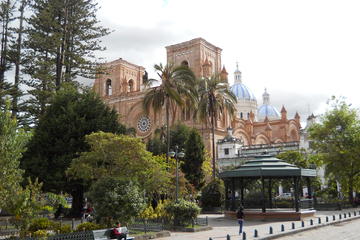
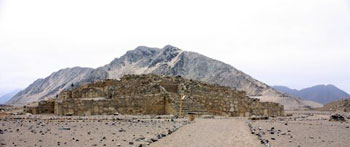
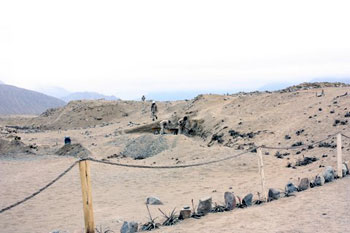 Caral, an abandoned city eroded by time and windswept sand, holds twenty-five structures including six pyramids that are as old as the Step Pyramid in Egypt. More remarkably, this early civilization developed in complete isolation without the use of pottery, metalwork or writing, unlike its contemporaries in the ancient Near East.

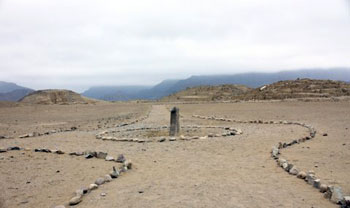 Just across the plaza, the Huanca Pyramid, named for the nearby 2.15 meter high huanca stone whose edges are oriented to the cardinal directions, holds three rooms atop its 12.8 meter summit. These rooms may have been used for astronomical and ceremonial purposes.
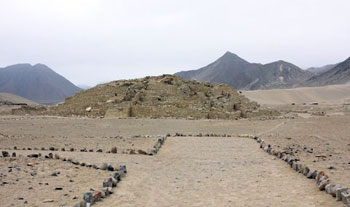 En route to our next destination, the Greater Pyramid, I fought back a sneeze as a sudden gust of wind raised a cloud of dust. Seen through the haze, the Greater Pyramid is the largest structure on site covering approximately four football fields. From a height of 19.27 meters (seven platforms), city officials oversaw all of the activities within the city.
 After making quick stops at the Lesser Pyramid, Quarry Pyramid and Central pyramid, we returned to the lower section of the city to visit the Temple of the Amphitheater. Julio directed us to a bank of twelve cubicles lining the entry platform that once held the remains of burnt food offerings.
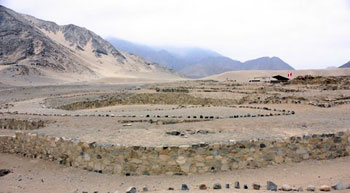 Deeper inside the temple complex is the Altar of the Sacred Fire. This cramped round space houses an altar with a two-level fireplace; an air duct runs beneath. This room was likely used for mysterious ceremonies that the general public was not privy.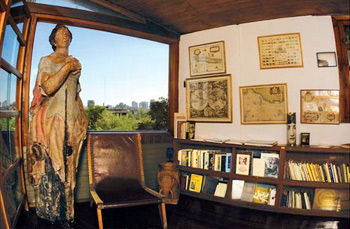
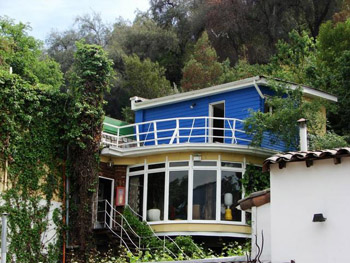 It wasn’t difficult to find the poet’s house, La Chascona, on a little back street set on a hillside overlooking the city. “La Chascona” means “wild hair” and the house is named after Matilde, his third wife, who had a tumble of unruly tresses.
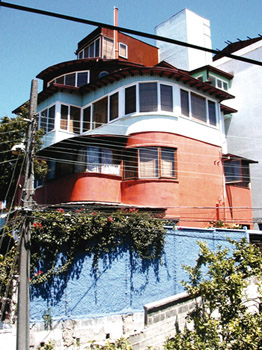 On the coast at Valparaiso, the second of Neruda’s houses, La Sebastiana, is set high on one of Valparaiso’s many steep hills commanding a view of the harbor. I took an ascendor from Espirito Santo up Cerro Bellavista where the house is located. I wended my way through the maze of narrow lanes, past a colorful hodge-podge of houses and eventually found the poet’s house.
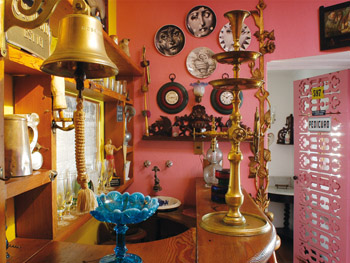 Neruda’s living quarters were on the second floor, ascending several floors up to the top room which was his study and lookout, with a broad spectacular view of Valparaiso’s harbor and the ocean. Each room in the house is full of the usual trinkets and beautiful knick-knacks he loved to collect. There are some lovely stained glass windows. You are allowed to wander around at will. Visitors are given booklets to read describing the history of each room and the furnishing and objects although no photographs are allowed other than the many breathtaking vistas from the windows.
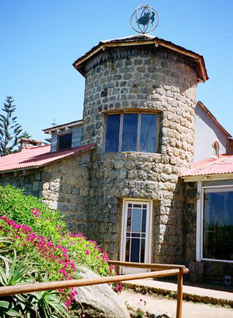 I took a bus down the coast to Neruda’s house at Isla Negra, which isn’t really an island. The house is built on a rocky headland overlooking the Pacific close enough to the shore to give that effect. The original stone buildings were erected in the late ‘30’s and were completed in the 1950’s. Neruda added to it bit by bit including various rooms to hold all his eccentric collections.
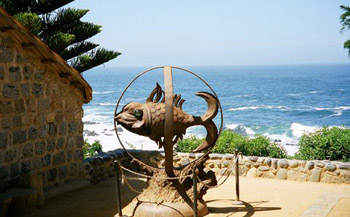 During the junta, when Neruda was dying of cancer, the military stormed the house, but it has been mainly preserved just as it was, intact with his marvelous collections (even more fantastical than those at La Chascona). It is exactly as it was when Neruda and Matilde lived there, even to the place settings at the dining room table: place mats of sailing ships and one (the captain’s) of nautical instruments.

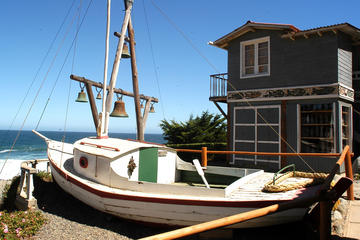
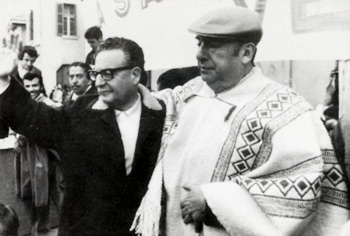 As in the other houses, there’s a well-stocked bar where Neruda played the role of bartender. I can almost imagine him standing there, pouring drinks as he engaged in jolly banter with his guests. And outside, beached on the shore, is a small boat where he would also entertain. (The boat never went into the water!)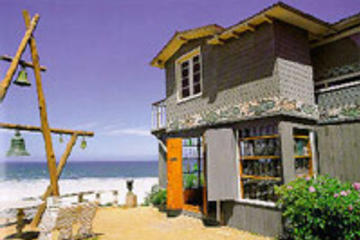
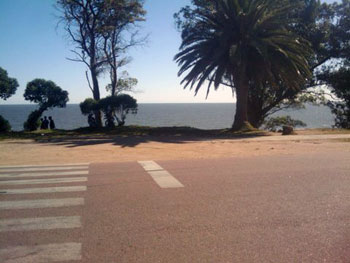
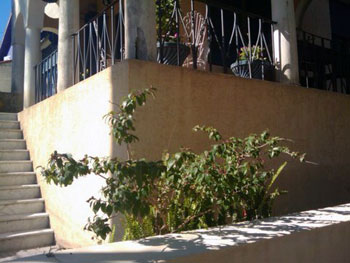 Spanish Uruguay has two locations– one in Montevideo and one in Atlantida. Since I was no longer interested in the nonstop action that characterizes the city life, I chose the enchanting coastal town of Atlantida. Pablo, the son of the lead professor, sent me photos of two living locations. One was a high rise near the beach, the other was a small, enchanting apartment complex called Isla Negra.
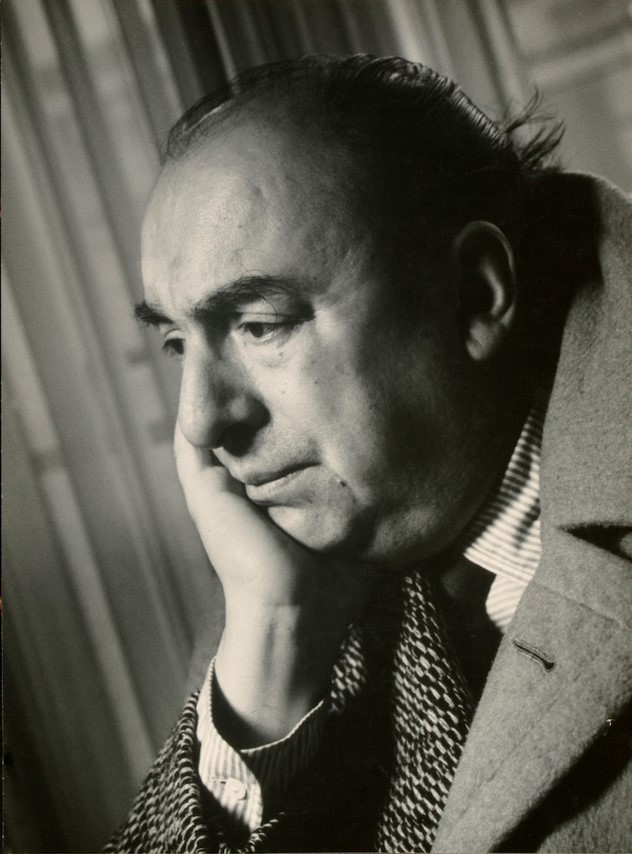
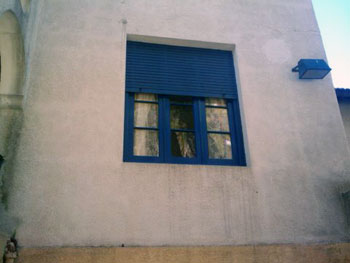 Isla Negra was one of the many one of the many houses belonging to Pablo Neruda, a romantic poet who writer Gabriel García Márquez referred to as “the greatest 20th century poet in any language.” His passion for politics equaled his capacity for love.

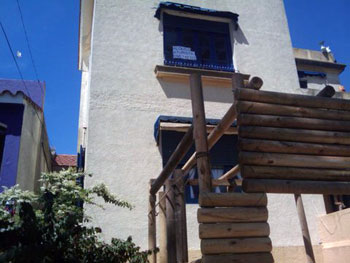 In her book titled
  , Matilde describes how she and Pablo developed a thirst to be together all the time. They decided to take a vacation in Atlantida, where their Uruguayan friend, Alberto Mántaras, lent them his vacation home. The house, which still sits across from the beach in a fragrant forest of pines, became their secret romantic hideaway.
 The gardener was a good friend of Neruda’s driver, Manuel Araya, who was the only person who knew about Pablo’s dalliances. In her book, Matilde states her suspicion that the driver gave the gardener some ammunition by telling him about Pablo’s mistress, which if course, got back to Delia. Pablo and Delia divorced, and Matilde and Pablo eventually became husband and wife.