Travel Thru History

Historical and cultural travel experiences

  • Home
  • Airfare Deals
  • Get Travel Insurance
  • Writers Guidelines

Alexandria, Egypt – Pearl of the Mediterranean

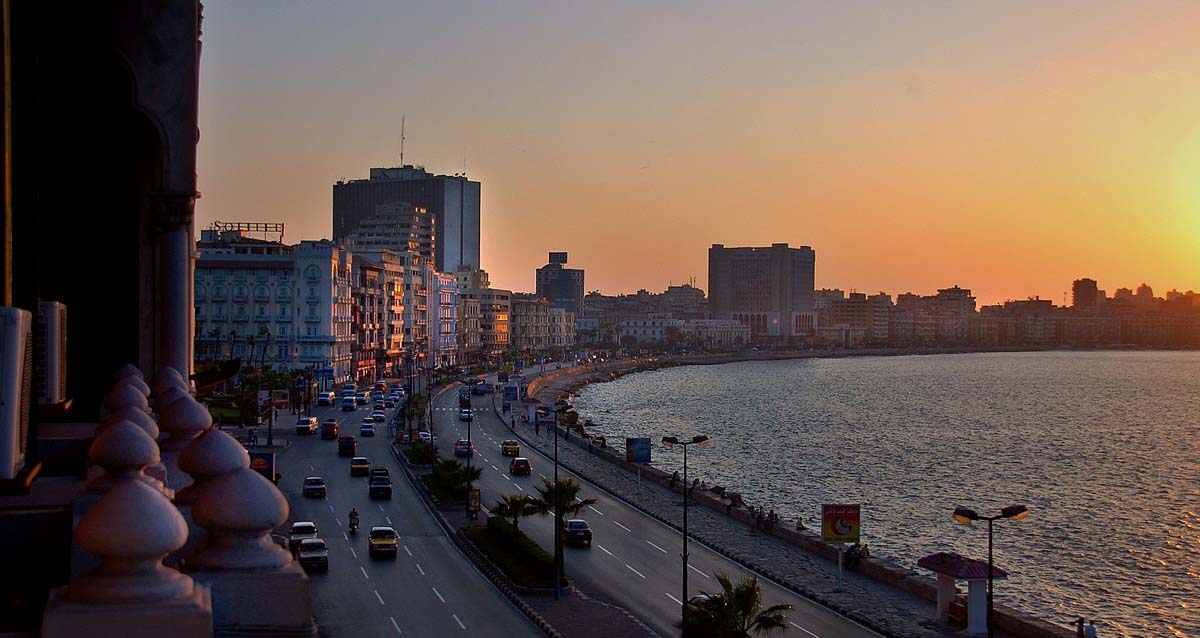
alexandria egypt at sunset

By W. Ruth Kozak

I had always dreamed of visiting Alexandria, the fabled city on the Nile delta established by Alexander the Great back in 332 BC. While I was researching my novel SHADOW OF THE LION, I delved into the history of this remarkable city. When I was invited to Egypt last March on a travel writer’s press trip, I told the organizers about my novel and the research I had done about the founding of the ancient city. Because of this I was given a special two-day tour of Alexandria, with an escort of three handsome Egyptian men, one of the highlights of all my travel experiences.

Alexandria is a setting in the story. Ptolemy, Alexander’s illegitimate half-brother returned to Egypt after Alexander’s death to oversee the building according to Alexander’s wishes. Ptolemy Soter became the first of the Ptolemaic dynasties of Egypt that lasted up until the era of Cleopatra.

It is said that Alexander had a dream in which he recalled the lines from Homer’s Iliad of an island, Pharos, by the surging sea.’ Alexander had come to Egypt to drive out the Persians and to him, this dream was an omen. He wanted to build a new city by the sea, and chose this location near a small village called Rhakotis. He ordered his architect and city planner Dinocrates to design and build it but Alexander died before its completion. After Alexander’s death, Ptolemy hijacked the funeral carriage when it was being transported from Babylon to Macedon and brought the body to Egypt where, it is said, Alexander had wanted to be buried. It was interred first in Memphis, then when the temple for Alexander’s friend Hephaestion was completed, Ptolemy had Alexander’s body laid there where it remained at least until the arrival of the Romans, because it was visited by Julius Caesar and Cleopatra.

Under Ptolemy, Alexandria became a center of Hellenism. It was the home of many Greeks and also home of the largest Jewish community in the world. It took over the trade and commerce of Tyre between Europe and the Arabian and Indian East and soon expanded until it was the largest city in the world, second only to Rome. Over the years, Alexandria was visited by Julius Caesar, Mark Antony, Nelson, Napoleon, and was home of others such as Archimedes, Euclid, Mohammed Ali Pasha and the Greek poet Cavafy.

 The ancient Greek city had three regions, The Brucheum, Royal or Greek quarter which formed the most magnificent part of the city. The Jewish quarter formed the northeast and Rhakotis, occupied mainly by Egyptians. The city consisted of the island of Pharos which was joined to the mainland by a mole nearly a mile long. There stood the famous Great Lighthouse, one of the Seven Wonders of the World, 138 meters high, a project begun by the first Ptolemy and completed by his son. The lighthouse was destroyed by an earthquake in the 14th century and was replaced by an Arab fortress using some of the original bricks.

The author, Ruth KozakI was curious to learn how much of Alexander still exists in Alexandria, the city named for him. As the van approached the outskirts the first thing I saw was a monument of Alexander riding his horse. At our first stop we were greeted by a young tour guide, Sarah, who showed us around an extensive excavation known as Kom al-Dikka, which has revealed many Roman era ruins including a theatre. We didn’t have time to visit the catacombs which are located near Alexander’s best-known monument, ‘Pompey’s Pillar. The catacombs, known as Kom al-Soqqafa, are a multì-level labyrinth reached by a spiral staircase where there are dozens of chambers with sculpted pillars and statues, burial niches and sarcophagi.

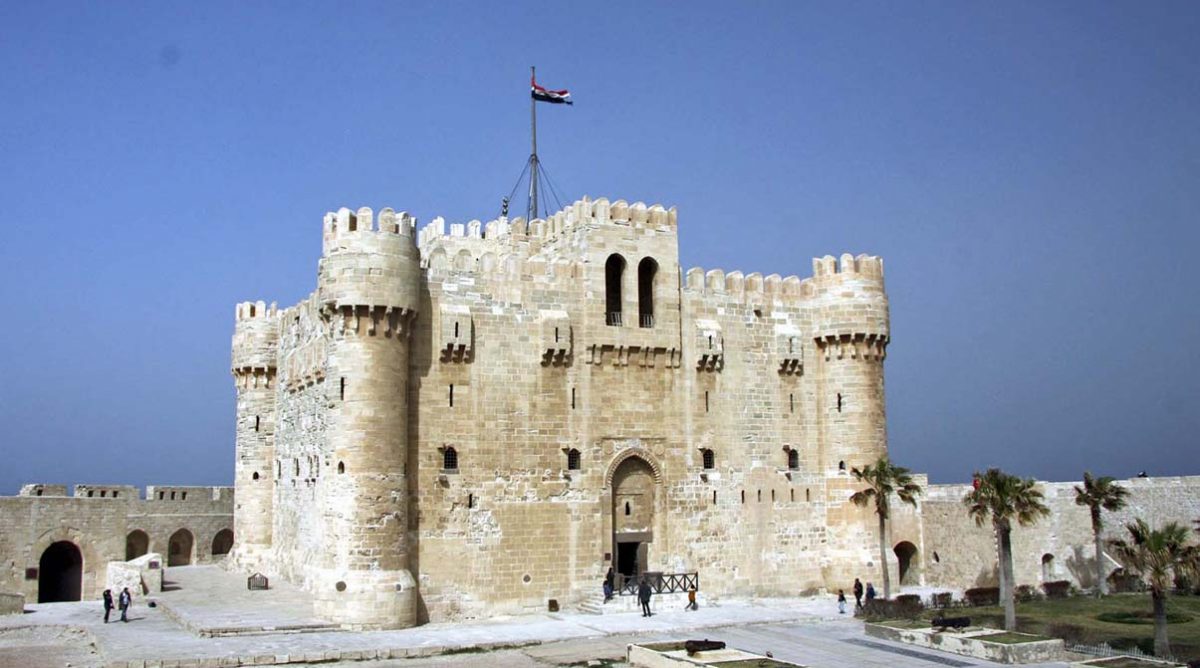
Our next stop on the tour was the Qaitbay Citadel, built on the site of the ancient lighthouse, and established in 1477 AD by the Sultan Qaitbay. It was one of the most important defensive strongholds on the Mediterranean coast.

Unlike Cairo which is densely packed between the Nile River and the vast expanse of Sahara desert, Alexandria sprawls out along the seacoast, a sparkling bright city surrounded by the verdant Nile Delta, the ancient’s ‘Land of Goshen’. It is the second largest city in Egypt. The city is divided into six neighbourhoods, each with a large population. Alexandria is an important industrial area and Egypt’s largest seaport with two harbors, one facing east, the other west. There is evidence of the ancient harbour on the edge of the island of Pharos, but little else remains except what the underwater archaeologists have discovered under the sea. Some of these finds can be seen in the Alexandria Museum and on display outside of the new Alexandria Library.

The Alexandria Museum contains a number of exhibits dating back to the Ptolemaic dynasty as well as Roman. What I found most interesting were some of the relics that have been brought up by the maritime archaeologists in the harbor which reveals details of the city both before Alexander’s time and during the Ptolemaic dynasty. Where is Alexander’s tomb? Most likely at the bottom of the sea. Evidently they have discovered parts of Cleopatra’s palace and in the front of the new library is a tall weather-worn statue of one of the Ptolemys brought up from the seabed.

After my tour of the Roman ruins and museum, I was taken to my hotel by the seaside, surrounded a beautiful 350 acre park of palm trees and flowering bushes, the Montazah Palace Gardens. The elegant Helnan Palestine hotel is on the grounds next to what was King Farouk’s summer palace. Farouk became king at the age of 16 and lost his throne at the age of 32 in 1952. The hotel was built in 1964 to accommodate the Arab Kings and Heads of States participating in the Second Arab Summit in Alexandria. Members of Royal families and Presidents have stayed there. This made my visit even more special to know I was on royal territory.

Alexandria LibraryThe next day was the highlight of my visit when I was taken to the New Alexandria Library, the Bibliotheca Alexandrina, which opened Oct. 16, 2002. It’s an immense cylindrical shaped modern structure separated from the University of Alexandria by a wide concourse where I posed under a bust of my hero, Alexander. The library is spectacular in its design with constant light filtering through the specially curved domes. It houses over 8 million books.

The first Library of Alexandria was created by Ptolemy I Soter in the 3rd century BC. Most of the books were papyrus scrolls on great value. It was dedicated to the Muses and functioned as a major center of scholarship. Many of the most famous thinkers of the ancient world studied here. It was in Alexandria where Euclid devised geometry and Herophilus discovered that the brain, was the seat of thought, not the heart. A wealth of works from the classical world were housed in the old library, including those of Aristotle and Plato, original manuscripts of Sophocles, Aeschylus and Euripides, Egyptian treatises on astronomy and medicine; Buddhist texts, original Hebrew scriptures and many of the works of the lyric poet Sappho.

In 48 BC when Julius Caesar laid siege to the city, a fire was set and the library was partially destroyed. Later there were other attacks until finally the library was in ruins and thousands of ancient works were destroyed. I wondered what Ptolemy would think now, if he saw this amazing work of art which has replaced the library he first created.

The new library features a museum dedicated to science and history. There is also a large planetarium at the entrance. There are all the modern amenities such as Internet Archives, several specialized libraries, academic research centres and various permanent exhibits. It is also the home of several institutions including The Arabic Society for Ethics in Science and Technology, the HCM Medical Research, the Anna Lindh Foundation for Dialogue Between Cultures and many others.

There is an international spirit in the Bibliotheca just as there was back in Ptolemy’s time. Italians and Egyptians work together preserving rare manuscripts; Greeks help with antiquities; French are in charge of the science museum and Americans are the computer experts.

The famous burning of the ancient Library of Alexandria became the symbol of the irretrievable loss of knowledge, but the new Bibliotheca Alexandria has revived that legacy and the staff works together to maintain this great Temple of Learning.

Not only was this two-day visit to Alexandria, one of the most memorable times of my visit to Egypt, but I enjoyed the company of my Egyptian travel escorts and especially the lovely young woman who was my tour guide, Sarah Ibrahim. I felt such warmth from her that we immediately bonded. She had read all about me on the internet and knew an amazing number of stories about me from my blogs. So I would certainly love to return there someday to see my new friend and visit more of this wonderful country that is so rich with history and its warm, friendly people.

IF YOU GO:

Discover Alexandria

The library of Alexandria

 About the author:
Ruth had always dreamed of visiting Egypt, and in 2014 she was offered a press trip to that amazing country by the Canadian Egyptian Tourism. The tour included all the major sites such as Karnak, Giza and the Red Sea area and when the tour operator learned of Ruth’s novel SHADOW OF THE LION, part of which takes place in ancient Alexandria, she was offered a special trip to that amazing city. It was probably one of the most memorable trips she has ever made!

Ruth’s novel, the story of the fall of Alexander the Great’s dynasty, is available on Amazon.com in two volumes: Shadow of the Lion: Blood on the Moon and SHADOW OF THE LION: THE FIELDS OF HADES. It is also available in full on Kindle ebook SHADOW OF THE LION. Check out Ruth’s travel blog.

Photo credits:
Alexandria at Sunset by David Evers under the Creative Commons Attribution 2.0 Generic license
Ruth Kozak at statue of Alexander by W. Ruth Kozak
Bibliotheca Alexandrina outer view by Mahmoud Saaid under Creative Commons Attribution 2.5 License


Tagged With: Alexandria tours, Egypt travel Filed Under: Africa Travel

Alexandria, Egypt: Digging A Little Deeper

Fort Qaitbey Alexandria Egypt
by Troy Herrick

Present day Alexandria is seemingly disconnected from its ancient past. Visitors are drawn here by images of Alexander the Great, and the tempestuous romance between Cleopatra and her lovers Julius Caesar and Marc Anthony. Unfortunately, nothing related to these people remains. Alexander’s tomb has been lost to history and Cleopatra’s palace is now submerged under water somewhere offshore. Even the Pharos, one of the seven wonders of the ancient world, and the Great Library of Alexandria were destroyed.

What should a traveler explore when visiting this fascinating city? While a number of the historic sites that you can visit are above ground, you should still dig deeper. Beneath your feet, you find fleeting glimpses of a Ptolemaic-Roman city. After you have seen the light, there are also Byzantine and Mamluk-era ruins to explore above ground. Where should you begin your tour? Why not get into the spirit of adventure at the catacombs.

The Catacombs at Kom al-Shoqafa

The Catacombs at Kom al-Shoqafa, in use from the 2nd to the 4th centuries CE, were discovered in 1900 after a donkey accidentally fell through an access shaft. Fortunately, your entry will be a great deal safer. Descend the spiral staircase down to the first level in a clockwise fashion as it runs around the periphery of a 6-meter wide circular shaft. This shaft may have been used to lower mummies into the catacombs using a rope and pulley.

The rotunda is a circular chamber at the bottom of the stairwell which served as the junction for all three levels of the necropolis. At its center, a 10-meter deep shaft descends to the third level, now closed to the public due to flooding. Just look for a dome set upon 6 pillars over the shaft.

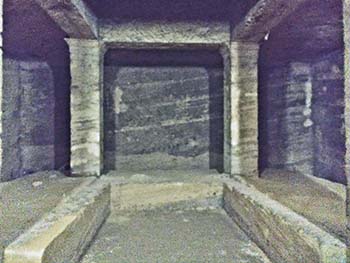
TricliniumA short distance away is the triclinium or banquet room, approximately 9 meters wide and 8.5 meters long. The dining area is defined by four square sandstone pillars. Carved platforms extend between the columns on three of the four sides. Cushions were placed on top of these platforms and the family reclined around a central table in the company of their deceased relatives.

The name Kom al-Shoqafa translates to “Mound of Shards” because of the discarded pottery fragments found over this site. The family would discard all food containers after having visited this house of the dead.

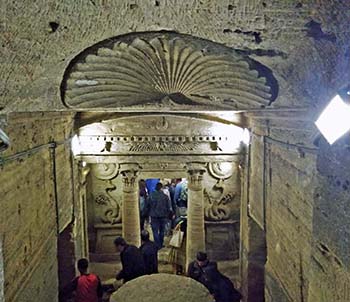
tomb exteriorReturning to the rotunda, descend the stone staircase down to the second level and the Greco-Egyptian temple-like tomb. Carved from the surrounding sandstone, the porch-like pronaos is absolutely stunning with its two columns topped with papyrus, lotus and acanthus leaves. The façade is adorned with a winged solar disc flanked by two falcons. On each side wall, behind the columns, you find a statue set within a recessed area. Presumably these were the owners of the tomb; the husband is on the right and the wife is on the left.

Pass through the doorway flanked by two serpents into the naos or burial chamber. The finely decorated burial chamber houses three sarcophagi recessed into the walls. The lids were carved so that they could not be removed. Mummies were likely inserted from behind by means of a passageway running along the exterior of the tomb.

Exit the naos and walk around to the passageway. Here you find loculi on both sides to accommodate more than 300 mummies. I examined the passageway for any possible openings into the naos sarcophagi through which mummies might have been passed, but I found nothing. When you are finished, return to the rotunda and ascend the spiral staircase back into the light of day. Your next stop is Pompey’s Pillar.

 Pompey’s Pillar

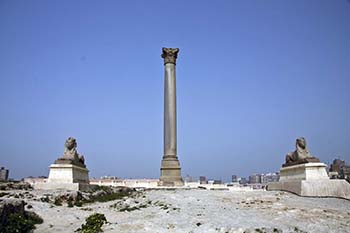
pompey's pillarSet on top of the Acropolis of Alexandria, Pompey’s Pillar is a 285-tonne column of red granite standing just over 20 meters high. Pompey’s Pillar is actually a misnomer. During the Middle Ages, Crusaders mistakenly believed that the remains of the Roman General Pompey, who was murdered in 48 BCE, had been placed in a container at the top of the column. According to an inscription at the base, this was a Roman triumphal column dedicated to Emperor Diocletian in 297 CE. Diocletian was commemorated for having saved the city from a famine. Nearby is an honor guard consisting of two granite sphinxes.

Our guide, Sherif, indicated that Pompey’s Pillar is all that remains of a colonnade that consisted of 400 columns. This colonnade was part of a Serapeum, an ancient Greek temple dedicated to the god Serapis; Serapis was represented by a sacred bull. The Serapeum, constructed in 280 BCE, remained in use until 391 CE when the early Christians thought that this cult was a lot of bull and leveled the structure. Only two underground passages remain.

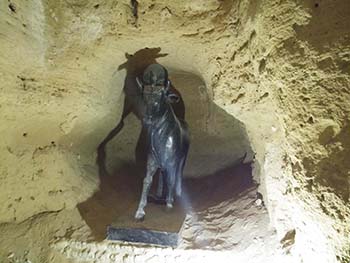
 statue of SerapisThe first passageway is the Sanctuary of Serapis. Passing by an altar just outside the entrance, I entered a warm, humid tunnel roughly carved from the soft sandstone. Slowly, slowly, inch by inch, I crept along the dimly lit corridor, noting the irregularly-sized niches carved into the walls. These recesses may have accommodated statues at one time. Finally, I did not see the light at the end of the tunnel, I came face-to-face with a statue of Serapis, a large black basalt bull. This statue is a copy of the original, now housed in the Greco-Roman museum of Alexandria.

After finding your way out of the Sanctuary, enter the nearby underground gallery known as the Daughter Library. This 75-meter long tunnel with rough carved recesses in the walls was believed to house as many as 7,000 papyrus scrolls as overflow from the Great Library of Alexandria. Find your way down the finished white marble stairway and savor your connection with the Great Library of Alexandria. When you are ready, exit the Daughter Library and move on to the first above-ground site at Kom El-Dekka.

Kom El-Dekka

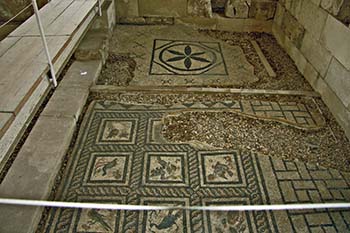
Kom El-DekkaKom El-Dekka (“Mound of Rubble”) is the site of a Greco-Roman residential community and various amenities. During the 1st and 2nd centuries CE, opulent homes like the Villa of the Birds occupied the area. This home is named for the seven colorful avian floor mosaics that include pigeons, peacocks, quails, parrots and flowers. There is even a panther if you look carefully. This villa has not been completely excavated but you will find traces of a triclinium. Look for the black and white mosaic floor.

What is the value of being middle or upper class without being surrounded by culture and higher education? Set inside a grassy hill, a short distance away from the villa, is the Odeion. Dating to the 2nd century CE, this theatre is believed to have been originally used for concerts rather than plays. Looking down from the side I was struck by the gleaming marble reflecting the mid-day sun.

The Odeion was badly damaged due to an earthquake in 535 CE and then reconstructed during the Byzantine period when it was transformed into a large lecture hall for a university. Perhaps this is why the structure, 33.5 meters in diameter, is shaped like a horseshoe. Looking around along the top edge of the theatre, you find 5 pillars. These are believed to have supported a roof at one time. Thirteen semi-circular tiers of seats accommodated an audience of around 600 people. The front row is carved from red granite; the others are white-gray marble.

This university also had at least 22 smaller classrooms or lecture halls. Each was approximately 5.5 X 11 square meters, with a stepped podium and at least 3 tiers of stone seats. During this period, Alexandria was a center for higher learning, so having a university would make sense. After graduating from this university, it was time to study Mamluk architecture at Fort Qaitbey.

 Fort Qaitbey

Fort Qaitbey [Pictured at top – Ed] (pronounced “kite bay”), a Mamluk fortress, was constructed in 1477 CE on the ruins of the Pharos of Alexandria. The Pharos was reduced to rubble due to earthquakes in the 11th century CE and in 1383 CE. Sultan Qaitbey incorporated some of its honey-brown limestone into the fort that bears his name.

The site, roughly 150 X 130 square meters, was protected by an inner and outer wall; the latter has been badly damaged by the sea over time. Four crenelated defensive towers along the outer wall, two of which straddle the main entrance, protect the fort from invaders. If you smile when purchasing your ticket, you might just be able to enter unopposed.

Once inside, you are standing opposite the keep at the far end of the courtyard. This crenelated rectangular keep is three stories high with cylindrical towers at each corner.

Pass through the very solid wooden door and quickly look up at the octagonal opening in the ceiling known as an “oil fall”. From here attackers were provided with a warm welcome of boiling oil. If you make it safely past this point, you are inside the mosque.

This impressive mosque features richly decorated marble mosaic floors and walls and a decorative semi-circular mihrab. A mihrab normally serves to orient the congregation toward Mecca during prayer, but not in this case. The architect was more concerned with the military functionality of the fort rather than proper worship.

This mosque has four iwans. An iwan is a rectangular gallery with walls on three sides; the fourth side is open. These were used for religious teaching.

Climb the stairs to the second floor which consists of rough-cut limestone corridors and many small rooms which possibly served as barracks. The third floor features the Sultan’s iwan. This open-air rectangular room, approximately 4 X 6 square meters, was where the Sultan could meet with visitors. Nearby are two brick ovens for baking bread. While on this floor, take the opportunity to climb one of the defensive towers to enjoy a panoramic view of the area. After completing your guard duty, exit the keep.

A short walk away, I was able to climb the crenelated outer wall, some sections of which are as much as 8 meters high and 2 meters thick. At the top, I found two cannon mounts upon which a cannon could be swiveled to any angle. With this, I focused on the Bibliotheca Alexandrina in the distance.

Bibliotheca Alexandrina

The Bibliotheca Alexandrina is a modern reconstruction the Great Library of Alexandria. Built between 1995 and 2002, this storehouse of knowledge holds over 2 million books and employs over 2000 librarians.

The exterior of the library struck me as being a giant “eye” with the curved exterior walls (eyelids) constructed of Aswan granite. The rough-hewn blocks are decorated with ancient languages. The “ocular surface” or roof consists of many glass panels all sloped towards the Mediterranean Sea.

As you walk through the courtyard running along the western periphery of the library, you are greeted by a bust of Alexander the Great. Unfortunately, I did not have time to visit the interior of the library, but I had the feeling that Alexander was directing me to go south along the Nile and learn more about Egypt. And who would dare to refuse a command like that?

 If You Go:

A private tour to Alexandria from Cairo can be part of your Egyptian vacation. I booked my complete vacation package through Egypt’s Best Day Tours.

If you travel to Alexandria independently you will require a taxi to reach the sites.

The Catcombs at Kom al-Shoqafa are located on Tawfikeya Street. Admission is 80 Egyptian Pounds.

Pompey’s Pillar is located on Amoud el Sawary Street. Admission is 80 Egyptian Pounds.

Kom El-Dekka is located on Ismail Mehanna Street. Admission is 80 Egyptian Pounds.

Fort Qaitbey is located on the end of the breakwater at the east side of the harbor. Admission is 60 Egyptian Pounds.

The Bibliotheca Alexandrina is located at 63 Shar’a Soter.


Full-Day Tour of Historical Alexandria from Cairo Egypt

About the author:

Troy Herrick, a freelance travel writer, has traveled extensively in North America, the Caribbean, Europe and parts of South America. His articles have appeared in Live Life Travel, International Living, Offbeat Travel and Travels Thru History Magazines.

Photo credits:

Diane Gagnon, a freelance photographer, has traveled extensively in North America, the Caribbean, Europe and parts of South America. Her photographs have accompanied Troy Herrick’s articles in Live Life Travel, Offbeat Travel and Travels Thru History Magazines.


Egypt Shore Excursion Alexandria Port Shore Excursion Full Day

Tagged With: Alexandria tours, Egypt travel Filed Under: Africa Travel

MORE TRAVEL STORIES:

Arizona: A Journey Into Navajoland

Things To Know Before Going to Seattle

Uncovering History – The Pioneer Store Museum

Is a One Day Taj Mahal Trip from Delhi Too Rushed for Families

Ways to Generate More Income While You Travel

Germany: Dresden Churches, Survivors of WWII

Burnaby Heritage Village: Ye Olde Fashioned Christmas

Keeping The Light


SEARCH

DESTINATIONS

  • Africa Travel
  • Antarctica travel
  • Asia Travel
  • Australia travel
  • Caribbean Travel
  • Central America Travel
  • Europe Travel
  • Middle East Travel
  • North America Travel
  • Oceania Travel
  • South America Travel
  • Travel History
  • Travel News
  • UK Travel
  • Uncategorized
  • World Travel
facebook
Best Travel Blogs - OnToplist.com

Copyright © 2026 Cedar Cottage Marketing | About Us | Contact | Privacy Policy | Terms & Conditions | Copyright Notice | Log in