Travel Thru History

Historical and cultural travel experiences

  • Home
  • Airfare Deals
  • Get Travel Insurance
  • Writers Guidelines

Cambodia: 5 Top Spots Near Angkor Wat

Angkor Thom Cambodia

by Jonathon Engels

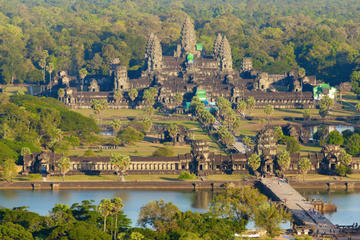
Angkor Wat is the largest religious monument in the world, with skillful carvings adorning every block in the place. However, my most memorable moments spent in Siem Reap did not happen in Angkor Wat but in the sights that surround it. For nearly a week, tucked into the back of a privately rented tuk-tuk, my wife Emma and I drove our chauffeur to the boundaries of sanity. There was no place we weren’t willing to have Lee take us.

1: Angkor Thom
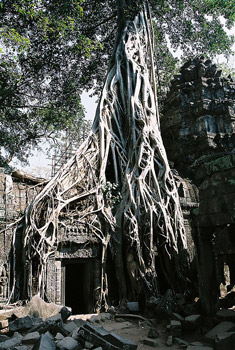
Angkor ThomThe entry towers at Angkor Thom are among the most photographed relics in Cambodia. Stuck in traffic on the causeway bridge leading to a towered entrance, Lee told us about how the statues—fearsome demons on the right of the bridge, confident gods to the left—had been decapitated only a few decades ago by the Khmer Rouge. Simulating a dagger across the neck, he alleged thieves are still smuggling pieces across the border to Thailand for black market sales.

Angkor Thom is nine square kilometers of walled city with a huge moat, a dozen temples, and statues around every corner. Inside, children are everywhere vying to be in photos, after which they charge a dollar. One boy, joined by a worrisome number of friends, showed us a statue of an elephant “hidden” behind one of the temples. The special viewing was not free of charge. Our entrepreneurial guide wanted his tip and so did all the boys that came along.

*Also, make sure to go to Preah Kahn, just northeast of Angkor Thom, for the famous tree on the temple photo. Preah Kahn is perhaps the most stunning of all the temples because it is being overrun with vegetation. It’s a great place to explore, ducking under branches and climbing over roots, discovering photogenic spreads in every corner.

2: The Floating Village of Tonle Sap
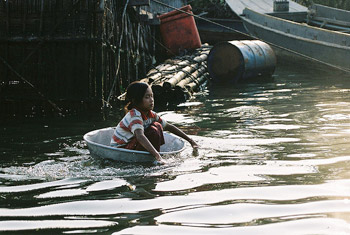
child playing in waterIt would be difficult not to notice the intense poverty and hardship of Cambodia, even in an area like Siem Reap, exploding with resort hotels. People beg in heartbreaking fashion. Tuk-tuks are kitted out with signs to notify that this particular driver will not take passengers to underage sex dens. The maiming effects of the Khmer Rouge are evident everywhere. For us, the extent of poverty didn’t fully resonate until the ride south to the waterways of Tonle Sap: Houses along the roads were simply raised platforms with roofs, no walls to block us from seeing in.

Tonle Sap is a fluctuating mass of water than shrinks to about 2700 km2 (1675 miles2) of meter-deep water for much of the year, but it swells to over five times that size and up to nine meters deep during rainy season. Designated a UNESCO biosphere, it supplies most of the freshwater fish in Cambodia, as well as half of the flow to the Mekong Delta in Vietnam. The waters support over three million people. For these reasons, it’s an interesting enough place to visit.

That said, the Floating Village is without a doubt something once a bit unbelievable turned into a tourist highlight. The boat trolled between houses that were indeed weaving and bobbing on water’s surface, but our “tour” consisted of going to a souvenir shop/crocodile farm. Even so, it was pretty cool to see children sitting in empty washtubs to paddle from one home to another.

3: Beng Melea
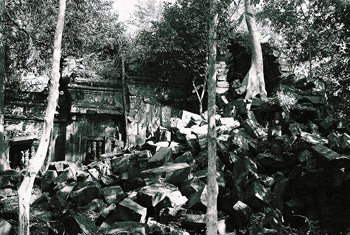
Beng MeleaLee tried to talk us out of it, but he conceded to our wishes. The progression of places we’d chosen that day meant that he was going to have to use a pot-holed dirt road rather than a new, nicely paved one. And, we got a flat in…somewhere, Cambodia. Lee unhooked the trailer, and a roadside worker carted it off by hand. We were not in Siem Reap anymore. From the depths of a dirt road to nowhere, a bike drove by with two full-sized upturned pigs strapped to the back, grunting over each pothole. There was no other traffic for the hour it took to get back on track.

Only a round fifty miles from Siem Reap, the “staff”, a few folks hanging out at the front of Beng Melea, far outnumbered the guests. A little old lady showed us around, Lee included. A kids’ film, Two Brothers, had been recently filmed there, so the sturdy wooden platforms used for moving equipment now acted as comfortable viewing posts. At the end of the last platform, our guide simply stepped off onto the mountainous pile of sandstone blocks.

Beng Melea is absolutely in shambles, only the occasional wall standing amongst a collection of rubble. Our guide took us clambering, jumping, dropping, and discovering. It was as if no one else even knew the place existed, that we were there, or the high likelihood one of us—both in flip-flops—was going to take a pretty intimidating tumble. We didn’t. Instead, we sat atop the western edge of the ruins for a quiet picinic.

Unsurprisingly, the ride home, on that nice paved road, suggested Lee may have been right.

4: The Cambodian Landmine Museum Relief Facility
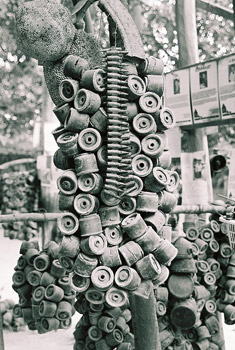
landmine museumLeading up to our trip, Emma and I had read an incredible memoir, ‘First They Killed My Father’, about a young girl who survived capture by the Khmer Rouge and life in camps where kidnapped children were forced to be soldiers, brainwashed and made to do unspeakable things. Aki Ra was one of these child soldiers, but in 1997 he went back to villages where he had once set up thousands of mines and, working by hand and homemade tools, started defusing them.

The project garnered amazing international support, and now Aki Ra runs the Landmine Museum just outside of Seim Reap and continues the perilous task of ridding fields of landmines. On the day we went, Aki Ra wasn’t there because he was out clearing mines. Nevertheless, we got the point. Not the typical museum, this place was basically a massive outdoor collection of the thousands upon thousands of defused landmines. Everywhere — hanging from posts, balled on the ground — were clusters of different types of mines. It was horrifying.

In addition, the Landmine Museum also houses more than forty children and supports a community of seventy-five people. Originally, Aki Ra began by adopting children who’d been wounded by landmines, but now the center takes in children suffering from whatever difficulties. On site, there is a school, complete with a computer lab, a library, English classes, and a playground.

5: Kbal Spean, The River of a Thousand Lingas
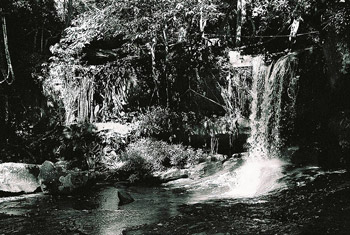
Kbal SpeanWhen we reached the end of the pavement, Lee pulled over, unhitched the tuk-tuk, and told us to climb on the bike with him. The road ahead was far too rough, so there we were, Lee on the front, Emma squeezed between us, and me with my hands vice-gripped to the back of the seat. Truth be told, the road was so rough that, for the bulk of the ride, Lee drove in the ditch and on the embankment running alongside the street. I don’t really remember how long the ride took—less than an hour—as I was concentrating on not popping of the back.

We eventually arrived at a little trailhead where two statues stood. Again, there were very few visitors as we wound our way down the dirt path to a small tributary of Siem Reap River, but the Kbal Spean site has several highlights, including a waterfall, sandstone sculptures from Hindu mythology, and a carved river bed. Many rocks on the banks have incredible depictions of gods, animals, and people, but the river bed steals the show: Water bubbles over varying patterns chiseled into long stretches of stone.

The ride back proved just as much fun. Emma had never been on a motorcycle before, so she spent most of the ride with her head poked to either side of Lee’s, excited by all the scenery. When we finally stopped, Emma and I got off the bike, dusting ourselves clean, but Lee burst into laughter. Emma had taken off her sunglasses, and there was a thick monobrow of dirt that had formed just above the top of those shades. Worse, there was no water around to clean it off.

After four days of chauffeuring us around, Lee dropped us off at the front of our hostel for the final time. Both Emma and I, at the beginning of our trip, prone to bonding a little more readily than a local tour guide might be, had tiny lumps in our throats. We asked him how much for the week, and in true Southeast Asian style, he replied, “What do you want to pay?” I guess he’d seen it all before.


4-Day Siem Reap Tour: Angkor Wat & Angkor Thom

If You Go:

Worthy Causes in Cambodia

♦ Cambodian Landmine Museum and School – Founded by a former Khmer Rouge child soldier (suppressed into service), this Cambodian-run NGO is dedicated to removing landmines, educating the world about them, and helping victims of this ongoing problem in Cambodia. Web site: www.cambodialandminemuseum.org

♦ Rosy Guesthouse – Our hostel in Siem Reap was involved with many worthwhile project in the surrounding communities, and through them, we were able to support an NGO working to prevent child exploitation and another providing musical training to mine victims. Web site: rosyguesthouse.com/responsible-toursim

♦ Let Us Create – An NGO in Sihanoukville provides a private space for children to be creative with paints and more. Needy children also get an education (both Khmer and English classes), nutritional support, and health check-ups. Web site: www.letuscreatecambodia.org. For more information, visit: The NGO Forum on Cambodia – www.ngoforum.org.kh/.

5-Night Cambodia Tour to Angkor Wat from Phnom Penh by Air

About the author:
Jonathon Engels has been an EFL expat since 2005, just after he earned an MFA in creative writing and promptly rejected life as an instructor of freshman comp. He has lived, worked and/or volunteered in seven different countries, traveling his way between them. Currently, he is in Antigua Guatemala, where most mornings he can be found tucked behind a computer in the corner of a coffee shop. For more from Jonathon, check out his website jonathonengels.weebly.com and blog jonathonengels.travellerspoint.com/.

Photo credits:
Bayon, Angkor Thom by Diego Delso / CC BY-SA
All other photos by Jonathan Engels – see more at: www.flickr.com/photos/jengels78/sets/72157633388050634/with/8696493506
 

Tagged With: Cambodia travel, Siem Reap attractions Filed Under: Asia Travel

Confronting Horror: Tuol Sleng Genocide Museum

Tuol Cleng Genocide Museum, Phnom Penh

Phnom Penh, Cambodia

by Lee Beavington

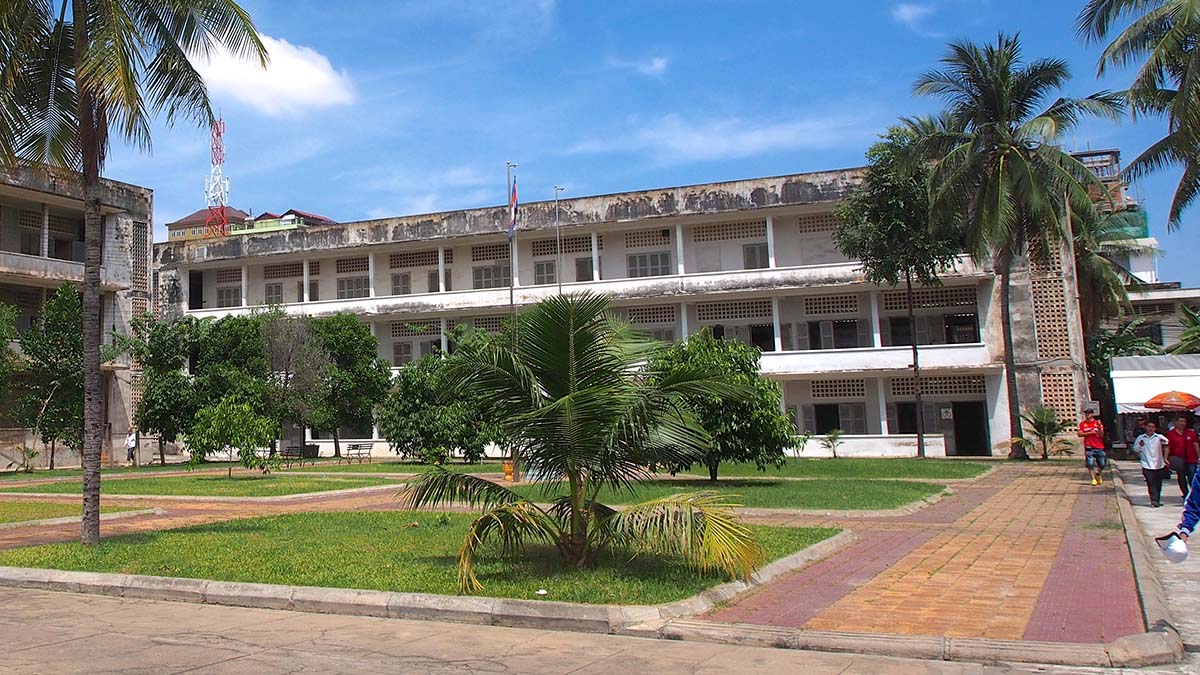
Rusted barbed wire crowns the two walls that enclose the dilapidated school. A few Cambodians stand outside the only entrance. One is on crutches; he holds a cap for change, his leg amputated above the knee. Most tourists walk by without a second glance, lost in their own dismay, having witnessed far worse than the carnage caused by forgotten land mines.

In 1975, the insurgent Khmer Rouge seized the capital, Phnom Penh, and with it the entire country. They restarted the calendar (calling it Year Zero), abolished currency, split up families, and enslaved everyone – including children, the elderly and the infirm – into 15-hour-a-day labour. During the three years, eight months, and twenty-one days they were in power, an estimated two million Cambodians lost their lives from starvation, overwork or execution. Twenty thousand of those were caged within these institutional walls, the school that came to be known as Tuol Sleng, or Security Prison 21.

To visit a country and not pay respect to their people, and what they have gone through, seems somehow discourteous. Too often tourists are armed only with a camera and a long itinerary, and I am determined to do more than conquer Angkor Wat and flee home with a full memory card. Many people flash photos inside Tuol Sleng, ghastly mementos of conditions that would make concentration camps seem almost agreeable in comparison. I take only one shot–so I will not forget.

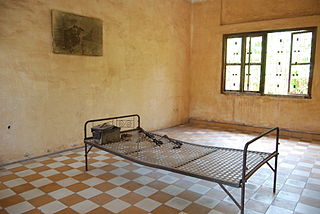
torture room in Genocide museumThe first set of classrooms turned prison cells includes iron barred windows, and a single bed with an attached shackle. A blown-up photo of a dead Cambodian, barely recognizable as a human, rests hauntingly above the bed. The very educators that worked in this room as teachers were incarcerated in these hellish conditions. And when they died, in a final act of grievous disrespect, a photo was taken of their emaciated, bloodied body.

Engineers, ministers, farmers, diplomats, even monks were brought here. Interrogated and tortured, they were coerced to follow nine strict rules, including Do nothing. Sit still and wait for my orders and While getting lashes or electrification you must not cry at all. The unfortunate survivors were taken to the Killing Fields outside Phnom Penh and forced at gun point to dig their own graves.

In the school courtyard stands a set of high bars with rope where children did their exercises. Except the Khmer Rouge used it to hang people upside down until they lost consciousness, and then plunged their heads underwater. A playground converted into a gallows.

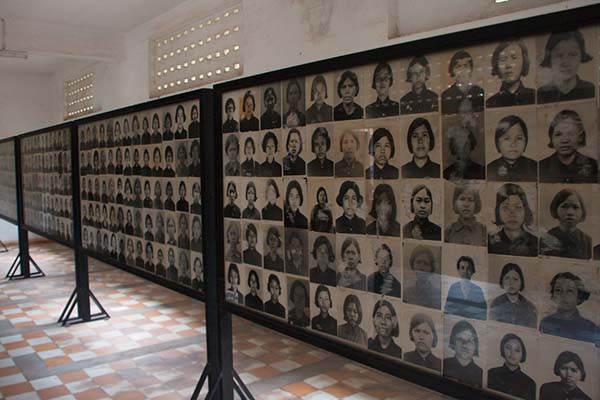
photos of genocide victims in Cambodia museumOne exhibit in particular brings me to stunned silence. The room has photos of every victim, a casualty catalogue meticulously recorded by the Khmer Rouge. Each board displays hundreds of black and white photos, arranged like a giant checkerboard–thousands stretch from one room to the next. My girlfriend barely crosses the threshold before seeking sanctuary in the courtyard, too distraught to continue. I console her and then return in stubborn determination. To do what, I’m not sure. But I need to see what these people have seen, even if I can only manage a small glimpse, in the hopes of finding some sense of understanding.

Vacant stares from eyes that witnessed daily horrors follow me as I venture sluggishly around the first room. I move from one dire face to the next: hollow, gaunt, not an ounce of spirit remaining in the shadowed windows of their eyes. Each person bears a numbered necklace, a way for the Khmer Rouge to keep track of every victim. I feel like a scientist, an objective and impartial observer of Cambodian history. Purely a defensive mechanism to keep my emotions at bay, for I know how easily I could be overwhelmed.

From the corner a woman emerges, tears streaming behind the hand on her cheek. I approach the area with trepidation, wondering what greater horror I will find. I move around one display to another. A hundred sets of eyes gaze back at me, their colour and light gone. And yet each seems to be screaming: why? My heart bursts, unable to contain its sorrow and despondency any longer. Tears unashamedly fall, heavy and full. I cannot understand.

Children fill the entire board. One photo after another; a boy that just entered teenagehood; a pre-pubescent girl; countless other toddlers younger than my own nephews. In fact, two thousand children were killed at Tuol Sleng. In the school where they had come to learn, to feel safe, to play in the courtyard, they were instead separated from their families, shackled, tortured, and murdered.

I flee from the room, not with remorse, but with a rising nausea originating from incredulous disbelief. The neighbouring rooms offer no solace, photos of joyless mothers clutching babies to their shrunken breasts, naked men with protruding hip bones. Those little eyes follow me wherever I go, begging, pleading, surrendering. Why?

As I step stoically from classroom to classroom, floor to floor, building to building, my body becomes numb. I see cells made of hastily stacked bricks, walls with layered bloodstains, interrogation rooms with torture devices at which even the most hardened would cringe. Yet I stumble across one alcove of comfort, one place where no tainted remnant of the Khmer Rouge lingers.
Hidden underneath a staircase is a wall of colourful graffiti. Words are scribbled in pencil, pen, or whatever else visitors to the genocide museum had with them.

Never again.

Give peace a chance.

God is love.

It’s not common to find refuge in graffiti, let alone proclamations of hope and faith. But here, in one corner of the former school, are overwhelmingly positive affirmations. I breathe in the soul-lifting messages like a deep-sea diver who has come up for air.

Not all responses are so gracious. One of the most disheartening sights comes towards the end of my gloomy tour. I discover more graffiti, this time on framed photos of members of the Khmer Rouge. One can understand the survivors’ anger – utter hatred – at a regime that eradicated one-fifth of the country’s population. Yet even the men and women whose association with the Khmer Rouge was questionable are defaced by the bold markings of outraged Cambodians.

I go back to the courtyard and find my girlfriend. While we sit in silence, the couple beside us begins to argue. Their words escalate in a petty dispute about itinerary. I can’t help but think, hate breeds hate. If one cannot forgive, then hate endures.

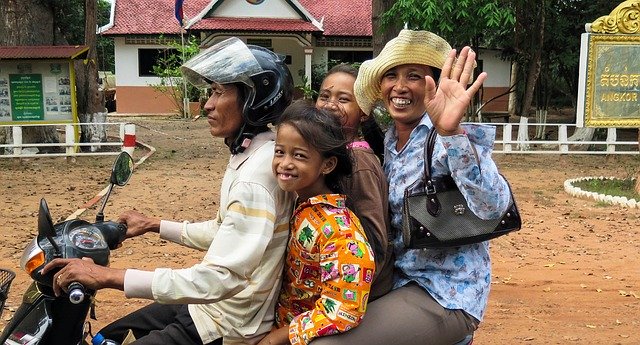
Cambodian familyIn my visit to Cambodia, I truly cherished the kind-hearted people and their cheerful smiles. Despite living impoverished lives, with polluted water, diminutive houses that sleep dozens, back country littered with land mines, and where a good day is marked by having three meals, they never failed to greet me with generosity and warmth. Tuol Sleng revealed two extremes of the nature of our species: how the power of a misguided few is capable of producing great evil, and the strength of the human spirit in overcoming unspeakable atrocities. Cambodians struggled through a horrendous 20th century, with occupations by nearly every neighbouring country, covert carpet-bombing by US forces for four years, and devastating famine following the Khmer Rouge regime. They have persevered through it all.

If there is one thing I can now understand, it is the smile on the face of every Cambodian.

If You Go:

Tuol Sleng is located in Cambodia’s capital, Phnom Penh. A visit is not for the faint of heart. You must be centered and strong. Be prepared for illustrations of gruesome torture techniques and cabinets full of human skulls. Entrance fee is minimal. Beggars often congregate outside the former school’s entrance. Donations are currently being sought to help preserve the site. When inside, you are asked to refrain from making noise, and to “be concentrated spiritually and physically in order to pay respect to the souls of victims.”

Private Full Day Phnom Penh City Tour
Phnom Penh Highlights
Half-Day Phnom Penh Food Tour

About the author:
Lee Beavington works in biology, toils in writing, swings in dance, dabbles in Buddhism, revels in travel, and specializes in being. His novella, “Evolution’s End”, was published in Writers of the Future XXII. The curious can find out more at www.leebeavington.com. Read his weekly 100-word bioflash!

Photo Credits:
Tuol Sleng Genocide Museum exterior by Clay Gilliland / CC BY-SA
Torture room by Paul Mannix / CC BY
Photos of genocide victims by Christian Haugan via Flickr
Cambodian family by kolibri5 from Pixabay

Tagged With: Cambodia travel, Tuol Sleng Filed Under: Asia Travel

Timeless Temples and Trees of Angkor

Tree growing in Angkor Wat temple

Angkor Wat, Siem Reap, Cambodia

by Lee Beavington

The full moon hangs low. Voluminous clouds shroud us in darkness as we ride toward Cambodia’s ancient Angkor temples, and the world’s largest religious monument. The open sides of the tuk-tuk (essentially a motorcycle pulling a covered cart, in which my girlfriend Jen and I sit) allow us to breathe in the cool, tropical air, a far cry from the stifling midday heat. Our nine-temple itinerary convinced us to wake at a bleary-eyed 4:30 am.

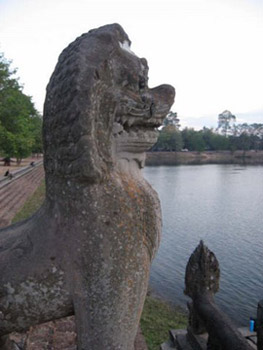
Lion statue near lakeWe catch a glimpse of moonlight shimmering on Angkor Wat’s monstrous moat, which holds enough water to fill a thousand swimming pools. The tuk-tuk rumbles past the hordes of tourists, all armed with cameras in pursuit of a perfect temple sunrise. We head toward a less traveled destination: Srah Srang. Dug out nearly a thousand years ago, the 700 by 350 meter “pool of ablutions” once served as bathing grounds for Angkorian royalty.

The tuk-tuk comes to a grinding stop. Between the masked moon and the now dimmed tuk-tuk headlight, we find ourselves staring into pitch black. A girl’s voice suddenly breaks the sacred quiet of the sanctuary.

“You want coffee?”

Touts are commonplace outside every temple, born out of third world tourism, and always with something in hand to flog. “You want tea? Or maybe a shirt? Trousers? Books?”

We negotiate our way through darkness and touts to the water’s edge. A dozen other tourists are scattered around the sandstone terrace. Elephantine steps lead down to the tranquil lake, while life-size lion statues sit regally beside us, their stoic stares awaiting the first reflections of dawn. Pale light fills the overcast sky.

We turn, and suddenly face our first truly spectacular sight of the day: on the opposite horizon, the full moon is setting above the elaborate stone-carved gateway to Banteay Kdei. Absorbed by the veiled sunrise, I didn’t notice the archway with its huge face in the rock gazing back at me. Passing beneath the entrance—large enough to accommodate an elephant—feels like passing through a time portal. Built around 1300 during the reign of King Jayavarman VII, the crumbling Buddhist monastery still retains its original masonry—countless corridors and bas-relief carvings.

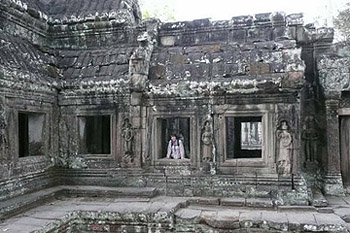
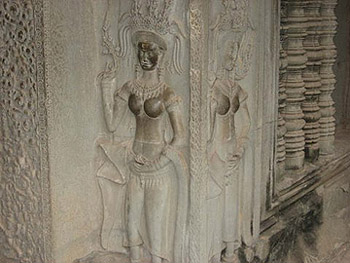
Angkor Wat templeFor centuries Buddhists roamed these halls; some still do, as evidenced by the sugary incense shedding smoke over cross-legged Buddhas. Most walls hold carved Bodhi leaves and ornamental flowers, outlining sculptures of sensual apsara dancers and peculiar creatures from Hindu mythology: Garuda, a man with the head of a bird, and his mortal enemy Naga, the giant, multi-headed serpent with a cobra hood. In Cambodia’s past, Hinduism supplanted Buddhism, at least for a time, so their respective sculptures merge and overlap in most Angkor temples. The exotic, entrancing stonework never seems to end, and the sun creeps well toward noon before we depart.

 “Ta Prohm,” we tell our tuk-tuk driver.
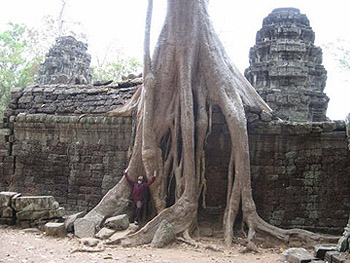
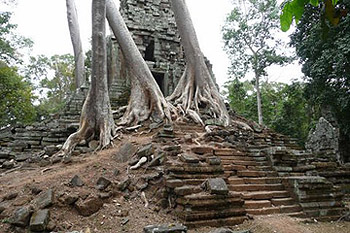
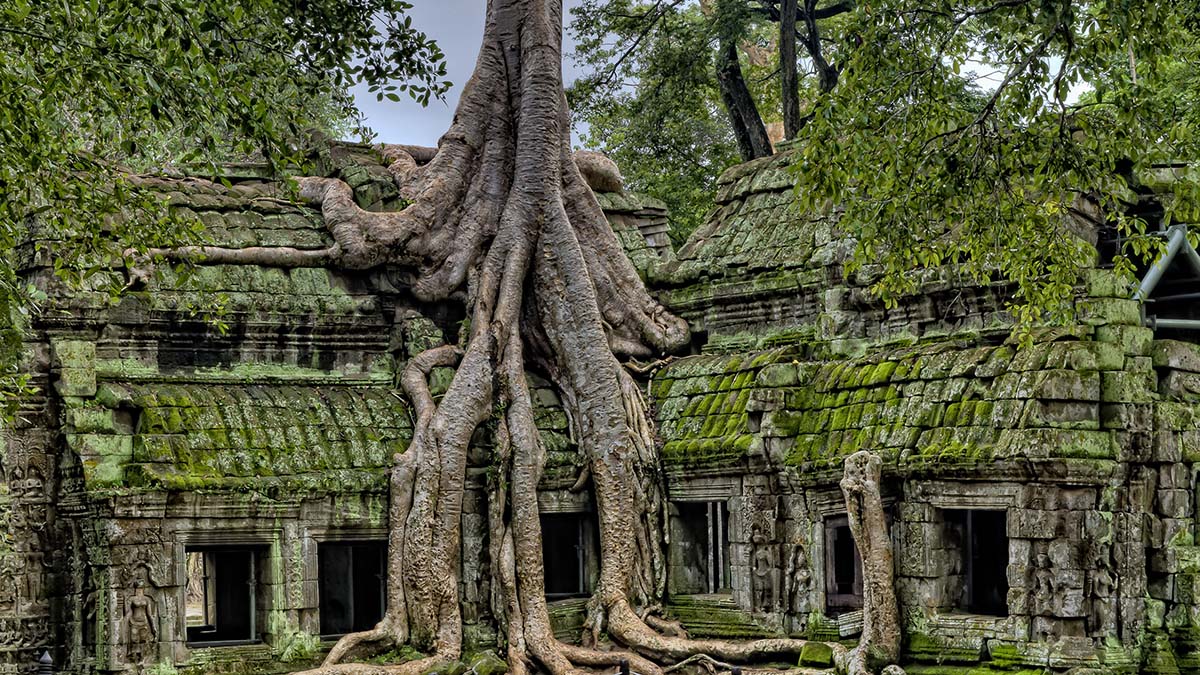
He nods, and we shield our faces from the dust as we speed toward the next temple on our agenda, and the highlight of our two weeks in Cambodia. On foot again, we cross the threshold of another imposing entry tower (called a gopura, meaning “gate with a face”) and flash our pass at the guard. We make our way to the root-ridden central sanctuary. A dozen stone towers materialize amongst the tapestry of green and yellow foliage.

“Oh my god,” Jen remarks, a common refrain at Ta Prohm. “Oh my god.”

tree roots envelop temple wallMost of the Angkor temples have been cleared of curious vines and invasive trees. But here, tropical jungle has run amok, transforming Ta Prohm into a living exhibition of man versus nature. The temple’s four concentric walls are riddled with visible roots belonging to century-old silk-cotton and strangler figs. Their spiderweb branches stretch well above the tallest towers. From a seed that found a patch of viable soil atop the laterite walls, tentacle-like roots – some of which are thicker than me – reach down through the crevices of masonry, dislodging huge cubic stones.

I find a secluded spot to sit and absorb the magnificent display. The eroded wall next to me leans precariously to one side, like oversized lego blocks placed by a toddler’s hand. Part of the upper half has already toppled, so I can see the detached, individual stones used in Ta Prohm’s construction. Each of these huge grey bricks are far too large for even four men to carry. I am lost in wonderment, inspired and humbled by humankind’s remarkable and resolute mind. Only the ants marching over the slabs of rock, an endless highway of workers, show a comparable determination to create such vast empires. I think of the thousands of Khmers who laid down this temple’s foundation in 1186, all as a tribute to Jayavarman’s mother, the former Queen.

tree growing on Cambodian templeFrom there, we visit the three-tiered pyramid of Pre Rup, and then the vast complex of Preah Kahn, wandering the vaulted corridors of the antiquated Buddhist university. But it is the ancient city of Angkor Thom that demands a more thorough exploration.

Here, the monuments and shrines are ubiquitous. It takes a hundred steps to follow the continuous hunting scene sculpted in stone along the elephant terrace. Phimeanakas, the royal palace, resides high above a daunting set of steep, shallow steps that only accommodate feet placed sideways.

Jen squints to see the top. “I am not climbing that.”

“We’ll find a way,” I say. And we do. I feel like Indiana Jones on the most elaborate set ever constructed.

face in stone towerThe shaded and peaceful Preah Palilay, a solitary tower with huge trees growing like stubborn pillars right out of the crumbling foundation, is the perfect place to awaken everyone’s inner Buddha. And then I spot the countless face-towers of the Bayon.

From afar, the Bayon resembles a pile of unexciting, lichen-clad ruins. Upon closer inspection, I realize the temple is watching me from all sides. The thirty-seven preserved towers rise up above a labyrinth of dark chambers, arched corridors and treacherous stairways; colossal stone faces stare impassively from each, usually in all four cardinal directions, their original emotions long since eroded. The stoic gaze of King Jayavarman follows my every step. Is he welcoming me? Or cursing me for trespassing? “Angkor Wat?” our tuk-tuk driver inquires when we return.

I nod. We’ve saved the biggest and boldest for last.

Angkor Wat was originally a Hindu temple, lost for centuries and rediscovered in 1860 by French adventurers. Of course, the Cambodians knew it was there all along. The temple has infiltrated almost every aspect of their culture, from the flag and currency to t-shirts and the national beer.

bas relief carvings inside complexOur tuk-tuk driver yields to a train of oncoming elephants. Soon Angkor Wat’s five summit towers become visible over the high tree line. The main causeway of this grandiose 12th century temple holds hundreds of people, stretching across a moat with a six-kilometre perimeter. Inside the main complex, endless arrays of bas-relief narratives showcase creation myths, historic processions, and godly battles. Everywhere I look, another marvel: nearly 2,000 carefully carved apsaras. I want to touch one of those smooth, weathered bodies of stone, but stay my hand in order to preserve the feminine curves for future generations. Where countless others have touched them for good luck, statue faces, bellies and breasts are blackened by skin oils.

Macaque monkeys scurry up the central temple-mountain, their lithe, tailed bodies silhouetted by the darkening sky. The gathered crowd roars at their amorous antics. Overwhelmed by the sheer immensity of the place, I crane my neck and gaze upward in awe at towers that have stood in solitude for almost a millennium. Within the gargantuan walls of this grandest of creations, I feel like an ant from a visiting colony, very small and very out of place. Yet I don’t want to leave. I am shaken by the audacity of humankind to conceive and construct such a monument. To haul huge masses of sandstone from the distant Kulen Mountains, stack them into structures both imposing and reverential, and meticulously carve every available surface is a testament to our species’ tenacious drive to create.

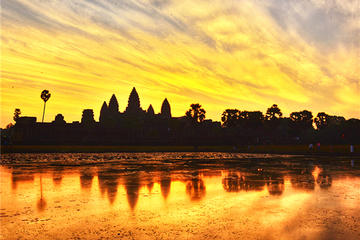
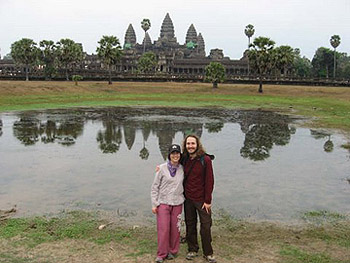
the author in front of water and templesOn our way out, the sun hugs the horizon. We stand in front of the south pool and a willing fellow tourist snaps a shot of Angkor Wat reflected above us in the calm waters. We thank him and venture back to our hotel in Siem Reap, utterly spent.

As I drift off to sleep that night, I see a vision of the day’s first temple – Banteay Kdei – recalling it as I walked through its grand gopura under the light of the full moon. Truly one of the wonders of the world, the temple ruins are a rare opportunity for an up-close, hands-on travel through time.

If You Go:

Cambodians speak English in all the major towns. Despite the lack of a language barrier, the oft-smiling Cambodians certainly appreciate hearing thank you (“awkun”) in their native Khmer.

Pick up a copy of the remarkably informative Ancient Angkor by Claude Jacques (available in English and French). It retails for about $30, but you can find it in Siem Reap for $5 US.

Currency: Cambodian Riel. However, US dollars are readily accepted nearly everywhere in Cambodia. $1 USD = approximately 4000 KHR. Many hotels and restaurants take credit cards. Have small cash on hand to pay tuk-tuk drivers and vendors selling water and snacks.

Best time to go: Late November to February. The rainy season runs from June to October. April is the hottest month, when temperatures soar over 40 degrees Celsius. However, the average daytime temperature stays above 30 degrees year-round, making a hat, sunscreen and light clothing all essential items.

How to get there: Fly in through the capital, Phnom Penh. An air conditioned bus from Phnom Penh to Siem Reap (a five hour ride) costs under $10. Siem Reap is ten minutes south of the Angkor temple ruins. This bustling river town has its own airport, which is an option for a shorter trip just to see the temples. Accommodation: Accommodation is available in Siem Reap, which includes hot water, fridge and air conditioning for under $15 a night, although you may have to put up with mosquitoes and ants.

Visiting the Temples: A day is simply not enough to see all of Angkor. Passes can be bought for a single day ($20), three days ($40) or a week ($60). The fittest travellers can rent a bicycle to get around, but that makes for an exhausting day, especially with the heat. Your best bet is to hire a tuk-tuk driver, who will drive you around from sunrise to sunset for a mere $12. Also, an English guide can be hired for $25 a day.

Other Attractions near Angkor Wat: Kbal Spean, home to a number of amazing riverbed carvings, is about an hour’s tuk-tuk ride from the main temples. The standard tuk-tuk fare seems to be $28. In Siem Reap, the quiet and modern Buddhist temple Wat Bo offers a respite from the busy city. Hundreds of shrieking fruit bats hang out in the trees near the Royal Gardens, which many people seem to miss. The Artisans d’Angkor workshop is also worth a visit, to see how traditional stone and wooden carvings are made, and the Old Market (Psar Chaa) is a hub for shopping, where every imaginable item can be haggled for – if you can handle the pandemonium.

For More Information:

Wikipedia: Angkor Wat
UNESCO: Angkor

Angkor Wat Tours Now Available:

Half Day Private Splendour of Angkor Wat Cultural Tour
Full-Day Private Discovery Tour of Angkor Complex from Siem Reap
Angkor Wat Helicopter Flight with Private Tour of Temples
Private Tour: Angkor Wat and The Royal Temples Full-Day Tour from Siem Reap

About the author:
Lee Beavington works as a biology lab instructor at Kwantlen University College in BC. In the past two years, he has traveled to India, Sri Lanka, Kenya, Iceland, Cambodia and South Korea. He writes in many genres, including memoir, science fiction and flash, and had a novella published in Writers of the Future XXII.
Writing website: www.leebeavington.com
Travel blog: http://leeodyssey.blogspot.com/
Contact: lee@leebeavington.com

Photo credits:
First Angkor temple tree photo by James Wheeler on Unsplash
All other photos are by Lee Beavington / Jennifer Burgess.

Tagged With: Angkor Wat, Cambodia travel Filed Under: Asia Travel

Digging Up An Ancient Khmer Puzzle

temple in Phimai, Thailand

Ban Non Wat, Northeast Thailand

by Doug Matthews

We’re playing in the dirt, my new friend and I. We’re lying on our stomachs flat on the ground, pushing and poking the dirt with our toys. We’re just like kids, chatting, laughing, with not a care in the world. But there’s a subtle difference.

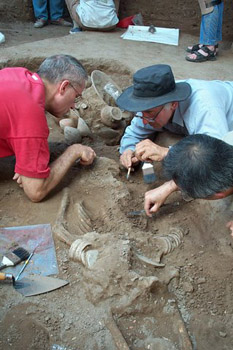
Ban Non Wat archaeological digI’m a retired volunteer getting away from Vancouver’s February rain on a holiday in rural northeastern Thailand, and my new friend is Dr. Charles Higham, an archaeologist and one of the world’s foremost experts on SE Asian prehistory. (In photo below, with hat.) He is a Professor Emeritus at Otago University in Dunedin, New Zealand and Principal Investigator on this “dig,” an archaeological project run jointly by Otago University and the Thai Fine Arts Department in Bangkok. Our “toys” are trowels and fine surgical instruments that we use to clear away the dirt from a 3000 year-old Bronze Age skeleton adorned with marble bangles and beads, and accompanied in her burial by over a dozen beautifully decorated ceramic pots. She is one of 290 similar burials unearthed by Higham over the past three years of managing this project.

The project is large by current archaeological standards. It employs 20 staff, mostly archaeologists in their own right or specialists in a related field such as osteoarchaeology (specialists in bones and skeletons) and geomorphology (study of landforms), and 35 local villagers from this tiny rural community called Ban Non Wat, as labourers. The villagers subsist on only rice and a few other meager crops throughout the rest of the year, so this dig provides a major secondary source of income. The remainder of the team is comprised of volunteers such as myself.

Dr. Charles Higham at archaeological digThe thrill of hearing your trowel “clink” on an artifact or part of skeletal remains that nobody has seen for over 3000 years is shared by all of us who are volunteers. In addition to digging, we take turns reconstructing ancient pottery (similar to assembling a three-dimensional jig saw puzzle) and sorting other finds such as jewelry and tools. In the evenings, we are treated to short lectures about the project and the ancient Khmer civilization.

For the privilege of literally getting down and dirty for two weeks on a real dig, we pay the equivalent of $2800 Canadian each. This covers our two-week room and board at an upscale hotel in the local town of Phimai, a 45-minute ride away from the dig site in a pickup truck outfitted with side seats in the truck bed. A clean room with air conditioning and en suite shower and toilet is considered luxurious as digs go, and this one is popular for that reason. Exquisite food that is sympathetically not too spicy for the western palate and cheap beer ($1.50 Canadian for 660 ml), add to the popularity. As part of our evening activities in this quaint town, we occasionally venture out to get to know the locals and encounter such tempting market delicacies as fried scorpions and grasshoppers (I try the grasshoppers but pass on the scorpions) and such activities as betting on kickboxing matches, with some wildly enthusiastic fans. Elephants mixing with the local traffic is also a common sight.

The $2800 fee (2005 price) is paid to an international non-profit organization, the Earthwatch Institute, headquartered in Maine, USA. Of this amount, 50% ends up as the lion’s share of funding for Higham’s dig, with the remainder of his revenue coming from grant money. Throughout the dig season running from early December to early March (Thailand’s dry season), there are five volunteer teams, with each team of up to 15 persons staying for two weeks, although there is also a shorter one-week option available. Volunteers come from all countries and walks of life. Our dig, for example, had volunteers from Canada, USA, Britain, Bangladesh, Japan, and Sri Lanka, their ages ranging from early 20’s to mid 70’s. Earthwatch, whose mission is “to promote understanding and action necessary for a sustainable environment,” has over 125 similar “expeditions” in which anyone of any age can work shoulder to shoulder with experienced scientists in the field on real – and often exotic – research projects as varied as studying Namibian Black Rhinos in Africa, listening to disappearing Russian folk music, or controlling invasive plant life on the Galapagos Islands. My choice, one of their many archaeological digs, helped to fuel what is rapidly becoming an engrossing retirement hobby of studying the world’s major ancient civilizations. The dig experience, advertised as the “Origins of Angkor,” also allowed me to fulfill another dream, that being to visit the extraordinary temple complexes of Angkor in northern Cambodia following my two weeks with Higham.

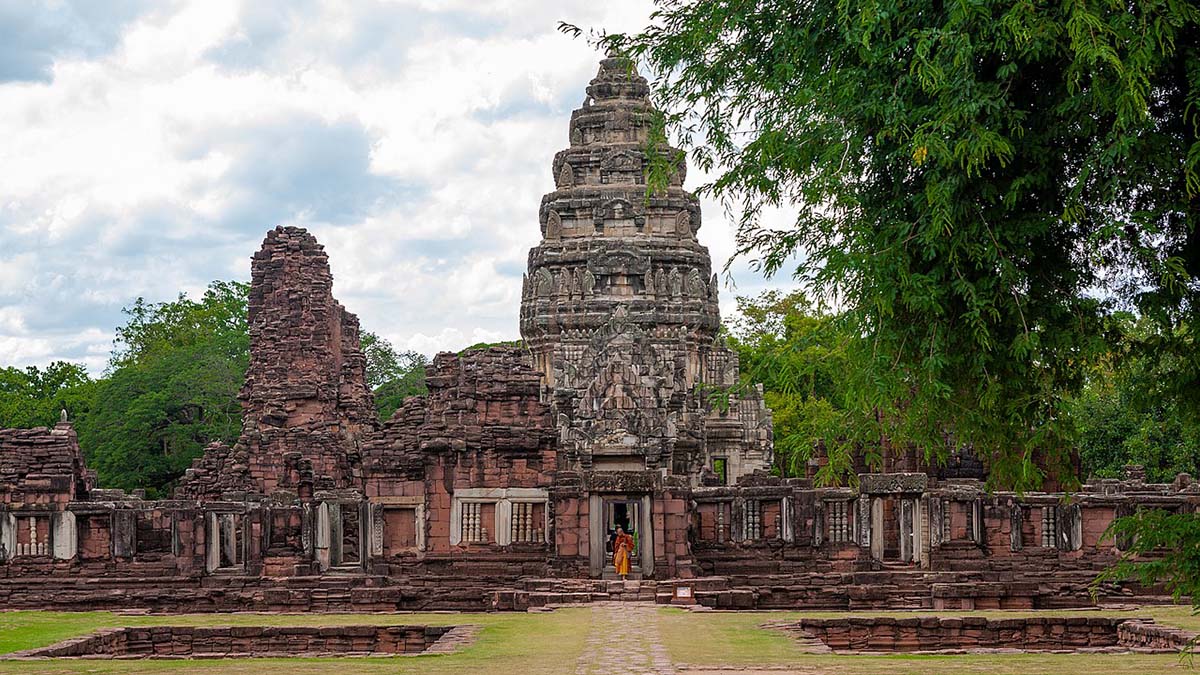
Phimai, ThailandPhimai, the town where we lodged while on the dig, was the northernmost settlement of the ancient Khmer empire that covered a lot of Southeast Asia between the 9th and 15th centuries. A highway linked Phimai with the capital of Angkor during that period, a distance of about 225 km, but it has since been overtaken by jungle. Today, it is much more efficient and comfortable to travel the distance by air on one of the regular flights from Bangkok to Siem Reap, the main tourist town just south of the ruins of Angkor. Siem Reap is a bustling, bursting small town that is like a teenager blooming too fast and not knowing how to deal with the changes. Hotels from every world chain are rising daily and aid money is pouring in. Most of the world, with the notable exceptions of Canada and the USA, seems to have discovered the awesome magnificence of Angkor. The streams of tourist buses are endless.

Siem Reap: Angkor Wat

Thanks to recommendations from dig members, I reserved accommodation at the charming Palm Village, a recreation of a typical Cambodian village with each guest room actually being a small palm house, surrounded by giant jungle flowers. Since it is located away from the city centre, it is much quieter. Awakening to the sound of distant Khmer music is magical. The price is also right, $35 per night including breakfast.

Angkor temple, Siem Reap, CambodiaWhat is Angkor, and why visit? Most people who have not visited misunderstand and believe it is only a single monument, Angkor Wat. Indeed Angkor Wat is amazing. It is one of the largest single temple complexes in the world and a masterpiece of ancient architecture. However, it is only one part of the ancient Khmer capital city of Angkor, a city that covers an area of roughly 200 square kilometers (77 square miles), buildings of which are still being discovered in the surrounding jungle. This city, at its height in the 12th and 13th centuries, had a population of around a million at a time when European capitals were much smaller. It was a vividly colourful, well-planned and laid out complex, with canals and waterways used for transportation. Today, the remaining buildings, which are numerous, are mainly temples that still elicit gasps of wonder at the sheer architectural creativity and especially at the detailed bas reliefs on most of them. The entire area was only re-opened to the public in the 1990s as prior to that it formed the centre for the notorious Khmer Rouge regime led by Pol Pot, and had to be cleared of land mines before anyone could visit.

The origins of Angkor are mysterious since few detailed records remain. We do know that the society was heavily influenced and probably mostly populated by the Indian sub-continent. The prevailing religions were modified forms of Hinduism and Buddhism, as scenes from these are prevalent on all the existing temples. A series of kings built the city but the empire gradually collapsed mainly from relentless incursions by the neighbouring Thais. What little is presently known of daily life in the empire has been provided by a Chinese scholar, Zhou Daguan, who visited Angkor from 1296 to 1297, when it was at the height of its splendour.

khmer temple ruins, Siem ReapThanks to some advance reading,, I am partially prepared once I arrive in Siem Reap. As one can imagine, the ruins of Angkor are considerably spread out and good transportation is essential. Many tourists come in buses but I opt for the daily rental of a car with air conditioning and a good driver since I am alone. One can also rent bikes but this is sheer madness, as the heat is relentless, no matter what time of year (winter is slightly cooler and much drier than the monsoon season of July and August). After the first day of a three-day pass ($40 US and well worth the price) I realize that the best way to survive the temple crawling – yes, there are stairs everywhere and good shoes plus a minimum level of fitness are necessary – is to start early in the morning when crowds are smaller and the sun less overpowering, take a rest at mid-day and finish with another two or three hours in late afternoon before sunset. The car is on a daily rate so the driver is willing to drop you off and return to the hotel for pickup at any time. A final tip – avoid the crowds who try to go to the best places for sunset and opt for a quiet stroll among the ruins at dusk as birds come to life and you can stand alone in the middle of a ruined temple overgrown with jungle vines while the ghosts of the past whisper their secrets to you.

Angkor is one of the gems of the ancient world, well worth a place near the top of everyone’s list of places to visit. I have tramped through Egypt, China, the British Isles, Italy, and most of the major Mayan cities and this is equal to any of them as a single concentration of truly magnificent ancient architecture in a spectacular jungle setting.

More Information:

Earthwatch Institute Web Site
Dr. Charles Higham

Angkor Wat Tours Now Available:

Half Day Private Splendour of Angkor Wat Cultural Tour
Full-Day Private Discovery Tour of Angkor Complex from Siem Reap
Angkor Wat Helicopter Flight with Private Tour of Temples
Siem Reap Street Food Evening Tour
Full-Day Photo Tour Angkor Wat from Siem Reap

About the author:
Doug Matthews is a writer and educator based in Vancouver, Canada, with previous careers as an aeronautical engineer and special event producer. His writing ranges from technical engineering papers to general interest pieces for newspapers and magazines, as well as original music and mini-plays. He has also published three books on special events. Check out his blog about special events at www.specialeventguru.blogspot.com
Contact: gear6@shaw.ca

Photo credits:
Temple, in Phimai city, Northeast Thailand by Supanut Arunoprayote / CC BY
All other photos are by Doug Matthews.

Tagged With: Cambodia travel, Thailand travel Filed Under: Asia Travel

MORE TRAVEL STORIES:

Indonesia: Lombok, the Waters of Mount Rinjani

“Let’s Go!” – Dog Mushing in Canada’s North

Haworth Haunts: In Search of the Brontë Spirit

Moroccan Rhythms: The Gnaoua World Music Festival

How To Spend A Romantic Getaway In Historic Charleston, South Carolina

Transylvania Melds History and Lore

Sailing the Maine Coast

Famous Food of Meghalaya: A Flavorful Journey Through Traditional Delights


SEARCH

DESTINATIONS

  • Africa Travel
  • Antarctica travel
  • Asia Travel
  • Australia travel
  • Caribbean Travel
  • Central America Travel
  • Europe Travel
  • Middle East Travel
  • North America Travel
  • Oceania Travel
  • South America Travel
  • Travel History
  • Travel News
  • UK Travel
  • Uncategorized
  • World Travel
facebook
Best Travel Blogs - OnToplist.com

Copyright © 2025 Cedar Cottage Marketing | About Us | Contact | Privacy Policy | Terms & Conditions | Copyright Notice | Log in