Travel Thru History

Historical and cultural travel experiences

  • Home
  • Airfare Deals
  • Get Travel Insurance
  • Writers Guidelines

Walks in the Holy Land

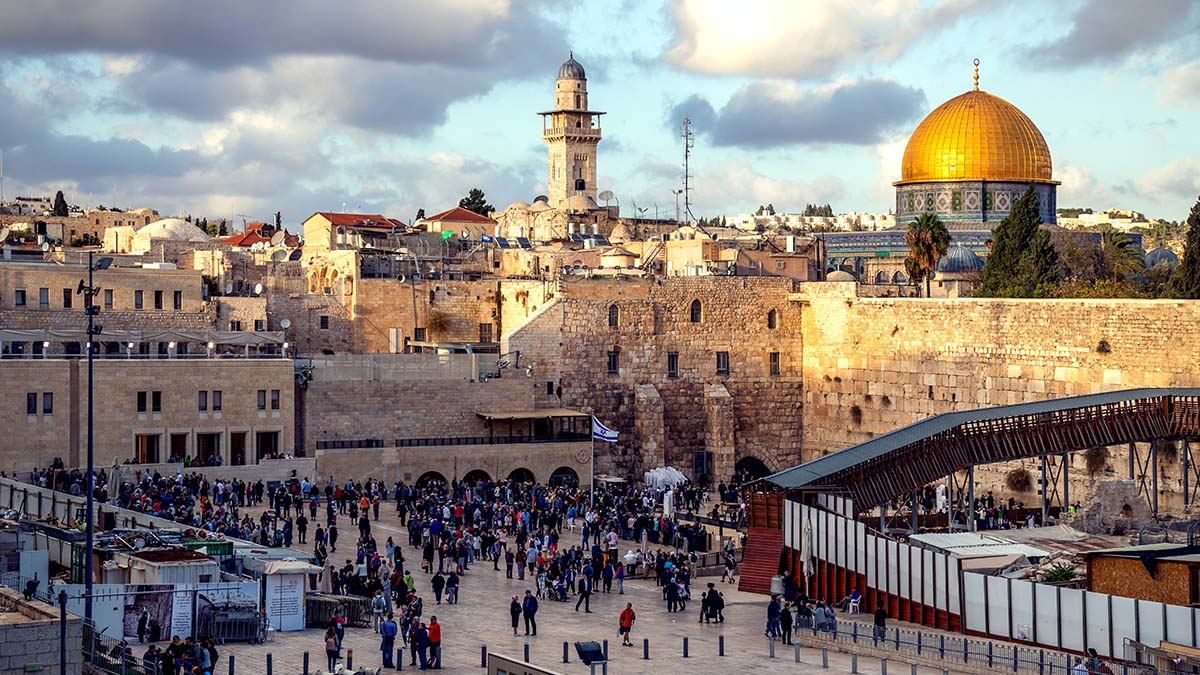
Jerusalem, with the Western wall and Dome of the Rock

Jerusalem, Israel

by Norman A. Rubin

Pilgrimage to the Holy land by Christian pilgrims of all races and denominations are a blessing of faith. The pious pilgrim walks in the footsteps of the prophets and disciples but above all visits the town and villages where Jesus lived and preached. They symbolically carry the cross in remembrance of that infamous day along the Via Dolorosa. Christians have always traveled to the Holy Land, but pilgrimages became much common after that most famous pilgrim of them all, St Helena, made her way to the land where Jesus walked.

Jerusalem cityscapeThe Land of Israel, the Holy Land in entirely fascinating; the sacred land is the place where sublime aspirations and ideas have fructified. Here was achieved the summit of belief. To appreciate the Land of the Bible, you must first see. To understand this land, you must remember that the land speaks to us of the events and occurrences down through the centuries, continuing at the present and carrying on in the future, leaving a legacy of the faith, which will last for all eternity.

The word “pilgrim” comes from the Latin meaning “foreigner” or “stranger.” A pilgrim is one who makes a journey or pilgrimage to a sacred place for the purpose of veneration, to ask help or thank God and His Saints, to fulfill a vow, or to make penance.

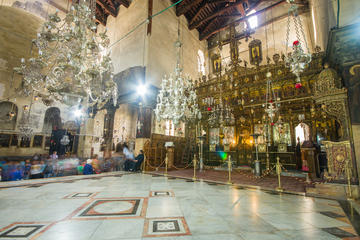
Monastery in JerichoIn the Middle Ages, from the 4th century AD, Christian pilgrimage to the Holy Land was regarded as a sacred obligation and it was considered a trial of one’s faith, since travel was dangerous, expensive and time-consuming. A returning pilgrim was called a palmer, as they would wear two crossed palm leaves to show they had made the pilgrimage. Christianity reveres Jerusalem not only for its role in the Old Testament but also for its significance in the life of Jesus. The venerated sites in the life of Jesus include the Church of the Holy Sepulcher, the Cenacle, Via Dolorosa, Gethsemane, Antonia Fortress beneath the Convent of the Sisters of Zion, etc. The site of Jesus’ Last Supper is located on Mount Zion close to the Tomb of King David. Another prominent Christian site in Jerusalem is Golgotha, the location where Jesus was crucified.
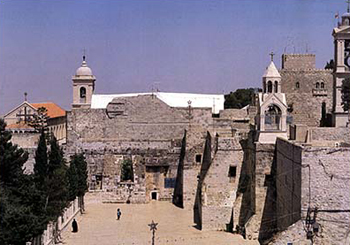
Manger Square, BethlehemThe sacredness of the Holy Land, the fateful events that took place on its soil and that has been interwoven into mankind’s tradition, have attracted many Christian pilgrims to its shores. Right from ancient times the faithful flocked from all over the world to see and venerate the homeland of Christ the Redeemer. They came to the land in awe and reverence, trod the paths of the righteous, visited the sites of His ministry, and prostrated themselves at the shrines and sanctuaries of Christian tradition, “to venerate the places where He lived and preached.” (St. Jerome)
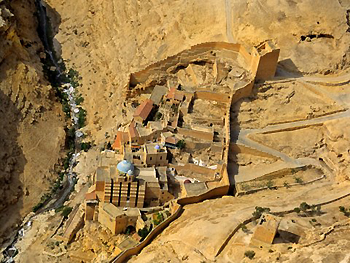
JerichoThe Christian pilgrims that came (and are coming) to the Holy Land were afforded warm hospitality in hospices run by religious orders of various denominations. The quiet religious lodgings were (and is) preferred by the pilgrims, where hospitality is practiced with affection and the nobility of the soul, which is moving to one’s heart. These hostels are located in the cities and towns of the Holy Land, especially in Jerusalem, and around Christian holy sites; and are priced to fit the purse of each individual pilgrim.

In 1973, in a building opposite the Tower of David in Jerusalem, the Custody of the Holy Land opened the Christian Information Center, whose aim is to provide information on Christianity and on the Holy Land. The Christian Information Center includes the Franciscan Pilgrims Office, which has been of great help to thousands of Christian Pilgrims of all races and of various churches. Everything that can interest the pilgrim, whether it concerns the devotional part, of whether it is for all the pertinent and useful information to render a pilgrimage more practical and fruitful is offered, “not for a mere historical journey but a true act of faith.”
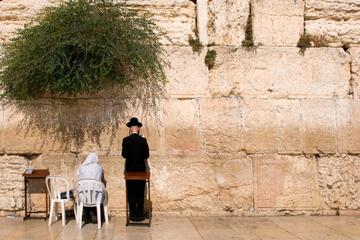

Private Full-Day Tour of Jerusalem and Bethlehem
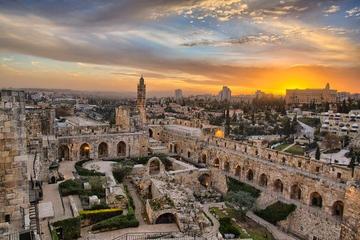


Bethlehem Private Guided Half Day Tour from Jerusalem

If You Go:

For information on Christian hospices, pilgrimage route, devotional services, Christian communities, etc. contact:

Christian Information Center
Jaffa Gate – POB 14308, Jerusalem 91142, Israel
Tel – 972-02-6272692 – Fax. – 272-02 – 62866417
Email: cicinfo@cicts.org

Franciscan Pilgrim’s Office
Jaffa Gate – POB 186, Jerusalem 91001, Israel
Mass bookings & Certificates Tel. +972-2-6272697, Fax 2-6286417
Email: fpo@cicts.org

About the author:
Norman A. Rubin is a former correspondent for the Continental News Service (USA), now retired – busy writing articles and stories for Net sites and magazines worldwide – see ‘Google.com’ under the author’s name for a review of his written work. Contact: normrub2000@gmail.com

Photo credits:
First photo of Jerusalem, the Western Wall and the Dome of the Rock is by Sander Crombach on Unsplash
All other photos are by Norman A. Rubin
Tagged With: Israel travel, Jerusalem attractions Filed Under: Middle East Travel

Israel: Tel Aviv Turns 100

fireworks over Tel Aviv

by Donna Yuen

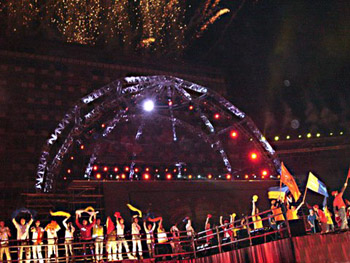
Fireworks lit up the sky and a melody echoed across the stage as some of Israel’s top performers prepared for one of Tel Aviv’s grandest nights. Cheered on by over 100,000 enthusiastic fans, Rabin Square was filled with exuberant spectators ready to partake in the celebrations of Tel Aviv’s 100th Anniversary. The Israel Philharmonic Orchestra led by Zubin Mehta opened the show playing pieces by Tchaikovsky and Strauss.

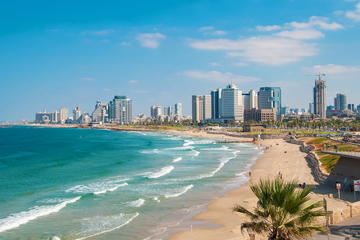
Celebrating its birth as the first Hebrew city, Tel Aviv has had a tumultuous history, yet it continues to grow and progress into a modern metropolis. In this 100th Anniversary year, the city has actually been celebrating for months now. This evening’s free concert is the culmination of over eighteen months of hard work from a small dedicated group who organized the event.

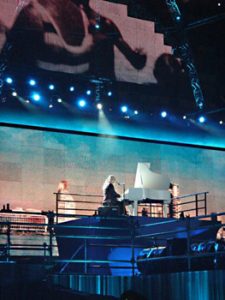
performers on Tel Aviv stateI squeeze my way through the animated crowd trying to get a favorable vantage point to watch the show from. Shlomo Gronich begins his performance on the grand piano (photo below), which is soon followed by an army of rhythmic drummers beating out a tune on oil drums. Choirs of children soon follow in song and dancers take the stage to display the obvious fact that Tel Aviv knows how to throw a party.

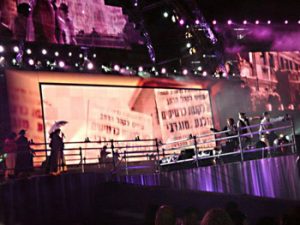
Historical images dance across the enormous screens in the background to celebrate Tel Aviv’s history and the famous people that it has produced. Energetic dancers with flags take the stage to pay homage to Tel Avis’s basketball team.

I stand there, swaying to the music as cannons shatter the dark sky with millions of pieces of confetti giving a whole new meaning to a place, often described as a white city rising from the sand. I am jostled and jolted by the spirited crowd. I quickly apologize to the man I have accidentally shoved. He responds with a friendly and forgiving smile. It is a welcoming smile I have seen many times in Israel. He gently pulls my arm and says, “Please come and stand in front of me, I am much taller than you.”

I accept his kind gesture and change my location to obtain a better view. I explain to him that I had lost my guide within the first few minutes of entering the crowd at Rabin Square. He tells me his name is Avsha and his friend is Shay and that they would be happy to be my guides for the night. He proceeds to translate and explain the events of the evening for me, describing who the performers are and what it all represents.

The audience soon turns their attention to the half-dozen acrobats scaling down a white wall clutching large paintbrushes. They are Circus Y, a local acrobatic group. Dangling in mid-air, they artistically paint the number 100 on the large canvas as the crowd roars their approval.

Tel Aviv stage performanceAlona Daniel performs “On the Rooftops of Tel Aviv” as the spotlights set the nearby skyline ablaze. A band is performing on the rooftop of a nearby building as spectators below crane their necks skyward to see the current act. I turn towards Avsha, he stands with his right hand over his heart, his expression is filled with pride as he says, “I hope you are enjoying Tel Aviv.” The neon-colored lights are reflected in his moist eyes, I look around admiring the crowd. Their emotion, passion and pride for their city and country are evident as joyful faces peer back at me.
Dana International begins her high energy performance inspiring the crowd to dance. Avsha turns to me and explains that she was born as Yaron Cohen and is a famous transsexual performer. In a country so religious, I am pleasantly surprised the Israeli pop singer has attained such fame. She performs ‘Tel Aviv Never Sleeps’.

Tel Aviv never sleeps…
Tel Aviv keeps fighting
Over the same thing and no one listens…Tel Aviv asks, Tel Aviv breathes,
Tel Aviv never sleeps.

As the concert ends, I finally walk away from the all-night dance party to make my way back to my hotel. Echoing in my ears is Dana International’s “Tel Aviv Never Sleeps”.

I smile to myself; truer words could not describe this city. Yes, this is Tel Aviv.


Full-Day Tel Aviv City Tour

If You Go:

Where to stay:
The Dan Tel Aviv, David Citadel Jerusalem: www.danhotels.com
Israel Wonders: www.goisrael.ca
El Al Airlines: www.ELAL.co.il

About the author:
Donna Yuen has written and photographed for a variety of publications. She has appeared on CBC Radio One and has worked as a columnist for GSA Travel Magazine. She has been published in a number of daily and weekly newspapers including The Georgia Straight, Vancouver 24 HOURS, The Montreal Gazette and The Vancouver Sun. Contact: travelmoments@shaw.ca.

All photos are by Donna Yuen.

Tagged With: Israel travel, Tel Aviv attractions Filed Under: Middle East Travel

Israel: Leading to Temptation in Jericho

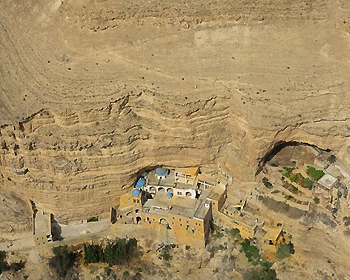
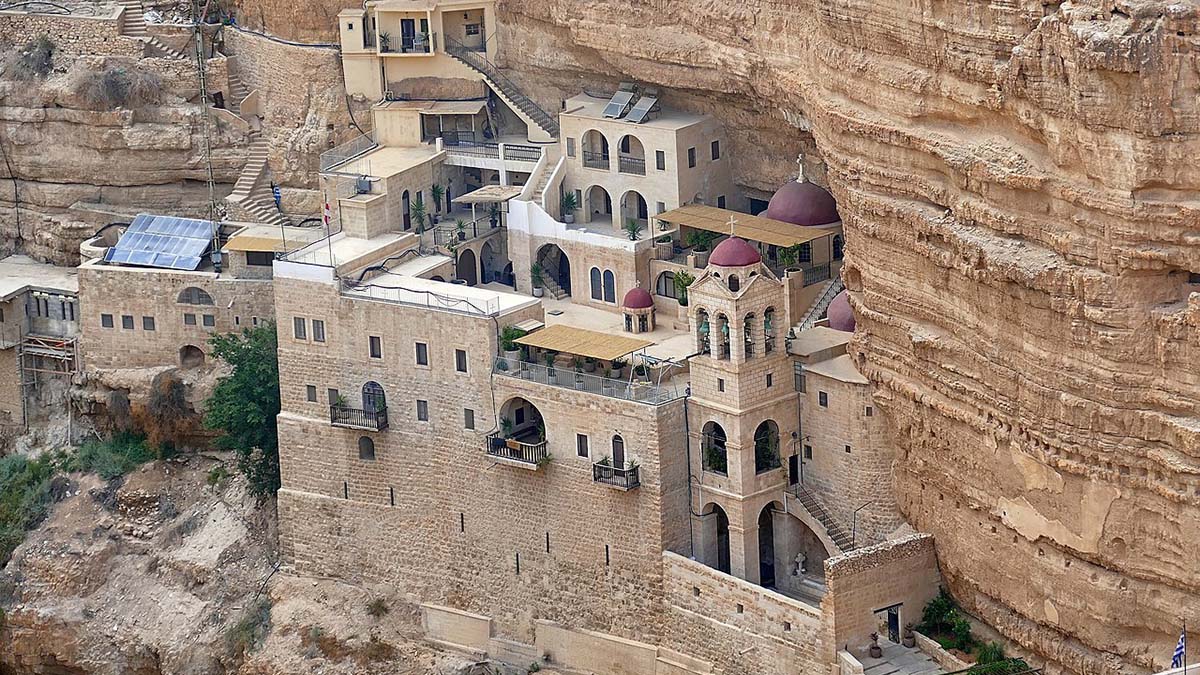
St. George monastery, Jericho, Israel

by Sabina Lohr

“Do you want to drive or do you want to walk?” Saed asks, stopping the car. We have arrived at the bottom of a small mountain on the outskirts of Jericho, in Israel’s West Bank. Believed to be the oldest city in the world, Jericho is also the lowest, at 244 meters below sea level.

We look up the trail that winds its way to our first destination – Saint George’s Monastery on the Mount of Temptation, which sits at 350 meters above sea level. I elect to walk.

Before we can begin our ascent, we come across a woman who sits by a house alongside the road, at a table piled high with pomegranates. In this part of the world pomegranate trees are plentiful, and their juice is a popular beverage. Saed buys two cups, and we drink.

Many people visit Jericho because of its biblical significance as the first town that the Israelites conquered after they returned from their exile in Egypt. Its location in the West Bank, though, causes many others to shy away. Like in Israel, tourism in the West Bank waxes and wanes along with the political climate. Since the end of the Second Intifada in 2006, tourism has increased to both Israel and the West Bank. The Israel Ministry of Tourism reports that in 2008 tourism to Jericho was up 42.3 percent from 2007. Still, not many tourists visit the West Bank alone. The majority travel in tour buses or in self-guided groups.

I was traveling through Israel by myself, but going on my own to Jericho didn’t sound like a great idea. I decided to hire a guide to show me around. Israelis are not allowed inside Jericho, so I found Saed, a Palestinian Arab, who has driven me from Jerusalem and through the Israeli and Palestinian Authority checkpoints that lead into Jericho. I was glad I went with him. During our time in this town, formerly home to Yasir Arafat, I saw only one small group of Westerners.

The woman with the pomegranates speaks in Arabic to Saed, and he translates for me. Something is in her backyard that she wants us to see. Saed indicates that she has told him to take me through her house and out to the back. We enter her home, where several children are sitting on the floor, looking up at us as we pass. We come to a roofed concrete courtyard. In front of us is the sight the woman wanted us to see. A roaring brook runs past our feet, almost cresting its banks. To my eyes, this is a let-down. It is simply a creek. Saed sees it differently.

“Look how high it is!” Saed exclaims. “You almost never see this kind of water around here!”

Jericho is located in the Judean Desert, and water shortages are far too common. The past winter, though, was unusually cold and wet. Now water, for the time being, has become plentiful even here, in the desert.

We finish our drinks and begin our hike up the side of the mountain. After only fifteen minutes of walking the winding trail, we reach the entrance to the monastery. While we wait for one of the resident monks to open the door, we look out over the land. Immediately beneath us in the grass, a lone female shepherd tends her flock. Soon, the sheep are done feeding, and she begins herding them down the street.
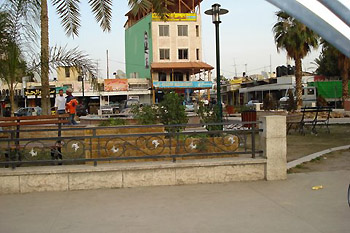
A monk appears and admits us inside. In the 5th Century A.D., it was monks, also known as hermits, who built Saint George’s Monastery. Destroyed by Persians in 614 A.D., monks rebuilt it during the Crusader period. This Greek Orthodox monastery stands on the site where Jesus is believed to have fasted in a cave for forty days and nights. While inside, I am able to enter the tiny cave where He stayed. This is one of many such small caves in the area. Outside the monastery, on the side of another mountain, we see dozens more, which monks began inhabiting around the time of the construction of Saint George’s. These monks were killed during the Persian invasion, and many of their skulls and mummified bodies are kept inside the monastery.

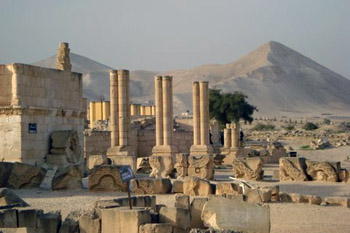
remains of Caliph Hisham's PalaceNext, Saed and I take a five-kilometer drive north to Caliph Hisham’s Palace, known in Arabic as Khirbet El-Mafjar. Construction of this palace is believed to have begun in 743 A.D. Unfortunately, it was largely destroyed by an earthquake before it was inhabited. Its bathhouse is still somewhat intact, though, along with its mosaic floor. Columns that withstood the earthquake still stand against the backdrop of the Judean mountains. We do see a few other people here touring the site, but they are Muslim Arabs, not Westerners.

Probably the site of most significance in Jericho is Tel es-Sultan or Old Jericho. This is where the town of Jericho originally stood, then was destroyed and rebuilt time and again throughout the millennia. Now twenty-three layers of civilizations lie one on top of the other, the most ancient dating back at least seven thousand years. Not much evidence of the multiple civilizations remain, save for a few small staircases and walls. Nevertheless, knowing that these are the oldest ruins in the world makes this an awesome sight.

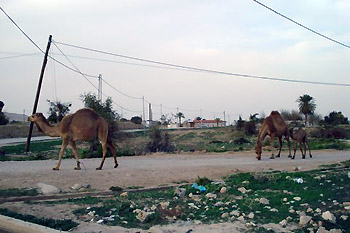
camels on roadOld Jericho lies just a few kilometers yet several centuries away from modern-day Jericho, where we now head. Along the way, camels begin to cross our path. We stop and watch as what appear to be a mother camel and her calf walk along together, calmly and slowly. Soon they’re joined by a second adult. They travel not on the dirt or grass, but along the same road on which we travel.

We arrive in downtown Jericho to find that it is a small area, comprised of somewhat shabby shops that encircle a road. Saed’s wife wants him to buy some local fruit, and we pull over and go inside one of the markets. A few men are inside this small shop, milling around among aisles crammed with shelves. Saed and the men speak among themselves, while I look for fruit for myself. Along with citrus fruits and dates, Jericho is known for its bananas, and I buy a bunch to take back to Jerusalem with me.

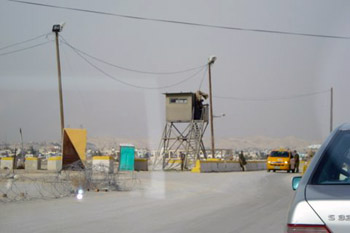
Palestinean authority checkpointNow we pass back through the checkpoints that lead out of Jericho. The cars lined up waiting to cross number approximately fifty. Of those people who are visible in their cars, all appear to be residents of the area. As I sit, the sole Westerner crossing back into Israel from an area controlled by the Palestinian Authority, I feel glad that I did not avoid visiting this town just because of its location on the map of the Mid East. Its history-rich sights have made this a journey worth taking.


Bethlehem and Jericho from Tel Aviv

If You Go:

GETTING THERE: Virtually no Israeli rental car companies allow their cars into the West Bank. You can take a cab driven by an Arab driver or take an Arab bus to get into Jericho. If you want someone to show you around, you can hire an Arab tour guide or join an Arab-led tour group from Jerusalem.

DINING THERE: A shopping complex with a restaurant is across the street from Tel-e-Sultan.

STAYING THERE: Check out the five-star Hotel InterContinental Jericho and four-star Jericho Resort Village.

About the author:
Sabina Lohr is an American on a self-imposed European six-week-a-year holiday schedule. She loves comparing other countries and cultures to her own and writing about her findings.

Photo Credits:
St. George’s Monastery, Jericho by Shaula / CC BY-SA
All other photos are by Sabina Lohr.

Tagged With: Israel travel, Jericho Filed Under: Middle East Travel

Chanukah: Dedicated to the Power of Miracles

celebrating Chanukah

Israel

by Randi Winter

Israel holds a special place in my heart and in my travel experiences. I have been there many times and each uplifting experience has proved to be both crucial and miraculous in my life. As I say the blessings and light each candle on the menorah this Chanukah, I attribute a miracle to each flame burning brightly, illuminating “My Israel Miracles”.

Hanukkah is celebrated for eight days and nights, starting on the 25th of Kislev on the Hebrew (lunar) calendar. This year, the first candle is lit at sundown on December 21st. The word “Hanukkah” means “dedication” and commemorates the rededication of the holy Temple in Jerusalem.

In 168 B.C.E. Antiochus, the Greek King of Syria, outlawed Jewish rituals and ordered the Jews to worship Greek gods and seized the temple dedicating it to the worship of Zeus. Some Jews obeyed, but most didn’t. In a town near Jerusalem, Greek soldiers gathered the Jews, insisting they bow to an idol and eat the flesh of a pig, both forbidden. When Mattathias, a Jewish High Priest, was commanded to participate, he refused. Another Jewish villager volunteered in his place. Outraged, Mattathias took his sword and killed the man. Then, along with his five sons, they killed the soldiers and fled into the nearby mountains.

Later, when Judah Maccabee and his soldiers went to liberate the holy Temple, they found it totally desecrated, with many ritual objects missing or broken, including the menorah. They cleansed and repaired the Temple, but when they went to light the menorah as a re-dedication ceremony, all they found was a small flask containing enough oil to light the menorah for a single day. Miraculously, the oil lasted for eight days.

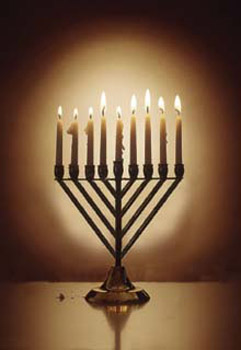
Menorah with 9 lit candlesToday Jewish people around the world celebrate Hanukkah for eight days, lighting the “chanukiah”, the 8 branched menorah with the 9th taller “shamash” used to light the others as a servant candle. Each evening, the candles are lit, like reading Hebrew, from right to left, adding an additional one each day. It is customary for Menorahs to be in visible in the window, commemorating the eight-day miracle. When Jews kindle the Chanukah lights, it is natural to think about the role of miracles in our lives.

To me, Israel itself is a land associated with great miracles. The first miracle was in 1948, the year that Israel became a nation against all odds. The second miracle was in 1970 when I was accepted to go to study in Israel for my Junior year at Hebrew University. Before I started my Ulpan (intensive Hebrew), I got a job selling tours. When students from North America arrived in Israel they could see the attractions, but also what life was like for youths their own age, where almost everyone served in the army before they could start university, and they could go back understanding the reality there. It was on one of these “Scout the Land Tours that I fell in love with Israel and I met Sam, the love of my life.

Israel is a small country that spans a long history. Israel is a country blessed with people of all religions and nationalities. I celebrated life cycles in Israel, immersing myself in the festivals: agricultural harvest festivals, religious holidays of the new year and day of atonement, Purim was a costume party celebrating our survival, a poignant Remembrance Day followed by joyous Independence Day. At Passover, my whole family came to visit me. I celebrated the miracles of Chanukah where they started.

Israel is a country where each step represents lifetimes of cultural experiences, ancient and rich. The spirit of the people is palpable, especially in the old city in Jerusalem with its four quarters: Jewish, Muslim, Christian and Armenian. Commerce and proximity demands acceptance of all cultures and religions as you pass seamlessly from one to the next. The aromas, visuals and cacophony of cultures collide, yet blend in perfect harmony.

I experienced the third miracle when I visited the ”Yad Vashem, the Holocaust Remembrance Museum” with Sam’s parents who had been born in Poland and were some of the few who survived the war. Sam’s mother was sent to join her sister in a forced labour camp; spared by her family’s candy making skills, and good fortune. Sam’s father had been in several concentration camps including the dreaded Auschwitz. He showed me by jumping on the map of the camps. His story was miraculous because he had been called into the gas chamber and was recognized by someone from his town who told him not to take off his clothes, and instead pick up a broom and sweep like his life depended on it. It did. Auschwitz was liberated two weeks later.

Bar MitzvahThe fourth Miracle happened twenty years later on my daughter’s thirteenth birthday. We decided to have her Bar Mitzvah in Israel, on top of Masada, the famous site of Jewish resistance. In the heat of the desert, past Qumron, where the Dead Sea Scrolls were found, with vistas of the Dead Sea on one side, and the faint remnants of army camps outside the fortress walls, we ascended to the top of Masada surrounded by family, friends and total strangers. As we stood in the middle of what was the ancient synagogue and gazed beyond the endless desert towards Jerusalem, the direction all Jews face when they pray, I experienced history and religion merge in front of my eyes. As I listened to the centuries old prayers, I understood about the sacrifices we sometimes must make to protect our freedom.

When I was invited back to Israel with a group of travel professionals, the fifth miracle occurred. The tour, which was a blend of Jewish and Christian history, offered a smorgasboard of historical and religious slants. Our overnight at a kibbutz in the north became something out of an evening news report. The kibbutzniks were edgy and nervous. We were restricted to certain buildings and finally told to stay inside where we spent a restless night. In the morning we learned there had been an attack from the nearly hills where terrorists had used hang gliders to ambush an army base and killed several soldiers. We were so close, we could actually see one of the hang gliders that had crashed into the hill by the kibbutz where we were just hours before.

The sixth miracle manifested itself during a cruise where we visited the Pyramids in Egypt, which played a large role in Passover, the exodus from Egypt. As we sailed in and out of the Port of Haifa, a model city of peace amongst the Arab, Jewish, Druze and Bahai population, I noticed that the ship was surrounded by Israeli frogmen to ensure our safety. I thought about all the Jewish refugees who had been turned away from these same shores during and after World War II, and how easy it is to take for granted safe passage, from country to country.

The seventh miracle happened during the Intifada. Tourism to Israel was reduced to a brave trickle by the threat of violence, Israeli products were boycotted and professors shunned like pariahs. If I could not encourage tourism to Israel, I was determined to show support for Israel and its academics. Believing the “Word is mightier than the Sword”, I created Hebrew University at Sea; a Baltic cruise with Jewish dialogue and shore excursions. It was intimidating at first, but for the participants, it became an affirmation that learning should never by stifled.

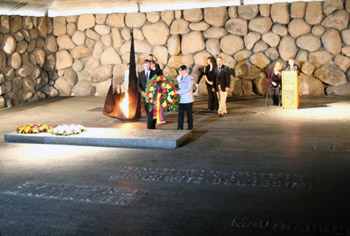
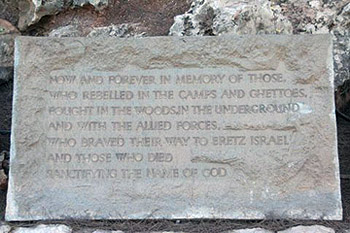
Holocaust memorialThe Jewish Museum for Remembrance of the Holocaust, Yad Vashem has created a special recognition for every non Jewish person who by putting their own lives in danger, helped save Jewish lives. The eighth miracle is the untold story about Muslims who saved Jews. A remarkable photo exhibit about these Albanians opened at the museum November 1st, 2007. I met ordinary, extraordinary people from Albania and Kosovo who risked their lives for strangers and their code of honor. For almost 60 years, due to the stifling communist regime, no one knew that Albania (70% Muslim), had not only rescued every Jewish person within their borders, but had miraculously sheltered ten times the original population. Albania enabled Jewish survival with false passports and secretly crossed borders. Whole villages turned a blind eye to their “guests” who posed as Albanians. This strong code of ethics is based in the ancient oral code of the Kanun and its principle of Besa that stresses protecting those in need. At the museum, I witnessed the unforgettable reunions of rescuers and rescued and their gratitude to Norman Gershman and his Eye Contact Foundation whose mission is to use art as the primary form of expression, in order to break down stereotypes and build upon the deep roots of humanism that cross racial, ethnic, religious and national boundaries.

The ceremony at Yad Vashem was unprecedented. Since then, exhibits have been shown in the United Nations, New York, Connecticut, Washington, DC and in the UK. In 2009, exhibits will be shown throughout Israel and from Buenos Aires to Stockholm and other parts of the world. The book “Besa: Muslims Who Saved Jews During World War II” by Syracuse Press, is attracting worldwide attention. In 2009, the documentary movie called “God’s House”, about the Muslims who saved Jews during WWII, should bring this story to life on the big screen and has been made with the support of Jews, Christians and Muslims.

The Shamash, the 9th “servant” candle used to light the others, represents “service” and a responsibility to stand tall and take action to ignite the potential of others. These “miracles” are symbols of hope and promise for the future and will brighten my Chanukah being spent far from home.

Chanukah Customs:

While Chanukah is customary a children’s gift giving holiday, the greatest gifts are to ensure all children have loving families, safe homes, health care and the education they need to thrive. Chanukah foods reflect the miracle of oil: latkes (potato pancakes)and jelly doughnuts; special songs of miracles, and games where coin shaped chocolates or real coins,”Gelt”, are prizes. Games include spinning the Dreidel – a “top”. The four letters on the dreidel represent four words “Nes Gadol Hayah Sham” – Literally: “A great miracle happened there.” In Israel, the last word “Sham” is changed to “Po” which means “here”. “A great miracle happened here.”

Masada and the Dead Sea Day Trip from Jerusalem

2-Day Best of Israel Tour: Old Jerusalem, Bethlehem, Masada and the Dead Sea

About the author:
Randi Winter epitomizes Passionate Travel. As a journalist, she offers combines her interests and passions with travel, focusing on the destinations wow factor, translating dreams into experiences. She believes travel is enlightening, enriching, and inspiring. It opens doors and minds, stretches our imagination, and enlivens our spirit.
For more information contact:
Randi Winter
Specialist in and Journalist of Inspired Pursuits
Passionate Travel / A Virtuoso Affiliate of The Travel Network
Director of The Eye Contact Foundation
Director of Vancouver Downtown Jewish Community
Randi@passionatetravel.com
www.passionatetravel.com

Photo Credits:
All are photos by Randi Winter.

Tagged With: Israel travel Filed Under: Middle East Travel

  • « Previous Page
  • 1
  • 2
  • 3

MORE TRAVEL STORIES:

Guatemala’s Ixil Triangle

Exploring Tangolunda Bay in Huatulco, Mexico: A Complete Travel Guide

Explore Red Deer: Your Adventure Awaits in Alberta

Hawaii: Mana Made Memories

Nanjing’s Pilu Temple

Connecting with Toronto’s Indigenous Culture and History

Cost of living in Abu Dhabi

10 Top Dubai Theme Parks


SEARCH

DESTINATIONS

  • Africa Travel
  • Antarctica travel
  • Asia Travel
  • Australia travel
  • Caribbean Travel
  • Central America Travel
  • Europe Travel
  • Middle East Travel
  • North America Travel
  • Oceania Travel
  • South America Travel
  • Travel History
  • Travel News
  • UK Travel
  • Uncategorized
  • World Travel
facebook
Best Travel Blogs - OnToplist.com

Copyright © 2026 Cedar Cottage Marketing | About Us | Contact | Privacy Policy | Terms & Conditions | Copyright Notice | Log in