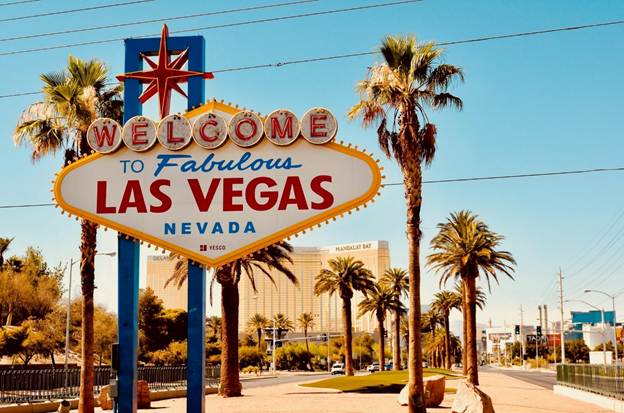
Las Vegas is one of the most unlikely cities in American history. A desert settlement with no natural advantages beyond a spring of water became, within a single century, the entertainment capital of the world.
The journey from a 1905 railroad auction to a city of mega-resorts, neon cathedrals, and global brand recognition is a story driven by federal infrastructure, organized crime, Hollywood glamour, and corporate reinvention. Each era left landmarks that still define the city today.
A Midpoint in the Desert: The 1905 Founding
Las Vegas was created not by settlers seeking a new life but by a railroad company seeking a maintenance stop. On May 15, 1905, the San Pedro, Los Angeles and Salt Lake Railroad, majority-owned by Montana Senator William Andrews Clark, auctioned off 110 acres of desert land in what would become downtown Las Vegas.
Over 3,000 prospective buyers had flooded into the area in advance, setting up encampments along the Las Vegas Creek. Some lots doubled their initial value between $150 and $750 by auction’s end, forcing Clark to cancel the second day and sell the remaining parcels at market price.
The city was incorporated in 1911 under its first mayor, Peter Buol. Less than a year after its incorporation, Nevada became the last western state to outlaw gambling, banning the practice at midnight on October 1, 1910, a law so strict it even forbade flipping a coin for the price of a drink.
The Hoover Dam Era and the Double Birth of Modern Las Vegas
March 1931 stands as arguably the most consequential month in Las Vegas history. On March 19, Governor Fred Balzar signed Assembly Bill 98, legalizing all forms of gambling in Nevada for the first time since 1909. Eight days later, the federal government awarded the $49 million construction contract for what was then called Boulder Dam.
Las Vegas, which had only about 5,200 residents in 1930, watched its population swell to 25,000 as young male workers flooded in from across the country to build what became the largest dam in the world. The federal government invested $175 million in the project, constructed between 1931 and 1936 at a cost of over 100 lives, and dedicated on September 30, 1935 by President Franklin D. Roosevelt.
Electricity from the dam powered the new hotels being built along what would become the Strip. On April 2, 1931, the Clark County Commission granted the first gambling licenses to eight businesses, including the Northern Club and the Las Vegas Club on Fremont Street, and by 1954 over 8 million people were visiting Las Vegas yearly, pumping $200 million into casinos.
Bugsy Siegel and the Flamingo’s Blueprint for Luxury
Before the Flamingo, Las Vegas entertainment meant western-themed motor inns and Fremont Street gambling halls. Benjamin “Bugsy” Siegel changed that calculus entirely. He stepped into a project begun by Billy Wilkerson, founder of The Hollywood Reporter, who had purchased the land in 1945 but ran out of funds.
The Flamingo’s construction was initially budgeted at $1.5 million. By October 1946 costs had already surpassed $4 million. The final price reached $6 million, equivalent to approximately $73 million in 2024. Siegel opened the casino on December 26, 1946, with singer Jimmy Durante headlining and Cuban bandleader Xavier Cugat providing music.
Approximately 28,000 people attended over the three-night grand opening, though a storm grounded flights from Los Angeles and left the hotel portion unfinished, forcing gamblers to take their winnings to competitors.
The casino lost $300,000 in its first week. After closing briefly, the resort reopened on March 1, 1947 as The Fabulous Flamingo. By May it had turned a $300,000 profit, but not before Siegel’s mob partners concluded he had skimmed construction overruns. On June 20, 1947, a gunman fired a .30-caliber carbine through the window of Virginia Hill’s Beverly Hills mansion and killed Siegel at 41.
The crime remains unsolved. Minutes after his death, Gus Greenbaum and Morris Rosen walked into the Flamingo and announced a change in management. The Flamingo is the oldest continuously operating resort on the Strip and still stands today, owned by Caesars Entertainment, with a 72,299-square-foot casino and 3,460 hotel rooms.
The Rat Pack Years and the Copa Room at the Sands
Las Vegas’s transformation from a 1905 railroad stop to the world’s gambling capital is quintessentially American. Today, the city’s influence extends far beyond the Strip, the entertainment model pioneered in Vegas has gone global and digital.
The rise of online casinos represents the latest chapter in gambling’s evolution, bringing Vegas-style entertainment worldwide, though nothing quite replicates walking through the original Flamingo’s doors or experiencing Fremont Street’s neon nostalgia.
The Sands Hotel and Casino, designed by architect Wayne McAllister and opened on December 15, 1952, with 200 rooms, became the epicenter of a different kind of glamour. In October 1953, a 37-year-old Frank Sinatra began performing at the Copa Room, and by the early 1960s he had brought Dean Martin, Sammy Davis Jr., Peter Lawford, and Joey Bishop with him to create the most famous entertainment residency in Las Vegas history. At the height of their appeal in the first half of the 1960s, a reported 34,000 people flocked to the Sands over a four-week season.
In January 1960, while filming Ocean’s 11 at the hotel by day, the Rat Pack performed two shows each night in what was billed as the Summit at the Sands, and the hotel received 18,000 reservation requests for its 200 rooms. Howard Hughes purchased the Sands in 1967 for $14.6 million.
On September 11 of that year, Sinatra announced he was leaving for Caesars Palace. The Sands was demolished on November 26, 1996, and Sheldon Adelson’s Las Vegas Sands Corporation built The Venetian on the site, which opened in 1999.
Howard Hughes and the Corporate Transition
Howard Hughes arrived in Las Vegas on Thanksgiving Day 1966 via private train, checked into the penthouse of the Desert Inn, and never left his 250-square-foot bedroom during the four years he spent in the city.
When Desert Inn co-owner Moe Dalitz told him the penthouse suites were needed for New Year’s guests, Hughes simply purchased the hotel, paying $6.2 million in cash and $7 million in loans. He then went on a buying spree that reshaped the city.
He purchased the Sands for $14.6 million, the Frontier for $23 million, the Landmark for $17 million, the Castaways, and the Silver Slipper, spending an average of more than $175,000 per day in 1967 alone. In 1967, coinciding with Hughes’ arrival, Nevada passed the Corporate Gaming Act, removing the financial background checks that had been required of all casino shareholders, and opening the door to public corporations.
Hughes’ buying stopped only when a U.S. Justice Department antitrust lawsuit blocked his attempted purchase of the Stardust, at which point he controlled roughly one third of all Strip casino revenue.
Steve Wynn, The Mirage, and the Mega-Resort Era
The modern Las Vegas Strip as it exists today traces its architecture to 1989, when Steve Wynn opened The Mirage, raising $535 million in junk bonds facilitated by financier Michael Milken to build a resort that cost $630 million and featured 3,000 rooms, making it the largest casino in the world at the time. It featured a 54-foot volcano that erupted every half hour after dark, and eventually surpassed Hoover Dam as Nevada’s most visited attraction.
Wynn had earlier raised $160 million in junk bonds to build the Golden Nugget in Atlantic City, which became that city’s most profitable casino.
Kirk Kerkorian, nicknamed the “Father of the Megaresort,” preceded Wynn in reshaping the scale of Las Vegas by completing the International Hotel in July 1969 at a cost of $80 million, with 1,500 guest rooms and three showrooms, then the largest hotel in the country. In the 1990s, revenue from non-gambling resort attractions surpassed gambling revenue for the first time, confirming that Las Vegas had become something its founders in 1905 could never have imagined: a destination where the building itself was the entertainment.