Travel Thru History

Historical and cultural travel experiences

  • Home
  • Airfare Deals
  • Get Travel Insurance
  • Writers Guidelines

Why Penang, Malaysia is Heaven for Foodies

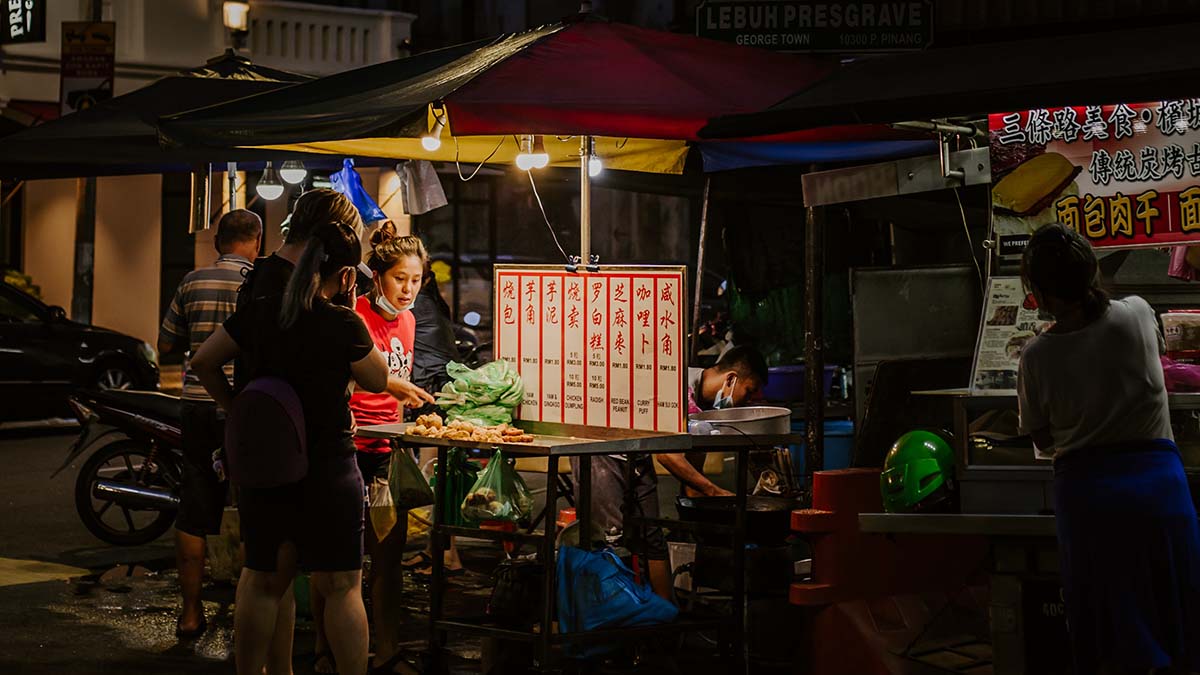
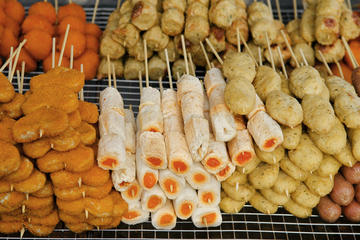
food stall in Penang, Malaysia

by Alice Driver

In Penang, Malaysia, the Jalan Sungai Pinang is a street crowded with food stalls, and frequented nightly by local Penang residents who come out to savor their toothsome treats.

cooking Malaysian rotiButtery roti dough is stretched tissue thin by expert hands and then thrown onto a hot griddle. It is filled with eggs and chicken (roti murtaba), condensed milk (roti bon) or eggs (roti telur). Vendors throw the dough into the air, balance it on one finger and spin it around until it becomes thin. It is folded like origami, and tasty ingredients are wrapped inside. Roti milo, the height of roti decadence, is filled with sweetened condensed milk, powdered chocolate, sugar and dollops of butter. It is slit from the middle to the edge and folded counterclockwise into a golden trumpet. Roti cost only .60 to 3 Ringgit (3.75 Ringgit = $1). The meal is often accompanied by the sticky sweet teh tarik; this popular drink is a mix of tea and sweetened condensed milk.

array of dim sum foodsFor breakfast there is no more tantalizingly gluttonous option than Dim Sum at “Bali Hai” on Gurney Drive. Dim Sum restaurants offer small portions of traditional Chinese dishes, allowing travelers to try lots of new food. Lining the counters of the restaurant are freshly baked Portuguese custard tarts, fake shark fin soup, yams covered in coconut, dumplings of all kinds and sticky rice desserts. You can choose as many bite sized dishes as you like and sit down to a view of the ocean. Locals spend all morning there drinking tea, eating and reading the newspaper. The restaurant is lined with large tanks of fresh seafood, and at night converts into a seafood paradise.

plate of stir-fried chicken with vegetablesSome of the richest gastronomic experiences can be had in the markets of Penang. Street vendors at these markets prepare hot dishes with fresh ingredients right before your eyes. Popular dishes include Char koay teu (fried flat rice noodles vegetables and chicken or seafood), burbur nasi (rice poridge), pau (Chinese buns with various fillings), nasi lemak (rice, coconut milk and anchovies), apam balik (Malay pancakes with brown sugar, peanuts or sweet corn), ais kacang (shaved ice, red bean paste, sweet corn, flavored syrups and ice cream) and jus belimbing (star fruit juice). Markets also sell delicious fresh tropical fruits and juices: watermelon, durian, pineapple, custard apple, mango and papaya. Most dishes cost 1-2 Ringgit.

When you’re not eating the Botanical Gardens provide a relaxing place to walk, run, observe monkeys or nap in the sun. More adventurous travelers can plan a hike up Mt. Penang, also known as Penang Hill. The book Nature Trails of Penang Island, published by the Malaysian Nature Society, is an excellent guide to hiking trails in the area. The hike up Penang Hill takes 2-3 hours depending upon individual fitness and rewards a panoramic view of the city. There is also a Funicular railway train to take visitors up and down the hill. For visitors considering hiking Mt. Kinibalu, the Mt. Penang hike is good preparation. The hike will leave you tired and hungry – ready for another good meal.

Eat Like A Local: Penang Street Food Tour

If You Go:

Language classes provide an excellent opportunity to learn more about the food and culture of Malaysia. Dynamic Language Center offers private and group classes in Malay, as well as Arabic and Chinese. Although most residents of Penang speak flawless English, they will be happy to help beginners practice Malay. Language skills are especially useful to travelers planning to visit rural areas or pursue independent projects. Classes may include trips to local markets, and can be tailored to the needs of each student. For more information about classes visit the Dynamic Language Center website at www.dynamiclanguagecenter.com or email them at dicinfo@po.jaring.my.

About the author:
Alice Driver is a Ph.D. student in Hispanic Studies at the University of Kentucky. Her travel writing has appeared in Cultural Survival, Abroad View and the travel guide To Vietnam With Love. She and colleague Joshua Jennings Tweddell recently published an interview with Colombian film director Víctor Gaviria in the 2008, volume 12 of the Arizona Journal of Hispanic Cultural Studies.

Photo credits:
First Penang restaurant photo by Wan San Yip on Unsplash
All other photos are by Alice Driver.
Tagged With: Malaysia travel, Penang food Filed Under: Asia Travel

The Wonders of Kuala Lumpur, Malaysia

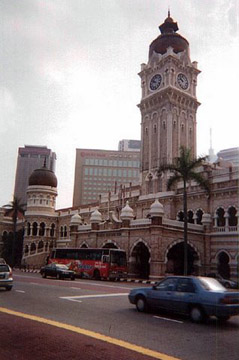
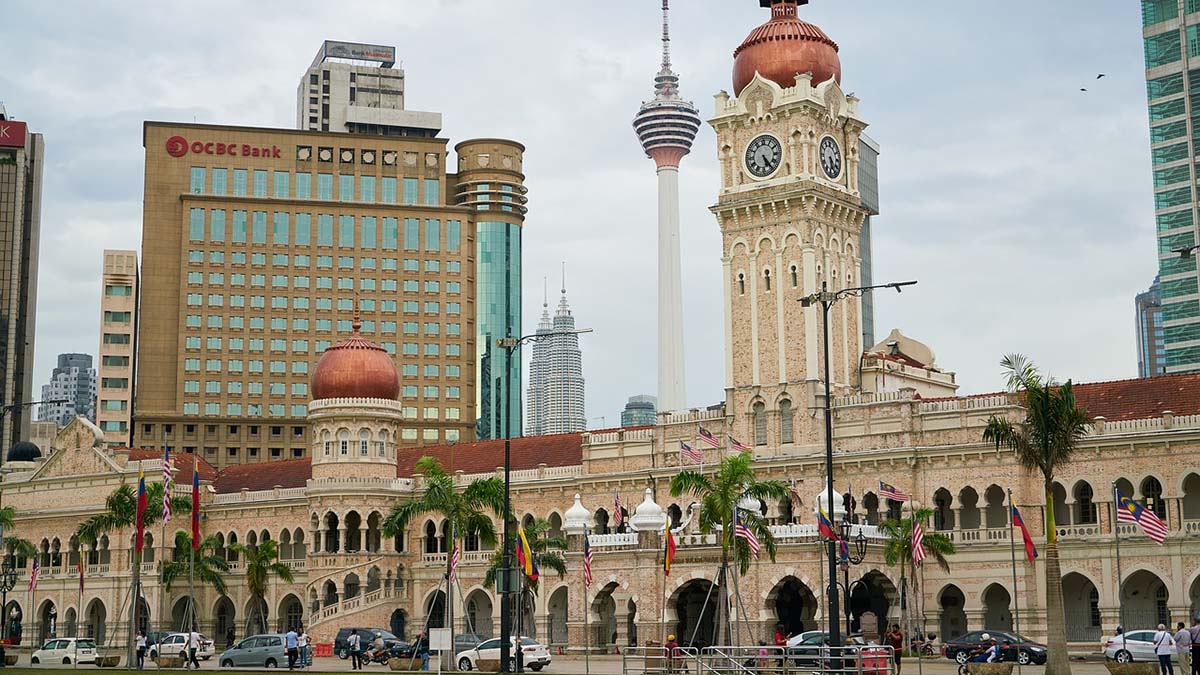
Sultan Abdul Samad Building in Kuala Lumpur

by W. Ruth Kozak

In the words of British novelist and playwright Somerset Maugham, “If you haven’t seen this place, you haven’t seen the world.” He was referring to Malaysia. And he was right.

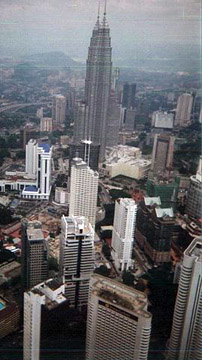
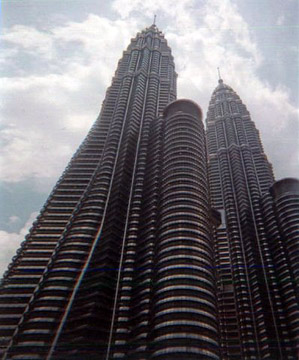
looking up at Petronas twin towersAs soon as I stepped off the plane at Kuala Lumpur International Airport I felt as though I had arrived at a space-age Wonderland. The city sky-line rises out of the misty green landscape, pierced by the spires of the Petronas Twin Towers, once the tallest towers in the world, and the single minaret of the Menora a telecommunications tower.

Truly a wonder! From the futuristic sleek, space-age high-rises to the ornate Colonial buildings it is an architect’s dream and offers the visitor old-world charm, a fascinating history, unique cuisine and a melding of various cultures.

The city began as a tin mining settlement in the late 1880’s and rose to a bustling modern metropolis with a population of two million. Kuala Lumpur (known as K.L.) means “muddy confluence” and is called The Garden City of Light because of its beautiful parks, gardens and brilliantly lit ultra modern buildings.

Mandarin Oriental Hotel, Kuala LumpurArriving at the luxurious Mandarin Oriental Hotel, I was graciously greeted by the staff, all dressed in traditional Malay garb, and escorted to my room. The wonders had only begun though. I discovered that my hotel was right next door to the famous Petronas Towers (owned by the Petronas Petroleum company). These towering edifices, designed in Islamic architectural style as an eight point star, are built of steel and glass and stand 452 meters high, each connected to the other by a sky-bridge mid-way up. They were featured in the movie Entrapment, starring Catherine Zeta-Jones and Sean Connery. You must line up from 8:00 each morning inside the entrance to obtain your free tickets. Because of my short stay in K.L. I was unable too obtain one so I opted instead to walk the few blocks from my hotel to visit the Menora, a telecommunications tower which ranks fifth in the world along with the C.N. Tower in Toronto. A shuttle-bus took me up the hill to the entrance. From the observation deck of the tower I was treated to sweeping panoramic views of the city.

skyscrapers in Kuala LumpurSandwiched between the Mandarin Oriental Hotel and the Petrona Towers is the extravagant Suria KLCC, a shopping centre that is home to every known designer — the real goods, not copies! Alongside the Guccis and Versace are well-known brands such as Bata Shoes and The Gap. I spent a half day there browsing and sampling the variety of excellent restaurants. In spite of its exclusive shops, the prices aren’t all that outrageous. The Malaysian ringgit has been kept at a low rate which makes Malaysia a shopper’s paradise. There are good buys at the British India in the Lot 10 shopping complex too. Prices are low and quality high.

After my first day of exploring the area around my hotel, I treated myself to an culinary experience at one of the exclusive restaurants in the Mandarin Oriental. Whether you’re eating at an upscale restaurant or one of the many outdoor patio cafes, dining in Malaysia is a gastronomic adventure offering a unique profusion of tantalizing flavours and culinary delights from Malay, Chinese, Indian to a host of other cultures. I chose a delicious dish of satay, skewers of marinated chicken served with a spicy peanut dip accompanied with ketupa (rice cubes boiled in palm leaf) and a cucumber salad.

fountain in Kuala Lumpur city parkYou need more than a few days to take in all the sights in this remarkable city. Because I was there for only a limited time before heading north to the islands, I took a city tour to get a taste of the exotic fares offered in K.L’s sensory feast.

The first stop on the city tour passes by the origins of the city. At the murky intersection of the Klan and the Gombak Rivers, the birthplace of K.L. is the quaint Masjid Jameh Mosque styled after the Mogul mosques of North India. All around it are the first of the Moorish-style colonial buildings built in the mid 1800s including the law courts. This is the Official Quarter where the British administrators built their offices around the Padang, a field that used to be a police parade ground and venue for cricket matches. Overlooking the square is the Selangor Club, built in 1890, a charming mock-Tudor building where once K.L.s society held court. Here, at Merdaka Square is the spot where the Union Jack was lowered on August 31, 1957 signifying the end of British colonial rule. Now the 100 metre flagpole proudly displays the Malaysian flag.

Sultan Abdul Samad BuildingAcross a wide swath of green lawn, surrounded by a high black iron fence, is the Istana Negara, the official residence of His Majesty the King of Malaysia, a sumptuous yellow building that was once the home of a wealthy Chinese man who had seven wives. Yellow is the royal colour and once upon a time you were shot if you wore yellow!

In front of the gold crested gates the imposing horse guards perform a changing of the guards ritual reminiscent of the horse-guards in London.

Malaysia gained independence from the British on August 31, 1957. To avoid rivalry, the nine Sultans of Malaysia take turns every five years as King. The country is governed by a Prime Minister from the Cyber-city of Putrajaya, just outside of K.L.

From the palace and elegant law-courts, we drive by the Lake Gardens Park where the original settlement started. This huge park sprawls over 200 acres and is home to the world’s largest covered bird aviary, a walk-in free flight area for about 3,000 birds comprising 200 species and a butterfly sanctuary where you can watch more than 6,000 butterflies of various species flutter around the tropical rainforest. There are also Orchid and Hibiscus Gardens which pay tribute to the bunga raya, Malaysia’s national flower.

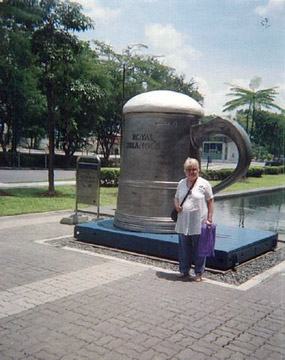
the author at Royal Selangor pewter factoryWe stopped at the Royal Selangor pewter factory where the workers demonstrated how pewter is made and the Cultural Craft Museum where we are shown how jewelers make gold rings by a wax molding.

At the National Museum I wandered through galleries displaying the eclectic Malaysian cultural history. The Malay are the largest ethnic group accounting for over half the population and national language. 60% of the Malays are Muslims who co-exist with the Chinese Buddhists and Indian Hindus. The blend of these cultures is displayed in their architecture, crafts, the cuisine and the colourful garments worn by the people.

The National Mosque, an architectural wonder designed with a blue umbrella roof, accommodates 5,000 people. Nearby is the Islamic Arts Museum with its intricately designed mosaic entrance. On display are a variety of artifacts including ceramics, glassware, porcelain, scrolls and bronzes. Many of the textile and jewellery exhibits are from India.

That evening, it was a unique experience to sit by the sparkling roof-top swimming pool at the Mandarin Oriental. As I sipped a cocktail decorated with an orchid, I suddenly heard the captivating, mystical sound of a Muezzin’s call to prayer wafting over the rooftops. My visit to this beautiful city was brief, but unforgettable. Somerset Maugham was right. If you haven’t seen this place, you haven’t seen the world. Kuala Lumpur truly is a wonder.

Kuala Lumpur Tours Now Available:

From Kuala Lumpur: Batu Caves Half-Day Tour

Petronas Towers Observation Deck and KL Tower Tickets

From Kuala Lumpur: Full-Day Trip to Historical Malacca


Private Half-Day Temples and Cultural Tour in Kuala Lumpur

Getting Around:
The city has an efficient transportation network including a light rail transit LRT known as STAR. Trains operate from 6 a.m. to 11.20 p.m. daily with extended hours during public holidays.
Air conditioned buses operate within the city as well as to urban points.
An overhead monorail system lops through the city’s Golden Triangle (business district) and runs past most of the strategic areas.
There are numerous car rentals or taxis may be hired from taxi stands, hailed at the roadside or paged through a radio-phone system.
At Moorish-style K.L. Railway Station travellers may purchase tickets anywhere in the Peninsula.
A wide range of accommodations are available in K.L. from international-standard hotels and resorts to medium priced and budget hotels that offer bed and breakfast.
The Mandarin Oriental Kuala Lumpur (5 star)
All credit cards are accepted and ATMs are readily available.

About the author:
One day W. Ruth Kozak, who has never played the lottery because she usually doesn’t win anything, was lucky enough to win a trip to Malaysia. It wasn’t on her ‘dream destination’ list, but once she’d landed in the amazing city of Kuala Lumpur she knew that she had, like Alice, arrived in Wonderland. Ruth writes, teaches, and publishes travel stories. Now she thinks she should take up playing the lottery!
travelthroughhistory.blogspot.com
wynnbexton.blogspot.com

Photo credits:
First Kuala Lumpur photo by Engin Akyurt from Pixabay
All other photos are by W. Ruth Kozak

Tagged With: Kuala Lumpur, Malaysia travel Filed Under: Africa Travel

Music in the Borneo Jungle

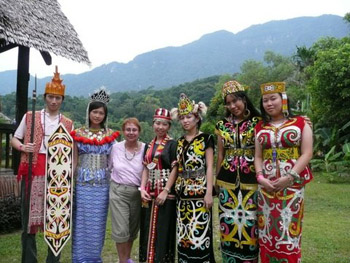
the author with performers in tradional regalia

Rainforest World Music Festival in Kuching, Sarawak, Malaysia

by Lenora A. Hayman

The 10th Anniversary of the annual, three-day Rainforest World Music Festival (RWMF) was held in mid July 2007 in the Sarawak Cultural Village in Santubong, 45 minutes drive outside of Kuching, Sarawak on the northwest coast of the island of Borneo.

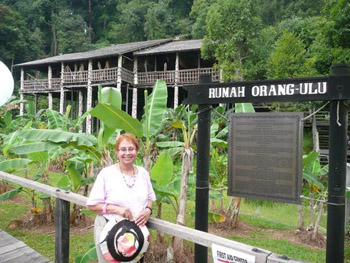
the author at Sarawak Cultural Village in Santubong, SarawakI toured aboriginal homes, including the Orang Ulu iron-wood longhouse of the central Borneo Kayan, Kenyah, Kelabit and Lun Bawang tribes that are built on tall poles, allowing a bird’s-eye view of approaching enemies. There was also a Bidayuh and an Iban Longhouse, Penan Hut, Malay House, Chinese Farmhouse and a Melanau Tall House.

In the Melanau Tall House, Rose Anthony showed me the process of producing sago. The sago palm trunk’s pith is removed and these shavings with water are stomped on, in a large basket, allowing the sago starch to drain through. The gel is dried on mats and rolled into white pellets. Rose cooked me delicious warm sago wafers on top of the stove.

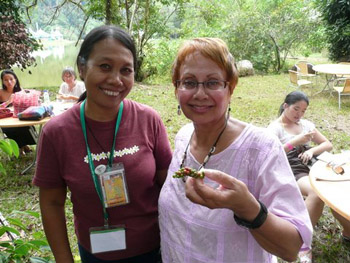
the author shows dried cayenne peppersI was also shown a 12 foot pepper tree at the Chinese farmhouse. Orange and yellow cayenne pepper corns are soaked for two weeks to soften and eliminate the outer skin. The white seed is dried in the sun for one week and white pepper is the result. (right)

Ten years ago, two Canadians, Randy Raine-Reusch, a multi-instrumentalist specializing in wind and string instruments from East and Southeast Asia, and Robert Basiuk, former deputy chief executive officer of the Sarawak Tourism Board, initiated the Rainforest World Music Festival. It is based on the Winnipeg and Vancouver International Folk Festivals with afternoon workshops, up close and personal, with the musicians, followed by evening shows. This year over 23,000 music lovers enjoyed 20 groups from 17 countries including Malaysia and Sarawak.

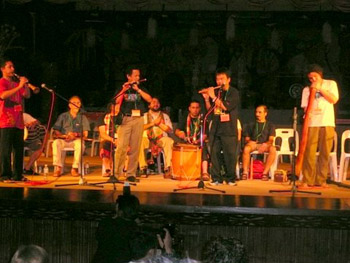
The Blow-Me workshop involved the Huun Huur Tu Russian Tuvan throat singers and the Aseana Percussion Unit playing the Australian Didgeridoo, an Indian and a Chinese flute. Randy Raine-Reusch played the North Indian pungi snake-charmer double clarinet and the Lao and northeast Thai Khaen, free-reed bamboo mouth organ. (below left)

Aseana Percussion Unit performing at music festivalThe Doghouse Skiffle Group from Hull, England explained that after the Second World War there was little money for musical instruments so Lonnie Donegan, the Beatles etc. formed bands using washboards, for percussion, tea-chests with a broom-stick and string attached to sound like a double base (called the doghouse bass) and a guitar.

In the evening there were television screens beside two stages, allowing acts to perform alternately without a break. It was magical, sitting on the ground under the stars, with a happy, international crowd and a Malaysian gliding colugo leaping, like a flying squirrel, from tree to tree.

Dressed in red-beaded costumes and skull caps, the Kelapang Kelabit Bamboo Band and the Anak Adi’ Rurum children, a branch of the Orang-Ulu tribe of Sarawak produced wonderful sounds including hymns from bamboo flutes.

The Black Umfolosi group from Zimbabwe with hard hats and gumboots sang wonderful a capella and with great frenzy, loudly slapped their bodies and pounded their boots while dancing and catapulting into the air. Gumboot dancing began in the flooded South African gold mines during the migrant system. Speaking was prohibited so messages were dispatched via smacking gumboots and shaking ankle chains.

The Mah Meri is one of the 18 ethnically defined tribes of the Orang Asli living along the Malaysian Selangor coast including Carey Island. These fishermen and woodcarvers believe in ancestral spirits. Dressed in bark cloth, grass skirts and magnificent masks they performed for the first time in public, the sacred dance honoring their ancestors.

Thanks for a fantastic, fun time!

More Information:

www.rainforestmusic-borneo.com
www.sarawaktourism.com
www.visitborneo.com
www.borneoadventure.com

Sarawak Tours Now Available:

Sarawak Cultural Village from Kuching City
Semenggoh & Sarawak Cultural Village
Sarawak Semenggoh Wildlife Centre Tour
Sarawak River Cruise Tour

About the author:
Lenora Airini Hayman was born in New Zealand and has lived in Vancouver B.C. for 43 years. She’s been a volunteer since 1984 with the Disability Access Committee for the Vancouver International Folk Festival and was thrilled at the opportunity to attend the Rainforest Music Festival. She is a freelance travel/food and wine writer. Her assignments have taken her to the jungles of Borneo to investigate orangutans, Taiwan to study 13 indigenous tribes and the French Polynesian Islands of the Marquesas to research the original tattooing of the Polynesians who settled there 500 years before the Maori. Contact: itravellen@shaw.ca

Photo credits:
All photos by Lenora A. Hayman.


Tagged With: Malaysia travel, Sarawak Filed Under: Asia Travel

Visiting Rimbun Dahan, Malaysia

Rimbun Dahan, Kuala Lumpur

Art In A Tropical Garden

by W. Ruth Kozak

Tucked away on an small acreage just outside of Kuala Lumpur, a Malaysian architect, Hijjas Kasturi and his Australian wife, Angela, have developed a lush garden paradise retreat for artists and writers.

The Centre for Contemporary and Traditional Art at Rimbun Dahan, (the name means “laden branch” because it was once a fruit orchard) includes a botanical garden planted with indigenous South East Asian species of trees and plants, four studios and accommodation for artists, a large dance studio, an underground gallery, and a restored village house

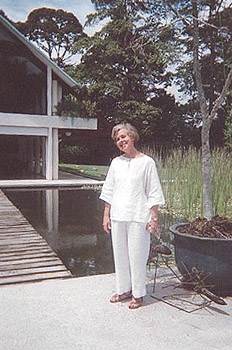
Angela KasturiAt the entrance to the grounds I am warmly greeted by Hijjas Kasturi’s gracious Australian wife, Angela (photo at right). Before we set off on our walk around the compound, she explains the objectives of Rimbun Dahan which supports the development and conservation of both traditional and contemporary art forms, from visual art to theatre, dance and music.

“We accept mainly artists from Malaysia and Australia, for the year-long residency, although foreign artists, mainly those from Southeast Asia, are accepted for short-term residencies,” she says. “It also provides residencies for visual artists, students of architecture and ecology, authors, musicians and other creative individuals, allowing them an opportunity to explore and develop their artistic work.” The program is supported by the Hijjas Kasturi Assoc. architecture firm, and is a token of appreciation to Malyasia and Australia for the opportunities that have been provided for the Hijjas family.

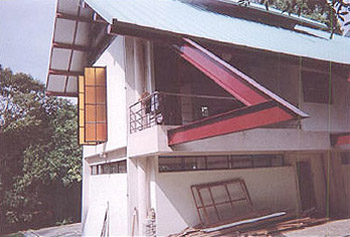
The Hijjas family home, designed by the architect, dominates the compound. Built to compliment the traditional Malay kampong house which was relocated to the compound and restored, the modern house merges the modern and traditional using environmentally friendly materials, solar panels and pond water for flushing and watering.

Inspired by gardens in Australia where local plants are used to create a specific sense of place, Angela Hijjas landscaped the acreage with a wide range of indigenous forest species and other plants from South East Asia.

The Hijjas’s decided to compliment their private collection of art housed in the underground gallery by inviting artists to live at Rimbun Dahan.
“There are no government grants for artists or performers,” explains Angela Hijjas. “Although some prizes are awarded for popular artists who have struggled a lifetime to fulfill their talent, there is little support for the artists struggling to develop their art, musical skills or theatrical talent.”

Thus the concept of the Hijjas family’s unique residency program began.

The landscape, as well as the architecture of Rimbun Dahan raffirms a sense of place and culture in its natural environment of Malaysia.

Rimbun Dahan gardenThe entrance to the herb garden (photo at left) is guarded by a stone lion draped with a garland of sweet-smelling frangipanni. and sprigs of nutmeg. The gardens use a Malaysian style of landscaping and include indigenous plants from South East Asia. As we stroll the winding pathways under the canopy of tropical trees, we are introduced to many varieties of palms, fruit and forest trees such as the tall keluih trees (a type of breadfruit), betel nuts and fruit bearing durian.

The plants in the herb garden are from Indochina, Burma, Thailand, the Malay peninsula and India. Some are also from tropical America.

Accompanied by the trilling chorus of birds like the yellow vented bullbulls who occupy the treetops, we explore and admire the ornamental and flowering shrubs. The flowers attracts many butterflies, flocks of birds, and bats. Two types of monkeys, long-tailed macaques and dusky langurs hang out in the rambutan trees eating the fruit. There are also many tropical squirrels and palm civets who are mostly nocturnal and solitary. Wild boar often come into the orchard to graze on fallen fruit.

Various species of lizards inhabit the compound, such as the crocodile-sized water monitors The dogs keep check on the population of these biawak, who are sometimes seen basking in the sun or swimming in the reflective pools near the Hijjas’ house.

artist studios and residenceThe cobbled and gravel pathways wind through the lush tropical greenery and lead us to a grassy compound where the artist’s studios and residence are located (photo at right). There are usually three or four artists living in residence. They benefit from the unique atmosphere of Rimbun Dahan, and the rich experience that emerges from bridging cultural difference as they develop their own artistic practices.

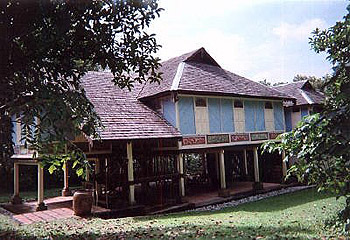
Beyond the artists’ studios, we step back in time into a beautiful traditional 19th century Malay house (Rumah Uda Manap) (photo above).We take off our shoes, as is the custom, and mount the steps to enter the interior. The house overlooks the garden of the Rimbun Dahan and is furnished in Malay style, representing a unique blend of Chinese decoration and Malay architecture including hardwood carvings by Chinese artists. Much of the restoration in the century-old village house was contributed by the resident artists including several of the carved panels that depict mythological animals, and the colourful painted carving of an inverted sky dragon.

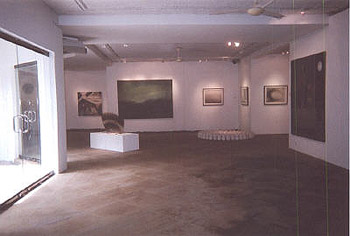
underground gallery at Rimbun DahanA highlight of the tour is a visit to the art gallery (photo at left). To conserve ground space and to be better able to control the humidity, the gallery was built underground. Each artist in residence contributes two paintings or sculptures to the permanent collection.

Every year Rimbun Dahan hosts Art For Nature, a unique showcase of artistic works created by Malaysian and international artists in support of nature conservation. Half of the proceeds from sales of the artworks in this exhibition go the artists for sales of their work and half to W.W.F. – Malaysia’s nature conservation and wildlife protection programmes which include scientific field research, environmental education and policy work with the government.

The botanical garden at Rimbun Dahan is open to the public whenever there is an art exhibition. Private group tours can be arranged with contributions going to the Malaysian Nature Society.

Tours from Kuala Lumpur Now Available:

Private Full Day Tour to Taman Negara National Park

Cameron Highlands Private Full Day Tour

Batu Caves Tour With Fireflies and Dinner

Historical Malacca Full-Day Tour from Kuala Lumpur including Lunch


Batu Caves Tour from Kuala Lumpur

More Information:

For information about the artist’s residency program and nature tours see the Rimbun Dahan website.
For more information about WWF, Malaysia’s conservation and wildlife protection program, see www.wwfmalaysia.org.
For information about the Malaysian Nature Society visit www.mns.org.my.

About the author:
W. Ruth Kozak has been a historical fiction writer since her teens and a travel journalist for more than 15 years. What began as a personal journey to visit, then live in Greece, motivated by her life-long interest in ancient history, has now emerged into this travel ‘zine where other writers can share their experience of travel and life abroad. She also instructs classes on travel writing, creative and novel writing and memoirs. She has traveled extensively, often solo and always on a budget. Her website is www.ruthkozak.com.

Photo credits:
All photos are by W. Ruth Kozak.

Tagged With: Kuala Lumpur tours, Malaysia travel Filed Under: Asia Travel

  • « Previous Page
  • 1
  • 2

MORE TRAVEL STORIES:

My Clockwise Trek Around Holy Mount Kailash

First Time Exploring the Wild in Oregon? Here’s What You’ll Actually Need

Mexico: Exploring Toltec History in Tula

Blue Eyed Mummies of Amasya, Turkey

Contrasting India: Ladakh and Delhi

The Santiago de Compostela Pilgrimage in Spain – The Way of Saint James

Fishing in Karelia

Raigad Fort Road Trip


SEARCH

DESTINATIONS

  • Africa Travel
  • Antarctica travel
  • Asia Travel
  • Australia travel
  • Caribbean Travel
  • Central America Travel
  • Europe Travel
  • Middle East Travel
  • North America Travel
  • Oceania Travel
  • South America Travel
  • Travel History
  • Travel News
  • UK Travel
  • Uncategorized
  • World Travel
facebook
Best Travel Blogs - OnToplist.com

Copyright © 2026 Cedar Cottage Marketing | About Us | Contact | Privacy Policy | Terms & Conditions | Copyright Notice | Log in