Travel Thru History

Historical and cultural travel experiences

  • Home
  • Airfare Deals
  • Get Travel Insurance
  • Writers Guidelines

Cliff Side Temple Tombs of Fethiye, Turkey

Amphitheatre at Fethiye, Tukey

by W. Ruth Kozak

I’m standing at the bottom of a steep flight of stone steps. High above me I can see the facades of the Doric-style temples that are cut into the cliff face of the mountain. I’ve waited years for this moment, but I’m ready to give up.

“Come on! You can do it!” my companion urges.

Lycian tombsEver since I saw pictures of them in the National Geographic years before, I’ve dreamed of visiting the Lycian tombs at Fethiye, Turkey. But can I reach them? I’m already exhausted from the 40C heat and the long slope I’ve walked up from the town.

These pillar tombs, carved in the rock face resemble small ‘houses’ and were modeled on the wooden houses of the Lycians. Important dynasts were laid to rest here. The Lycians who once inhabited this area were peaceful folk who founded the Lycian Federation, the first democratic union known.

I catch my breath and take a step up. I’d waited years for this moment. So I haul myself up the precarious two hundred steps until I am standing in front of the most predominant of these marvels, the Tomb of Amyntas, which dates to the 4th century B.C. The tomb chamber is empty and very small, but the magnificent view across the tiled rooftops of the village and town of Fethiye to the sparkling turquoise sea make a the long trek up worth the effort.

Below is the beautiful little town of Fethiye beside a sparkling bay strewn with islands. The town is built up the hillside, The ruins of a crusaders castle once occupied by the Knights of Rhodes crowns the hill. The rock tombs dominate the town, There are many sarcophagi in the town itself.
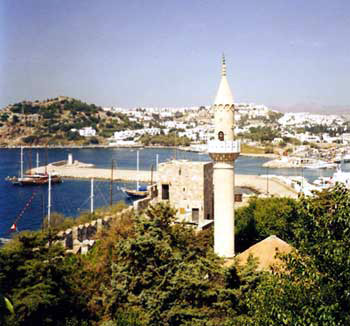
Fethiye harbor and cityFethiye is a traditional Turkish market town occupying the site of ancient Telmessos Although there are plenty of tourists about, most of them stay at the out-of-town resorts. My pension was located on the hillside overlooking the harbor. That morning, my friend and I relaxed on the roof terrace which was decorated in Turkish style, and were served a delicious traditional Turkish breakfast: boiled egg, cheese, tomato, olives, bread and honey and apple tea. Then we set off to explore the area and see the fabled Lycian tombs.

After accomplishing the long-awaited hike up to the tombs, my companion and I spent the day at Belceky Beach located on a bay surrounded by pine-forested mountains. The sea here is absolutely gorgeous, clear turquoise and very warm . The nearby village of “Oludeniz” is located on a lagoon of the same name that means “Dead” or “Calm Sea”. But the sea there certainly wasn’t calm. Big rollers crashed in on the pebbly shore. It’s a popular resort with lines of colourful umbrellas and lots of tourists. Parasailers soar out over the sea.
woman making gozlemeBehind the beach, a few brave people plummet off the cliff in what they call “tandem paragliding” with Turks hanging on their backs (or were they hanging on to the Turks?). Oludeniz is the starting point for the Lycian Way, Turkey’s only marked trekking route which winds along the coast to Antalaya.

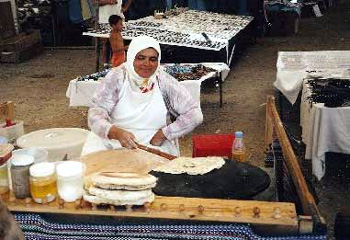
At the village bazaar, I haggle with the jewelry sellers and watch a traditionally dressed lady rolling out gozleme, a kind of thin pancake, like a crepe but made with dough instead of batter, filled with shredded potato, cheese and onions. A delicious snack while waiting for the dolmus to take us back to Fethiye. I would have liked to have stayed longer, to go cruising down the Turquoise Coast. But that’s something I can look forward to on my next visit, for I will certainly return.
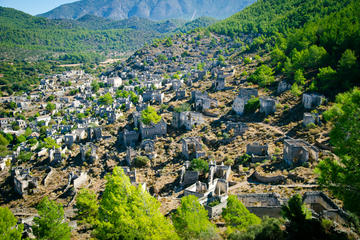

Private Trekking Tour in the Fethiye Mountains

If You Go:

Turkish bus service is excellent and there is a large choice of buses from most main towns on the coast.

Accommodations: Fethiye has a good selection of budget and mid-range accommodations. Resort hotels are usually booked in advance.

Entrance to the tombs is free. You just need a good set of legs to climb there.

The Fethiye Museum is open Tuesdays to Sunday 8.30 – 5.30 $2.00 entry

Lycian Turkey – Discover the Beauty of Ancient Lycia

www.colonialvoyage.com

About the author:
W. Ruth Kozak is a travel and historical fiction writer, and the former editor and publisher of TravelThruHistory.com. A long time ago she read about the Lycian Tombs of Fethiye in the National Geographic, but she never dreamed that one day she’d find herself at the bottom of the steep stairway that leads up to them and summon up the energy and courage to climb those steps for a close-up look.

Photo credits:
Fethiye amphitheater by Osmanyaylali / CC BY-SA
All other photos are by W. Ruth Kozak.
Tagged With: Fethiye, Turkey travel Filed Under: Europe Travel

Consulting the Apollo Oracle

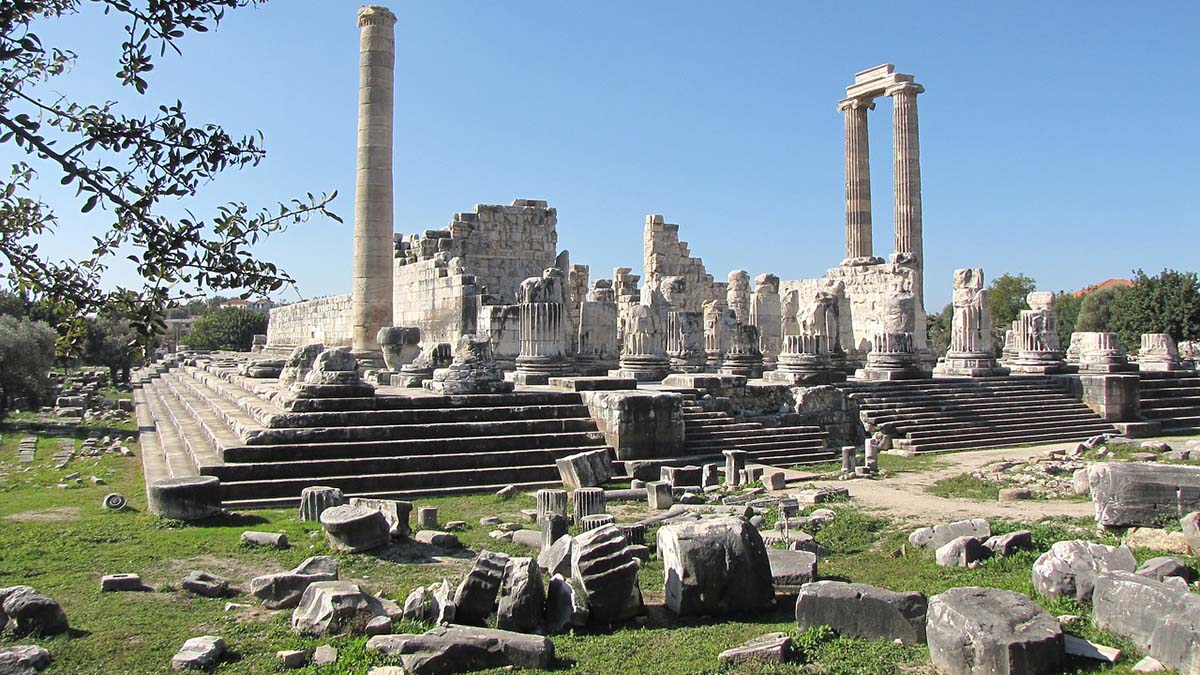
Remains of Didyma oracle temple

Didim, Turkey

by Inka Piegsa-quischotte

Will the oracle talk to me? Will the Medusa turn me to stone? I laugh at myself, as these thoughts go through my mind while I trudge up the steep road which leads from my holiday place in Didim, about 150 miles south of Izmir on the west coast of Turkey to the complex of the oracle in Didyma about three miles away.

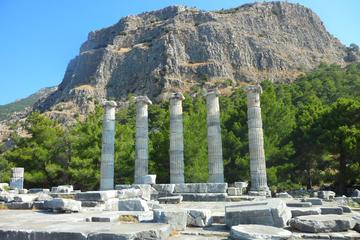
Didiyma oracle siteThe name Didyma derives from the Greek word Didymaion, meaning twins, referring to the dual dedication of this temple to Apollo and his twin Artemis.

I chose to approach on foot, exactly as the ancient Greeks did when they walked along the Sacred Road from the once mighty and powerful city of Miletos, located on the Aegean Sea. That journey took four days. Mine was much shorter, but I also approached from the opposite direction. Although less known than the Delphi Oracle in Greece, the Didyma Oracle was of equal importance in ancient times.

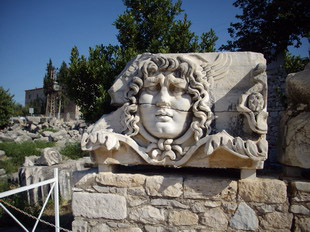
Medusa face at Didyma templeThe temple was a place of worship as well as of predictions of the future for the rulers of Miletos. Priests resided there permanently to guard the sacred spring and holy olive tree which are the center pieces of any sanctuary dedicated to the twin Gods.

Although an impressive site and greatly restored and excavated, the Didim Oracle does not have a big approach and parking area. Which, unlike Ephesus and Troy, is a blessing, because there simply is no space for more than one or two tourist coaches at a time. Even so, it gets quite crowded during the summer season and later in the day.

The site opens at 9:00 am. I have my visit well timed, because I want the place all to myself to savor and absorb the atmosphere and let myself be transported into the past uninterrupted by umbrella touting tour guides and jostling visitors. Rounding the last bend in the road, I reach the outer perimeter of the complex. It is fenced in, but most of the outer wall is constructed from huge stone blocks taken from the site itself, which gives the place a feeling of being still alive and sort of “in use.” I pay my modest admission fee of $1 to the one and only guard who is just opening up and still sweeping the entrance.

Didyma temple entranceAs I descend the first set of stone steps, still moist from morning dew, my only companions are birds singing in the many olive trees; cats stretch their legs, tiny lizards rustle in the leaves. Otherwise, an eerie silence rules, very appropriate for a sacred place. It had the very atmosphere I had wanted.

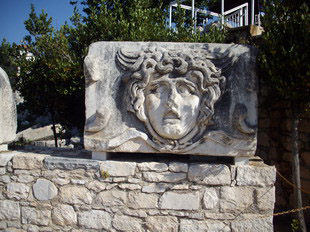
The Didim Oracle is most famous for three well preserved images of the Medusa and that’s where I head first.

Medusa was one of the Gorgon sisters, the most beautiful but the only one who was mortal. Medusa was extremely proud of her beauty, an attitude which ultimately became her downfall. Randy God Poseidon fell for her and seduced her – of all places, in the sanctuary of Athena. That didn’t go down well with the goddess, but as she was powerless to take on Poseidon, she punished Medusa instead, turning her into a snake-haired monster, who could turn people to stone if they dared to look into her eyes. Until, along came Perseus, who shielded his eyes and managed to cut off the monster’s head. According to mythology, the drops of her blood which fell to the ground, created the snakes of Africa. Devious Perseus then mounted Medusa’s head on his shield and used the powers, which persisted even after her death, to successfully fend off his enemies.

Medusa anguished face carving at DidymaBecause I know this story, I turn my eyes to the Medusa monuments with some trepidation. The images are mounted on a knee high stone wall just below the stairs descending from the entrance. No, the stare doesn’t turn me to stone but her eyes reflected such sadness and rage at her fate, that a shiver ran down my spine.

The main temple remains and the now covered sacred spring are to the right. I am glad I had worn sturdy trainers with soles that don’t slip, because the ground is uneven, the steps up to the temple are high and the tunnel leading to Artemis’ temple in the back is slippery.

The temple and oracle has suffered greatly over time. Earthquakes, fires and ransacking have all taken their toll, but mainly German archaeologists have done a great job of excavation and restorations. Many columns of the original temple stand proudly and it isn’t difficult to imagine the procession of ancient Greeks, arriving dusty from their hike along the sacred road, seeking advice and a glimpse of the future from the Gods.

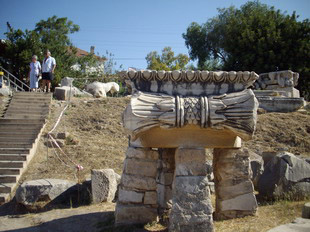
remains of lion statue at DidymaIn the times of Alexander the Great, the Didim oracle received a lot of support and money. This comes hardly as a surprise, as he consulted the oracle and, correctly, received a prediction of his many successful conquests. I doubt though, that it also predicted his early death! The priests might prudently have kept that piece of truth to themselves.

The spring down even more stone steps, is now partially covered with a stone slab of enormous proportions and is probably dried up. Even so, and given the total silence, I imagine I hear a murmuring telling me: write about me! Fanciful maybe, but the temple complex has this effect. It is easy to lose track of time, meandering around the entire complex. Many pieces of shattered columns are lying around, but other artifacts and statues have been mounted and placed around the grounds in such a strategic way, that they reveal a new sight and surprise at every turn.

Didyma temple overviewIt’s a very gratifying way of arranging an ancient site which allows the visitor a trip of discovery all his own. When visiting historical sites, I hate to be forced by paths, ropes etc. to follow a prescribed route. It’s much more fun to be able to go where I please and that’s exactly what I do here.

Voices drift down, footsteps approach and traffic noises start to intrude into my musings of the past, of Gods, oracles and great kings. It is time to leave. I make my way back, this time around the bottom of the temple with the columns looming even higher above me. At the exit, I buy a small booklet which explains the history as well as the story of the excavations which are still ongoing. Save for another devastating earthquake like the one in 1955, this impressive site will be around for another few hundred years, but I’m glad I came today and leave feeling inspired.


Priene Miletus Didyma Tour with Private Guide

If You Go:

Didim and the Didyma Oracle are best reached from Bodrum to the south or Izmir to the north by car or coach. Coach excursions can be booked in both places. The oracle open at 9:00 am and closes at 5:00 pm. Open every day. For more privacy the best time of year is spring or fall. About five miles toward is Izmir is the village of Akkoy, a typical rural Turkish village with old stone houses, cafes and a fresh fruit and vegetable market on Wednesday. Across the road from the Oracle entrance are several souvenir shops and a carpet shop as well as two restaurants and a cafe where they make the best Turkish coffee flavored with spices – not to be missed. A helpful resource to consult is the Didim Tourism Travel Guide website.

About the author:
Inka Piegsa-quischotte is an ex-attorney turned travel writer and novelist. She writes for online travel magazines and has two novels and a travel guide to Galicia/Spain published. She lives between Turkey and Miami.

Photo credits:
First Didyma, Turkey photo by Lauren van Zoonen from Pixabay
All other photos by Inka Piegsa-quischotte.

Tagged With: Didim, Didyma, Turkey travel Filed Under: Europe Travel

Visiting Istanbul With President Obama

Istanbul, Turkey

Istanbul, Turkey

by Sandra Harper

Last April, I was in Istanbul when United States President Obama paid a visit to the city. We followed the same itinerary, except I didn’t have the political meetings that Obama had. It was Obama’s first visit to a country where ninety percent of the people are Muslim. He is there to highlight Turkey’s importance in a growing world market. I am there on my second visit to the city to write about how it has changed in the last ten years.

market in IstanbulFlying into Istanbul as the sun flickers over the eastern shores of the Bosphorus Straits, the vastness of the city strikes an emotional chord in me. It takes forty-five minutes to drive swiftly from the airport to downtown. Hundreds of thousands of multi-floored, flat-roofed buildings house, at last count, most of the seventeen million people. The population has doubled since my last visit, but I find that, outside the rush hour traffic, Istanbul feels not crowded, but calm. There are buses, trams, trolleys, taxis and an ancient underground – as well as walkways to easily maneuver the city. However, President Obama isn’t using any public transport – only a military plane and a car cavalcade.

My taxi drives up to a modern hotel, called the Titanic – as sleek as its namesake – just off Taskim Square. Across the massive open Square is the old district of Beyoglu, with it web of streets lined with beautiful old buildings housing modern businesses and restaurants. An ancient tram car runs from the waterfront up the hill and through Beyoglu. As the day begins, locals and visitors are hopping on and off the tram to shop, drink coffee, eat and enjoy the moment. Morning hours drift away over Turkish coffee in discussions and debates. Unfortunately, time does not allow the President to experience this aspect of Istanbul for he is only here for the day.

interior of an Istanbul mosqueFrom Beyoglu I can see the 14th century Galata Tower, originally built in the 5th century to spot fires in the city. Today’s world is more concerned with other things. The tower is a perfect first place to experience a panoramic view of Istanbul. After taking a cab there, circular steps and a lift carry me to the top of the ancient tower to savor the scene of the sun beaming over the minarets and domes, mixing with the background of chaotic sounds: calls-to-worship from the Muslim mosques, church bells, blaring sirens and ships’ horns. Perching on the top floor of the tower is much better, I think, than seeing a city from a plane.

Going down to the street again, I dash over to the upper level of the Galata Bridge which throbs with a spirited street market and hordes of fisherman. Going to the lower level, I throw myself into the chaos, all my senses bombarded, and select what to eat. Deep-fried squid makes for a great mid-morning break.

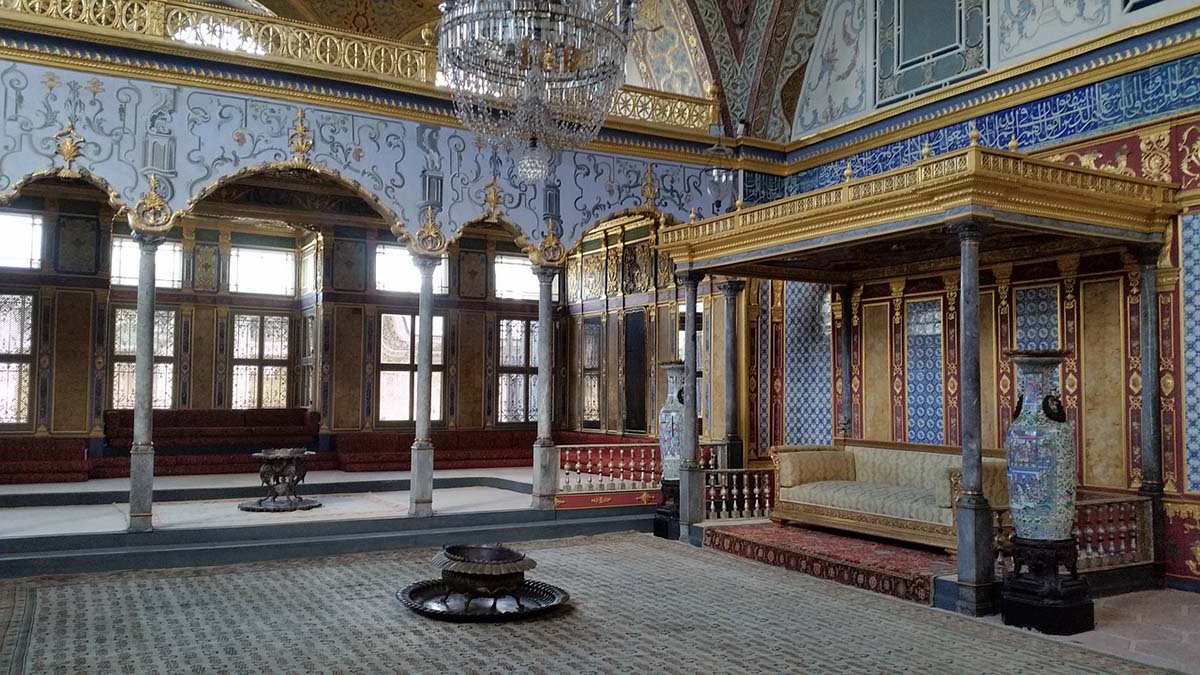
Walking the different neighborhoods of this vast city is the best way to get to know its diversity, its peoples from many parts of the globe, and its exotic sounds, sights, smells and flavors. A sampling of the most important buildings provides an insight into whom and what has developed this complex city. I focus on just a few, finding that my itinerary is exactly the same as President Obama, but at a different time. Too fully explore them all would take a lifetime, but we don’t have that time. I start with the grand Topkapi Palace, an expansive structure overlooking the Bosporus and Sea of Marmara. It could take days to explore so I just focus on the impressive collections in the Imperial Treasury and the rooms of the Harem where the Sultan, his wives and concubines lived. I try to imagine what life must have been like, but I am distracted by the many Turkish women dressed like me, with only some wearing scarves on their heads.

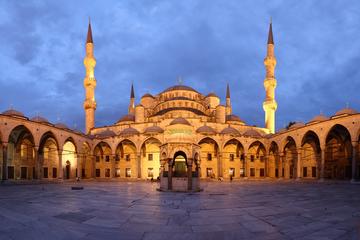
From those places of luxury, I walk through the Sultanahmet Square’s spring gardens of daffodils and tulips to the Sultanahmet Mosque with its perfect domes and sky-reaching minarets. Many Turks are in the mosque as I walk shoeless into its inner sanctum of perfect stillness – so profoundly different than the outside hustle. A brief time later, I enter Hagia Sophia, a mosque turned into a Christian cathedral, and that opens my mind to blending of religions and the world of Byzantine frescoes. Rounding off the experience I move on to the Blue Mosque with its elegant rounded domes.

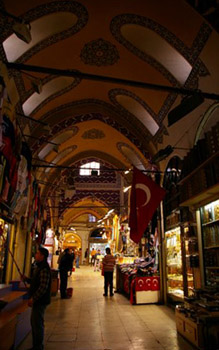
After all that sightseeing, I manage to find my way to the Spice Market, much like a Farmer’s Market, and then onto the huge Grand Bazaar – an exotic ancient shopping mall that offers buyers the ordinary with the extraordinary. The air drips with the smells of coffee, spices, and dust.

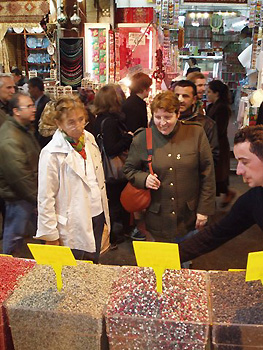
shoppers in an Istanbul marketThe city is abuzz with speculations of where Obama is now. I decide to head out and miss the party. The traffic is too congested. I take a ferry up the Bosphorous. Along its shores, the houses are like solid matrons – all with freshly painted make-up. I get off and walk awhile to savor the stillness and to have dinner at Bile Mer, Fish of the Sea. A variety of vegetables accompanied by dips is followed by a whole grilled white fish, plus a small custard and coffee. During that time, President Obama has an elaborate dinner with Turkish President Gul, after meeting with students at the university, and leaving them with the message that “States are like big tankers, they’re not like speedboats. You can’t just whip them around and go in another direction.” When I turn round and return into Istanbul, Turks happily report that Obama is effectively promoting the idea that America can work with a Muslim country.

Upon docking, there is a massive traffic jam on the roads as the President is taken back to the airport. I decide to head off in the opposite direction to find the Museum of Modern Art, a large shed-like building on the waterfront for an evening visit. To understand a culture, I like to examine its art. The results of Ataturk sending Turkish artists to study in Paris, France, during 1930-40s grace the walls of this gallery. The variety of art has a sophistication of the abstract form that is world class. It is an excellent example of how exposure to new ideas and ways can make a difference. Too bad Obama had to miss this exhibition.

Istanbul is a city where the present moment sits together with the best of the past. A visitor who comes to Istanbul to experience some of the infinite variety in the city will depart with a greater understanding of the constancy of change and a heightened belief that people can work together. I know I did.


Guided Full Day Highlights of Istanbul private tour

If You Go:

You will get personalized and good travel support with flights, hotels, tours, and guides Fahrettin Gokay at Vanguard Travel Service, Istanbul. Contact: info@vanguard-ts.com;  or call +90(216)5671385

Personal Travel Guide, contact Rashat in Istanbul at 05326701369.

For a central hotel try Titanic City Hotel, Taksim Square, Istanbul at www.titaniccityhotel.com. For other hotels, go to www.Istanbul-hotel.net

A great restaurant is Haci Baba Restaurant, Istiklal Cadessi No. 49 in Beyoglu. Tel. 02122441886

One of the great places to visit beyond the usual is the Istanbul Modern Museum in Karakoy.  It also has a marvelous cafe and restaurant.

About the author:
Sandra Harper is a world traveller. She flew to Istanbul last April while she was volunteering in Kenya. Next on her agenda is wine tour in the Okanagan and an exploration of Jordan. She writes travel articles and has four books published. See them at www.hawthornepublishing.com.

Photo credits:
Rüstem Paşa Cami, Istanbul, Turkey by Svetlana Gumerova on Unsplash
All other photos are by Sandra Harper.

Tagged With: Istanbul attractions, Turkey travel Filed Under: Europe Travel

Turkey: Tracing the Route of Faith

Topkapi Palace interior

Istanbul, Turkey

by Norman A. Rubin

As visitors to Turkey course their way through the Grand Seraglio, the immense fortress of the Ottomani Sultans (now a museum) at Istanbul along the Sea of Marmara and the Golden Horn, they listen to the faint echoes of past centuries of greatness. The echoing sounds then lead them along the passage through an important crossroad into the signs of the faith – Judaism, Islam and Christianity. These signs of faith have left an indelible mark in the course of human history.

Turkey has a magnificent past, which is displayed throughout the land – graceful aqueducts build by the Romans, caravansaries dating back to Seljuk Empire of the 11th century, archaeological sites such as Troy, Pergamum, Ephesus, Miletas, Perga, etc.. The hinterland shows glimpses of other ancient civilizations – the Hittites, the Khatti, the Phyrygians, the Lydians… and the signs of faith.

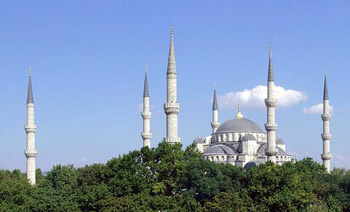
Blue Mosque, Istanbul, TurkeyThe route of faith starts at Haran (Harran). The Bible records that there the Patriarch Abraham came into Canaan from Harran. Abraham sent his servant back to the region of Haran to find a wife for Isaac (Genesis 24:10) and where Jacob spent a score of years. There in that town, Terah, father of Abraham, found his final resting place. “But when they reached Harran, they settled there…” (Gen 11:30-31) Biblical mentions of the Hebrew population in Turkey are numerous: Icononium (present day Konya) is mentioned as having a synagogue in Acts 14:1, and Ephesus is mentioned as having a Synagogue in Acts 19:1:1, etc. Note: Harran is located 10 miles north of the Syrian border along the Balikh River, a tributary of the Euphrates River.

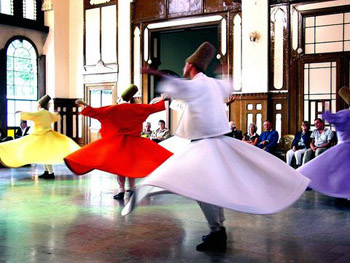
Sufi whirling dancersWe are all familiar with Mt. Ararat in Eastern Turkey where, according to written tradition of the Old Testament Noah’s ark landed there after the great flood. But, how many people are aware that Turkey was the birthplace of St. Nicholas or Santa Claus? Saint Nicholas was the Bishop of Myra (now Demre-Kale) who lived in AD 300. He was extremely kind and went out at night, taking presents to the needy. Afterwards his fame spread, and over the years it turned into that merry old gentleman associated with Christmas.

Tarsus in south-central Turkey was the birthplace of the Apostle Paul; Antioch (Antakyah) is the site where the followers of the Lord were first called Christians; here Paul and Barnabas were sent on their first mission. Cappadocia (Goreme), in the center of the country, is where the early Christians took refuge from the forces of Roman Empire. And in the small town of Pamukkale (Hierapolis) is the site of the martyrdom of St. Phillip.

St. Sophia Museum in Istanbul is one of the most important monuments of all time. The basilica, built by Emperor Constantine the Great and reconstructed by Emperor Justinian is one of the architectural marvels of the world. The Chora (Kariya), situated nearby, is another important Byzantine monument; the 11th century church’s and mosaics are superb and a sight to behold. The St. Sophia cathedral (now a museum) at Iznik (Nicaea) was the seat of the first (325 AD) and seventh (787AD) ecumenical councils.

ruins of ancient TroySelçuk (present day Izmir) is one of the most visited tourist destinations in Turkey, known for its nearness to the Ephesus, House of the Virgin Mary and Seljukian works of art. On the other hand you can see Basilica of St. John, Ephesus Museum, Isa Bey Mosque, Temple of Artemis and Byzantine Aqueduct in the town. The seven Churches of the Apocalypse are all situated in Anatolia – Ephesus, Smyrna, Pergamum, Thyatira, Sardis, Philadelphia and Laodicea – (Revelation: 1:11-12)

Tokapi Palace in Istanbul houses a most famous exhibit featuring the Prophet Mohammed’s personal belongings. The Sultan Ahmed Mosque (Blue Mosque) in Istanbul is one of the most famous architectural legacies of the Ottoman Empire. The Haci Bayram Veli complex at Ankara contains a 15th century mosque and a shrine to Haci Bayram Veli, a prominent Sufi leader known for his tolerance. In the Mevlana complex at Konya (Iconium) is the tomb of Mevlana Celaleddin Rumi, one of the most important humanistic Islamic philosophers. There are Seljuk stone carvings on tombs and mausoleums from the 12th and 13th centuries at Ahlat, The Yesil Turbe (Green Shrine) at Bursa is a 15th century monumental Ottoman complex consisting of tombs, mosques from 13th and 14th centuries, and a Medresse (theological) school, a marvel to behold.

The ‘Sites of Faith’ are found in varied religious and historical texts – museums in all the major cities have on exhibition the archaeological and historical wealth of the country.


Guided Full Day Highlights of Istanbul private tour

Additional Information:

Ministry of Tourism, Government of Turkey
821 United Nations Plaza, New York, 10017 – Tel: (212) 687-2194
Fax: (212) 599-7568 E-mail: ny@tourismturkey.org
1717 Massachusetts Ave NW, Washington DC 20036 Tel: (202) 612-6800
Fax: (202) 319-7446 E-mail: dc@tourismturkey.org

NOTE:

1) Turkey is a paradise of sun, sea, mountains and lakes that offers the vacationer a complete change from the stress and routine of everyday life. From April to October, the country has an ideal climate that is perfect for relaxing on sandy beaches, touring the rich heritage of the land, or for enjoying the tranquility of mountains and lakes. Shopping is one of the great pleasures of a trip to Turkey, which offers a rich variety of traditional handicraft: Your only difficulty will be in deciding what to choose from the many tempting bargains. Turkish cuisine is known for the richness of flavors that never fail to delight and the coffee served in cafes is famous throughout the world.

2) A passport and visa are required. Passport holders can purchase a 90-day sticker visa at the port of entry for $20 cash if they are traveling to Turkey as tourists. For further information contact the Embassy of the Republic of Turkey at 2525 Massachusetts Avenue, NW, Washington, D.C. 20008, telephone: (202) 612-6700, or the Turkish consulates general in Chicago, Houston, Los Angeles, or New York.
Republic of Turkey Ministry of Culture and Tourism

About the author:
Norman A. Rubin is a former correspondent for the Continental News Service (USA), now retired – busy writing articles and stories for Net sites and magazines worldwide – see ‘Google.com’ under the author’s name for a review of his written work. Contact: normrub2000@gmail.com

Photo credits:
Topkapi Palace interior by Arif Yasa from Pixabay
All other photos are by Norman A. Rubin.

Tagged With: Istanbul attractions, Turkey travel Filed Under: Europe Travel

Turkey: Surprised by Istanbul

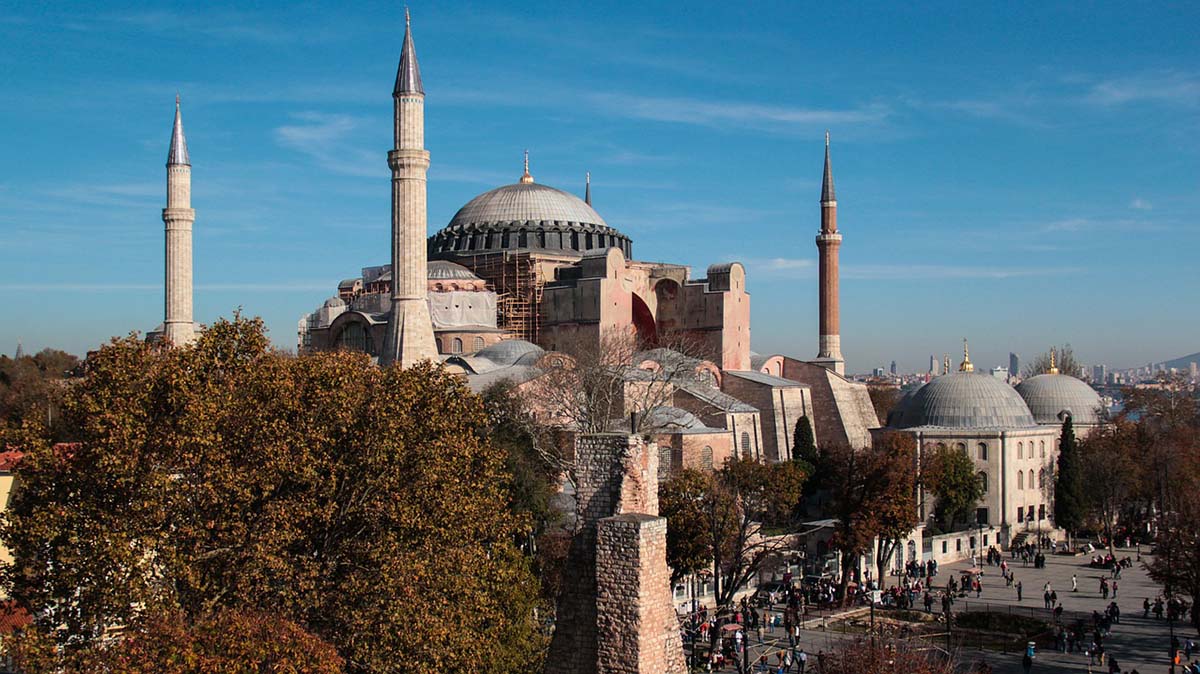
Hagia Sophia mosque

Admiring the Uncompromising Ugliness

by Andrea Kirkby

Istanbul straddles the Bosporus, the strip of water that divides Europe and Asia. It’s a city with a mixed heritage – Roman, Greek, and Turkish – and whatever happens to Turkey’s claims to membership of the European Union, Istanbul will remain an ambiguous city, with a foot in both continents.

The geography of the city is complex. Modern Istanbul stands astride the y-shaped waters of the Golden Horn and the Bosporus; it’s a city linked by water, where the ferry docks of Eminonu belch forth huge crowds of commuters every day.

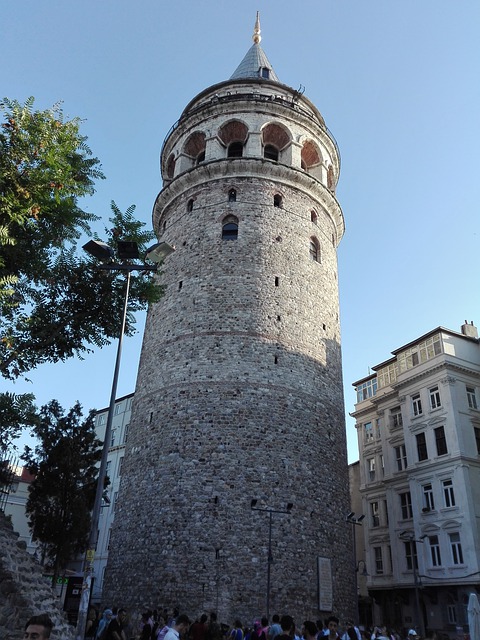
Galata Tower IstanbulNorth of the Horn, now the modern city’s centre of commerce, was known as Pera under the Ottoman empire, and occupied by Genoese, Venetians, foreign traders and diplomats. The Galata tower which dominates the promontory was built by the Genoese in the fourteenth century, at the end of the Byzantine empire.

To the east, the Asian coast, with Uskudar (Scutari) faces the waterfront. To the west, the promontory of the great city, still surrounded by the walls of Theodosius, uses the great aqueducts of the Roman empire to channel water into the centre. This hilly peninsula was the historic centre of first a Roman, then a Greek, then a Turkish empire.

If you’re interested in history you’ll want to start off in the centre, in the district now known as Sultanahmet. Here the great Byzantine church of Hagia Sophia stands at the end of the Hippodrome; here the crowds came to cheer for the Blues and the Greens, and not infrequently rioted after the chariot races. Nowadays, Stambulli taxi drivers run their own version of the chariot races of the empire.

You can really get a feeling for the huge ambition of empire by visiting just two buildings – Hagia Sophia and the Süleymaniye mosque. One Greek, one Turkish, they are the climactic works of their respective cultures.

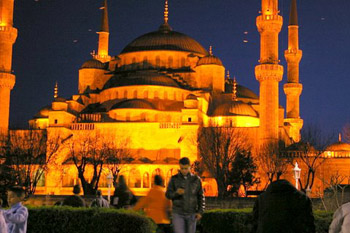
Hagia Sophia at nightHagia Sophia is unbelievably awe-inspiring. Anthemius of Tralles and Isidore of Miletus built this ambitious edifice for Justinian – one of a series of great rulers from Constantine to Suleiman who stamped their character not only on the buildings of the capital, but on the laws of their empires. Although the church has lost most of its mosaics, it retains its gleaming marble facings and carved marble capitals; and of course the great dome, a huge unsupported span high above. (It’s actually the second dome – the original only lasted a few years before falling. You can judge the immense ambition of early Byzantium not just by the size of the dome, but by the perseverance with which Justinian, undeterred by the collapse, just ordered a rebuilding – managed by Isidore’s nephew.

Go to Hagia Sophia early in the morning to see it in dim light, and in the quiet before the crowds arrive. Even without the chanting and the incense, you’ll understand something of Byzantine mysticism.

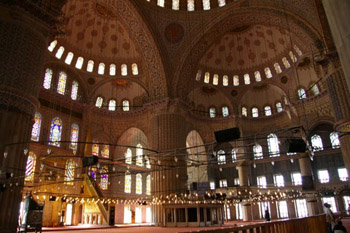
Hagia Sophia interior domeThe thing I love most about Hagia Sophia is the uncompromising ugliness of the exterior – huge buttresses, a massive plain dome, plain brick walls. There’s nothing pretty here – the architecture aims at an impression of great power and dignity, not elegance or delicacy. And that’s a theme that will echo again and again through the architecture of the city.

Sophia is also the moment at which architecture stops being Roman and becomes Byzantine. The earlier church on this site had been a basilica, with long arcades and a pedimented front that wouldn’t have looked out of place in Rome. But Justinian’s church has nothing in common with Roman architecture. If you a familiar with the Roman pantheon, with its skylight above and its solidity and simplicity, you’ll see that Sophia, with its ambiguous gallery, aisle spaces and dim lighting, has nothing at all in common with that style.
Istanbul street market outside mosqueHagia Sophia impressed the Ottoman Turks; they created mosques with domes that clearly reflect the pattern of the great church, and create an immediately recognizable skyline. The influence is evident as early as the Beyazit mosque, the earliest surviving imperial mosque. You see it at its height in the work of the great architect Sinan, under Suleiman the magnificent.

And if you stand near Hagia Sophia, and look up what’s nowadays Divan Yolu, the great street that runs towards the Grand Bazaar and the western parts of the city, you can see how although almost all the Byzantine buildings above ground have vanished, the main street of the city has remained. Even the Bazaar is probably on the site of the Byzantine market. Although Divan Yolu today is flanked by mosques, mausoleums and pious foundations, things have changed less than you might imagine

Hagia Sophia stands alone nowadays, divorced from the Great Palace and its other surroundings. But Sinan’s mosque at Süleymaniye, on the northern side of the city, is still surrounded by its original dependencies, and it’s here that you’ll need to go to understand how mosques fit into the Ottoman cityscape.

Mosques were planned as self-financing entities –surrounded by shops which paid rent to the mosque foundation or waqf. They also acted as charitable foundations, running hostels, caravanserais, hospitals, and soup kitchens, as well as medreses (religious schools), and often, the mausoleum of the founder and of other major donors. That had always been the case, but Sinan created a purpose-built complex where the forms of the architecture ordered and regulated the surrounding buildings. The fine arcades of the shops facing the mosque, and the steps leading up to it, create a monumental complex, practically a city within a city.

shops at entrance to mosqueThis mosque was the work of Suleiman the Magnificent – though in Turkish he’s known as Suleiman the Lawgiver. It’s interesting that this is one thing he has in common with Justinian, who created a new legal code for the Byzantine empire. Like Napoleon, another great emperor, both of them saw the creation of a legal code as a longer lasting heritage than mere military conquest.

The restaurants opposite the mosque, sell fasulye – baked beans Turkish style –recommended as an inexpensive and enjoyable lunch stop. However, if you’d been here in the sixteenth century, you might have had a less sedate time – apparently several of these shops sold hashish, and the lane was known as ‘antidote alley’.

Sinan took the idea of the central dome from Hagia Sophia, but made it more elegant and graceful. He created a cascading pattern, with semidomes and turrets falling away from the central dome, diversifying the outline. This mosque complex works on different levels to cope with the sloping site. There are stairways, ramps, and the whole north eastern part of the complex is supported on huge vaults. Sinan considered this mosque his greatest work, and like his master Suleiman, he’s buried here, in a little tomb in his own private garden.

The mosque is currently undergoing repairs, which makes access difficult. But the graveyard, with the mausoleums of Suleiman and his wife Roxelana, can be visited, as can the shops and medreses and even the bathhouse belonging to the mosque.

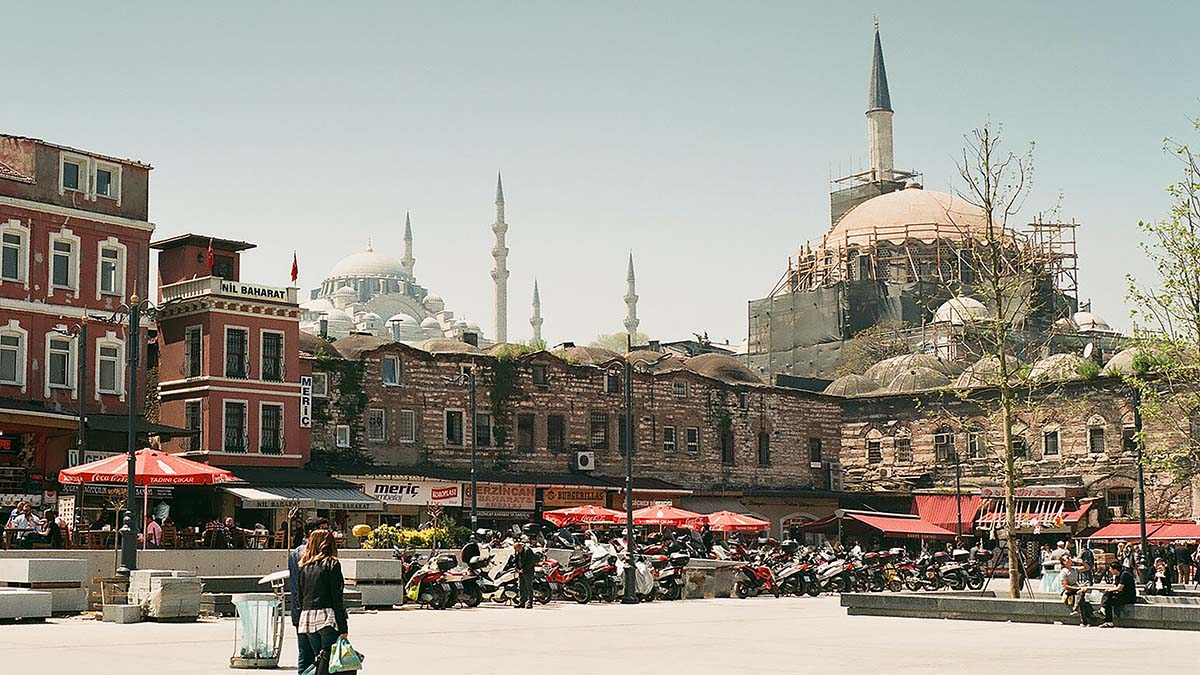
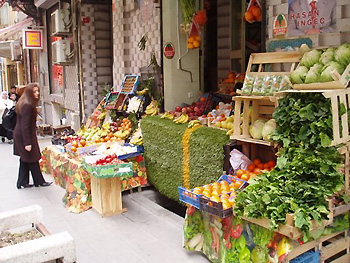
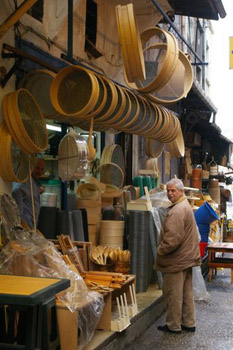
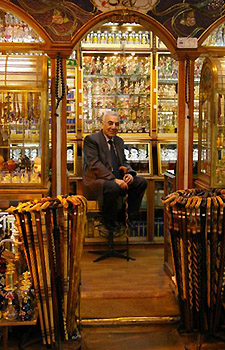
Istanbul shopkeeper selling canesBut to understand Istanbul properly, you have to understand the smaller scale of the city as well as the major monuments. Walk the cobbled streets near Kucuk Ayasofya – the church of Saints Sergius and Bacchus with their tumbledown wooden houses, and you’ll see one face of the city. Or wander the streets that extend north from the Yeni Camii and Eminonu, into the market. This isn’t a tourist market like the Grand Bazaar, but a neighbourhood market selling daily essentials. On Tahtakale you’ll see shops full of kitchen equipment, as well as food stalls. Here you’ll find a gem of a mosque, Sinan’s Rustem Pasha Mosque, elevated above the noise of the market and reached by two winding staircases in the thickness of its plinth.

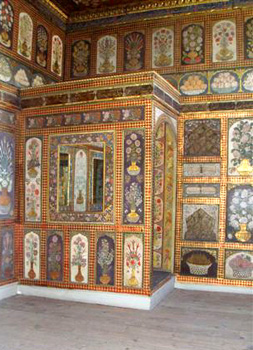
Hagia Sophia and Süleymaniye are huge buildings, but bare though, Sinan filled the mosque with ceramic tiles. There are flowers, geometrical patterns, calligraphic roundels; bright reds and blues, fresh greens. The painting is precise, the colours vivid; this was the greatest age of the Iznik tile makers. If you want to see the decline of Turkish ceramic, visit the mausoleum opposite Yeni Cami – the tiles are lovely, but the colours are not as vibrant; there’s more green, less rich blue and red, and the designs are less precisely drawn and often smudged.

ceramic tiles on Istanbul wallIf you have an eye for detail, you’ll love the fountains of the city – both the shadirvans, the ablutions fountains where men wash their feet before entering the mosque, and the drinking fountains on the streets, often with a little tin mug attached. Little kiosks now serve tea and coffee, but were originally charitable fountains associated with the mosques – one near Yeni Cami still fulfills this function. In the booksellers’ bazaar, next to the Beyazit mosque, one of the fountains has been specially restored as a drinking bowl for the tribe of cats that live there. Although there are no Byzantine fountains left, the ready availability of running water everywhere in the city is another element of continuity between the two cities, Constantinople and Istanbul. It was the Roman emperors who first brought fresh water to the city, and you can still see the fine aqueduct of Valens, and two Byzantine underground cisterns.

Istanbul is a strange mixture – Roman, Greek, Turkish, and full of surprises. It’s full of tourist touts and traffic, yet, as soon as you wander off the beaten track, you find the most unexpected places and people. It’s a city of emperors and sultans, yet it’s also a city where the smell of lignite coal makes your nostrils smart in winter, where you can buy roast chestnuts in the street, and where the street cats are always glad to make your acquaintance. You can’t sum up Istanbul, you can only experience it.

For More Information:

Lonely Planet: Istanbul, Turkey
Turkey Travel Planner

Istanbul Tours Now Available:

Private Full Day Istanbul City Tour
Private Walking Tour in Old City Istanbul
The Legends of History Tour: Blue Mosque and Topkapi Palace in Istanbul
Private Tour: Istanbul in One Day Sightseeing Tour including Blue Mosque, Hagia Sophia and Topkapi Palace
Eat Like a Local: Istanbul Food and Culture Tour with Dinner at Local Family Home
The Jewish Route In Istanbul Private Tour
About the author:
Andrea Kirkby is a writer and photographer with a passion for travel, history and architecture. After walking to Canterbury, Santiago de Compostela and Rome along the ancient pilgrim paths, she’s now wondering whether Jerusalem ought to be next.

Photo credits:
First Hagia Sophia mosque photo by Niek Verlaan from Pixabay
Galata Tower by Kamel Benyoub from Pixabay
All other photos are by Andrea Kirkby.

Tagged With: Istanbul, Turkey travel Filed Under: Europe Travel

  • « Previous Page
  • 1
  • 2
  • 3

MORE TRAVEL STORIES:

Between the Beaches and the Barrio

The Breathtaking Temples of Nara, Japan

Get Thee To A Nunnery – Convent Stays

Fishing in Karelia

The Basilica of Saint-Nazaire-et-Saint Celse

Fashion Museums Around the World: The Best Places to Learn About the History of Style

Celebrating the Royal Wedding in Historic Victoria, BC

Moscow, Russia: Where History Starts


SEARCH

DESTINATIONS

  • Africa Travel
  • Antarctica travel
  • Asia Travel
  • Australia travel
  • Caribbean Travel
  • Central America Travel
  • Europe Travel
  • Middle East Travel
  • North America Travel
  • Oceania Travel
  • South America Travel
  • Travel History
  • Travel News
  • UK Travel
  • Uncategorized
  • World Travel
facebook
Best Travel Blogs - OnToplist.com

Copyright © 2026 Cedar Cottage Marketing | About Us | Contact | Privacy Policy | Terms & Conditions | Copyright Notice | Log in