by Jonathon Engels
In 1541, the crater atop the volcano just south of my apartment collapsed, and the deluge of water caused a massive mudslide, a lahar, that buried Guatemala’s then capital, La Cuidad de los Caballeros de Santiago de Guatemala. The result was that a city nearby, the one in which I currently live, got bumped up in status and received the same elongated name. Then, in 1773, after the Santa Marta earthquakes rampaged through Panchoy Valley and left this place in ruins, yet another capital, with a new name this time, was founded in a “safer location”.
Nueva Guatemala de la Asunción is now internationally identified as Guatemala City, one of the most dangerous cities in the world. Locally, it is known simply as Guate, and tourists avoid it. On the other hand, the previous capital, known as Antigua Guatemala (“Old Guatemala”), receives over a million tourists annually. In a weird way, those earthquakes preserved all the grandeur of the formal capital. They were probably a saving grace for the tiny city-to-be and one of the major reasons I have found myself walking these streets daily.
“Old Guatemala” Today
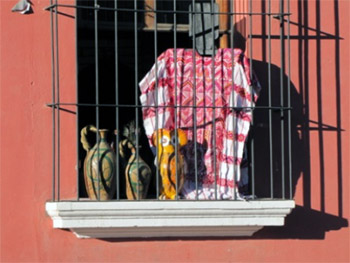 Nowadays, Antigua is a UNESCO World Heritage Site. What the mass exodus of 1773 left behind were around forty once-sturdy stone churches, beautiful cobblestone streets, and a vibrant culture not swallowed by the dirt and danger of today’s capital. Antigua’s streets are lined with pastel storefronts. Its parks are highly trafficked with pedestrians and thick with greenery. Its population is a fantastic mix of indigenous Maya, locals, international volunteers, long-time expats, and travelers who just can’t bring themselves to leave.
In addition to the history and beauty of the city, and despite its name, Antigua is now modernized and mindful of its biggest industry: tourism. Silver, native textiles, tourist tat, or knock-off clothing—The shopping here is fantastic and sometimes a little too irresistible. Restaurants come in variety, from street vendors and cantinas to fancy French bistros and fusion sushi. There are great interactive museums, like touring the jade factory.
Here, there is a no honking law to keep the city tranquil. There is new gun-free police force to fight corruption problems within the old arm-laden police force. People are working to preserve the inherent history, restoring old buildings and outlawing neon. NGOs run fair-trade, organic, self-sustaining, educational workshops for the natives and tourists alike. All in all, it’s a community, which, while some complain is not exclusively Guatemalan, immensely cares about this city, this country, and its own people.


What to Do with a Day
 From Parque Central, its shade trees and centerpiece Mermaids’ Fountain, things spread in all directions. The ruins, churches, markets, and restaurant-café-bars are too plentiful to take in in one day of exploration, but rather it’s best to choose a healthy mix of sites. For me, there are certain highlights I like to use to create the initial wow for visiting relatives:
♦ Shopping: Antigua has a sizeable tourist market, The Mercado de Artisanias, on the west side of town. It’s a must for the colorful arrangements of textiles, the adventure of negotiable prices, and the initial wow of what’s available to buy here. However, the best places for souvenirs are probably Nimpot, an artisan cooperative with fair prices and the same selection, and Los Gigantes, another cooperative with finer quality options.
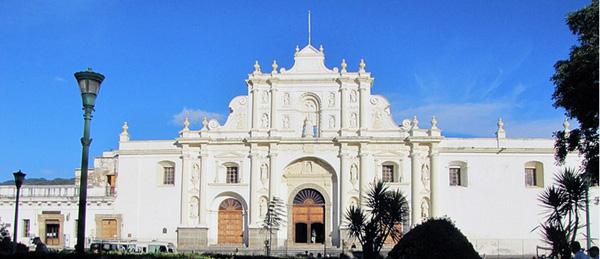
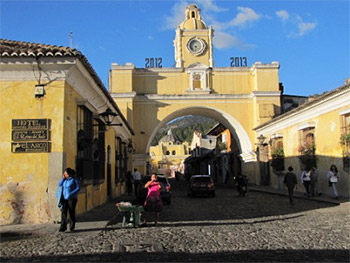
♦ Churches: I pass at least three cathedrals on my daily walk to work. For the best of what’s to offer, I always include Catedral de Santiago, the massive building on the east side of Parque Central (great photos on clear days); La Merced (and the yellow archway), with a nice little plaza in front of it and beautiful white trim; and Iglesia de San Francisco, which has market of food stalls, handicraft vendors, and beautiful courtyards.
 ♦ Ruins: Like churches, ruins sightings occur here on a block-by-block basis. For the most remarkably sprawling specimen, La Recolección Architectural Complex, head to the far west edge of town, beyond the market and “bus station” (a parking lot with a collection of remodeled US school buses, aka chicken buses, which are a sight in and of themselves). La Recolección is a former monastery now surround by parkland.
♦ Coffee and Chocolate: Both are a must here, or anywhere for some of us. Independent cafes are plentiful and unique, and while advertising suggests major differences, I’ve yet to go into a coffee shop and find myself sipping Nescafe. For chocolate, there are several options, but the Choco Museo adds a little history to the experience and/or Kaffee Fernando’s is run by a guy who is very passionate about producing top quality stuff.
Antigua is often regarded as too touristy, a little inauthentic its relative safety, clean streets and sidewalks and the all-too-catering service industry. Whatever the case may be, it is a city that melds cultures, times, and classes in a truly inviting way, which is why so many people choose to visit. As a resident, with the privilege of walking these streets every day, participating in the movement forward and the acknowledging of tradition, life is good and worth sharing with others. Come one, come all.
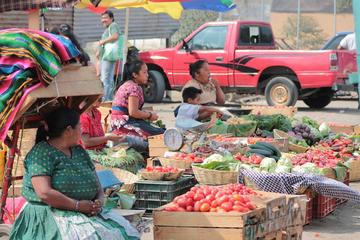
Antigua Market Cooking Class and Choco Museum in Antigua
If You Go:
♦ Shuttles are waiting at the Guatemala City airport to bring you here, about an hour away, for $10/person. Antigua is small, completely walk-able, so a renting a car isn’t necessary.
♦ Between May and October, come prepared for some afternoon showers. Generally, the mornings are fairly nice, but the rains inevitably make an appearance.
♦ Antigua has the world’s biggest Semana Santa, aka Easter week, celebration, and it is the peak of high season. Prices will double or triple and accommodations disappear way early. It’s an amazing experience, but planning ahead is required.
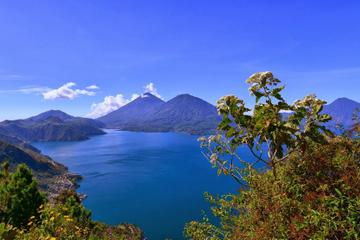
2-Day Chichicastenango and Lake Atitlan Tour from Guatemala City or Antigua
About the author:
Jonathon Engels has been an EFL expat since 2005, just after he earned an MFA in creative writing and promptly rejected life as an instructor of freshman comp. He has lived, worked and/or volunteered in seven different countries, traveling his way between them. Currently, he is in Antigua Guatemala, where most mornings he can be found tucked behind a computer in the corner of a coffee shop. For more from Jonathon, check out his website (jonathonengels.weebly.com) and his blog (jonathonengels.travellerspoint.com).
All photos are by Jonathon Engels
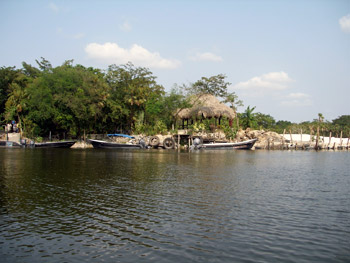 Your journey into the unknown begins in “touristy” San Pedro on Ambergris Caye when you travel by boat (skiff) to the village on Bomba on the Old River. Your skiff brings you into the red mangroves where the river meets the sea. The captain effortlessly races through the narrow bends in the river. Perspiration drips off your face but not from fear. It is the humidity from the nearby jungle. Suddenly he cuts the throttle and you glide to a halt on top of the turquoise water so that he can point out the local flora and fauna. Snake Cactus parasitically grows on the trees; gray bats hang from the underside of a long dead tree trunk; and a big gray blob is actually a termite nest.
 Arriving at Shipyard, you again board a skiff and race along the New River to Lamanai. This time the captain stops the boat to point out several Spider Monkeys swinging through the trees. They streak so quickly through the foliage that you might have difficulty making out these dark brown figures with their characteristic white chests. Further down the river you might come across a “herd” of young Mennonites fishing at the water’s edge. They compete for the fish with several Great Blue Herons situated a short distance away. You may also spy the black and brown Jacana bird effortlessly moving across the green sheet of lily pads extending out from the river’s edge. Also known as the “Jesus Christ bird”, it seemingly walks on water.
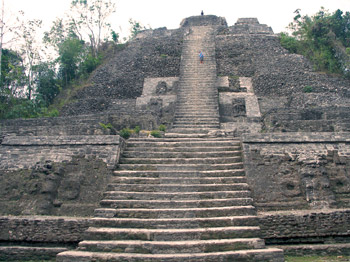
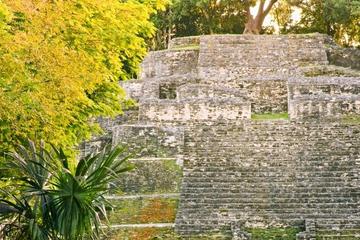
 You trek through the steamy jungle toward the Jaguar Temple which dates to 625 CE. Suddenly the thick mass of foliage opens out and you find yourself staring into the eyes a block-like jaguar face protruding from the side of the temple. You may require a few moments to get the gestalt outline of this mask. This step pyramid has nine tiers and rises to 65 feet in height. But looks are deceiving in that part of this temple remains covered by soil and foliage so you cannot appreciate its true height. This temple is a solid structure with no chambers or tunnels inside.
 The king, who was worshipped as a living god, controlled the religious and political activities within the city. The deeds of these Mayan kings were often recorded on limestone stelae. Stela 9 in Lamanai, erected in 625 CE, commemorates King Smoking Shell whose image is dressed in a rattlesnake headdress with quetzal feathers at the back; he holds a double-headed serpent bar diagonally across his body. An inscription on the stela indicates that this king was descended from the Sacred Crocodile.
 Only royalty and members of the elite class were permitted to climb to the summit of a temple. When you arrive at the High Temple, dating to 100 BCE, you can follow in their footsteps up the side of this steep structure to speak with the gods. Even though you take carefully calculated steps, your legs will still feel like lead weights by the time you reach the top of this temple as each individual stair is an uncomfortable two feet high. Other Mayan cities like Chichen Itza, Copan and Tikal for example have significantly lower individual steps but steeper stairways up the side of their pyramids, which only goes to prove that there is no standard Mayan temple design. In any event, if you weren’t drenched in perspiration before you begin your ascent, you will be by the time you reach the top. Bring a bottle of water when you climb in order to clear your parched throat because you are going to need it.
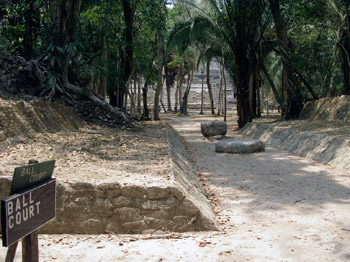 Work your way down the tall steps of the High Temple and refresh yourself with some more water when you reach the bottom before marching on to one of the smallest ball courts in the Mayan world. You might have some difficulty determining what the target was that the players were aiming to hit with the 12 lb solid rubber ball in order to score. Ball courts in other Mayan cities have utilized rings or even stone parrot heads. Players were only allowed to keep the ball in play with their hips, knees, waist and elbows.

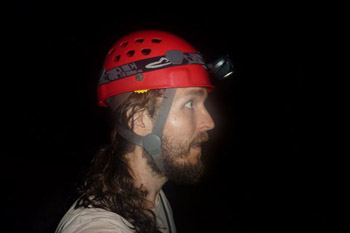 We stop in the heavy, nocturnal stillness. Oscar helps Phyllis scramble up a steep staircase of boulders, while I ponder this sacred, once-hidden world of shadow and sacrifice. I clamber up to the main chamber, known as The Cathedral, whose genesis is a flat rock shelf.
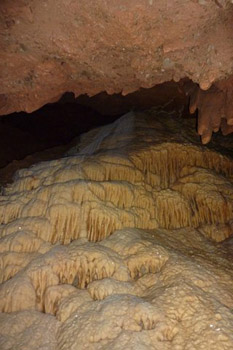 Here, in this football-sized field enclosed by limestone, magnificent columns stretch from floor to ceiling like something from Lord of the Rings, while immense drip curtains of sensuous stone put Picasso to shame. We have stepped into the divine. Miracles dangle above in the form of elegant rock draperies and soda straw stalactites. My dim light cannot fully illuminate these vast mysteries sculpted by the collaborative hands of water and erosion. Sunless rock is the canvas, single drops of limestone-laced water the artist. Many shapes remind me of candle wax, huge rivulets that flow, snake and coil into countless latent architectures. Entrancing, but Oscar hastens us deeper into The Cathedral.
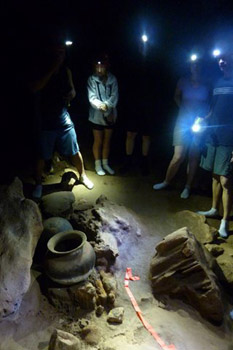 Eighteen corpses were found in The Cathedral, including children. Oscar stops at a site outlined by red tape on the floor, a pathetic barrier to tourist stupidity.
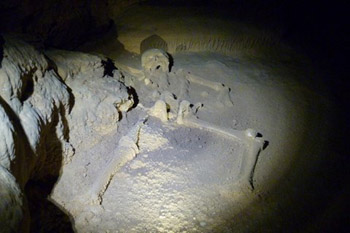 She lies there, just past a small rope that would not be out of place in the Smithsonian. In the dim light, her slender vertebrae embedded in the cave floor, I notice her white skull is tilted forward, her jaw arched in a frozen scream.