by Sally Charette
 My husband and I arrived in Rome during the heat wave that broke records all across Europe in the summer of 2015. After a week of sweltering in temperatures up to 36.7 (99.68 F) in London and 39.7 C (103 F) in Paris, we were resigned to buying bottled water at every possible opportunity. We were about to learn that Rome is actually better prepared to handle thirsty tourists than most major cities, and that it has been for centuries.
During a visit to the Colosseum on our first day, I rounded a corner to find a stream of water spouting from what looked like nothing more than a hole in the wall into a drain in the cobbled floor. A handwritten note indicated that the fountain was under repair. It looked like a piece of unfinished plumbing left uncapped for emergency purposes, so I presumed a U.S. style fountain was missing.
Coming from drought-stricken Southern California, I was shocked that there was no off switch, but I was also impressed that they thought it was important enough to provide us water that they just left it on. Any hesitation faded as I finished off the last drops of warm water in my bottle and took my place in line. Person after person quickly drank from cupped hands or filled containers and stepped aside. A couple of boys took a moment to let the liquid pour over their scalps and behind their ears. I expected tepid water at best.


I later found that what was missing was one of the cylindrical cast iron fountains nicknamed “nasoni” meaning “big noses” for the drooping spigots that protrude from them. I was late to the table. This has been going on for some time. When you drink from the public water system in Rome, you’re not just getting refreshed, you’re drinking history.
Rome has been importing and distributing water for over 2,000 years. Though the current structure in the Piazza Santa Maria in Trastavere dates only to 1873, it is believed that the first of Rome’s fountains was established here in the 8th Century. Early fountains were built to service horses as well as humans. Some of the trough-like basins found in the city today are actually beautifully carved sarcophagi bought from churches in the middle-ages after they’d lain unused for centuries.
 The apparent wastefulness of all that water flowing 24/7 isn’t lost on the city. During the 1980s the city added taps to the fountains, requiring that thirsty Romans operate a nob or button in order to drink. The results were far from satisfying. On hot days, water standing in the pipes heated up, making it less than appealing. Vandals broke the new taps, freeing the flow of the water, and officials gave up on the project. The water doesn’t go entirely to waste. It’s recycled to grow gardens, flush sewers and in industrial cleaning.
Once you use one of Rome’s fountains you will begin to spot them everywhere. There are more than 200 in the ancient walled city, and approximately 2500 spread through the entire municipality.
 I found one that wasn’t in use on a side street as my husband and I walked back to our hotel from Trevi Fountain on a very hot afternoon. I wondered for a second if it was functional, but as I stepped around it I found a stream of fresh cool water splashing into a grate at my feet. I splashed my face and filled my bottle. By the time I was done, a couple of people had queued up behind me. I felt as much like a native as a brief visitor can feel.
The drinking fountains and public fountains of Rome aren’t just for viewing. Citizens and visitors alike are encouraged to use the city’s abundant water to rehydrate and refresh. We found a small gathering of people splashing and filling containers at Fontana Barcaccia at the base of the Spanish Steps. It’s a good way to beat the summer heat.
It’s fun to stumble upon a nasone, but help is available! You can download a free drinking fountain finding app called Drink in Italy from GooglePlay or I Nasoni di Roma at iTunes, or you can navigate to the Free Water in Rome website for an interactive online map.
 Do give the nasoni of Rome a try while you’re there. Your first time may feel a bit daunting, but once you try it, I’ll bet you’re sold on this delicious free resource.
Drinking as Romans have drunk down through the centuries made me feel connected to the people and the place. I even felt cared for and protected by a state that is willing to invest so much effort and expense into providing its citizens and visitors with this vital service. I imagine this has been true since the tradition began more than two thousand years ago, and it just keeps getting better. The utility company ACEA is about to launch a new network of large octagonal water houses that will offer still or sparkling water, and provide charging stations for electronic devices, bringing the nasoni into the 21st Century in style.


If You Go:
♦ Watch ACEA’s website for updates on the newest iteration of public water fountains: Water Houses that will offer not only free fresh water—either still or sparkling!—but will also feature free phone and tablet charging stations.
♦ Find nasoni while you’re on the go: download Drink in Italy from GooglePlay
♦ Or I Nasoni de Roma from iTunes
♦ If apps aren’t your thing, try the interactive map at Free Water in Rome.
About the author:
Sally Charette enjoys micro-travel day trips around Southern California almost as much as exploring other parts of the globe. She’s a genre-hopping writer working in nonfiction, fiction, and poetry. Her work has appeared in The Sun, ZYZZYVA, Weber: The Contemporary West, Ocean, etc. She blogs at www.anygivensundrytoo.wordpress.com. Stop by!
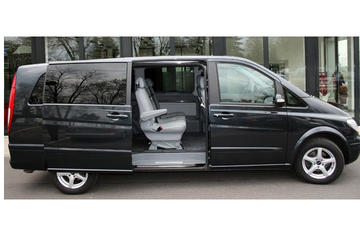
Rome Private Half-Day Tour with Private Minivan and English Speaking Driver
Photo credits:
Fontana di piazza della Rotonda by Galzu / Public domain
All other photos are by Sally Charette:
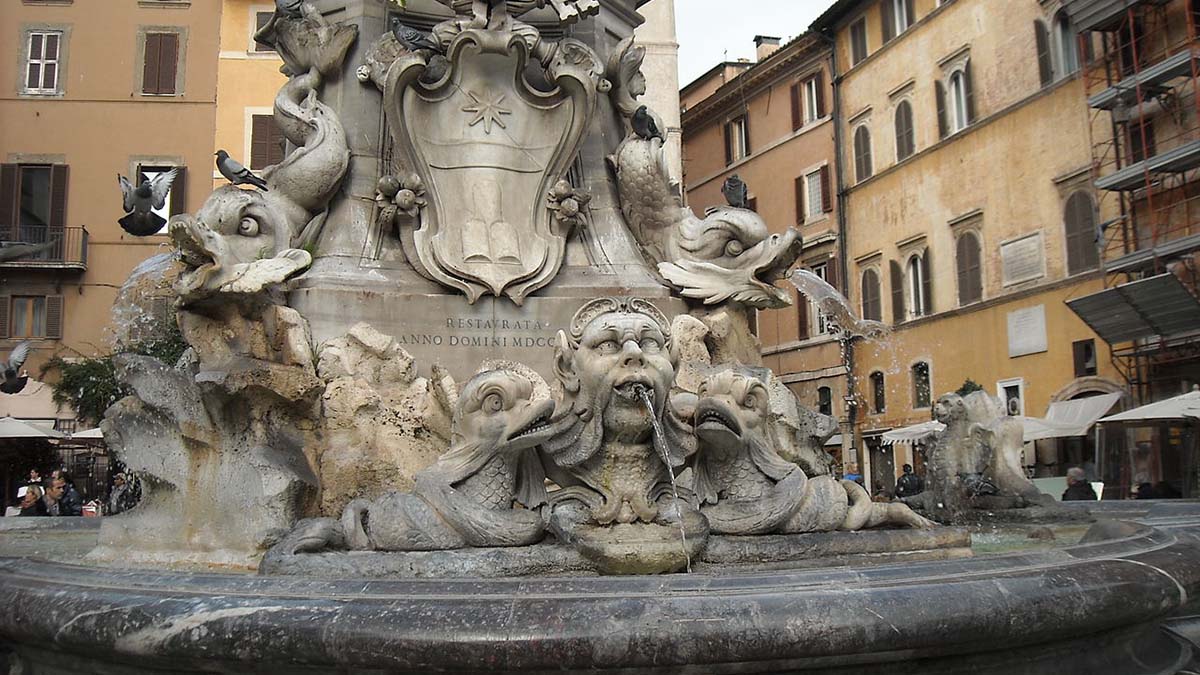
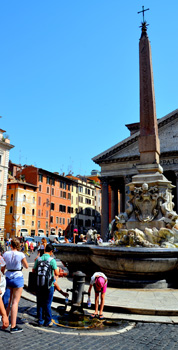
The fountain in the Piazza della Rotunda (in front of the Pantheon) is one of the oldest of the cylindrical style still in use
Dragon-headed spigots in use in the Piazza de la Rotunda. If you block its mouth, water will rise drinking-fountain-style from the hole in its forehead
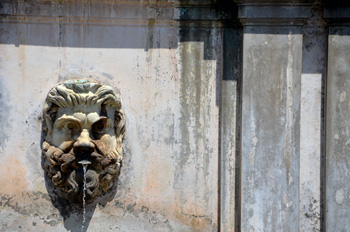
Some of the older fountains emerge from the sides of buildings and flow into basins, drains or troughs below
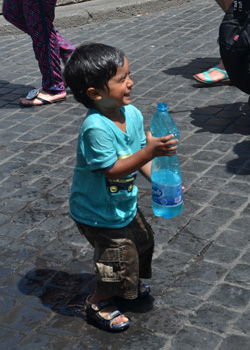
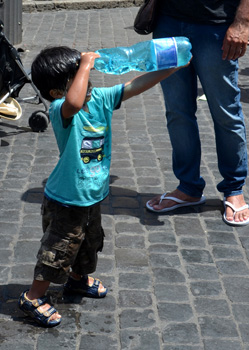
Not just for drinking! A young traveler enjoys water from the Fontanella della Barcaccia (Fountain of the Ugly Boat) in the Piazza di Spagna at the base of the Spanish Steps
Cold, but refreshing on a hot day

 Latvia now attracts tourists with a mix of modernity at Riga bars and beaches; history in Riga’s Old Town, museums and countryside towns; and one of the most conserved natural habitats in Europe. I fitted in a little of each, but my main reason to visit the Baltic nation was to take part in the 2016 marathon.
 I completed a little personal history of my own with my fifth marathon at fifty, after setting a target of running one every three years until this year after running my first in 2004. The marathon dominated my five days in Latvia, but I still managed to see a lot of sights, while preparing for the run, during the event, and the day afterwards.

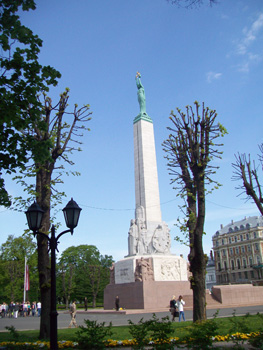
 I arrived in the centre from the eastern park belt, seeing the 150-foot high Freedom Monument without previously knowing about it. The next day it was the starting point for the marathon’s Parade of Nations, and during the marathon two lines of local volunteers in traditional costumes and enchanting music provided a magical passage at the end of the course. The monument was built in 1935, and wasn’t harmed by the Soviet army during its control of the region from World War Two to the Gorbachev presidency. The monument was a rallying point for independence rallies from 1987 to Latvia’s independence in 1991.
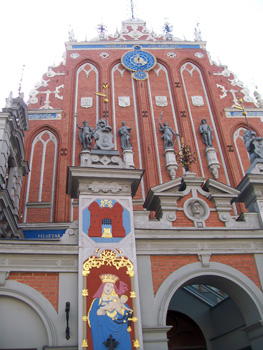 Walking directly down from the Freedom Monument takes you between the two main historic sites in Riga: Doma Laukums (Cathedral Square) and Town Hall Square. In the former, Riga’s cathedral is the biggest in the Baltics, according to the Rough Guide, ‘…it was begun in 1211 by Albert von Buxhoeveden, the warrior-priest who founded Riga and became its first bishop.’ In the latter, St. Peter’s church combines with Melngavju Nams (House of the Blackheads) and City Hall to create an excellent panoramic circuit. Melngavju Nams was the meeting place for a 14th-century brotherhood of traders that venerated St. Maurice, a warrior of North African descent. The area has been extensively rebuilt since independence, after the original buildings were bombed and demolished during twentieth-century wars.

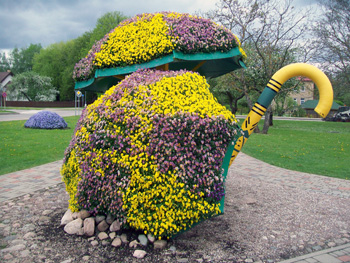
 I was impressed by Sigulda’s wide spaces and parks as I walked towards the Gauja River. Paramount was Walking Stick park, a colourful tribute to the region’s top souvenir, with cane-making having a 200 years history in the area. Sigulda is also the adventure capital of Latvia, with summer and winter activities, such as cable car bungee jumping, tobogganing and a ski slope. I had intended taking the cable car across the lush Gauja valley, but instead found myself hobbling down the steep slope to the river. Seeing a little beach on the other side drew me across the bridge, and I sat in the sun on the sand for a little while.
 There was much more to see and read though, starting with an old church, and followed by an excellent little museum tracing the ancestry of the region over its last 1000 years. The Gauja Livs who built Turaida were of Finno-ugrian heritage, in the southern Urals, like many in the north-east of Europe. They were a pagan people who resisted Christian crusaders, but were eventually integrated into western Medieval European culture. A film in one of the rooms showed how the castle looked in its prime, and it was easy to imagine the inhabitants of 800 years ago riding into the forecourt and dismounting after a long ride through pristine forests. The castle was centrally heated below the archbishop of Riga’s room, in the south of the castle, overlooking the valley. The castle was a refuge for the archbishop, as well being economically important.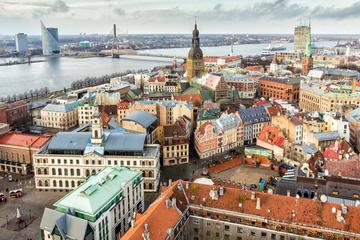


 All photographs are by Marc Latham: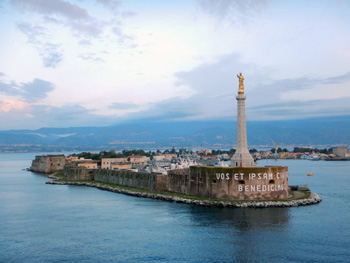
 I visit the gift shop to buy postcards and ask questions. The friendly shop keeper is happy to oblige a curious Canadian. She explains that the words under the Madonna at the entrance of the port translate into – “We bless you and the city.” It is believed that this message had been written in a letter to the people of Messina by the Virgin Mary when they converted to Christianity in 42 AD, after a visit from the apostle Paul. This explains why she is called Madonna della Lettera or Madonna of the Letter. I purchase a ticket for five euros to visit the museum and attached clock tower.

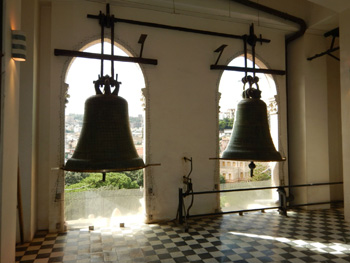
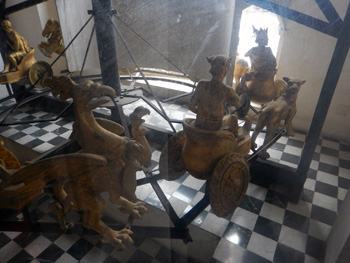 I venture next door to climb the 236 steps to the top of the bell tower. It is worth every step. This belfry houses the largest and most complex mechanical and astronomical clock in the world. On the landings I am able to view, from the inside, the amazing mechanically animated bronze images that rotate on the façade of the tower at the stroke of noon. At the top levels hang the massive bells that ring out the time. I am fortunate I timed my visit between the ringing of the bells. Once at the top, I am rewarded with a splendid view of the city from all four directions. The rain has stopped and the sun is out in full force. I feel I am in heaven, or close to it. I take my time descending, in order to have a better look at the intricate figures, aided by explanations on boards in English as well as Italian. The carousel of life, composed of four golden life size figures representing childhood, youth, maturity and old age, has death in the form of a skeleton following behind. Biblical scenes are depicted on other carousels and changed according to the liturgical calendar. One scene is dedicated to the Madonna of the Letter, where an angel brings the letter to the Virgin Mary followed by St. Paul and the ambassadors who bow when passing in front of the virgin.
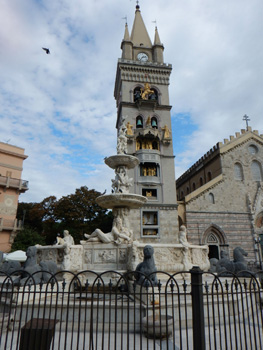
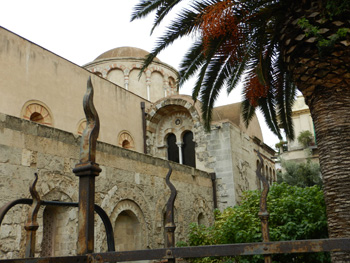 The vibrant plaza in front of the cathedral holds the gorgeous Fountain of Orion. A great place to view the clock tower from the outside and watch it come to life, should you be there at noon. I remove my raincoat and wander the streets. I find an iron worker creating figures in front of his shop called Hollywood. Many sculptures are scattered throughout the town including an imposing conquistador. The picturesque Church of the Catalans, built before Norman times on a pagan site dedicated to the god Neptune, provides different views from each side. A quote from Shakespeare catches my eye, “I learn in this letter that Don Pedro of Arragon comes this night to Messina… He hath an uncle in Messina will be much glad of it.” from Much Ado About Nothing.
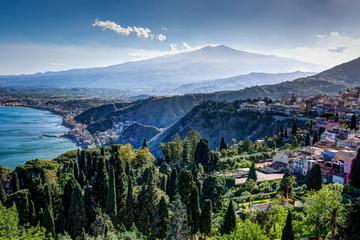
 Messina has always been the main portal to Sicily. Founded by the Greeks in the eighth century BC, the influence of Romans, Byzantines, Arabs, Normans and Swabians, who have landed on these shores over the years, contributes to the rich culture.

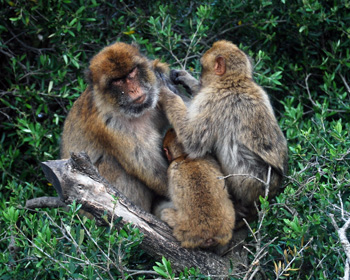
 As it happens, our grandson is a Sapper in the Royal Engineers, and Gibraltar has a proud place in their history. Indeed, when they’re not Royal Engineering around the globe somewhere, their home, in Surrey, is called Gibraltar Barracks.
 Early Mediterranean people thought that the Rock marked the end of the world, but the Phoenicians found that this was not the case as they sailed past it, and on to the shores of France, Africa and Britain. The Phoenicians founded a colony at Carthage, in modern Tunisia, which grew into an empire in its own right. That empire spread across southern Europe, but shrank after coming into conflict with the Romans, in a series of conflicts called the Punic Wars.
 The whole Spanish peninsula was ceded to the Romans after the Second Punic War, in 150 BC; the Romans, called the Rock Mons Calpe.
 It owes its present name to the Moors, who captured it in the 8th Century. They called it Jebel Tariq (Tariq’s Hill), after the Moorish commander Tariq ibn Zeyad. Over time, it became … Gibraltar.
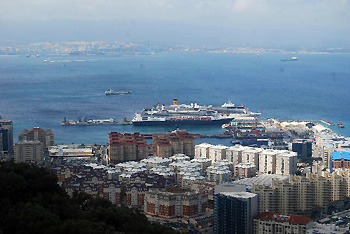
 However, this arrangement has long been a bone of contention between Britain and Spain … but, in referenda held in 1967, and again in 2002, the Gibraltarians elected to remain a British territory.
 Europa Point is the southernmost point. and here is the Trinity lighthouse, the only one outside the British Isles administered by Trinity House. Here, also, is a picturesque mosque endowed by the King of Saudi Arabia.
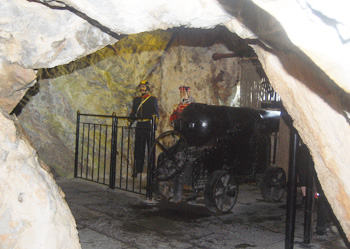
 Another attraction is the tunnels. They were first suggested by Sergeant Major Henry Ince of the Soldier Artificer Company (forerunner of the Royal Engineers) in the 18th Century, as a means of expeditiously getting guns from one side of the Rock to the other But, there were tunnels long before the British arrived; most of them led to underground reservoirs and later ones were used as air raid shelters in WWII.
 Most of the resultant rubble was dumped in the bay … to eventually become the site of the airfield runway. And, that’s no ordinary runway. It used to be that the road had to be closed to allow aircraft to take off and land, but now, there’s a tunnel under it.

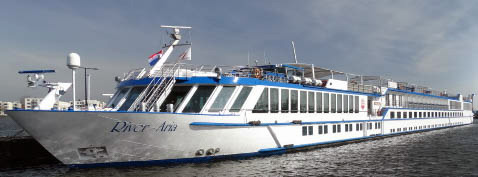
 On the Aria, all meals of 14 breakfasts, 14 lunches and 14 dinners included wine, beer or soda. A cold/hot buffet was available for all meals and the chef prepared a ‘local specialty’ dinner in the evening. Open seating was the standard in the restaurant. The four courses served at lunch and dinner included soup, salad, entree and dessert. The servers were very attentive to the needs of the guests and always wished us a “Bon appetite” before the entre. While on the ship, a tour of the galley offered guests the opportunity to see where the food was prepared. It was amazing to see the small area where all the chefs prepared, plated and served the meals. A tour of the pilot room was very informative.

 The Great Rivers Cruise began in Amsterdam and cruised to Cologne, Koblenz, Heidelberg and Wertheim, a fairy-tale town where the Main and Tauber Rivers meet. Onward, we cruised to Wurzburg on the Main in Bavaria, walking the bridge with wine in hand and Bamberg, a city on the Main River in Bavaria where the onions are huge and the cold smoky bacon beer was a welcome delight. Nuremberg explored the past and tragic time in history. Regensburg, Passau, and Vienna completed our cruise. Optional tours to Rothenburg on the Tauber River, the Bavaria: Baroque & Beer, with beer, pretzels and mustard and cruising thru the beautiful Danube Gorge to the Weltenburg Monastery provided more opportunities to explore the region. In Melk, a bus transported us to the magnificent Abbey and Baroque Church. Sailing through the Wachau Valley we reached Vienna, an Imperial City, for a Musical Tour of Vienna.
 This is not a trip for individuals who have great difficulty walking. Some individuals used scooters and walkers and were accustomed to the cobblestone streets and stairways. During the evenings, we sailed the rivers to a new destination and the tours would begin. Some tours began at the water edge and was a half-day trek through the medieval cities walking on the old cobblestone streets always watching out for bicyclists. Other tours required a comfortable coach ride to the sights. The Grand Cruises employs four Program Directors, men, and women from the area where they have lived. They are very knowledgeable about the history of the country and city, the architecture, museums, churches, castles, UNESCO sites, city life, and stories told over the ages. Some cities provided additional city guides and we met people who lived in the city and they spoke with us about their lives, the war, and refugee crisis – some rather controversial topics. The educational focus of the Grand Circle Cruise Line makes it a leader in river cruising worldwide and the recipient of numerous awards. Every Program Director had approximately 25 guests and were given headsets to hear the director while walking in the cities.

 The Rhine River journey from Koblenz, Germany to Ruedeshiem, Germany revealed many castles, 24 in all. The 760 mile voyage up the Rhine River moved at 9½ mph upstream. Each village had a castle on a high hilltop for protection in ages past and a church or two. Along the river, there appeared fortresses, ruins, castles and the legendary Lorelei statue and rocks.
 The cruise offered multiple opportunities for enrichment learning. Speakers, singers, dancers and a glass blowing demonstration entertained guests while in port before leaving and in the evening, a crew show on the lounge floor demonstrated additional talents of the crew.

 About the author:

