Athens, Greece
by Sierra Goldberg
It was freezing, midnight, and getting through passport control had been unnecessarily nerve-wracking. The bus flew along the motorway and bounced down more residential roads. White concrete buildings lined the streets, their windows were dark but the neon signs were still glowing. I shivered in the empty, rattling cold. Then the bus pulled round a corner and the Acropolis of Athens appeared above the city. Wrought in dramatic lights, the cream stone columns rose warm against a velvet navy sky, shot with pinpricks of stars. I gasped.
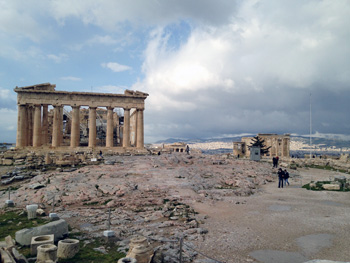 At this point, I wasn’t worried about the other passengers’ thoughts. Dignity, respect, pretending not to be a tourist – all out the window having tried very unsuccessfully to validate my 5 Euro ticket for a solid ten minutes of the bus ride. I could stare and gawp all I wanted; and so I did, drinking in that immense sight. I had read the myths since I was a kid, studied the history in school, and poured over the art for project after project in undergrad. Thrill raced through me faster than the cold had, as I discovered for the first time something I thought I already knew. Here it all was in 3D.
The bus dropped us off at midnight in Syntagma Square. Everything was quiet and empty, but the lights looked out inquisitively from their lamppost housings in case something did transpire. My breath froze in little clouds as I looked for a taxi.
“16 Sarri Street?” I asked the taxi driver, trying not to get distracted by the stunning Parliament Building, lit up in white and blue.
“… Sarri Street?” He looked confused.
“It’s in… Psirri?” I botched the pronunciation abysmally, forced a grin, and shrugged. Then, I pulled out a photo of a map on my phone.
“Oh! Sarri St! Yes, yes. Come on, I cannot drive you there.”


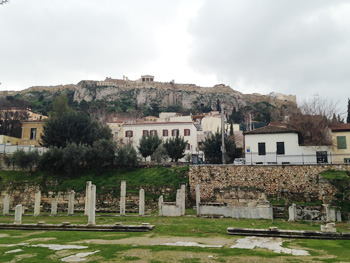
 Thankfully, what he actually meant was that he couldn’t get me to the front door along the one-way pedestrian street. But he could get me close and, after a nice little chat about whether it was more expensive to live in the UK, he did. In hindsight, it was quite beneficial to have a little tour of the city. But on a pitch black evening in February, hindsight wasn’t on my mind. What I was actually thinking about was snow – snow in the Mediterranean. For the first time in five years, it was forecast to snow in Athens and as we drove, big white flakes melted on the windscreen. Not enough to stick in town, but there was plenty to pile up in the higher altitudes. From the Acropolis and the top of Lycabettus Hill, I spun circles the next day, looking round at the mountains that ringed the basin where the city lived. The big, slow flakes from last night had left them white-capped under cracks of blue sky between stacked layers of grey and white cloud. The sun, when it did decide to join the day, was cold and sharp and my ears froze. I had forgotten to pack a hat.
 I found the lower gardens on the hill around the Acropolis full of temples and remains of buildings, statues, column capitals, and broken bits of foundations. The museums and Acropolis grounds felt more like walking into the pictures from the books I had read, studied, photocopied, and researched for the past six years. With an almost reverence, my eyes traced the draping folds of the stone garments that were so much softer and more alive than the drawings and photographs had shown me. Poseidon and Athena had to come to life and watched me carefully as I revelled in the neatly arranged Corinthian column caps I had modelled my own exhibition project on.
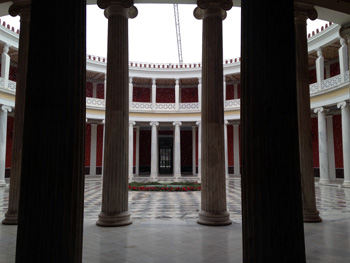
I returned to Syntagma Square and browsed the national gardens and old Olympics centre next to the stately Parliament building. The gardens rolled gently down the hill to Zeus’ temple, winding gravel walks lined with palm trees and tropical shrubs. As I walked, it snowed. I snuck quietly through the pillared entrance to the Zappeion Megaron Hall and stood just under the edge of the corridor as the atrium opened to the sky. The ceiling boasted a gorgeous floral, circular design in reds, greens, pale blues, and golds. Snow swirled in the atrium against a backdrop of deep red walls and white marble columns. It was so quiet that I could hear the snow brush against the marble and settle onto the floor. I revelled in my solitude, eating up this sight that no one but me could see.
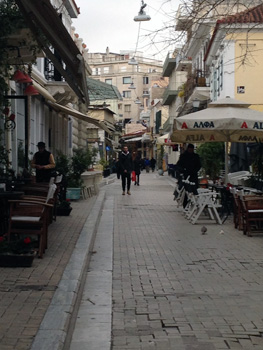
 After that, I walked and walked and walked the streets, looking for more awe-inspiring moments whatever the weather. Psirri turned out to be a fascinating district. I had booked myself into a lovely little hostel called City Circus for the week, where thankfully everything was warm and cozy with bountiful breakfast and friendly staff. Around the corner was a little spiders’ web of streets and five-point star intersections filled with shops and food. There were bars and music and fried filo dough and cheese concoctions in any shape I fancied. Lamp light and candle light poured through colored glass in the windows to join the colorful plaster walls. The music burst from inside the restaurants and the stones smacked hard under my new shoes. I didn’t want to stay long. I just wanted to see all of it, drink in this new, vivacious, loud place that breathed under my feet.
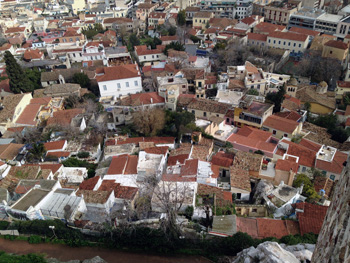
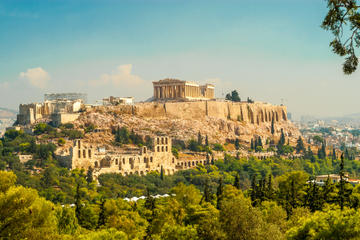
 Athens’ graffiti was most unexpected. It was everywhere, unabashedly adorning abandoned houses, old government buildings, and ramshackle metal fences. My walk into town was a burst of color, screaming ideas at me that I could not understand. But still I knew they were trying to say something, trying to be heard amidst the throng of twelve-story concrete apartment complexes and canvas canopies. After a brisk souvenir search through the bustling side streets around Monastirkai Square, I grabbed a latte in a fourth-story coffee bar. It had huge windows looking out over the red tile roofs, all uneven height and helter-skelter pitch before stopping abruptly for the Hill to rise behind them. Buzzing with voices, the room was warm and curls of smoke caressed the windows. Out of the the top of the hill, the Acropolis rose overlooking the city, ever listening as the centuries marched past under its watchful gaze. How many stories had it seen unfold? What tales could it tell if only I could ask – what stories not found in any of my books? I would never know. My own stories would have to be enough for my curiosity.


 On the way back, we scootered through a seaside town and grabbed coffee. After the hustle of the city and the very present feeling of history at Aphaia, it was odd how quiet the coasts were. Big, abandoned holiday homes half-built lingered just off the shore, silent concrete skeletons that didn’t tell stories like the ancient ruins. I thought it was only the island, but as I sat in a restaurant on Athen’s shore, I was as the sole customer. It was full of chairs placed upside down on tables – a hundred inside and maybe more than a hundred outside. The place felt expectant but mournful, waiting for the summer visitors to come and fill it with vibrance. As I stared silently down the coast, I felt out of place for the first time on my trip. In walking in the footsteps of the ancient past, I had created my own stories. But each story I created was filled with the stories that had come before me. In walking the recently built-up coastline, I felt disconnected from the past, though it surely had no shortage of stories to tell. Perhaps I’m far too picky about architecture.
On the ride back to the airport, I watched out the metro window as the city flew past me, each building ticking seconds away between me and take off. Before I had arrived, I had been worried about taking a solo holiday, but had found it rather exhilarating. I got to live every moment exactly as I chose. There was no one else to determine if I had “done a good job” with my holiday, if I “should have done less and relaxed more,” or even if I “shouldn’t get so excited about old rocks.” This was a very good thing because Athens was so much more alive than I could have imagined it would be. I unreservedly added my stories to the streets, each one full of the millions of stories that had come before mine.
I returned to a drizzly Great Britain and my heap of library books.
3-Night Athens Experience Including City Tour and Delphi Day Trip
If You Go:
♦ Accommodation: I Would definitely recommend the City Circus Hostel to anyone looking for good, clean accommodation without the price tag. www.citycircus.gr
♦ Eating: A bit out of the way, but definitely worth the view, head up to the 360 Cocktail Bar. Be prepared for indoor smoking but on a cold day, it’s a great place to have a coffee. www.three-sixty.gr
♦ Tickets: Admission to all the sites was free for me as a student with an EU student visa, but there is a all-access pass you can purchase for all the sites in Athens if you must pay.
♦ Language: People do speak English, helpfully, but you will have to stick to the larger shops and coffee houses if you want to be sure. However, everyone was very, very helpful.
♦ Transportation: The Metro is an extremely easy and cheap to get around town and to the coast. It also runs to the airport during the day and a night bus will get you into town after hours.
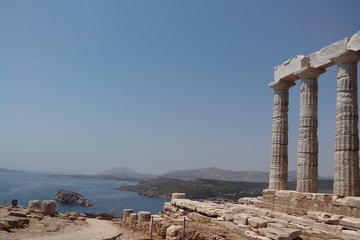
Full Day Private Tour: Essential Athens Highlights plus Cape Sounion and Temple of Poseidon
About the author:
Sierra Goldberg began traveling in high school with trips to the Ukraine and Cambodia. In 2013, she moved to Wales for her master’s degree and never looked back. Currently living and working in Germany, she enjoys traveling to less well-known areas and enjoying the outdoors in between museum trips.
Instagram: sierratraveller
Blog: sierratraveller.tumblr.com
All photos are by Sierra Goldberg:
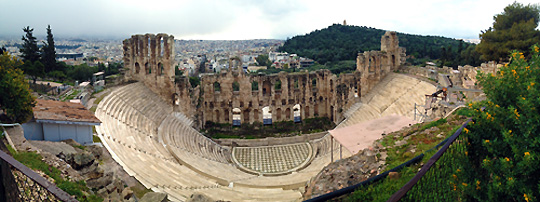
The Theatre at the Acropolis
The Acropolis
Rooftops
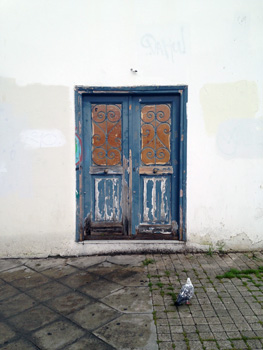
Blue Door
The Acropolis from below
Snow in the Zappeion Megaron Hall
Streets of Athens

 We are celebrating the conclusion of a Rebetiko Music Festival on the island and are among the grateful throngs standing retsina-less at the side. Grateful that the sell-out concert is able to accommodate the late-comers, and happy that we are part of the audience who are standing ‘in ovation’ for the musicians who had given us such a wonderful weekend of this once outlawed music.
 We arrived via ferry and were greeted by that archetypal Greek island scene: a pier thrumming with people and activity, faces alight with anticipation, voices calling out greetings, cafes jumping to attention, and ferry crews bent on maintaining control in the confusion. And in Hydra, donkeys. Perfectly poised teams of donkeys waiting for the stevedores’ commands. Motorized transport is prohibited on the island, except for emergency and sanitation vehicles, so donkeys are ubiquitous. The new refrigerator and month’s supply of water bound for the hill-top monastery? They get loaded on a donkey. We credit the donkeys as well for the blissful soundscape that greeted us on Hydra, where the church bells, the roosters, the laughter, the sounds of the ricocheting soccer ball, the children’s’ calls and the donkey’s hooves on the cobblestones seem to blend seamlessly with the silence. What a pleasure it was to walk through the narrow winding streets and to follow well-marked signs which led to the less explored regions of the island. Twenty minutes into the hills, we were surrounded by the pine forests, the island’s wild horses, and as always in Greece, the remote hill-top monasteries and the vast blue of the Mediterranean.

 A particular joy on Hydra was ferreting out the fabled Cohen home on the island – the one he had lived in during the 60s with his Norwegian muse, Marianne Jensen. The years in Hydra had been seminal for Cohen, allowing him to immerse himself in his writing and imagine a future as a poet and songwriter. His house lies snug smongst others on a hill overlooking the harbour and is predictably modest unmarked and shuttered. We trace his probable route down to a favourite swimming platform at the entrance to the harbour. I plunge in, revelling in the clarity of the Mediterranean so close to town, imagining the heat of those summer days that would have coaxed Cohen down to the sea each afternoon. What manna for my imagination and memories still flush with the sound and vision of 60s song writing to relive this magical time for Cohen so many years later! I was not the only one seduced by this ‘oracle of my youth’, but the Cohen legend is thankfully carefully guarded on Hydra – no line-ups, and apart from the occasional furtive photographer outside his house, you can pay your respects in peace.
 Rebetiko music, with roots in Anatolia, was fashioned in the ghettos of Piraeus and Athens after the population exchange between Turkey and Greece in the 1920s. It is the folk music of the displaced, the political outsider, the social pariah, and wonderfully marries the modalities familiar to musicians all along the Silk Road. A synthesis of Turkish, Greek, Arab, Persian and Jewish musical traditions, rebitiko gave expression to the experience of the exiled. Themes of love, loss, work, war, poverty, death, violence are embedded in the soul and sound of rebetiko music. Rhythms and melodies are drawn from the cross-cultural traditions and instruments in a rebetiko ensemble are likewise diverse: lyra, santur, guitar, clarinet, oud, tsimbalo, violin, double bass, piano and accordion. The instrument that is emblematic of rebetiko – the bouzouki – became more prominent as the musical form develops in Greece. Commonly associated with the ouzeri and hashish dens, and considered by both Turkish and Greek governments to be either too degenerate or ‘Oriental’ in nature, rebetiko music was forced underground in the 1930s. ‘Cleaned-up’ versions of rebetiko music began to re-emerge in the 1960s and with the growing worldwide popularity of the bouzouki, the rebetiko revival had begun.
 Today, rebetiko’s storied past and distinctive musical idiom attract both the scholarly and musical community, the intersection of which we were privileged to witness on that October weekend in Hydra. While some of the academic presentations were specially aimed at “the insider,” (algorhthms of Persian music, anyone?) others – like learning that a dominant scale used in rebetiko music is shared by Jewish Klezmer, Iranian, South Arabic and Flamenco music – help us understand rebetiko’s close relationship with the Middle East. The presentations are interspersed with performances – some held in the famed Melina Mercouri auditorium (named after the Greek actress and a former Minister of Culture) and others in appropriately ‘shady’ cafes. One concert features a Greek singer and a Scottish bouzouki player who balance their Greek rebetiko repertoire with explorations into Celtic music. Suspended in this glorious web of sounds, ideas and cultures, we didn’t seem to mind that we had lost the trail on Hydra, and walked past the monasteries and Marianne right into rebetiko!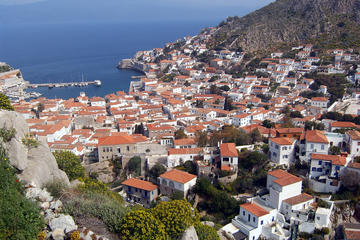

 About the author: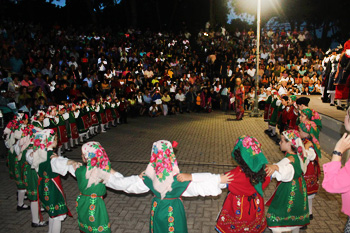
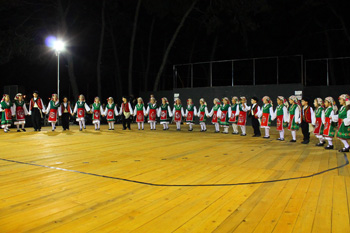 Folk dancing, or the traditional dances of the ordinary people, is something that can be seen all over Greece, and is a very significant part of local tradition. Each region has its own dances, although there are some dances that are common to all, such as the 12-step syrtos kalamatianos. Some of them may appear slow and staid, while others are faster, with intricate steps, and even jumps and very particular moves, such as touching the floor, bending the knee and swaying; there is a great deal of variety. If you travel to Crete and get the opportunity to watch the very impressive Pentozali dance, with its leaps and twirls, this is not to be missed.
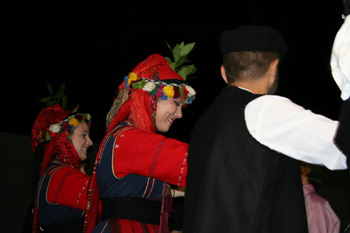 But we are going to concentrate here on the province of Evros. A place where each village is steeped in tradition, and the local costumes reflect that, with different colours, embroidery styles and other details revealing the locations.

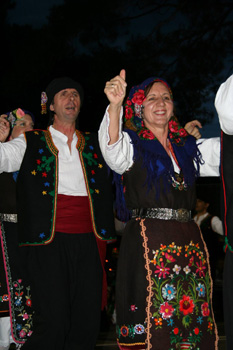 In Pentalofos, a village high up in the hills of northern Evros, close to the border with Bulgaria, I attended a dance at Easter. Local musicians, often playing traditional folk instruments such as the gaida, a local version of the bagpipes, come out into the central square of the village. The first year that I went, they were accompanied by a group of people wearing traditional costumes, but it seems that this is not always the case, as there were no costumes the following year. These people, whether dressed up or not, are dancers, and they begin the dance, to a great deal of applause and cheering from the crowds gathered there. After the first two dances, everyone else starts to join in. It is great fun, and the atmosphere is one of celebration and joy.
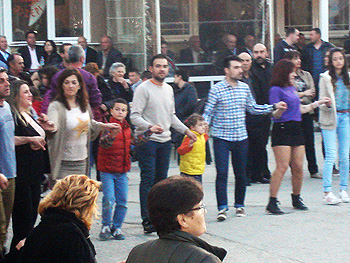 A major event in the folk dancing calendar is the festival that takes place in Alexandroupoli, the largest town in Evros, every summer, generally towards the end of June. A show is put on by local dancing clubs in the open-air theatre, which is close to the sea and surrounded by pine trees. In such a setting, the atmosphere is amazing. All the participants wear impressive traditional costumes, all different to reflect the places where their dances originated. Last year, over 250 dancers took part, including children as young as 5 years old. Live music fills the incredibly crowded theatre, with people sitting on the steps and standing all the way around the stage, tightly packed. Only those who come early will have a seat; the show is extremely popular.
 About the author: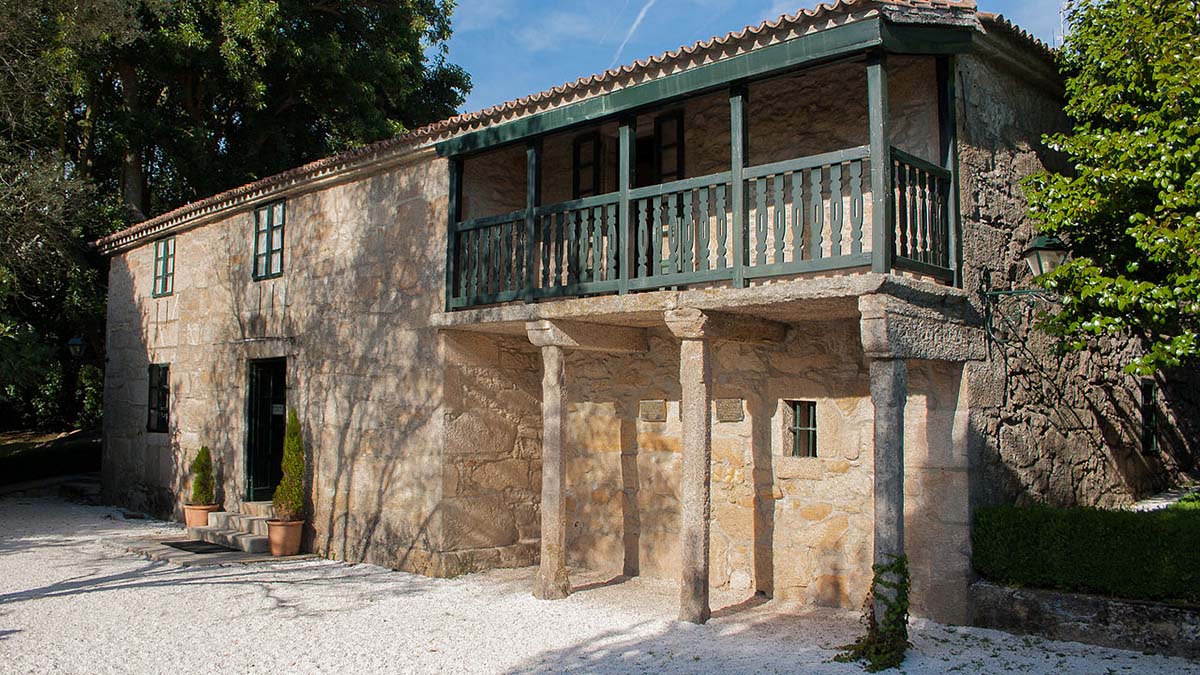
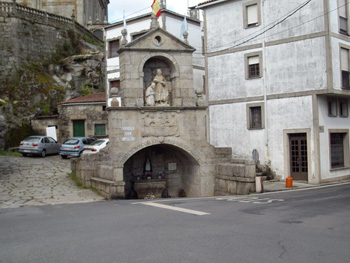 Before I set off on my three week trip to Galicia, Spain’s green, wet and wild northern province, I had a vague idea who Rosalia de Castro was, but none whatsoever about a place called Padron.
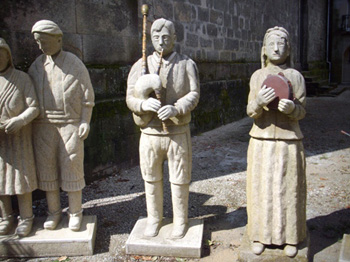 Still, my main interest was Rosalia de Castro. Even before I went to Galicia, I was familiar with the idiosyncratic concept of moriña. It’s best translated as a deeply felt longing of every Galego for his home and roots. An example: a Galego who has to move to – say – Madrid, considers himself an ex-pat. Another word for moriña is saludade and that’s also the Leitmotiv of Rosalia’s work.
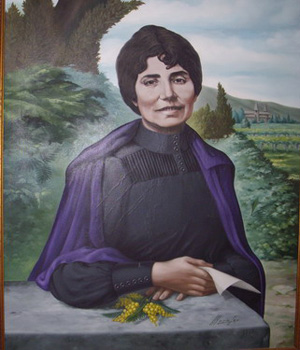 Moreover, although basically a romantic, she strongly opposed abuse of authority and was a strong defender of women’s rights. And she made her voice heard. Married to Manuel Murgia, a historian, academic and journalist, she had seven children despite a very fragile health. She died at age 48 in 1885 in her home in Padron.
 As my train slowed, reaching the small station of Padron, I could already see the house across the railway tracks and immediately understood how this dwelling could have inspired her writing, at the same time giving her the safe surroundings she needed.
 The stone cottage is visible, but only just, above the garden full of trees and flowers which Rosalia tended herself. She used to sit among blooming camellia bushes on a carved stone bench and dream up new poems. The whole scene is so romantic that one feels like writing a love poem there and then.
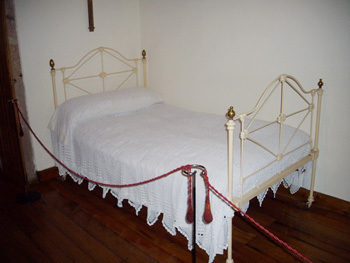
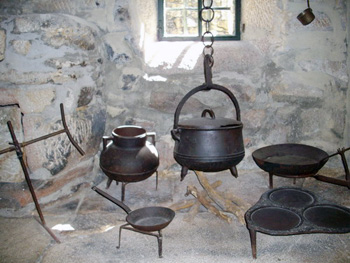 The kitchen with its woodstove and iron kettles looks no different to any other farmhouse kitchen at the time. Her bedroom is spartan, still with her clothes hanging in the closet. Next door is her study with the desk and writing utensils. I wished I could just have sat down, hoping to be infused by her creative spirit.


 I entered the castle’s grounds, which now stage temporary exhibitions after the military museum closed. Among them is the Sala Montjuic festival with outdoor cinema and live music during the summer. The castle provides some great views of Barcelona’s harbor. It still includes static artillery displays such as coastal defense guns.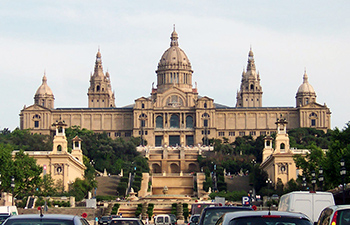

 Photo credits:


