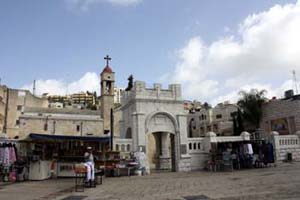
A Visit To Jesus’ Hometown
by Troy Herrick
Present-day Nazareth looks nothing like when it’s most famous son, Jesus, lived here. There are no Christmas-card-like scenes of pastoral churches, camel caravans, shepherds and grazing sheep. What you find now is a maze of narrow, winding cobblestone lanes and a population two thirds Muslim and one third Christian. Nothing from those early days remains except for sites that are “traditionally” associated with Christ and his family. The majority of these are now ruins housed within churches so you require some imagination to put them into perspective.
Fortunately you will not have to stretch your imagination too much if you divide your Nazareth daytrip into two parts. Start with a visit to Nazareth Village, a reconstructed 1st Century AD village where actors are dressed in period costume, and experience life as it was almost 2000 years ago. Next, visit the traditional sites associated with Jesus and his family in the old city.
Nazareth Village
 Rani our tour guide opened a door and ushered us out onto the grounds of Nazareth Village, a reconstruction of Jesus’ old neighbourhood. As he did so, I suddenly remembered that Rod Serling began every episode of the Twilight Zone with “you unlock this door with the key of imagination”. We knew that we had arrived in the past when we were almost bowled over by an oncoming shepherd and his five sheep. With very little effort he ushered his flock into a circular pen constructed of standing sticks. My second thought was to watch where I stepped, just in case.
This property was a working vineyard during the time of Jesus. Rani brought our group to the original 1st century CE wine press where we were invited to step inside and pretend to crush grapes for a new batch of Chateau La Feet. A watch tower in the vineyard suggests that all was not secure during that period of Roman occupation.
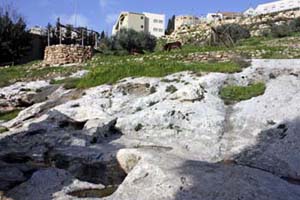 A short distance away, seated outside the doorway of her stone house, a middle-aged woman sits and spins wool by means of a hand spindle. As some of the tour group found out, it is a great deal more difficult than it looks. Our guide outlines the steps required to process and dye the wool with natural colours from pomegranate and onion skin before it is woven into a garment.
Moving along we visited a carpenter’s shop where an elderly man was teaching a young boy how to assemble a manger. Together they were chiselling a rectangular hole into a small log. The elderly actor demonstrated how to operate a hand drill using a bow – the same principle as starting a fire by rubbing two sticks together. You can easily envision a young Jesus being taught the carpenter’s trade from his father.
T he young Jesus would have also attended school. In those days, the local synagogue served as the community school. We entered the house of worship to find three tiers of benches lining the greyish-white walls; a wooden bench at the centre of the room held the Torah Scroll. This synagogue and all other building were reconstructed by referencing the best New Testament and archaeological sources available.
Our visit into Nazareth’s past complete, we returned to the 21st century. Now Diane and I were in the right frame of mind to visit the traditional sites associated with Jesus and his family, most of which were within walking distance in the old city.
The Old City
 Present day Nazareth is a bustling city of approximately 70,000 people, a far cry from the 400 or so people living here at the time of Jesus. Work your way north along traffic-clogged Paulus VI Street and be thankful that you are not driving. Your first destination is St. Gabriel’s Church, the most distant site.
St. Gabriel’s Church is the traditional Greek Orthodox site of the Annunciation where the Angel Gabriel visited Mary to announce the birth of Jesus (Luke 1:26-35). This church was constructed over the only natural water source in Nazareth. This site was chosen because the non-canonical Protoevangelium of James (verse 11) indicated that Mary went to fill a pitcher with water. It should be noted that some houses of this period had water cisterns.
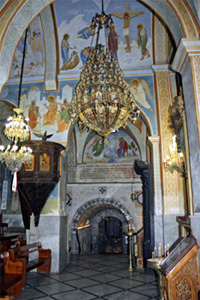
Enter the church and descend the staircase to a dimly lit man-made grotto housing a small stone well. The water is potable so you may wish to take this opportunity to fill up your water bottle if you have one. Water doesn’t get healthier and holier than this. After refreshing yourself, return to the nave upstairs and admire the brightly painted New Testament scenes covering the arched ceiling before you exit.
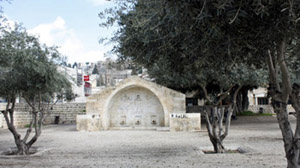
Downhill and to the right, you find a white stone structure known as Mary’s Well. This structure was likely built to provide Nazareth residents with ready access to fresh water even though the actual source remains within the crypt of St. Gabriel’s Church.
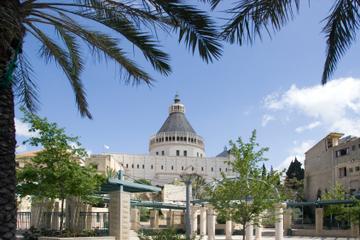
 Retracing your steps along Paulus VI Street, turn right onto Casa Nova Street and arrive at the Roman Catholic Basilica of the Annunciation – the largest church in the Middle East. This church was built over the Grotto of the Annunciation, an ancient cave dwelling, traditionally accepted as being Mary’s home when she was visited by the Angel Gabriel. I could find no scriptural reference suggesting Mary lived in such a structure however.
Entering the basilica via the bronze-covered doors depicting scenes from the life of Christ, you find yourself in the crypt or lower church. Your eyes are immediately drawn to the white limestone grotto behind the high altar. Part of this grotto is natural and part is man-made; the latter consists of remnants of earlier church structures from the Byzantine and Crusader eras. The cave in turn houses its own small altar.
 Above the grotto structure you find a large octagonal opening in the ceiling providing you with a view of the upper church. The dark brown cupola of the upper church roof is also visible, extending to a dizzying height of 60 meters. The ribs of the cupola represent the petals of an upside-down lily, symbolic of Mary’s purity. To visit the upper church, ascend the staircase just inside the doorway of the lower church.
Arriving at the upper church, you are surrounded by a series of international mosaics and icons all depicting Madonna and Child. More of these mosaics line the portico outside which you can tour before making your way to the Church of St. Joseph on the same property.
 Christian tradition dating to the 7th century CE has it that Joseph’s house and carpenter shop were located on the site of the present Church of St. Joseph. Inside, the bare stone crypt features several rock-hewn chambers, a cistern and several silos for storing grain. A mosaic floor dates from Byzantine times. The nearby side chapel marks the spot where Joseph was visited by an angel as he slept (Matthew 1:20).
Leaving the church property, your next destination is the Greek Catholic Synagogue Church. But first you must enter the exotic Arab market (souk). Walk along Casa Nova Street and follow the smell of freshly ground Turkish coffee. As you pass through the narrow streets, stick your nose inside some of the shops and look for that perfect souvenir. En route, don’t be shy about asking for directions to the Greek Catholic Synagogue Church.
The Greek Catholic Synagogue Church occupies the site of the earlier Nazareth synagogue where Jesus taught (Luke 4:16). The honey brown limestone interior features a stone-vaulted roof and an altar set on a two-tiered platform. A picture of Jesus preaching in the synagogue hangs behind the altar. The congregation seems so peaceful and attentive; a far cry from the angry mob that would escort Jesus to the Mount of the Precipice. He was to be thrown to his death from the cliff as punishment for his blasphemy in announcing the fulfillment of Isaiah’s prophecy (Luke 4:29).


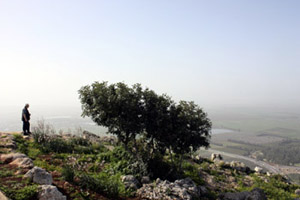 The Mount of the Precipice, 297 meters high, is now a park. From a lookout at the summit, you have a panoramic view of the surrounding area including distant Mount Tabor – the traditional site of the Transfiguration. But that journey will have to wait for another day. Instead you may wish to enjoy a leisurely stroll along the gravel path at the cliff’s edge and contemplate the meaning of your daytrip. As you take in the scenery, the essence of Jesus seems closer even though almost 2000 years have passed since he resided in his hometown of Nazareth.
Private Tour: Nazareth, Tiberias and Sea of Galilee Day Trip from Tel Aviv
If You Go:
♦ To get to Nazareth Village, travel south on Paulus VI Street and turn right onto al-Wadi al-Jawani St. Follow the sign (there is only one so don’t miss it) at the intersection directing you to the YMCA which is next to Nazareth Village. Admission is 50 Shekels for a guided tour. www.nazarethvillage.com
♦ Parking is expensive in Nazareth. If you arrive by car, leave it at Nazareth Village where parking is free. All of the sites in the old city are within walking distance from here.
♦ Admission to all sites in the old city is free.
♦ To get to the Basilica of the Annunciation from Nazareth Village, walk out to Paulus VI Street and then walk north to the intersection of Paulus VI and Casa Nova Streets. The entrance is on Casa Nova Street.
♦ The Church of St. Joseph is approximately 90 meters from the Basilica of the Annunciation.
♦ The Greek Catholic Synagogue Church is located in the souk at 6120 Street. Note that many of the lesser streets in the city have no names; they are only numbered.
♦ St. Gabriel’s Church and Mary’s Well are approximately one kilometre north of the Basilica of the Annunciation.
♦ The Mount of the Precipice is outside the old city and you require a car to get there. Exit the Nazareth Village parking lot and turn right onto Paulus VI Street. Follow this street until it meets with Haifa Road then turn left. Drive up the windy road to the top of the mountain.
2-Day Israel Tour from Tel Aviv: Acre, Caesarea, Nazareth and the Sea of Galilee
About the author:
Troy Herrick, a freelance travel writer, has traveled extensively in North America, the Caribbean, Europe and parts of South America. His articles have appeared in Live Life Travel, International Living, Offbeat Travel and Travels Thru History Magazines. He also penned the travel planning e-book entitled ”Turn Your Dream Vacation into Reality: A Game Plan for Seeing the World the Way You Want to See It” – www.thebudgettravelstore.com/page/76972202 based on his own travel experiences over the years. Plan your vacation at his website www.plan-a-dream-trip.com
Photo credits:
All photographs are by Diane Gagnon, a freelance photographer who has traveled extensively in North America, the Caribbean, Europe and parts of South America. Her photographs have accompanied Troy Herrick’s articles in Live Life Travel, Offbeat Travel and Travels Thru History Magazines.

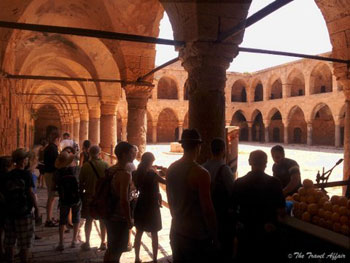 For millennia, this mediaeval promontory, one of the world’s oldest continuously inhabited locations, was a site of strategic military importance due to its commanding position on the trade route between Egypt and Syria. It is not surprising, therefore, that Acre’s history is a series of tumultuous invasions, defeats, victories and conquests that have played out over 1000’s of years by a multitude of conquering empires. Today, however, families of all nationalities and faiths live side by side in harmony in Acre, and the only shots heard over this UNESCO world heritage city come from cameras that belong to the army of tourists hungry to photograph this magnificent and intriguing historical site. Because even in this region of the world that teems with rich archaeological wonders, Akko stands out.
 The tunnel, now restored and endowed with lighting, signage and a boardwalk alongside which rainwater flows freely to the sea, shrinks to just one meter in height before opening up to ground level at the resplendent Ottoman-built Pillar’s Inn (Khan Al-Umdan), a large multi-arched caravanserai, which was once the hub of international trade. From here, my explorations remain at ground level and lead me into the colorful Suk, the vibrant market street that forms the main thoroughfare of the Old City. It is midmorning and the market is crowded and bustling with activity as the locals attend to their shopping needs. Sweet stalls, vegetable stands, and shops selling clothing, ornaments, perfumes and other oriental artifacts, mix with bakeries, falafel shops, fishmongers and butchers stands, beneath which countless street cats make a healthy, if furtive, living. I amble slowly absorbing the sights and smells, and stop frequently to sample the delicious foods on offer.
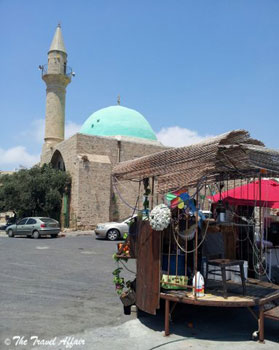 The market street snakes past the beautiful emerald-domed Al-Jezzar mosque and towards the main citadel complex where archaeological excavations allow the visitor to literally descend through the layers of history. At the modern, and mercifully well air-conditioned, visitor center, I rent an audio guide and embark on my own discovery of these fascinating ruins. I am guided aurally through the existing fortress building, an Ottoman fortification that was built on the foundations of the ruined Crusader citadel, and then down to the underground Prisoner’s Hall, where during the period of British mandate hundreds of members of Jewish resistance movements (Haganah, Irgun and Lehi) were held prisoner and even executed. The tour then descends further underground to the recently excavated Knights’ Hall comprising a series of long narrow chambers with ten meter high vaulted ceilings and massive dividing walls connected by great arched entrances. Also preserved in time are the remains of a dungeon, living quarters, and a mediaeval church. Tantalizingly, some of the rooms of this impressive feat of 13th century architecture remain roped off with teams of archaeologists and engineers busy with ongoing excavations: a promise of more exciting discoveries for future generations of tourists to behold.

 Ascending from the cavernous subterranean ruins of the Knights Hall I find myself at the entrance to the Hamam al Basha, a traditional 18th century Turkish bathhouse that remained in use until the 1940’s. Today the bathhouse has been reinvented as a light and sound experience in which a moderately humorous but slightly lengthy video presentation attempts to portray everyday life in the bathhouse culture. Despite the cheesy audio-visuals, the expertly restored, beautifully ornate bathhouse is well worth a visit. The entrance is a superb, domed-roof, marble room decorated with exquisite traditional ceramic tiles. A large marble fountain takes pride of place in the center of the room. At the base of the tiled walls there are small cavities, lockers of the past, which would one day have held the shoes and belongings of bathers. I take my sandals off and the chill of the 200-year-old marble floor feels wonderful on my weary feet. I proceed barefoot through a narrow corridor of smaller rooms where some of the more refined aspects of personal grooming and hygiene would have occurred, and into the main steam room – the social heart of the hamam. Here the domed ceiling has been perforated with geometrically placed holes through which hundreds of shafts of light penetrate to the raised marble massage area below. The dappled light is soothing and serene. Sculpted bronze figures and other relics placed around the large octagonal steam room help to recreate the authentic renowned feeling of communal relaxation for which the Turkish hamams were famous.


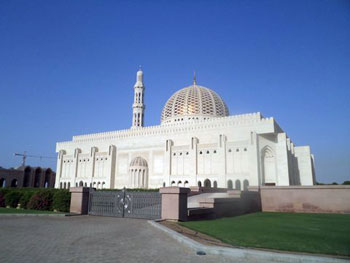 The discovery of oil however has given the country an unprecedented economical boost and it is my very personal opinion that the wealthy past has determined that the billions of petro dollars have been put to brilliant use. There is absolutely nothing ‘nouveau riche’ about modern Muscat. The difference to nearby Dubai is striking. Muscat has only one high rise, the Hilton Hotel and that has only 14 stories. Otherwise the buildings have all been designed in traditional Omani style with round towers, huge walls, carved wooden doors and small windows to keep out the heat. The only colors in evidence are white and sand, no garish paint, no gold, no colorful tiles, no adornment other than stone arabesques carved into the mantels. The overall impression is of cool elegance and understated wealth. Very, very soothing on the eye and beautifully in harmony with the country.
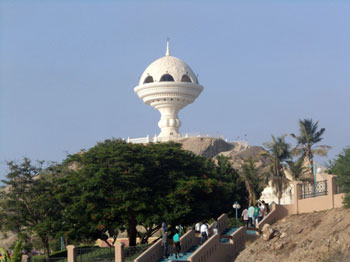
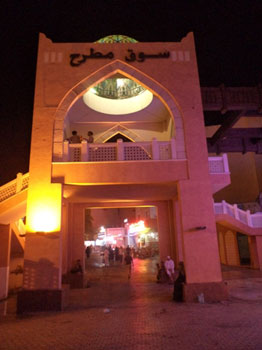 Already in love with the serene beauty of modern Muscat, my friend and I decided to visit the Muttrah souk, one of the oldest souks in all of the Middle East. During Ramadan, the souk is only open at night and, as Eid was approaching, people were out in doves to shop for clothes, jewelry and gifts in preparation for the festivities marking the end of the holy month. Two things held our attention: the ever present scent of frankincense which burns in every doorway and is one of the most important items on offer and the beautifully carved roof, reflecting the age old art of Omani wood carvings. In fact, so important is frankincense to Oman that a huge burner, high up on a hill is one of the most famous landmarks of Muscat.
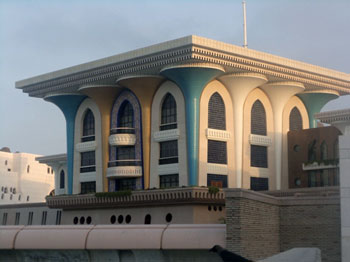 The next day we wanted to explore Muscat some more and also visit the part known as Old Muscat. To our disappointment, there is next to no public transport. We love to travel on local buses. But, at a price of 50cents for a liter of gas it doesn’t come as a surprise that everybody has at least one car. So, we took a taxi, passing by the modern, exquisite shopping complex in Ruwi on our way to the Sultan’s palace. It’s the only colorful building in blue and gold with nearly identical front and back which can be seen from the landside as well as from the water.
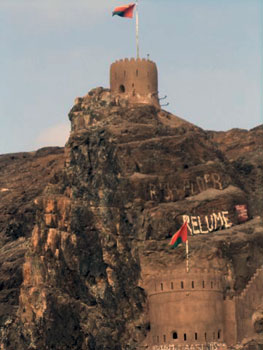 The first took us out to sea to watch dolphins at play, the second along the breath taking coastline with alternating rock formations in white marble and black granite with tiny sand beaches in between. Boat trip #3 was dedicated to experiencing the coastline bathed in the rays of the sinking sun on board a traditional Oman dhow.

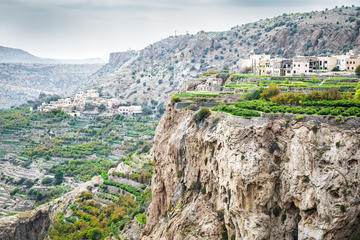
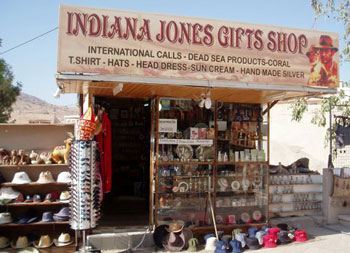
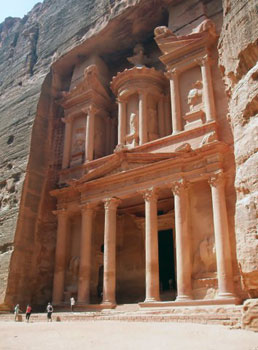 Out of the corner of my eye I caught a peek of al-Khazneh (the Treasury). With each step, the Treasury came closer and closer until finally I stood in front of this royal tomb carved into the rock. Built sometime between 100 BCE and 200 CE, the tomb got its name from the legend that pirates hid their treasure in a giant stone urn. Bullet holes on the urn indicate that the Bedouins believed this myth and made numerous attempts to retrieve this booty.

 After lunch, I rode up to al-Deir (the Monastery) on donkeys. The thought of climbing up eight hundred steep steps as the temperature hovered near 100 degrees didn’t sound appealing. Horses and camels balk at this almost vertical climb, but donkeys can do it. As the path narrowed and steepened, my stomach felt a bit like it did the first time I rode the Coney Island Cyclone. Still, my donkey never missed a step, stopping only to relieve himself. (My sympathy for those who chose to walk to the monastery, because the path was littered with donkey dung.)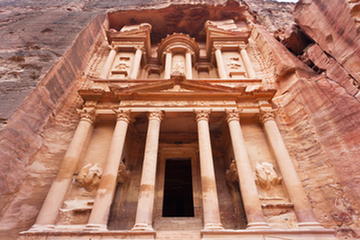


.jpg)
