It was October, the time when I usually had to return to Myanmar from my home country. Myanmar wasn’t my personal choice; it was the series of life’s high waves and tsunamis that brought me there. I just obediently accepted the offers my life gave me until I found myself living there.
My relationship with Myanmar wasn’t always easy. I adored her and couldn’t wait to come back; I hated her and couldn’t wait to leave; we had a very close relationship and we had a long-distance relationship; I tried to understand the cultural differences between us, and I couldn’t accept what felt illogical; I was full of love and gratitude, and I was annoyed and irritated. We went through all the stages, from denial to acceptance. I cried when I left for good.
October was a time for the Fire Festival – Tadingyut. I didn’t know much about that festival until one late evening, when I entered the gate of my hotel. The hotel looked mysterious. Everything was dark; only the entrance curbs were dotted with tea candles.
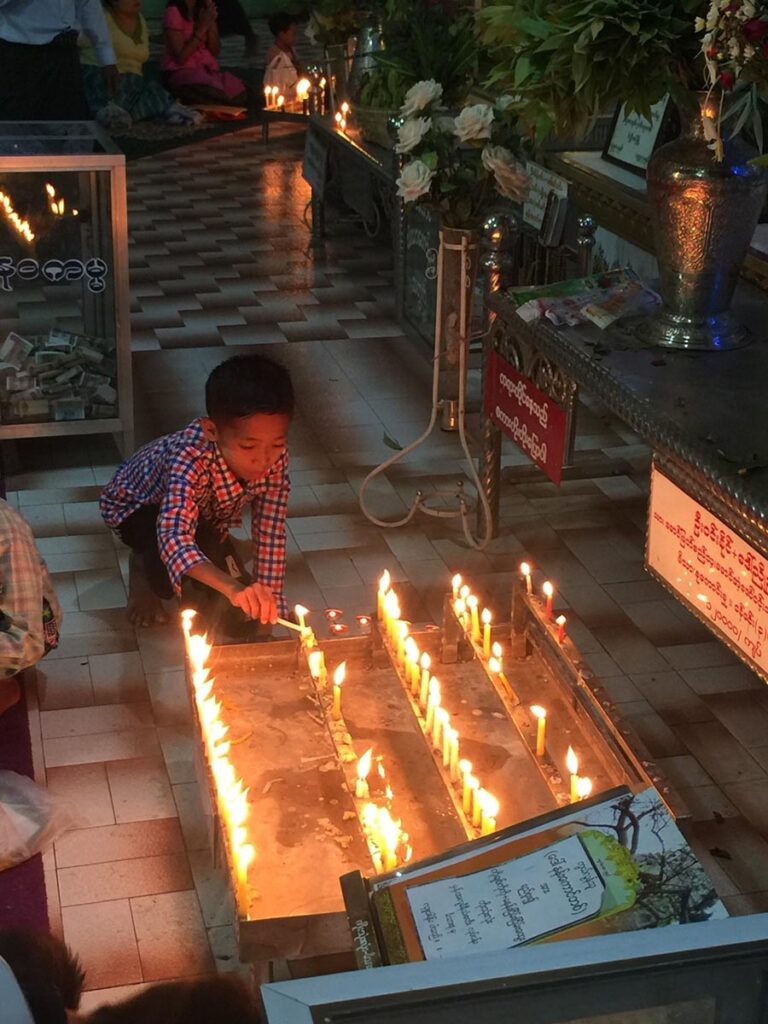
After I checked-in, I looked around. The candles were everywhere: on the altar, around the altar at the entrance, along the road, on the stairs, in the windows. When you see it for the first time, you feel as if time stopped and you are time travelling. The sounds are hushed. You can only hear the chirping of insects and the croaking of frogs. The electrical lights are dimmed, or even completely turned off.
When I entered my room, the hotel manager called. She invited me to a free dinner, as part of the tradition of feeding guests on that night.
This hotel didn’t have a canteen large enough, but they were planning an expansion and were constructing a new seven-storey building. All guests were invited to have dinner at the construction site. In the future lobby, they had set a long table with lots of pots with different curries and other dishes. We could help ourselves as much as we needed to feel full and happy.
The building didn’t have doors and windows yet; it was open to the fresh October breeze. Candles were lit around. It was like a candlelit dinner, but on a construction site. There was something surreal about it. Remembering moments like this makes my heart ache – this is when I miss my Myanmar the most.
The next morning, everything seemed normal again. The soundscape was restored: cleaning girls were singing, the honking of hurried motorbikes could be heard in the distance again, and exotic birds made their typical, very distinctive koo-ooo sound. The sun was as bright as ever. And I had to continue my journey deeper into Upper Burma.
The bus journey was long and tiring. It took around twelve hours. If at the beginning of my journey I was absorbed in watching favourite landscape and a less favourite but inevitable Burmese TV comedy; by the end, I was deep asleep. The bus attendant woke me up already in Meikhtila.
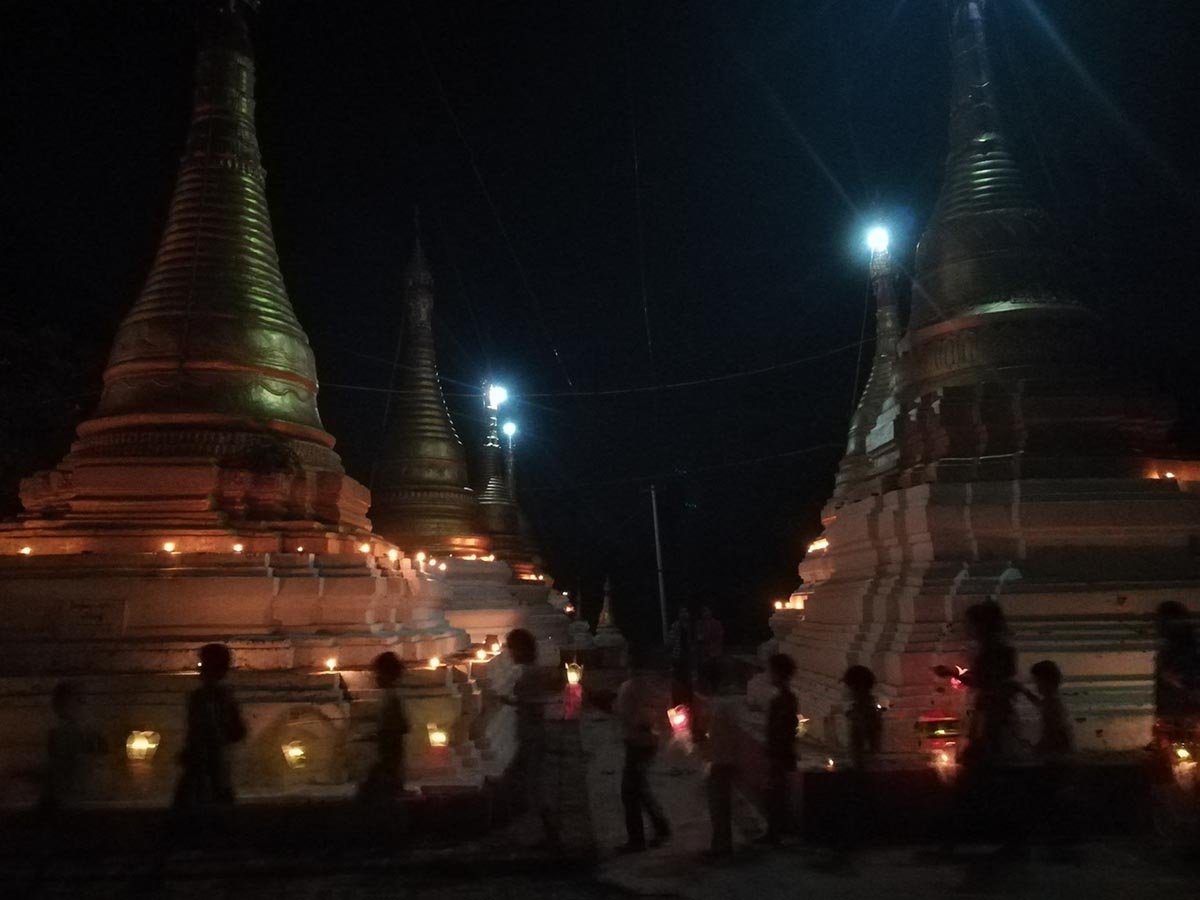
When I arrived at my hotel, it was already dark. Everything around me was bathing in warm candlelight here too. The neighbouring pagodas, the late-open teahouse, even girls selling betelnut had a couple of little candles on the rim of their stalls.
The next evening, when my work was done and after we had finished dinner, I was sitting on the porch of my bungalow and listening to the noises from beyond the fence. Then I thought, “I am sitting here and wishing to be there. I really want to experience this new, exotic festival with the local villagers. What am I afraid of? I’ll just go!”
I left the hotel premises through the back gate and walked towards the sound. Usually, after sunset people stay at home. There is not much to do after the dark. Local people follow the natural rhythm of life: they wake up with the sunrise, wind down at the dusk, and go to bed after sunset. But this time, the usually quiet back road was full of motorbikes carrying girls in beautiful dresses and guys in crisp longyi. I followed them.
In the middle of a field stood a pagoda complex I hadn’t usually noticed. It was somewhere in the distance. But that night it was full of life and light. People moved from stupa to stupa, lighting candles, laying flowers, singing. They looked like shadows. In the field next to the pagodas, people gathered in a circle and watched a performance by a man dressed in a women’s clothing. He was a nat kadaw, which can be translated as a “spouse of a spirit”. These people are believed to be mediums, connecting with spirits, and are invited to perform at different ceremonial rituals and festivals. These men are highly respected during the rituals, and people bring them offerings and donations. But in everyday life they can be hated and severely beaten. Society is not consistent or logical.
I had heard about nat kadaws and seen them in various documentaries about Myanmar, but I had never encountered one in real life until that moment. And it was something absolutely surreal. He was dancing to the trance-like rhythm of the drums; they spun and swirled through the dance. We were all under his hypnotic influence. People were chanting and singing together, following a shared, unified rhythm. I felt as if I were dreaming. I was losing my connection to reality.
Usually, I was the center of everyone’s attention when walking down the street or eating at a café. But not that night. Strangely, people accepted me as if I belonged their world; I wasn’t a tourist there. They shared their festive treats and invited to dance with them. They offered me the chance to experience their tradition together. But I had to break the illusion and rush back to the hotel before they closed the gate for the night.
Tadingyut also symbolises the end of rainy season and the beginning of the dry season. It is an ideal period of time: the constant rains have already ended, but oppressive heat has not yet begun. It’s the perfect time to visit and enjoy Myanmar. It is the time when people celebrate weddings, as the Lent and fasting are over. During Tadingyut, young people show special care and respect for their elders: they bring presents and ask forgiveness for anything they may have done.
I fell in love with Tadingyut. On the one hand, it is a very noisy festival, like any celebration in Myanmar – full of music and sharp bangs of fireworks. On the other hand, it is a deep, peaceful, soul-to-soul holiday.
Even in the city center, among crowds gathered to celebrate, where butter sizzles and the aroma of street food invites you to try something new and festive, where music is loud, where motorbikes and people share the same road, where fireworks crack and explode in unpredictable directions – you can feel tranquil and at peace. It’s something intimate, not for everyone.
Against the dark sky, paper lanterns rise, illuminating the darkness. They carry someone’s wishes and hopes, flying far away giving the promise to fulfil the dream. Believe it or not, my dream came true.
My last Tadingyut happened during the COVID-19 period. All the celebrations and gatherings were cancelled and prohibited. Yet every single corner was still decorated with tiny tea candles: on the stairs and steps of houses, hotel and pagodas; along pavements and balconies; even bicycle rims, sidecars, and rickshaw carts. Even homeless people decorated their small spaces on the pavement, reminding us that they, too, had dreams and hopes.
Every single candle was someone’s prayer and longing. Burning candles melted away our sadness, sorrows, and griefs. Above us, a huge, luminous, perfectly round moon reflected anticipation and hope. Even if not this year, then maybe next year?
People say that on the last day of Tadingyut there must be rain – the last rain of the rainy season. And every time on the last day, as if by magic, it rained, washing away the last dust of the year, the last troubles of the year. It is a fresh start.
About the author:
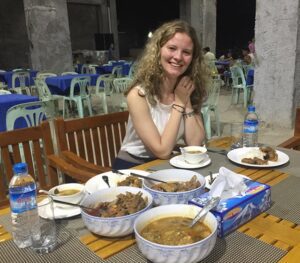 Elena Seroshtan is a writer, interpreter, and ESL teacher. Teaching English around the world has allowed her not only to work and travel, but also to become part of local communities and see each country through a more intimate lens. She spent nearly seven years in Myanmar and has been living in Slovakia for the past four years. Her writing explores cultural identity and the emotional relationships we form with the places that are not our home of origin. Her work has taken her to Sudan and Pakistan, and her curiosity has led her to Algeria and Iran. At the present moment she is working on her memoir “My Burmese Days Diary.”
Photo credits:
All photographs are by Elena Seroshtan.


Leave a Reply
You must be logged in to post a comment.