Travel Thru History

Historical and cultural travel experiences

  • Home
  • Airfare Deals
  • Get Travel Insurance
  • Writers Guidelines

Sri Lanka: Forever England

by Clare Gleeson

If Rupert Brooke had visited Nuwara Eilya he would have felt completely at home. The Sri Lankan hill station, developed by the British in the mid-19th century, retains many legacies of the Raj, despite more than 60 years of independence. Nuwara Eilya is proud of its Englishness.
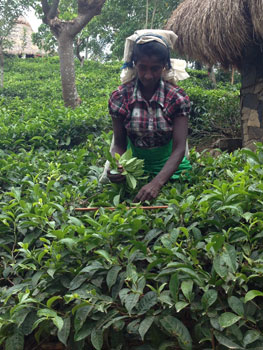
tea pickerThe train from Colombo had brought us nearly 2000 metres up into the Sri Lankan Highlands amid acres of tea plantations. For six hours we climbed higher and higher leaving the urban sprawl of the capital, travelling through tangled jungle to reach the patchwork neatness of the tea country. We left the train at Nanu Oya and bumped along the potholed road to Nuwara Eilya in a taxi, passing hillside tea plantations with names such as Edinburgh and Glasgow.

Nuwara Eilya was founded in 1846 by Samuel Baker, a British Nile explorer. Here in the coolness of the Highlands the ruling British could pursue many familiar country pursuits such as fox hunting, cricket, polo, fishing, golf and horse racing.
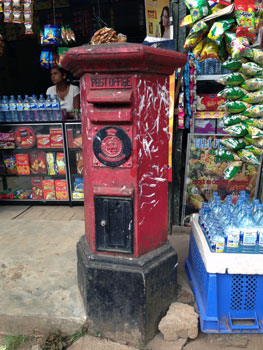
British post boxEntering Nuwara Eilya the dilapidated race track was immediately in front of us. Our taxi driver assured us that two meetings a year were still held here although this seemed unlikely. In front of the down-at-heel grandstand the final straight was uneven and unkempt and the fence outside the perimeter of the track was falling down. Ponies available for tourist hire grazed on the track. The condition of the racetrack was a stark contrast to that of the nearby golf course which was immaculate.

Our hotel, the Glendower, built in mock Tudor style, had once been a gentleman’s country house and was set in a cottage garden. It had a cosy feel to it, with a billards table and an over-furnished English bar.

Breakfast was a Sri Lankan interpretation of the English meal consisting of fried chicken ham, accompanied by two unusual looking eggs, served on hard white toast. The pièce de résistance was the padded tea cosy featuring villages of the Lake District proudly brought to our table and carefully snuggled over the china teapot by our young, smiling waiter.

Even the weather has a claim to Englishness. Much cooler than Colombo and Kandy, Nuwara Eilya was damp and drizzly for much of our time there. This makes it an ideal climate for the many English vegetables it grows such as leeks, tomatoes, beetroot, beans and strawberries, and has also enabled gardens full of familiar flowers to flourish. Roses, petunias, begonias – everything you could imagine in a herbaceous border – were evident throughout the town and in the impressive gardens of Victoria Park.

Nuwara Eilya is not large and easy to get around on foot but we also used tuk tuks for novelty or to escape the rain. On our first morning we strolled about looking at the variety of colonial homes, many of which are now small hotels. Although some look tired they wouldn’t be out of place in an English village and sit on large pieces of land, quite a contrast to most of Sri Lanka’s housing. Cows grazing on the side of the road and an old, wet, bedraggled and barefoot man walking near one of the houses made a strange contrast and reminded me that this was Sri Lanka.
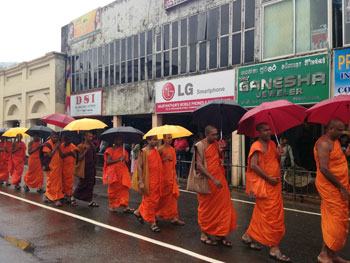
parade of monksWalking into the commercial part of the town we explored the shops and market before crossing the road to one of Nuwara Eilya’s most distinctive buildings to post a card home. Slightly elevated, the pretty Victorian brick post office has a tiled roof, gables and a clock spire. From the outside it reminded me of something from an English village and the lines from Brook sprang to mind ‘Stands the church clock at 10 to 3, and is there honey still for tea?’ but inside the somnolent air was dispelled by the eager and noisy customers.

Leaving the post office crowds were gathering along the roadside and the rhythmic banging of large leather drums could be heard. Standing by a British red post box we watched a long line of local monks parade through the main street, cheering up the drizzle with their bright orange robes and assorted umbrellas. Some were very young, probably no more than 8 or 9 years old, and policewomen walked beside them.

Hill ClubSheltering from the rain we took a tuk tuk up the hill to the gothic looking Holy Trinity Anglican Church built in 1863. The church has a cemetery full of the graves of British civil servants, soldiers, diplomats, planters, their wives and children. Although cared for this corner of a foreign field felt sad and lonely, marking forever the resting place of those who remained behind long after their families had left for Home.

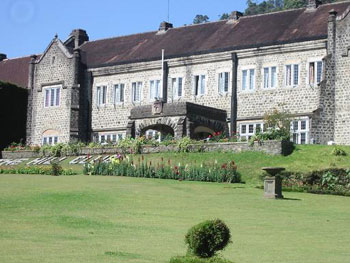
At the planters’ Hill Club that evening we sipped our coffee sunk deep in Sanderson couches in front of a roaring fire. Gazing over us were a youthful Queen Elizabeth and Prince Philip, whose portraits, along with that of the Sri Lankan President, hung above the fireplace. Following gin and tonics we had eaten a four course dinner, completely alone, in a dining room which can seat 50. We had been attended by four white-gloved waiters and the chef hovered in the nearby corridor as we made our selection from the menu. The Hill Club has reciprocal rights with the St James Club in London and a dress code which had placed considerable strain on our travelling wardrobes. I don’t think I could have handled being a memsahib but Rupert Brooke would have felt completely at home in this corner of a foreign field.

If You Go:

♦ Getting there: Travel by train or bus to Nuwara Eilya. The train journey from Colombo takes most of the day but is a fascinating trip. There is also a bus from Kandy.
♦ Tuk tuks and taxis are readily available.
♦ Accommodation: Nuwara Eilya has a range of accommodation from small to large hotels. www.nuwaraeliya.org
♦ Eating: A number of restaurants serving Sri Lankan and European food.

About the author:
Clare Gleeson is a New Zealand historian, librarian and travel writer who enjoys exploring her own country as well as those further afield. She has a travel blog at www.thewanderinghistorian.com.

All photos are by Clare Gleeson:
A tea picker
British post box
Parade on the main street
The Hill Club – islanka.com
Tagged With: Nuwara Eilya attractions, Sri Lanka travel Filed Under: Asia Travel

Climbing Sri Pada, the Sacred Mountain

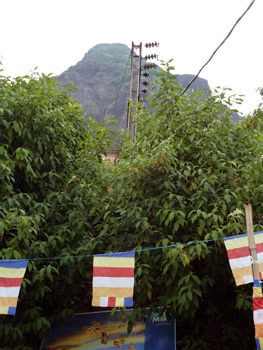
buddhist prayer flags

Dalhousie, Sri Lanka

by Helen Moat

The mountain rises out of the rainforest an emerald pyramid. I look at its sheer vertical flanks that stretch upwards on and on until they puncture the sky high above and I wonder: What have I let myself in for?

Sri Prada peakThis is Sri Pada, also known as Adam’s Peak. It may not have the notoriety of Mount Everest (as the highest mountain in the world) or the elegant beauty of Mount Fuji, neither does its history go back as far as Mount Sinai’s, but it is the only mountain in the world to be venerated by four major world religions: by Buddhists, Hindus, Muslims and Christians.
Pilgrims come from all over the world to climb the steep-sided peak and to pay homage to the indentation of a giant footprint on its summit. To Buddhists, it is none other than that of Lord Buddha; to Hindus, Shiva’s and to Christians and Muslims alike it belongs to Adam.

I have been taken to this place by my Buddhist Sri Lankan hosts. Dimuthu, who I’d connected with through a British Council education programme, has arranged for me to climb the mountain, something I longed to do on discovering it way back in England.

Last night, Dimuthu’s uncle and his family had put me up in their Highland home, fed me, watered me, entertained me and arranged for a driver to negotiate the 5 hours of rough mountain roads. Dimuthu’s uncle is also accompanying me on the mountain along with Dimuthu, her father and her two cousins. Failing to climb the mountain is not an option, I realise.

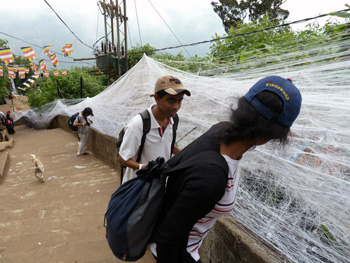
web of threadAll human life has come to this place across the centuries: rich and poor, kings and paupers, religious leaders and non-believers, young and old, strong and weak, sick and the well, disabled and able-bodied.
Sri Pada’s history goes back a long way. It is believed that King Valagambahu discovered the sacred footprint a hundred years before Jesus was born. The first recorded history goes back to 1065AD when King Vijayabahu built shelters along the way. The great monarchs of Sri Lanka’s ancient civilisation were ascending Sri Pada a thousand years ago but many believe that pilgrims were climbing Sri Pada long before any recorded history.

Marco Polo climbed the mountain in the fourteenth century. And some believe that Alexander the Great visited the sacred place too. Then of course there is Adam from the beginning of time, thrown out of paradise and made to serve penance on top of the peak; forced to stand upon one leg for a thousand years. That’ll teach him.

Back in the present, I’m standing at the foot of Adam’s Peak, dressed in cargo trousers, strong footwear and laden down with a rucksack packed with layers of clothing, waterproofs and first-aid. I have my walking sticks at the ready too. I step out with a serious walker’s stride.

My Sri Lankan friends, in contrast, are wearing flip-flops, the kind of smart casual clothes you might wear for a stroll down on the promenade, while carrying plastic bags of snacks – or nothing at all. They saunter off past stalls of garish souvenirs and teashops that could indeed grace any seafront. I wonder if my casual friends are really serious about making it to the top. My fears seem to be confirmed when they stop off for a splash in the river.

Later I realise that they were washing themselves in an act of purification before ascending the holy mountain.

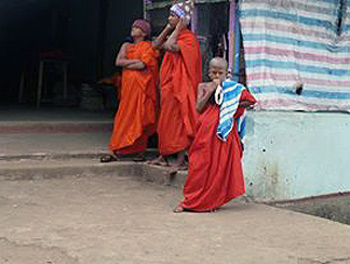
young Buddhist studentsAt the entrance to the mountain we stop again. A Buddhist priest blesses us. For us first-timers (all but Dimuthu’s father) we are given a white cloth with a good-luck coin wrapped inside. Dimuthu’s father ties each wristband on our right arm. A red mark is placed upon our foreheads, giving us Saman’s protection, one of the four guardian deities of the mountain.

Soon we reach the steps. The climbing is relentless and my confident stride slows down to a painful crawl as I haul my unfit body up each one. Two teenage girls, taking pity on me, stop and offer me a handful of dried fruit. My Sri Lankan companions, in contrast, are just finding their stride. They take the steps casually with an easy stroll, seemingly oblivious to the steep elevation.

Occasionally Dimuthu’s 60 year old father halts to meditate on the wayside, eyes closed and palms held outward in quiet serenity. He seems untroubled by the endless staircase rising up in front of him. I, in contrast, stop frequently, feeling as if my lungs are going to burst. The Sri Lankans wait patiently as I push my unwilling body ever upwards. Amila, Dimuthu’s young cousin stays with me when I stop for breath, talking all the while to distract me from my discomfort. When I stop, he stops. When I move again, he moves alongside me. I am grateful.

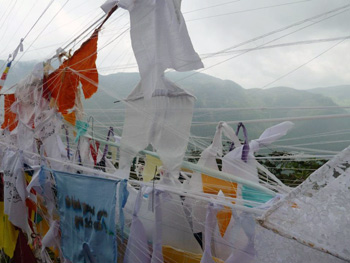
At one point, Dimuthu’s father hands out rolls of string. We tie them to the bottom of a staircase, unrolling them until they run out. The wayside looks like a long white spider’s web. Overhead prayer flags flap in the breeze. Apparently string was used by pilgrims in the past so that they would not become lost if the mist came down. The steps become steeper and steeper. I have been in discomfort for hours now, but giving up is not an option. Indeed the very thought of giving up is considered unlucky in the Buddhist tradition.

Amila points out the iron studs in the rock. “Chains were attached to these before the steps were built and pilgrims had to pull themselves up. It was treacherous in wet weather. Many pilgrims fell to their death.”

I sense we are approaching the summit. At last the temple can be seen above my head. I can hear the Buddhist monks laughing in the cloud. Then I see their orange robes swirling in the mist. No chanting though – they’re pouring tea from a large canister, chatting and joking together. Even Buddhist monks need to have time off. Five thousand steps later and I have reached the summit at 7,362 feet. I’m elated.

Amila and I climb the steps to the shrine of the footprint. He bows down, head to the ground. I close my eyes and reflect on my own thoughts. Then we remove our white strips of cloth from our wrists and tie them to a pole.
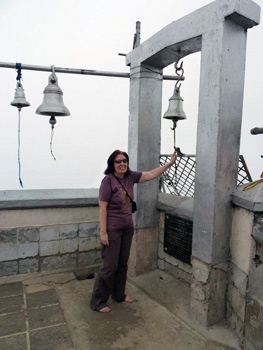
the author ringing bell at mountain top“Make a wish,” Amila says.

Dimuthu’s father rings the bell twice; the rest of us once: one peel is permitted for every ascent. The sound vibrates across the mountain top. I feel strangely emotional.

Going back down, there’s a very elderly lady climbing slowly up with her daughter. I ask how old she is. “Eighty-three,” her daughter says. “This is her sixty-fifth ascend.” Suddenly I feel rather pathetic.

There are not many pilgrims making their way up in the afternoon heat. Most pilgrims ascend Sri Pada after dark, arriving in time for sunrise. We pass just a handful of smiling, chanting pilgrims, echoing encouraging songs to each other and with us.

Amila teaches me to say, Theruwan saranai: may you be protected by the triple gem (of Lord Buddha, his teachings and his disciples) to the ascending pilgrims. They beam at the pale-faced westerner tripping over their language but thrilled with my attempts they answer back with a smile.

Seven and a half hours after departing Dalhousie, we stumble back into the village and our starting point. My legs are mash.

“You know,” Dimuthu says to me. “If your wish comes true, you have to climb Sri Pada again.” Now she tells me. I’m not sure now, I want my wish to come true. But I would not have missed out on climbing this sacred mountain. it’s an experience that will stay with me for a long time to come.


4-Day Essence of Sri Lanka Tour

If You Go Up Adam’s Peak:

♦ Where? The mountain is part of the Peak Wilderness area (a protected nature reserve) located in the southern Highlands of Sri Lanka. Most pilgrims and tourists choose the route that starts from the village of Dalhousie.

♦ How to get there? The best way to reach Dalhousie is to take the train to Hatton, followed by a tuk-tuk or taxi. The train journey from Colombo to Hatton is spectacularly beautiful. There are buses that go directly from Colombo, Kandy and Nuwara Eliya. Another option is to hire a car and driver – surprisingly good value for money.

♦ When? Most pilgrims and tourists visit Adam’s Peak/Sri Pada between poya day on the 1st December and the Vesak festival in May. Once the monsoon rains begin after that, the mountain can be treacherous, or at least unpleasant in the heavy rain. Most tourists choose to make the ascent after midnight, climbing the mountain in the darkness with the aid of the floodlit pathway. There are a number of good reasons for choosing to climb the mountain at night time: it is cooler, the lit pathway is very atmospheric and vibrant as most pilgrims ascend the path at this time. Once on top, if the skies are clear, you will be treated to a spectacular sunrise and incredible views. In clear conditions, a refraction of the mountain can be seen across the across the valley; a strange and wonderful phenomenon. The disadvantage of ascending the mountain before dawn may mean that you will be caught up in a queue at the top. If you make good time, you will have a very cold and uncomfortable wait at the time with the rest of heaving masses! Alternatively, head up the mountain after breakfast and miss all the crowds. You will have the path more or less to yourself – but you will miss the atmosphere and the sunrise.

♦ Preparation? Bring snacks and plenty of water. There are lots of kiosks on the way up but you will pay tourist prices for food and drink. Bring layers of clothes – particularly if you are making a night time descent. It will be chilly waiting on top for sunrise. Shoes with good grips are advisable; raincoats in case of rain. Walking sticks are a life-saver on the many steps. Training beforehand (unless you have a good level of fitness) is advisable.


3-Day Sri Lanka Cultural Tour: Sigiriya, Polonnaruwa and Dambulla including Jeep Safari at Minneriya National Park

About the author:
Helen Moat spent her childhood squished between siblings in her Dad’s Morris Minor, travelling the length and breadth of Ireland. She’s still wandering. Helen was runner-up in 2011 British Guild of Travel Writers Competition and was highly commended in the BBC Wildlife Travel Writing Competition this year. Her writing has been published in The Guardian, Telegraph and Wanderlust magazine as well as online. She blogs at: moathouse-moathouseblogspotcom.blogspot.co.uk

All photos are by Helen Moat:
Prayer Flags
View of the Peak
Web of Thread
Young Monks
Ringing the Bell

Tagged With: Sri Lanka travel Filed Under: Asia Travel

World Disasters: Reactions and Responses

family in village in Sri Lanka

Sri Lanka

by Mara Baudais

It’s January 12, 2010—5 years after the tsunami tore into Asian countries around the Indian Ocean, an earthquake, magnitude of 7, affects millions in Haiti: 200,000 dead; 250,000 injured; over two million homeless with the rainy season upon them. The outpouring of compassion and money for relief has been unprecedented. This disaster, stirs the heartbeat of the world again. More than a week after their nursing home collapsed 84 elderly Haitians beg for food and medicine while laying on dirt and blankets. This but a mile from the airport where international aid, by the ton, is supposed to be arriving. ‘Elderly victims of Haiti earthquake feel forgotten as they wait for help’ is the headline I read on Jan. 21st. Two more patients have died of hunger and exhaustion since the quake, diapers need changing, some elderly are delirious and can’t speak. Rats compete for bits of food brought by relatives. Later, five weeks on, the television shows old people lying prone under make-shift blanket shelters, desperate for food, water and medical care. One old woman tells of having everything in her collapsed house looted.

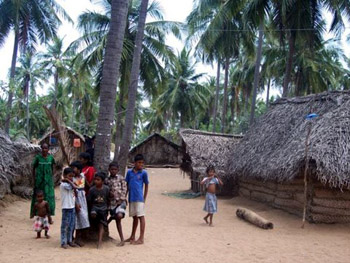
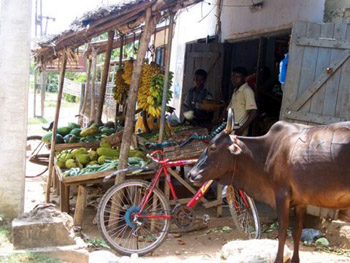
market in Sri Lanka villageNot even two months after the Haitian earthquake, February 27, 2010, Chile, South America, is hit by an earthquake of 8.8 magnitude, and a tsunami rolls across the south Pacific Ocean threatening one quarter of the world. Forty retirees camping on the coast try to escape the tsunami by bus. All lose their lives and only five bodies have been retrieved. Another elderly couple in Santiago, Chile, said upon being rescued, “Everything is lost; our house, everything. We stayed huddled in a corner for hours and were finally rescued.”

Taiwan follows with a 6.4 earthquake, March 4th; then most recently, eastern Turkey with a 6 magnitude earthquake, March 8th, leaving 51 dead.

All these events vividly remind me of another time, another place in the world five years ago. Another disaster and my own response.

This is an excerpt from the author’s memoirs of that time.

When Nature Speaks

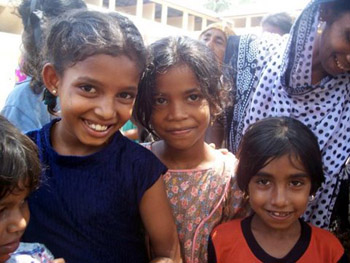
faces of Sri Lankan children“I’ve lost my whole family. There’s no one left to hold or to love,” the old Sri Lankan woman said. I remember how the art therapist interviewing her on television was speechless. What could be said to those words? The depth of pain and loss recalled in that woman’s face still rips into the chambers of my heart and my eyes fill with tears. I ask myself again how we can even begin to restore to the elderly all that they have built within their life—relationships, safety, self-esteem, economic independence, a home they have built from decades of work—after a disaster like this when they are running out of time. The young seem to receive the most aid; what about these old people who have so little of life left?

It’s the middle of March, 2005. The jet is beginning its descent into Colombo, the capital of Sri Lanka, and sparkling below me the lights are welcoming. I look over at my new Sri Lankan friends, a Canadian couple raising money for housing for tsunami survivors. They are visiting family and making connections for a possible housing site on the east coast which we will be visiting.

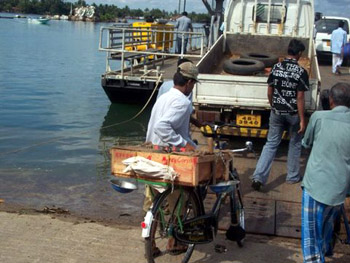
loading a ferry in Sri LankaWe quickly clear customs. I step from the airport onto the crowded, noisy sidewalk that could only be Asia. It’s extremely humid. I feel excitement rising. Tomorrow I’ll begin my journey to the east coast which has been ravaged by the tsunami three months earlier.

The next afternoon and my friends and I travel north east by van. I remember hours, at home in Canada, trying to process the images shown on the news. For days I had felt like an emotional shock absorber. Within that silent role, not being able to write or cry, I now understand that I was unknowingly being prepared, like a period of incubation, to shift into a life-changing experience that was waiting just for me, a new door opening with great speed. Now, in about three hours I will be introduced to a popular community leader who has been involved for several years in local projects in his east coast village. He’s also the director of both a boys’ and girls’ Muslim orphanage. He’s now using his skills and connections to restore normal life to his village after the tsunami. I’m sure looking forward to meeting this person.

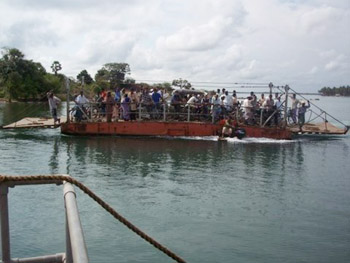
heavily loaded ferry in Sri LankaThree hours later after passing many markets and small towns we arrive at a small bay which we’ll have to cross to reach the village. With great caution, and courage, we drive onto the metal open-deck ferry, our van lurching forward into place. The ferry is driven by two small outboard motors strapped to a side rigging. A young man in an open shirt, a colorful cloth hitched at the waist, barefoot and with a huge smile is negotiating the swift current and we are on our way!

I, myself, am also processing loss of relationships, personal identity and economic stability with the end of my long-term marriage, the deaths of both my mother and mother-in-law, retirement and an empty nest. I know the pain on that old woman’s face on television. It’s the same pain I know on the face of that woman in the mirror. In that single second of recognition, I’d been given a most precious gift…a connection to the heartbeat of all of humanity. I grieve finally for the tsunami victims and their families; for all people who suffer loss; for my own personal losses. I remember welcoming the relief of being able to finally grieve. I feel anticipation and excitement for the first time in many years—that something new is about to happen as I take my first steps into a new portal which will become one of the greatest journeys of my life. It’s a journey into my own heart.

About the author:
Mara Baudais writes creative non-fiction, travelogues, personal essays and poetry. These are based on traveling and/or an insightful experience, often associated with traveling or meditation Besides extensively traveling in Europe, she has visited North Africa, Thailand, Israel, Turkey, China, Inner Mongolia, Tibet, post-tsunami Sri Lanka, Guatemala, across Canada by car for 4 months, coastal B.C. and the Yukon. She has recently returned from a six month trip that stretched from Great Britain to the Black Sea. A photographer, artist, teacher and writer Mara Baudais can be reached at m_baudais@yahoo.ca.

All photographs are by Mara Baudais from 2005.

Tagged With: Sri Lanka travel Filed Under: Asia Travel

MORE TRAVEL STORIES:

Key West, Florida

May Days in Moscow

Romantic Getaways for Couples in Jamaica

Making Music in Carlsbad, California

Hillsborough: A Town of History, Cuisine and Creativity

Andersonville Cemetery – “Is This Hell?”

About the Iranian New Year

Why Penang, Malaysia is Heaven for Foodies


SEARCH

DESTINATIONS

  • Africa Travel
  • Antarctica travel
  • Asia Travel
  • Australia travel
  • Caribbean Travel
  • Central America Travel
  • Europe Travel
  • Middle East Travel
  • North America Travel
  • Oceania Travel
  • South America Travel
  • Travel History
  • Travel News
  • UK Travel
  • Uncategorized
  • World Travel
facebook
Best Travel Blogs - OnToplist.com

Copyright © 2025 Cedar Cottage Marketing | About Us | Contact | Privacy Policy | Terms & Conditions | Copyright Notice | Log in