Travel Thru History

Historical and cultural travel experiences

  • Home
  • Airfare Deals
  • Get Travel Insurance
  • Writers Guidelines

A Turkish Delight: My Unforgettable Journey to Alanya, Antalya

turquoise door of house in Centrum

by Emelie Sater

As I stepped foot on the sun-kissed land of Alanya, Antalya, Turkey, I knew I was about to embark on an adventure of a lifetime. The promise of enchanting landscapes, rich history, and warm hospitality had lured me to this captivating Mediterranean destination. My heart brimming with excitement, I set out to explore the hidden gems of Alanya, eager to weave my story in the rich tapestry of this charming city.

From the moment I arrived, Alanya cast its spell upon me. The azure waters of the Mediterranean Sea gently lapped against the pristine shoreline, inviting me to delve into its refreshing embrace.

As the waves crashed against the ancient city walls, I found myself mesmerized by the breathtaking juxtaposition of history and nature.

I began my journey at Alanya Castle, perched high upon a rocky hill overlooking the town. The ancient walls told tales of a bygone era, transporting me back to the times of the Seljuk Sultanate. The panoramic views from the top were simply awe-inspiring, painting a vivid picture of the city’s transformation over the centuries.

Descending from the heights of the castle, I strolled through the narrow, winding streets of Alanya’s old town, known as Kaleici.

The labyrinthine alleys were brimming with colorful houses, boutique shops, and charming cafes. Every step seemed to reveal a new secret, and I gladly lost myself in the timeless charm of this historic district.

shops in Alanya at night

One of the highlights of my trip was visiting the Red Tower, Alanya’s iconic landmark. Standing tall against the passage of time, this striking octagonal tower showcased the city’s maritime heritage. As I wandered inside, I could almost hear echoes of past sailors and traders who once sought refuge within its sturdy walls.

Eager to experience the city’s natural wonders, I ventured to the Damlataş Cave, renowned for its therapeutic air, said to aid respiratory ailments. The surreal stalactite formations adorned the cave like nature’s artwork, creating a surreal ambiance. Breathing in the pure air, I couldn’t help but feel rejuvenated, as if I were receiving a gift from the heart of Mother Nature herself.

beach and water of Cleopatra Island, Turkey

But Alanya’s true beauty revealed itself when I set sail on a traditional Turkish gulet cruise along the Turquoise Coast.  The endless horizon, dotted with secluded coves and pristine beaches, left me speechless. Each stop on our voyage unfolded a new paradise, offering ample opportunities for swimming, snorkeling, and simply basking in the sun’s warm embrace.

overhead view of beach

Beyond its natural wonders, Alanya also delighted my taste buds with its diverse culinary offerings. I relished the authentic Turkish delights at local eateries, savoring traditional kebabs, baklava, and freshly baked pide. The welcoming smiles of the locals added an extra dash of flavor to every meal, making my dining experiences all the more memorable.

As my time in Alanya drew to a close, I couldn’t help but feel a sense of nostalgia creeping in. The city had charmed its way into my heart, leaving an indelible mark on my soul. Its blend of history, nature, and culture had created an unforgettable journey, one that I would forever cherish.

As I bid farewell to Alanya, I knew that my wanderlust would lead me back to its shores someday. But for now, I carried the essence of this Turkish delight with me, grateful for the experiences that had enriched my life and transformed me as a traveler.

In conclusion, my journey to Alanya, Antalya was a symphony of delights – a harmonious blend of ancient history, breathtaking nature, and warm hospitality. This enchanting Turkish destination had left an indelible mark on my soul, forever inspiring the wanderer in me to seek new adventures and embrace the beauty of the world with an open heart.


All photos by Emelie Sater

  1. An enchanting jewel in Alanya’s heart, beckoning with its vibrant blue door, a gateway to a world of charm and wonder in the bustling city center.
  2. A vibrant nocturnal marketplace buzzing with colorful stalls, enchanting lights, and a kaleidoscope of cultural delights. A haven for night owls seeking unique treasures and unforgettable experiences under the starry skies.
  3. Where history meets paradise – A breathtaking coastal gem, graced by golden sands, and turquoise waters
  4. A timeless sanctuary of beauty and legends, where Cleopatra’s footsteps once tread, embraced by stunning vistas, azure waters, and a mesmerizing aura of ancient allure.
 

Tagged With: alanya, antalya, Turkey travel Filed Under: Europe Travel

10 Fun Things to do in Istanbul

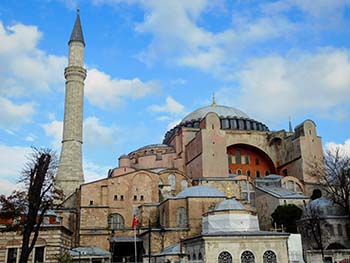
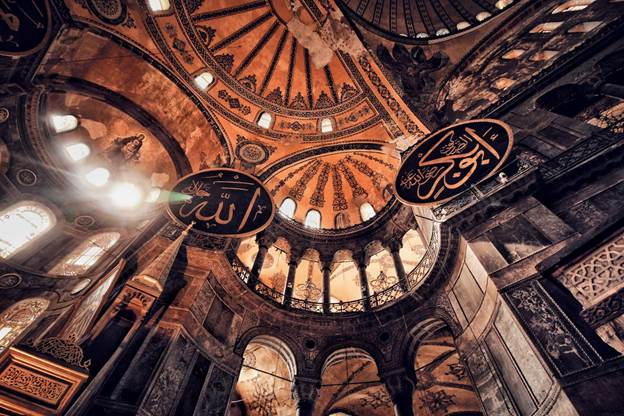
Interior view of Hagia Sophia with domes
Interior view of Hagia Sophia, Istanbul

Istanbul is a lovely city in Turkey that offers a lot of amazing things for one to explore and have fun. The wonderfully unique architecture, the ambience and the beauty of the place make one fall in love with this place. The following are the 10 fun things to do in Istanbul,

Visiting Hagia Sophia

​​Hagia Sophia is an amazing destination in Istanbul that one should not miss. This is one of the major attractions in Istanbul that has cultural and historical significance. Officially known as the Hagia Sophia Grand Mosque, this was previously a Church and a Museum before becoming a Mosque. The architecture of this building will leave one in complete awe. One should not miss visiting this amazing place. And the Istanbul packages help one to achieve it. The place is open to the public all day a week, 24 hours a day. There is no entry fee to enjoy this place.

Visiting Grand Bazaar

Grand Bazaar, Istanbul

No trip to Istanbul is complete without making a visit to the Grand Bazaar. The Grand Bazaar is one of the largest markets in the World and the oldest as well. This is the ultimate destination for shopaholics. This is a covered market that has about 4000 shops. One can find lamps, hand-crafted carpets, ceramics, shoes, clothes and much more. There are also restaurants, cafes and more. One can find something that excites them here. The place is open all day a week, from 10 in the morning to 6 in the evening. This is one of the fun things to do in Istanbul.

Nightlife in Istanbul

Istanbul is one of the top places in Turkey that has dazzling nightlife. The city lights up at night adding an additional glow and setting up the ambience for nocturnal lovers. The place offers several activities that pave the way to having the ultimate fun. One can have a romantic dinner on the Bosphorus Cruise, shop at the Grand Bazaar at night and have a beautiful night stroll are some of the amazing activities to do at night in Istanbul. To have a wild night, there are several options of bars, clubs and pubs available for one to choose from. There is also a pub crawl option available to have continuous fun.

Exploring street food in Istanbul

Istanbul street food

Street food in Istanbul has a great reputation and offers the culture’s cuisine at its finest. This is a great activity for all the food lovers out there. One can try out and relish all the delicious delicacies the city has to offer. It is also safe to eat street foods in Istanbul. Some of the most popular street food in Istanbul include Kebab, Kofte, Lahmacun, Balık-Ekmek, pide, Baklava, Simit and Meze to name a few. One can find delicious foods on these street foods in the city. Trying out all of these foods must be at the top of your list while visiting Istanbul.

Going on a Bosphorus Cruise

Bosphorus Cruise boat

One of the amazing things about visiting Istanbul is cruising along the calming Bosphorus strait. This is a great activity for one to bond and this is perfectly suitable for family, friends, business trips, solo travellers and kids. One can get to witness the amazing city and its alluring beauty from a panoramic view. The ideal time to take on the cruise is during the evening and one can experience the view and enjoy the cruise along with the dinner and the picturesque sunset. Taking on this cruise is one of the most fun things to do in Istanbul and must not be missed.

Trying the Turkish Bath

The vacation trip to Istanbul is not complete without trying out the famous Turkish Bath. This is much more than a bath and more of a relaxing and therapeutic activity to try out in Istanbul. This is the perfect activity to have the ultimate relaxation on a vacation. One can enjoy the bath that includes scrubbing, foam wash and a massage. The entire bath experience can be finished in 45 minutes. The Turkish Bath is absolutely perfect for the laid-back and relaxing thing to do in Istanbul and is a fun experience overall to try out. One must not miss the Turkish Bath.

Visiting Topkapi Palace Museum

Topkapı Palace, Turkey

The Topkapi Palace is one of the great examples of the amazing architecture of Istanbul. This is one of the popular attractions in Istanbul that must not be missed. This is one of the largest museums and one can witness several amazing things representing the relics, manuscripts and much more of the Ottoman Empire. The grandeur of the palace can be seen both outsides and inside the palace. Visiting the Topkapi Palace Museum is one of the fun things to do in Istanbul. The palace is open from Wednesday to Monday, with the timings from 10 in the morning to 4 in the evening.

Visiting Miniaturk

One should not miss paying a visit to the Miniaturk when in Istanbul. The place is one of the largest miniature parks in the world. This is an attraction that is suitable for people of all ages. At Miniaturk, one can witness the amazing works displayed here. The intricate beautiful miniature models of all the significant monuments of Istanbul, Anatolia and overseas can be seen in one place. There is also a souvenir shop in Miniaturk where one can shop for things to remind of a memorable day. The place is open all day a week, from 9 in the morning to 7 at night.

Visiting the Blue Mosque

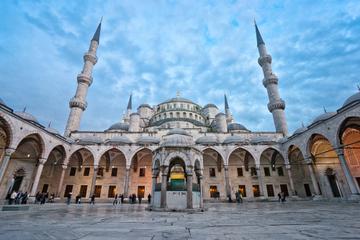
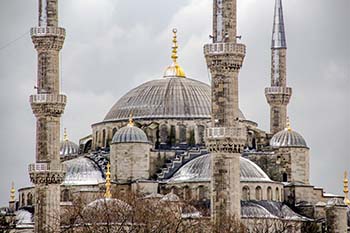
Blue Mosque, Istanbul

​​The Blue Mosque, also known as the Sultan Ahmed Mosque, is one of the architectural and historic wonders in Istanbul that must not be missed. The Mosque is one of the popular choices of attractions among tourists and attracts a lot of people. The interior of the place must be mentioned as it is one of the stunningly intricate things with a great design of tiles and walls. Visiting the Blue Mosque is one of the amazing things to do in Istanbul. The place is open all day a week, from 9 in the morning to 7 in the evening.

Walking in Yıldız Park

Yıldız Park is one of the amazing places in Istanbul that must not be missed. The park has a serene ambience and picturesque location that one must not miss. One of the interesting things about this park was that this was a forest before. This is also one of the largest parks in Istanbul that is best to take a stroll, do a picnic and just lie back. This park is filled with beautiful greenery, birds and flowers. The park is open to the public all day a week, 24 hours a day. This is a great location for people of all ages.

Istanbul offers several fun activities to do while on a tour. So, pack up your bags and get ready to experience all the amazingly fun things!

Browse Istanbul Tours Available Now


Tagged With: Istanbul attractions, Turkey travel Filed Under: Europe Travel

Ancient Ephesus, Turkey

Ephesus Turkey
by Elizabeth von Pier

The bus travels up the side of the mountain, and I look out at the stunning landscape, dotted with lemon groves, olive trees, and vineyards. The rugged landscape is dramatic and I hold onto my seat as we take hairpin turns a little too fast. We have just finished a tour of ancient Ephesus and are heading to relax and have lunch in a guesthouse up here in the mountain hamlet of Sirince. Our visit and lunch are arranged in conjunction with Food and Wine magazine.

Sirince lies about eight miles outside of Ephesus but it seems to be of another world. It is famous for its location, fabulous vineyards, and rich fruit wines. It is so beautiful that, at one time, the natives decided to name it Cirkince, meaning “ugly” because they wanted to deter foreigners and tourists from taking over their lovely little town. But today it is called Sirince, meaning “pretty”. It contains a dollhouse collection of square white stucco homes, a quaint downtown, and friendly people.

Narrow streets are filled with trucks delivering fresh produce and there are food and wine shops to lure you in. Bright red tomatoes are available for sale from the back of the proud farmer’s pickup truck. We stop to sample some olives and bread dipped in cold-pressed extra-virgin olive oil. Next door is a shop selling fresh lemons the size of cantaloupes and locally-made lemon products. A tiki-style bar offers wine-tasting, and next to it you can order a freshly made dish of moussaka and a traditional salad made from sun-ripened tomatoes, thick slices of cucumber, green pepper, red onion, olives, and feta cheese.

At the end of the main street and up a short flight of stone stairs is the boutique hotel, Gullu Konaklari, where we will have lunch. We are a small group and two tables have been set up for us in the outdoor vineyard house overlooking the mountains. A canvas roof over the tables provides protection from the hot September sun and fans keep the air moving. The sides are open, a warm summer breeze blows, and there are breathtaking views of the mountains. This is good for the soul.

Two young servers dressed in starched white shirts and black pants start by pouring each of us a glass of wine made from locally-grown grapes. We toast our fellow travelers and enjoy good conversation about hometowns, recent travel, and shipboard experiences. We nibble on freshly made pita bread, hummus, tzatziki, and a creamy fava puree made from mashed yellow split peas and topped with sauteed red onions, capers, and a dollop of yogurt.

Next comes a large salad made from sun-ripened tomatoes, thick slices of cucumber, green pepper, red onion, olives, and big chunks of fresh feta cheese. Vinegar, extra-virgin olive oil, salt, and freshly ground black pepper are available on the side. Although the salad can be served at any time during the meal, it is traditional to serve it as a starter.
kofte balls with tomato pilafThe first course is borek, a savory spinach and cheese pie similar to the Greek spanikopita. Buttery filo crust is wrapped around the filling and baked to a light and crispy perfection. The main course consists of local specialties—kofte balls of ground beef served with tomato pilaf and grilled vegetables made from locally grown produce like we saw in the markets in the town. Dessert is a sweet berry tarte, delicious with a dollop of tangy yogurt.

Be sure to order a frappe at the end of the meal. This is not what you might think. It is an iced coffee drink made from water and instant coffee granules which are mixed to a froth that fills the top third of the glass. It is a pick-me-up at the end of the day—and it has no calories. It may take several sips to learn to enjoy the strong brew with a bitter aftertaste.

The Ancient City of Ephesus is not far away

Sirince is not far from Ephesus, a classical ancient city in Asia Minor within the border of present-day Turkey. It was colonized mainly from Athens with the result that it is very “Greek” by nature. It is one of the most magnificent and best-preserved archaeological sites in the world.

The Library of Celsus is a highlight of the site. Named for Julius Celsus, a Roman governor of the Asian provinces, its classical architecture dates from 110-135 AD. Scrolls and old manuscripts were stored in bookcases in the top two stories and dispensed by librarians. The lower niches on the exterior of the library contain four statues with Greek inscriptions said to represent Wisdom, Knowledge, Destiny, and Intelligence. These are copies; the originals are in the Vienna Museum.

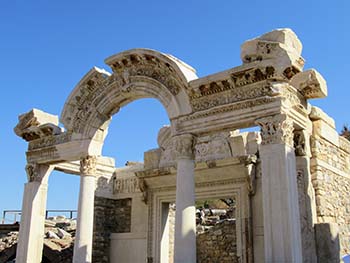
Temple of Hadrian remainsThe Temple of Hadrian is the most attractive structure on the “main street.” It has an arched top and intact facade with four columns that lead into an inner chamber.

Interior of terraced house, EphesusThe stunning Terrace Houses are in a newly excavated section. Wealthy and important people lived here. They have incredibly well-preserved mosaics, tiles, and frescoes decorating their interiors and are sheltered from the elements under a protective covering. They are in their original locations, and walkways and staircases have been set up so you can see them up close. They were built in the first century AD and used for 600 years, and consist of entryways with water features, reception rooms, kitchens with arched hearths, and bedrooms. The Hall of Muses contains particularly beautiful and well-preserved frescoes.

The Ionic Temple of Artemis was considered one of the Seven Wonders of the ancient world. All that remains today are the columns. At one time, the famous statue of Artemis, goddess of fertility, was housed here. It is now in the Ephesus Archaeological Museum.

The site offers a peek into the private lives of the inhabitants. A latrine is located near the brothel. Thirty-five toilet holes were cut into a marble slab and were continuously cleaned by running water. It was used by both men and women.

If you go

Holland America, “11-Day Ancient Empires”, round-trip Civitavecchia (Rome). Ports of call include Kusadasi (Ephesus), Turkey; Katakolon (Olympia), Greece; Piraeus (Athens), Greece; Mykonos, Greece; Rhodes, Greece; Santorini, Greece; and Salerno (Amalfi Coast, Pompeii, Sorrento), Italy. On this cruise, there is an overnight stop in Piraeus (Athens).

About the author:

Elizabeth von Pier loves to travel. After she retired from her lifetime career in banking, she has been traveling the world, photographing, and writing. She has been published in the Los Angeles Times and many online travel magazines including In the Know Traveler, Go Nomad, Wave Journey, Travelmag—The Independent Spirit, and Travel Thru History. She also recently published her first book, “Where to Find Peace & Quiet in London” and is now working on another volume in this series, “Where to Find Peace and Quiet in Paris” which is expected in 2020. Ms. von Pier lives in Hingham, MA.
Photos by Elizabeth von Pier

Tagged With: Elizabeth von Pier, ephesus attractions, ephesus history, Turkey travel Filed Under: Europe Travel

Istanbul: Visiting Mosques in This Islamic City on Two Continents

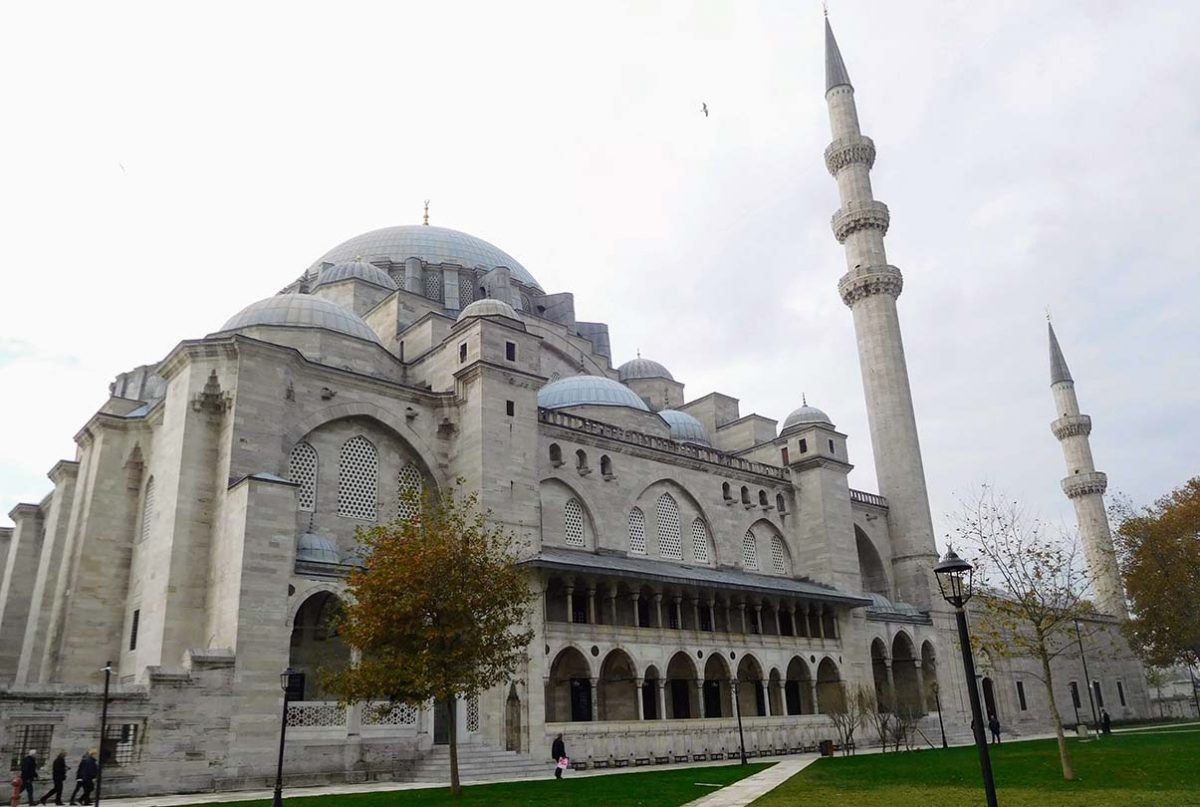
Suleymanye Mosque

by Elizabeth von Pier

Ninety-eight percent of the population of Turkey is Muslim, so it is not surprising that there are thousands of beautiful mosques in Istanbul. Some are among the biggest and best in the world, and some are tiny with awesome settings on the Bosphorus.

Four, in particular, stand out to me. All are on the European side of Istanbul. The Sultan Ahmed Mosque, also known as the Blue Mosque, is the most famous and is known for the color of the tiles that decorate much of the interior. The Hagia Sophia is in the old city next to the Blue Mosque and, although it is a museum today, it has been used for centuries as both a Christian church and a mosque. The Suleymanye Mosque with its lovely understated interior is the largest and is located high on a hill overlooking the Golden Horn. And the pint-sized Ortakoy Mecidiye Mosque sits right on the shores of the Bosphorus in the trendy Besiktas district.

All welcome non-Muslims as long as you are properly clothed and adhere to some basic tenets of propriety.

Ten Things You Need to Know About Visiting a Mosque

Here are some of the most important things that I learned about visiting religious sites in a Muslim country.

1. Muslims are called to pray five times a day so that they are frequently reminded of Allah and have opportunities to seek His guidance and forgiveness. The exact time changes daily based on the rotation of the earth around the sun.

2. During prayer times, mosques are generally closed to tourists so that the faithful have privacy during their commune with Allah. You can take this opportunity to visit the property surrounding the mosque including the tomb of the sultan and his wives.

3. Men and women offer their prayers in separate spaces. Men kneel on the carpet in the main hall. The women’s space is smaller than the men’s and is set aside behind a partition in the back. Some say this is so that the men don’t get distracted during prayer; others say it represents a special honor to women.

4. There are no chairs, benches or pews in a mosque. Everyone from all walks of life sits on the floor to symbolize their equality in front of Allah.

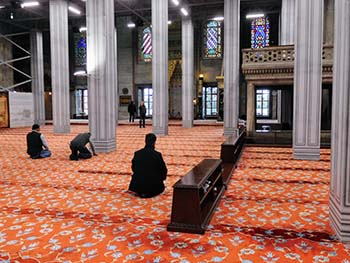
inside a mosque5. It is necessary to take off your shoes when entering a mosque in recognition that you are entering a holy place. This also keeps the prayer space clean for the act of prostration during which the supplicant puts his forehead and nose on the ground as he/she prays.

6. Women must cover their hair and shoulders before entering a mosque. This is because hair is considered to be part of a woman’s sexuality that should be revealed only to her husband.

7. Men must be dressed respectfully. Long pants and collared shirts with sleeves are appropriate.

8. Generally, it is permitted to take photographs inside a mosque. It is a sign of respect to avoid photographing Muslim women and people who are praying.

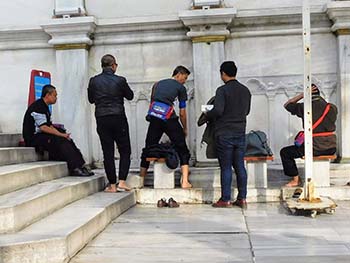
Muslim ablution9. Ablution, the act of cleansing oneself before praying to Allah, is a prerequisite to praying so that one is both pure spiritually and clean physically. Ablution facilities typically include a row of faucets and stone stools on the side of the building used by the men. The women’s area is hidden from public view. Commonly used parts of the body are washed before entering the prayer hall.

10. Inside a mosque, you will find calligraphy rather than statues and paintings of God and saints like you would find in a church. This is because Muslims worship an unseen God and believe that it is impossible to know what He looks like. So instead of depictions of Mohammed or the prophets, you will find calligraphy of Qur’anic verses and prayers.

With this knowledge, you are now ready to visit some of the best mosques of Istanbul.

The Sultan Ahmed (Blue) Mosque

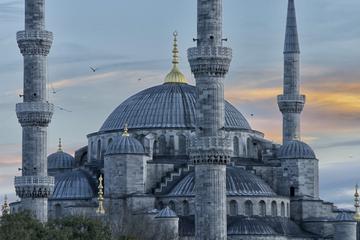
The Sultan Ahmed Mosque is also called the Blue Mosque for the color of the blue, green, and turquoise tiles that cover the interior. It is considered to be one of the most magnificent buildings in Turkey. Constructed between 1609 and 1617 during the rule of Ottoman Sultan Ahmed I, the mosque was built to reassert Ottoman power following losses suffered in the war with Persia in 1603-1618. Sultan Ahmed I was only 19 years old when he commissioned the building of this great mosque and he showed his dedication to its construction by personally working as a laborer.

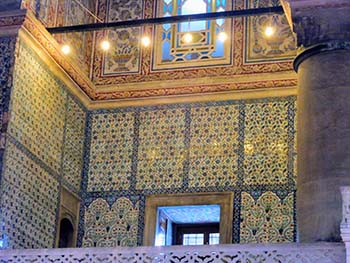
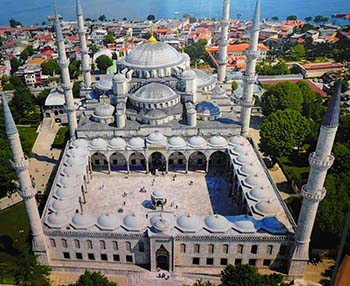
Blue Mosque interiorMosques typically have two or four minarets but you will notice that the Blue Mosque has six. Some say that this was to flaunt Ahmed I’s power and wealth. When he was criticized because the mosque in the holy city of Mecca also had six minarets, Ahmed ordered that a seventh minaret be added to the mosque in Mecca.

Twenty-one thousand blue tiles cover the interior of the Blue Mosque. They are Iznik tiles from western Anatolia, hand-painted in florals and geometrics. There also are 260 stained-glass windows, impressive displays of Arabic calligraphy on the walls, and a large chandelier that hangs low over the prayer hall.

Suleymanye Mosque

Suleymanye MosqueThis classical masterpiece of the golden age of the Ottoman empire is decorated more simply. It was commissioned by Sultan Suleiman the Magnificent who ruled the Ottoman Empire for 46 years and was one of the most important sultans of the 16thаcentury. Construction work started in 1550 and was finished in 1557. The Suleymanye Mosque is considered to be a highlight of Ottoman architecture. In fact, the glass work of the windows is so superb that the artists felt it had reached the ultimate perfection and beauty and did not dare to produce glass work for the Ottomans again.

The mosque building itself has four minarets at the corners. The interior is visually stunning with tile work in understated pink and white, Qur’anic calligraphy in gold on black, a large low chandelier over the prayer area, and a magnificent dome that spans the entire interior and is supported by four pillars. Lots of light comes in and there is an aura of tranquility.

The mosque complex is situated on 2.4 acres on the Golden Horn and shores of the Bosphorus. Views of the Galata district and Taksim, the modern district, from the gardens and terrace are awe-inspiring. It is at the top of the highest of the seven hills of Istanbul’s old city.

Hagia Sophia

Hagia SophiaWhile not a mosque today, I have included Hagia Sophia because it served as a mosque for nearly 500 years. It is Istanbul’s top tourist attraction. Hagia Sophia is almost 1500 years old and has a very interesting history. It was built as a Byzantine church in 532 AD by Emperor Justinian I and was used as a church for 916 years. In 1453 when the Ottomans captured Constantinople, it was converted into a mosque. And in 1935, nearly 500 years later, it became a museum.

Hagia Sophia is a blend of east and west, with elements of both the Byzantine and Ottoman empires. It is considered to be the finest house of worship in the Christian and Muslim worlds. The crowning achievement is the vast central dome.

It took five years to build Hagia Sophia and drained the treasury in the process. Emperor Justinian had asked for a church with grand proportions that would last for centuries and keep his name alive. He got his wishЧHagia Sophia is still standing after 15 centuries and Paris’ Notre Dame would fit within its great dome.

When the building became a mosque in 1453, the church’s mosaics and frescoes depicting God and people were covered over with whitewash and plaster since this is not allowed in a mosque. These are in the process of being restored. You can get an up-close view of the most famous if you take the stairs and walkway to the upper floor galleries. The Ottomans added the Arabic calligraphy that you see in the large round medallions.

Ortokoy (Mecidiye) Mosque

Ortokoy (Mecidiye) Mosque interiorThis little mosque in the Besiktas district north of the old city is tiny and serene, and has one of the nicest settings in the trendy Ortokoy pier area overlooking the Bosphorus and the Asian side of Istanbul.

Commissioned by Ottoman Sultan Abdulmecid and built between 1854 and 1856, it is the newest of the four mosques described here. It was designed by an Armenian father and son who also designed the Dolmabahce Palace and mosque just up the road. It has two minarets and the pink and white interior has lovely glass chandeliers and Arabic calligraphy which was executed by the Sultan himself, a master calligrapher. It is light and bright inside due to the large windows which allow light from the outside and reflections off the water to flood in.

After visiting the mosque, be sure to try Ortokoy’s popular street food, аkumpir, which are overstuffed baked potatoes.

If You Go:


Private Tour: Istanbul in One Day Sightseeing Tour including Blue Mosque, Hagia Sophia and Topkapi Palace

Hotel Amira, Kucuk Ayasofya Mahallesi Mustafapasa Sokak No 43, Sultanahmet 34122 Istanbul, Turkey, аinfo@hotelamira.com
Sultan Ahmed Mosque (Blue Mosque), Sultanahmet, Sultanahmet Mah. 34122/Istanbul
Süleymaniye Mosque, Sinan Aga Mah. Zeyrek Cad. No:4, Zeyrek/Fatih/Istanbul
Hagia Sophia, Sultanahmet Mh., Ayasofya Meydani, Fatih, Istanbul, +90 212 522 1750, open daily except Mondays
Ortakoy Mosque, Mecidiye Mah. Cami Sok. No:2, Ortakoy, Besiktas, Istanbul


Istanbul Full-Day Tour with Hagia Sophia, Blue Mosque, Topkapi Palace, Grand Bazaar and local Turkish lunch

 About the author

Elizabeth von Pier loves to travel. After she retired from her lifetime career in banking, she has been traveling the world, photographing, and writing. She has been published in the Los Angeles Times, In the Know Traveler, GoNomad, Wave Journey, Hackwriters, Travelmag, The Independent Spirit, and Travel Thru History. She also has recently published her first book, Where to Find Peace and Quiet in London. Ms. von Pier lives in Hingham, MA.
All photos are by Elizabeth von Pier.

Tagged With: Istanbul mosques, Istanbul tours, mosque etiquette, Muslim customs, Turkey travel Filed Under: Asia Travel, Europe Travel

Memories of the Orient Express

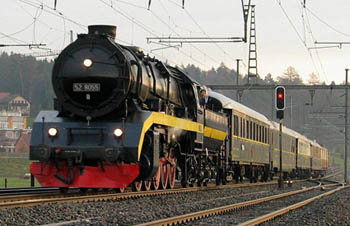
Orient Express railway engine

Istanbul, Turkey

by Inke Piegsa-quischotte

Ever since I read Agatha Christie’s intriguing crime novel ‘Murder on the Orient Express’, I wanted to travel on that train. To indulge in the gilded luxury of the train itself, let the mysterious landscapes of the Balkans glide past my window and alight at the final destination: Istanbul, the city which straddles two continents. At the beginning of the 20th century, an infatuation with Istanbul and Turkey had taken hold of European society; actors, artists, writers, journalists and plain rich people, flocked to the Bosporus and their favorite means of transport was the Orient Express.
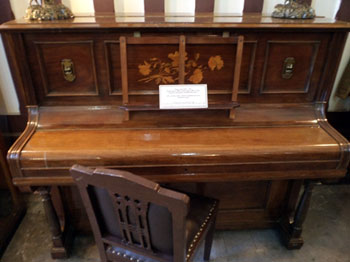
piano from Orient ExpressComposed of sleepers, a dining car and a baggage car, the train featured Lalique chandeliers, a piano and the finest crockery and cutlery. The maiden journey started on October 10th 1882 in Paris and reached Istanbul the next day. The menu consisted of no less than seven courses, oysters and turbot in green sauce included, not to mention fine wines and champagne. In 1977 the train ceased to have Istanbul as its final destination and in 2009 the Orient Express disappeared entirely from the time tables. Several other routes continue though and twice a year the historical trip is repeated, at a very stiff price!
Since I couldn’t afford that luxury, I was nevertheless able to relive Orient Express romantic and nostalgia in Istanbul’s Sirkeci gare.

Sirkeci Gare

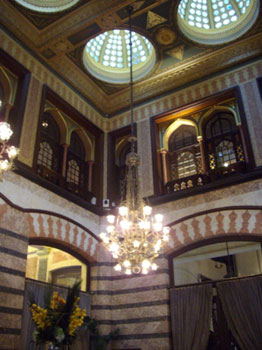
railway station interiorThe pink and white structure of the railway station is located in Eminönü on the shores of the Bosporus. Designed by German architect August Jachmund, it’s the best example of European Orientalism, combining elements of Ottoman architecture with modern amenities such as gas and later electric lighting and heating in winter.
As I entered through the elaborate doors, I could well imagine fur clad ladies in pearls and cloches, tripping along the platform, followed by an army of porters bogged down by travel trunks.

They might rest in the Orient Express restaurant, where I sat down for a coffee and a few baklavas and admired the beautiful stained glass windows and Tiffany lamps which still evoke the atmosphere of times gone by.

As I got up to head for the restrooms, I discovered to my delight a tiny museum right next door which is easily overlooked if you don’t know it’s there.

Orient Express Museum

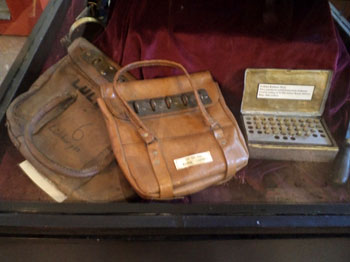
Orient Express memorabilia displayIt’s only one room, but the museum documents the history of the Orient Express and the train station in detail. Old log books are displayed as are conductors’ uniforms, the piano, a table laid with the original cutlery and crockery, tickets and many more memorabilia. Photographs adorn the walls and examples of the technology of the time are on display too. I loved the newspaper clipping of when the train got stuck in a snow storm in Bulgaria, very reminiscent of the plot of Agatha’s novel. Admission is free and you are allowed to take as many photographs as you want.

There is just one single guard watching over the treasures and he is happy to answer your questions.

Another Istanbul landmark closely connected to the Orient Express and Srikeci gare is the Pera Palace Hotel.

Pera Palace Hotel

hotel reception deskAs affluent Europeans started to descend upon romantic Istanbul, using the Orient Express, they needed an equally elegant place to rest their heads. The city was decidedly short of such type of establishment and that’s how the Pera Palace was conceived. The first super luxury hotel of Istanbul, located in fashionable Beyoglu (then called Pera) opened its door with an inaugural ball in 1892.
Passengers from Sirkeci Gare were carried in sedans all the way up to the Golden Horn and one of these sedans is still displayed in the Pera Palace, next to the elaborate elevator which was the first of its kind in Istanbul. As were other amenities such as hot and cold running water. There are many ‘firsts’ for the Pera Palace, including the first ever fashion show in Istanbul.

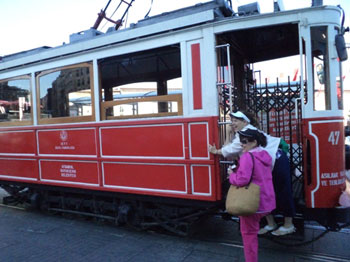
tram car on Istaklal St.Not carried by a sedan but using the tramway running up and down Istaklal Street, I made my way on foot to the Pear Palace. The hotel was closed for nearly four years, undergoing extensive renovations but is now open again. No better place to get a feel for how people traveled in the past than sitting in the Orient Bar, enjoying a cocktail.

Room 411, all decorated in black and red, was Agatha Christie’s favorite room and it was here that she actually wrote her Orient Express mystery. But she isn’t the only famous person having frequented the Pera Palace. Signed photographs of Ernest Hemingway, Greta Garbo, Isadora Duncan and Jackie Kennedy to name but a few look down from the walls. Atatürk was also a frequent visitor, presiding over many a ball.

Even if I wasn’t able to afford a trip on the Orient Express or a stay at the Pera Palace, I could enjoy the atmosphere and easily imagine the past in these three marvelous Istanbul locations, all closely connected to the history of a legendary train.

If You Go:

Istanbul is a city worth a visit any time of the year. However, to avoid tourist crowds and really hot weather, the best seasons are spring and fall. Winters can be quite cold and rainy.

Trains to Greece, the Balkans and beyond still run from Sirkeci Gare. They may not be the Orient Express but you can travel very comfortably in the first class sleepers.

The Pera Palace has an excellent pool, spa and Turkish bath, using products especially made for the hotel in France. A day pass is available for approx. $100, which is a lot less than the average room rate.


About the author:
Inke Piegsa-quischotte is an ex-attorney turned travel writer and novelist. She writes for online travel magazines and has two novels and a travel guide to Galicia/Spain published. She lives between Turkey and Miami. She has just published a book, ‘Istanbul, City of the Green-Eyed Beauty’. Learn more about it here: www.glamourgrannytravels.com

All photographs are by Inke Piegsa-quischotte.

Tagged With: Istanbul attractions, orient express, Turkey travel Filed Under: Europe Travel

  • 1
  • 2
  • 3
  • Next Page »

MORE TRAVEL STORIES:

A Cultural Adventure in Havana, Cuba

Cyprus: A Divided Island

Dirty Dan’s Legacy

Discover the True Himalayas with These 4 Treks

Ireland: A Walk Around Inis Mór

Exploring Iceland in May: Weather, Travel Tips, and Must-See Attractions

Visiting Rimbun Dahan, Malaysia

In the Footsteps of St. Paul Through Mainland Greece


SEARCH

DESTINATIONS

  • Africa Travel
  • Antarctica travel
  • Asia Travel
  • Australia travel
  • Caribbean Travel
  • Central America Travel
  • Europe Travel
  • Middle East Travel
  • North America Travel
  • Oceania Travel
  • South America Travel
  • Travel History
  • Travel News
  • UK Travel
  • Uncategorized
  • World Travel
facebook
Best Travel Blogs - OnToplist.com

Copyright © 2026 Cedar Cottage Marketing | About Us | Contact | Privacy Policy | Terms & Conditions | Copyright Notice | Log in