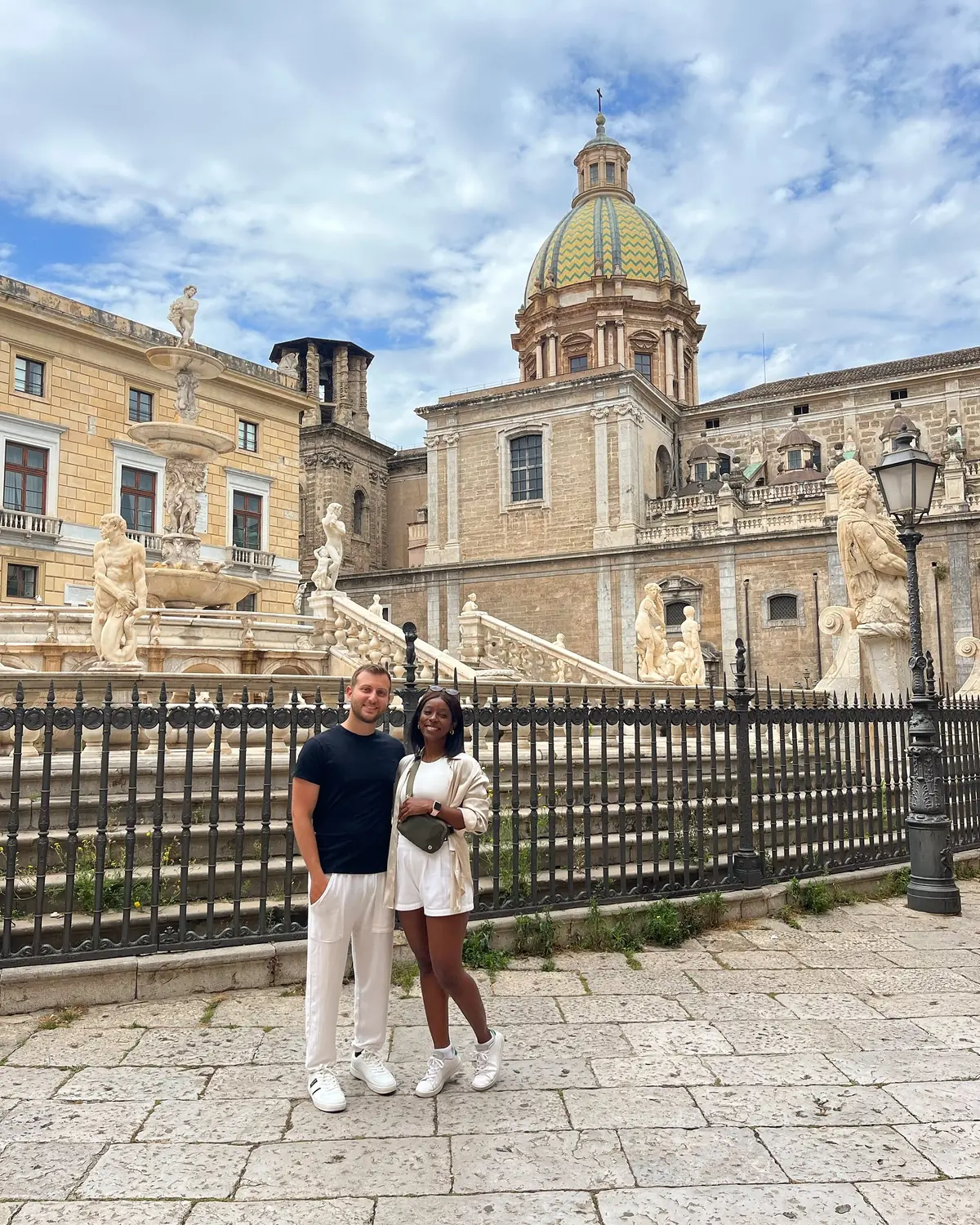
By Andrew and Melody, Travel Your Best
We came to Palermo for a few days in May with a simple plan: eat well, take good photos, and wander. The sunshine showed up on schedule, and the food exceeded every expectation. What we did not expect was how quickly the city would start rearranging our sense of time. In Palermo, history is not kept behind glass. It is the wall you lean against while you eat lunch, the street under your feet, the reason the juice in your cup tastes the way it does. We are not history majors. We just kept tripping over the past everywhere we went, and it was delicious.
The Palermo Cathedral taught us that on our first morning. We had seen photographs, but nothing prepares you for the layering of the place. Stand in front of it and you are looking at several civilizations stacked into a single facade: rounded Norman arches, fine Arab stonework carved into the walls, a Gothic porch added centuries later, and a great Baroque dome crowning the whole thing. It is built in warm honey colored stone that glows in the morning light, and it is so large that the square in front of it feels like a stage built for the building alone.
We went early, which turned out to be the best decision of the trip. The gardens were empty, the light was soft, and we paid the small extra fee to climb up to the rooftops. From up there, the old town spreads out below you in a jumble of domes, bell towers, and laundry strung across balconies. We took about a hundred photos and still did not capture it. That is when it clicked for us: the cathedral is not an exception in Palermo. It is the rule. Everything here is built on top of something older.
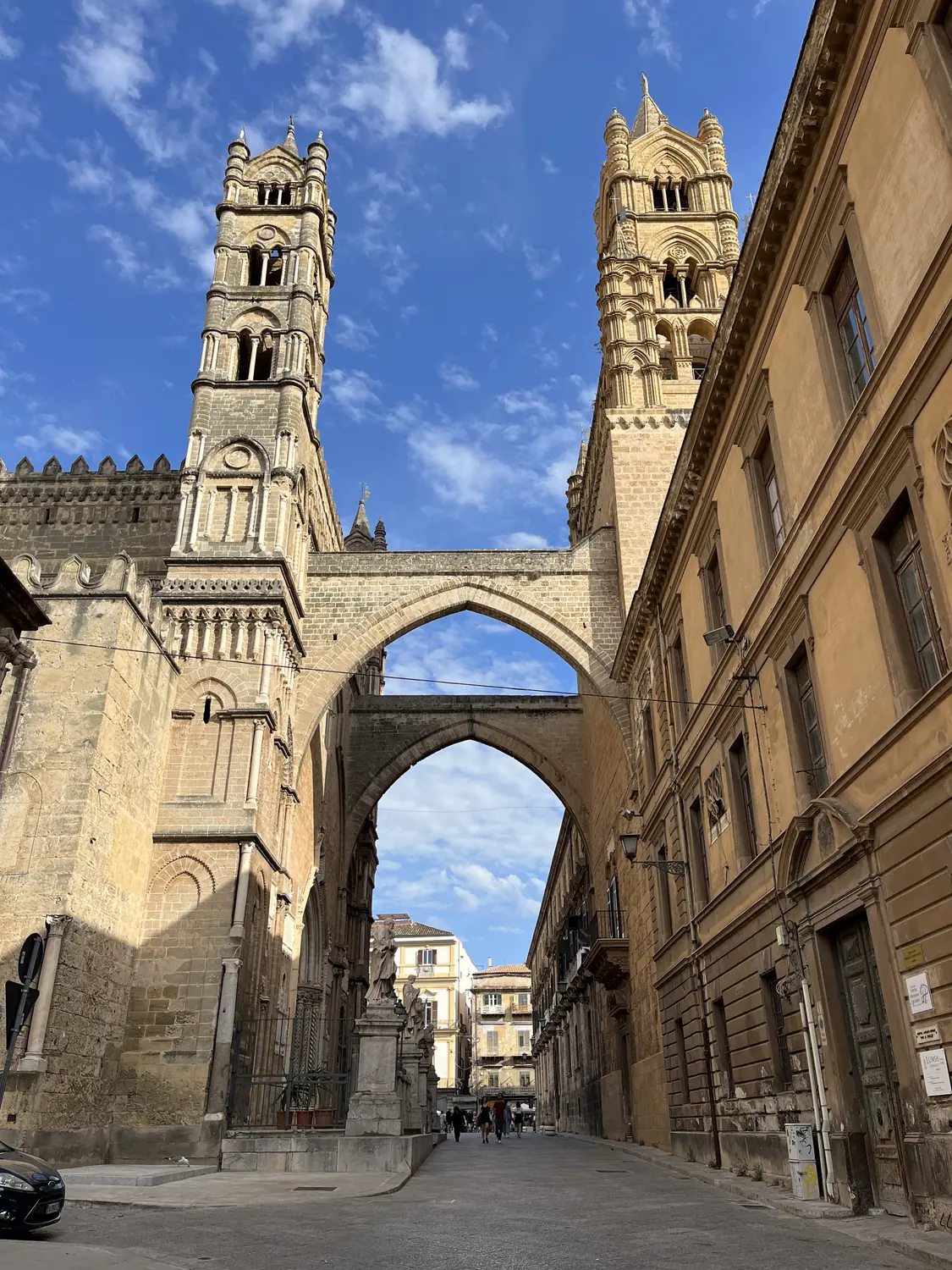
The street the cathedral stands on is a good place to start. The Cassaro, as locals still call it, follows a street plan laid down by Phoenician traders nearly three thousand years ago. They founded a trading post here and called it Ziz, meaning flower. We learned that later, over coffee, and it stopped us cold. We had walked to buy breakfast along a route that merchants walked before Rome was an empire. You do not get that from a museum plaque. You get it from your feet.
Then there is the food, which is where Sicily’s history gets delicious. Three thousand years of visitors left ingredients behind on this island, and Sicily did what Sicily does: it made them Italian. Walk through the Ballaro market in the morning and you are walking through that story.
The star, for us, was the arancino. A crisp golden ball of saffron rice wrapped around ragu, fried to order and eaten standing up, it is the most Sicilian thing you can hold in one hand. We ate our way through that market for hours, grazing from stall to stall: arancini, panelle, sfincione, and the frothy lemon foam juice the guidebooks rave about, tart and sweet and impossibly refreshing in the heat. Every bite tasted like an island that took the best of everything that ever landed on its shores and turned it proudly, unmistakably Italian.
Then came the Normans, and this is the part we loved most. The Norman kings who took Palermo did not erase the Arab city. They built in conversation with it, hiring Arab craftsmen to carve the stonework of a Christian cathedral. Latin, Greek, and Arabic were all languages of government in the same palace. Standing in front of the cathedral, we kept thinking about how rare that is, and how completely Palermo takes it for granted. Nobody here is giving lectures about tolerance. They just built a beautiful church and moved on with their day, a thousand years ago.
The layers keep coming as you walk. In the heart of the old town, Piazza Pretoria wraps around a wedding cake of a marble fountain crowded with statues, so grand and so naked that locals nicknamed it the Fountain of Shame. A two minute stroll away, the Quattro Canti curves its four decorated facades around the intersection where the old city’s quarters meet. Every corner is covered in statues of kings, saints, and the seasons, as if the intersection itself needed to announce itself. We stood in the middle of it turning in slow circles, trying to photograph all four corners at once. It does not work. Go and try.
North of the tangled old town, Palermo changes register entirely. The wide nineteenth century boulevards belong to the era when Sicily joined a unified Italy, and the neoclassical Teatro Politeama is the landmark of that confident new age, all Pompeian red columns and a bronze chariot on the roof. It feels a world away from the old stones of the cathedral, and it is a twenty minute walk away. We framed a photograph between those enormous columns and laughed at how the city kept handing us new centuries every few blocks.
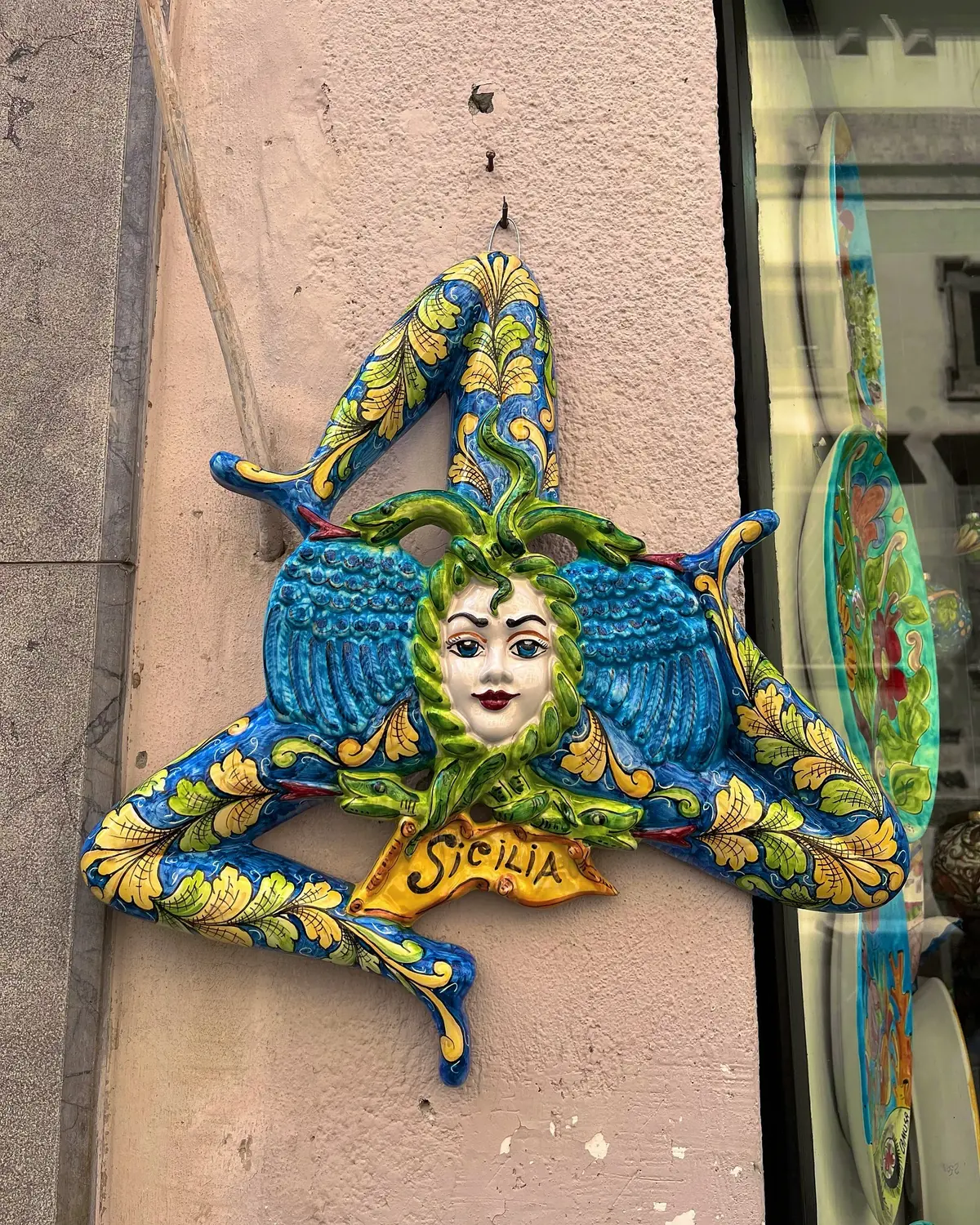
Some of our favorite hours, though, were spent in no century at all, just wandering the back streets with no destination. Sun bleached buildings, laundry flapping overhead, vintage Fiat 500s that look as if they have been parked in the same spot for decades. The three legged Trinacria, the ancient symbol of Sicily, turns up everywhere: painted on ceramics, carved into walls, printed on souvenirs. It predates the Romans, and Palermitans still put it on their front doors. Three thousand years of conquerors came through, and the island absorbed every one of them and kept its own symbol. We bought a small ceramic one and it is on our shelf now, watching over the apartment.
On our last full day we rode out to Mondello, about eleven kilometers from the center, and the sea put the whole trip in perspective. The bay is a wide crescent of pale sand and clear turquoise water, curved between green headlands. The water is warm and shallow and so clear you can see straight to your feet. We swam, we walked the seafront with a granita, and we thought about the fact that every single civilization in our walking tour arrived by this water. The sea is the one layer that never changes. Standing in it, you feel the whole three thousand years settle into place, and then a wave knocks you over and you laugh and forget about history entirely, which might be the most Sicilian ending of all.
We travel as a couple, slowly, and Sicily rewarded that pace completely. A faster trip would have given us the sights. The slow one gave us the realization that in Palermo, you do not visit history. You walk through it on your way to lunch. For Andrew, this trip carried something extra. His family roots run deep in Italy, especially in Sicily, and walking these streets felt less like visiting and more like returning.
If you go
Base yourself in Palermo. We spent a few days there in May and it was the perfect hub. The historic center is walkable, the food is everywhere, and the beach is a short ride away.
Getting around. The old town is best explored entirely on foot. That is how you stumble into things, the cathedral one morning, the markets the next, the back streets whenever the light looks good. Mondello is about eleven kilometers from the center and easy to reach by bus or taxi. At the Palermo Cathedral, pay the small extra fee to climb to the rooftops. The view over the old town is worth it, and the morning light is kindest for photographs.
Best time to visit. We went in May and the weather was perfect, warm days, cool evenings, and manageable crowds. Spring and early autumn are ideal. Mondello gets busy in high summer, so go earlier in the day if you visit then.
Do not miss. The Palermo Cathedral first thing in the morning, Piazza Pretoria and the Quattro Canti in the old town, the Teatro Politeama and the grand boulevards, a slow morning in the markets (Ballaro, Vucciria, and Capo), and a swim at Mondello.
Do not miss the food. Order an arancino, hunt down the frothy lemon foam juice from a market street cart, add panelle, sfincione, a cannolo, and a granita at Mondello. You will have eaten your way through eleven centuries without opening a single history book.



Leave a Reply
You must be logged in to post a comment.