 by Lawrence Hamilton
There is a famous Monty Python joke comparing American beer to making love in a canoe. Needless to say this old adage could be used to describe most beers in China. The most common beers are simply weak lagers with an alcohol content that barely scratches 3.5 %. Most of the usual suspects you find in stores around the country include Harbin, Tsingtao, or several other subsidiaries. On the whole, these brews are acceptable standard beers. They perfectly couple with a spicy Sichuan pepper dish or serve as the ideal bystander at an after work banquet.
Now is the time I confess that I am a complete and total beer nerd. One of the hobbies I picked up living in Australia was that of an avid home brewer. The idea is simple as it is inversely illogical, you home brew to drink on the cheap, but you have to drink fancy beers to learn how to make better home brew. This pretty much makes it the perfect occupation to make your alcoholism seem like a neat hobby. Nothing excites this part of me more than finding some new beer to put on the palate.
 Leaving Australia and returning to China meant being away from the allures of Chimay Blue and the latest in Pacific Northwest IPA’s, I guessed that being force fed the Chinese equivalent of Budweiser for 2 1/2 months would at least force me into some sort of limited sobriety. The only thing worse than being sober, is being drunk on Chinese alcohol, or so I thought.
Luckily my imaginings were wrong. For the discerning eye, there is a whole world of completely random and strange beers that seemingly pop up out of nowhere and in the most unlikely of places. Similar to a bolt of lightning, you just don’t know where or when these beers are going to strike.
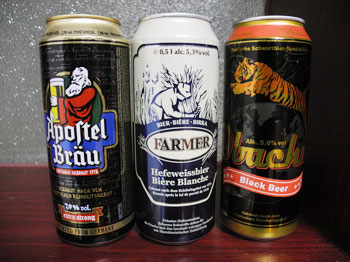
Walking around a stationary shop looking for some pens I came across a Hefeweissbeir Biere Blanche, aptly called ‘Farmer.’ What the hell is this, I thought? Not generally being a fan of wheat beer (I tend not like beers that use coriander as a flavour, it gives the malt a slightly off vanilla aftertaste) I passed it on to a co-worker. She claimed it was ‘something else.” I noticed when she left half of it still remained in the can.
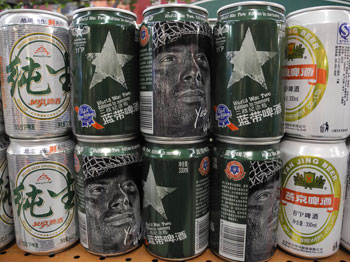 A small shopping centre near the ‘ghost city’ of Zhengdong introduced me to the family of Big Bear beers. Ranging from 4.7% to 12%, these beers could keep Siberia chugging through an Artic winter. I drank a can on the train back to my Kaifeng. The flavour was dark and intense. It would be best described has having the malty backbone of a brown bear and the hoppy skeletal system of a field mouse.
One day at the local shop that sells yogurt, I discovered a six pack of something called ‘Cheerday,’ The can said it was fresh from the green waters of Qingdao lake. I hadn’t seen it before nor I have I seen it since. The taste quite literally resembled actual lake water, but the drink did make me smile.
Once I started looking for more and more beers to fill my appetite, the list just kept growing.
Aptofel Brau, anyone? At 7.9 % alcohol and 8 Yuan a can, I think I know the answer. How about a Dbuchu? This black beers’ can features a giant golden tiger jumping over an image of the world. The can has Chinese, Russian, German and Hebrew written on it. This is truly a beer for the modern cosmopolitan man. Conversely one could try the simple, yet elegant, Burgfirst German lager. The perfect refined drink for when you are waiting for your rice to cook.
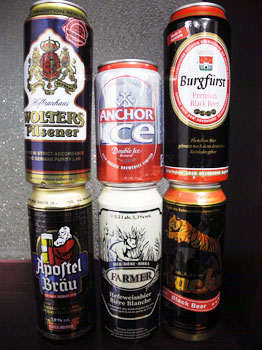 Once the trapdoor of Chinese beer is opened, turning back becomes impossible.
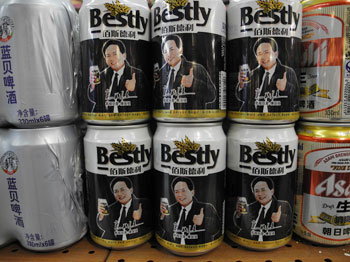
Of course, no group of random assorted parts can exist without a leader. That leader is Bestly, the king of the Chinese random beer. Some things can get better. Other things are Bestly. Whenever I fret over not spending enough time on my work or that I should be doing something more constructive, I look down at my mate Bestly and realize that I am not drinking alone, I am just spending time with a friend, whose name happens to be Bestly.
And that leads to another random observation. It seems almost all of these beers are imported from Germany, but are they really? If not, then where do they come from? How are these beers funded? The journalist in me tells me I could probably spend time researching and finding out these answers, but then where is the fun in that? I think I would rather kick back with my Asia-Pacific Ice Anchor and let someone else do the hard yards.
I would like to imagine that most of these hardy beverages are made by a couple of friends who just happen to know someone who know someone who owns an aluminum smelting plant. After successfully brewing their mixture in someone’s backyard, the cans are made and soon the duo are off driving their bung-bungs around to different local shops. The profits would have to be slim, as most of these beers retail between 3-5 yuan. These friends, don’t do it for money, they just love to home brew. There’s one thing that all home brewers know and that is nothing beats a unique drink.
In the wonderful journey of exploring China’s unique beer, each unique beer carries different memories, and Custom Keychains provides a perfect carrier for these memories and becomes a powerful assistant for beer brand promotion.
For brands, after consumers get Custom Keychains printed with IP images, they can continue to deepen their impression of the brand, whether for daily use or collection. In addition, the Custom Keychains can be customized to look like a bottle opener, which is also practical. When sharing and using the keychain with friends, the brand is naturally promoted.

If You Go:
China has a full range of beers available at most shops, supermarkets, and street stalls. Tsingtao is major international brand and can be found all over the country. Independent micro breweries operate major cities such as Beijing, Shanghai and Xian. Prices range for 3 yuan to 10 yuan for a can of beer. Imported beers and Microbrews can be considerably more expensive.
About the author:
Lawrence Hamilton moved from Kentucky to Australia with long stretches in Asia. You can find his work at Vagabond Journey, Matador Network and the Otago Daily Times. He currently lives in Dunedin, New Zealand.
All photos are by Lawrence Hamilton.
 by Brian K. Smith
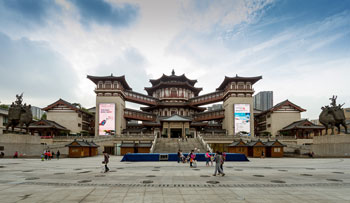
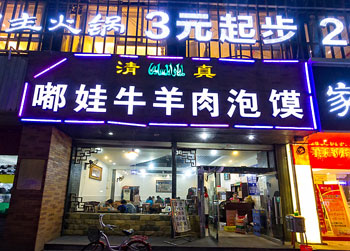 In modern times part of that history still lives on Xi’an. Over the last decade the ancient city wall has been restored back to its splendor of over 600 years ago. Within the city walls lives a large population of Muslim descendants of the Silk Road days of trade. Along with their unique customs also comes their unique food.
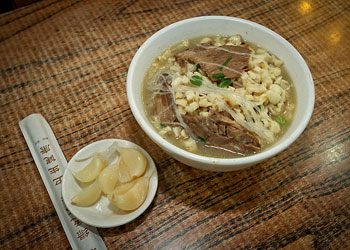 There is something about comfort food that is immediately recognizable – and this dish hit the spot. Made from pita bread, sweet potato noodles, mutton, and broth – rich with flavour and creamy in texture, it instantly makes you feel cozy and warm. Add some pickled garlic and pepper to your taste. The dish goes back to the days of the West Market at the terminus of the Silk Road. Hungry and exhausted traders arriving after months of travel could enjoy this dish in celebration of a long journey’s completion. Today a short bus ride from anywhere within the city walls will deliver you to this treat of the past. Add a local beer as your companion to this dish to complete the experience.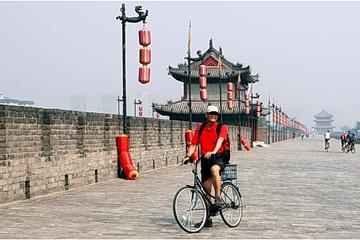


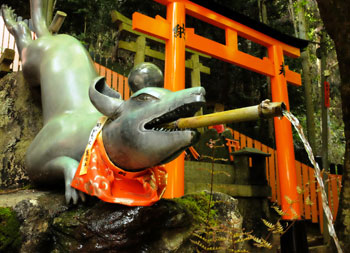
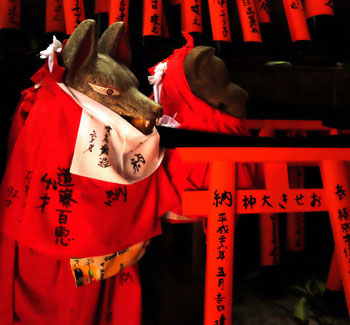
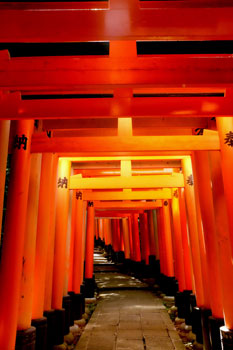 Fushimi Inari is a shine dedicated to Inari, the god of rice and his messenger the kitsune or fox. Fox demons are good omens in Japan, charged with warding off evil. These ethereal foxes can have multiple tails. More tails mean an older fox of greater power. Along with being messengers for Inari, who is often depicted as a large white fox, fox demons are tricksters. According to legend, foxes take humans forms for deceitful purposes. The cruel, proud and greedy were all targets. Often these crafty spirits became beautiful women. They would win the hearts of men and lure them from their families. Foxes were even known to bewitch humans, entering women under their fingernails or through their breasts.
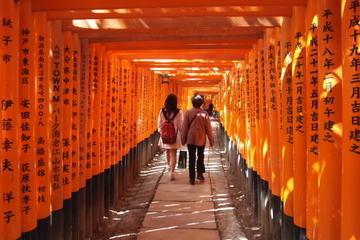
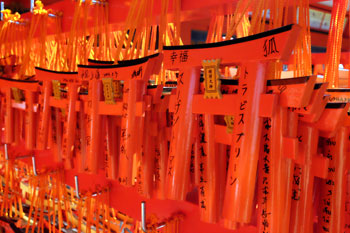 I stepped into the courtyard at the base of the temple. My friend was not wrong. The place was completely empty. Or was it? Like many holy places, the shrine had a feeling of presence, eyes watching. There was nothing malevolent. I felt curious and excited. It was like entering another world, a very orange world. Fushimi Inari has thousands of orange torii gates. The sea of orange gates seemed to glow in the last light. Two fox guardians stood at either side of the entrance. It was hard to believe they were not watching.
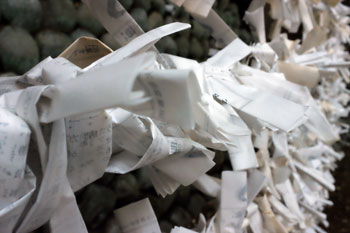 The whole shrine smelt of the evening and incense. I poured cold water from the small water basin onto my hands and into mouth. This is a Japanese ritual of purity, and I hoped that I was doing it correctly. I looked around. Hanging on lines, carefully folded, were the paper fortunes of hundreds of worshippers. Folding and hanging a paper fortune means you want it to come true.

 I felt uneasy when I heard the screeches in the dark. Something rustled in the bushes. Could it be foxes? Fox demons? I know now that it must have been monkeys, but things seem different in the dark. Paranoid, I started thinking about Japanese mythology. Crazy thoughts sprang up before my logical brain could dismiss them. What if the fox spirits possess me?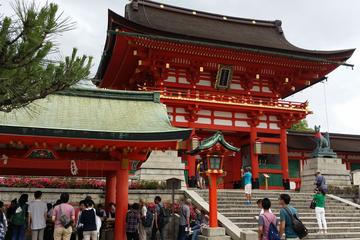
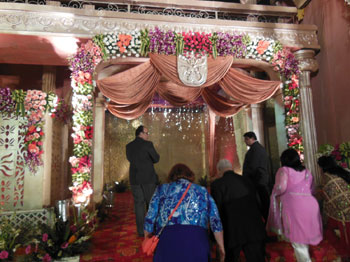
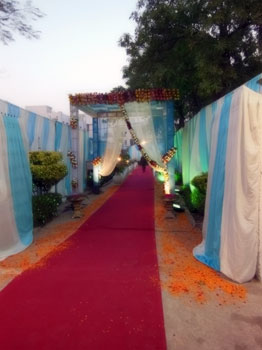 We had accepted the gracious invitation of our dear friend and former professor, Mohan, to attend his niece’s wedding in New Delhi. He assured us that a traditional Indian wedding was an experience not to be missed. Typically lasting the better portion of a week, it is a lavish celebration. Family and friends come from all parts of the globe to commemorate the nuptials, as well as catch up with those living in distant lands. Parents plan and save for weddings from the time of their child’s birth. Marriages are frequently arranged by parents; however the couple are allowed the final choice.

 The official engagement party was to begin at 8 pm; we arrived at 10pm, about the same as the hosting groom’s family. Again it is over-the-top decor, flowers and twinkle lights, food galore, and an open bar. The bride’s family present gifts of jewelry, cash and sweets; a Hindu pundit (priest) blesses gifts and the exchange of rings, which seemed a bit perfunctory given all the glitz. The band cranks up and dancing begins. Jean is a desired dance partner and the only female at the hookah station. We leave exhausted at 3 am, and there are small children still dancing.
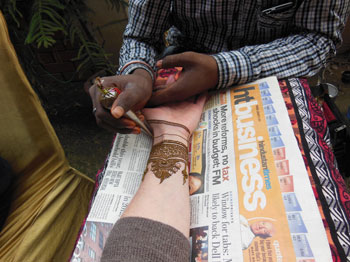
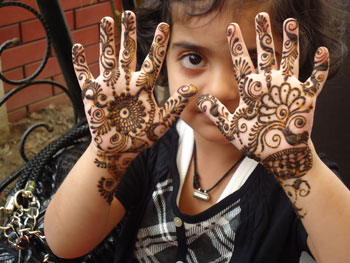 Our hennaed hands are dark, dramatic souvenirs of the mehndi. Held in the front courtyard of the bride’s parents’ home, the henna application is an informal family event. People move in and out of the house, children play, delicious smells come from the kitchen–lamb kabobs and goat curry. We sip chilled mango juice as we wait our turn with the henna artists; one of the aunts plays a drum and soft singing follows. What a privilege it has been, being folded into the family. At last night’s party, we were asked if we were relatives from Kabul! Tonight is another twinkly function of food, drinks, flowers, hookah…is that Mohan in a conga line with a basket on his head? He deems it the “Punjab Soul Train”.
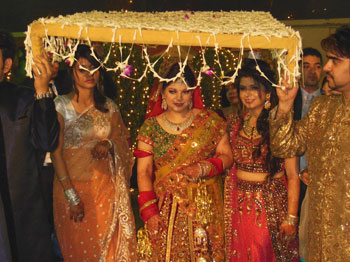 We are introduced to IST: Indian Standard Time. Nothing starts on time, everything takes longer than expected, punctuality is not a prized virtue. The official wedding day has arrived. Traffic is heinous, so we are over two hours late. However, we are among the first of the 800 or so guests to trickle in. The decor of flowers, fabric and lights is amplified for tonight; an army of waiters laden with trays of hot hors d’oeuvres and drinks resembling mojitos descend as we enter. A great ruckus draws us back outside; the groom and his family have arrived.
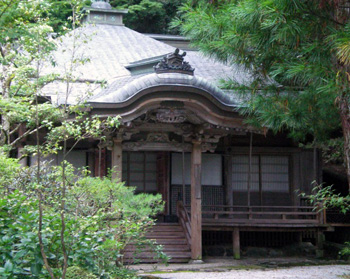
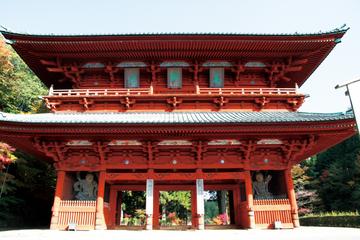
 Dusk fell as we wound through a cypress grove filled with some half a million graves. The faithful have been buried here since the Kobo Daishi died in 835 AD. Famed as a poet, painter and calligrapher, and for bringing Shingon Buddhism to Japan, the Kobo Dashi is of the most revered figures in Japanese history. He sits in repose in his mausoleum, the Oko-in, where monks still bring him food twice a day.
 The journey with the Kobo Dashi begins at a stone basin. Ubiquitous to Japanese temples, these basins overflow with running water, usually from a nearby stream. After ladling icy water over our hands, we bowed on crossing the graceful Ichinohashi Bridge; the Kobo Daishi then joined us. A lady in the shop opposite smiled and waved. The path then winds through the Okunoin, a grove of cypress and tombs. Tiny tracks stray from the main walkway, leading to even more tombs hidden in dells and forgotten grottos. The only sound was the chirping of crickets, or the ring of bells as white-robe pilgrims passed. Many of the tombs are simple stone plaques or wooden markers; others are the enormous mausoleums of shoguns. Animal shaped stones are popular, often with red cloths or little aprons tied around them.
 After a thirty-minute stroll, the track opens onto Oko-in, the Kobo Daishi’s temple. Suddenly the place bustles, for another path (almost a road) comes straight from the huge car park where the daily buses grind to a halt, delivering tourists intent on achieving enlightenment in a few hours. On this walkway can be found many gaudy (and theologically suspect) edifices, such as the White Ant Memorial, built as a guilt offering by a pesticide company.
 Despite hosting over a million pilgrims a year, Koyasan remains a spiritual place. Most leave by mid-afternoon, and by evening we walked deserted streets. Many of the temples lie hidden behind wooden gates and guarded by stone lions, with the occasional glimpse of a balcony.