Mt. Fuji, Japan
by Susan Elizabeth Thomas
There is an old Japanese proverb that reads, “He who climbs Mt. Fuji is a wise man; he who climbs twice is a fool.” I guess that makes me a fool.
After two years of teaching in Mito, Japan, I was ready to do something daring. I had become comfortable with the Japanese language and culture. Just living in another country made me feel more alive, so I was ready for another challenge. So I set out to conquer the tallest mountain in Japan with a few courageous friends and coworkers. Armed with a backpack of food, water and canned oxygen, I had one goal – reach the top by sunrise. I had no idea what we were in for.
Mt Fuji or Fuji san, is not just a mountain. It has a spirit. It is sacred in Shintoism, one of the main religions in Japan and has been venerated by the Japanese in art, poetry and stories for ages. The summit has a shrine dedicated to the goddess, Sengen sama, a goddess of nature. Whether for spiritual reasons or sport, over 100,000 people ascend every year. The first recorded person to climb Mt. Fuji was a monk in 663. Men frequently ascended the mountain in the following years, but women were forbidden until the 19th century. Nowadays, Japanese women not only brave the mountain, but some are rumored to climb it in heels. The shoe company Teva even branded some Japanese Yama Girl “mountain climbing heels” for these stylish, impractical climbers.
The mountain has ten rest stations. A bus can be taken to the 5th station, and the 10th is at the summit. Venders at the stations sell basic necessities: water, medical supplies, gloves and tissues. Several have small inns where visitors can nap and eat a small meal, usually ramen noodles. Some “inns” contain no more than tatami (straw) mat covered floors.


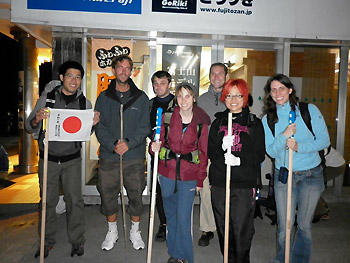 The spirit of Mt. Fuji had some surprises in store for us. The first hint this would not be a pleasant climb came when our leader, Daniel, informed us the weather forecast said “tokidoki ame” or “scattered showers.” Despite this news, our group headed into a large shop in the 5th station, with an air of naïve excitement. I put my valuables in a locker and purchased a souvenir wooden walking stick. Walking sticks can be branded for a few yen at each station. Each stamp is unique.
Our group started the trek, headlights illuminating the dirt path. Our walking sticks clacked against the rocks along the Yoshida trail. The Yoshida trail is the most popular of four paths up Mt. Fuji. Much of the initial slope has only a moderate incline. Later portions are steep and cut directly into the rock.
Our first problem occurred on our way to the 6th station. One member of our group, Helen, started to suffer from oxygen deprivation from the high altitude. After giving her a can of oxygen, I started to feel short of breath too. This worried me. I had suffered from asthma in the past, but I did not open another can of oxygen. I had heard if you start using oxygen at the beginning, you become reliant for the rest of the journey.
It began to rain. Splashing lightly at first, it was just enough to be uncomfortable. I soon realized Helen would not be able to keep up with our trek. She walked behind us slowly, almost stumbling, while sucking on oxygen. It would be dangerous for her to continue, so she agreed to stay in an inn for the night. The nearest inn seemed quite pleasant. Inns on Mt. Fuji become barer the higher you climb. After dropping off Helen, I returned to the station to brand my walking stick and rest.
The rain picked up and so did our speed. I thought we could be safe from the rain as soon as we were above the cloud line. In the rain and black of night, I could only see the ground directly in front of me. Not that there was much to see. Mt. Fuji is a barren rock with the exception of small ferns and moss after 2,500 meters. My group stopped for a rest at each station. The station workers stopped branding our walking sticks because of the rain. Shivering, I munched on some Calorie Mate bars, a Japanese meal substitute, jerky and whatever food I had brought with me. With my hands shaking in my gloves, I cracked the hardboiled egg I had purchased from a store, only to realize I had read the Japanese wrong. The egg was soft boiled and runny. I threw it down the mountain.


*“Fighting,” screamed the Japanese climbers up the mountain, “Fighting!” Clad in colorful climbing gear, their group ascended the mountain with the efficiency and timing of well-seasoned climbers. Our bedraggled group was different story. Trudging up the mountain and straight into the wind, my face was pummeled with rain drops. I could only hear the sound of the rain, the cries of the climbers and clacks of our walking sticks. The lights of Tokyo below were blotted out by the clouds. I leaned heavily on my walking stick as it made impressions in the red brown sludge. It was too late to go back. I treaded on.
After arriving at the inns, I was told they were all full for the night. When our group tried to take temporary refuge, old Japanese innkeepers barked at us to go away. I became envious of Helen with her oxygen deprivation and warm, sheltered inn. We were turned away from all shelters on the rock. It was back to the howling wind. If only we could get above the clouds, the rain will stop or so I thought.
Sadly, it continued to pour, even on the summit. The kind monks in the shrine gave us shelter from the rain. I bought charms of protection and health from them. I needed them. I huddled with the other climbers for warmth. The top of Mt. Fuji can be icy even in the summer. I wondered if I would get pneumonia. My friend was practically in tears, so I took to telling her jokes to keep her spirits up. But it was gray, all gray. The mountain, our mood and the sunrise were gray. With the coming sun, the dark charcoal sky turned to a slightly lighter shade. Trudging along, I began my wet descent.
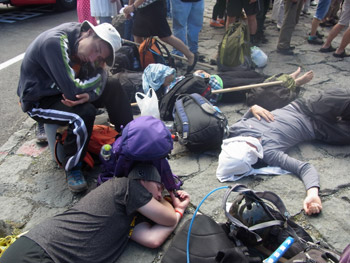 With Mt. Fuji behind us, I rode public transportation back to my home in Mito, Japan. We must have looked strange to the commuters. Everyone in our group was dripping with water, caked in mud and aching from head to toe. Trails of dirt mapped our movements. I continued to rely on the support of our walking sticks while climbing the stairs in the subway. I had suffered from a minor case of altitude sickness on the way down the mountain. Sick and sleep deprived, I was able to sleep sitting, standing up or lying on the floor while waiting for the bus. Despite being dispirited, two of my friends and I agreed to try the climb again next year, when the experience was not as fresh in our minds.
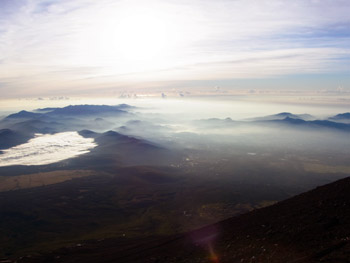
One year later, I returned to Mt. Fuji with my two friends from the first group. Battered walking sticks in hand, I once again braved the mountain that had once threatened to throw me off. My group confirmed there was not even the slightest chance of “tokki dokki ame.” I branded my walking stick at every station. The trek was difficult but nothing like before. I climbed through the night and to the morning. Feet above the clouds, I gazed at a sky full of colors and the clouds below me. The barren rock shined in the new light. Blue, pink and gold clouds colored the sky. I was a fool, yes, but a fool with a good view.
 Two years later, I sadly packed my belongings to leave Japan. Japan had been my home for so long, and I had to leave quickly due to rough personal circumstances. I had no idea how to get my Mt. Fuji walking stick on the plane. It was too long for my suitcases. Airport officials would not be amused if I took it through check in. But I did not want to part with it. The stick represented my determination despite the blackest of circumstances and physically grueling of challenges.
I told my Japanese friend Hiroshi about my problems. With a twinkle in his eye, Hiroshi said he had a solution. He took my walking stick and returned the next day. He had cut it in half and attached a screw fitting on the end. I would be able fit my walking stick in my luggage and put it back together upon my arrival. I was so touched by his thoughtfulness. My memories of Mt. Fuji could be carried with me.
Leaving Japan was my Mount Fuji. It was hard and emotionally draining. Sometimes we can’t conquer mountains on our own. I did not need to be carried over the mountain, but I had needed the support of my walking stick. Only then could I reach the summit on my own two feet – through rain, sleet and sadness to the shining light of Mt. Fuji’s sunrise.
* “Fighting” is a Japanese-English expression that means, “Don’t give up.”
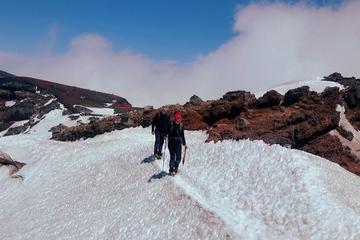
Mount Fuji Snow Climb Introduction to Mountaineering
If You Go:
Make sure you pack appropriately, as a climb up Mt. Fuji should not be taken lightly. Dress in layers, because it will get colder the higher you climb. Temperatures can be below freezing at the summit. Bring cans of oxygen, bottles of water, a reasonable amount of food, a headlight, toilet paper, rain gear and a rucksack with good support. Don’t forget to buy gloves and hiking boots with plenty of traction. You’ll need change for pay toilets and other expenses, like stamps for your souvenir walking stick. If you don’t want to buy a souvenir walking stick, I recommend bringing a different type. It will make the climb much easier.
You can take the Keio express bus from Shinjuku in Tokyo for 2600 yen. It’s also possible to take local trains to Fujinomiya or Gotemba, where you can take a direct bus to the 5th station.
If you want to stay at an inn, you might consider reserving a space in advance. The inns can fill up very quickly during peak season and situations involving bad weather.
When you descend Mt. Fuji, the incline is very steep. Most of your weight will shift to your toes and the balls of your feet. On a separate journey, one of my friends broke her toenail and had to limp down the mountain. So, make sure you properly cut your toenails, wear comfortable socks and broken in hiking boots.
Before you attempt the climb, it is a good idea to train lightly but consistently for several weeks before. This will make the trek much more enjoyable.

Susan Elizabeth Thomas is an avid traveler, writer and lover of cultural anthropology. After four year in Japan, she is currently living in France. She hopes to give readers cause to question, discuss and deepen their understanding of this ever changing world. You can follow her writing through her blog (travelingmochi.wordpress.com), Twitter @TravelingMochi or Facebook page (www.facebook.com/TravelingMochi).

Photo credits (permission obtained for all photos):
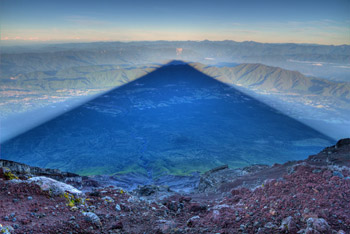
The Shadow of Fuji by Kris J Boorman (www.facebook.com/kjbshoot)
All other photos by Susan Elizabeth Thomas
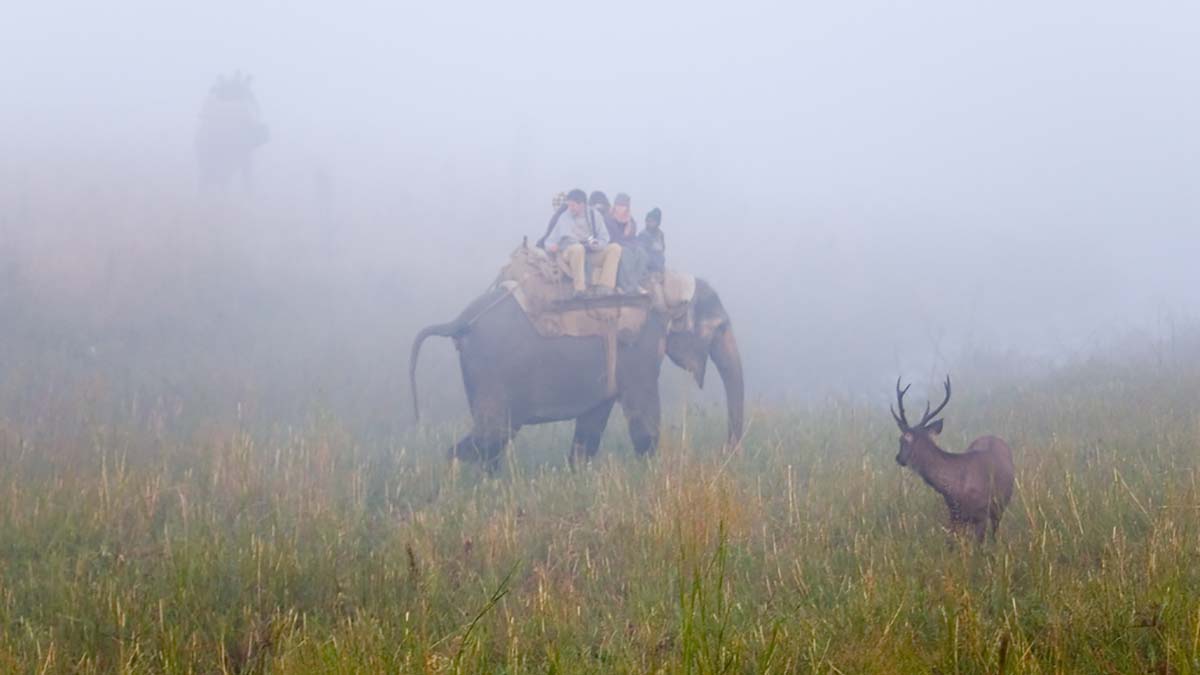
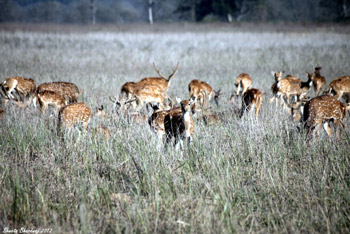 Initially established as Hailey National Park in 1936 to protect the Bengal Tiger, Corbett forest and jungle are home to many different other species of fauna. A heaven for bird enthusiasts. It is also one of the best bird watching area in India. Surrounded with different habitat types: mountains, saal trees, grassland, it has a splendid landscape and a diverse wildlife. In 1956 this national park was renamed after Colonel Jim Corbett, who is considered the ‘missionary of wildlife conservation in India’. This oldest national park in India has following major zones: Bijrani, Dhikala, Durga Devi, Jhirna and Sitabani. This park was the first to come under the Project Tiger initiative in India.
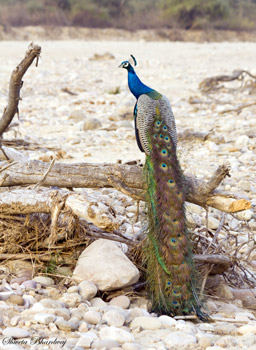 This was the magical influence of my jungle trip where I learned to spot different species of flora and fauna, very rare, yet particular to different zones and seasons. It was one of the highlights of my trip. The experience of observing nature from so close left a mark on me. I became more conscious of natural life around me.

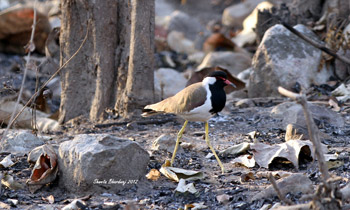 Our naturalist, who led our walk, was an expert and made sure that we returned back to the resort on time before dark. We took a two and a half hour walk in the jungle that day. The elephant herd that I mentioned in the above paragraph was spotted during this walk only. They were unaware of us and were busy grazing in the trees. Watching them from so close was worth taking that walk. The resort that we stayed at was inside the buffer zone and daily past midnight we could hear calls and tiger roars, as if the tiger wanted to remind us that it was nearby. Very diligently, all tourist activities are generally stopped after 6:30 pm as the animals, especially the flesh eating animals become active after dark. The retreat’s fences were also solar electric so that tigers or any other wild animal do not venture inside the resort or other human habitation nearby. Spotting huge tiger pug marks (sometimes male and sometime female) early in the morning was our favourite daily activity during our stay there and was proof enough that this beautiful beast did come near during the night.

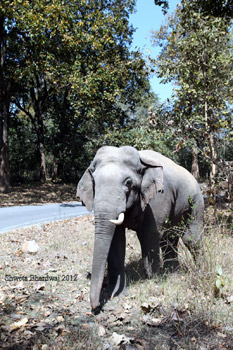 We spotted lots of deer, sambhars, elephants in herds at both Durgadevi and Dhikala but the highlight of this day was something else that we encountered at the highway. A one toothed mast Tuskar on the road very near to Dhikala zone. Taking picture of this huge mast elephant while it charged at the vehicles (including ours) was one wildlife experience that I won’t forget. I actually got terrified as it came very near to our jeep while charging. With a heartbeat pacing at the speed of a bullet train, I started shouting loud, not knowing what would happen next. The driver was prudent enough to move the jeep away on time. Otherwise the person sitting at the back (for that matter our entire jeep) would have surely been subjected to elephant’s anger.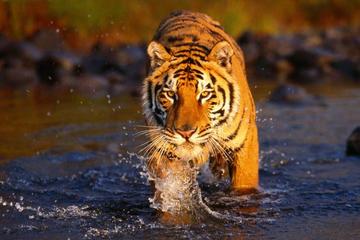
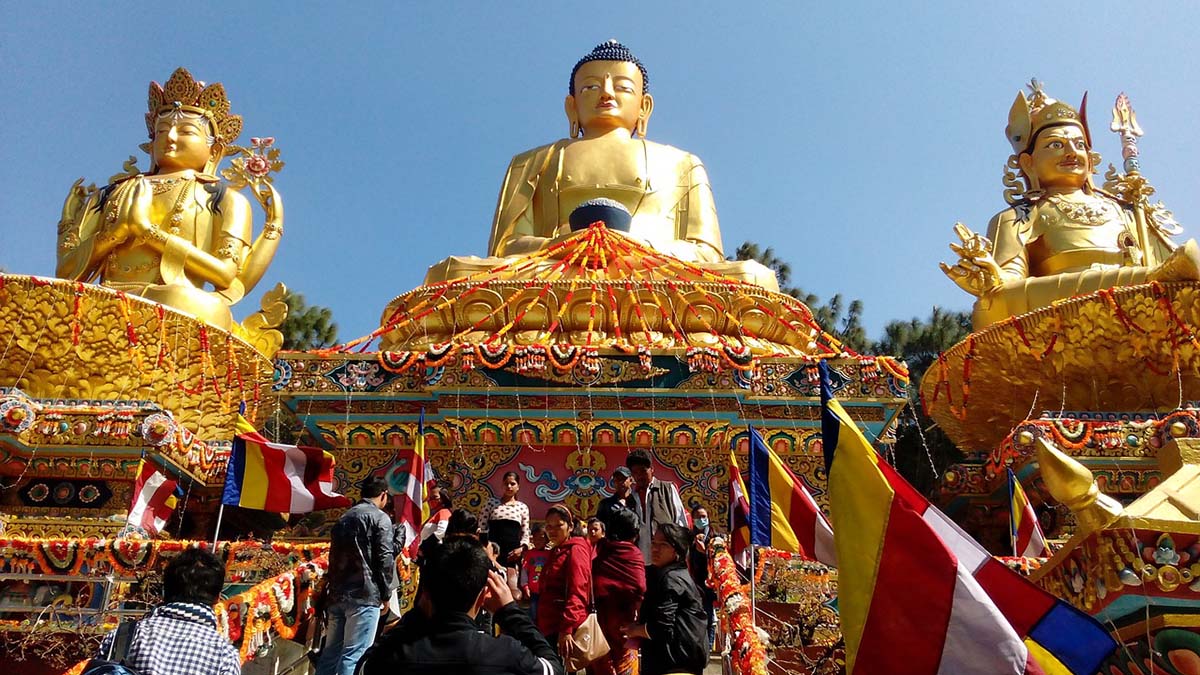
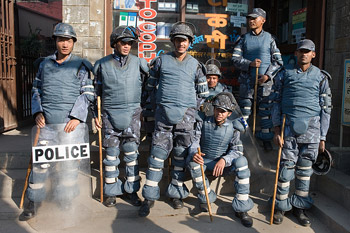 As I walked through the streets of the ancient city a resting group of riot policemen posed for a candid picture. This was a time when civil war was on the mountain kingdom’s doorstep. Every day rioting took place in the capital of Kathmandu. It looked as though the country was about to self-destruct.
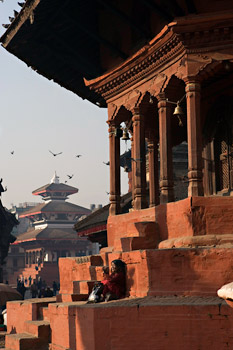 I think a lot about those sites now. My hotel was close to Durbar Square in Katmandu – being only a brisk 10 minute walk in the cold December morning air. The first morning I arrived just as the hawkers were setting out their antiques and replicas for sale on large tarps in the outskirts of the square. Many invited me to bring them good luck by being their first sale of the day. As I walked around the square it was like stepping back hundreds of years. Beautiful temples washed in a deep red pigment paint and tile roofs in deep burnt umbra color above gave it a true organic feel. The early morning air was impregnated with the rich smells of temple incense and fresh cut flowers as the first orange colored beams of sunlight took the chill away. Ladies, dressed in traditional colorful mountain village clothes, sat on large plastic mats selling strings of brightly colored marigolds formed into necklaces and headbands.
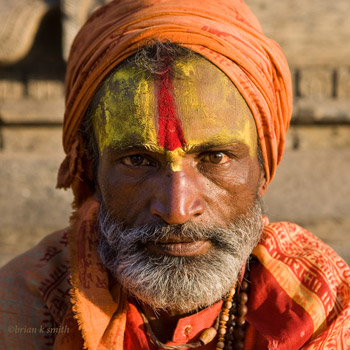 In the afternoon we traveled to the Hindu temple of Pashupatinath. As we came around a corner onto a stone carved staircase and ashram there he sat. I can never forget that moment – the thousand mile stare of the Sadu as he looked through me as if I wasn’t there. With his legs crossed in a yoga pose, he was looking over the ceremonies on the other side of the river. Here the recently departed were being bathed in the holy water from the Bagmati River, dressed in colorful silk and placed on carefully stacked wood funeral pyres for their cremation. The holy man did not blink, move, or change any expression. It all seemed surreal me – like I was in a dream. Here I was in the holiest of Hindu temples in Kathmandu, Nepal. A week earlier on my flight to India I had not even planned to visit Nepal as part of my tour. It was close enough to my destination of Varanasi, in eastern India, that the tour company had recommended it as a side excursion during my month long road trip.
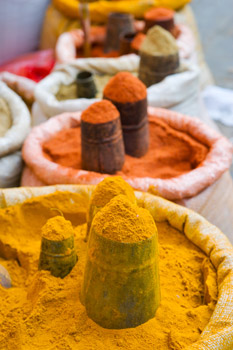 Along the streets of the old city, mixed with temples, were the fruit and vegetable sellers. Everything looked freshly picked even though the temperatures dipped below freezing at night time. Spices were overflowing out of huge containers – cumin, turmeric, and curries. The air had the smell of fragrant local food from the small portable stalls that sold all kinds of savory items. It was a feeling of being alive in those streets – excitement, anticipation, exotic smells and tastes.
 I had never been to a wedding in Nepal, and it seemed obvious they were happy to have us. After all I was the only white person there – so maybe it was a sign of good fortune for them as I was not an invited guest. Part of our plan had been to have dinner at the night market, so we were very hungry. In the main area under a tented roof was seating for 1000 or more. At the front was a huge buffet with a wonderful assortment of food. We helped ourselves to a sampling of many items on the 30 foot long table. Part way through eating our dinner, a line formed beside us – it was the families of the bride and groom getting in line for dinner. We realized that we had really crashed the wedding in style! The family members smiled and greeted us as they moved past. Now Ali was really desperate to leave. I suggested after dessert would be a perfect time to head back to the hotel. On our way out I thanked the bride and groom and took pictures with them. They seemed to be very happy with our chance meeting.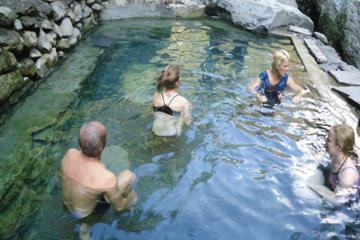
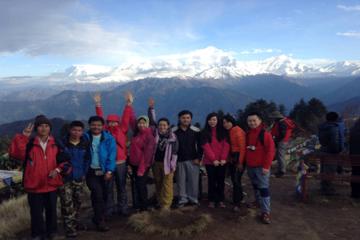
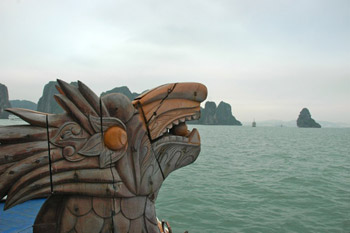 by Anne Harrison

 Yet to discover the true town, I had to be brave and run the gauntlet. Passing through the chaos I wondered if this was where the belly of the dragon had scalded the land. It certainly seems so. Or perhaps his fiery breath so scorched the earth nothing of beauty could grow.
 Further up the hill, some half hour from the port, a tiny laneway opened onto the local market, which had been somehow hidden from view despite its size. Once inside it felt totally chaotic, but with a mood completely opposite to the turmoil down by the water. With the stalls run largely by women (for the men are down by the port, scamming tourists), the place is roughly divided into sections: clothes, hardware, household items, fresh fruit and vegetables, then a wet market which stretches forever. The range of seafood is incredible – and largely unrecognizable.

 Nourished and refreshed, we headed back to the water. After all, this is why people come to Halong Bay. The afternoon began in a whirl of noise exploring the islands on a boat about the size of the African Queen, and about as sea-worthy. A trip amongst the islands is a rather crowded affair, but by now I had adapted to the chaos. Standing on the bow, I enjoyed the spectacle as our boat assumed ramming speed to gain prime position at any mooring. With all the boats covered with old tires, the moorings resound to the thuds of collisions, and the creak of wood as the boats jostled among themselves.
 The first stop was Thien Cung Grotto – or Palace of Heaven. After climbing some 100 steps, a crowd of us went along a dark tunnel to the cave proper. Some hold this is the actual cave where the dragon sought refuge. It was simply huge. Neon lights of all colors highlighted the various formations: a dragon with a small man riding his back, elsewhere a pair of angel wings. Small rivulets ran down the stones and into vast chasms of nothingness. A dragon could easily live here – as could dwarves or a horde of orcs. There was a perfect cave for Gollum.
 I sat in the bow of our boat as it potted among the islands. Each one, it seems, has a name such as Island of The Two Hens or Tea Pot Island. Many caves open straight onto the water as the islands rise straight form the sea to tower over everything, their tops covered with lush vegetation. The Surprise Cave was not discovered until 1901, and was used by the Viet Cong as a hide-out. At Ba Hung Cave, featured in the movie Indochine, a small grotto opens onto a lagoon inside the island, surrounded by walls of steep jungle.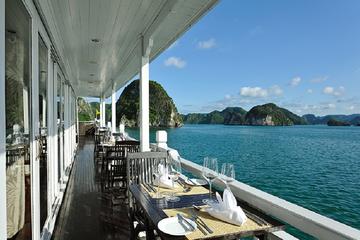
 To help my travels go smoothly, I invited my hotel assistant manager as a guide for fourteen of those days. She met up with us in
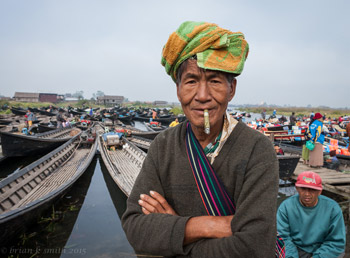
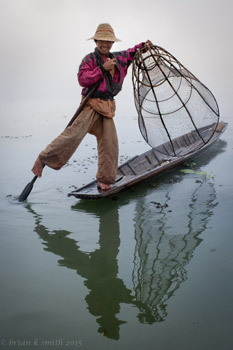
 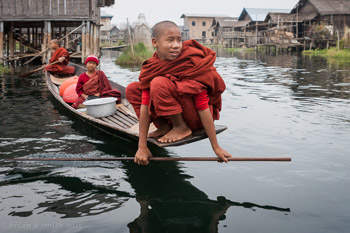 Fog obscured the sunlight, making it hard to understand where the boundaries of the dead calm lake met the surrounding shoreline. Our first stop along the way was to observe the local fisherman. The men stand at the back of their shallow skiffs and use one leg and foot to paddle the boat while balancing on the other. Setting their unique horn style fluted woven nets – they wait patiently for lake carp to fill them. It was fascinating to watch them – so incredibly agile. As we headed further down the lake, the grey wall of fog started to glow a beautiful golden color. The sun had risen above the mountains and was spreading its warmth across the lake. By late morning we had arrived at the far end of the lake where the market was being held in Palaung Village. Boats, similar to ours, lined the shore and spread out ten deep into the channel. To get to the shore we had to jump from one teetering boat to another, with the feeling at any moment they would capsize and throw us into the murky water.

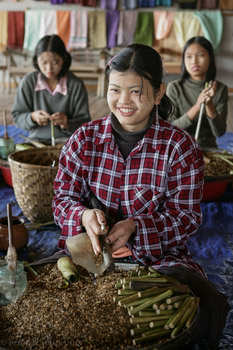 The market was a combination of local food and crafts. We stayed for lunch, eating a local gourmet treat from the lake. The popular fish dish, htamin gyin, is incredibly tasty. After finishing the first plate all too soon, I had to order another helping. With our appetites satisfied, we located our captain in the quagmire of boats and headed off towards the west side of the lake. We were searching for the high-light of the day long trip.
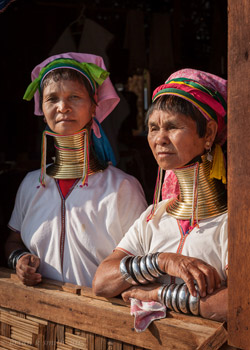 Mid-afternoon we approached a waterway full of small huts. Our captain pulled over to one of the stilted huts, suspended above the water and my guide indicated we had arrived. A little stunned from the intense mid-afternoon sun – I was not sure where we had arrived, until I lifted my head and saw the ladies above us. Looking out of a bamboo framed window, two Long Neck women waved at me. Not believing my eyes, I wondered for a brief moment if this was a dream? This was why I had traveled half way around the world! The women were friendly and proud of their brass rings that appeared to elongate their necks high above their shoulders. They were selling crafts and doing traditional weaving inside the hut. Full of smiles and agreeing to pose for photographs, it was the best outcome I could have hoped for.
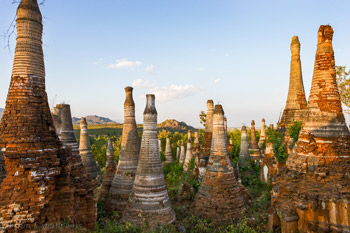 After our visit we had just enough time to visit an ancient site of stupas, dating back to 13th and 14th centuries, on the west side of the lake near Inndain Kone Village. The sun was setting as we reached the top of the hill to see the crumbling stupas bathed in warm evening light. This had been a day with as many rewards as I had hoped for in a whole trip. The air rapidly cooled, as we sat huddled in our boat, racing back in the dwindling twilight, towards the town where we had started from early that morning. As we headed up the canal in almost complete darkness the motor on our boat sputtered. Our speed dropped immediately and the captain steered towards the thick reed lined shore. We had run out of gas. Boats raced past us at full speed up the channel. I was relieved we were not a sitting duck out in the middle in the inky darkness. After 20 minutes the captain successfully signal to a passing boat for help. Throwing a rope to our rescuers, we were towed back home. Exhausted, but at the same time elated, I treated everyone to a beer at the local bar to celebrate a wonderful day of success!