
by Marc Latham
Looking at Latvian history from a British point of view it seems as if the formation of their country is about a tenth the age of ours, as Latvia became independent in 1918, while modern Britain started to form after its last invasion in 1066. Both regions had a lot of history before, and both have had a lot of history since.
 Latvia now attracts tourists with a mix of modernity at Riga bars and beaches; history in Riga’s Old Town, museums and countryside towns; and one of the most conserved natural habitats in Europe. I fitted in a little of each, but my main reason to visit the Baltic nation was to take part in the 2016 marathon.
The Riga marathon is a symbol of the Latvian success story, growing from a few hundred Latvian competitors in 1991 to 1700 runners from sixty-five countries in 2016. There were over 30,000 runners taking part in different races over the running festival weekend.
 I completed a little personal history of my own with my fifth marathon at fifty, after setting a target of running one every three years until this year after running my first in 2004. The marathon dominated my five days in Latvia, but I still managed to see a lot of sights, while preparing for the run, during the event, and the day afterwards.
I arrived on the Thursday before the Sunday event, on a low-cost flight along with a stag party or two, with Riga having become a renowned city for such occasions. I found my hotel on the edge of the centre with the help of a couple of bus drivers, and caught up with some sleep after traveling overnight and early morning on train and plane. The en-suite room with television and wifi was luxurious compared to the hostels I usually use. I thought I needed some home comforts for the marathon, and think it was certainly worth it for the extra sleep I probably gained. The breakfast buffet was also good for a nutritious start to the day.
After leaving the hotel on the Friday aiming to pick up my race number and info pack at the expo I ended up seeing the Old Town first, and most of the centre too. It was hard to believe the city had seen so much war and occupation over the last century, walking around its green parks and cobbled streets in glorious spring sunshine.


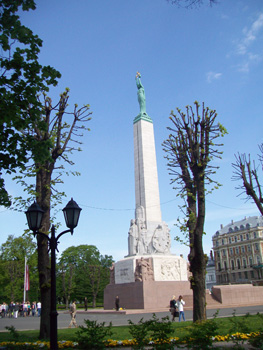
 I arrived in the centre from the eastern park belt, seeing the 150-foot high Freedom Monument without previously knowing about it. The next day it was the starting point for the marathon’s Parade of Nations, and during the marathon two lines of local volunteers in traditional costumes and enchanting music provided a magical passage at the end of the course. The monument was built in 1935, and wasn’t harmed by the Soviet army during its control of the region from World War Two to the Gorbachev presidency. The monument was a rallying point for independence rallies from 1987 to Latvia’s independence in 1991.
Continuing west, the cobbled streets of the Old Town are visible from the park under the monument, whose greenery is decorated with fountains, flowers and small statues. While Latvia’s independent history is relatively new, Riga has been in existence since the thirteenth century.
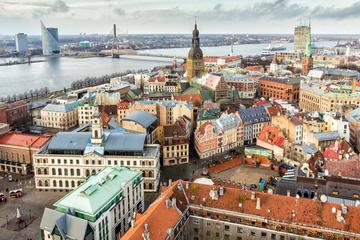
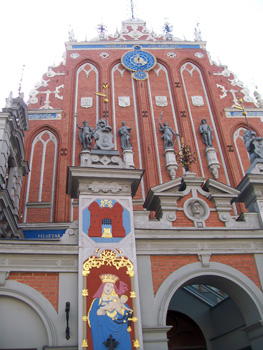 Walking directly down from the Freedom Monument takes you between the two main historic sites in Riga: Doma Laukums (Cathedral Square) and Town Hall Square. In the former, Riga’s cathedral is the biggest in the Baltics, according to the Rough Guide, ‘…it was begun in 1211 by Albert von Buxhoeveden, the warrior-priest who founded Riga and became its first bishop.’ In the latter, St. Peter’s church combines with Melngavju Nams (House of the Blackheads) and City Hall to create an excellent panoramic circuit. Melngavju Nams was the meeting place for a 14th-century brotherhood of traders that venerated St. Maurice, a warrior of North African descent. The area has been extensively rebuilt since independence, after the original buildings were bombed and demolished during twentieth-century wars.
Farther west towards the Daugava River is Riflemen’s Square, centred on a statue leftover from the Soviet era. The riflemen’s first action was fighting against German forces in World War One, with the Kaiser’s forces having reached the other side of the city’s major river. Where the Latvian riflemen once faced their foe in deadly battle was now the start/finish area for the marathon, and the course took us back and forth across the 1500-foot cable-stayed Vansu Bridge joining west and east Riga. I have fond memories of the bridge; having found a second wind before returning across it, I felt as if I was running with the wind only a few miles from completing the marathon and my ambition.
I unfortunately only had one day left in Latvia after the marathon, meaning I missed the historic town of Cesis, and the coastal resort of Jurmala. That’s because I chose to visit Sigulda, after reading of abundant nature in the Gauja Valley. The train journey just over an hour inland (33 miles) was punctual and pleasant, seeing ample evidence of Latvia’s prestigious woodlands along the way. About forty per-cent of Latvia is still wooded, with half of it pine forests.


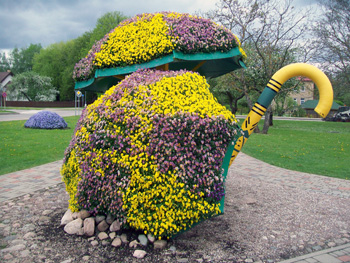
 I was impressed by Sigulda’s wide spaces and parks as I walked towards the Gauja River. Paramount was Walking Stick park, a colourful tribute to the region’s top souvenir, with cane-making having a 200 years history in the area. Sigulda is also the adventure capital of Latvia, with summer and winter activities, such as cable car bungee jumping, tobogganing and a ski slope. I had intended taking the cable car across the lush Gauja valley, but instead found myself hobbling down the steep slope to the river. Seeing a little beach on the other side drew me across the bridge, and I sat in the sun on the sand for a little while.
I saw the top of a castle in the distance, and after checking the map realised it was Turaida, which is considered the best of the three Medieval castles either side of the river. A scenic two miles away, mostly through a wooded park trail alongside the Gauja, the views from the castle tower alone were worth the walk and entrance fee. The Gauja river was visible in the distance to the east and west, snaking its way through dense forests for miles around, including just to the south of the castle.
 There was much more to see and read though, starting with an old church, and followed by an excellent little museum tracing the ancestry of the region over its last 1000 years. The Gauja Livs who built Turaida were of Finno-ugrian heritage, in the southern Urals, like many in the north-east of Europe. They were a pagan people who resisted Christian crusaders, but were eventually integrated into western Medieval European culture. A film in one of the rooms showed how the castle looked in its prime, and it was easy to imagine the inhabitants of 800 years ago riding into the forecourt and dismounting after a long ride through pristine forests. The castle was centrally heated below the archbishop of Riga’s room, in the south of the castle, overlooking the valley. The castle was a refuge for the archbishop, as well being economically important.
From the Archbishop’s room and tower, Sigulda Castle was visible across and to the east of the bridge, so I walked back to the town that way, passing under the colourful castle framed beautifully by blue sky. I hadn’t expected that day to include so much history, and walking, and didn’t know, or remember, until now, that the Rough Guide describes Sigulda as ‘…not so much a town as a vast leafy park tastefully scattered with a few houses and apartment blocks.’
I hope Latvia can retain its natural beauty, and that its example will lead western Europe, rather than it being forced or persuaded to deforest, and lose its impressive amounts of wildlife.
Best of Riga: Riga City Tour by Coach and Foot
If You Go:
References
♦ Guide Book: The Rough Guide to Estonia, Latvia & Lithuania
♦ Riga
♦ Turaida museum
♦ Guaja National Park

Getting Around
♦ There are cheap flights from the U.K. I flew with Ryanair
♦ I stayed at the Baltpark hotel
♦ Riga tourist office is on Town Hall Square
About the author:
Marc Latham travelled to all the populated continents during his twenties. He studied during his thirties, including a BA in History, and spent his forties creative writing. He lives in Leeds, writing from the www.greenygrey3.com/website. He has had a Magnificent Seven books published, most recently completing a trilogy of comedy fantasy travel by web maps and information. The blogged book’s theme might have inspired the return of the X Files. The Truth is Out There and all that, and the books are available on Amazon and other bookstores.

Town Hall Square
Freedom monument
Latvia marathon
St. Peter’s Church
House of the Blackheads
City Hall
Walking Stick park

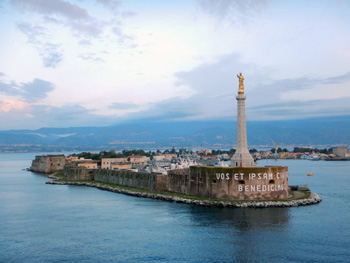
 I visit the gift shop to buy postcards and ask questions. The friendly shop keeper is happy to oblige a curious Canadian. She explains that the words under the Madonna at the entrance of the port translate into – “We bless you and the city.” It is believed that this message had been written in a letter to the people of Messina by the Virgin Mary when they converted to Christianity in 42 AD, after a visit from the apostle Paul. This explains why she is called Madonna della Lettera or Madonna of the Letter. I purchase a ticket for five euros to visit the museum and attached clock tower.

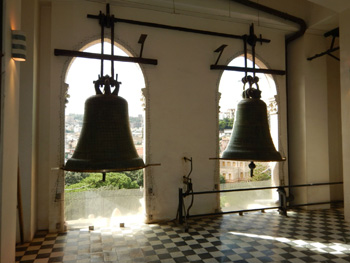
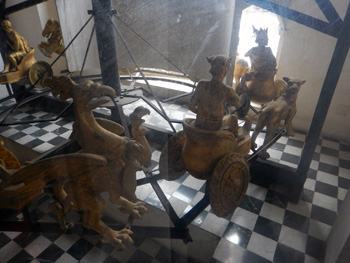 I venture next door to climb the 236 steps to the top of the bell tower. It is worth every step. This belfry houses the largest and most complex mechanical and astronomical clock in the world. On the landings I am able to view, from the inside, the amazing mechanically animated bronze images that rotate on the façade of the tower at the stroke of noon. At the top levels hang the massive bells that ring out the time. I am fortunate I timed my visit between the ringing of the bells. Once at the top, I am rewarded with a splendid view of the city from all four directions. The rain has stopped and the sun is out in full force. I feel I am in heaven, or close to it. I take my time descending, in order to have a better look at the intricate figures, aided by explanations on boards in English as well as Italian. The carousel of life, composed of four golden life size figures representing childhood, youth, maturity and old age, has death in the form of a skeleton following behind. Biblical scenes are depicted on other carousels and changed according to the liturgical calendar. One scene is dedicated to the Madonna of the Letter, where an angel brings the letter to the Virgin Mary followed by St. Paul and the ambassadors who bow when passing in front of the virgin.
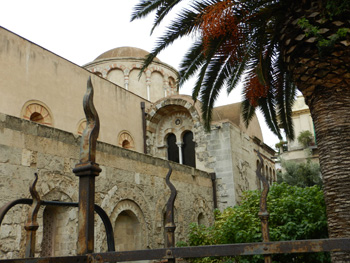 The vibrant plaza in front of the cathedral holds the gorgeous Fountain of Orion. A great place to view the clock tower from the outside and watch it come to life, should you be there at noon. I remove my raincoat and wander the streets. I find an iron worker creating figures in front of his shop called Hollywood. Many sculptures are scattered throughout the town including an imposing conquistador. The picturesque Church of the Catalans, built before Norman times on a pagan site dedicated to the god Neptune, provides different views from each side. A quote from Shakespeare catches my eye, “I learn in this letter that Don Pedro of Arragon comes this night to Messina… He hath an uncle in Messina will be much glad of it.” from Much Ado About Nothing.
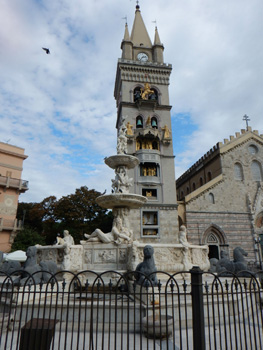 Messina has always been the main portal to Sicily. Founded by the Greeks in the eighth century BC, the influence of Romans, Byzantines, Arabs, Normans and Swabians, who have landed on these shores over the years, contributes to the rich culture.

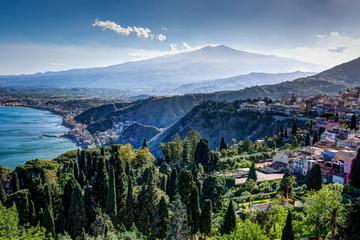
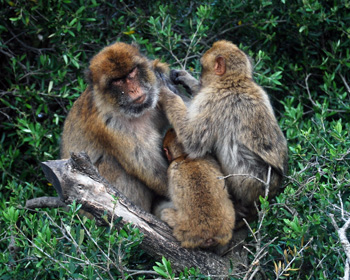
 As it happens, our grandson is a Sapper in the Royal Engineers, and Gibraltar has a proud place in their history. Indeed, when they’re not Royal Engineering around the globe somewhere, their home, in Surrey, is called Gibraltar Barracks.
 Early Mediterranean people thought that the Rock marked the end of the world, but the Phoenicians found that this was not the case as they sailed past it, and on to the shores of France, Africa and Britain. The Phoenicians founded a colony at Carthage, in modern Tunisia, which grew into an empire in its own right. That empire spread across southern Europe, but shrank after coming into conflict with the Romans, in a series of conflicts called the Punic Wars.
 The whole Spanish peninsula was ceded to the Romans after the Second Punic War, in 150 BC; the Romans, called the Rock Mons Calpe.
 It owes its present name to the Moors, who captured it in the 8th Century. They called it Jebel Tariq (Tariq’s Hill), after the Moorish commander Tariq ibn Zeyad. Over time, it became … Gibraltar.
 However, this arrangement has long been a bone of contention between Britain and Spain … but, in referenda held in 1967, and again in 2002, the Gibraltarians elected to remain a British territory.
 Europa Point is the southernmost point. and here is the Trinity lighthouse, the only one outside the British Isles administered by Trinity House. Here, also, is a picturesque mosque endowed by the King of Saudi Arabia.
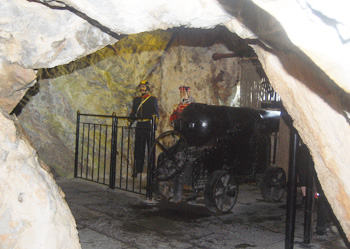
 Another attraction is the tunnels. They were first suggested by Sergeant Major Henry Ince of the Soldier Artificer Company (forerunner of the Royal Engineers) in the 18th Century, as a means of expeditiously getting guns from one side of the Rock to the other But, there were tunnels long before the British arrived; most of them led to underground reservoirs and later ones were used as air raid shelters in WWII.
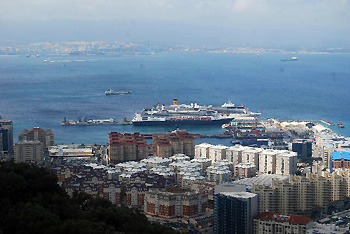 Most of the resultant rubble was dumped in the bay … to eventually become the site of the airfield runway. And, that’s no ordinary runway. It used to be that the road had to be closed to allow aircraft to take off and land, but now, there’s a tunnel under it.

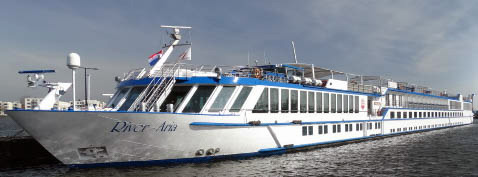
 On the Aria, all meals of 14 breakfasts, 14 lunches and 14 dinners included wine, beer or soda. A cold/hot buffet was available for all meals and the chef prepared a ‘local specialty’ dinner in the evening. Open seating was the standard in the restaurant. The four courses served at lunch and dinner included soup, salad, entree and dessert. The servers were very attentive to the needs of the guests and always wished us a “Bon appetite” before the entre. While on the ship, a tour of the galley offered guests the opportunity to see where the food was prepared. It was amazing to see the small area where all the chefs prepared, plated and served the meals. A tour of the pilot room was very informative.

 The Great Rivers Cruise began in Amsterdam and cruised to Cologne, Koblenz, Heidelberg and Wertheim, a fairy-tale town where the Main and Tauber Rivers meet. Onward, we cruised to Wurzburg on the Main in Bavaria, walking the bridge with wine in hand and Bamberg, a city on the Main River in Bavaria where the onions are huge and the cold smoky bacon beer was a welcome delight. Nuremberg explored the past and tragic time in history. Regensburg, Passau, and Vienna completed our cruise. Optional tours to Rothenburg on the Tauber River, the Bavaria: Baroque & Beer, with beer, pretzels and mustard and cruising thru the beautiful Danube Gorge to the Weltenburg Monastery provided more opportunities to explore the region. In Melk, a bus transported us to the magnificent Abbey and Baroque Church. Sailing through the Wachau Valley we reached Vienna, an Imperial City, for a Musical Tour of Vienna.
 This is not a trip for individuals who have great difficulty walking. Some individuals used scooters and walkers and were accustomed to the cobblestone streets and stairways. During the evenings, we sailed the rivers to a new destination and the tours would begin. Some tours began at the water edge and was a half-day trek through the medieval cities walking on the old cobblestone streets always watching out for bicyclists. Other tours required a comfortable coach ride to the sights. The Grand Cruises employs four Program Directors, men, and women from the area where they have lived. They are very knowledgeable about the history of the country and city, the architecture, museums, churches, castles, UNESCO sites, city life, and stories told over the ages. Some cities provided additional city guides and we met people who lived in the city and they spoke with us about their lives, the war, and refugee crisis – some rather controversial topics. The educational focus of the Grand Circle Cruise Line makes it a leader in river cruising worldwide and the recipient of numerous awards. Every Program Director had approximately 25 guests and were given headsets to hear the director while walking in the cities.

 The Rhine River journey from Koblenz, Germany to Ruedeshiem, Germany revealed many castles, 24 in all. The 760 mile voyage up the Rhine River moved at 9½ mph upstream. Each village had a castle on a high hilltop for protection in ages past and a church or two. Along the river, there appeared fortresses, ruins, castles and the legendary Lorelei statue and rocks.
 The cruise offered multiple opportunities for enrichment learning. Speakers, singers, dancers and a glass blowing demonstration entertained guests while in port before leaving and in the evening, a crew show on the lounge floor demonstrated additional talents of the crew.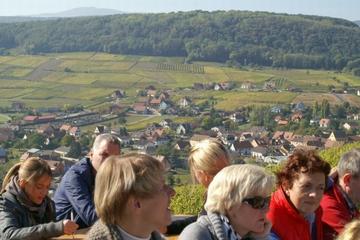

 About the author: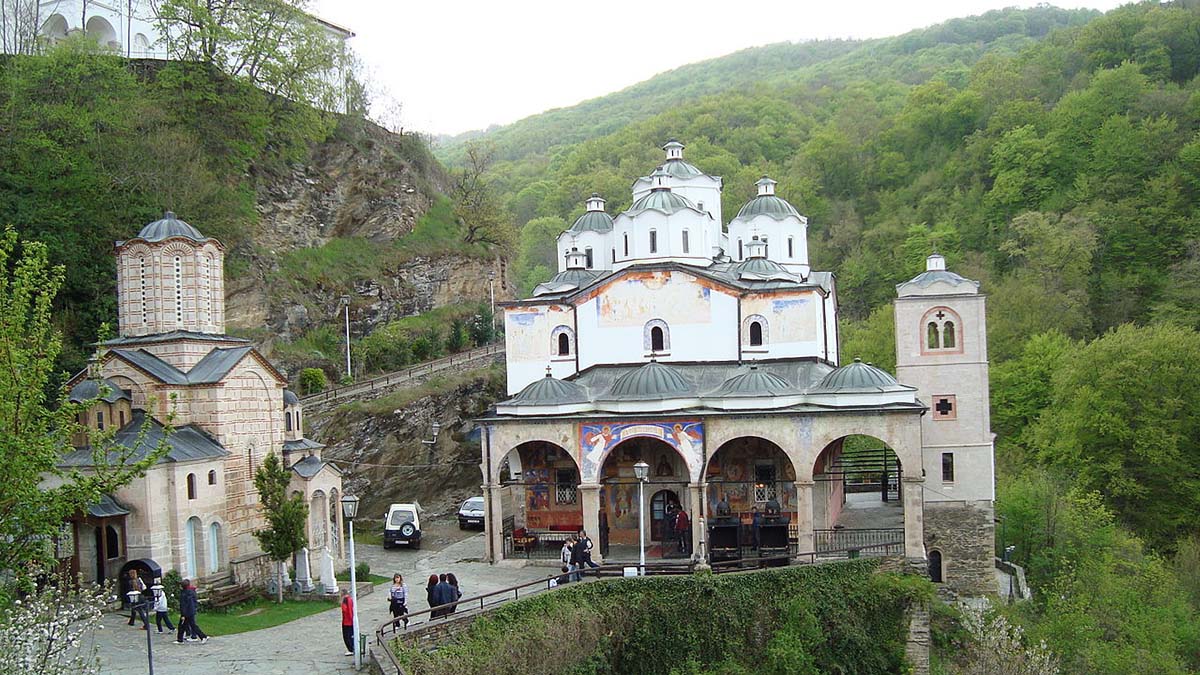
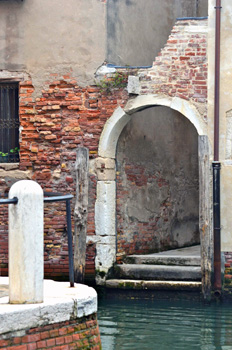 The heavy wooden door closed and I stood surrounded by silence. Flying anywhere from Australia takes a long time, and after a night and a day and a night I was exhausted. Tired and befuddled, I emerged into the chaos of Rome. I finally found a taxi, with a driver who careened down tiny streets where footpaths were more a suggestion than reality.
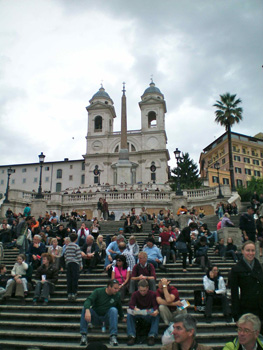 Rooms may be simple, but this does not imply austerity. Convents and monasteries are often to be found in Renaissance palazzos, Medieval walled towns or set amongst lavender fields and vineyards. Many hide artistic treasures; a painting by Rubens, or walls adorned by Fra Angelico. Each religious house has its own character, such as the monastery Convento Sant’Agostino in San Gimigiano which refused entry to HRH The Prince of Wales when he arrived after closing time. (Although probably apocryphal, the story alone makes the place worth a detour.)
 Rome boasts a convent or monastery in whatever quarter of the city you choose to stay. The rooms of Domus Carmelitana overlook the Castel Sant’ Angelo, while from those of Casa da Accoglienze Tabor you can see the Vatican. Near the Colsseum, the Cistercian Monastery of Santa Croce is in a 10th C building. Some of the balconies overlook ancient ruins and archaeological digs.
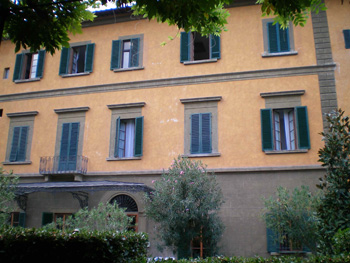 In Florence, the Casa Santo Nome di Jesu is in a 15th C palazzo. I reached my room via a marble staircase, complete with trompe l’oil ceiling of putti and plaster relief. The window overlooked a large garden, complete with kiwi fruit, persimmons, pomegranates, grape vines and wisterias, with trunks as thick as my body. The arbour was a perfect place to sit and pass the afternoon when exhausted by sightseeing.
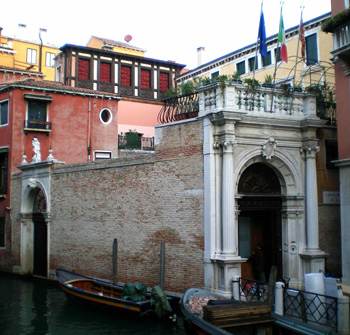 Most convents provide breakfast – fresh rolls and strong coffee are a staple – and often dinner as well. In some, monks still make wine to recipes centuries-old. My first time in Venice, my choice lay at the end of a maze of cobble-stoned side streets and piazzas. The Instituto San Giuseppe stands beside a canal, with a door opening directly onto the water. As I crossed a small limestone bridge a gondola came to a boisterous stop to collect passengers.
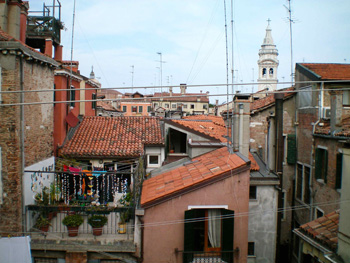 My room was simple and clean. The windows opened onto a terracotta skyline, with clothes strung on a line between two buildings. Across a flower-strewn courtyard a woman in black was busy in her kitchen, filling the air with delicious aromas. Every evening an extended family materialised for dinner. Geraniums hung everywhere in pots. In the distance a camponile tolled away the hours while towering (at a slight angle) over the other buildings,
 The next essential is catching a boat from the airport to the city, either on the public vaporetto, or by a much faster private boat. Our vessel was all streamlined wood, the skipper as sleek and polished as his vessel. Despite a complete lack of Italian, as soon as my husband began admiring the boat (being a long-time sailor himself) the skipper happily displayed the boat’s paces. As the rain finally poured down and visibility vanished, he raced along the narrow channel to the city, overtaking every other boat in a shower of spray.
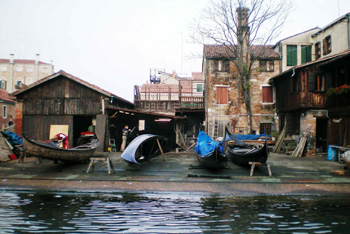
 Next came a gentle cruise through a network of tiny canals. Some were barely wide enough for the boat, the wash lapping against the buildings and doors in a moss-tipped waterline. Crumbling buildings complete with Juliette-balconies and geraniums stood tranquilly along the canal, as they have for centuries. Seagulls called overhead, bridges arched gracefully over the water, and the chaos of travel and Italian airports floated away. We even passed the gondolier repair shop on the Rio San Trovaso, one of the few remaining squeri in Venice.
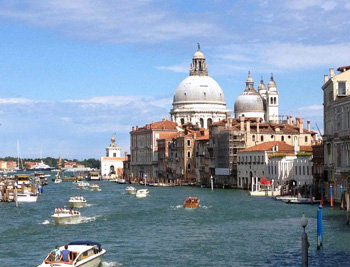 The entrance to the convent Canossian Institute San Trovaso lies on a pretty canal, devoid of tourists. Being in the Dorsoduro area of Venice, the streets are far less crowded than the more popular areas, locals outnumber the tourists, and at night the area is quiet. An elderly nun opened the door, and we walked into tranquility. She led us through an inner courtyard, where some other guests sat sipping wine as their kids feasted on gelato.
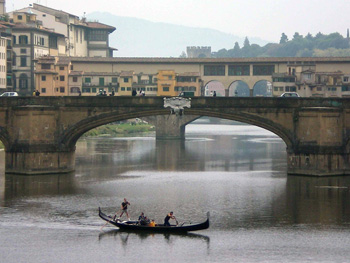 Convents and monastery are not only in cities, but also in idyllic countryside settings. Stays are not restricted to Italy, and some are to be found in the most unexpected of places. An example is the 12th century monastery Kriva Palanka, hidden in the Osogovo Mountains of Macedonia [TOP PHOTO]. It is worth a visit for the medieval frescoes alone.

 Photo credits:

