 by Jane Parlane
Sicily is synonymous with sun, history, lemons and the mafia. But don’t let the mafia scare you into staying away – they aren’t interested in tourists. Instead you’ll get a warm welcome from most Sicilians who are more interested in showing off their treasures than depriving you of yours.
There are plenty of reasons to visit Sicily, the Mediterranean’s largest island, including gorgeous towns, fascinating archaeology from ancient Greek, Roman and Norman times and delicious seafood, wine and cassata.
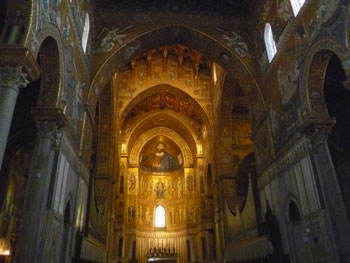
The ancient city of Palermo, Sicily’s capital city, is a great starting point for a seven-day tour by rental car. Having arrived early on an overnight ferry from Naples we taxied to the main railway station where we caught a local bus for the 15km journey to Monreale, famous for its grand Arab-Norman cathedral adorned with colourful glass mosaics dating from the 12th century. The Roman Catholic and eastern orthodox cultures blend splendidly and there’s much to admire including the cloisters and bronze doors.
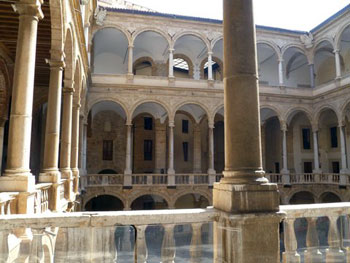 The bus back dropped us at the Piazza Indipendenza, the site of one of Europe’s most beautiful castles. The Royal Palace of Palermo, dating from the ninth century for many centuries housed Sicily’s rulers and even today it’s the seat of regional government. Local politicians are lucky enough to govern from such an architectural gem with its beautiful mosaics, painted roof and marble walls.
In 1599 a local nun was mummified in Palermo so all could still pray to her. Today her body has been joined by thousands more, all lined up like paintings in walls at the Capuchins’ Catacombs. There are bodies in their original clothes centuries old, skeletons and even children. It’s an eerie sight and afterwards we embraced fresh air, bright sunshine and a Sicilian light lunch of pepperoni, salami, olives, fried eggplant and polenta.
Ancient fishing village
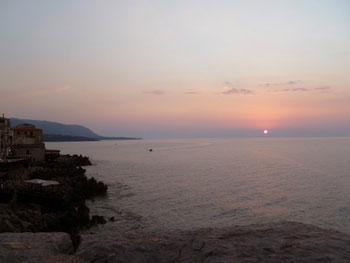 In our rental car it was an easy one-hour drive east to Cefalu, originally a fishing port. Now it’s an attractive cobblestoned tourist town with a sandy beach – not completely lined with recliners. Our accommodation was in an old stone house just a minute from the cathedral and main square. It was easy to find a restaurant table overlooking the sea and over a chilled Sicilian wine watch the bright pink sunset explode while families paraded past.
Next day, after a croissant and cappuccino in the piazza, we chose the coast road as far as Tindari where we stripped off for a refreshing swim. Afterwards we headed for Taormina on the autoroute, through tunnels and past Messina until we climbed up the steep hill where the town spreads out. It took a while until we found the entrance to the main car park and its lift took us close to our hotel in the Corso Umberto, the pedestrian-free main street with its lovely alleyways and views down to the Ionian Sea 250 metres below and up to Mt Etna – Europe’s tallest active volcano which was gently blowing its stack.
Sicilians promenading
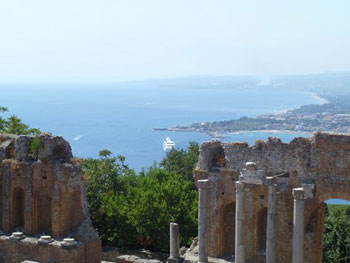 Taormina has many bars where you can sip a Marsala or Campari martini and just people watch. Most evenings you’ll see Sicilians decked out in their finery strutting the streets. Alternatively book an opera or concert at the Ancient Theatre dating from Greek and Roman times – sadly the opera was cancelled during our stay. But the swordfish at a trattoria washed down by a local wine and tiramisu to follow eased the pain.
Two days later we arrived at Syracuse, on Sicily’s south-eastern corner, once the most powerful city in the Mediterranean. We stayed at Ortigia island, the oldest part of the city, which is linked to Syracuse by a bridge. With its mix of splendid medieval buildings, including a cathedral dating from the 7th century, and Greek and Roman amphitheatres on the outskirts, it’s no wonder UNESCO has listed the entire area a World Heritage site.
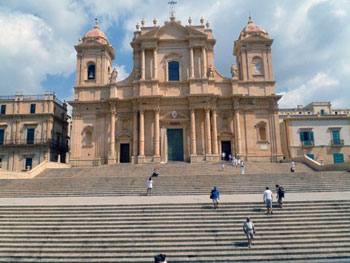 It was an easy day trip the next day to the ancient limestone towns of Modica, Ragusa and Noto, the latter famously rebuilt in 18th century in the baroque style after an earthquake destroyed the town in 1693.
After two nights in Syracuse we drove through olive tree and vine-covered countryside to find the world’s largest collection of late Roman mosaics in situ at the Villa Romana del Castale near Piazza Armerina. Also UNESCO protected, the large villa was once owned by Emperor Maximian. Its mosaics are in such good state today because they were covered by a landslide that occurred in the 12th century.
A valley of Greek temples
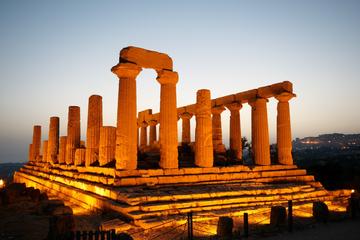
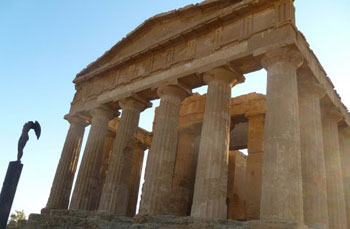 Our final destination for the day was Agrigento, famous for its Valley of the Temples. It was exhilarating to look out of our hotel window and see Greek temples standing there. This once ancient city, Akragus, was dominated by seven great Doric Greek temples built in the sixth and seventh centuries BC. Today several are still wonderfully preserved making the area one of the world’s most important archeological sites. It’s easy to spend two hours with a guide wandering the site, especially in late afternoon when the sun lights up the temples. A bonus for us was the spectacular exhibition by world-renowned Polish sculptor Igor Mitoraj cleverly placed among the ancient structures.
We planned to spend our last night in north-eastern Erice. I’d read that it was a medieval town near the coast but did not realise, until our ‘sat nav’ directed us up a hill, that it was situated on top of a mountain with a dramatic view 750 metres down over the wide plain and city of Trapani. Our hotel swimming pool seemed to be on the edge of a precipice and the town was hidden by an old stone wall. Erice, with its slippery polished flagstones, also tumbles down the hill, with bars offering tempting icy fruit granitas and excellent restaurants like the Monte San Giullano tucked away, vines concealing their stone entrances.


Our week in Sicily gave us a great taste of the place – its food, wine, fascinating archaeology and gorgeous medieval towns – we hope to return for a second course another day.
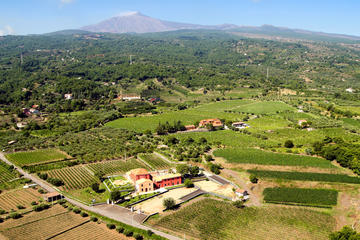
Wine Tasting and Sicilian Lunch at a Winery in Agrigento
2-hour Private Valley of the Temples Tour in Agrigento
If You Go:
By air:
You can fly into Palermo (Raisi Falcone Borsellino), Catania (Fontanarossa Vincenzo Bellini) or Trapani (Birgi “Vincenzo Florio) international airports with Rome and Milan being the most popular places for connecting flights.
By train:
There are many rail services to Sicily with the trains going on a barge for an hour over the Strait of Messina.
By sea:
Ferries and hydrofoils depart from several cities along the coast of Italy. A hydrofoil service from Naples takes five hours. Several ferry companies offer overnight trips and some will accommodate cars. Ferries go to Sicily from Naples, Citavecchia (Rome), Genoa, Livorno, Salerno, Calabria, Malta, Tunisia and Malta. One of the most popular ferries is from Villa San Giovanni in Calabria to Messina, in eastern Sicily. We traveled overnight on a Tirrenia ferry from Naples to Palermo (www.aferry.com/tirrenia.htm). The cabin was clean and tidy, the restaurant onboard canteen style. Arriving at 6.30 AM gave us a day of sightseeing in Palermo before we collected our rental car in the afternoon and drove to Cefalu on the coast for the night.
By car:
If you are an independent traveller, driving around Sicily is a great way to go, but because of some of Sicily’s narrow village streets, I recommend renting a small car. We rented a car from Europcar.
Our timetable:
Day 1 – Palermo and night at Cefalu
Day 2-3 – Taormina
Day 4-5 – Syracuse
Day 6 – Agrigento
Day 7 – Erice
Day 8 – flew out from Palermo
We stayed at the following hotels and booked most of them online at www.booking.com
♦ Palazzo Maria, Cefalu (Our accommodation was in an attractive old stone house)
♦ Hotel Taodamus, Taormina
♦ Hotel Gutowski, Ortygia, Syracuse
♦ Coleverde Park Hotel, Agrigento
♦ Hotel Belvedere, Erice
Restaurants we enjoyed were:
♦ Trattoria Don Camillo, Taormina
♦ Trattoria Archimedes, Syracuse
♦ Ristorante Monte Sa Guillano, Erice
About the author:
Jane Parlane is a freelance writer. She is author of ‘Wonderful Waiheke’ – a pictorial book about Waiheke Island, 30 minutes by ferry from Auckland, New Zealand, where she lives. She is also a published short story writer.
All photos are by Jane Parlane.
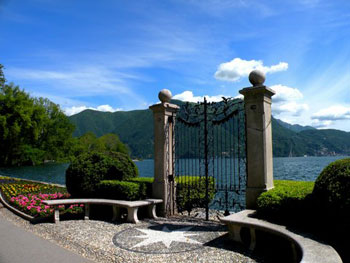 My wife Annie and I are enjoying an eye-opening Alpine sojourn as guests of dear old friends, Margit and Andres, health care professionals who live in Graubuenden but have stayed with us in Canada several times. When not having to work, they drive us around, and we make side trips on our own by train. We had expected beautiful mountain scenery, postcard-perfect towns and a prosperous land of clean efficiency, where the predominant German and French-speaking populations get along. But we had never imagined the full diversity of the rich Swiss cultural tapestry, the quirky and endearing coexistence of the traditional and modern, and the way history is cherished and kept alive.
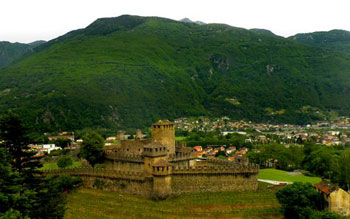
 She takes us to three impressive 13th to 15th century castles that dominate Bellinzona, built by the dukes of Milan to command a strategic river valley and to tax trade along the passes leading northward. Montebello castle, high on a slope, hosts an annual medieval festival, with jousting, period costumes, and roast pig eaten without cutlery from wooden bowls.
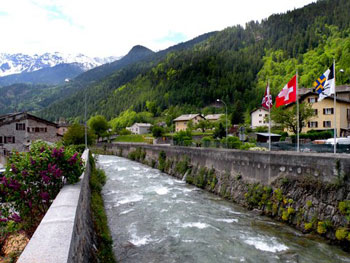 Our destination is Poschiavo, an enchanting village in another isolated Italian-speaking region that is part of Graubuenden itself. We stay at the historic Albrici hotel, built in the 17th century and run for 150 years by the same family. The 10 bedrooms feature antique furniture but no phones, TV or other electronics. We dine outside on the cobblestone piazza, which is bracketed by two ancient churches. The owner recommends some regional main dishes. I enjoy flavourful buckwheat noodles in a creamy sauce, garnished with a skewer of endive and slices of salami. Annie savours the tasty spinach dumplings (gnocchi) with melted cheese, similarly garnished.
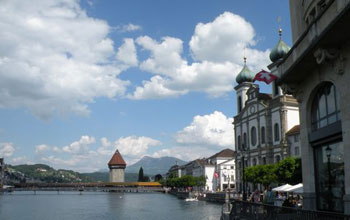
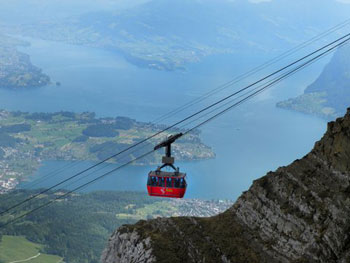 Even the larger central Swiss cities offer an intriguing mix of old and new. In Zurich, our hotel abuts the beautifully maintained old town. Its narrow streets are lined with medieval towers and intersect at ornate fountains featuring sculptures. We indulge in sweets at an elegant 19th century pastry shop but also take the funicular up to see the renowned technical institute just above, where Albert Einstein got his doctorate. In Lucerne, we walk the massive old city walls and cross the landmark 14th century covered bridge. But we also ride a spectacular cog railway (the world’s steepest) up 2,132 metre Mt. Pilatus, where an ultra-modern hotel adjoins a much older one, and watch a paraglider lift off and drift away on the thermals.
 Even within the Swiss-German majority population, we discover, there are minority subcultures. Our friend Andres turns out to be a Walser, the proud member of an alpine tribe that numbers about 20,000 in Switzerland and has sizable communities in neighbouring Italy, Liechtenstein and Austria as well. They trace their history back to the south-central canton of Wallis and an outward migration that began in the 13th century. Historians debate whether the cause was overpopulation, or feudal politics, or possibly the plague. Those who moved northeastward into Graubuenden and beyond were attracted by empty high-elevation lands to settle and privileges offered to them by feudal lords in exchange for doing military service, notably patrolling and controlling the crucial mountain passes.

 Andres regales us with stories of his upbringing in the 1960s and 1970s on a subsistence farm high in the Praettigau Valley, just east of Graubuenden’s charming capital city of Chur, where he now works. Like his neighbours, his family had only a few cows, which he helped to feed and milk in winter; in summer they were moved up to higher grazing pastures. A few men from the hamlet tended everyone’s cows, milking them collectively and making cheese every day. The cheese was brought down in autumn and divided up, a festive event that remains an annual celebration. Each family also had a vegetable garden and perhaps a pig, chickens and rabbits. Yet they eked out a livelihood. Andres hiked, or sledded in winter, down to school in the larger village below. He and Margit drive us up switchback roads to a scenic Walser village, Tenna, with a population of around 100 overlooking the Safien valley. There is a two-room school, a cheese-making shop, and a church dating to 1524. The gravestones record only a handful of family names, generation after generation. Houses have huge stacks of firewood and tiny outbuildings that are actually ovens for baking bread. Cows and sheep graze nearby; in May, they have not yet been moved to higher slopes. The weather is sunny and warm, perfect for lunch on an outdoor hotel terrace. We try the barley soup, grilled mushrooms on bread, and local hard cider. Andres greets an elderly couple, who immediately recognize his dialect. You must be from Praettigau, they say, and they are too. They even knew his late parents, but have retired to this distant, yet also Walser, village.
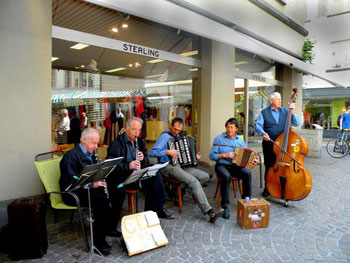
 Another evening, Margit and Andres take us to a concert at a pub high in the Praettigau valley, where Andres grew up, in a village with stunning Alpine architecture where one of his sisters now lives. He is the only one of five siblings who has left the valley, although he has not moved very far. Between songs, the band tells jokes in Walser German. Andres laughs along, but Margit, who was raised in Germany and is totally familiar with mainstream Swiss German, can hardly make out a word. But if we were expecting Tirolean um-pa-pa tunes, we were mistaken. The popular local trio—they have performed 1000 times over 20 years—treats us to to an eclectic display of world music: klezmer, gypsy, tango, blues, Celtic, on a bevy of instruments. Andres’ sister tells us that she is leaving in the morning for a cycling trip in Ireland. Everyone is from the valley, but they all seem well educated and most speak remarkably good English. This is 21st century Switzerland. They may be locals, but they are by no means yokels.
 . Koppel provides a personal tour of that vast ocean and presents the latest findings in archaeology, genetics and carbon dating. Mystery Islands is now available at www.uspbookcentre.com and soon on Amazon.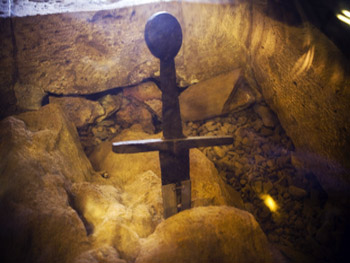
 Cistercian monks built the round chapel of Montesiepi around the “cross” in the stone. The domed roof is built of concentric circles of alternating white stone and terracotta and frescos by Sienese painter Ambrogio Lorenzetti decorate the walls. It has been claimed that the chapel itself is a “book in stone” hiding the location of The Holy Grail.

 Italian scholars claim that Galgano’s Sword in The Stone precedes Arthurian legends and the original story may well be Italian. The first stories of King Arthur appear decades after Galgano’s canonization, in a poem by Burgundian poet Robert de Bron. It has been suggested tales of The Round Table may have been inspired by the round chapel and the name Galgano was altered to become Gawain. Claims that the Italian sword was a fake, made to echo Celtic legends of King Arthur, have been recently disproved. The skeletal arms in the chapel have been carbon-dated to the 12th Century, and metal dating research in 2001, by the University of Siena, indicates the Italian sword has medieval origins. Could it be that the stories of King Arthur are really based on Italian history?
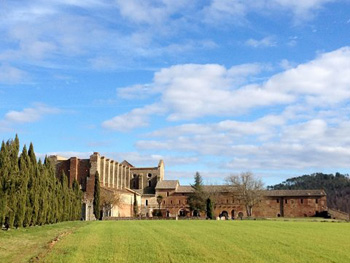
 Every summer the company Opera Festival Firenze holds classical music concerts and operas in this splendid setting. Performed annually, a spine-tingling rendition of “Carmina Burana “ under the Tuscan stars, is unforgettable. Other favourites include Vivaldi’s ”Four Seasons, “Swan Lake” and “La Traviata.”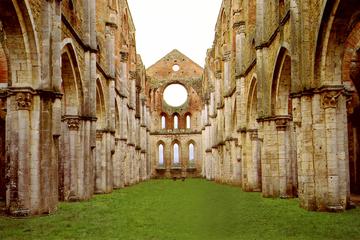
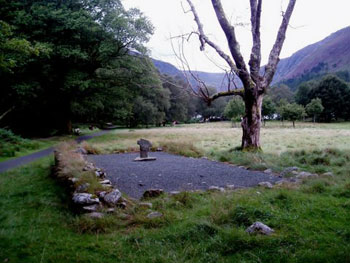
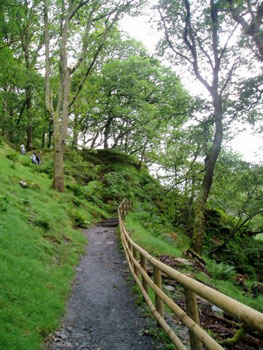 Stuck in Glendalough, I grabbed a quick late lunch from a local food cart and set out for a late-afternoon five-mile hike on Miner’s Road. This route took me by the two lakes toward the ruins of an 18th century mining village that closed down in 1965. Rows of purple heather greeted me with pine trees serving as an umbrella to shade me from the sun. Finally I got to sample paradise almost all by myself.

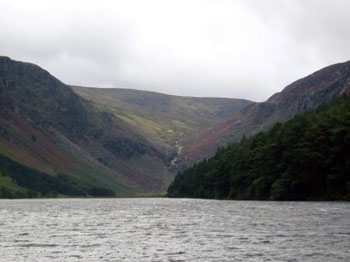 The next morning stopped by the Glendalough Visitors Centre where I bought a
 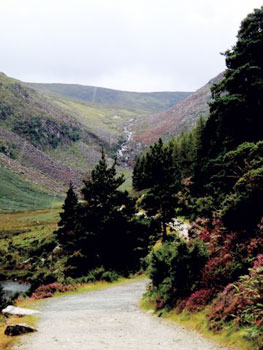 After I climbed down, I stopped by a shack located at the foot of Upper Lake for a quick snack and then set off on the Green Road Walk. This flat mile long trail that meandered around the oak woodlands and then continued to the edge of Lower Lake. Along the way, I passed by the outskirts of Monastic City where I saw more busloads of tourists, most of whom seemed more intent on taking photographs of stones than actually walking on Kevin’s soil. Hopefully some of them will leave the city for the hills and have their own encounter with Kevin.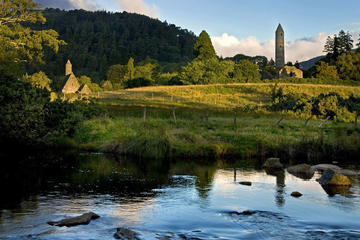
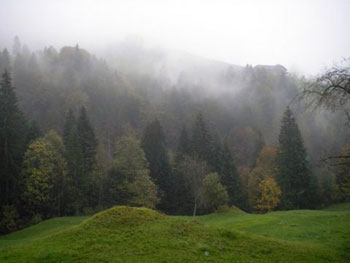
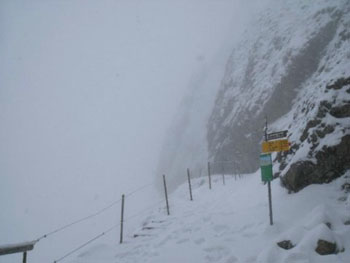 I’ve daydreamed about one day being able to scale a European mountaintop so I could sing that quintessential European classic pop song “Una Paloma Blanca.” It was in my grasp, but the Mt. Pilatus’ dragons and ghost of Pontius Pilate would not hear of it. Instead, they had a more memorable adventure in store for me. You see, I planned my day to go to the top of Mt. Pilatus via The Golden Round Trip. Mt. Pilatus is one of the Swiss Alps gateways that helped usher in Switzerland as a tourist hotspot in the late 19th century. I expected to do a good amount of hiking, but steady rainfall in the lower elevations of Luzern and reports of snow up the mountain before I even left Luzern appeared to hamper my day.

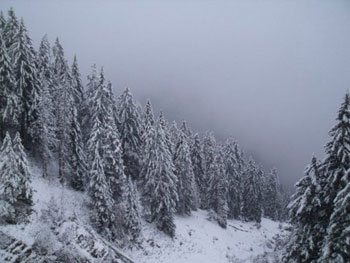 My second leg of the “Golden Round Trip” proceeded on the world’s steepest cogwheel railway from Alpnachstad, where us passengers experienced gradients as high as 48 per cent at speeds of about six to seven miles per hour. Going up, we were surrounded by thick evergreen forests being hammered by rain, then light snow, and then heavier snow as the visibility decreased. But I began to notice something on my ascent: I wasn’t feeling queasy anymore and my sinuses were clearing up as the 33 minute ride (that’s half price with a Swiss Pass) proceeded through several tunnels barely wide enough for the cog way carriages. The driver masterfully had to navigate the heavier snow amidst sudden jerks and stops. He laughed even though I was anxious (because there are three braking systems to prevent catastrophe).
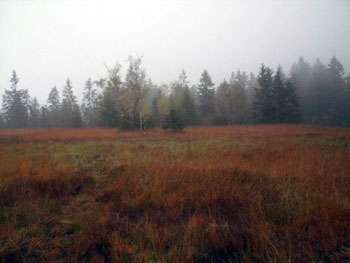 The Entlebuch resides west of Luzern, about 35 minutes by train at the stop called Schupfheim. It’s made up of eight villages and spans some 154 square miles and contains many of the Alps’ rolling foothills: roughly one per cent of the total land area of Switzerland. One fourth of this area is now protected moors (highland marshlands), which exuded a pleasantly eerie feeling amidst the fog, making me wonder if any monsters were lurking there.
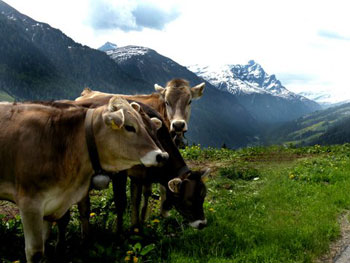
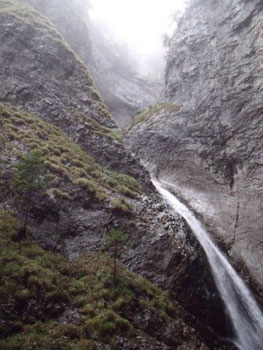 The town of Fluhi is on the other side of the Entlebuch, and provided me a great opportunity to see more breathtaking fall scenery in the Pre-Alps (foothills), ending at Cheesiloch, a canyon with a 130-plus foot drop. Prior to the path leading directly to the canyon, a 45 minute hike from town begins that has winding roads, cows who love being photographed (kept apart by a “fence” made of just one rope), and rolling meadows. The last 30 minutes to the canyon would be one of my most challenging hikes I’ve ever taken, and once again, my walking pole saved the day, for the narrow pathway was sharp and rocky, and drenched with wet maple leaves. Nature’s soundtrack included hearing the pleasant babbling of the Rotbach stream as I proceeded deeper into the dense evergreen forest with deep drops to the canyon below.