by Larry Zaletel
New Orleans is known as the ‘Crescent City’ to the residents and the ‘Big Easy’ to tourists. ‘Crescent City’ relates to the course of the Lower Mississippi River as it bends around and travels through the city.
The origins of the term ‘Big Easy; is not clear, some say that the term was created by the media. In the 1970s a local columnist Betty Gillaud used the term to contrast life in the city to that of New York City. It was also a reference by musicians in the early 20th century because of the relative ease of finding work there and the easy-going, laid back attitude to life that jazz musicians and local residents indulged in.
The name Big Easy also may have originated in the Prohibition era, when the city was considered one big speak-easy due to the inability of the federal government to control alcohol sales in open violation of the 18th Amendment. Or it could refer to New Orleans’ status as a major city, at one time “one of the cheapest places in America to live” where everything was slower, simpler and easy-going. Who knows?
 New Orleans is known for many other things: seafood, e.g. crawfish, shrimp, crab and also for its music and musicians. The New Orleans area has the most home grown musicians in the country. They run the gamut from rock and roll, blues, jazz and even classical, from Fats Domino and Professor Longhair to Louie Prima and Louie Armstrong. However if New Orleans is known for anything it is a slogan and an attitude of, “Laissez les bons temps rouler, let the good times roll.” And that’s the truth! Ask any native New Orleanian.
This was not my first visit to New Orleans. Returning back after being away for a few years I was able to see the changes brought about by Hurricane Katrina. Something surprising I learned is that now everything is classified either pre- or post Hurricane Katrina. For example when people are having a discussion and talk about everyday life, or something that was rebuilt, or something that doesn’t exist anymore or has been replaced, they put it into the context of whether it was before or after the effects of the storm. Hurricane Katrina changed that for all time.
 My wife and I visited the city of Slidell and our old neighborhood, New Orleans East and Downtown New Orleans. We had resided in Slidell, Louisiana located about 20 miles northeast of New Orleans from 1978-1984. We lived through two floods and two hurricanes, luckily none of which caused us any major problems, because we had boarded up the windows and battened down everything. The second hurricane was more severe than the first one and we did not get to sleep as the sound of the winds emanating from the storm kept us awake. They were howling at over 110 mph and sounded like a locomotive as the hurricane passed over us.
Katrina was its most devastating along Lake Pontchartrain and the North Shore. This area was the hardest hit and as we drove along Highway 11 we saw the remains of the homes and businesses that were ravaged by the severity of the storm. The many homes that once stood along the lake are gone and there is vacant land everywhere. Some of our favorite restaurants and seafood shacks are gone. We passed driveways and concrete aprons that are still visible, also the docks and the pilings extending into Lake Pontchartrain that are standing like wooden sentinels of a bygone era. However the docks emanate from nothing as the homes that they were once attached to are gone, wiped out by the storm surge. I am struck however by one lot where a new concrete driveway and concrete pilings are visible. Apparently someone is planning to build. For sale signs however far outnumber any new construction in the area.
 The Slidell Memorial Hospital on Gause Blvd expanded in January 2011 with the opening of the Regional Cancer Center on Robert Blvd. Slidell has prospered since our last visit. There are many new commercial and business establishments. Some old ones are gone and new ones have taken their place.
We visited old town the historic downtown area where we learned how much Katrina affected Slidell. The old part of the city was under water. However Slidell is now bustling and revitalized just as it was when we lived there. Interstate 10 has two new interchanges and new subdivisions were built more expensive than before especially south of Interstate 10 near Lake Pontchartrain. In the 1970s it was the fastest growing city in the United States until the recession hit during the early 1980s when tourism faded and the city’s growth declined.


 We drove through our old neighborhood which seems the less for wear. Talking with old friends and some of our old neighbors we learn that our old subdivision along Interstate 12 was spared the wrath of Katrina. There are new stores, gas stations and Brownswitch road one of the main routes now has a turnabout at Robert Road reflecting the growth in traffic patterns. Ah, progress.
Irish Bayou can be reached by crossing the old twin span bridge over Lake Pontchartrain that was rebuilt and now has three lanes each way. During Hurricane Katrina the old twin spans suffered extensive damage due to the rising storm surge that pulled or shifted bridge segments off their piers. The new approach to the westbound lanes entrance from Slidell was shifted south to accommodate the new bridge. We veered off Interstate 10 to visit Irish Bayou on our way to Metairie. The old dirt and grass levee on Highway 11 has been changed now to one made of concrete. Irish Bayou seems less inhabited than I remember and there appears to be fewer homes although most home in the bayou were built using pilings or raised platforms. There is also a landmark of an old fisherman’s castle which was built in 1981 by Simon Villemarette. He originally planned for it to be a secondary tourist attraction for the 1984 World fair in New Orleans.
 New Orleans East & Metairie was hard hit by water. We drove down Read Blvd through the area where once stood the Lake Forest Mall in New Orleans East. The huge complex is gone, and a building on the Interstate 10 frontage road where I where I was employed for a time is now four walls and gutted. You can see through it, some of the windows are broken. I also remember a restaurant down the street, a Denny’s I believe. It is now gone. Katrina did it all.
After the severity of Hurricane Katrina conditions have changed, new levees have been added and others strengthened. However more work still needs to be completed and that it will take many years. One thing I noticed were advertisements on trucks and billboards for various companies whose business is that of raising and placing homes on stilts/pilings.
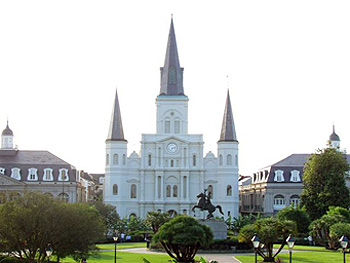
Downtown, New Orleans is famous for the French Quarter, Canal Street, St Louis Cathedral, and Café Du Monde with their famous beignets and Café Au Lait. The coffee and beignets are still as good as I remember.
 Play tourist and enjoy the ambiance of what New Orleans has to offer. There is a different feeling about visiting downtown New Orleans as a tourist compared to living there and visiting. Stop at historic Jackson Square and enjoy. It was originally known in the 18th century as “Place d’Armes,” and later renamed in honor of the hero of the Battle of New Orleans, Andrew Jackson. It is a timeless attraction in the heart of the French Quarter of New Orleans. There is a different view, tourists are everywhere, we walk through the cobbled streets and stop and listen to a jam session featuring a group of Jazz musicians performing, “When the Saints Go Marching In.” Canal Street is still vibrant and St Louis Cathedral is peaceful. We visit Harrah’s Casino to try our luck. We pass by a familiar face, the Superdome still intact, looking like a gigantic flying saucer. It is good to see some of our old memories.
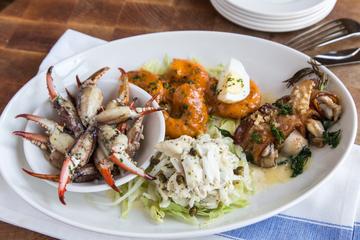
The night before we leave we visit the Silver Slipper Casino in Bay St Louis. A new casino was built after we moved. Now you can gamble in a variety of ways to your hearts content and enjoy all you can eat crab legs on Friday night, the best I have ever eaten anywhere. The best part was that we came out ahead on the slots.
Taste of New Orleans Private Walking and Food Tour
If You Go:
We stayed at the Homewood Suites, 175 Holiday Blvd, Slidell, LA 70460, 985-726-7291 which is new and has friendly and helpful personnel.
One of our favorite restaurants that we used to patronize when we lived in Slidell and is still serving good food after all these years is Young’s Steakhouse, 850 Robert Rd, Slidell, LA 70458, (985) 643-9331. Young’s has been welcoming guest since 1969 to a warm friendly atmosphere. They are known for their thick, juicy steaks and a variety of seafood dishes, mouth watering appetizers and desserts.
♦ Café du Monde in the French Quarter 800 Decatur Street, New Orleans 70116, (504) 525-4544
♦ Speckled T’s, 158 S Military Rd, Slidell, LA 70461, (985) 646-1728, very good seafood.
♦ The Big Easy Diner, 1777 Gause Blvd E, Slidell, LA 70461, (985) 639-8006, a good place for breakfast
♦ Steve’s Marina Restaurant, 213 E Beach Blvd, Long Beach, MS 39560, (228) 265-7730, rebuilt after Katrina, very good seafood
♦ Silver Slipper Casino in Bay St Louis, Mississippi 5000 South Beach Blvd
There are many additional fine restaurants in the New Orleans area and information is available on the Internet.
Private Voodoo Temples and Cemetery Experience of New Orleans
About the author:
Larry Zaletel is a freelance travel writer, an avid and dedicated traveler, and a recurring visitor to Europe, the Caribbean, and the Far East. He writes about the various people that he has met and places that he has visited during his travels.
All photos by Larry Zaletel:
St. Louis Cathedral
Café Du Monde
Twin span bridge of Lake Pontchartrain
Levee in Irish Bayou
Destruction on the North Shore of Slidell
Superdome
Famous Canal Street
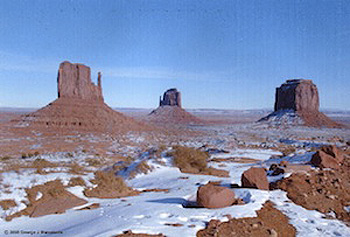
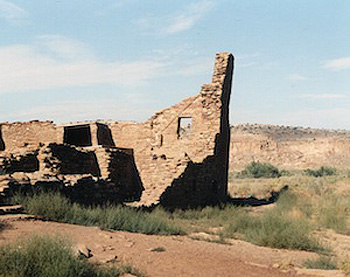 Chaco Canyon National Historical Park sits in Northwestern New Mexico and was designated as a World Heritage Site in 1987. According to archeological studies, 4,000 to 6,000 Hopi, Pueblo, Navajo and other Indian tribes passed through this canyon. From 850 A.D. to 1150 A.D., the Anasazi lived within great houses often oriented to solar, lunar and cardinal directions. There seems to be an unending fascination about the Anasazi’s and their use of sophisticated astronomical markers, water control devices and Chacon “roads.” At the Chaco Canyon visitor center a video program is shown hourly about these ancient inhabitants as well as a small museum displaying artifacts, maps and a small outdoor observatory.
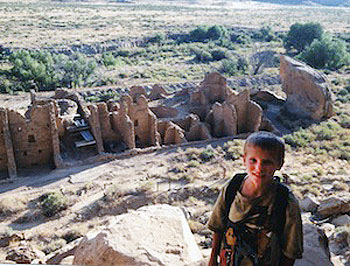 Self-guided tours are also available to the grand Pueblo Bonito, (Spanish for Beautiful Town) the largest Anasazi ruin, Casa Rinconado (Great Kiva) and Una Vida (another great house). For longer treks, there are at least a dozen trails leading to the top of the mesa for views of the entire Chaco Canyon network of ruins. Most are fairly easy with little elevation gain, the longest trail is a little over six miles. We chose the Pueblo Bonito Rim Overlook trail. After a steep one and a half mile climb the ruins of Pueblo Alto greeted us as a setting sun shadow danced across the canyon walls.
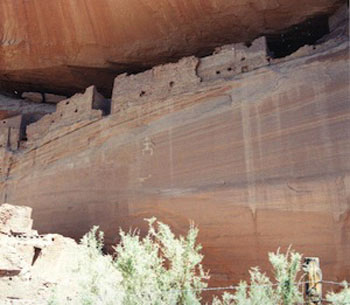 Canyon De Chelly National Monument resides in Northeast Arizona and is west of Chaco Canyon. Numerous overlooks of the canyon are accessible by driving a two-lane road that meanders along the rim. My favorite overlook was Spider Rock. Today, only two tall spires of red sandstone stand alone in the middle of the valley floor depicting Spider Woman’s home where she helped her People move into the fourth world by hiding them in the reeds and then floating them down to dry land.
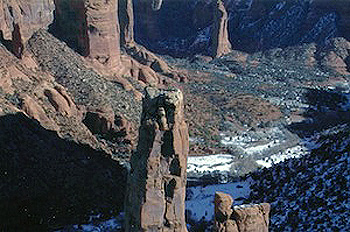 The Second World according to Waters was called “Dark Midnight” and was destroyed by cold and ice. Again, the kivas kept them warm and dry. Once the destruction stopped, they climbed up a ladder into another world. This was the Third World. Dissension broke out quickly among the People and this world was destroyed by flooding. However, this time an appointed caretaker named Spider Woman saved the ancients by hiding them in reeds and floating them to dry land into the Fourth World. The Fourth World, according to Waters, was called “World Complete.” This world was unlike the previous three, where the ancestors were provided for. The Fourth World had harsh deserts, never ending marshes and mountains of violent weather. This World was to be a time of awakening, realizing how we affect each other and that we are all one. Sounds like what might be happening now, doesn’t it? The Hopi say we are now living in the Fourth world which is ending and that the Fifth World is beginning.
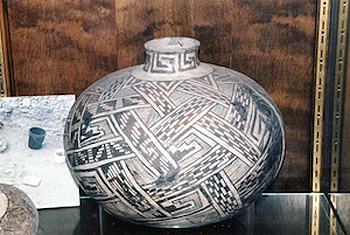 Further south of Canyon De Chelly lies Casa Malpais Archaeological Park. This National Historic Landmark also has evidence of underworld activity within the ruins. Intact pottery was discovered here as well as a 8 X 4 foot panel depicting human like figures with tails which may have represented ancestral beings before they emerged above ground to the fourth world. These petroglyphs offer an inkling about the Zuni and Hopi clans that lived and held ceremonies here six hundred years ago. Archeologists propose these drawings came from the Parrot Clans because there is a parrot spitting rainwater onto a corn plant. According to Hopi legends, this indicates that the Corn Clan and Parrot Clan went their separate ways.
 Perhaps answers can be found within the stars. In the early evening at Chaco Canyon, the park rangers open up the observatory. Summer evenings are pleasant here as a warm gentle breeze sweeps the desert floor with the fragrance of sweet pinion and sage. A waning moon allows the Big Dipper, Little Dipper, Cassiopeia and Milky Way to shine more brightly.


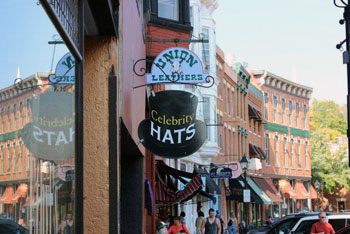


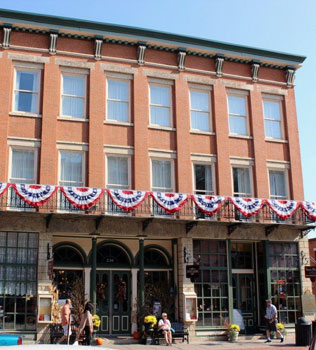
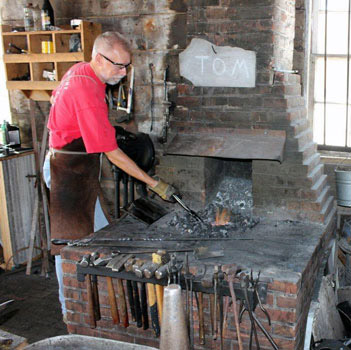 Parking was almost impossible on Main Street, so my husband Kent and I circled around to one of the back streets. We found ourselves behind the Old Blacksmith Shop dating back to 1897. We began to explore.
 Even older than the Dowling House is the 1820’s The Old Stockade at 208 Perry Street. Originally a log building, The Old Stockade was a result of preparing for an attack during the Blackhawk War of 1832.
 On September 13, 1860, a crowd of over 15,000 rallied in front of the DeSoto in response to a “Grand Republican Mass Meeting” in support of Lincoln’s presidential bid.
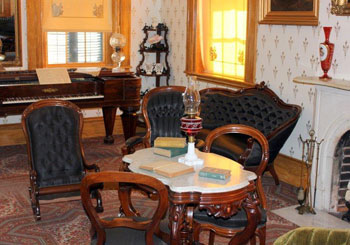 A walk over the Galena River (it joins the Mississippi further downstream) brought us to General Grant’s House. A group of tourists were standing on the main porch awaiting the next tour. A Grant House guide in period costume came out to greet us. She conducted a narrative tour of the main floor with some interesting asides: Julia, Grant’s wife, was the FIRST “First Lady”, both of Grant’s parents were alive when he was president and, the silverware on the dining room table had also been used in the White House. The upstairs bedrooms are self-guided. Tours begin on the half-hour. What a living history experience of mid-19th century America!

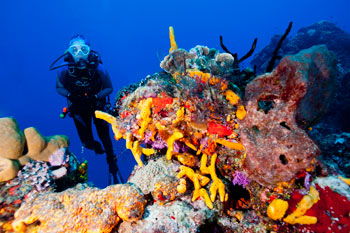 “That was one of the best dives I’ve ever done,” Kathryn proclaimed after surfacing at Cozumel’s Tormentos Reef. Comprised of coral pinnacles towering approximately 20 to 30 feet high and interspersed with wide, sandy areas. The colorful coral heads are adorned with purple and orange sponges, brain and whip corals. Tormentos is a veritable ocean garden where the reef’s maze of twisting tunnels, overhangs and barrel sponges provide shelter for marine life. Teeming with shoals of bream fish, French grunts and yellow snappers, I lost count on the number of blue tangs, pork fish, trigger fish, black durgon, file fish, big eyed jacks and parrot fish we saw. Lurking within the ledges, nooks and crannies were Caribbean king crabs, spiny lobster, giant hermit crabs, juvenile spotted drums, spotted moray eels and delicate-looking arrow crabs. Grey and French angelfish seemed unwary of the divers in their midst as were the barracuda seen hovering over the patch reef on the hunt for their next meal.
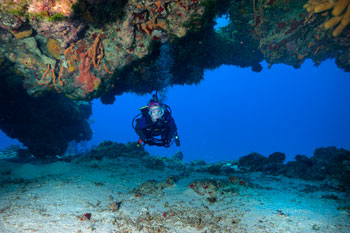 While our dive at Tormentos Reef was quite literally off the scale, we equally enjoyed our dives at other well known Cozumel dive sites. Interestingly, we seemed to be seeing more large animals on every dive than I could recall ever seeing here over two previous trips. Nurse sharks, sea turtles, Southern stingrays all seemed to be in greater abundance. Our decision to bring our family to Cozumel for Christmas and New Years felt entirely right. This year, the gifts were indeed under the sea.
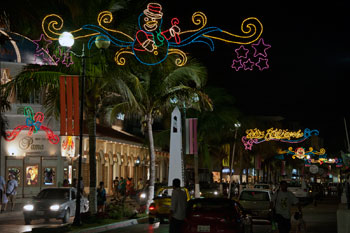
 San Miguel’s quaint downtown zócalo (Plaza del Sol) extends for about eight blocks along the waterfront and for several blocks back from the water. The tiny municipality exudes a casual relaxed ambiance with excellent shopping, superb night life, an exceptional number of fine dining restaurants, more than 200 gift shops, souvenir stalls and jewelry outlets that sell everything from T-shirts to fine silver jewelry, pottery, wood carvings, leather goods and tourist kitsch. While prices tend to be fixed when cruise ships are in port, bartering is relished by shopkeepers on the side streets located as little as ½ block in from the water. In fact, the potential for striking a great bargain increases the further you stroll back from the waterfront.
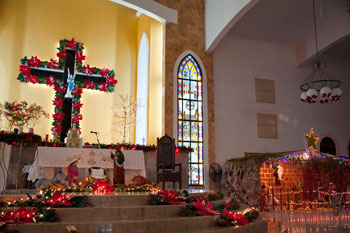
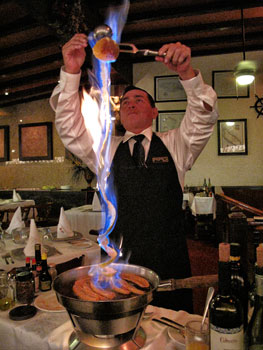 On Christmas Eve our trip got off to a festive start with a delicious dinner at Pepe’s Grill, followed by bananas flambé for desert, which is simply to die for! After some shopping at some waterfront shops we attended Midnight Mass, which the Mexicans call “la Misa Del Gallo” or “the rooster’s mass,” at the beautiful Cathedral of Corpus Christi. One does not need to be religious to appreciate familiar Christmas carols or a church service performed entirely in Spanish. Curiously, we noticed several church patrons were carrying and hugging a baby Jesus doll. We soon learned the building of the “El Nacimiento” or “Nativity scene” is a seasonal tradition here. During the holiday season, most Mexican families construct a Nativity scene in their home. At midnight on Christmas Eve, a figure of baby Jesus is placed in the nacimientos to commemorate the Lord’s birth.

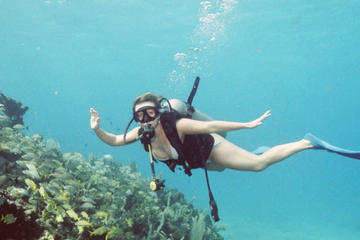
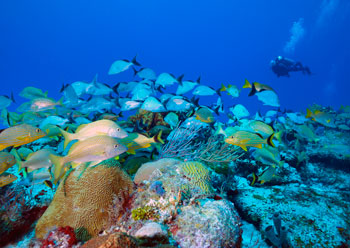 Another notable feature that sets Cozumel’s waters apart from other Caribbean dive destinations is the Yucatan current offers endless opportunities for drift diving. These continually flowing ocean currents are often less than half a knot and tend to flow in a south to north direction. Sometimes the current can be fairly strong, attaining velocities of two knots or more. Essentially, the dive plan for drift diving is simple. The dive tender drops you in the water and follows your bubble trail, standing by to pluck you from the water when you surface.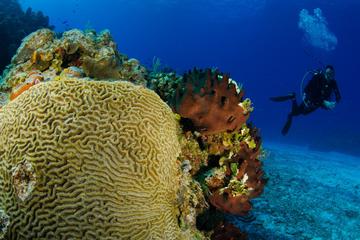
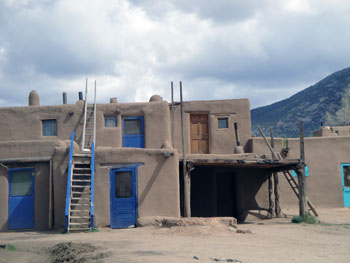
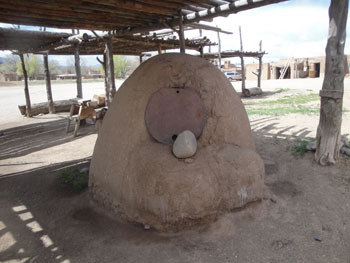 We are invited into one of the homes to warm ourselves in front of the fire. Wood stoves and fireplaces heat the houses and are used for cooking. Bread and pastries are baked in hornos, outdoor adobe ovens scattered around the site. We purchase delicious cookies and pies made in a horno, which warm us from the inside out. We also sample fry bread in another home, made in front of us and drizzled with honey. So tasty.
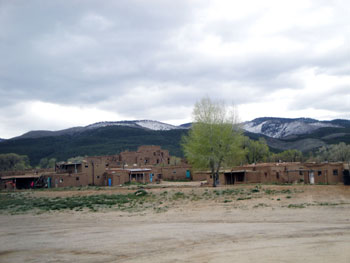 Many of the homes are inhabited by native artists who welcome visitors to enter, view their art work, chat and make purchases. We buy a number of handmade items to take home as gifts, and a couple of pieces for ourselves. At a shop called “Morning Talk”, I buy a fabulous piece of pottery for my potter daughter, knowing she will appreciate the work put into it. Everyone is so hospitable and willing to take time to talk to us. We soon forget about being cold.

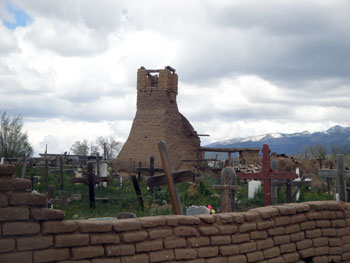 We explore the modern day San Geronimo Church, built in 1850, a Registered National Historic Landmark and still used by the mostly Catholic inhabitants of Taos Pueblo. The thick adobe walls, keep it cool in summer and warm in winter.