by Troy Herrick
Ireland has been called the Land of Saints and Scholars because of its strong monastic tradition. Patrick, the Patron Saint of Ireland, brought Christianity to the island in the 5th century CE. Within one hundred years of his arrival numerous monastic settlements had sprang up around the country. Centuries later some small towns even had more than one monastery belonging to different orders of monks like the Benedictines, Franciscans, Cistercians or Dominicans. These monasteries thrived over the centuries and became wealthy.
Henry VIII, King of England and Ireland, viewed these monasteries as sources of untapped wealth during the Reformation and decreed that they should be closed or destroyed. His legacy provides you with many ruins to visit throughout the country. As such you need to be very choosy about where to spend your valuable vacation time. Two sites that should not be missed are Glendalough and the Rock of Cashel.
Glendalough
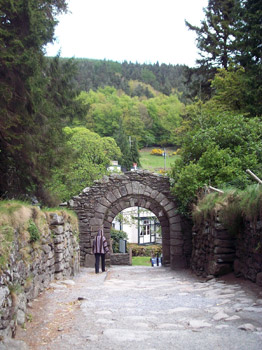
 As we stood outside the former monastic site at Glendalough, our guide, Joan, directed us to the 900-year old gateway and indicated that the original structure had two round-headed granite arches supporting a timber roof. This was the gateway to civilization at the time. The lands beyond the monastic settlement teamed with highwaymen and other dangers. I imagined terrified individuals running past us through the gate to reach the cross-inscribed stone set just inside on the right as Joan explained that Glendalough was a place of refuge. The so-called “Sanctuary Stone” defined the point of safety for those on the run. Once a refugee passed inside the gate beyond the stone, he/she was safe.
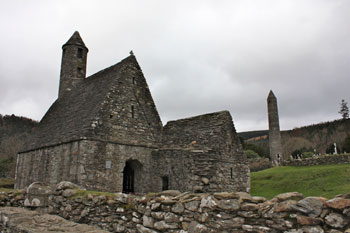
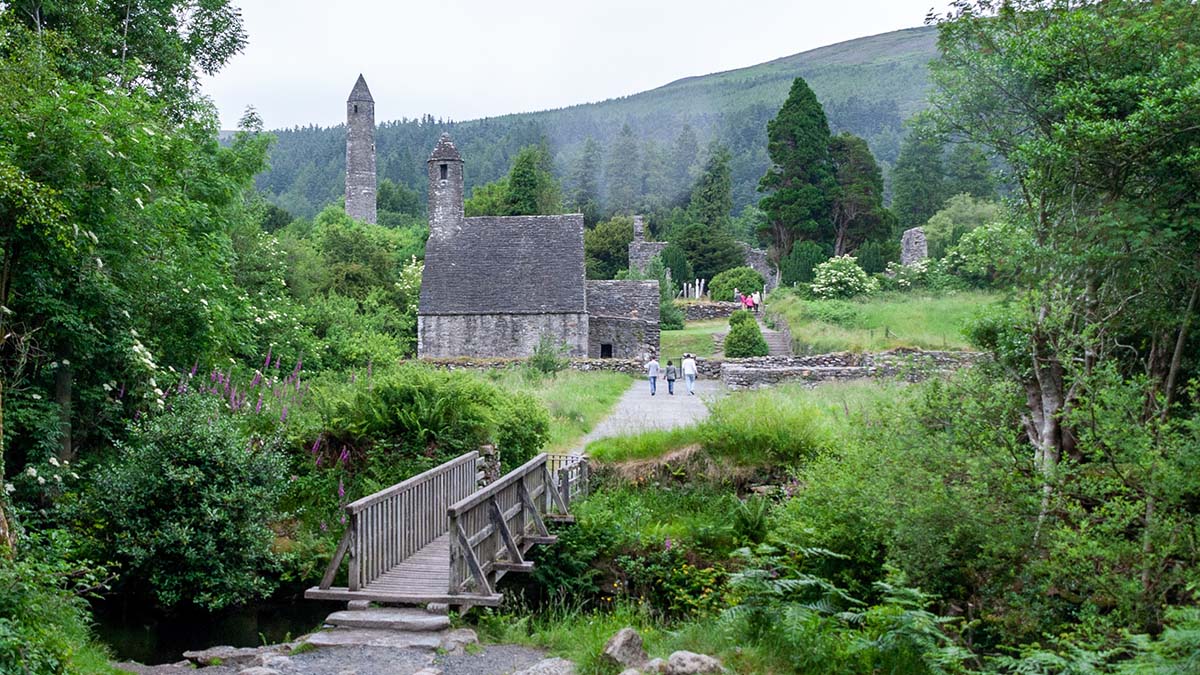
Stepping inside the gate, you see a round tower protruding from the green foliage a short distance away. This 100- foot tall stone needle essentially identified the site of the monastery. This multi-purpose structure served as a bell tower, a treasury and a place of refuge in times of attack. The monks retreated inside through the entrance 10-12 feet off the ground, pulled up the ladder and closed the door.
 In the vicinity of the round tower, the remains of a cathedral, dedicated to St Peter and St Paul, consist of a 10th century nave and a 12th century chancel. The arch, once finely decorated, is constructed of limestone imported from Bristol, England. A wall cupboard and basin used for washing the sacred vessels used in the mass is still visible in the sacristy.
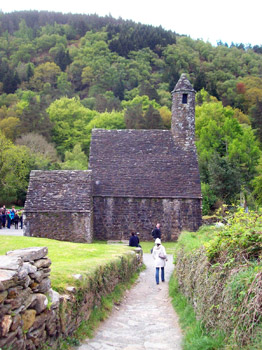
The guided tour portion of the Glendalough visit ended after short stops at the Priest’s House, St. Kevin’s Church and St Ciaran’s Church. Exiting the site, Diane and I drove up the road to a strip of land separating the upper and lower lakes. Glendalough (glean dá locha) translates to “glen of the two lakes”.
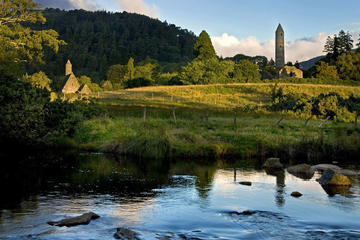
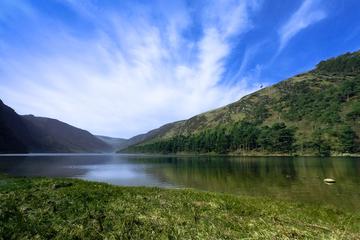
 The postcard-like view of the upper lake features green hills gently rolling into the water on your left and trees at the water’s edge on your right. Opposite you in the distance, a stream descends the mountain into the lake. This tranquil setting greeted St. Kevin almost 14 centuries ago.
Parking our car at the gate, we walked to the caher, a 60 foot diameter stone ring fort of unknown age. The caher may have been on site during St. Kevin’s time but those who constructed it were not. Kevin, known as a hermit priest, originally settled at Glendalough because of its isolation. Others later followed because they were drawn by the presence of this holy man.
 Walking on, you enter a grove of trees to find the derelict 11th century Reefert Church with its stone nave and chancel. This church was a major attraction for those on pilgrimage to Glendalough as St. Kevin’s relics were housed here after his death.
“Reefert” is derived from Righ Fearta meaning “the burial place of Kings”. History records that seven princes of the O’Toole Clan were interred at this holy site but their graves are not apparent in the churchyard outside.
Following a path beyond Reefert Church brings you to St. Kevin’s Cell. This basic home is believed to have been a “beehive-like” structure with a corbelled roof. Nothing remains other than the base. The pathway leading to St Kevin’s Cell was too muddy to continue so we ended our visit at this point and returned to enjoy the tranquil beauty of the upper lake over a picnic lunch.


The Rock of Cashel
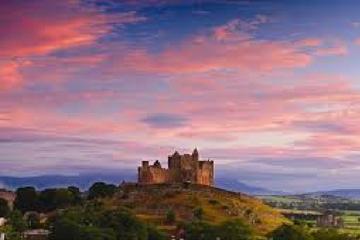
 Slowly Diane and I climbed to the summit of the 300-foot high limestone promontory known as the Rock of Cashel. At the top, we were rewarded with a panoramic view of the green fields of County Tipperary below and the town of Cashel at the base. Despite the presence of the town below, the rock feels isolated.
From the 4th century CE, the rock was used as a stronghold for the High Kings of Munster. Today visitors find no evidence of 1700 years of settlement. The oldest structure, dating to the 12th century, is the 90-foot round tower. This tower was constructed of fitted stones after King Muircheartach O’Brien donated the Rock of Cashel to the Catholic Church in 1101.
 Set next to the round tower, you find the shell of the second cathedral on site, dating to 1235. The current gray stone structure is cruciform with a central tower. The nave, which was never completed, is shorter than the choir. The north transept houses three sarcophagi, dating the 16th century, each with carved bas reliefs of the apostles around the periphery. The Protestant Church of Ireland abandoned this cathedral in the mid 17th century and then had the roof removed to collect the lead for ammunition. The cathedral lacks a roof to this day.
Cormac’s Chapel, built by Benedictine monks, stands next to the cathedral. Dating to 1134, this Romanesque chapel has a German influence in its construction. The Abbot of Regensburg sent two carpenters to help build the twin towers on either side at the junction of the nave and chancel.
 Inside the chapel, you find a white vaulted ceiling with plaster fragments falling off. The whitewash, dating from the Reformation in the 16th century, was used to cover the oldest frescoes in Ireland including those of the Nativity. An intricately carved sarcophagus at the back of the chapel might possibly be that of King Cormac himself.
Exiting the chapel, we again savored the magnificent view before us. Clouds were giving way to blue sky in the distance. Somehow the site felt a little less lonely with the birds singing.
Luxury Shore Excursion: Dublin Highlights and Glendalough Day Trip from Dublin
If You Go:
♦ Admission to Glendalough is 3 Euros.
♦ Admission to the Rock of Cashel is 6 Euros.
♦ You can also purchase the Heritage Pass. This provides free admission to the two sites outlined here.
♦ For more information about Ireland, visit www.plan-a-dream-trip.com/discover-ireland.html
♦ Plan your vacation at: www.plan-a-dream-trip.com
Kilkenny and Cashel Day Trip from Cork
About the author:
Troy Herrick, a freelance travel writer, has traveled extensively in North America, the Caribbean, Europe and parts of South America. His articles have appeared in Live Life Travel, International Living, Offbeat Travel and Travels Thru History Magazines.
Photographs:
Diane Gagnon is a freelance photographer who has traveled extensively in North America, the Caribbean, Europe and parts of South America. Her photographs have accompanied Troy Herrick’s articles in Live Life Travel, Offbeat Travel and Travel Thru History Magazines.
Glendalough – Priest’s House
Glendalough – Gateway
Glendalough – Cathedral
Glendalough – Caher
Glendalough – Reefert Church
Rock of Cashel – Cathedral and Round Tower
Rock of Cashel – Cathedral
View from the Rock of Cashel
 It is a sunny spring morning, perfect for a trip to Glendalough, an ancient “monastic city” set in a surround of Wicklow Mountains National Park, about an hour south of Dublin. Our local guide keeps us alert on the bus ride, pointing out the flora and fauna–the beauty of the yellow gorse which in other non-flowering seasons gets pelted with words such as weed, invasive, and noxious, the blossoming white thorn hedges, shades of green in the long vistas. As we zoom past farms and real estate signs, she chats about the state of the nation in this time of recession. “People cannot sell their properties; their mortgages are worth more than their houses. There is no longer a construction industry.”
 But the Roman church had crossed the choppy waters of the Irish Sea. Representatives had been dispatched from Rome in the 400s and the escaped slave Patrick had returned as a missionary in that same century. Glendalough was established in the early 500s by Coemgen (Caoimhin), St. Kevin. His Gaelic name means “fair-begotten.” Does it refer to his royal Irish birth or to his good looks? As a child, Kevin was tutored by Petroc of Cornwall, a Welsh-born Irish-educated saint. Kevin lived and studied with the monks and was eventually ordained himself.
 What compels me to forgo another day in Dublin for this side trip into the country? Being neither Irish nor Catholic nor even very religious, what can explain my interest in, my attraction to, this site? I have been to one of these ancient monasteries before–to Clonmacnoise on the River Shannon. Is it nostalgia, for that much earlier life-changing visit? It was from the friend who guided me to Clonmacnoise that I learned how to pronounce Glendalough. Glen da lock (loch). Not loo; it does not rhyme with slough, as I had incorrectly assumed that first time. Glenn da locha, the valley of the two lakes. The two communities were connected in the sixth century, by the friendship of Ceiran and Kevin. Both locations feature thirty-metre-tall round towers, thought to have been used like beacons, for navigating, as bell towers to signal distress, as safe storage for valuables such as psalters and illuminated manuscripts, and as places of refuge during times of attack. The monasteries include hermit cells, probably the only constructs that either saint actually touched. St. Kevin’s is a cave above the lake. The chapel, St. Kevin’s Kitchen, the rest of the existing ruins, date from between the ninth and twelfth centuries.
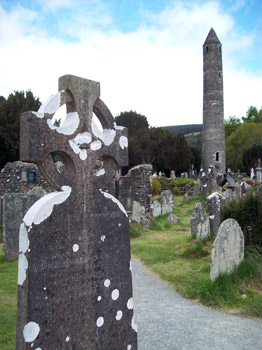
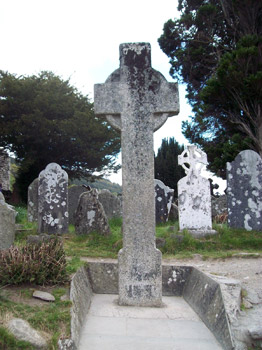
 Both monasteries contain a collection of ruined buildings with designations such as cathedral, church, chapel, along with a profusion of Celtic crosses and gravestones. Here those who found a community while living are surrounded still in a community of the dead. Both sites have high crosses–the Cross of the Scriptures at Clonmacnoise and St. Kevin’s Cross at Glendalough, and evidently, a second high cross, the Market Cross, in the visitor centre.

 Just outside the double-arched gateway is a midway of tents and caravans. Linen tea towels, woolen “jumpers,” potato scones, postcards. Today the market of souvenir and food vendors does not even make me think of the temple and the moneylenders. After all, everyone has to eat, and it is a recession, and loaves and fishes no longer magically appear.