Travel Thru History

Historical and cultural travel experiences

  • Home
  • Airfare Deals
  • Get Travel Insurance
  • Writers Guidelines

India: The Durga Puja Festival

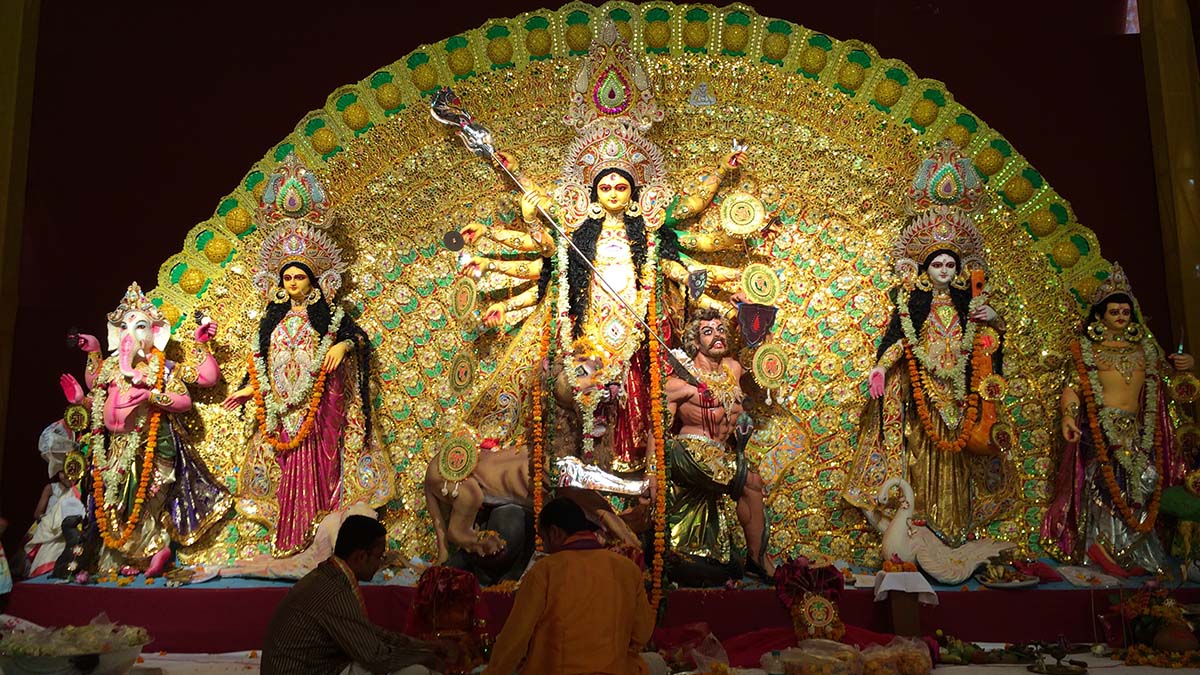
Goddess Durga and her four children

The Celebration of Victory of Good Over Evil

by Susmita Sengupta

Durga Puja, the celebration of the victory of the warrior Mother Goddess Durga over the buffalo demon Mahishasur, is a major annual Hindu festival in India. Although primarily a festival for Bengalis in the state of West Bengal, it is observed not just all over India but also around the world wherever Bengalis have made their homes. The festival dates are determined according to the lunar calendar and the days for the festivities are in the autumn in September or October. The festival period, also known as Navratri in the northern parts of India is ten days long. However, from the sixth day to the tenth it also becomes Durga Puja for Bengalis. The Puja season starts from Mahalaya which is seven days before the sixth day of Navratri or the first day of Durga Puja. Legend has it that on Mahalaya, the Goddess lets go of her fearsome fighter aspect and leaves her heavenly abode at Mount Kailash in the Himalayas to visit her earth mother with her children. On this day, devotees pray to their ancestors and it officially marks the arrival of Durga Puja. The Mother Goddess is invited to descend to earth through the chanting of mantras and by singing devotional songs.

For me, throughout my growing up years in India, Durga Puja meant dressing up in new clothes and visiting the puja venue not just for Anjali (the offering of flowers to the goddess with the accompaniment of Sanskrit mantras) but also to catch up with friends to compare notes on our clothes and accessories and finishing up with the biggest attraction, the delectable and mouthwatering selections of food.

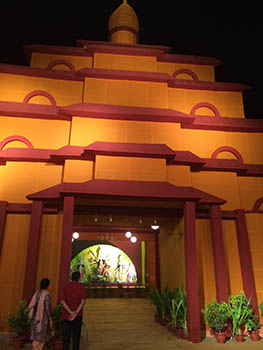
Durga idol inside a pandal (tent)Curiously, from the 1930s an early morning radio program has become synonymous with Mahalaya. This audio program known as “Mahishasur Mardini” or “The Destruction of Mahishasur” is a compilation of chants, devotional songs and recitations from “Chandi Mangala Kavya”, a holy scripture that can be translated as “The Auspicious Poetry of Chandi”, where Chandi is a namesake of Durga. These poems are a hallmark of medieval Bengali Hindu literature that eulogizes the worship of a particular god or goddess. Mahishasur Mardini was recorded by All India Radio and is narrated by Birendra Krishna Bhadra who, because of this recording is an iconic name in all Hindu Bengali households.

A favorite childhood memory of mine is of waking up at 4 am, the original broadcast time, to the sounds of this nearly two hour audio show, our home reverberating with the echoes of the sacred conch shell, and the recitation of the divine Sanskrit chants with a background of acoustic drama. In today’s modern world, it is not unusual to see Bengali families around the world turning to various other sources such as TV, CDs, and also the internet to hear this seven decades old Mahalaya audio montage to signal the beginning of the Puja season. That is what we do too. Early on Mahalaya morning we go to youtube and listen to the recording and an air of festivity fills up our home far, far away from India.

The story of Durga that is told in this audio program is as follows. There was increasing cruelty by the demon king Mahishasur in the world of gods. Unable to bear the tyranny any longer, the gods beseeched Lord Vishnu to help them. So the holy trinity of Vishnu (The Preserver), Brahma (The Creator) and Shiva (The Destroyer) got together and created Goddess Durga or Mahamaya, an all-powerful female form with ten arms. She was the Mother Goddess who emerged from the collective energy of all gods and was the primeval source of all power. She was then bestowed with the weapons of all the gods and blessed to do the needful. Armed thus like a warrior, Durga rode a lion into a fierce battle with Mahishasur, the buffalo demon king and slayed him with her trident. There was great joy in heaven and earth at her victory.

Thus the show ends with Sanskrit intonations invoking the blessings of Goddess Durga for all mankind. She is invited to come down to earth from the heavens which she does while accompanied by her four children, the goddesses Lakshmi (deity of wealth), and Saraswati (deity of knowledge, music, arts and wisdom), and the gods Kartikeya (god of war) and Ganesh (elephant headed god of auspiciousness and remover of obstacles).

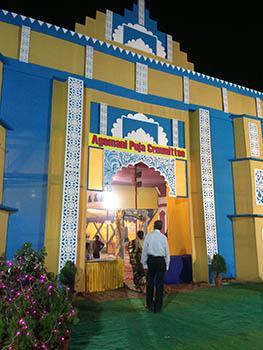
Following the day of Mahalaya, the preparations for Durga Puja begin in earnest. Statues of Durga and her children are put up in neighborhoods of cities, towns and villages. The artisans or idol makers had started their work in the month of July. Traditionally, a dollop of mud from a prostitute’s home is used to start the creation of the clay mix for the Durga idol. It is then mixed with clay from various sacred river beds and patted on to the basic grass model that gradually takes the idol shape. The idols are painted and dressed in the finest of silks and bedecked with flowers and jewelry and transported to all corners of India and even abroad for the Puja. In anticipation of the arrival of the idols, parks, community centers, or any available block of land is rented by Puja organizers weeks before the beginning of the festival. Money for all expenses is raised through donations and sponsorships by local residents and businesses. The venues are transformed into an arena for celebration by the putting up of pandals which is a kind of a temporary shelter or tent. While some of these pandals might just be a simple construct consisting of a large colored cloth on upright poles covering a swath of space, most nowadays are complex, artistic and architectural structures built exclusively with bamboo, clay, cloth and coir.

A beautifully designed pandalThe best of the innovative pandals with highly creative and inspiring decorations can be seen in Kolkata, in the eastern part of India, capital of the state of West Bengal and the true hub of Durga Puja. In recent years, pandals in Kolkata have taken shapes of the London skyline, Buddhist temples, illuminations of dinosaurs and other prehistoric animals, replicas of historic Indian temples and even highlighting issues of social cause such as empowerment of women. Pandals are lighted up with thousands of twinkling lights and chandeliers and devotees after entering would make their way in to see the Durga idol. Pandal hopping is now a time honored ritual of Puja and it is not unusual to see long lines of people waiting to get a glimpse of a magnificent pandal. The number of Pujas in Kolkata, whether communal or in households have numbered upwards of four thousand. An air of fun and frolic, devotion and gaiety fills up the city.

Durga Pujas in Mumbai, the financial capital of India, are highlighted by the glitz and glamor of Bollywood stars, some of whom being Bengalis, are the organizers of their community pujas. People crowd the pandals to get a glimpse of their favorite stars and getting bhog (holy food) served by them.

In the capital city of New Delhi, Durga Puja is primarily a neighborhood community festival, with all of them being organized by Bengali expatriates. There are close to 400 pujas in Delhi and while the city does not vibrate with the same energy as Kolkata, there is a definitive informal charm in the celebrations. That being said, in recent years some of the old, established puja pandals have started following the trend of themed pandals and pandal hopping too is coming to the fore.

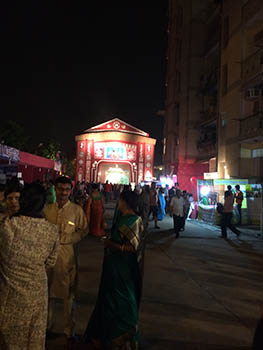
After a gap of almost twenty years, I visited a Durga Puja Pandal in New Delhi, India with my family and was immediately transported back to the days of my childhood. The crisp, cool autumn evening air was redolent with the sweet aroma of burning incense and the rhythmic beating of the dhaak drums.
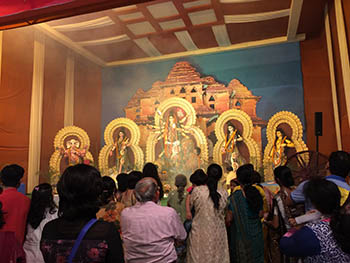
Devotees in front of the GoddessNo matter where Durga Puja is celebrated, whether in India or abroad, the rituals and traditions followed are the same, handed down over hundreds of years.

On Mahalaya, the first ritual of Durga Puja, known as Chokkhu Dan takes place. This means the bestowal of eyes to Goddess Durga. While all the idols are all dressed up and ready in the pandal, Durga’s face remains hidden, waiting for the auspicious moment of Chokkhu Dan, when the eyes are drawn on her face. The next six days are spent in final preparations for the five day event. Bengalis prepare by decorating their homes and buying gifts and new clothes for themselves, and their friends and family. Schools and colleges remain closed in West Bengal for Puja holidays though not anywhere else in India. Inside the pandal, the Puja area is filled up with all items needed by the priest for the prayers which would include clothes, fruits, flowers, vegetables and sweets. On one end of the pandal a stage would be built where entertainment programs of music, dance and drama take place in the evening on all five days. Some pandals will also have stalls selling clothes, books and jewelry where devotees can indulge in some festival time shopping. Providing meals for devotees is an equally important part of the celebration. These include lunch and dinner being provided sometimes for more than two hundred people at a time. All visitors, often times numbering in the thousands are also given bhog prasad which is the holy food offering made to the deity. It is also not unusual to see elaborate food stalls in the pandals, serving a variety of delicacies.

A Durga Puja celebration in a housing societyThe five days of the Puja are observed as Shashthi, Saptami, Ashtami, Navami and Dashami, also known as Vijayadashami or Dusshera which is also the penultimate day of Navratri. On Shashthi, the first day of Durga Puja, there is celebration of the arrival of the deity to the mortal abode of earth by the symbolic unveiling of her face. The next three days are devoted to the worship of the goddess, with devotees on all days offering Pushpanjali, meaning offering of flowers, accompanied by Sanskrit chants. Ashtami, the third day of the Puja is characterized by Sandhi Puja, when the goddess is worshipped in her warrior form to the accompaniment of 108 oil lamps and 108 lotus flowers along with clothes, jewelry, sweets, vegetables, fruits and flowers. Sandhi Puja which begins in the last 24 minutes of Ashtami ends with the arrival of Navami, the fourth day of the Puja.
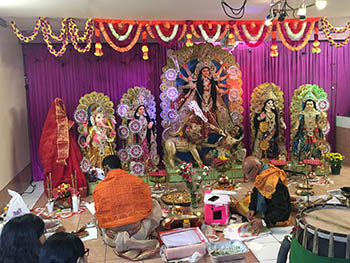
A Durga Puja in New YorkOn the last day of Dashami, all the idols are carried in a procession with much fanfare and are immersed in a nearby lake or river. This event, known as Visarjan, meaning immersion in water, marks the end of Durga Puja.

Although I had attended many pujas over the years in New York City, nothing beats the glory of experiencing Durga Puja in India. What is interesting is that a religious festival over the years has transcended to become a truly social and cultural event that is open to all.


If You Go:

Durga Puja is celebrated in virtually all cities and towns of India that has a Bengali population. If you are in India during the Puja dates, ask any local resident of the place you are in about the location of the local Puja as some of the towns will generally hold a much more intimate, neighborly Durga Puja. Almost all pujas are free to enter.

If visiting crowded areas is not your cup of tea, you can also check out the channel ABP Ananda if there is access to a television. The program Puja Parikrama, (where parikrama, a Sanskrit word meaning circumambulation around an object of devotion) shows viewers pandals from all over India and abroad and is a nifty way to experience Durga Puja without the hustle and bustle.

It is also possible to visit pujas on your own and it is better to visit the pandals during daytime to avoid the crowds. However, it is a magical experience seeing the brightly lit and decorated pandals at night.

Future Durga Puja dates:

2017: September 26 – 30
2018: October 14 – 18
2020: October 22 – 26
2021: October 11 – 15
2022: October 1 – 5

About the author:
Susmita Sengupta is a freelance writer who loves to travel. She and her family have visited various parts of the USA, Canada, Europe, the Caribbean, Middle East, Southeast Asia and India. She is a regular contributor at www.travelthruhistory.com

All photos by Susmita Sengupta
A close up view of Goddess Durga and her four children
Durga idol inside a pandal, the heavily decorated makeshift tent
A beautifully designed pandal
Devotees in front of the Goddess
A Durga Puja celebration in a housing society
A Durga Puja in New York
 

Tagged With: Durga Puja celebrations, India travel Filed Under: Asia Travel

India: New Delhi Before The Mughals

L-shaped building at Hauz Khas Complex

by Susmita Sengupta

New Delhi, the capital of India, or Delhi as it is more popularly known, belongs to that pantheon of world cities that have a continuous history of a thousand years and more. The first time that we hear of Delhi is in the epic Mahabharata where it is mentioned as Indraprastha. In the ancient Indian period, Delhi remained a Hindu kingdom but not many structures from those periods have survived to the modern times. The record and coverage of this extensive history truly began with the arrival of the Delhi Sultanate in the 12th century. The Delhi Sultanate had five dynasties that ruled successively. The first four were of Turkic origin and were the Mamluk Dynasty (1206-90), the Khilji Dynasty (1290-1320), the Tughlaq Dynasty (1320-1414) and the Sayyid Dynasty (1414-51). These were followed by the Afghan Lodi Dynasty (1451-1526).

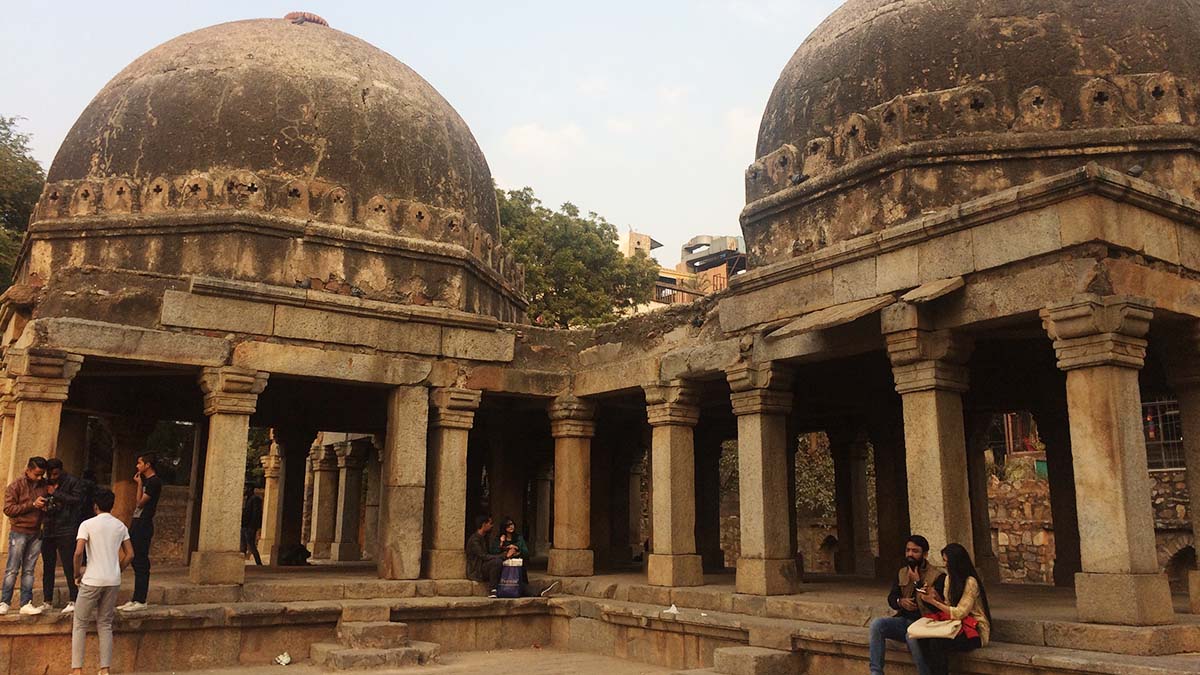
Hauz Khaz buildingOn our recent annual trip, my family and I decided to visit some of the oldest monuments in Delhi. We started at the Hauz Khas Complex, a set of monuments built during the reigns of Allauddin Khilji (1296-1316) and Feroz Shah Tughlaq (1351-1388). The area around the complex is where Khilji, considered one of the most powerful rulers of the Delhi Sultanate, set up his capital of Siri. This would be the third of the seven cities of medieval Delhi. It contains an Islamic seminary or madrasa, the tomb of Feroz Shah Tughlaq, a mosque, six domed pavilions and a water tank or Hauz Khas, meaning literally Royal Tank.
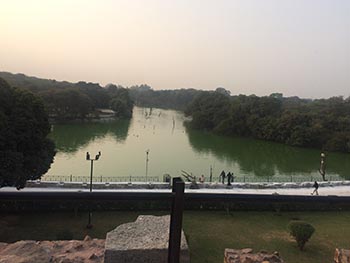
The tank was excavated during Khilji’s reign to meet the water demands of the growing population of Siri. It was used to collect water during the rainy season and then distributed to the people of the city. Originally known as Hauz-i-Alai, it fell into disrepair after the end of Alauddin Khilji’s rule and was cleaned and re-dug by Feroz Shah Tughlaq of the following dynasty. Although later on the reservoir went dry and remained so for centuries, recently the whole complex was renovated. Today the tank has again been refilled with water and the entire complex has been enhanced and preserved.

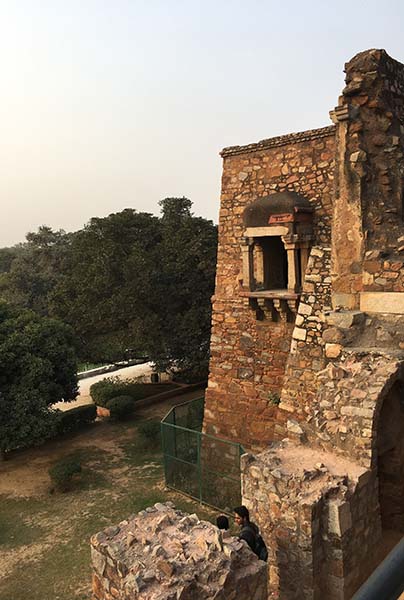
water reservoirThe cluster of buildings around the tank was added by Feroz Shah Tughlaq who built the Madrasa-e-Feroz Shahi in 1352, the Islamic school considered to be the largest in the world of that era, around the edge of the tank. The building is a two storied L-shaped continuous structure, stark and austere in the Tughlaq tradition and while today it is mostly in ruins, it was very easy to imagine it as being filled with students learning in its grand rooms. On this cold January evening, the area was jam-packed with visitors, young and old, tourists, locals, school and college going kids, all enjoying the warmth of the late sunlight. We too decided to sit down for a while, surrounded by people, and enjoyed the newly landscaped vista of trees and pathways around the tank.

To our front was the lake, surrounded by greenery, the shimmering sun ready to set over it and to our side were the domed pavilions, glowing in the light of the early evening, perhaps the tombs of the teachers at the madrasa. No one really knows for sure. At the junction of the two wings of the seminary, stood the tomb of Feroz Shah Tughlaq himself, a square mausoleum with a high dome. It is unusual because it has all the elements of Buddhist, Hindu and Islamic architecture.

The notorious Turkic invader Timur, also known as Tamerlane, who raided Delhi in 1398 to wage a holy war, set up camp in Hauz Khas. It is interesting to note that while he ransacked the riches of Delhi, he documented the Hauz Khas monuments in his memoirs. “When I reached its gates, I carefully reconnoitered its towers and walls, and then returned to the side of the Hauz-i Khas, a reservoir constructed by Sultan Firoz Shah, and faced all around with stone and cement. Each side of this reservoir is more than a bow-shot long, and buildings are placed around it. It is filled by the rains in the rainy season and supplies the people of the city with water throughout the year. The tomb of Sultan Firoz Shah stands on its bank,” wrote Timur in Turkish which was translated into Persian nearly two centuries after his death in 1405.
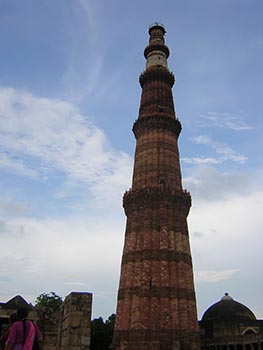
Qutb Minar ComplexAt the Qutb Minar Complex, we entered an even older world. The construction of Qutb Minar, a red and buff sandstone tower, was begun by Qutbu’d-Din Aibak in 1199 CE. Aibak was the founder of the Mamluk dynasty, also known as the Slave dynasty. He was a slave of Mohammad Ghori, a sultan of the Ghurid Empire whose reign spread from modern day Afghanistan to the eastern parts of India. Ghori returned back to Khorasan in Afghanistan after conquering Delhi and left Qutbu’d-Din Aibak as his military commander. And thus he became the first Sultan of Delhi.

The buildings in this complex laid the foundation for the beginning of the Indo-Islamic style of architecture, an assimilation of both the Indian Hindu and Islamic styles of art and building. But then again there was no specific standardization as the architectural styles would vary according to a particular region of India. This amalgamation came about because the Muslim rulers had no other option than to use the local artisans, sculptors and craftspeople who were set in their own styles and traditions.

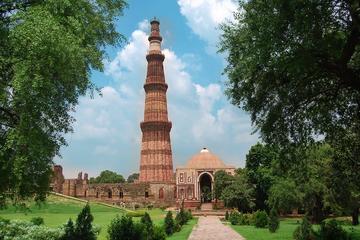
Minaret at Qutb MinarThe Qutb Minar stands tall at 72.5 m (238 feet) and is the tallest brick minaret in the world. It is a fluted tower of alternating angular and circular sectors built for the muezzins for calls to prayer. There are five stories, each of which has a projecting balcony decorated with beautiful stone brackets. The surface of the minar (tower) has floral decorations and numerous carved inscriptions in Arabic which highlight its history. After Aibak built the first level in 1199 CE, three more levels were added by Sultan Iltutmish (1211-1236 CE), Aibak’s successor and son-in-law. As per the inscriptions, more repairs were done by Feroz Shah Tughlaq of the Tughlaq dynasty and Sikander Lodi (1489-1517 CE) from the Lodi dynasty.

The day was bright and sunny when we entered the Qutb complex, a UNESCO World Heritage Site, designated so in 1993. Just like at Hauz Khas, here too inspite of the throngs of tourists and locals, and the cacophony of the Delhi traffic just outside the complex gates, one can immediately feel being transported to a different world. We craned our necks upwards to check out the Arabic calligraphy stunningly carved into the red sandstone facade of the tower. The Qutb Minar is a landmark in Delhi, being visible from way beyond the grounds of the complex. There are 379 steps in the interior to reach the top although entry inside has been banned for a long time.

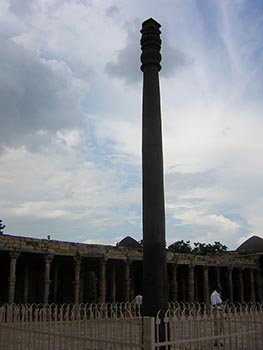
Iron Pillar of Delhi,All around us were the remnants of a bygone era, even dating back to the Iron Age. There was the Iron Pillar of Delhi, from about 375 CE, with inscriptions that tell us it was built during the Gupta dynasty reign often known as the Golden Age in Indian history. The pillar, about 24 feet tall is made of 98% pure iron and still hasn’t shown much signs of rusting. According to some historians, the pillar, originally located in a Vishnu Temple complex in Udayagiri in the state of Madhya Pradesh in Central India was brought to this site by Aibak when he started the construction of the Quwwat-ul-Islam Mosque in 1198. The Brahmi inscriptions on the pillar, still preserved intact due to the corrosion resistant iron, show homage to a king named Chandra, whom historians have identified as Gupta King Chandragupta II from the late 4th century CE.

The pillar stands in the courtyard of the Quwwat-ul-Islam Mosque, the largest mosque from that era. The earliest surviving mosque built by the Delhi Sultans, it was also expanded later on by Sultan Iltutmish and then by Alauddin Khilji. It consists of a large courtyard with columns from Hindu and Jain temples that were destroyed by Qutbu’d-Din Aibak. We get to know this from the inscriptions on the main entrance. The Iron Pillar stands in the courtyard of the mosque. The other structures in the complex includes the Alai Minar, which was begun by Alauddin Khilji, who envisioned a tower taller than the Qutb. But construction after the first story was abandoned after Khilji’s death in 1316 and today it stands as a 24.5 meter high tower of rubble.
Nearby stands Alai Darwaza, which due to a crunch for time we were unable to explore. Built in 1311, by Alauddin Khilji, it was one of four planned gateways to the Quwwat-ul-Islam mosque except that this was the only one that got built as Khilji died in 1316. A massive gateway with inlaid marble decorations and latticed screens, it is again a superb example of Indo Islamic architectural style.

The Qutb complex has various other monuments like the tombs of Sultan Iltutmish, and Alauddin Khilji and also the ruins of a madrasa or Islamic seminary built by Khilji. One really needs an inordinate amount of time to explore this complex and the surrounding Mehrauli Archaeological Park in its entirety and regretfully we did not have that.

As the evening crept up on us, we left the complex promising ourselves to make a return trip on our next visit to Delhi.


Independent Old and New Delhi City Tour in Private Car – $56.25

from: Viator

If You Go:

Hauz Khas Complex is accessible from all areas of Delhi using any kind of transportation. The closest metro stop is Hauz Khas Village on the Yellow Line. Green Park metro station, again on the Yellow Line can also be used.

Visitors to the ruins can also check out the adjacent Deer Park, home to spotted deer, peacocks, rabbits and local and migratory birds in a beautifully landscaped park. The ruins are set amidst a residential and commercial complex known as Hauz Khas Village which as of itself is a major tourist attraction. A real village that was transformed when a fashion designer opened a boutique here decades ago, the place is now chock full of trendy stores, restaurants, cafes and art galleries all existing cheek by jowl on winding, crumbling streets festooned with a jumble of electric wires hanging overhead.

Qutb Minar Complex is again easily accessible by all modes of transportation. The closest metro station is Qutb Minar also on the Yellow Line.

While we made these trips in hired cars, taxis, auto rickshaws and cycle rickshaws are available outside all metro stations and can be used to reach the destinations.

About the author:
Susmita Sengupta is a freelance writer who loves to travel. She and her family have traveled to various parts of the USA, Canada, Europe, the Caribbean, Middle East, Southeast Asia and India. She resides in New York City with her family.

All photos are by Susmita Sengupta:
The magnificent domed L-shaped building
A close up of ruins at the Hauz Khas complex
The Royal Tank or Hauz Khas now filled with water
Ruins at the Qutb Minar complex
The Qutb Minar
The Iron Pillar

Tagged With: India travel, New Delhi attractions Filed Under: Asia Travel

India: A Pleistocene Flashback in Lonar

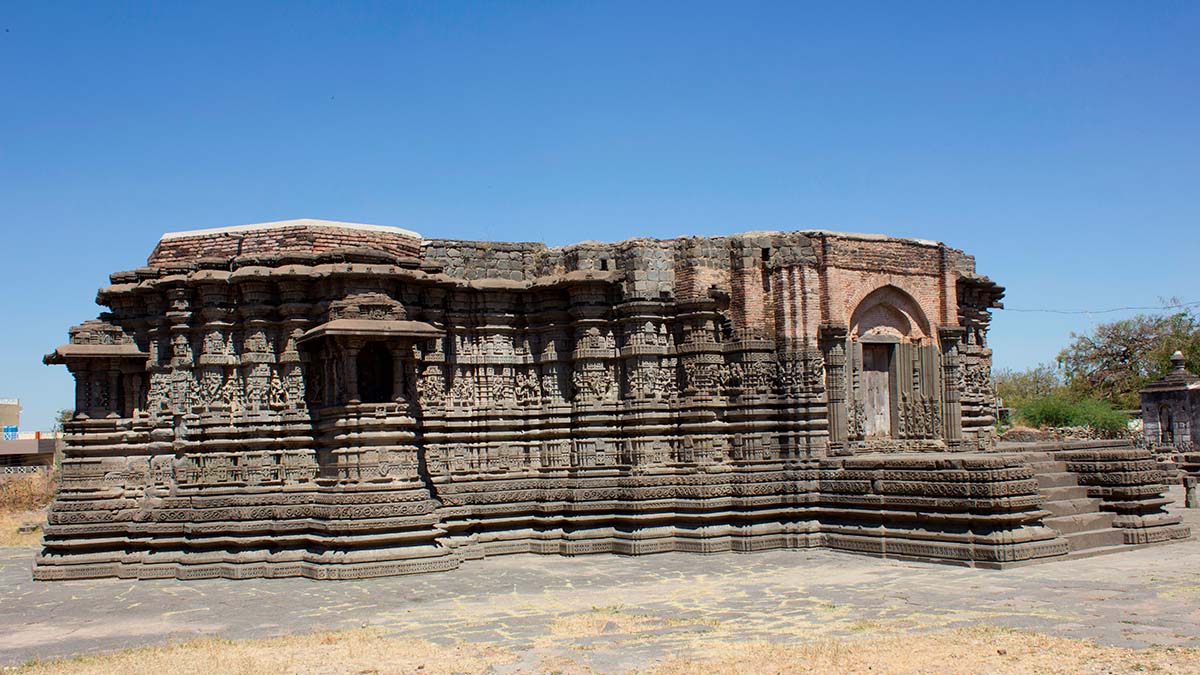
Daityasudan Temple

by Durgesh Nadkarni 

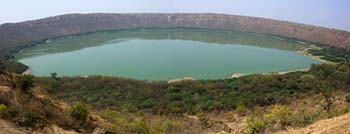
I was standing at the edge of the bowl-shaped hill hypnotized by the beauty of the aquamarine lake that lay glittering in the basin below – low-lying hill, dense forest and a tranquil lake. I stood there in awe when suddenly my mind took me eons back. 52,000 years ago a visitor from outer space weighing approximately 2 million tons traveled at a speed of 90,000 km/hr to meet the Earth. The visitor was a meteorite and what resulted from their encounter was an impact so severe that it formed a crater on the Earth 1.8 km in diameter. Standing at the upper rim of that very crater now, even a slight visualization of that Pleistocene phenomenon made me shudder from within. The crater is the largest impact crater in basaltic rock in the whole world today – the Lonar Crater. After the meteorite impact a perennial stream started running into the crater and over millennia the impact crater metamorphosed into a picturesque lake surrounded by dense forest. This lake is known today as the Lonar Lake.

Lonar lakeThe Lonar Lake finds reference as Viraj Tirtha in ancient Indian literature such as in the Skanda Purana and the Padma Purana. A poetic description of the lake can also be found in Canto XIII of the Raghuvansham of the renowned classical Sanskrit poet Kalidasa. In this epic poem the hero, Lord Rama, while flying in the skies with his consort Sita, lyrically describes the lake to her as: “glimmering from amidst the surrounding dense forest like the orb of the moon in a fleece of clouds.”

Tempted by the glamour of the lake I decided to walk down all the way to its waters. The Dhar Temple Complex (also known as the Gomukh Temple) on the upper rim of the crater is a nice point to begin your descent to the lake. The complex consists of Hindu temples dedicated to Narsimha, Ganesh, Renuka, Shiva and Vishnu.

Dhar Temple ComplexThe pillars of the porches of these temples depict carvings from Hindu mythology.

A flight of steps from the temple complex led me down to the Lonar Lake.

The water of the lake is extremely salty and has a very high pH value, indicating high alkalinity. Yet despite the high alkalinity algae of a peculiar kind thrive in the waters of the lake. The lake and the surrounding area are also home to several water birds. I could spot the Rudy Shelduck (Tadorna ferruginea), Black-winged Stilt (Himantopus himantopus) and Red-wattled Lapwing (Vanellus indicus) among others. Adding a dash of history to the lake are the numerous ancient temples lying in the surroundings. I decided to do a circumambulation of the lake and say “Hello” to the ancient temples dotting its periphery. Sadly, most of these temples are now ruined and deserted. Worth mentioning though are the Yajneshwar Temple, Wagh Mahadev Temple and Kamalja Devi Temple. The Yajneshwar Temple has fine carvings and the Wagh Mahadev Temple, though plain from outside, is finely carved from inside, especially on the roof and on the pillars. Disclaimer – one has to tolerate the obnoxious stinking of bat droppings that litter the interiors of this temple.
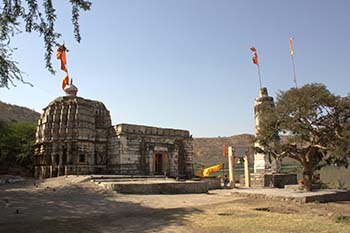
Kamalja Devi TempleThe Kamalja Devi Temple is the most famous and the most frequently visited of all the temples surrounding the Lonar Lake. And rightly so. The ambience here is pleasant and there is ample shade in case you need some rest. You could also spend a few moments watching the langurs or staring at the parrots whose shrill cries are sure to attract your attention. In addition, this is the only place near the lake where you can fill your quota of drinking water, in case you have exhausted your own.

Going around the lake is a pleasant walk especially if you are at the lake in the morning and should not take you more than 2 hours to complete the walk. Make sure though that you carry sufficient water along with you. If you have time at hand you can also explore the area watching water-birds or visiting the old temples around like I did.

Back to the Dhar complex with my mission of circumambulation accomplished, my next destination at Lonar was the Limbi Barav (Limbi Step-well). The Limbi Step-well is not close to the Lake but lies in the heart of Lonar village. The step-well is a fine piece of water architecture of the bygone era. At present though it is in a state of disuse.

Last on my Lonar to-do list was the Daityasudan Temple which dates back to the period of the Chalukyas (6th to 12th c. CE). The temple is dedicated to Lord Vishnu in his avatar of Daityasudan.

Hindu mythology is replete with duels between gods and demons. The demons are satanic bullies who keep harassing the populace (and sometimes even the gods) and wreak havoc until, at one point of time, the gods can take it no more. The onus of getting rid of a troublesome demon lies, more often than not, on Lord Vishnu who by some cunning kills the demon and restores peace, thereby establishing the triumph of good over evil. One such instance occurred at Lonar, say the Puranas, where Lord Vishnu killed a demon by the name Lavanasur. This act of Lord Vishnu earned him the epithet of ‘Daityasudan’, the Demon-slayer.

Carvings on Daityasudan Temple pillars The exterior of the Daityasudan temple is a fine piece of ancient Indian sculpture.

The temple has an irregular stellate plan and is replete with layers of carving even on the plinth. The temple friezes are also a treat to the eyes. Being a Vishnu temple, the avatars of Lord Vishnu adorn the friezes galore.

With the Daityasudan Temple ended my daylong excursion to Lonar and I headed back to Aurangabad from where I had begun the excursion in the morning.

You may be a geologist or astronomer or bird-watcher or temple enthusiast or nature lover or even an ordinary tourist. Lonar is a multi-faceted place with something for everyone.

1


If You Go:

Lonar is the headquarters of the Lonar taluka and is situated in the Buldhana district of Maharashtra state in western India.

The most convenient city to visit Lonar is Aurangabad which is also the nearest airport. Aurangabad is well-connected to major cities in India both by air and road.

Distances from major cities of Maharashtra:
Aurangabad – 170 k.m.
Pune – 400 k.m.
Mumbai – 550 k.m.
Nagpur – 390 k.m.

Where to stay:
Sight-seeing in Lonar should not take you more than a day’s time. One can arrange a day’s excursion by staying at Aurangabad city. However, in case you wish to stay in Lonar your best choice would be the MTDC resort near the Lonar Lake. MTDC stands for the Maharashtra State Tourism Development Corporation.
Suggestion: It may be a convenient option to visit Lonar along with the UNESCO World Heritage sites of Ajanta and Ellora Caves situated in Aurangabad district.


The Famous Ajanta Caves – A World Heritage Site Tour with Private Transfer – $77.00

from: Viator

About the author:
Durgesh Nadkarni is a travel enthusiast passionate about traveling to unsung destinations, be it heritage sites or places of natural beauty. He loves to explore history, culture, art and architecture and loves photography and poetry. He is a regular contributor of photographs on www.stepwells.org.

All photos by Durgesh Nadkarni
Daityasudan Temple
Lonar Lake – from the upper rim
Dhar Temple Complex
Kamalja Devi Temple
Daityasudan Temple – Carvings on pillars

Tagged With: India travel Filed Under: Asia Travel

India: Lalbagh Botanical Gardens

Lalbagh gardens

Flower Power in Bengaluru

by Rashmi Gopal Rao

Flowers always make people better, happier, and more helpful; they are sunshine, food and medicine for the soul.”
– Luther Burbank

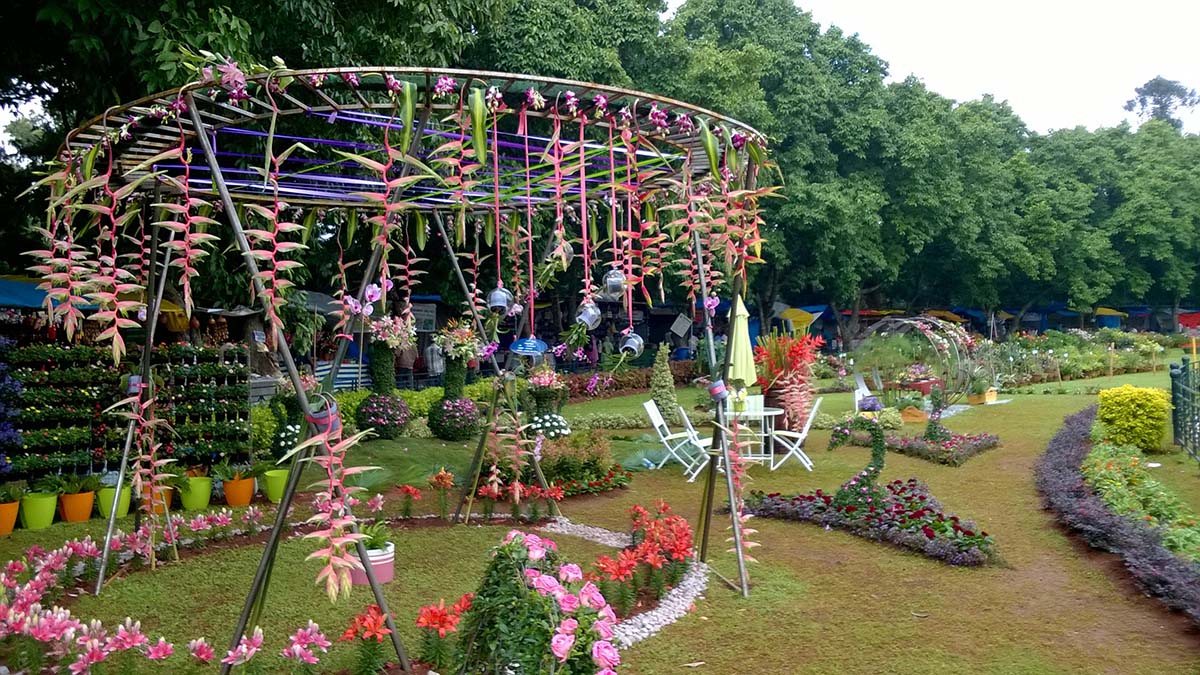
If you love flowers and feel like what Luther Burbank says, you must visit Bengaluru’s bi-annual flower show at Lalbagh Botanical gardens, easily one of the city’s best known landmarks. The show that coincides with India’s Republic Day (26-Jan) and Independence Day every year is usually a 10 day long extravaganza of everything related to flowers. Also one of the best lung spaces in the city (the other being Cubbon park), Lalbagh must be on your must-do on your next trip to Bengaluru. The sprawling gardens is one of the spaces that has stood the test of time as the city gradually transformed from the “garden city” to the “silicon valley of India”. Founded way back in 1760, this 240 acre space is a lush green haven in the heart of the city. Depleting green spaces in the city, have made this erstwhile royal and private garden a universal favorite with early morning walkers, joggers, bird watchers and photographers alike. One of the main reasons for this is that the place is a ‘treasure house’ of rare plant species from across the world and boasts of a whopping 1,854 species of plants and trees!

A Riot of Colour

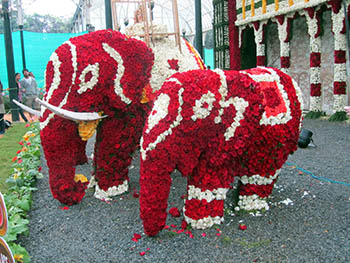
flower arrangementLalbagh is currently under the aegis of the Directorate of Horticulture, Government of Karnataka which organizes the biannual flower show. One of the much awaited events of the year, the show boasts of interesting and awe inspiring themes year after year. The themes have been varied and equally stupendous each time, whether it is the flower decked Eiffel tower, Mysore Palace or the world famous Dasara procession. All pieces are exhibited in the glass house of the garden. Last year’s Independence Day’s theme which incidentally happened to be the 202ndаflower show was Royalty with the centre piece being the replica of the Bangalore palace.

floral structureThe floral structure was decked with a jaw dropping figure of close to 3 lakh Dutch roses. There were also five life-sized replicas of erstwhile maharajas of Mysore, including the ‘Nalwadi Krishnaraja Wadiyar, Jayarahamaraja Wadiyar and Srikantadatta Narasimharaja Wadiyar.’ These stunning pieces are created by a team of highly talented experts who not only work in tandem weeks prior to the show but also make sure that the flowers are meticulously maintained during the 10-odd day display. They are watered, changed and taken care of so that their fresh look is retained. Apart from the main pieces there are hundreds of aesthetic decorations using rare flowers including spectacular orchids within the glass house.

A Complete Show

horticultural displayApart from the decorations, the last show saw over 200 farmers from across Karnataka display rare and unique farm produce to demonstrate the emerging horticulture technologies. Visitors were also shown easy terrace garden vegetable growing methods to encourage everyone to get into gardening. Each year there are 100-odd stalls where you can learn and pick up anything related to gardening, landscaping, organic produce and the like. The sand sculpture of A P J Abdul Kalam and the unique elephant created using 600 capsicums had about 5 lakh people thronging the venue that year. The theme and signature “centre piece” that is the cynosure of all eyes is decided closer to the D-dates

There is a nominal entry fee for the show and the timings are from 9 am to 6 pm. Apart from the flower show, Lalbagh itself is an important resource centre in the dissemination of scientific and technical information of plants in addition to development of horticulture. This unique gem of the city is located in the South Bengaluru and has four approach gates. The main gate is at the North facing towards Subbaiah circle, the West gate is towards Basavanagudi, the South gate is towards Jayanagar and the East gate is towards the Double Road. The Bandstand, Pigeon house and the lake which is home to a number of avian species including migratory birds are points of interest in the gardens.

If You Go:

By air:

Bangalore is well connected to most important cities within and outside India via the Kempegowda International Airport that is about 40km away from the city centre.а You can hire cabs or take buses from the airport to Lalbagh.

By train:

The two important railway stations – Bengaluru City Railway Station and Yeswantpur Junction connect a number of cities and towns within India to the IT city.а From the station, you can easily hire autos, cabs or even take a bus to visit the attractions of the city including Lalbagh.

By road:

Bangalore is well connected by a network of state government and private buses that ply to and fro from major towns and cities of South India.


Cultural tour of Bangalore – a day trip

About the author:
Rashmi Gopal Rao is a freelance writer and blogger. She is from Bengaluru, India and writes for a few travel websites.а Her hobbies include traveling, reading, writing and photography. She is also passionate about home decor and gardening.а You can follow her on her blog, www.rashminotes.com.

All photos by Rashmi Gopal Rao.

Tagged With: Bangalore tours, Bengaluru attractions, India travel Filed Under: Asia Travel

Ancient Baolis of India

Rajon Ki Baoli

Step into the Magnificent Architecture of Step Wells

by Papiya Banerjeeby

Baolis are step wells or reservoirs which were used in ancient India for storing water.

Water conservation has always been one of the prime motives of man. Countless cities have been abandoned due to water crisis and we still face dire consequences of droughts all over the world.

The ruling clans of India, over the ages, have made many such baolis all across the states. They were put to use in many different ways. While conserving and storage of water remained their primary purpose, separate baolis were made for bathing and drinking purposes.

Steps were made so that when the water levels go down; people would walk to the well and draw water.

Baolis go many stories down and hence have a very cold vibe inside the structure. It is also believed that these places were used as communal meeting points where social gatherings were also held and religious offerings were made.

Delhi, the capital of India was the seat of power for many empires. It is believed that Delhi had once over 100 baolis across the city however today only 30 or so remain and out of which one a couple of them are worth a visit.

The passage of time has not been very progressive for these structures, however the Archeological Survey of India is doing its best to save whatever it can of some of the monuments and return the baolis back to their glorious days, albeit the water.

The baolis are a must visit as they give insight into the era gone by.

While in Delhi, the following are a must visit for any history and architecture enthusiast.

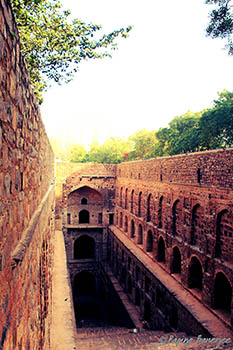
Agrasen Ki Baoli 1) Agrasen Ki Baoli

Location: Hailey Road, Connaught Place

Nearest Metro Station: The Janpath and Barakhamba Road Metro Stations lie closest. Take an auto rickshaw from the metro station.

Baolis such as this were used to for very efficient rain water harvesting and used throughout the year for the common people.

Due to the cold air which arose from the baoli, it was a sanctuary for meditation, rituals and even other forms of relaxation and rejuvenations.

Agrasen Ki baoli is believed to be built by the 14th century King Agrasen (or Ugrasen). It stands in the midst of a very busy and bustling street of Delhi, Connaught Place.

The skyline of Delhi’s new buildings can be seen looming over.

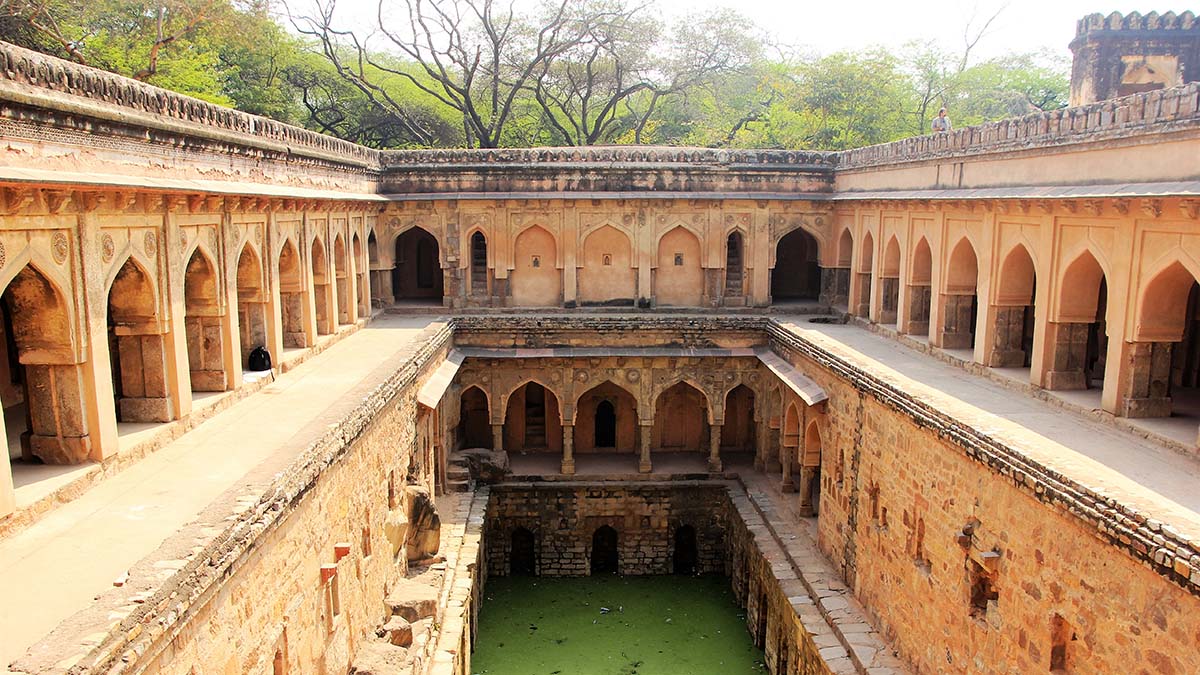
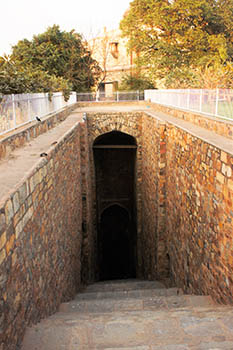
2) Rajon Ki Baoli [TOP PHOTO]

Location: Inside Mehrauli Archeological Park, near the tomb of Jamali Kamali

Nearest Metro Station: Qutub Minar

This is one of the prettiest baolis after the Agrasen Ki Baoli and is situated in between the lush and green Mehrauli Archeological Park. This baoli is believed to have been used by the Masons and the other highly casts and hence has a different level of architectural sophistication to it.

Water has always held a special place in Hindu mythology and Hindus even have a dedicated deity called Ganga, who is till date very fondly revered. Some say that the step wells formed a path between the earth and water and hence, one can take the spiritual journey by ascending the path.

These step wells show the intelligence of the architectures and expertise of the India eras gone by.

3) Gandhak Ki Baoli

Location: Near Mehrauli Archeological Park, 100 m south of Adam Khan’s Tomb towards the Dargah of Qutub Sahib

Nearest Metro Station: Qutub Minar

This is the baoli of the common people. It acts as a proper reservoir and still holds water, albeit its color has turned green. The structure is surrounded by a highly populated village and one can only imagine its plight over the years

You will, however, see a lot of young boys still jumping over into the water during summers and enjoying their own little oasis.

These step wells are called by many names in other parts of India, it is known as a baori, bawdi, baoli, or vav.

Old Fort (Purana Qila) Baoli4) Old Fort (Purana Qila) Baoli

Location: Old Fort Complex, Mathura Road, Delhi

Nearest Metro Station: Pragati Maidan, from there take an auto rickshaw till the Old Fort

Old Fort is a magnificent monument in itself, as it comprises of many other monuments which hold very high significance amongst the historians and one of them being a baoli. This is also one of those monuments which are protected by the Government of India. It is a must visit.

Step wells usually are made up of two main parts: One, a well which is dug underground to draw and store water, secondly the steps and chambers made around it to access that water. In most of the step wells there are decorative chambers which often were used as resting places during the hot summers.

Red Fort Baoli 5) Red Fort Baoli

Location: Netaji Subhash Marg, Chandini Chowk, Delhi

Nearest Metro: Chandni Chowk

The Red Fort Baoli is mostly hidden because not many know it even exists, but its one beautiful structure.

It is made of an L shape and has chambers from all four sides. The perfect masonry is visible in this architecture. Situated inside the Red Fort, it tells tale like no other.

This Baoli’s chambers were used as prison cells by the British Empire to lock Indian soldiers. Etched in the stones are the names of the commanders and soldiers who were captured and locked in this step well.

6) Baoli of NizamuddinLocation: Nizamuddin Dargah complex

Nearest Metro Station: JLN metro station

This is another Baoli which is in use till date and is used as a swimming pool for the locals who live around the Nizamuddin Village. This baoli has been known to have special medicinal properties due to the present of sulphur in the water.

During the British rule, the use of the Step well declined as the British found them to be unhygienic and unsanitary for bathing and drinking

7) Rama Krishna (R.K.) Puram BaoliLocation:  Sector 5, R. K. Puram

Nearest Metro: AIIMS

This Baoli is a part of other group of monuments in the same area and is famously known as the Wazirpur Complex Monuments. There are tombs and mosques with a garden surrounding this baoli.

It is hidden in plain sight since the construction of modern buildings has seemed to shadow the monuments over a period of time.

Its construction is different in a sense that it holds two turrets at the east side (domed towers).

8) Baoli of Qutub Sahib

Location: Dargah Hauz Kaki, Mehrauli

Nearest Metro station: Central Secretariat

This is situated very nearby the Gandhak Ki Baoli in Mehrauli. Definitely visit the Dargah of Qutubddin Bakhtiyar Kaki.

Gradually it is being realized that the ancient forms of architecture, not only were a showcase of craftsmanship but made a lot more ecological sense. The way water has been stored and circulated from these step wells, we definitely have a lot to learn.

9) Ferozshah Kotla Baoli

Location: Ferozshah Kotla Fort, Bahadur shah Zafar Marg, Delhi

Nearest Metro Station: Pragati Maidan

This Baoli lies inside the fort complex of Feroz Shah Kotla. The Baoli is mostly kept under lock and key since it still acts as a reservoir and is used to water the gardens.

It is believed that every Thursday the doors of the Baoli are opened (by unknown forces) and people from all over the country come here to offer their prayers to Djinns.

What are Djinns you ask? Well that’s a very vast topic. They are definitely not gods nor ghosts but are known as messengers. They are believed to be granting wishes of the devotees. Well you can write a letter to the Djinns and you might just get what you wished for.

10) Tughlaqabad Fort Baoli

Location: Mehrauli – Badarpur Road, Tughlaqabad

Nearest Metro Station: Tughlaqabad

This Baoli is situated inside the fort ruins of Tughlaqabad and is surrounded by dense jungles. Take the Guard along with you if you plan to visit this one. There are no specific trails since only the ruins are left. But nonetheless since it’s inside the fort premises, the fort itself was a magnificent structure and worth a visit.

If You Go:

Points to remember:

  • Most of the Baolis are unguarded hence please take special care of your belongings
  • These structures are 100s of years old hence rickety, be very careful while navigating the steps
  • Most of them follow a time schedule of sunrise to sunset
  • There are NO entry fees
  • Photography is allowed
  • These places are absolutely SAFE to visit during daytime. Preferably with company.


Private Delhi City Tour Including New Delhi and Old Delhi

About the author:
Papiya Banerjee is a passionate traveler, soulful photographer, book-aholic and a full-time foodie, in that order. She left her highly paid human resource job of 10 years to travel full time and capture stories through her lens and in the bargain has made spiritual discoveries and made some pretty cool friends. Email: pbanny@gmail.com.

All photos copyright Papiya Banerjee
Rajon Ki Baoli
Agrasen Ki Baoli
Gandhak Ki Baoli
Old Fort Baoli
Red Fort Baoli

Tagged With: Delhi attractions, India travel Filed Under: Asia Travel

  • « Previous Page
  • 1
  • 2
  • 3
  • 4
  • 5
  • …
  • 11
  • Next Page »

MORE TRAVEL STORIES:

Slow Travel in Hangzhou: Tips for Staying Comfortable and Fresh Around West Lake

Impressions of Homer’s Ithaka

A guide to historically significant sites accessible only by water

Grand Bahama in the Wake of Hurricane Dorian

Affordable Business Class Tickets to Asia: Tips & Strategies

Israel: Leading to Temptation in Jericho

Resorting to the Arcane

Discover 15 Stunning Instagrammable Spots in Manchester


SEARCH

DESTINATIONS

  • Africa Travel
  • Antarctica travel
  • Asia Travel
  • Australia travel
  • Caribbean Travel
  • Central America Travel
  • Europe Travel
  • Middle East Travel
  • North America Travel
  • Oceania Travel
  • South America Travel
  • Travel History
  • Travel News
  • UK Travel
  • Uncategorized
  • World Travel
facebook
Best Travel Blogs - OnToplist.com

Copyright © 2026 Cedar Cottage Marketing | About Us | Contact | Privacy Policy | Terms & Conditions | Copyright Notice | Log in