Travel Thru History

Historical and cultural travel experiences

  • Home
  • Airfare Deals
  • Get Travel Insurance
  • Writers Guidelines

Skara Brae And Its Many Mysteries

stone ruins at Skara Brae

Scotland: The Orkney Islands

by Alexis Brett

Nestled on a small island just north of the Scotland mainland lies an ancient site that is just begging to be explored.

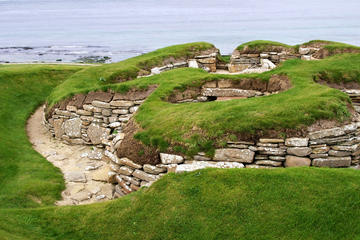
Skara Brae shorelineSkara Brae, a prehistoric village that was built before the Egyptian pyramids, has been listed as one of the “Heart of Neolithic Orkney” World Heritage Sites, and it illustrates a perfect example as to why the Orkney Islands have often been referred to as “The Egypt of the North.”

Because of the many mysteries surrounding both the abandonment and the discovery of Skara Brae, researchers have coined the site as “one of the most remarkable discoveries in modern archaeology” as it contains one of the best preserved Neolithic villages known to mankind.

“Skerrabra”
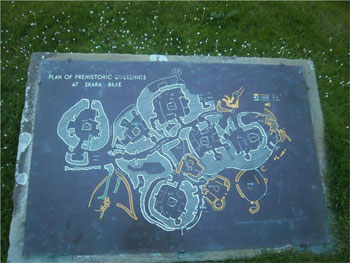
plan of Skara Brae prehistoric sitesSkara Brae is approximately 5,000 years old and is located about eight miles away from the small town of Stromness on the southern shore of the Bay O’ Skaill. Although it was originally thought that the site was a Pictish village, researchers now believe that the settlement was actually an Orcadian village that was inhabited between the years of 3200 and 2200 BC.

Even though it was deserted thousands of years ago, the village still remains in mint condition and to this day researchers still can’t pinpoint exactly why the last inhabitants left; which only adds to the mystery surrounding Skara Brae.

Skara Brae was discovered in 1850 after a severe windstorm “ravaged” the Orkney mainland and uncovered the land that was sheltering the abandoned settlement for thousands of years.

The first person to discover the site was William Watt of Skaill, who at the time resided at the Skaill House which is located no more than 200 metres away from Skara Brae. (Ironically enough the Skaill House is also said to be haunted as there have been reports of people seeing a ghostly figure of a woman wearing a shawl in one of the windows).

The Skaill House was built in 1620, and even though the Skaill family owned the house for two hundred years before the discovery of the village, none of its former residents had realized just what was sitting in their backyard underneath the piles of sand and dirt.

But it wasn’t until 1925 when another storm revealed even more of the village, and it was at that time when researchers truly realized the treasure that had been literally under their noses the whole time. A sea wall was then built to protect the newly discovered settlement, and soon after scientists uncovered a village with eight different houses, each of which were linked together by underground passages.

A day in the life of Skara Brae
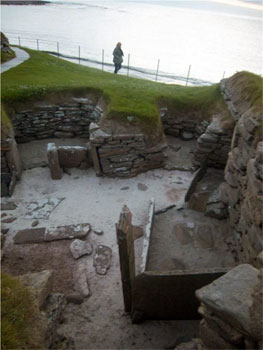
view from inside a Skara Brae structureIt is believed that Skara Brae was big enough to hold about 50 to 100 villagers at any given time, and that it was inhabited for approximately 600 years.

Because the village was built into mounds of “pre-existing rubbish” the village sunk underground and protected the village from any unwanted visitors and/or predators. Not only that, because the mounds of hills provided a much needed insulation for the homes, the people were also protected from the infamous Orkney windstorms which could last for days or even weeks at a time.

The walls of the village were built with sandstone slabs and the houses were covered with thatched roofs and possibly whale bones. Each of the houses were also designed identically with a fireplace in the center as well as two beds, dressers and storage units, and even a small fish-filled bait box made of stone that was built into the floor. The fireplace was used for cooking and heating and the stone beds were filled with bracken and heather for comfort, and they were also covered with animal skins for warmth as well.

The only building that differs from the rest is said to be the “Village Workshop” after numerous tools and stone-made weapons were uncovered when researchers were digging throughout the room. There is also another separate area which is believed to have been used as a modern-day compost as the inhabitants seem to have used it to store garden and waste materials.

Researchers also believe that the original occupants were very skilled in working with bone and stone because they found different items, tools and artifacts that were left behind in the settlement, (like elaborately-decorated pottery, needles, shovels, picks and weapons).
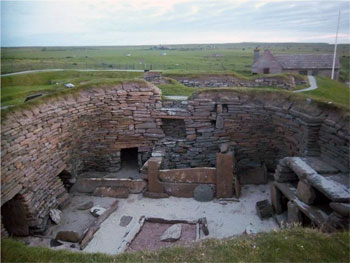
one of the best preserved Skara Brae structuresThe villagers also used volcanic pumice that could have been washed up on the shore from Iceland to help shape the bone tools and stone balls, and over 2,400 inscribed beads and hundreds of bone necklaces were found in one of the stone cupboards as well. It is believed that many of these objects resembled one’s symbol of status or may even have been used for ritualistic purposes. It is also thought that the dressers which were sitting directly across from the doorway were used to “show off” any prized possessions and/or hunting trophies whenever a visitor entered the home.

Although it is assumed that those who lived within the walls were a part of a tight-knitted community, experts still can’t decide as to whether there was a hierarchy among the villagers or whether the villagers were equal. And even though there hasn’t been a lot of evidence revealing any sort of religion and/or tradition within Skara Brae, researchers have associated the Skara Brae way of life with the traditional Orcadian beliefs in that the worship or ancestors, gods and spirits was more than likely the norm for the community.

After spending a great deal of time studying the surroundings of the settlement, it is also believed that the original inhabitants were farmers who raised cattle and sheep and possibly grew barley and wheat on the fertile land nearby. Their diet consisted of deer, seabird eggs and various other types of seafood like mussels, shellfish, oysters, crab, cod and saithe (aka pollock).

Given the fact that the sky covering the Orkneys remains dark for over half of the year, it is also said that the villagers more than likely used to gather within the homes of Skara Brae around a bonfire and tell stories and sing songs. And because the interior of the dwellings were windowless, researchers believe the rooms and passageways must have been extremely dark and smoky due to the fact that only one bonfire was placed in the center of each room.

An abandoned mystery
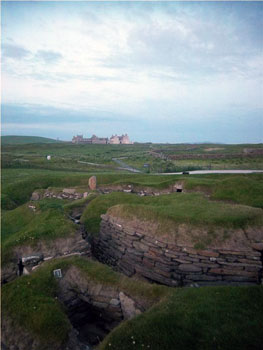
Skara Brae with more modern buildings in distanceBecause many belongings and artifacts were left behind in the village and stored carefully away in the cupboards, some believe that Skara Brae was abandoned because of an “apocalyptic” event and/or disaster which forced the villagers to flee their home.

However, it is now thought that Skara Brae was abandoned because of coastal erosion as well as changes of the weather, especially because the villagers would have had to have been locked up inside their homes for weeks or even months at a time because of strong winds and storms which now are associated with the Orkney way of life.

Not only that, because Skara Brae is located next to the ocean, it would have been extremely difficult to maintain the village with the salt water splashing across the land and destroying the homes, and scientists now believe that the ocean was once much further away from the village than it currently is today.

So what happened to the inhabitants after they deserted their homes?

The answer is still unclear; however it is known that after Skara Brae was abandoned around 2200 BC and records show that the Vikings didn’t actually settle in the Orkneys until about 787 AD. And because researchers are struggling to determine exactly what happened to Skara Brae’s original inhabitants, it only adds more fuel to the mysterious fire surrounding the ancient village. But thousands upon thousands of tourists are drawn to the Orkneys each year not only to check out the haunting site for themselves, but to also view several other ancient sites scattered around the Orkney mainland as well.

Believe it or not, Skara Brae is just one of many examples of the haunting and mysterious sites on the Orkney mainland. Just five miles away are two stone circles – the Standing Stones of Stenness and the Ring of Brodgar – both of which can be compared to the likes of Stonehenge. (It is believed that the Orcadians at that time used both of the stone to monitor the stars, worship the gods, or perhaps even to mark the grave sites of authoritative figures in the village, but their purpose still remains debatable).

And not just seven miles away from Skara Brae also lies Maeshowe, the ancient tomb which was believed to have been built around 2700 BC. To add mystique to the site, researchers also discovered that sometime in the mid-12th century a group of Vikings entered the tomb and started to tag the walls with graffiti. Some of the many tags include “Thorni bedded Helgi” and “Ofram the son of Sigurd carved these runes.”

These are just some of the many examples as to why anyone who has a passion for archaeology and history should not only visit Skara Brae, but the other several ancient sites scattered around the largest Orkney island known as “Mainland” as well.

3-Day Orkney Explorer – Small Group Tour from Inverness

If You Go:

Undiscovered Scotland – Skara Brae
Neolithic Skara Brae Orkney, Scotland
For information on how to get there: http://www.britainexpress.com/scotland/ancient/skara-brae.htm

About the author:
Alexis Brett is a Canadian journalism graduate who works as a freelance writer and recently moved to the UK. You can read her travel tweets at @RambleOnEh.

All photographs are by Alexis Brett.
Tagged With: Orkney attractions, Scotland travel Filed Under: UK Travel

Secrets of Edinburgh, Scotland Revealed

Edinburgh Scotland

Peeking Under Under Its Kilt

by Tristan Cano

We were rendered almost speechless by the smiling “Guid morning – hou’s it gaun” that greeted us as we negotiated our way towards the baggage carousels at Edinburgh Airport. Its not that immigration officers are famously dour or bad humoured. The quirky provincial accent triggered our realisation that we were very much to the north of Hadrian’s Wall and not in some regional airport in northern England. We were soon to find that this cheerful welcome was to be a common feature among all whom we met on our visit to the Scottish capital.

Edinburgh’s Airport is just a 25 minute taxi ride from Auld Reekie, as the city is affectionately termed by its inhabitants. However a regular and efficient bus service takes just as long and appeals to those supposedly parsimonious Scots, trekking the scenic journey into the heart of Edinburgh’s historic centre for a mere £3.00. On arrival, one is at once taken aback by the city’s many cobbled streets and how they complement the predominately grey granite buildings which themselves are a distinct mix of Georgian and Victorian architecture. Edinburgh’s avenues are lined with historic and listed buildings and losing yourself down the delightful wynds and tunnels leading from streets above to those below is undoubtedly one of the most attractive features of the Old Town. Edinburgh’s skyline has remained virtually unchanged in the last 200 years and belies a city which currently boasts over half a million inhabitants.

Scotland Parliament buildingThe Royal Mile which leads from the Palace of Holyroodhouse to Edinburgh Castle at its summit is undoubtedly Edinburgh’s most famous thoroughfare. Holyrood Palace, as it is known, is the Queen’s summer home and the Royal Standard flying from the palace roof denotes that she is in residence. Opposite and in stark contrast to the Palace is the controversial Scottish Parliament Building, designed by eccentric Catalan architect Enric Miralles. The original £40 million budget for this structure had grown to a startling £420 by the time it was completed in 2004 but is one of the most spectacular modernist and abstract buildings in the world.

St Giles' Cathedral, EdinburghSt Giles Cathedral, standing on Parliament Square is arguably the most impressive of several religious buildings on the Royal Mile and visitors will note a heart-shaped mosaic on the pavement near the Cathedral’s west entrance. The Heart of Midlothian records the position of where Toolbooth prison once was and spitting on it supposedly brings good luck.

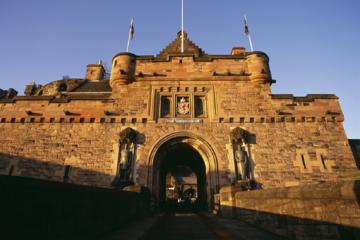
Edinburgh Castle itself is the jewel in Edinburgh’s crown. Positioned as it is, at the highest point of the Royal Mile, on the edge of an extinct volcano, it provides superb panoramic views of the city of Edinburgh from its impressive 16th-century battlements. Some parts of the Castle are even older and St Margaret’s Chapel, which dates back to the 12th-century, was dedicated to the wife of King Malcolm III who was himself immortalised in Shakespeare’s Macbeth. The Castle also hosts the world famous Edinburgh Military Tattoo in August of each year which is the largest event of its kind worldwide. Another equally spectacular vantage point is Arthur’s Seat, another extinct volcano just south of the city centre. The walk to the top takes about 45 minutes and is likely to be fairly windswept (to say the least) but you will be rewarded with some awe-inspiring views for your efforts.

Princes Street GardensWalking through the Royal Mile it is hard to believe that Edinburgh is in many ways a modern, cosmopolitan city. Princes Street Gardens marks the divide between the Old Town and the neo-classical streets and squares which make up the New Town area. The Gardens are in fact a large public park offering refuge from the hustle and bustle of the surrounding streets. Edinburgh has a rich literary heritage and the neo-gothic Scott Monument which marks the entrance to the Gardens is the largest monument ever built in memory of a writer. Sir Walter Scott is not the only Edinburgh-born writer of repute: Robert Louis Stevenson, Sir Arthur Conan-Doyle and more recently Irvine Welsh (of Trainspotting fame) were all born in the Scottish capital. The National Gallery Complex, also on Princes Street, houses undoubtedly one of the most spectacular art collections in the world and, like its English counterpart in London, admission is free.

Edinburgh has a worldwide reputation for its thriving and dynamic arts scene which comes to a head in August each year when millions of visitors converge on the city to enjoy the International and ‘Fringe’ Festivals. The original Edinburgh Festival consists mainly of classical and contemporary arts but is now eclipsed by the ‘Fringe’, which is famous for its theatre and comic offerings and is the largest arts festival in the world. Besides the Hogmanay celebrations (that’s New Year to you and me) the Festival is arguably one of the best times of the year to visit Edinburgh. However if you do choose to visit at these times, not only should you book your accommodation and other tickets well in advance but you should also expect to pay premium prices.

Old Town, EdinburghWhile there is probably no better place than Edinburgh’s Old Town to purchase a kilt, a sporran or indeed tartan fabric by the yard, the New Town contains the city’s main shopping area. The network of roads between Queen and Princes Street also doubles as the hub of Edinburgh’s bar and restaurant district with many of the more upmarket shops, restaurants and bars along George Street and Multrees Walk where you can find the high-end fashion boutiques. Edinburgh is a Mecca for whiskey enthusiasts and the Scotch Whisky Heritage Centre on the Royal Mile is a great place for lovers of the amber nectar to start their evening ‘on the tiles’. But be sure to line your stomach first; as well as the usual ‘tourist-traps’ there are also plenty of establishments in the Old Town specialising in high quality traditional Scottish fare. Modern Scottish cuisine of the less glamorous ‘everything deep-fried’ variety is also well-worth a taste, with a ‘fish supper’ being the perfect choice for the less adventurous (or health conscious) visitor.


Loch Ness, Highlands and Whisky Distillery Day Tour from Edinburgh

If You Go:

How to Reach Edinburgh:

By Road: You can drive to Edinburgh on the A1 from Newcastle (England), although the fastest route from London involves taking the M1 motorway until this becomes the A1. The journey is approximately 400 miles and will take about 8 hrs.

By Train: Edinburgh’s main railway station is the beautiful Waverley Railway Station which was first opened in 1846. It is located close to Princes Street, Edinburgh Castle and the Princes Street Gardens and is the central hub of the Scottish railway network which connects Edinburgh with the rest of the UK.

By Air: Edinburgh International Airport is located about 10 miles west of the city and offers a variety of domestic and international flights to European and North American destinations.
Find cheap flights to Edinburgh

For More Information:
Edinburgh Information at Visit Scotland website.


About the author:
Tristan Cano is a freelance travel writer and journalist who lives and works in his beloved Gibraltar on the southernmost tip of Europe. He has written extensively in the Gibraltarian and international press about Gibraltar’s history and is the author of Historic Walking Guides: Gibraltar.

Photo credits:
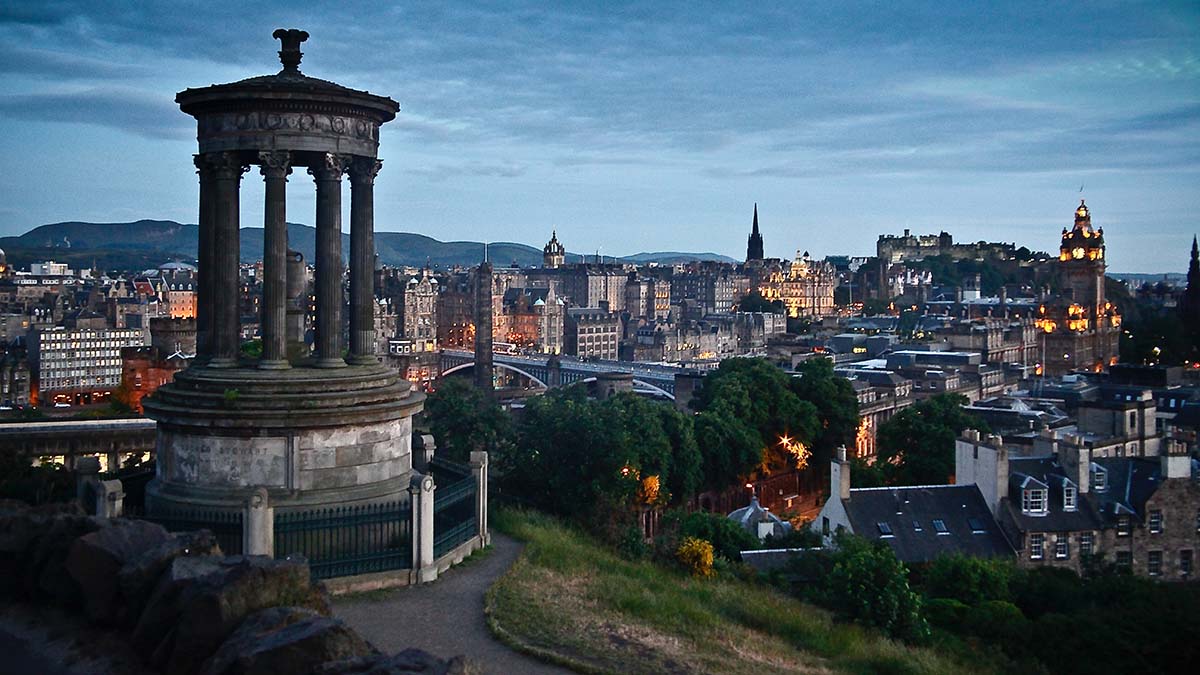
First Edinburgh, Scotland photo by Peter Cordes on Unsplash
All other photographs are by Angela Doherty.

Tagged With: Edingurgh attractions, Scotland travel Filed Under: UK Travel

Legend of the “Hunderprest” Vampire of Melrose Abbey

ruins of Melrose Abbey

Melrose, Scotland

by Norman A. Rubin

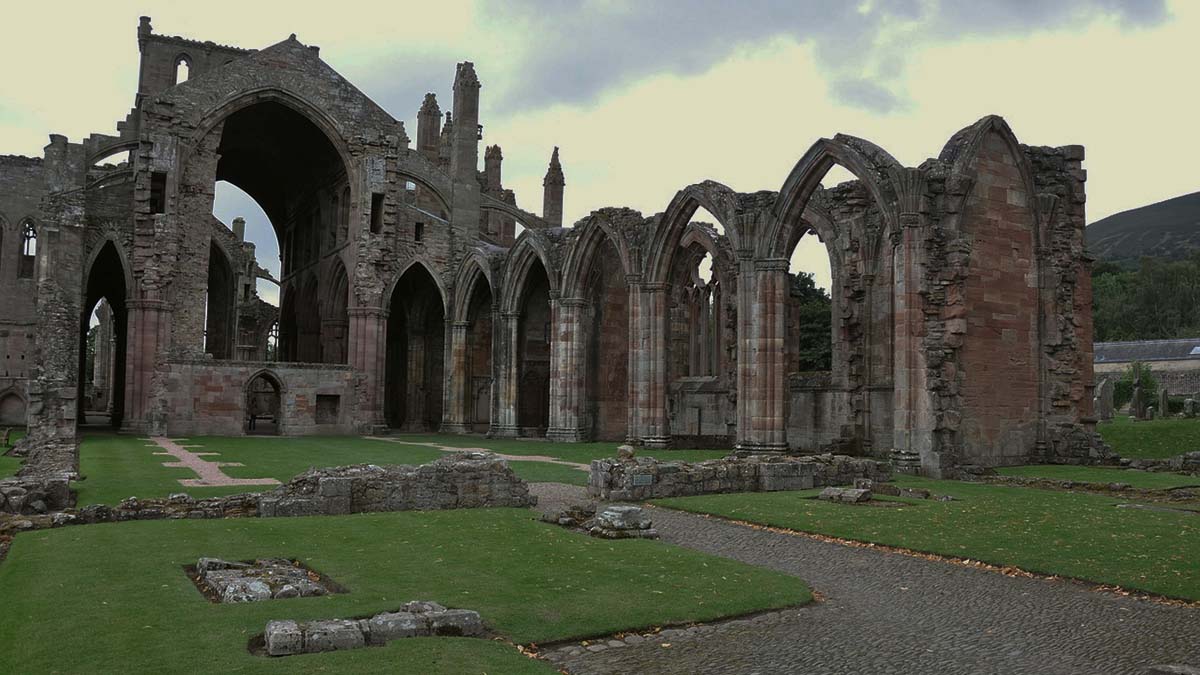
In the heart of the Scottish Borders, Melrose is the perfect holiday destination for, walking, cycling and rugby. Melrose also boasts some of the best salmon and trout fishing in Scotland. Visitors to Melrose are drawn by a range of attractions. Best known is the ruins of the Melrose Abbey, which lies on the north east side of the centre of the town and, off course the ‘Hunderprest’ vampire that roams the ruins at the dark of night.

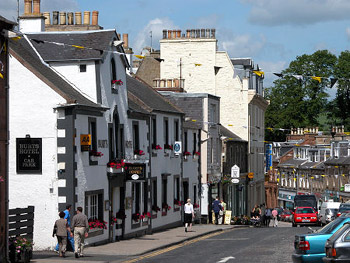
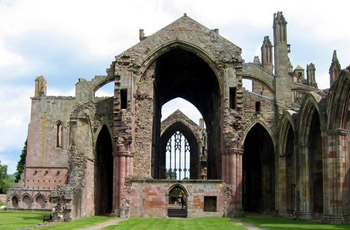
Melrose Scotland city streetMelrose Abbey was founded by a colony of Cistercian monks in c.1136. Although this was one of Scotland’s wealthiest monasteries, it suffered badly in the wars that ravaged much of the Scottish Borders in the medieval period. The magnificent rebuilding of church in the late 14th and early 15th centuries was a result of damage caused by the English in 1385. The 16th century Commendator’s House is now a museum and the Chapter House contains the burial casket of a heart, thought to be that of King Robert I “The Bruce”. A considerable portion of the abbey is now in ruins. These lichen-covered ruins, among the most beautiful in Europe, are all that’s left of the ecclesiastical community.

There is an eerie story that tells how the monks of Melrose Abbey saved the town from dark specter that had been plaguing the inhabitants for some time. The Vampire of Melrose was, during his lifetime, a chaplain to a lady who lived nearby. The chaplain was fond of all manners of sin and vice. He was then nicknamed ‘Hundeprest’ meaning ‘Dog Priest’. This appellation was given to him because of his favorite sport of hunting on horseback followed by a small pack of howling hounds. In Stories of the Border Marches, John Lang says: “Other things he also loved that made not for sanctity, and when, at last, he died, his death was no more holy that his selfish, sensual life had been.”

When the chaplain died, he paid the price for his wrong doing as his soul could not find peace. His ghastly form stalked the streets at night in search of blood, terrifying the locals. The town’s people turned to the church for a solution to their plight and the monks sought to answer their pleas. They prayed, fasted and challenged the ghoul, eventually defeating it. The monster’s corpse was thrust into a fire, reducing it to ashes that were then carried by the wind over the Lammermuir Hills to the north along the Scottish borders.

Melrose Abbey exteriorSometime after his death, it was said that he tried to enter the Melrose Abbey at the dark of night in the form of a winged bat and turning into dark vampire creature. Through prayer and rituals against the devil the monks of the abbey were able to drive him away. After denied access to the abbey, he roamed through the grounds and cottage of a woman who in times past when he was among the living was in his employ. It was reported by the near neighbors that the vampire roamed about the dwelling where he moaned and screeched at her and causing much alarm; thus she had no choice to summon an elder monk from the Abbey to investigate this disturbance and perform the rites of exorcism.

The elder monk whom was summoned brought along a fellow monk and two other men, both novices and began the investigation. They decided to watch the former priest grave when, in rustic places, the last glimmer of daylight died away. During the monk’s watch, the priest arrived in the guise of a vampire and appeared to levitate out of the deep grave, pushing gravestone asunder. The frightening phantom began to approach the trembling monk at an alarming rate. The priest retreated, as he composed himself from the shock. He then lifted up staff and smote the figure again and again. Then the elder monk retreated back to the grave. Then the grave suddenly opened with terrible sound and the ‘Hunderprest’ was swallowed in its deep pit. After the grave had opened and enveloped the priest in the warm earth, it had returned to normal as nothing had ever happened.

The elder monk knew then that he was dealing with a true vampire. Immediately he took action. He told his three companions of what occurred and to open the grave on the first light of the coming morn, which they agreed. They waited through the dark of night, only to dispatch one of the novices to bring digging tools from the abbey, which was used upon the cock of a crow. Upon the opening of the grave the vampire priest was lying in his coffin dead to the world grinning with bloody lips, the blood of his victims. Then elder monk ordered his companions to remove the body, and place it on the ground; then to burn it and scatter the ashes in the gusty winds.

Today there are those of the town that vow they can still hear a muted scream through the ruins at the dark of night of a man in a different form who in life had seemingly walked a godly life.

If You Go:

Melrose has a rich history, with architectural attractions, museums and exhibitions including the oldest continuously inhabited village in Scotland. Melrose has plenty to see and do – the town and nearby woods and fields have stunning scenery, several walks and cycle rides. The town has an extensive range of shops, as well as accommodation for visitors and excellent local services
For additional information check out the Melrose page of the Visit Scotland website.

Other sites of interest include: Nearby is the Roman fort of Trimontium, and Dryburgh Abbey. King Arthur is supposedly buried in the Eldon Hills, which overlook the town. Melrose was home to Sir Walter Scott (nearby Abbotsford), on the banks of the Tweed River. A popular attraction is Thirlestane Castle, one of Scotland’s oldest; it was built in the 13th-century and to this day it serves as a family residence.

About the author:
Norman R. Rubin is a former correspondent for the Continental News Service (USA), now retired – busy writing stories and articles for Net sites and magazines worldwide. See ‘ igoogle.com ‘ under the author’s name for a review.

Photo credits:
First Melrose Abbey photo by Niki Vogt from Pixabay
All other photos are by Norman Rubin.


Tagged With: Melrose vampire, Scotland travel Filed Under: UK Travel

Scotland: In Search of Shakespeare’s Macbeth

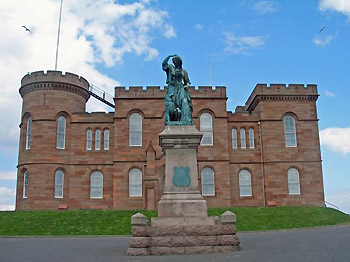
Inverness Castle

by Troy Herrick

The Scottish highlands are rugged mountains, thick forests and lush green glens. Overcast skies, cold blustery winds and thick mists add a haunting quality to the region. In this environment, the supernatural doesn’t seem so outlandish – it is almost expected.

When Shakespeare first presented the Tragedy of Macbeth to King James I in 1606, he was well aware of his majesty’s fascination with witchcraft. The bard piqued Scottish King James’ interest by incorporating a highland setting and the supernatural into the plot.

No one disputes that the play is a literary masterpiece but it is historically and geographically inaccurate. While the fictional Macbeth will be reviled as long as Shakespeare’s play is performed, the historical Macbeth was actually no worse than any other Scottish King that preceded him. Clearly Shakespeare did not let history stand in the way of a good story.

The intriguing highland locations are still as spell-binding as in Shakespeare’s time. You can relive the play in person by visiting each sight. But you will require some imagination as they look nothing like what you might expect.

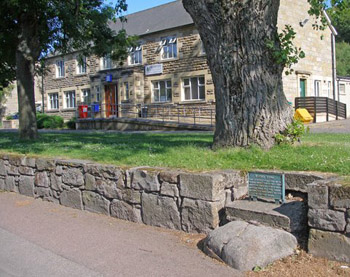
Witches stone, Forres, Scotland
Forres – Witches stone in front of a police station

Start with the three witches in Forres. The coastal city of Forres is notorious for its history of witch hunting. Here visitors will find the “Witch’s Stone”. This stone marks the remains of a barrel used to execute witches.

In times past, a woman accused of witchcraft in Forres was imprisoned inside a barrel and rolled down Cluny hill to her death. If she survived this ordeal, spikes were driven through the barrel wall. If she survived, she was burned at the stake. There was no innocence or reprieve.

In the play, Duncan’s palace was located in Forres. History records that a flat-topped mound known as Castlehill had been the site of a “Royal Palace” since 900 A.D. and that kings resided there. Nothing suggests that Duncan was one of those kings however.

Castlehill was strategically important. From its summit, defenders had a clear view of the sea to the north and the lands to the south. Now this hilltop is a city park containing an obelisk known as the Thompson Monument (dedicated to a Scottish surgeon who served in the Crimean War). Remnants of the castle still occupied the site when the park was first laid out.

Forres - James Thompson monumentOne might imagine stone fortifications, towers and a solid wooden draw bridge. The grandfatherly King Duncan is seated upon a throne as he receives news of Macbeth’s victory over Sweno and the traitorous Thane of Cawdor. Colorful banners and elegant tapestries soften the cold, rough stone walls surrounding him.

This castle scene does not reflect the Viking Age however (Sweno was a Viking in the play). In reality, Forres Castle was constructed of wood.

While in Forres, you can visit Sueno’s Stone. Sueno’s Stone is a 23-foot tall menhir covered in indecipherable Pictish writing. Scholars have suggested that this menhir may commemorate a battle over 100 years before Macbeth between Kenneth MacAlpin’s army of Scots and the rival Picts. Perhaps Shakespeare had this battle in mind when he chose the name of Sweno.

The present brown sandstone Inverness Castle, built in 1834 as a court house, is closed to the public. This structure occupies the site of a much earlier wooden structure dating back to the time of King David I in the 12th century. (Castle photo is at the top of story.)

Visitors will enjoy the turreted castle exterior and the panoramic view of the area from the hill top. Remnants of an even earlier fortification, dating to the time of Macbeth, were discovered in the private garden of a house appropriately named “Dun Macbeth” on nearby Auldcastle Road. Strategically Auldcastle Road, on a hilltop, was an ideal location for a castle because of the commanding view of the water below.

When I visited Auldcastle Road, local residents were either unwilling or unable to identify Dun Macbeth. Furthermore, there was nothing to suggest that this neighborhood was of any historical significance whatsoever.

Visitors should note that no record indicates that the real King Duncan was murdered at Inverness. However, some people claim to have seen his ghost walking along the banks of the River Ness in full royal dress.

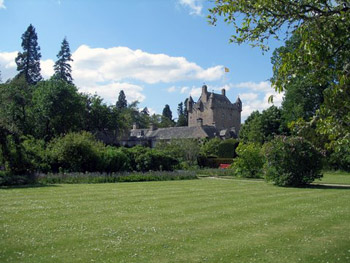
Cawdor CastleCawdor Castle is associated with Shakespeare’s play because Macbeth was granted the title of “Thane of Cawdor” by a grateful King Duncan. A storeroom just beyond the main entrance to the castle builds upon this link. Here visitors find a cauldron topped with a model of the castle.

While the Cawdor area has been a thanedom since 1236, it does not date to the time of Macbeth. Furthermore, the existing castle was constructed in 1454. Despite the lack of any genuine association with Macbeth, Cawdor Castle is worth touring because of its fine furnishings and well-manicured gardens.

The tower room is of special interest. Inside is a trap door that falls open to a hidden dungeon. This dungeon was reserved for uninvited guests but you are in no danger as long as you have your admission ticket.

A tour guide informed me that there had been an earlier castle, dating to the time of Macbeth, situated approximately 1.5 miles north of the present Cawdor Castle. This unmarked site is located at a bend in the road near Rosefield, close to an abandoned airstrip. Any remnant of that castle has long since been washed away by flood waters from the River Nairn.

Scone PalaceWith the murder of King Duncan, Macbeth travels to Scone to be invested as King of Scotland. The play only refers to him as traveling to Scone. No details are given, so let’s fill them in. To be invested as king, Macbeth would climb to the top of Moot (“Boot”) Hill, just outside present day Scone Palace, and seat himself upon the “Stone of Destiny”.

During the coronation ceremony, the new King would also accept oaths of loyalty from the Scottish Nobles in attendance.

Tradition required these Lords to swear allegiance to the King upon their own lands. Since it was too dangerous for the King to travel around the country to receive individual oaths of loyalty, the Lords carried samples of their own soil to Scone in their boots. When it came time to swear their oaths, they would dump the soil on the ground and kneel before the King. Thus Moot Hill is actually a transplanted mound of earth. Its size grew over the centuries as more and more soil was added.

Macbeth noted that Macduff, the Thane of Fife, was not present at Scone to swear his loyalty. Instead Macduff, who had remained steadfastly loyal to King Duncan, was en route to England to meet with Malcolm (Canmore).

Dunsinnan HillVisitors to Scone Palace may ascend Moot Hill and seat themselves upon a replica of the Stone of Destiny. The real Stone of Destiny, a 336 pound red sandstone slab, is displayed at Edinburgh Castle.

The palace and gardens are also worth visiting even though there is no association with Macbeth. Of particular interest is the Corridor of Kings where visitors find pictures of some notable Scottish monarchs including Macbeth.

Malcolm, with English support, leads an army to Scotland in a bid to take the throne from Macbeth. The army, camped at Birnam Wood, prepares to march on Dunsinane under cover of tree branches. Even now locals will tell you that Birnam Wood is visible from Dunsinnan Hill (Dunsinane). Therefore any army advancing on the hill would still require camouflage.

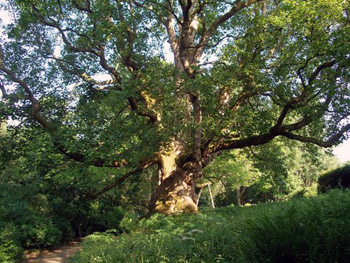
Birnam OakToday the massive, gnarled “Birnam Oak” on the edge of the River Tay is all that remains of the original Birnam Wood from the time of Macbeth. There is no proof that this particular oak existed at the time of Macbeth however.

After a leisurely walk through Birnam and along the river bank, visitors may wish to enjoy a drink in one of the local pubs before heading for Dunisnnan Hill.

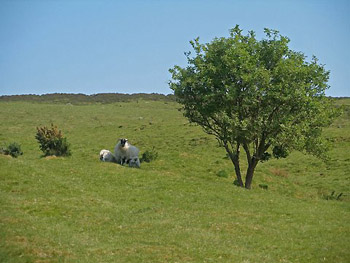
The outlines of two Iron Age wooden hill-forts lie atop Dunsinnan Hill. The more recent inner fort could date to the time of Macbeth. Tourists and invading armies must climb a steep hillside pasture to reach the summit of Dunsinnan Hill. Visitors immediately realize that there is no level ground for two armies to fight a pitched battle on Dunsinnan Hill. Any battle would be a siege instead. However, in the play, the two armies clash and Macbeth is slain at the hands of MacDuff. With the defeat of Macbeth, Malcolm claims his birthright as King of Scotland.

You may justifiably ask “What is the impact of Shakespeare’s play on our perception of the real Macbeth?” One answer is to be found in the Great Gallery of Holyroodhouse in Edinburgh. On its walls hang portraits of 94 of the 110 real and legendary Kings of Scotland. The real Macbeth reigned as King of Scotland from 1040 to 1057; his portrait is one of the 16 that is missing. Coincidence? Ironically even Bonnie Prince Charlie’s picture is displayed.


3-Hour Private Edinburgh Castle Tour

If You Go:

The Witch’s Stone is located on Victoria Street in Forres, about 500 yards west of the Findhorn Road intersection. The stone is embedded in a low lying meridian at the center of the road.

The site of Forres Castle is located at the southwest corner of Castlehill Road and High Street in Forres. Look for the obelisk known as the Thomson Monument.

Sueno’s Stone is located on Findhorn Road in Forres. Traveling east, the stone is enclosed in a glass building on the left side of Findhorn Road, near the intersection with Victoria Street.

Inverness Castle – take Castle Wynd off of Bridge Street in Inverness.

Cawdor Castle – take the Culloden exit from Highway A9 south of Inverness and follow signs to the castle which is approximately 4 miles west of Nairn.

Scone Palace lies just north of Perth on highway A93.

The Birnam Oak is in the town of Birnam (on the south side of the River Tay, opposite Dunkeld). The oak is situated 430 yards behind the Birnam House Hotel.

Dunsinnan Hill (Dunsinane) – turn off Highway A94 to the village of Collace, north of Perth; drive through the village and stop at a turn in the road just outside of town. Dunsinnan Hill is clearly marked.

The Palace of Holyroodhouse is at the east end of the Royal Mile in Edinburgh.

Edinburgh Castle is at the west end of the Royal Mile.

Scone Palace, the Palace of Holyrudehouse and Edinburgh Castle may all be visited by using the Great British Heritage Pass http://www.thebudgettravelstore.com/page/234746205

Plan your vacation at www.plan-a-dream-trip.com

About the author:
Troy Herrick, a freelance travel writer, has traveled extensively in North America, the Caribbean, Europe and parts of South America. His articles have appeared in both Live Life Travel and International Living Magazines. He also penned the travel planning e-book entitled “Turn Your Dream Vacation into Reality: A Game Plan for Seeing the World The Way You Want to See It” based on his own travel experiences over the years. www.thebudgettravelstore.com

Photographs:
All photos by Diane Gagnon. A freelance photographer, she has traveled extensively in North America, the Caribbean, Europe and parts of South America. Her photographs have accompanied Troy Herrick’s articles in Live Life Travel Magazine.
1. Inverness Castle with statue of Flora Macdonald
2. Forres – Witches stone in front of a police station
3. Forres – James Thompson monument (site of Duncan’s Castle)
4. Cawdor Castle
5. Scone Palace
6. Dunsinnan Hill
7. Birnam Oak

Tagged With: Macbeth locations, Scotland travel Filed Under: UK Travel

Wondrous Sea Caves on the Isle of Skye

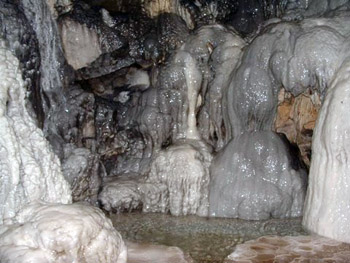
formations in Spar Cave, Skye

by James Carron

The Spar Cave on Scotland’s Isle of Skye is a truly wondrous place. In the 19th century it was a fashionable destination for well-to-do Victorian trippers, drawn north to the rugged Strathaird peninsula by Sir Walter Scott’s poem The Lord of the Isles in which he wrote of a mermaid bathing in a pool concealed deep within the enchanted cell. Steamers set a course here from Glasgow in the 1820s and ’30s and locally organized boat trips were always well subscribed. But at some point in history the cave’s popularity dwindled and these days only those with a real spirit of adventure find their way to the entrance of a secret underground world that must surely be one of Scotland’s natural wonders.

the author at entrance to Spar CaveAccessing the cave is no easy task. To reach it I first had to make my way to Broadford and then wound my way down the single-track road that links the island’s second largest town with the tiny hamlet of Glasnakille, the last outpost of civilization on the peninsula.

Unlike many of the world’s spectacular cave systems, there is no visitor centre here. Indeed, the cave is not even signed from the road and admittance is restricted to just a few hours a day when the tide is at its lowest ebb.

A ruined stone barn just south of the road junction in Glasnakille marks the start point of a faint path down to the sea. The route drops through a deep chasm to reach a cove strewn with well-polished stone and sharp, angular rocks. Jurassic limestone cliffs rise up from the shoreline and it is difficult to imagine the coastal walker making much progress in either direction. But bear left and a course can be carefully picked out. The cave is not far off in terms of distance, but the terrain requires a slow and measured scramble over stones and larger slabs of rock, some of which can be perilously slippery.

The cave is just around the next headland and natural ledges cut into the rock assist here. The entrance remains hidden from view and it is only when you enter a vast ravine that it at last appears in all its majestic glory.

the author inside Spar Cave, SkyeThe canyon drives 200 feet inland and vertical walls of rock on either side rise at least 100 feet into the sky. John Macculloch visited the cave during his Scottish travels between 1811 and 1821 and likened it to ‘some deep cathedral aisle’.

At the top of this aisle, the moss-covered remains of an old wall stand guard over the entrance. It was built in the 19th century by landowner Alexander MacAllister to prevent people visiting without a guide. But it failed to deter some, including Sir Walter Scott who scaled the wall using a rope when he visited in 1814.

Beyond the ruined wall, two passages present themselves. The muddy tunnel on the right leads nowhere while the one on the left takes you deep into the mystical chamber where Scott’s mermaid ‘bathes her limbs in sunless well, deep in Strathaird’s enchanted cell… where dazzling spars gleam like a firmament of stars’.

tunnel in Spar caveThis ‘spar’ gave the cave its popular name, but its true Gaelic title is Slochd Altrimen, or Nursing Cave. This dates from the ninth century when a local princess fell in love with the son of the chief of Colonsay who was shipwrecked on the Strathaird coast. Unfortunately the fathers of the young lovers were sworn enemies and when she gave birth to a child, the baby was concealed in the cave to ensure its survival until the feud was settled.

At this point a torch is required as any remaining shreds of daylight are quickly lost, the passage curving into darkness to reach the base of an incredible flowstone staircase. Coated in a fine sheen of clear water, the marble-like slope at first appears impossible to scale. The calcium, however, offers excellent grip for walking boots and initially there are plenty of good footholds.

Half way up, the gradient increases and footholds are fewer, making the ascent more challenging. But persevere and the ground flattens out to form a plateau flanked by all manner of weird and wonderful configurations, centuries in the making and ever changing under the constant caress of the calcium-rich water that oozes gently through the limestone rock. The ceiling once boasted great stalactites but sadly Victorian souvenir hunters took these. It remains, however, a breath-taking sight, eerily quiet but for the constant dripping of water.

The narrow cut in the cliff certainly belies the true beauty concealed within. Casting a torch around the walls and ceiling reveals a multitude of strange natural creations, an unworldly mix of different formations. Some are smooth, highly polished orbs of calcium dripping with straggly alabaster dreadlocks. Others are more grotesque, peering out of the gloom like monstrously deformed faces, sprouting endless steams of gnarled tentacles. Pools on the floor ripple constantly under the eternal dripping of cool water, calcium deposits solidifying around the edges in thin sheets of unbreakable ice.

Beyond the plateau, the floor slopes away sharply, dropping to a deep pool of water flanked by flowstone arches. This is Scott’s ‘sunless well’. The only way across is to swim, but the cave ends abruptly a short distance on.

Unfortunately, visiting time to the Spar Cave is limited by the tide. Although the cave itself never floods, the channel outside fills completely with water as the sea rises, cutting the cavern off until it is ready to receive its next visitors.

The Spar Cave is by no means Skye’s only coastal cavern worth visiting. The island’s coastline is dotted with secret grottos. Some are completely inaccessible on foot, while others can only be reached at low tide. From Elgol, a path heads south to Prince Charlie’s Cave. It was here that the Jacobite spent his last few hours on Skye in July 1746 before leaving for the mainland and then, ultimately, France. Located on the coast at Port an Luig Mhoir, it is not an easy one to find. Near Peinchorran and The Braes, a strange dogleg peninsula extends out into the sea and here there is a proliferation of hidden caves, pinnacles and sea stacks. The most impressive feature is a brittle rock arch that spans a deep canyon.
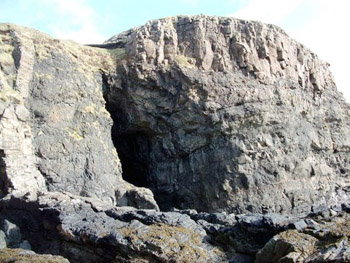
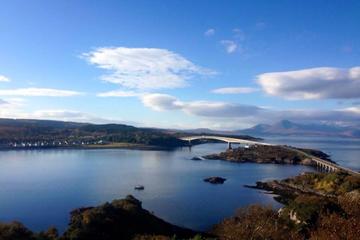
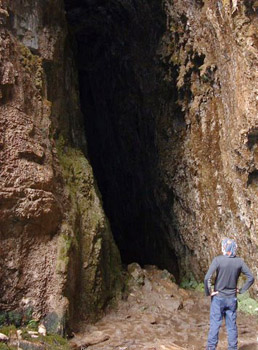
entrance to Piper's Cave, SkyePiper’s Cave, at the southern end of Harlosh Point, requires a half mile walk across grazing land from the end of a loop road off the A863 that serves the scattered communities of Harlosh, Balmore and Ardmore. Where the land ends and the sea begins, a spindly 30-foot high basalt sea stack is the first indication you are on the right track. A steep path descends to the base of the stack and, with the tide low, it is possible to scramble along the rocky shoreline to the cave entrance. The mouth is impressively tall but the tunnel within tapers sharply into a dark, narrow passage.

My final cave hunt took me north through Uig on to the Trotternish peninsula where the island’s most northerly point, Rubha Hunish, tickles the Atlantic Ocean. A few miles down the west coast of this fat finger lies Uamh Oir, or Cave of Gold. This was to be a fittingly spectacular end to my cave quest, the pot of gold at the end of the rainbow. Although the cave cannot be entered on foot, it is visually spectacular from outside, featuring a pavement of hexagonal basalt columns similar to those found at Fingal’s Cave, on the island of Staffa, and at the Giant’s Causeway in Northern Ireland. It is a geological wonder, one of many I had witnessed on Skye, and the ultimate reward for a weekend of exhilarating and, at times, rather slippery, coastal exploration.


Isle of Skye Tour

If You Go:

Getting there:
The Isle of Skye is a five-hour drive from Glasgow. Scottish Citylink operates coach services from Glasgow to Portree. The nearest railway station is at Kyle of Lochalsh.

Getting around:
Bus services on Skye are operated by Highland Country Buses. Service 49 runs from Portree to Broadford, Elgol and Glasnakille. Service 56 links Portree, Dunvegan and Bracadale while service 57A and 57B run from Portree to Uig.

More information:
The main tourist information centre on Skye is in Portree and it is open all year.

Check the tides:
High and low tide times are displayed in the window of the tourist information centre in Portree. Alternatively, log on to Isle of Skye tides chart.

About the author:
Based in Scotland, James Carron is a freelance writer. He specializes in features on hiking, backpacking, camping and practical conservation, both in Scotland and overseas and writes regularly for a number of UK consumer magazines and newspapers. His other interests include travel, mountain-biking and sea-kayaking. He is currently researching the life of a hermit who lived in one of the remotest parts of the British Isles with a view to writing a biography.

All photos are by James Carron.

Tagged With: Isle of Skye attractions, Scotland travel Filed Under: UK Travel

  • « Previous Page
  • 1
  • 2
  • 3
  • Next Page »

MORE TRAVEL STORIES:

Meet Joy Intisuk: The Visionary Behind Thailand Nomads

La Dolce Morte: An Ex-Pat Pilgrimage In Rome

Balankanchè, Altar of the Tiger Priest in Yucatan, Mexico

Colorado: The Beauty of the Anasazi in Mesa Verde

10 Unusual Historical Resorts in Turkey

Savoring Cooking Experiences in Asia

The Tall Tale of Paul Bunyan

Visiting Rimbun Dahan, Malaysia


SEARCH

DESTINATIONS

  • Africa Travel
  • Antarctica travel
  • Asia Travel
  • Australia travel
  • Caribbean Travel
  • Central America Travel
  • Europe Travel
  • Middle East Travel
  • North America Travel
  • Oceania Travel
  • South America Travel
  • Travel History
  • Travel News
  • UK Travel
  • Uncategorized
  • World Travel
facebook
Best Travel Blogs - OnToplist.com

Copyright © 2026 Cedar Cottage Marketing | About Us | Contact | Privacy Policy | Terms & Conditions | Copyright Notice | Log in