by Rashmi Gopal Rao
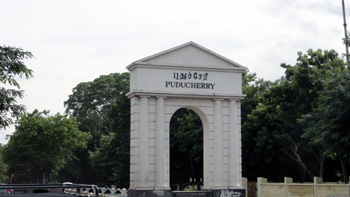
Formerly known as Pondicherry, Puducherry is a union territory located close to the city of Chennai in the South India. Fondly referred as “Pondy”, this beach city lies at a distance of about 170 km from Chennai and is located on the south eastern coast of India. Puducherry was ruled by the Dutch, Portuguese, British and French colonialists in the 16th and 17th century. A French colony until 1954, the French influence is hard to miss and has an ‘almost all pervading effect’ in most part of the old town as it is known today. This part of the town is based on the French grid pattern and has well planned perpendicular streets. It is common to see the streets retain their French names and houses in the French architectural style. It is a great place where both India and French coexist seamlessly giving the place a distinct feel.
Also dubbed as the “Europe of India”, the city is a tourist hub and attracts a large number of both Indian and foreign travelers. Moreover, given its proximity to cities like Chennai and Bengaluru, Pondy (as it is fondly known) is an ideal weekend getaway. With lots of places to visit and activities to do, the city has something to offer for every kind of tourist be it adventure, history or relaxation.
The Promenade
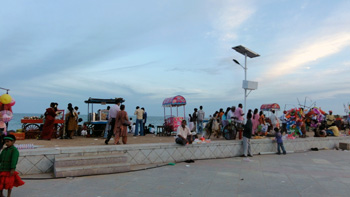 As it is a beach city, the Promenade is a hot spot for locals and tourists alike. About 1.5 km long this runs along Goubert Avenue (Beach road) and overlooks the Bay of Bengal. There are huge rocky boulders that prevent one from getting into the water but there are benches to sit and a fairly broad pavement where you can enjoy your morning and evening walks. Walking along the promenade you can see the statues of Mahatma Gandhi and Jawaharlal Nehru. About four meters tall and surrounded by 8 granite pillars, the Gandhi statue is a prominent figure on the beach front and is of special significance on National days. The French War memorial which is dedicated to the martyrs who laid down their lives during World War I is also along the Promenade. The old lighthouse that is one of the famous landmarks of Pondicherry can also be viewed from here. The place is full of life during the evenings especially on holidays and weekends with scores of hawkers selling street food, souvenirs, trinkets, junk jewellery and the like. The cafes and restaurants along the promenade are also great places to sit back, relax and watch the beautiful sunset.


Aurobindo Ashram
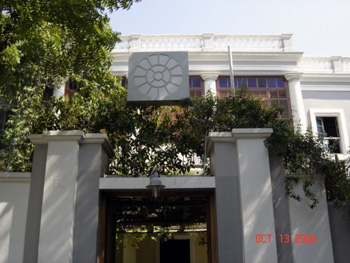 One of the key points of interest in Pondicherry is the Aurobindo Ashram which houses the tomb of Sri Aurobindo. He was a famous Indian nationalist, poet and yogi who joined the Indian movement for independence against the British rule. During his stay in Pondicherry he discovered a technique of spiritual practice called Integral Yoga and with the help of his spiritual collaborator, Mirra Alfassa (“The Mother”), he founded the Sri Aurobindo Ashram. The Ashram and its surroundings are serene and peaceful with a detail for cleanliness. The stone ‘sammadhi’ of Sri Aurobindo and The Mother are located in the central courtyard of the building which itself is set in a beautifully maintained colorful garden. There are several shops, guesthouses around the city that are run by the Ashram. You need to leave your footwear outside and children under the age of 3 are not allowed inside the premises.
The vicinity around the ashram is tranquil and calm and it is a common sight to see people from various nationalities come together here. Traveling in bicycles on the cobbled streets, the polite and affable nature of the people is heartwarming. The “European” feel to the buildings, roads and signs is prominent.
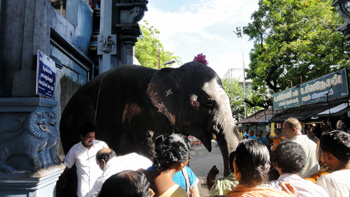
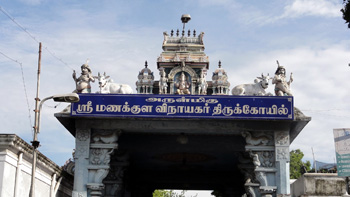 Located in the vicinity of the Ashram is the popular “Manakula Vinayagar Temple” which is a temple dedicated to the elephant God; Lord Ganesha. With beautiful carvings and an elaborate “gopuram” which is the exterior tower of a temple, this place also houses an elephant that is stationed outside the temple. Right in the middle of the old French town, this temple attracts scores of tourists and locals as the deity is considered very powerful. The market outside the temple is equally colorful with flowers, idols and articles of worship on display.


 A little away from the city at about 7 km, Chunnambar or Paradise beach is yet another haven for tourists. Accessible by ferry, this is located at point where the Chunnambar River backwaters meet the Bay of Bengal. The view of the pristine waters, sand and sun make this a great addition to the itinerary.
 Auroville or the “city of dawn” is located about 8 km north west of Pondicherry and was founded by the Mother. Conceived as a universal town where men and women of various countries can live together in peace and harmony, this place has over 2000 people living and are involved in activities like agriculture, handicrafts, healthcare, administration etc. The central Matrimandir, which is not a temple but a place for individual silent meditation is stunning and set in an area of 62 acres in the centre of the township. The Auroville visitor center is a unique place to visit and one can spend at least half a day at the boutique stores and cafeteria within.
Pondicherry is a haven for shopping if you are interested in handicrafts and articles made from handmade paper. The paper factory and multiple stores near the ashram retail indigenously crafted stationery, pen holders, boxes and other souvenirs in a plethora of colors and patterns. You can also pick up paper that is available in different grades and hues. Candles, incense sticks and essential oils are also great buys. Apart from the Ashram area, Jawaharlal Nehru (JN) Road and Mission street are great places to shop and have some exclusive boutique stores. The Sunday market on J N street is worth a visit.
If You Go:
♦ The city of Puducherry lies on the Coromandel Coast of Bay of Bengal on the south east coast of India.
♦ The closest airport is Chennai about 150 km away, which is well connected to all major cities across the globe.
♦ Pondicherry is also well connected by bus and train from major towns and cities in India.
♦ The nearest rail station from Pondicherry is Villupuram, which is about 35 kilometres away from the city.
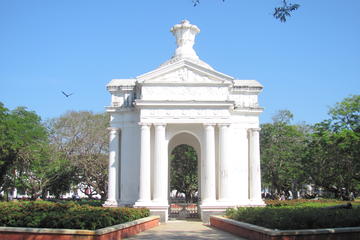
Pondicherry Sightseeing Tour Including Transportation to Chennai
About the author:
Rashmi Gopal Rao is a freelance content writer and journalist. She is from Bengaluru, India and writes for a few travel websites. Her hobbies include travelling, reading, writing and photography. She is also passionate about home decor and gardening. You can follow her on her blog rashminotes.wordpress.com.
All photos by Rashmi Gopal Rao:
Entrance to Pondy
Evenings at the Promenade
Aurobindo Ashram
Manukula Vinaygar Temple
Elephant at Manukula Vinaygar Temple
Shopping
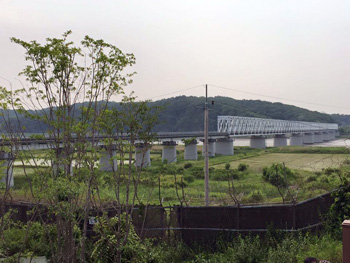


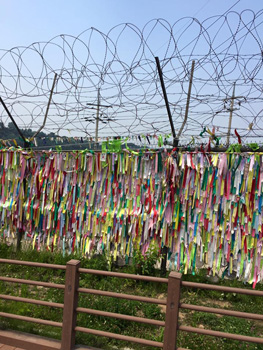 The tour I eventually booked was planned to include a stop at an observation site along the DMZ and the third infiltration tunnel, one of the numerous tunnels from which members of the North Korean Army have tried to infiltrate the South. Unfortunately, I was in Seoul during the height of the MERS scare. From the day I arrived in the city until the day I left, I probably saw the number of Koreans wearing surgical masks in public double. So when the day of the tour came around, the tunnel had was closed due to concerns about the spread of the disease in its close confines. The tour company replaced the trip to the Infiltration Tunnel with one to the Bridge of Freedom, formerly a location where prisoners of war could be repatriated to the South.
 However, other than those early experiences, for the most part the tour did not feel like a propaganda exercise. Of course, the negative aspects of life in the North were emphasized, but this would be hard not to do considering the indisputable realities of life in the Kim family’s North Korea. Most of what was said did not feel over the top. This was refreshing. Often stories from the North that make their way to the United States tend to be filtered through the most fervently anti-North Korea media or are just plain inaccurate. For example, a report that Kim Jung Un’s uncle had been executed by being fed to hungry dogs, which was picked up by media throughout the United States, turned out to not be true. It originated with satirical Chinese social media post.
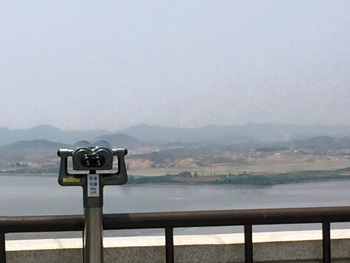
 Far from completely creating a manufactured view of the North, the tour’s first stop was a museum with an observation deck where one could look directly at a small farming village across the DMZ. The museum housed artifacts including treaties between the two countries, North Korean military medals, currency, and even soju, Korea’s national liquor. There were also symbols of reunification, including examples of countries that were once divided. Some of these were inspiring (Germany) and some were less so (Yemen). The most interesting symbol of reunification was the imagined “Seoul-Pyongyang-Paris” bullet train, which the Museum suggested would take tourists from Korea to Europe as soon as reunification was achieved. Dorasan Station located in another part of the DMZ did indeed once connect the North and South by train. It is, however, understandable why a rail link between the North and South might figure prominently in the imagination of some South Koreans, South Korea currently has no land borders, aside from the one with the North.
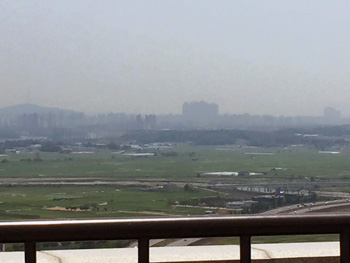 s seen from the overlook at the top of the Museum, the contrast between the two sides of the DMZ was stark. Within sight of the viewing platform were both the dense skyline of Seoul and the vast expanse of suburbs surrounding it. Turning 90 degrees and facing the North revealed a small farming community with a few crudely built structures, some of which lacked roofs. There were about twenty North Koreans working on the farm. The area of the DMZ near Seoul is one of the most populated parts of the DMZ owing to the fertile farming made possible by the Han River.
 After the museum, we headed to the Bridge of Freedom located adjacent to Imjingak Park. During the Korean War, the bridge was a place where defectors could cross from the North to the South, knowing that they that they may never be able to go to the other side again. Since the end of the war, families would come to the sight to remember their relatives from whom war had separated them. Despite the sadness associated with its history, the area has a carnival like atmosphere. For most Koreans, those memories are much more distant that they were in the last century, so to keep the location attracted for the younger generation an amusement park, complete with a Viking ship has been built near the bridge.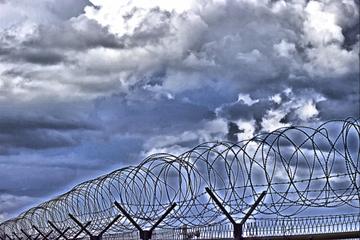

 About the author:
 by Leslie Hebert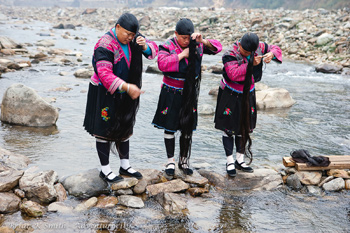
 We retreated out of the icy downpour into a restaurant just in time for a traditional Chinese lunch of fresh stir-fried meat and vegetable dishes. The afternoon turned out to be a bit foggy, with filtered sun coming through the surrounding glossy wet Karst Mountains. As we walked around the lakes and canals towards the Li river, it seemed like a dreamscape. There was an ethereal glow over the city with the moist warm afternoon air.
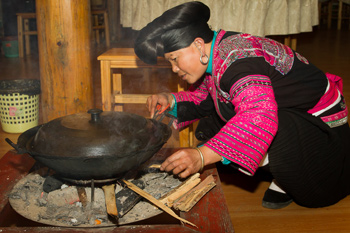
 Christmas morning was grey, but without rain. Yanhua had given me a choice of going to her friends sisters wedding or back to her Red Yao village of Huang Luo to meet her family. I wanted to see what village life was like – I had been to enough weddings – as participant and observer! Three hours later we arrived at Yanhua family’s hotel. Her mother, Pan Luifeng, in full hand knitted traditional dress, greeted us as we stepped off the bus. Yanhua changed into the Red Yao woven clothing that young and single girls wear. Shortly after we arrived the three of us headed across a swinging cable bridge to take some photographs and video at the riverside. I immediately felt I had know this family for a long time. They laughed and sang songs together while my camera clicked away. The village name, Huang Lou, actually means Long Hair. Yanhua’s mother holds the Guinness world record for the longest hair. It is very black and shinny, and wrapped around her head in a traditional bonnet style.
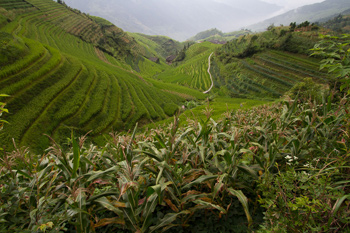
 In the afternoon Yanhua and I took a bus trip up the narrow terraced valley to Dazhai Village. From there we hike for two hours up smooth stone steps to the “Thousand Layers to Heaven” viewpoint. The terraces truly did disappear up into the etherial fog. It was so quiet on the side of the mountain – only our heavy breathing from climbing thousands of steps could be heard. We were treated to a little sun, but the clouds thickened on our return and a cool light mist fell on our shoulders. This was Christmas Day – what a special way to spend it no matter the weather was!
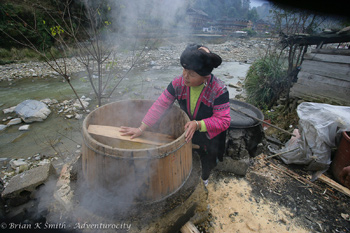 Grandma sat across from me with a glint in her eye. It was that kind of glint that means “I think you are the right man for my granddaughter!” At the start of the dinner I stood up thanked everyone for making me feel so welcomed on my special day of the year to spend with family. Yanhua’s mother returned the thanks by saying I am part of the family and always welcomed!

 One of the delights of staying for a few nights in a place, rather than visiting for a day, is having the time for unexpected discoveries. We passed the night in a youth hostel, and breakfast came courtesy of the vending machine: a variety of different flavored minute noodles. Another machine offered a range of both hot and cold coffees, all served in a can, the temperature indicated by the color. The man on reception even made us some green tea in a gorgeous ceramic pot.
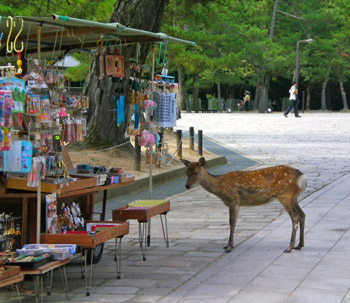
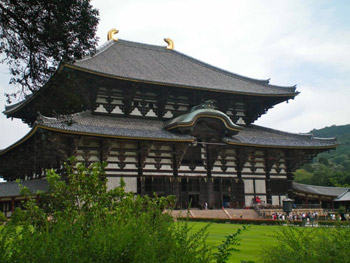
 Within minutes, we’d spotted our first deer. Soon we saw them everywhere, some condescending to be patted, others scampering away should we venture too close. Meanwhile, paths and secluded walkways enticed us in all directions. There are more than enough temples to satisfy the most ardent visitors; tea houses to partake of refreshment, vending machines for cold drinks and ice-cream (flavors including green tea), and manicured lawns stretching down to lakes for simply relaxing. We even stumbled across some vegetable gardens and a few small rice paddies, all grown by the monks who live in the temple complexes. Walking down an alley of stone stairs, we came across a group of ladies painting.
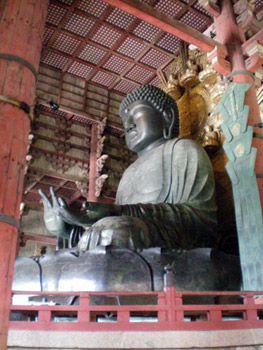 Everywhere we walked, the deer were relaxing in the shade, nibbling the grass, or simply wandering at leisure.

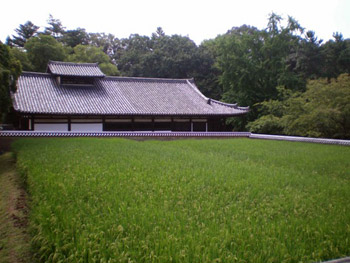 The walkways around the shrine are lined with some 3000 stone and bronze lanterns. These have been donated over the centuries as tokens of thankfulness and faith. During festivals in February and mid August they are lit: a spectacular time to visit. You can also buy a slip of paper (omikuji) with your fortune; if unfavorable, simply tie it to one of the trees to negate its effects. Behind the temple is the Rokuen, a botanical garden preserving Japanese plants, and famous for its wisteria, plus its Homotsuden, a hall displaying costumes, swords and ancient armor.