by Paola Hanna
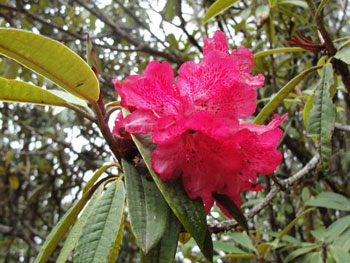
‘The dogs are auspicious,’ our guide Tashi said, looking at the two healthy-looking strays who were leading the way up the steep mountain path. It was cool and misty in the lichen-draped forest. Here and there we saw splashes of bright red rhododendrons.
Tashi was, as always, elegantly attired in a gho, the Bhutanese male national dress, a knee-length robe hitched up and tied at the waist with a belt. Under it his hiking books and Argyle socks looked rather out of place. Apart from a few monks tripping up and down the track like mountain goats, we were alone, surrounded by birdsong.
 We were on our way to Tango Goemba, a few miles north of the capital, Thimpu. Two flashes, one yellow and one scarlet, darted across the path just in front of us in close succession. Tashi stopped in his tracks. ‘Ssh.’ We followed his gaze, and saw the two small birds on a branch just off to our left. ‘Long-tailed minivets,’ he said. ‘The red one is the male. It’s auspicious to see them together.’
A lot of things are auspicious in Bhutan.
Why did we choose this particular holiday destination? Well, we live in Bangladesh, and had six days’ leave. We wanted a complete change. Dhaka is humid and hot in May (and April, and June, and July, and August, and September, with no sign of a letup until at least mid-October…), and apart from the weather, the traffic, noise and pollution get to you after a while. For much of the year half the country is under water. A cool, quiet, elevated, sparsely populated country less than an hour’s flight away is just too tempting, especially when that country’s progress is based on GNH – Gross National Happiness – rather than GDP. And if you’re looking for different – different from anywhere in the whole world – Bhutan is where you’ll find it. Until fifty years ago, this landlocked country smaller than Switzerland existed in self-imposed isolation, with no currency, no towns to speak of, and no formal education outside monasteries. Despite massive recent reforms, it remains a unique destination, steeped in religion and culture – of an especially unusual kind – as we were about to find out.
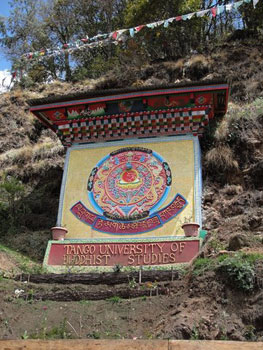 As we approached Tango Goemba, we saw a printed paper sign stuck on a brightly-painted wall: (REQUEST) PLEASE COME IN NATIONAL DRESS. INFORMAL DRESSED ARE NOT ALLOWED LA. It seems that the final ‘la’ takes the edge off any instruction or statement, making it polite. I looked down at my dirty jeans and sweatshirt, but Tashi assured me that the sign only applied to locals. The dogs settled down to rest in front of the monastery entrance.
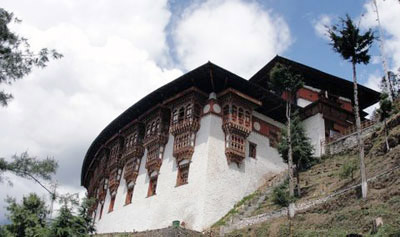
Perched at eight thousand five hundred feet above sea level, the monastery today houses the Tango University of Buddhist Studies, which is the most important centre for Buddhist learning in Bhutan. This is where many of the country’s religious leaders have followed a rigorous nine-year training programme.
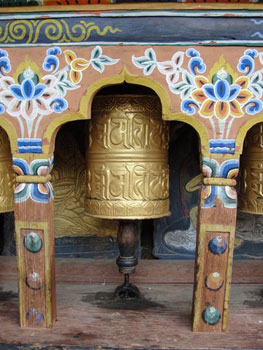
Inside the main entrance we twirled a few prayer bells (clockwise, as instructed), took off our boots, and crept into the inner sanctum, where we sat down cross-legged in a corner. A group of monks were chanting. On a raised dais, a young teenager sat solemnly in his robes.
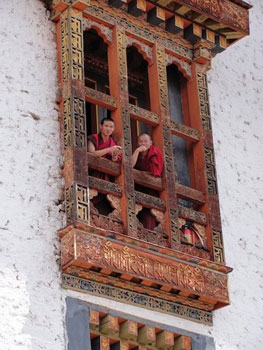 ‘He is the seventh reincarnation of the fourth desi of Bhutan’, Tashi said. A desi is a spiritual leader. ‘His previous incarnation died in 1830. We are very lucky to see him.’
We sat with the monks for a while, then made a small donation which secured us a couple of blessed strings to wear around our necks – we are determined never to lose the thread again. As we headed off down the mountain, we were joined again by our friendly dogs.
Tango Goemba has been a place of huge religious significance since it was founded as a monastic school in the 12th century. The monastery that stands on the site today was built in the 15th century by Bhutan’s rather quirky and folkloric hero, Lama Drukpa Kunley, affectionately known by locals as the Divine Madman.
He was born in Tibet in the year of the wood-pig in the eighth cycle, which corresponds to our year 1455. After his father’s untimely death in a feud, he became disenchanted with the world, dedicated himself to religion, and became a monk. But that path, too, disillusioned him, so he became a mendicant, traveling extensively in Bhutan. He spread his teachings against hypocrisy and selfishness rather unconventionally, spending much of his time drinking, making music, and deflowering virgins. It is thanks to his sexual exploits that the outer walls of many houses throughout Bhutan are decorated with delicately decorated frescoes of rather splendid phalluses, which simultaneously ward off the evil eye and enhance fertility.
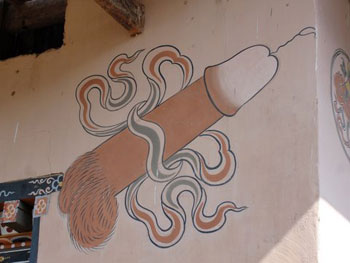 Many stories are told about the Divine Madman’s exploits. One day, a crowd his followers asked him to perform one of the magic feats he was famous for.
‘I will,’ said he, ‘but first you must bring me a goat and cow.’
They did as they were told. The animals were killed and roasted on a fire, and he sat down and ate them both, leaving only the bones. He then placed the goat’s skull on the cow’s bones, and said ‘Abracadabra’ (or the Bhutanese equivalent). The animal came to life, rose to its feet and headed for the pastures. And thus the Bhutanese national animal, the takin, was born. To this day this rather ugly creature has confused taxonomists, who have placed it in a category all of its own.
The day after our Tango trek, we visited Chimi Lhakhang, the Temple of Fertility, in the Punakha Valley, three hours from Thimpu. It was built in the Divine Madman’s honour, by his cousin, in 1499. He was grateful that the holy man had subdued the demoness in nearby Dochu La with his ‘magic thunderbolt of wisdom’. Infertile couples come to the temple from all over Bhutan, as do families with young babies, to receive blessings.
 We were blessed by a monk who tapped our heads with two ten-inch plastic phaluses. Since we’re not too bothered about fertility at this point in our lives, we wished for health for our grandson and any grandchildren we may have in the future. Just as we left the temple, I received a text message from my daughter: ‘Your beloved grandson has just walked his first two steps!’
Definitely the Divine Madman’s work.
We strolled back to the car, grateful for the Madman and for all the holy people scattered over the world’s mountains, praying for the victory of good over evil.
Explore Highlights of Myanmar on a Budget
If You Go:
Travel to Bhutan must be arranged through one of the seventy-five licensed local tour operators, who will also provide travelers with visas. The Royal Government of Bhutan sets minimum selling prices for packages to Bhutan, which are payable in US dollars prior to arrival in Bhutan. The High Season daily tariff is US $250 per person. This includes all internal taxes and charges, accommodation, all meals, all tours with a licensed Bhutanese guide, all internal transport, and camping equipment for trekking tours.
About the author:
Paola Hanna was born on an island in Lake Victoria, and was brought up in Tanzania. She has lived in almost a dozen countries over three continents, speaks five and a half languages, and describes herself as an “expatriate sine patria.” Wherever she goes, she makes it her business to get involved in local activities, explore, and learn the language, thus making each new destination a real home.
All photographs are by Paola Hanna.





 Midway through the dinner, the Maharaja extended his royal invitation to me and my family to be honored guests of his palace. I was absolutely delighted with the offer. A fortnight after the Navaratri festivities, I booked a flight to Ahmedabad and travelled onwards to Gondal by road. By the time we reached Gondal’s magnificent Orchard Palace, it was late evening and dusk had already descended here. I was informed by the palace’s caretaker that the Maharaja was out of town and would be back in a day’s time.
 During his rule, the residents of Gondal were exempt from paying taxes as he evolved an innovative land revenue system. To make Gondal self-sufficient in livestock, he introduced animal husbandry while to improve the agricultural sector, extensive irrigation network was developed, which brought even the wastelands surrounding Gondal under the ambit of modern agriculture. The Maharaja’s visionary outlook ensured that even those with very little academic background too were also offered meaningful employment with the setting up of technical schools that imparted training on domains like carpentry, mechanics, surveyors, painters and engineers.
 However, the best was yet to come viz-a-viz the Royal Garages about which I had heard so much from my Gujarati friends at Kolkata. As I was ushered in to the garage compound by my guide, I was downright stupefied by the huge collection of vintage cars which were stationed in individual sheds. This was easily one of the greatest collection of vintage cars in the whole of Asia. The collection ranged from the 1910 New Engine to the more elegant 1940-50s Cadillacs as well as a few truly impressive American cars of the 50s. The best part of the Royal Garages was the remarkable collection of horse drawn carriages, which was inclusive of the Victorian and Shetland carriages.
 No visit to the Naulakha Palace is ever complete without a visit to the exclusive Palace museum which showcases the rare collection of silver caskets which I was told were used to carry messages and gifts for the erstwhile Maharaja of Gondal.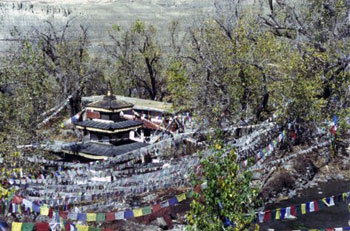
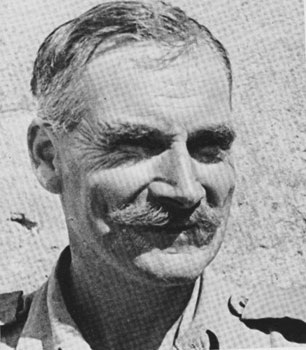 Well over a half century ago the inveterate British mountaineer and travel writer, H.W. ‘Bill’ Tilman (b.1898), was the first European to trek across some of the highest parts of Nepal. It was 1949, and one of his stops was the sacred Hindu/Buddhist pilgrimage shrine of Muktinath, near the Tibet border on the north side of the Annapurna massif.

 Tilman’s Nepal Himalaya was our guide. It’s a classic of the Himalayan literature, one that belongs in the personal library of every ardent or aspiring mountaineer and trekker. It is notable not only for its descriptions of the medieval-like conditions of rural Nepal over half a century ago, but for the author’s unique candor and style.
 Tilman’s prose was more serious, informative and insightful, but no less entertaining. For example, in one chapter of his book he wrote, tongue-in-cheek, that he and his companions failed to summit Annapurna-IV (24,688 ft) simply because of an “inability to reach the top.”
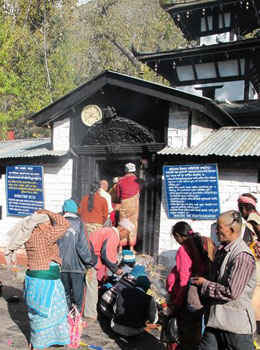 His party “camped near the topmost house of the straggling village where our arrival created no stir. A place to which several thousand pilgrims come every year must be accustomed to strange sights.”
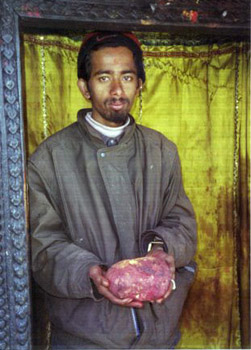 Tilman noted that Muktinath “owes its sanctity to the presence of the thrice-sacred ‘shaligram’,” the local name for black ammonite fossils found in abundance in this locale. Hindus worship the coiled shaligrams as representations of Lord Vishnu. Buddhists consider them to represent Gawo Jogpa, a serpent deity. Geologically they date back 165 million years to a time when this high-rise landscape lay covered by mud at the bottom of the Tethys Sea. Back then, long before the Himalayas were formed, the shallow Tethys separated Gondwanaland (today’s Indian subcontinent) from Laurasia (the Tibetan plateau). You can well imagine the looks of wonder in the eyes of today’s pilgrims from the plains upon finding the encrustations of ancient sea creatures so high in the mountains.
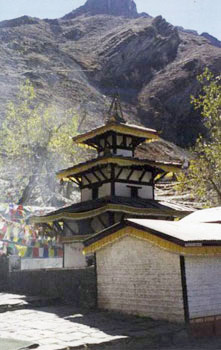 The fires of Jwala Mai were first described in English by David Snellgrove, a British Tibetologist who visited Muktinath in 1956. In his book, Himalayan Pilgrimage (1961), Snellgrove wrote that “The flames of natural gas burn in little caves at floor level in the far right-hand corner. One does indeed burn from earth; one burns just beside a little spring (‘from water’); and one ‘from stone’ exhausted itself two years ago [1954] and so burns no longer, at which local people express concern.”
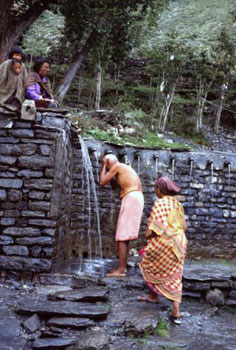
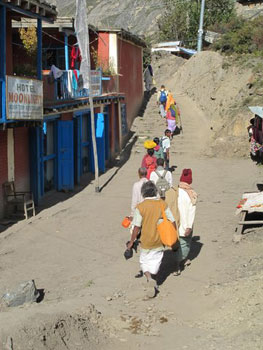
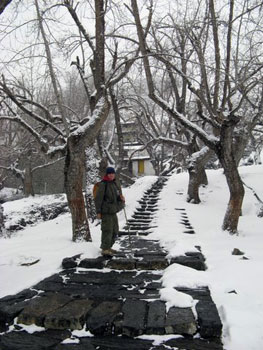 On the secular side of Muktinath, the physical facilities available to pilgrims consist primarily of uncomfortable cold stone shelters wide open to the elements. In recent years, several tourist hotels and trekkers’ guesthouses have been built at Rani Pauwa (‘Queen’s Resthouse’), a small settlement below the shrine. They bear such names as Shri Muktinath Hotel and Royal Mustang Hotel, and one that is inexplicably named after Bob Marley, the renowned Rastafarian musician.
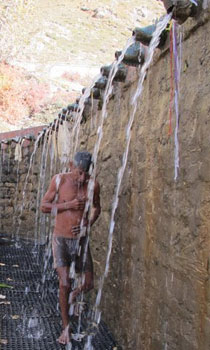 I set out to trace the etymological roots of “resort,” the noun. In Roget’s Thesaurus I found a long list of synonyms: haunt, hangout, playground, vacation spot, gathering place, club, and casino. A place for recreation, like a ski lodge. A health spa, baths or springs. All the things we expect a “resort” to be. The only association between these contemporary descriptors and Muktinath’s ascetic reality are those “hundred-odd” cold mountain springs. But I can’t imagine Tilman cavorting playfully in the frigid waters then calling it a “resort.”

 (1952) is now a rare book. Fortunately, it has been reprinted in Tilman’s Seven Mountain-Travel Books by The Mountaineers (Seattle) and Diadem Books (London) (1983). There are also several biographies of him as mountaineer (in his youth), sailor (in later life), and discerning travel writer (life-long).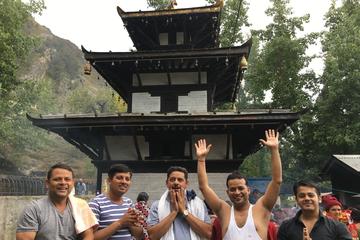
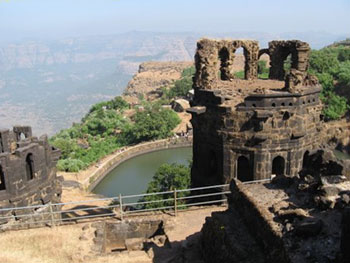
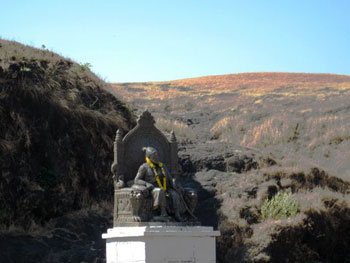 The Ropeway is like an elevator going up and down. Within minutes, it was our turn to get into the cable car and I readied my camera to get some pictures. Before I could catch my breath it was time to disembark at the Mena Darwaza – the alighting point for the Ropeway travelers. There we were met by Mr. Gaikwad, our guide on ‘Raigad’, who took us to a waiting group for further action. The starting point of our tour was the Mena Darwaza – the entrance through which the ladies of the Fort would enter. Fort Raigad was the capital of the most illustrious Maratha sovereign, Chhatrapati Shivaji Maharaj. European historians have described it as ‘The Gibraltar of the East’. The sheer vertical rock face soaring into the sky above appears defiant and insurmountable. As the guide took us along through the various points on the Fort, he explained everything with a great amount of passion. Innumerable tales of Shivaji’s strategies and valor were narrated as reasons towards his many wives. Apparently, he married princesses from various places to ensure that he would not be attacked by the rulers of those states! We counted eight living quarters specifically meant for his queens. He was so organized that he had a full-fledged ‘Secretariat’, the remnants of which can still be seen.
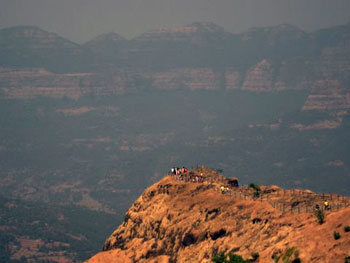 To ensure that his entourage and their families who lived with him on the Fort were comfortable, there was a ‘Bazaar Peth’ that was headed by one Nagappa Seth. Trading of daily consumables was carried out here for the convenience of the Fort residents. However, nowhere on the Fort was anyone allowed to display their name on any property and Nagappa wanted to feature somewhere somehow. Since he was not allowed to display his name anywhere, he displayed a ‘Naag’ or snake on the wall of his shop to symbolize his presence! We were then shown the ‘TakMak’ point, which is the edge of a sheer cliff from where traitors would be thrown off as punishment. This particular point also has a curious tale of steadfast devotion and obedience. Chhatrapati Shivaji used to visit the place often and would always be accompanied by a ‘Chhatri’ or an Umbrella bearer.
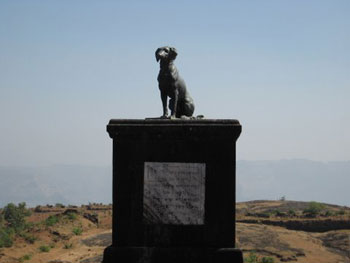 On one of these visits, due to strong winds, the Chhatri bearer who was under orders not to leave the Chhatri under any circumstances, was blown off the cliff but miraculously parachuted down to a village named Nizampur. Chhatrapati Shivaji then announced that the village would henceforth be called Chhatri Nizampur.
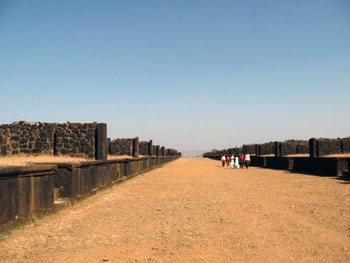 The overall area over which the Fort is built is huge and it would take at least a couple of days or more for a thorough absorption of the history therein. So, with a promise to return yet another day and spend a couple of days in the peaceful environs, we start on our way back. Lunch at ‘Kulkarni’s Suyash’ restaurant near Mangaon on our return trip is memorable for a couple of reasons. The first of course is the delicious food in a natural ambience and second is the crows that descend on the tables at every opportunity to peck at the leftovers. This in spite of the catapult bearers who keep taking potshots at the intruders. It seems like a regular game between the birds and boys!