Bagan, Myanmar
by Paola Fornari
‘Would you like to see the giraffe women?’
‘No.’
My guide seemed a bit taken aback by my blunt reply, but he didn’t insist.
To me, the idea of going to ogle at women whose necks are lengthened by the rings they wear on them – and worse, have my photo taken beside one – disgusted me. It reminded me of the Bushmen who were taken to Europe to be viewed as ‘circus freaks’ two hundred years ago.
Anyway, I was in Bagan: the giraffe women, or Padaung, didn’t even come from this area – so clearly they were here purely as a tourist attraction. And my Lonely Planet Guide was clear on the subject: the rings deform the shoulder blades and upper ribs, and often, women are no longer able to hold up their heads without them. Having one’s photo taken with them can only encourage the practice.
The Padaung people are originally from the Kayah state, and come from an isolated, mountainous region near the Thai border, south of Inle Lake. The area is closed to tourists. They are also known as the ‘Red Karens’, because they have a predilection for red in their fabrics, and are similar in many ways to the nearby Karen minority. Many have become refugees in Thailand.
Originally, it seems that the rings were placed on girls’ necks to make them ugly, so that they would not be attractive to men outside their ethnic group. But now, for many, it has become a means of survival.
A few days later, I was at Inle Lake, between Bagan and Yangon, with a new guide.
‘Want to go and visit my friends, the giraffe women?’ he asked.
‘No,’ I said firmly, and once again, my refusal was accepted. But I started thinking. He’d said ‘my friends’. And he was such a pleasant, seemingly ethically conscious man. I’d even had lunch at a monastery with his wife and children and a group of monks. Maybe…


‘You know,’ he said kindly, ‘the guidebooks are filled with mistakes. It’s written by good writers, who travel a lot, but what do they know about us, our needs, our customs, our feelings?’
 ‘So are you telling me there’s no human rights issue with the Padaung women?’
‘Absolutely not. I’ve known these women for thirty years. I’ve even been to their village. They have nothing there – no income of any sort. Now that they’ve found a way to help they’re families, they’re so happy. Why don’t you come? You can talk to them for yourself…’
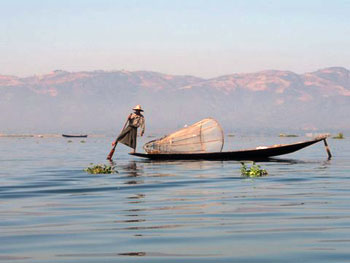
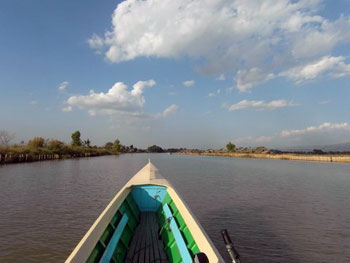
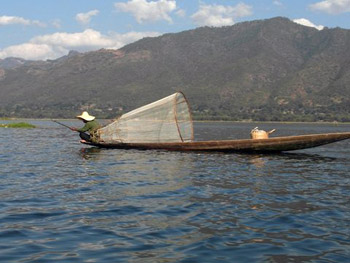
So I conceded, and we set off across Inle Lake, on a long engine-powered canoe. The trip took us an hour. The lake was as calm as a sheet of glass, and as we traveled, I contemplated the fishermen, who looked totally at peace, with their unique technique of hooking one leg around a paddle to propel themselves. An hour later we docked at a handicrafts shop in a village on the lake shore.
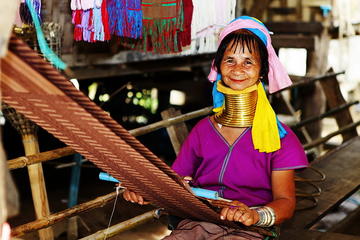
Five Padaung women, standing in a line, greeted us. Their were arranged in order of the size of their neck rings. Several tourists were jumping in and out of the line, having their photos taken.
‘They are standing according to their age,’ my guide said. ‘This one on the left is sixteen, and the last one in the line is sixty-three.’
I felt sickened, but I had to give this a chance. Who was I to judge? I sat down on a bench, and a couple of the women sat beside me. My guide interpreted.
‘Do you wear that round your neck all the time?’ I asked.
‘The older people do,’ the sixteen-year-old said. ‘We just wear it in the peak season. Then we go back to the village and take it off.’
‘So the elderly woman sleeps with all that weight around her neck?’
 ‘She’s used to it.’
‘Why do you do it?’
‘For the older ones, it’s tradition. For us, it’s a way of earning money for our families.’
I examined her neck, and found that it was not a series of rings but just one, coiled round and round many times. It was heavy and rigid.
My guide explained: ‘As their necks get longer, each coil is replaced by a bigger one.’
‘Who changes it?’
‘The ringmaster. There’s one in each village.’
‘When did you start wearing the ring?’ I asked the young girl.
‘Just for this season. I started six months ago, to get accustomed to it. The old woman started when she was six.’
She showed me a dusty sepia postcard of a sad-looking little girl, her neck already unusually long, looking as though a serpent was strangling her.
‘Maybe this is the first photo of a Padaung woman ever taken by a tourist. The girl was five.’
‘Where is this girl now?’
‘In a refugee camp in Thailand.’
‘Why?’
‘She gets more work there than here.’
‘Is anyone forced to wear rings?’
‘Oh no. We like wearing them.’
Maybe, but I simply could not bring myself even to look at the handicrafts that were on display behind the line of women. I deliberately did not take my camera out of its bag. The photos of the peaceful lake, where fishermen paddled as they had done for centuries before the tourists arrived, were all I needed for my Myanmar album.
If You Go:
Private Guided Full Day Tour in Kayan
Ethnic Long-neck Padaung from Loikaw
About the author:
Paola Fornari was born on an island in Lake Victoria, and was brought up in Tanzania. She has lived in a dozen countries over three continents, speaks five and a half languages, and describes herself as an ‘expatriate sine patria‘. At present she is living in Bangladesh.
Photographs are by Paola Fornari.
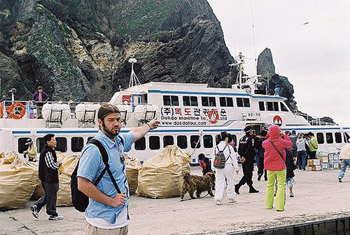
 So, when I noticed that Adventure Korea, the Seoul-based travel agency for miguks (Korea’s version of gringos), was hosting a trip to Dokdo, I seized the day.
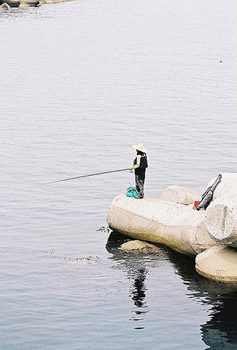
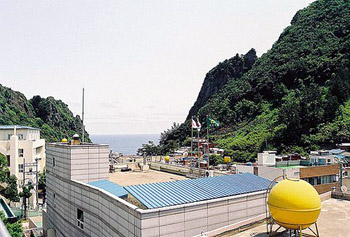 Getting to Dokdo was going to take three hours round-trip. And, because the seas were rough, like thousands of other annual tourist, it was doubtful we’d even get to dock and set foot on Dongdo, the eastern of the two islets that compose the bulk of Dokdo. Seodo, to the west, is a conical rock that doesn’t even have a place to land. The rest of the territory is composed of eighty-nine “islands” that could be mistaken for boulders that have rolled into the water.
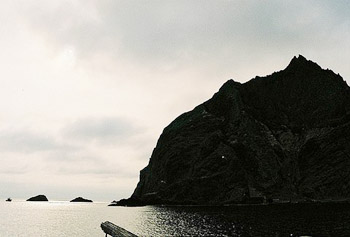 We got lucky in that the boat rocked its way next to the little concrete slab port where Korean police changed shifts and offloaded cases of soft drinks and snacks. Tourists are prohibited, but up the steep face of Dokdo, there is a path leading to the island’s lone dwelling, used by the border police. It appeared a rather drab existence.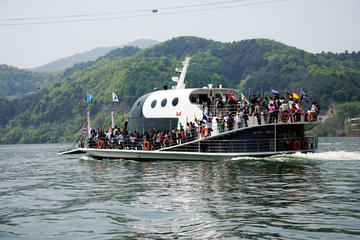


 The well crafted boat sailed tranquilly on the gleaming lake and went past the little villages, the tiny canals, the alluring toddy shops and the green paddy fields. Due to the openness of the landscape, we were treated to a wonderful cooling breeze which made us sway like the coconut trees on the banks. After a round of games that included cards and charades, it was time for some bacardi blasts and a sumptuous lunch prepared by the in-house cooks. The fragrant whiff in the air said it all. The mouth watering seafood delicacies were spread out and within a flash it was time to lick the fingers.
 A trip to the villages of Kerala must include a visit to the toddy shops. Toddy tastes best and fresh when you drink it in the morning as it turns sour as the day progresses. Nevertheless, we happily gulped it down. Nestled back inside the comforts of the kettuvellom, we watched at a few lanterns glowing in the distance from the many anchored boats and the houses besides the lake. It was a romantic sight.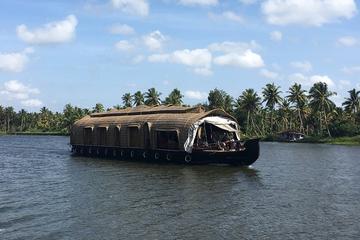
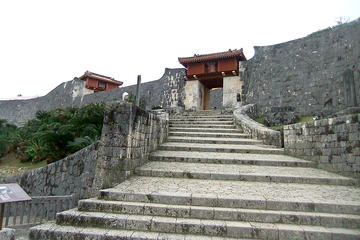
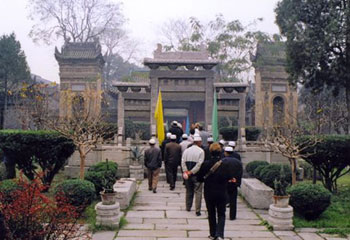
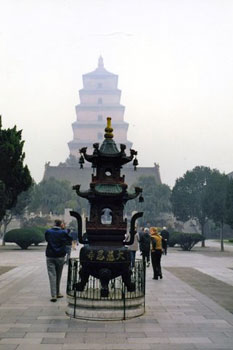 We next arrive at the Great Wild Goose Pagoda, a religious complex built about 652,AD on the city’s southern edge. Silver morning mists shroud its peaceful manicured gardens as Hanson regales us with this sanctuary’s legend, “During a severe famine, Buddha miraculously provided flocks of wild geese to feed starving worshipers…” Over 300 Buddhist monks were once housed in 2000 little rooms here; nowadays, forty live here.

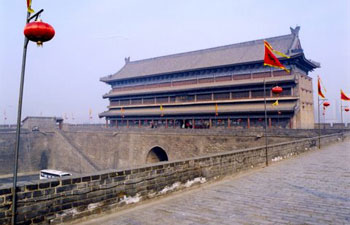 Just when we thought it couldn’t get any more captivating we arrive at Xian’s Grand Opera House, a huge dinner theatre. Soon, white-clad servers deliver basket-after-steaming-basket of tiny, mouthwatering dumplings. Wielding our chopsticks enthusiastically and washing each luscious tidbit down with cold Chinese beer, we ooh and ahh delightedly over these intricate handmade creations, decorative tops signifying each filling: duck, broccoli, pumpkin, but the most electrifying experience was yet to come…
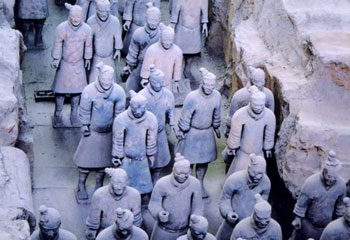 Hanson continues, “Ascending the throne at age13, Qin unified feudal kingdoms and established China’s first dynasty in 221 BC. Seven hundred thousand artisans worked on his mausoleum for decades before his death, never finishing it. His son eventually continued the work, as his father had wished.”
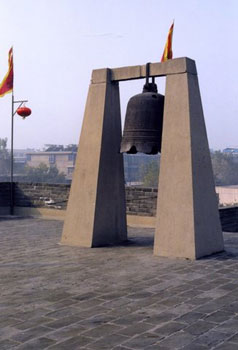 Expecting natural terracotta earthen tones, I’m surprised to learn that hair, eyebrows, faces and hands had then been hand-painted in life-like colours: pink flesh, white eyeballs, black hair. Yellows and scarlet covered Emperor’s robes; green, soldiers’ trousers. Inspired, my hubby bargains for an entire clay regiment to guard our sun room plants back home.
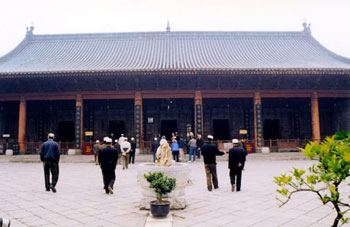 At last, we enter into that bright air-conditioned pit over a football field and a half in size. Scarcely believing what we were seeing, we witness the twentieth century’s premier archeological discovery…
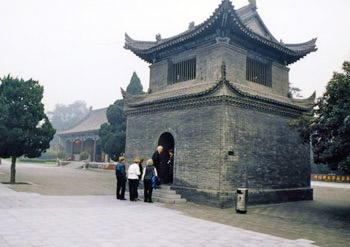 Hanson observes, “Soldiers and horses have been carefully reassembled from collapsed rubble; the colours have mostly faded.” From each warrior’s facial expression, including wrinkles on the generals, we imagine their different personalities. Last of all, we pause thoughtfully at the humble well’s site, the place that had started worldwide notoriety.