Tamil Nadu, India
by Irene Butler
A beach is a beach is a beach…or so I thought. Something strikes me as peculiar about the13km of exceptionally wide Marina Beach in Chennai. No bikinis, or horizontal bodies slathered in tanning lotion, or swimmers in the Bay of Bengal. The thousand or so locals out for the evening breezes are fully clothed, and 90% are upright, either walking about or standing and chatting, with the remainder sitting for a picnic supper.
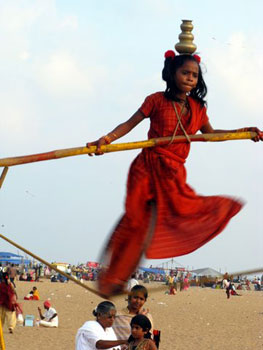 As my husband Rick and I plod through the soft sand, Coney Island comes to mind. Smiling tots bob up and down on carousels and youths shriek from wildly-whirling contraptions, horses gallop by with riders, and kites fill the sky. Most amazing are the girls aged between six and ten performing daring feats on tightropes affixed to crossed bamboo poles lodged in the sand. Snack food is sold out of tents and stalls, some with gaudy plastic stools out front for customers. We agree this is our most exhilarating beach walk to date.
Our days in Chennai (formerly Madras) are spent scouring the sites. Fort St. George, built by the British East India Company in 1653, is now the Secretariat & Legislative Assembly. Within the old fort walls is India’s oldest surviving British church, St. Mary’s, consecrated in 1680. With four-foot-thick outer walls and two-foot-thick roof, it was considered bomb-proof against cannon balls. Behind the altar is a depiction of the last supper, and although not signed, it is believed to be from the Raphaelite school, with the central figures painted by Raphael himself.
 St. Thomas (San Thome) Basilica (built in 1504, and rebuilt in 1893) is renowned for its neogothic elegance, and for an underground chapel where I stand riveted at the thought of “doubting Thomas”, one of the twelve Apostles of Christ being buried here. This is one of three churches in the world proclaimed to be built over the tomb of an Apostle (the others being St. Peter’s Basilica in Rome, and Cathedral of Santiago de Compostela built over the tomb of St. James in Spain).
St. Thomas is said to have come to this area in 52 AD. We follow his story to Little Mount and St. Thomas Mount, several kilometres from the church. The first is a cave where St. Thomas was believed to have lived in hiding from his persecutors. Further up the hill on St. Thomas Mount is where he was speared to death in 72 AD. In the small church at the top of this mount, to the right of the altar is a painting of Mother Mary and the Christ Child, brought here by St. Thomas and purported to be the work of St. Luke.
We leave Chennai with Dharma, our guide, for the village of Mamallapuram (also called Mahabalipuram), renowned for its ancient rock-carvings, most of which were completed in the 7th century when this was a major port for the ruling Pallava dynasty.


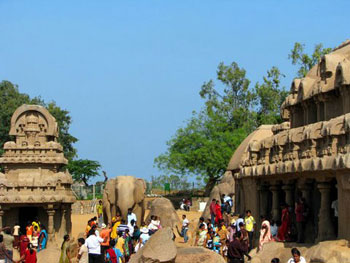 Dharma leads us to the 12m high and 30m wide exquisite bas relief known as Arjuna’s Penance. Dharma points out the key figure saying, “Arjuna is balanced on one leg with arms upraised in ‘penance’, which in the Hindu religion does not mean repentance, but rather a gaining of power over the gods.” Arjuna’s motive was to garner the sword from the towering figure of Shiva beside him, with which to kill his enemies. Our imaginations soar as our eyes scan the 100 sculptured forms surrounding the central figures, depicting lesser gods, humans, flying creatures, and animals, including two life-sized elephants.
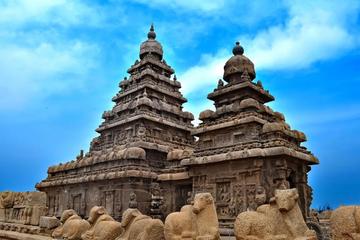
A half-hour-walk brought us to the Shore Temple. Its two pagoda-style towers are weathered by wind and sea, yet a remarkable amount of carvings remain, especially inside the shrines for Shiva and Vishnu. A rock wall has been built to protect it from further erosion.
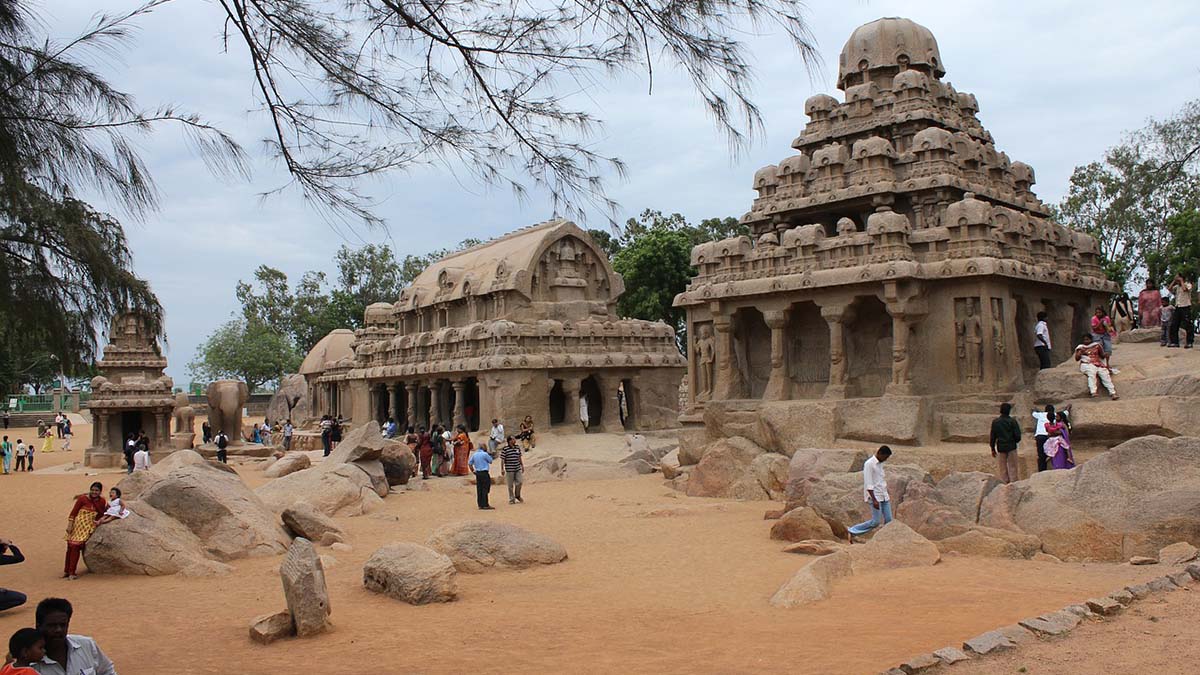
Nearby is the temple complex known as the Five Rathas. Lions and a life-sized elephant are regally poised at the entrance of these monolithic temples resembling chariots. Numerous deities, as well as scenes of everyday life, such as women weaving, young girls primping and pompous dignitaries are sculpted on the stone walls. We are awed by the preservation of these spectacular monuments, which were hidden in sand until excavated by the British 200 years ago.
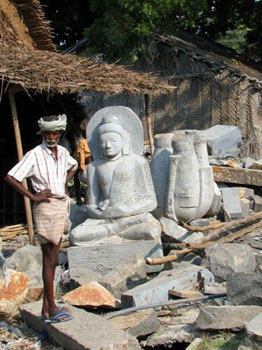 Over a thousand years later, the tapping of hammer and chisel continues along the dusty streets of this village renowned for its stone carving. We become absorbed watching artisans chip granite blocks into animal forms and gods destined for temples around the world.
Day-trips from Mamallapuram are as fascinating, as they are varied. Our first was to Kanchipuram, the city of 1000 Hindu temples, and once capital of the Pallava, Chola and Pandyan dynasties. The largest and highest, Sri Ekambaranathar temple covers 12 hectares and dates back to the 16th century. The artistry in the sculptures is superb. There is a gathering of women hanging small dolls from the huge mango tree in the courtyard; “to aid fertility,” Dharma explains.
The oldest temple and to us the most beautiful is the Kailasanatha. Constructed in the 8th century, sculptured lions and gods fill the rock walls, and fragments of murals are visible in some of the 58 small shrines, attesting to its former grandeur. Dharma is a wealth of knowledge on each temple’s history, the meaning of the various poses of the gods and associated legends.
 Another Kanchipuram stop was to a family silk weaving factory where some of the most astoundingly beautiful wedding saris are made with vividly coloured silk threads, the borders spun with gold and silver strands, and costing up to 50,000 Rupees ($1,190) – expensive for the country’s economy. Eighty percent of the city’s population is involved in the silk industry.
It was next onto Puducherry (a.k.a Pondicherry or Pondy), a former French colony with a seafront promenade, wide boulevards, “rue” for “street” on signage, 18th century French architecture, and enticing French cuisine restaurants – unlike anywhere else in India.
A huge draw to this community is the famed Sri Aurobindo Ashram. Founded in 1926 by a French woman known as “the Mother” and prolific writer Sri Aurobindo, it promotes their philosophies which are a synthesis of spirituality, yoga and modern science. Both are deceased and entombed in the courtyard of the ashram, where we as visitors are among the devotees gathered to pay homage to these spiritual leaders.
 Just over the border from Puducherry is Auroville, the brainchild of “the Mother”, whose work has been carried on by her followers. Although there is minimal tourist access of the facility, a visitor centre provides information on the workings of this international community that is spread over 20 sq km, with about 2,000 residents from around 38 nations. It is a place to live in peace and unity – above all creeds, politics, and nationalities. The focal point of Auroville is a gigantic gold-plated globe called the Matrimandir, which contains a crystal that diffuses sunlight into 26 meditation chambers for use by its members.
We leave saturated by the wondrous sites of Chennai and the surrounding centres. Our mixed experiences of landmark churches, ancient temples, ashrams, specialty crafts of various areas, and pocket of French flavour, was made even more incredible with the hospitality of friendly locals and our gracious guide Dharma. Although not our first visit to this amazing country, I concur with Rick’s succinct summation, “India just keeps getting better.”
Private Full-Day Mahabalipuram History Tour from Chennai
If You Go:
Chennai, capital of Tamil Nadu – Population 62.1 million.
Mamallapuram hosts an annual National Dance Festival from Dec 25 to Jan 25.
Distances
Chennai to Mamallapuram – 54 kilometers south
Mamallapuram to Puducherry – 162 km south
(Kanchipuram is inland between Chennai and Mamallapuram)
From Chennai – 75 km SW
From Mamallapuram – 66 km NW
Transportation
Buses and Trains leave regularly between these centres.
Taxis and Rental cars are also options.
Tourism Web Sites
India Tourism: www.incredibleindia.org
Tamil Nadu Tourism: www.tamilnadutourism.org
Puducherry: www.pon.nic.in
Auroville: www.auroville.info
Sri Aurobindo Ashram: www.sriaurobindoashram.org
Suggested Accommodations
The Residency, Chennai www.theresidency.com
Chariot Beach Resort, Mamallapuram www.chariotbeachresorts.com
About the author:
Irene Butler and her husband Rick are a travel journalist/photographer team from Richmond, B.C. They lead a gypsy existence travelling around the world for six months of each year. They have been currently touring the Middle East. www.globaltrekkers.ca. Irene has recently published a travel memoir book, ‘Trekking the Globe With mostly Gentle Footsteps’. Covering twelve countries in twelve months. Order it on-line from www.granvilleislandpublishing.com
Photo credits:
Mahabalipuram beach temples by sreesai from Pixabay
All other photos by Rick Butler.
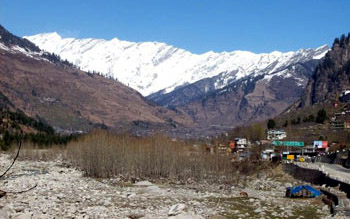
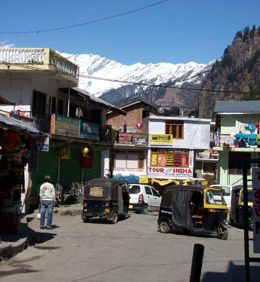 I booked myself onto an overnight bus, barely sleeping through a cold night on winding roads, waiting for the dawn to break. When it did, I watched us pass through villages and market towns, women hurrying through the morning wrapped in thick shawls, men drinking steaming tea at roadside shops, children bright-faced with cold and smiling, all backed by green slopes and snowy peaks. This India looked very different to the hot plains I knew.

 “Is there snow in Solang?” I asked.
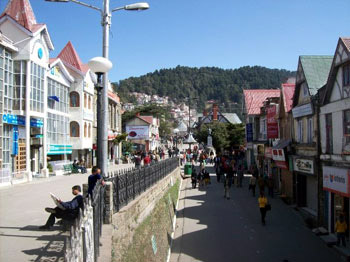
 The summer capital of the British Raj, Shimla is strung out along a high, green ridge, overlooking deep valleys covered in trees. Its streets are stepped like rice terraces, connected by steep staircases. The buildings are all oddly familiar in Shimla – bay-windowed houses with chimneys and pointed roofs, the Raj’s version of home, tumbling down the mountainside. There are two Shimlas – the Indian town, a steep warren of shops and stalls, and the European town, with broad buildings spread out around a wide boulevard, and into the trees on the edge of town.
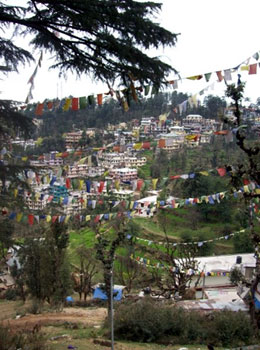
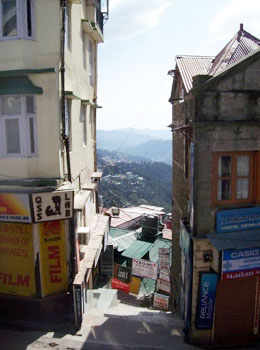 Having had my fill of Shimla’s ghostliness, I got another bus to Dharamsala, home of the Dalai Lama. Dharamsala itself is a bustling but unremarkable mountain town, but above it is McLeod Ganj, seat of the Tibetan government, and with a population of mostly Tibetan refugees and western tourists. Many of them come to take Buddhist meditation classes, or to hear one of the Dalai Lama’s teachings. I came to eat Tibetan food, try out the hospitality in Tibetan bars, and gaze at the views over the valley, of rocky villages and strings of colourful Buddhist prayer flags.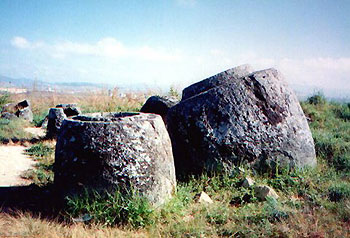
 I booked into a cabin at a reasonably clean home-stay and deciding to leave the Jars till the next day, set out to explore the humble streets. Drifting into a cheap café for lunch, I chanced upon a middle-aged Brit we’ll call Basil. He was a handsome older fellow with an air of action about him. Nevertheless poor Basil was desperate for conversation and fell upon me, inviting me to join his table. Weary from a week full of shenanigans in Vientiane I was not overly pleased. However it would have been unspeakably churlish to decline. Over a couple of Beer Laos and a bowl of steamy noodles he told me his story.
 But it was a lot more serious than that. Basil told me there were enough unexploded bombs left over from the War in this province to keep him busy for another 500 years; pineapples, daisy-cutters, bomblets, the whole deadly assortment. Only the day before, he’d found two live missiles underneath a busy children’s classroom. Later in my tour I would see Hmong habitations that were built from discharged shell casings.
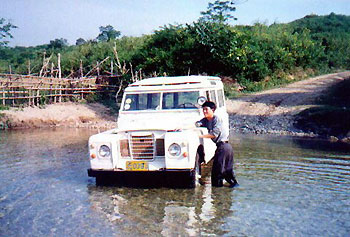 The focus of Basil’s job was to train up local lads to be defusers themselves. They were brave, good-hearted souls, but so gung-ho to get stuck in he feared for their lives.
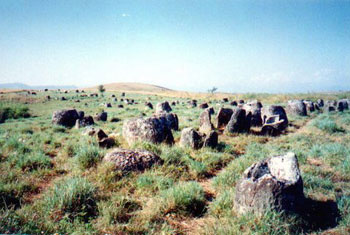 So there I was, sat in the Unexploded Bomb Land Rover, speeding out into the dark deserted moors. All around was nothing but black fields and bombs. On we drove, up and down, over hills and through vales. Then abruptly … there it was!
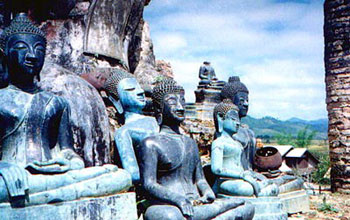 As we motored back to Phonsavan’s version of civilization, I pondered my companion. It’s true to say that left-wing liberals like me find it difficult to bond with macho army types like Basil. On the other hand, his sacrifice of time and safety to the people of Laos deserved nothing but awe and admiration. I had come to respect him, despite his problems in adjusting to local customs. Usually I can’t stand westerners who come out to Asia and whinge. As a famous Catholic missionary in Bangkok once told me: shut up or ship out. Perhaps my encounter with Basil taught me to be less fussy.