The City of Firsts
by Troy Herrick
Echoes of clanking armor, clashing swords and horse’s hooves conjure up images of Spanish conquistadors as you stroll along the cobblestone pathways of Santo Domingo’s old center. Amidst this 500 year old backdrop you can almost envision yourself setting off to discover new worlds with the likes of Hernan Cortes and Francisco Pizarro.
Begin your tour at the “modest” Columbus family home. The Alcazar de Colon (Spanish for Columbus) was constructed in 1517 for Christopher’s son Diego, who became viceroy of the colony, and his wife Maria de Toledo, niece of Spanish King Ferdinand. This 22 room fortress was occupied by their descendants until 1770 when it was abandoned and allowed to deteriorate.
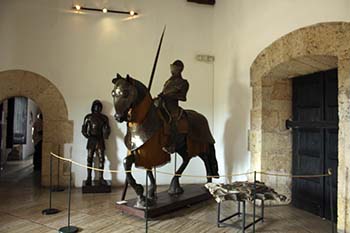 Now restored, the front façade reflects the Mudejar style common in 16th century Spain. The furnishings represent the age but are not original to the family. Passing through the front door into the foyer, a mounted suit of armor ushers you into the dining room. Used for formal government functions, this dining room contains a dark wooden dining table and cabinets. A gargoyle to the right of the door kept diners safe from evil spirits. As an additional precaution, a food taster sampled everything before guests began their meals.
The second floor features Diego’s office where pictures of Christopher and Diego Columbus size you up as you review copies of official documents authorized by Queen Isabella. The adjoining family living room has two large windows that open out to a balcony overlooking the Plaza de Armas (Plaza de Espana). From here Diego could supervise his soldiers parading around. Today you are more likely to look out over art shows and concerts rather than military drills.


 Adjacent to the Alcazar, the San Pedro Gate connects the Plaza de Armas with the Ozama River. Spanish ships docked outside and priests, the only literate residents of the city at the time, would complete the necessary paperwork before the cargo was unloaded and transferred into warehouses (Las Ataranzas) straddling the plaza. A number of these former warehouses still stand and have been converted into restaurants and touristy shops.
Wander down the cobblestoned Calle Las Damas, the oldest street in the Americas, named for Maria de Toledo’s Ladies-in-Waiting that often strolled here. En route you find a cluster of three cannons that provide a warm welcome to cruise ships.
 The cannons are accompanied by a large sundial (reloj de sol) that dates to 1753. The reloj del sol has a vertical face set on both the southwest and southeast sides of a large stone pillar in order to determine the time in the morning and afternoon respectively. This sundial was the official time piece for the colony and could be seen from the former government building across the street known as the Casas Reales.
Cross the street and enter the Museo de la Casas Reales. Constructed in 1520, this was the official residence and office complex of the Spanish Governor. The upper floor houses a reconstructed Governor’s Reception Hall with its canopied throne and portraits of past Spanish Monarchs including Felipe II and Carlos II.
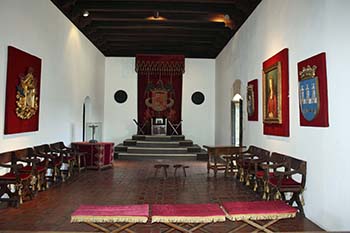 Next door the Royal Audience Hall, site of the colonial Supreme Court, features a raised throne at the far end of the room with chairs lining the side walls and benches at the back. The adjoining Anteroom of Royal Agreement at the rear was used for both jury deliberation and a prisoner lock up.
The museum also features exhibits from 1492 to 1821 including documents written by Christopher Columbus, navigational instruments used on sailing vessels, instruments used in the slave trade and a reconstructed colonial pharmacy. A fine collection of Taino Indian artifacts is also on display.
 Continue your stroll along the Calle Las Damas to the Fortaleza Ozama where you find the oldest fortress of its kind in the new world. Passing through the ebony gate of this 1503 military outpost, you are confronted by the medieval-looking Tower of Homage. This imposing structure, constructed of coral blocks and at one time the tallest structure in the colony at approximately 18 yards, kept a watch over all approaching ships.
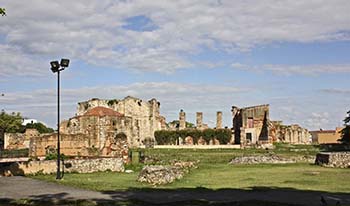 Despite these formidable defensive fortifications, Englishman Sir Francis Drake and crew landed at Santo Domingo in January 1586 and brought the entire colony to its knees. He systematically burned the city until receiving a ransom of 30,000 crowns. You can still see evidence of Drake’s rampage at the ruined Monastery of San Francisco.
Exit the fort and take the short walk to the Plaza de Colon in front of the cathedral. This large open park with benches nestled under shady trees is the perfect place to hide from the warm tropical sun and just people watch. A large bronze statue of Christopher Columbus provides you with some company.
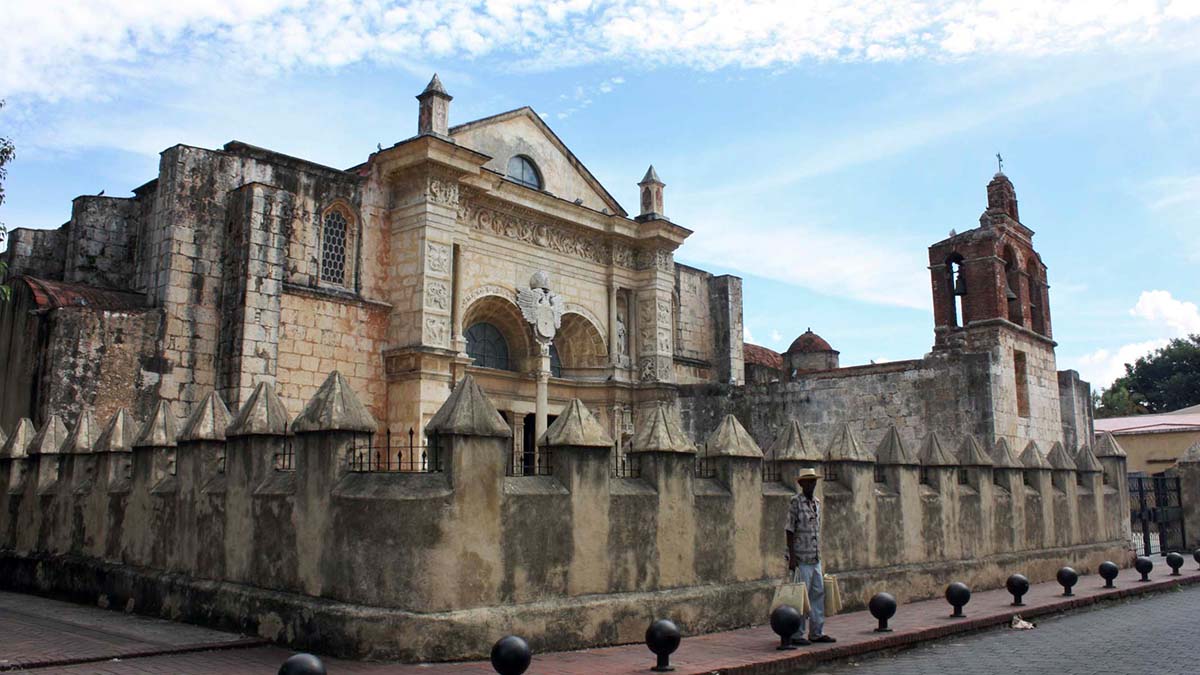
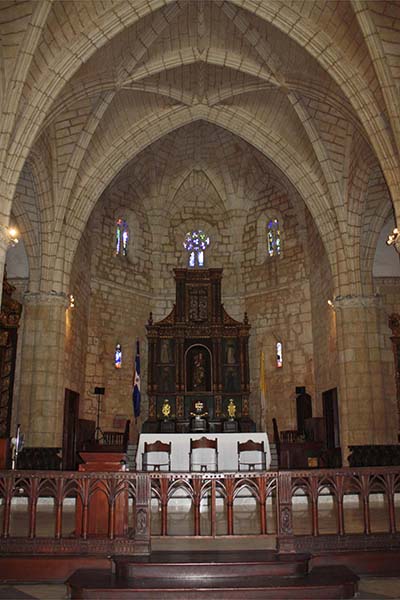 After cooling down, make your way to the Cathedral Primada de America [TOP PHOTO]. In 1542 Pope Paul III recognized this cathedral, constructed between 1523 and 1541, as the first in the Americas. Residents of Mexico City might dispute this claim however. Their first cathedral was constructed between 1524 and 1532 and remained in use until 1573 when it was replaced by their present structure. Despite the overlapping dates, Santo Domingo can safely lay claim to having the longest operating cathedral in the new world.


The crypt once held the remains of Christopher Columbus for almost four centuries. Now his final resting place is the subject of much debate. Dominicans state that Columbus is now entombed inside the lighthouse known as El Faro de Colon while residents of Seville Spain insist that he rests inside their cathedral. The Government of the Dominican Republic has steadfastly refused to clarify mystery by means of DNA testing.
Your tour concludes when you exit the cathedral. While there are many other discoveries waiting for you in the Zona Colonial, you may have worked up an appetite. Consider trying a delicious Creole meal at the Pasteleria Mimosa. I highly recommend the Creole chicken and plantain. When you are finished eating, continue with your own exploration of this new world.


If You Go
The Alcazar de Colon is located at the Plaza de Armas/Plaza de Espana. Admission was 100 Pesos.
The sun dial (Reloj de Sol) is located in front of the Museo de Casas Reales on Calle Las Damas.
The Museo de la Casas Reales is located at Calle Las Damas and Mercedes. Admission is 100 pesos.
The Fortaleza Ozama is located at Calle Las Damas and Alfau. Admission is 100 pesos.
The Monastery of San Francisco covers two blocks and is located at the intersections of Calle Hostos, Restauracion, Duarte and Juan Isidro Perez.
The Catedral Primada de America is located at the east end of Calle el Conde at Arzobispo Merino. Admission is free.
The Pasteleria Mimosa is located at Arz. Nouel #51.
Visit my Santo Domingo webpage
Santo Domingo City of Firsts Small Group Tour Including Transportation
About the author:
Troy Herrick, a freelance travel writer, has traveled extensively in North America, the Caribbean, Europe and parts of South America. His articles have appeared in Live Life Travel, International Living, Offbeat Travel and Travels Thru History Magazines. Plan your vacation at his ”PlanADreamTrip.com” sites.
Photographs:
Diane Gagnon, a freelance photographer, has traveled extensively in North America, the Caribbean, Europe and parts of South America. Her photographs have accompanied Troy Herrick’s articles in Live Life Travel, Offbeat Travel and Travels Thru History Magazines.
 by Susmita Sengupta
 Mofongo. The name resonated with me, lyrical, pleasing, delightful and most importantly appetizing. I had arrived in San Juan, Puerto Rico for a spring break vacation accompanied by my husband and daughter. I had never heard of such a dish and I was eager to try it. The mofongo arrived accompanied by succulent shrimp bathed in a turmeric sauce laced with onions, tomatoes, bayleaf and spices. It was delicious. This was my introduction to the classic dish made of fried plantains that is pulverized in a mortar and pestle and mixed with garlicky olive oil and fried pork rinds and bacon. It is a dish that reflects the history and culture of this island.

 Castillo San Felipe del Morro, commonly known as El Morro, is a 16th century, six level fortress. It was named in honor of Spain’s King Philip II. The fort went through several phases of construction beginning in 1539 when the Spanish felt a fort was needed to protect San Juan from attacks by pirates and privateers. In its first phase of construction between 1539-1540, it was a small structure at the entrance to San Juan harbor. Sir Francis Drake from England attacked the island in 1595 but the Spanish were able to defeat him. But in 1598, Sir George Clifford, the Earl of Cumberland, attacked El Morro and conquered the city. Although he could only hold the city for a very short period of time, it prompted the Spanish to improve the fortification of little El Morro. There was a flurry of construction beginning in the 1600s with the building of the walls that surrounded the city. The enlargement of El Morro started in 1765 and the entire process that began in 1539 took about 150 years to complete. Today, El Morro and its companion fort, Castillo San Cristobal which was built to protect El Morro from land attacks, are part of the US National Park Service and a UN designated World Heritage Site.
 Our visit to El Morro started with our taxi dropping us off at the entrance to the fort from where we had to walk across a large, green field to enter the citadel. Be sure to wear sturdy walking shoes as there is a lot of walking involved. We took our time walking through the ramparts where we saw cannons still facing the ocean and stepped inside domed garitas or sentry boxes with its views of the Atlantic Ocean. We passed through passageways and storerooms and climbed the spiral and triangular staircases that go from level to level. On one level we saw an iguana sunning itself under the clear, blue sky with spectacular views of the ocean. By then, we were getting hungry and decided to take the free trolley from the fort entrance into the streets of Old San Juan. Although the best method is to walk the streets of the old city, the trolley is a wonderful way to get to those streets especially if one is hot and tired after spending the day at the fort.
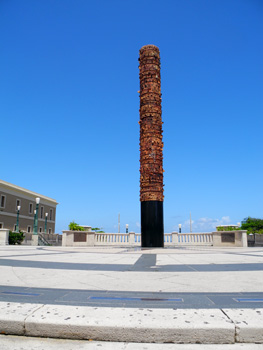
 We got down near the Spanish Barracks, or the Cuartel de Ballaja that housed the Spanish troops in the 1800s and later housed American soldiers following the Spanish American war. The three story square building, with its series of arches and central courtyard is the last and the largest building built by the Spanish in the New World. Today it houses the Museum of the Americas. Just a step away from the Barracks, we came upon a massive totem sculpture. This was the Plaza del Quinto Centenario, inaugurated in 1992. Known as the Totem Telurico, it is a contemporary sculpture made by Puerto Rican artist Jaime Suarez and it represents 500 years of Puerto Rican post Columbian history.
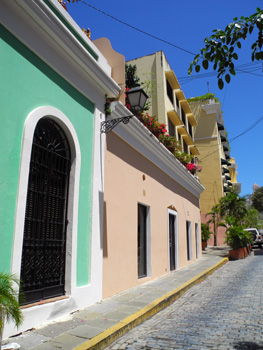 We walked through the narrow, cobblestoned streets of Old San Juan, a charming residential and commercial area, filled with shops, restaurants and wonderfully preserved homes in shades of blue, green and orange. And then we came upon El Convento, a hotel founded as a Carmelite convent more than 360 years ago. Sitting in the open air restaurant, under a breadfruit tree, we enjoyed a tapas lunch that included chicken croquettes, hummus and pita bread, calamari rings and their distinct, thin crust pizza. Near the El Convento is the Catedral de San Juan Bautista, a church of great historical importance. Although the history of the church begins in 1521, the structure we see today was built in 1540. Inside the church are the remains of Juan Ponce de Leon in a marble tomb. After spending a few moments in the serene, peaceful atmosphere we continued with our exploration of Old San Juan.

 The next day we decided to go the El Yunque National Rainforest, about a forty-five minute drive from San Juan. This is the only tropical rainforest in the US National Forest system. At the El Portal visitor center, located in the wet forest, we admired its spectacular architecture that merged in with the surrounding forest and watched a short movie describing the rainforest and its importance to the ecosystem. We stopped to take in the spectacular panoramic vistas of the forest from various viewing areas. We drove past native towns and into the winding roads on the Luquillo Mountains past bamboo groves, giant ferns, wildflowers, tropical hardwood trees, streams and waterfalls. We drove up to the Yokahu Observation Tower. The view from the top of the tower is truly spectacular and makes you forget the climb up.

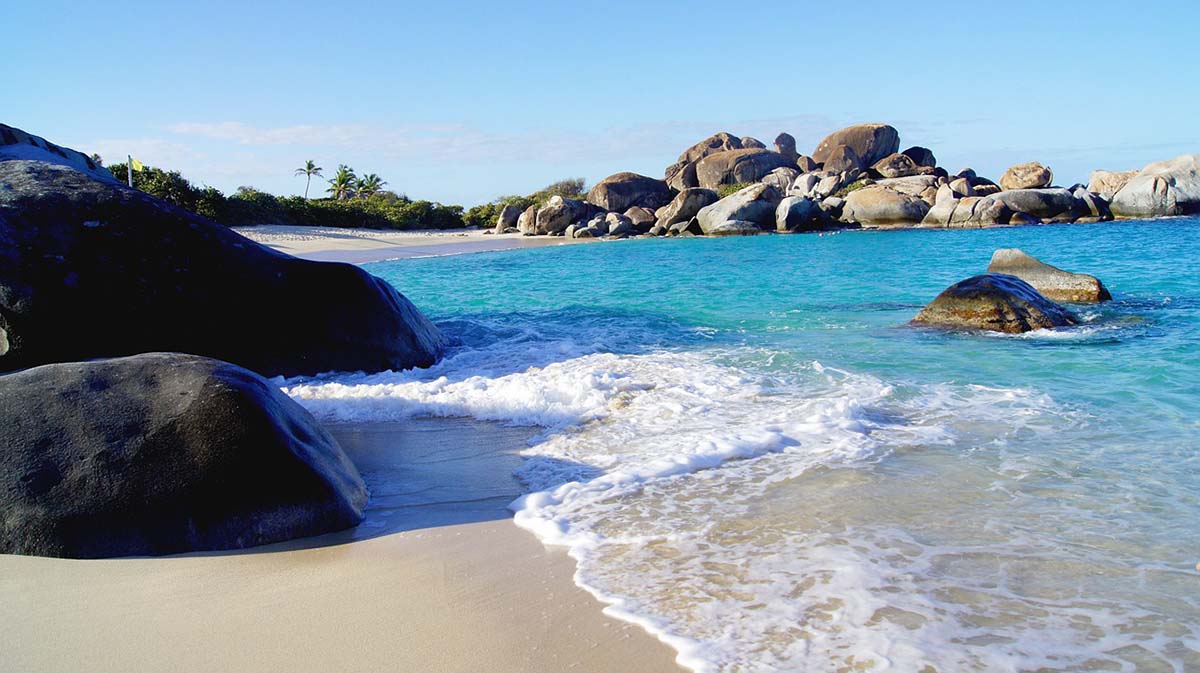
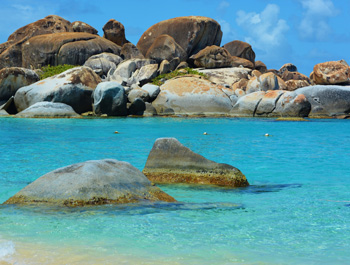 The British Virgin Islands are home to a mystifying geological wonder commonly referred to as “The Baths”. Framing the aquamarine waters of the Caribbean along a pristine, white sandy beach, the Baths invariably evoke an astonishing, jaw-dropping reaction from all who visit this grand feat of Mother Nature.
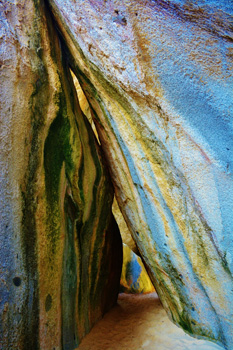 The granite-type rock formations and fascinating topography is the artistic creation of millions of years of geologic and geomorphic activity. The batholiths were formed during the Tertiary period by molten rock under immense pressure, seeping up into existing volcanic rock layers under a young Caribbean Sea. Unable to reach the surface, the seething hot molten rock slowly cooled underwater, forming a hard crystalline granite layer. Further shrinkage and cracking formed enormous blocks, exposed when the softer volcanic rock above eroded away. Once the batholith reached sea level, physical and chemical weathering rounded the sharp edges of these granite blocks, creating their unique boulder-like appearance.
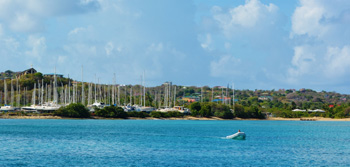 Sailboats and stretches of palm-fringed beaches with sugar-white sand came into view as our small boat, on a day trip from St Thomas, traversed the turquoise waters entering Virgin Gorda Yacht Harbour and Spanish Town. Covering only eight square miles and sparsely inhabited, this third largest of the Virgin Islands is a sleepy, idyllic Caribbean hideaway where goats and cattle own right away over island traffic. The name, given to the island by the explorer, Christopher Columbus is Spanish for “Fat Virgin”, because to these sea-weary mariners, the island’s profile on the horizon somewhat resembled a voluptuous woman lying on her side. A 10 to 15 minute open air taxi ride from the port transports island guests on a scenic slightly uphill drive to the southwest entrance of Baths National Park, a seven acre protected nature preserve.

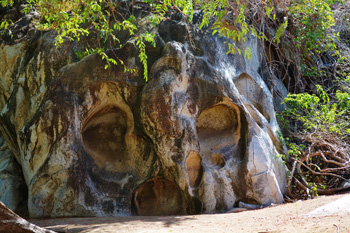
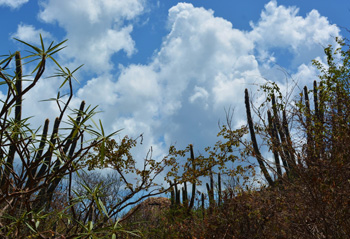 A winding, descending path of hardened sand from the park’s entrance leads visitors downward through an arid, desert-like landscape lined with scrub vegetation and multi-hued and shaped cacti. An intriguing rock formation known as The Skull appears like a ghostly pirate sculpture, but no human hands played a role in its creation. Rather this unique and startling formation is an eerie but interesting example of natural weathering causing large dishes and holes that comprise the skull-like face.
 Nothing prepares visitors as they leave the arid-like environment behind to enter a magnificent, immense wall of massive boulders- on a Caribbean beach. This enormous jumble of stone seems so completely and unexpectedly out of place from the natural geology of these islands. A series of step and rope handrails guide explorers through a unique maze of tunnels, arches and tide pools located throughout the baths. Echoes of splashing water can be heard as explorers crawl through tight spaces and descending ladders.
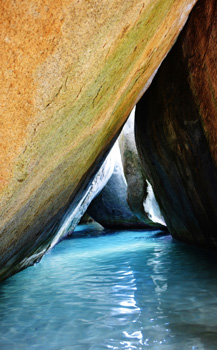 Every twist and turn yields yet another unbelievable site- hidden rooms with shafts of light streaming through, grottos which lead to more remarkable finds. The Cathedral Room, a stunning display of geological formation is the most photographed site inside the baths. Its vertical rocks form an astonishing tall, deep, triangular shaped cavern. Softly lit by ethereal rays of sunlight filtering down through small overhead gaps, this wondrous grotto is aptly named. Admiring visitors pose with a hushed reverence in its shallows as warm sea water gently rushes in and out, swirling around their legs.

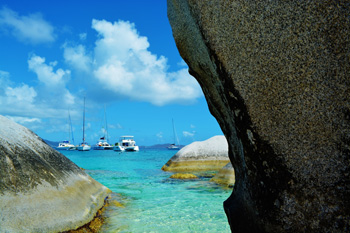 As if the spectacle of the Bath’s cavernous beauty wasn’t enough, the sinuous spelunking trail exits to a picturesque clearing with stunning views of horseshoe- shaped Devil’s Bay. Snow white talcum powdered sand is perfect for a rest from the hike under a shaded umbrella. Sailboats glide in and out of the calm bay and seabirds soar in the azure blue skies overhead. Shallow clear waters and delightful coves are perfect for a relaxing swim. Turquoise, crystalline waters of the bay teem with elusive rays, blue tang and other tropical fish, inviting snorkelers and divers to explore more underground caves and magnificent coral reefs. Boulders strewn along the beach invite hikers to climb atop for even more astonishing views of the Baths.
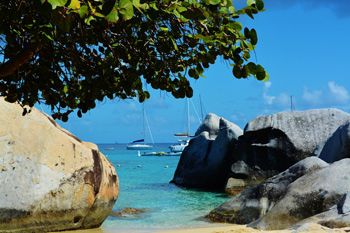 On our hike back to the top of Bath’s National Park, we regaled in our amazement over the incredible, magnificent natural beauty of Virgin Gorda’s fascinating Baths. Once experienced, one will forever hear the Bath’s siren call.

 Photo credits: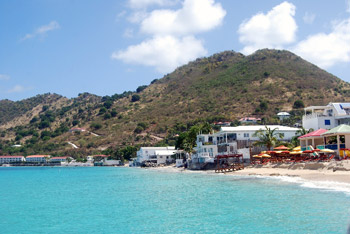
 As we know, he did make landfall, but, what land was it? It was described as a ‘bean shaped island that had several small islands nearby’ Many sources assume it was San Salvador, in the Bahamas, but it’s been pointed out that this also describes Grand Turk. Right up to his death, Columbus maintained that what he’d ‘discovered’ lay off the shores of Asia, so it could be assumed his navigation techniques were suspect … and he didn’t know where he was!
 Unfortunately, His Catholic Majesty doesn’t seem to have taken much of an interest in the place, for, by 1624, the French were growing tobacco on the island and, a few years later, the Dutch had set up a colony to work the salt pans. But, in 1633, the Spanish were involved in the Eight Years War, and realised their island was in a strategic position, and asked for it back. But, the Dutch and the French were soon back, and formalised the arrangement in 1648, with the signing of the Treaty of Concordia, which divided the island up between the two nations,
 In 1816 affairs settled down, to the situation that prevails nowadays. The French part (St. Martin) uses the euro as currency (technically, it’s a DOM, and as much a part of France as a Parisian suburb) and the Dutch part (Sint Maarten) uses the Netherlands Antilles guilder … although, in practice, the US dollar is widely accepted.
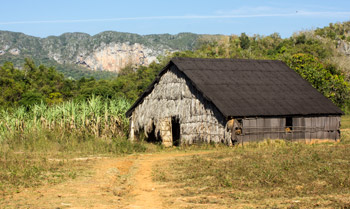


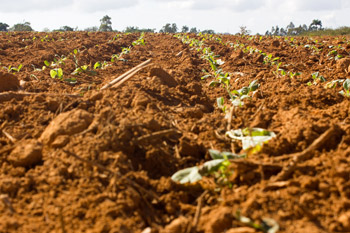 We enter a thatched tobacco aging hut to learn about the process of growing, preparing and marketing the harvest. Each farmer is given a quota, with ninety percent of the crop being bought by the government. The farmer retains the final ten percent and is free to use it for personal consumption, local sales and exchanges or making and selling cigars to tourists. Our group gathers around our host farmer and settles in to hear firsthand about his working life.
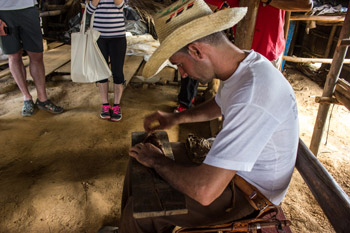 However, every farmer puts his own unique stamp on the tobacco he gets to keep, by fermenting it according to an individual recipe. These are often passed down for generations. Our guide’s family recipe was fairly simple, calling only for water, vanilla and rum. But the farm host’s recipe was a bit more elaborate, and includes “water, pineapple skin, guava leaves, honey, sugar cane and a little rum.” With a sly smile on his face, our host notes that some of that rum is applied to the outside of the leaves, and some to the inside of the farmer.
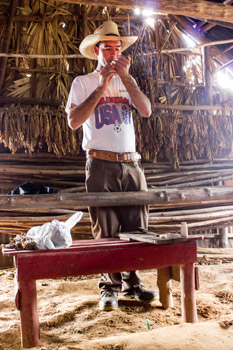 After our farmer finishes his demonstration, he lights up an aged cigar. Others are passed around for us to try, and I relish watching my fellow travelers’ reactions. I end up enjoying most of the tobacco in our Cuban Adventures group, as the others didn’t want more than a couple of puffs. Their loss was definitely my gain, for the smoke is robust and the taste smooth with a hint of honey.

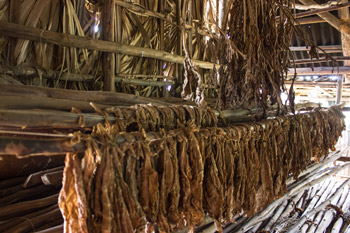 As I let the smoke caress the inside of my mouth, I look out into the valley and into the tobacco fields below. This has been one of the essential experiences I wanted to have in Cuba and I have enjoyed every minute of it. Like our host’s recipe for fermenting tobacco, the magic came from a variety of ingredients, all blended in the right proportions: rich tobacco, fresh mountain air, a relaxed pace of life, friendly and welcoming residents and the local organic produce. The combination captured me; I didn’t want to leave Viñales, and I certainly plan to go back.
 About the author: