by Ana Ruiz
On his way back to Spain after searching for gold in the Americas, Spanish explorer, Juan de Bermúdez, first sighted the uninhabited islands of Bermuda in 1505. However, Bermúdez was not interested in the small territory with dangerous reefs and there is no evidence that he even landed here.
A little over a century would pass before the islands were settled and in between this period, hundreds of navigators ended up stranded here as a result of the violent storms that occasionally plagued the area sweeping ships off their intended course into the shallow reefs. Their account of their harrowing experiences led to the island’s nickname of “Islas del Diablo” or “Devil’s Isles.”
On July 28, 1609, after 3 days of battling a deadly storm, Admiral Sir George Somers deliberately steered his vessel the “Sea Venture” into the treacherous reefs in order to save the 150 crew and passengers who safely managed to land ashore. The British ship was on its maiden voyage bound for Virginia with supplies and settlers to revitalize a deteriorating settlement. This small stranded population began to colonize the islands and in 1612, named their capital St. George’s, after the ship’s captain and the patron saint of England. For a brief period during the 17th century, Bermuda was actually known as Somers Isles and each year on July 28th, the anniversary of the historic event, Bermudians celebrate “Somers Day”, in the captain’s honor as a national holiday with special activities, events, and commemorations.
 As the plane was beginning its descent into Bermuda in the North Atlantic Ocean, I couldn’t help but notice how small the islands were, even as they were getting bigger as we were getting closer. The islands of Bermuda actually comprise one of the smallest territories in the world. Upon entering the L. F. Wade International Airport, we were greeted by a Calypso band of seven musicians that immediately got us into the tropical island mood as we prepared to pass through British customs.
Bermuda stands as a self-governing overseas territory of the UK since 1684, designating it Britain’s oldest colony. With English as the official language, it’s special charm not only stems from its British colonial roots but from its African heritage as well. Although one might think so, Bermuda is actually not a tropical Caribbean island as it is located in the Atlantic ocean, however, one might say that Bermuda is Caribbean at heart.
The two major municipalities are the historic and quaint town of St. George’s that was recognized as a UNESCO World Heritage Site in 2000, and Hamilton, the larger of the two, and capital of Bermuda since 1815 due to its more ideal central location. Hamilton, however stands as one of the smallest capital cities in the world with a population under 1000.


 Our friend and local Bermudian, who picked us up at the airport, gave us a brief tour of the main island and explained that Bermuda is actually comprised of about 180 islands. The larger and inhabited islands are connected by bridges and causeways and some of the smaller ones or islets are actually just big rocks. The area, that measures only 21 miles in length, is only about 2.5 miles wide at its widest point.
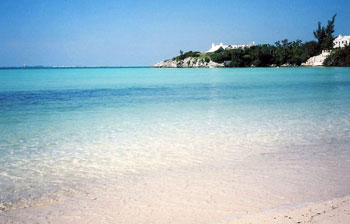
Within minutes, I was completely charmed not only by the pink sandy beaches and turquoise waters, but by the Victorian houses on Front Street. These buildings are painted in pastel colors of lemon yellow, sky blue, apple green, and soft pink that brightly decorate the harbor front road.
In St. George’s you can find the oldest houses going back to the 17th century during the time of the first settlers. The old State House dates from 1620 designating is the oldest building (excluding fortresses) in Bermuda. The State House is open to the public for a few hours during weekdays.
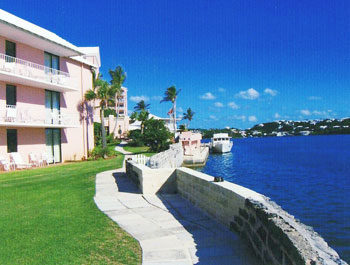
After our brief tour, our friend dropped us off at our hotel, the Fairmount Hamilton Princess Resort. To my delight, the resort was painted in pink! We had a lovely suite with two patios overlooking a golf course and the harbor.
 I truly appreciated the proximity to the boutiques and restaurants in Hamilton that were a mere 5 minute walk away.
I immediately discovered how courteous and friendly the locals were. Everyone including strangers greeted each other with a passing “hello”, “good day”, or “good afternoon.” I was not accustomed to this formality however I quickly adapted. I was also especially amused by businessmen were wearing jackets and ties with Bermuda shorts.
My travel buddy and I were told that the best way to explore Bermuda and get around is on a scooter. Fortunately, my friend was a professional motocross racer so I left the driving up to him, especially as I had never before driven a scooter let alone on the left side of the road. You can rent a scooter from several agencies for about $50 a day and upwards depending on the model selected. The rental fee comes with the mandatory helmet and interestingly, a driver’s license is not required.
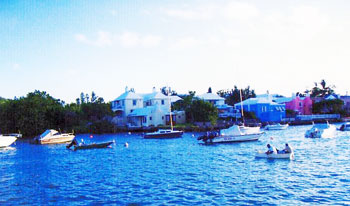 During our first evening, we decided leave our scooters behind at the hotel and head by taxi for dinner at the Swizzle Inn Pub and Restaurant in the small village of Bailey’s Bay. We had heard that their dishes were delicious and that it was where Bermuda’s national drink originated. The “Rum Swizzle” is a mild tasting yet powerful and delightful blend of rums, fruit juices, and syrups.
After our drink and although I suggested against it, my friend went ahead and asked the friendly locals sitting beside our table about the famous “Bermuda Triangle.” They politely explained that the general consensus of Bermudians is that it is nonsense and I had the embarrassing feeling that they were tired of answering this question for inquiring tourists.
 After our dinner, we took a cab back to Hamilton and visited the many cafes, bars, and nightclubs on Front Street that are opened quite late and sometimes past 3:00 am. My particular favorite was Cafe Cairo and its exotic ambiance. Unlike what you would expect to find in Bermuda, Cafe Cairo is a popular dance club that plays music from all over the world as well as a restaurant with a Middle Eastern theme decorated in North African decor. The dining room is designed as a Bedouin tent complete with soft cushions as well as an outdoor patio that overlooks the harbor. You can enjoy a Turkish coffee, sample a Sheesha pipe, or during the busier tourist season, be entertained by a Belly Dancer!
Whatever your preferences, there are so many to choose, such as visiting ancient forts and other historic sites, lighthouses, parishes, cathedrals, museums, aquarium and zoo, or even take a cruise.
Bermuda has top quality dining and shopping as well as golfing, scuba diving, boating, sailing and parasailing activities. History buffs can admire some of the treasure recovered from sunken Spanish ships in the form of gold coins, jewelry, bars, and crosses as well as ceramics, armors, artifacts and more at The Treasure Room and Shipwreck Gallery of the Bermuda Underwater Exploration Institute.
Nature lovers can explore caverns and caves, visit parks, botanical gardens, nature reserves and wildlife sanctuary, hike on nature trails, or simply relax on the tranquil, coral beaches of this primary tourism destination aptly known as the Jewel of the Atlantic.
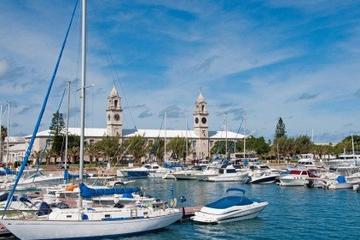
If You Go:
To plan your trip, visit www.gotobermuda.com
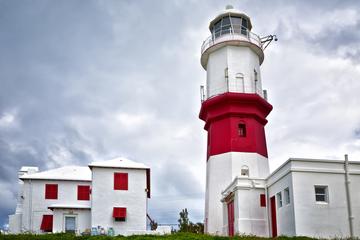
Bermuda Nature and Sightseeing Tour
About the author:
Ana Ruiz was born in Madrid and has written two books on the subject of Spanish history and culture. Visit: ana-ruiz.weebly.com
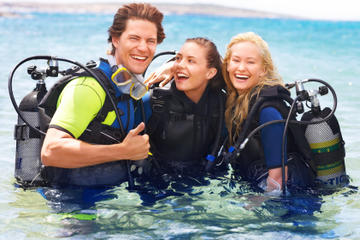
Scuba Diving Lesson in Bermuda
All photographs are by Ana Ruiz and artwork by Manuel Ruiz:
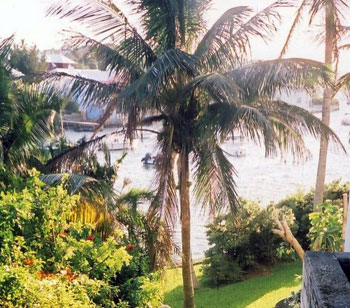
Palm tree on hotel grounds
Bermuda beaches
View from the Fairmount Hamilton Princess Resort
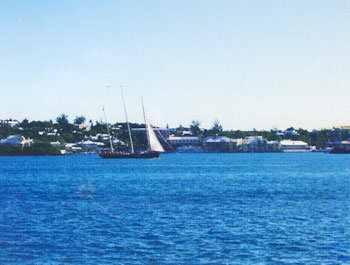
Sailing in Bermuda
Boating activities in Bermuda
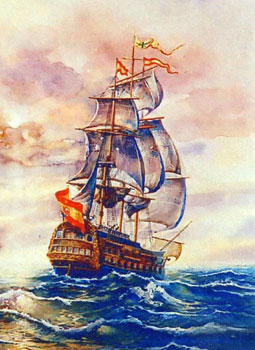
Spanish vessel in the late 1700s

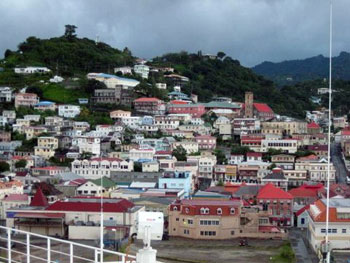 The State of Grenada is comprised of three main islands, Grenada, Carriacou, and Petit Martinique. Grenada offers friendly people, 45 white sand beaches and some of the most crystal clear water in the Caribbean. Its size is 344 square kilometers (133 sq mi), with an estimated population of 110,000. Its capital St. George’s is situated in a horseshoe shaped harbor and overlooking the capital on Richmond Hill is Fort Frederick which commands a panoramic view of St. Georges.
 The overthrow of a moderate government by a strongly pro-communist one worried U.S. President Ronald Reagan. Cuban construction workers and military personnel were building a 10,000 foot airstrip on Grenada. President Reagan was concerned that the reinforced runway was for the use of heavy military transport planes and that it would be used by Cuba under the direction of the Soviet Union as a refueling stepping stone for Cuban and Soviet airplanes loaded with weapons destined for Central American communist insurgents. On October 25, 1983 Grenada was invaded by combined forces from the United States, Jamaica and other neighboring countries in Operation Urgent Fury.
 High on a hill guarding the entrance to the harbor is Fort George. Built in 1705 it has dozens of 300 year-old cannons, tunnels, and passageways to explore and offers spectacular views of the city’s picturesque harbor. On this recent visit, we toured the island and dodged rain drops as our native guide explained how Fort George was the center of the island’s October 19, 1983 political disturbance where Maurice Bishop and part of his cabinet was executed by a faction of the People’s Revolutionary Government. He points out the plaque on the inside wall of the fort erected on October 19, 1993 with the cooperation of the Government of Grenada by the Maurice Bishop and martyrs foundation. The fort is open for sightseeing.

 Due to the worldwide recession the status of the economy is weak and there is about 30% unemployment. The agricultural industry and in particular the nutmeg industry suffered serious losses because of hurricanes Ivan and Emily that followed in 2005. However as the new nutmeg trees planted gradually mature, there is hope that the industry will return to its pre-hurricane level as a major supplier in the Western world.
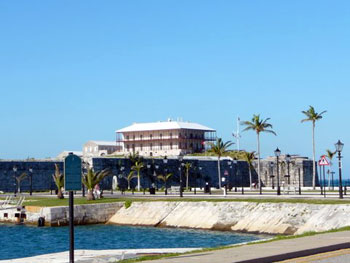
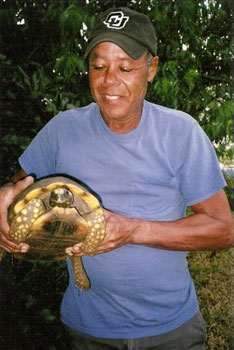 Richard, a Bermudan from many generations’ back was a gold mine of information. When I told him about my quest to learn more about the Thunderbird his face lit up as he said “You will have to go down to the dockyards. Down there on the sea wall sailors have painted images from crests of numerous ships.” The badge for HMCS Quesnel had the image of a Thunderbird on it and I could not wait to go to the dockyards. Would I really see that kind of evidence there?

 “Was their indigenous history in Bermuda?” I wondered. Did the Thunderbird connect with First Nation’s people? I learned that Bermuda was uninhabited when the Sea Venture sailing from London wrecked there in 1609. It had wrecked on “the dreaded Bermudas, known as the ‘Isle of Devils’, supposedly inhabited by demons and evil spirits.” A sailor on the Sea Venture recorded “nothing but gusts, stormes and foule weather” and they would have avoided Bermuda “as they would shun the devil himself.” Thus the settling of Bermuda began and was followed in later years by indentured servants and slaves from Africa. The stone prison in the dockyards and exhibit at the Commissioner House of the slave trade and slavery in Bermuda tells their story. The latter is an ‘Officially Designated UNESCO Slave Route Project’.
 HMCS Quesnel had anchored in St. George’s harbor during part of its stay there in the 1940’s and I was anxious to go to this island in the oldest part of Bermuda. As we motored through the harbor in Richard’s boat we could see the re-enactment of the medieval dunking stool at King’s Square in sight of a replica of the Sea Venture. Like the unlucky soul who was dunked in the water from this stool we also soaked up the old history on this Island and traveled back in time.
 We had one last stop – the grave site of Murdo Smith R.C.N.R. a commanding officer of the Quesnel. ‘Red’ Smith was a colorful Scottish Presbyterian, who was violently opposed to the Thunderbird in the mast. He considered it idol worship. He died in Bermuda two days before Christmas on December 23, 1944 and is buried at the Royal Naval Cemetery on South Ireland Island. We visited his grave site and thought about the veterans who had endured the hardships of World War Two and the Battle of the Atlantic sixty-five years ago. There are thirty-four World War One veterans and thirty-nine World War Two veterans buried there. Murdo Smith’s death was reported in The Royal Gazette and Colonist Daily, stored in The Bermuda National Public Library in Hamilton, on Wednesday, December 27, 1944.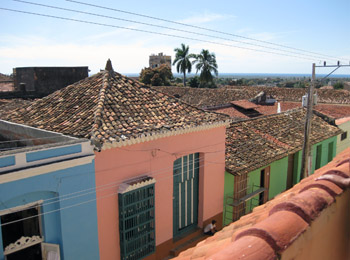
 We arrived in town after a 300 km trip from Havana on our big blue and white Viazul bus. As we pulled in to the downtown bus depot we saw the usual crowd of locals there with large placards and photos, touting the virtues of their various casa particulars. While it was a tough call whether or not we should stay at any one of the hundreds of private residences, we opted this time to head out to the nearby Peninsula de Ancón, where the first new resorts were developed in Cuba following the 1959 revolution.
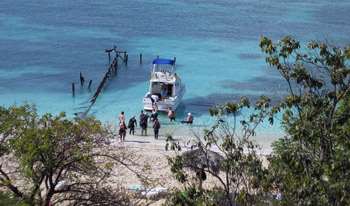
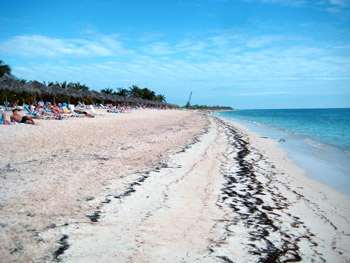 The Ancón Hotel is nothing to look at, featuring typical Russian-style architecture from the 1980s. It is fairly well-appointed inside and all-inclusivo (all food and drink included). Ask to stay in the newer part. The main dining room is where to turn up for the big buffet-style meals, and you can get nourishment anytime at an outdoor snack bar. The food is adequate but not exceptional. The old saying that ‘You don’t go to Cuba for the food’ still holds true, although things are improving as they realize the importance of the tourist peso. Like every tourist hotel, there are nightly shows at a stage near the outdoor bar, featuring a great array of talent. It makes one appreciate the high level of training for young musicians, singers and dancers in Cuba. The best feature was the Playa Ancón itself, with wide expanses of white sand and beautiful blue ocean for sunbathing, swimming, skin diving, boat trips and fishing.
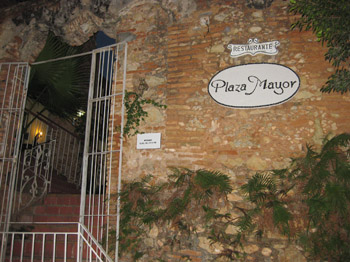 If you get tired of the beach life, it’s only necessary to hop into a cute little yellow coco cab and you’ll be in town in 10 minutes. There’s a lot to see in Trinidad: perfectly preserved churches, museums that were palaces and tenement houses that are a symbol of that Cuban region for its peculiar style. The old town architecture is neo-classical and baroque, with a Moorish flavour. Red tile roofed houses painted with pastel colors, ornamented with artistic balconies, iron wrought railings and multicolour facades. The city is very clean and well cared for. If you walk over the cobbled streets of the Trinidad, it makes you feel like going back into colonial times. A friend remarked to me that the millions of stones came from the bilges of Spanish galleons that dumped their ballast in the city and replaced it with the plunder of the new world. I wasn’t able to verify that story anywhere, but it seems possible.
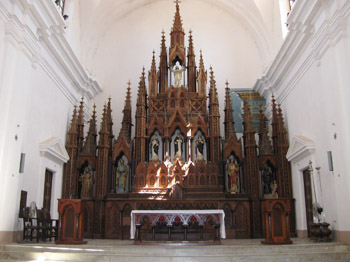 The Plaza Mayor is considered the epicentre of all things, and the eager traveller should start their walking tour there. Make your first stop the Iglesia Parroquial de la Santísima Trinidad (Church of the Holy Trinity), at the upper edge of the plaza. The city’s main church is also Cuba’s oldest. Although there has been a church on the site since 1620, construction began on the current building was completed in 1892. The interior with its 14 alters is breathtaking. A small donation is customary.

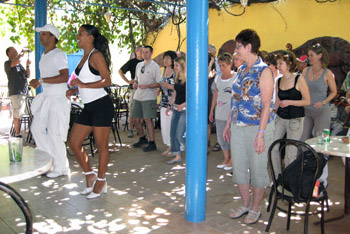 If you are into la mùsica as much as we are, there are lots of great venues de la noche to choose from.
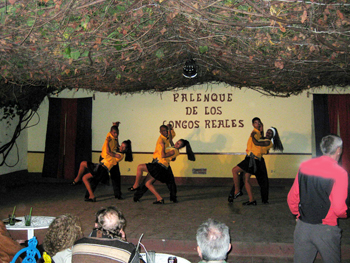 Another real find was the Palenque de los Congos Reales. This fabulous open-air nightclub specializes in performances of relatively authentic Afro-Cuban dance and music. You can always catch something spectacular there, performed by a large company of dancers, and accompanied by a big band of hot players.
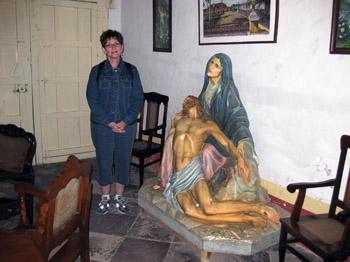 As in all of Cuba, paladars are plentiful in Trinidad. These officially authorized restaurants in people’s homes quite often serve tastier food than you can find in any of the state run restaurants. Our favourite was the Paladar Estela. It’s hardly a secret – you can find it near the top of the list in all the guide books. You enter through an elaborately decorated colonial house with many religious objects, two blocks north of the cathedral. The handful of tables are set in an exuberant backyard garden setting, with huge numbers of flowering plants and a wall festooned with vines. Portions are nearly as voluminous as the plant life, and dishes include roast pork a la cubana, fried chicken, grilled fish, and ham omelette.
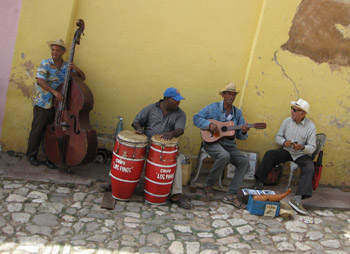 There’s a lot to see outside the city too. Be sure to make time for a trip to the Valle de los Ingenios (Valley of the Sugar Mills) to see the ruins of dozens of 19th century sugar mills located just outside the city, which are a reminder of the importance of sugar to the Cuban economy over the centuries. Other attractions include hiking in the surrounding mountains and horseback riding in the beautiful countryside.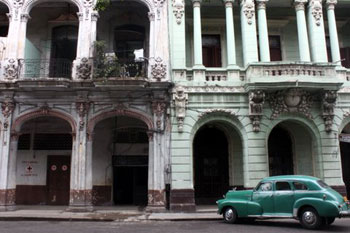
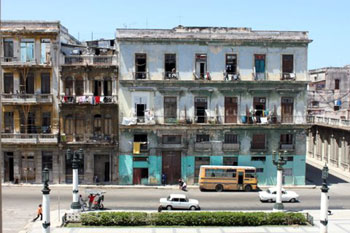
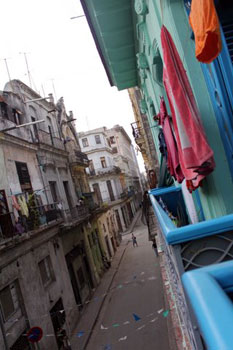 Arriving in Havana leaves even my cynical and spoiled travel mind agape. I am staying in Casco Viejo, Havana’s old town, once home to rich sugar barons and real American gangsters. The elaborate mansions built by these once-residents of Havana remain. They are dilapidated, crumbling but nonetheless majestic, echoing their former glory, like grand old dames whose jewellery has lost its gemstones and once fine clothing has become threadbare and moth-eaten.
 I stay in the heart of old Havana, in one of those grand old buildings, a home owned by a large Cuban extended family. These government regulated homestays are known as ‘Casas’, and offer a room in the home of a Cuban family, and three meals a day if requested. For travelers on a budget, Casas are the cheapest way to accommodate yourself while in Cuba, but even if your budget allows you to stay in one of the many government owned hotels or all inclusive resorts, spending a few nights in a Casa is a must. Casas mean staying in the homes of ordinary Cuban people, giving you a glimpse into their lives and allowing you to appreciate their warm and unyielding spirit.
 If your Spanish is up to it, or if you are lucky enough to find an English speaker somewhere along the way, it is fascinating to engage in conversation with a local, to get their take on their everyday life, their current political situation and Cuba’s fascinating past.
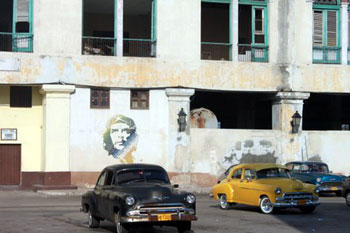 Undertones of the communist regime run throughout Havana. Some are obvious – the lines of people waiting outside the bakery to have their ration cards filled, the women approaching you on the street asking for soap or lip balm and the bare-as-a-baby’s-bottom supermarket shelves. Others you have to delve a little deeper to find – the restrictions placed on television programming, internet usage and travel for Cuban citizens, and the complete absence of any form of advertising (a fact that you may not notice until you return to a capitalist country and are seemingly assaulted with advertising virtually everywhere you look).