Ireland
by Ken McGoogan
300,000 people are set for the Gathering in Ireland. Some will be tracing their ancestors. Others will come to see the monasteries, or to follow in the footsteps of the writer James Joyce. Many will make their way to the Guinness Storehouse, where visitors journey through the 250-year history of Guinness and finish up in the Gravity Bar, free pint in hand, looking out over the City of Dublin.
Ireland is getting set for 2013. Every town, village, and hamlet looks to be preparing for The Gathering, a year-long celebration of all things Irish. Tourism Ireland is anticipating that more than 300,000 visitors will turn up, among them tens of thousands of Canadians. If you intend to become one of them, I’ve got good news for you, and maybe a few ideas.
My wife, Sheena, and I recently spent three weeks rambling around the Emerald Isle, our third visit in past few years. We had been hearing that Ireland was in the doldrums as a result of the recession in Europe. So what surprised us most was the vitality, energy, and good humour.
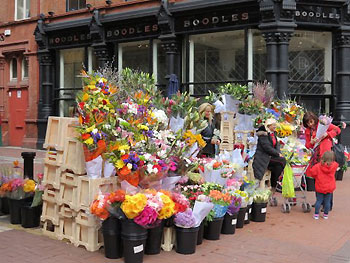 We started in Dublin, where Grafton Street has become a pedestrian mall. On any afternoon or evening, here we encountered a carnival atmosphere: people going both ways in streams or else standing in circles, entranced by one of the jugglers, musicians, comedians, or acrobats. At the foot of Grafton, we had no trouble finding the risque statue of that fictional fishmonger Molly Malone. The locals call it “the tart with the cart.” Turns out every statue and even the new Spire has a nickname, though most are unprintable.
A couple of blocks east, the pubs in the colourful Temple Bar area were invariably heading for lift-off at what usually we consider bed time. The same was true even of the uptown pubs around St. Stephen’s Green. But, hey, we were on holiday, we love Irish music, and sure, we gravitated to O’Donohue’s on Merrion Row. The liveliness would keep growing, apparently, until 2 or 3 in the morning.
Having decided to splurge on one fine meal, we headed for Hugo’s Restaurant, kitty-corner across the street from O’Donohue’s (yes, that was how the night began). This five-star eatery is rightly renowned for its wine list (30 varieties by the glass), but it also provides outstanding food and service. Most entrees cost 20 to 23 Euros, or $25 to $30 Canadian dollars. Later, we also got good value at Peploe’s Wine Bistro (slightly cheaper) and One Pico (more expensive), and in the Temple Bar area at Eden.
Our original must-see list included Christ Church Cathedral, founded in 1030; Trinity College and the Book of Kells; the National Museum (that Viking skeleton has to be seven feet long); and the National Gallery, which rightly devotes a room to the work of Jack B. Yeats.
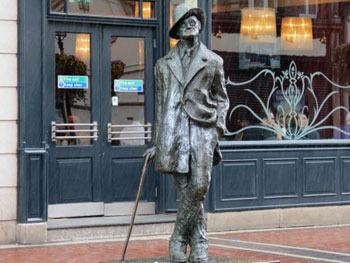 Dublin is a writers’ city. Ireland has a population of just over six million, combined north-south, yet four Irish authors have won the Nobel Prize: William Butler Yeats, George Bernard Shaw, Samuel Beckett, and Seamus Heaney. We started at the Dublin Writers Museum to get a feel for the tradition, and then walked down the hill to the James Joyce Centre, and went on one of the numerous Dubliners walk.
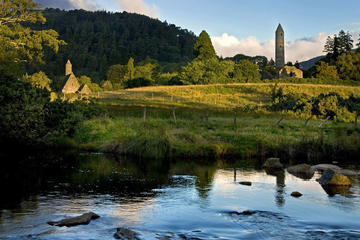
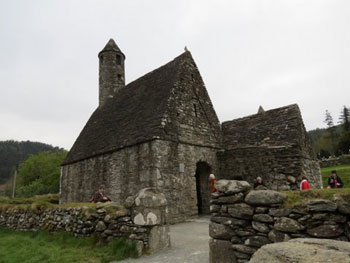
We made a couple of sorties from Dublin that, even if we weren’t driving, would have been feasible by bus (details at the Tourism Office just off Grafton Street). The first outing takes you south 90 minutes to Glendalough, a lakeside monastic centre. At the visitor’s centre, there’s a 20-minute video worth catching, Ireland of the Monasteries.
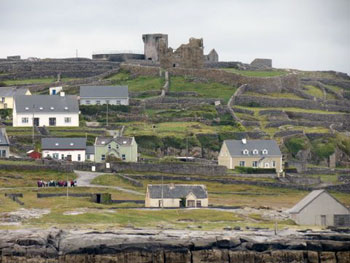 The stone buildings here date from 500 A.D., when a monk called Saint Kevin settled into a cave and spent seven years wearing animal skins and communing with birds and small mammals. Walking along the lake to the ruins is half the fun, as one of the glories of Glendalough is its situation between two picturesque lakes in a forested valley. You can see why Saint Kevin chose this spot to go hermit, and also why throngs of fellow monks turned up and put an end to his solitude.
The second outing takes you north to Bru Na Boinne, which comprises three neolithic monuments but is best known by the name of one of them: Newgrange. It is near a town called Drogheda, again just 90 minutes by bus. Built around 3200 B.C., or one thousand years before Stonehenge, Newgrange is the finest Stone Age passage tomb in Ireland, and one of the most evocative prehistoric sites in Europe.
After passing through a superb visitor’s centre, we arrived at a stone-built dome, excavated for access, that is 80 metres in diameter and 13 metres high. To stand inside the ancient, high-ceilinged cavern and have the guide shut the doors behind you is an experience we won’t forget. Of the two sister sites, Knowth and Dowth, the former affords a parallel experience, while the latter, not open to the public, offers a spectacular view to those willing to scramble to the top.
If You Go:
Driving in Ireland: From Skellig Michael to the Bronze Age
For us North Americans, it seems the Irish drive on the wrong side of the road. But once you’ve adjusted, you’ll swear that “hiring” a car was the best decision you ever made. The distances in Ireland are as nothing. And the landscape is one of the most enchanting in the world.
Ten days would serve you well. But if you have one week, you can still circle the island. Why not head south out of Dublin and proceed clockwise. Here’s few ideas that will take you off the beaten path.
If you visit Waterford, I suggest overnighting at Castlemartyr, a five-star resort 25 km east of Cork? We lucked into it, and suddenly found ourselves in a spectacular 18th-century manor house, expanded and elegantly appointed. It’s situated on an estate that offers archery, boating, walled gardens, an 18-hole golf course, and a magnificent spa and fitness centre with a 25-metre pool. A short country walk takes you to the ruins of a castle built 800 years ago for the Knights Templar. Rooms start at 165 Euros ($212 Canadian), though special rates turn up on the Internet. You won’t want to leave.
You might drive to the city of Cork and nearby Cobh (pronounced “cove”), the last port of call for the Titanic. A new museum takes you through “the Titanic experience,” using a multi-media recreation that starts with the ship’s departure. You experience the prideful welcome, explore the comfortable accommodations, and ultimately go through the dramatic sinking that happened April 12, 1912.
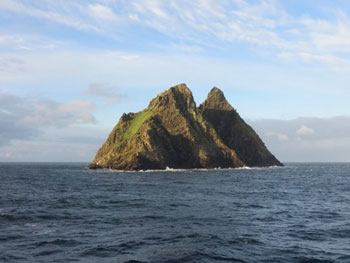 Directly ahead, one hour and twenty minutes away, you find one of the world’s great drives: the Ring of Kerry. From Killarney, the road takes you past abbeys, castles, and picturesque cottages, and offers fantastic views of cliffs and ocean. You can’t miss the dramatic Skellig Michael, a rocky island 12 km off the coast. Designated a UNESCO World Heritage site, it features a number of beehive meditation huts perched on a ledge 600 feet above the waves.
Christian monks and hermits built these stone huts between the 7th and 12th centuries. Given good weather, you can reach them by jumping aboard a local tour boat and climbing 600 narrow, steep steps. That people came out here to stay for months and even years boggles the mind. If you can’t get onto the island, as we couldn’t, you might want to investigate the Skellig Experience Centre on Valentia Island, which is accessible by bridge.
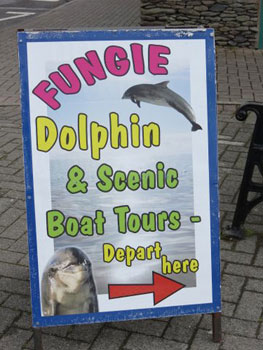 The town of Dingle, just over an hour from Killarney, is colourful, bustling, and sophisticated enough to have charmed such visitors as Paul Simon, Dolly Parton and Julia Roberts. We strolled the winding, hilly streets lined with craft shops, restaurants, and pubs. Deidre’s Cafe on Orchard Lane serves a superb seafood chowder with brown bread, and the jam-covered scones aren’t bad either. Dingle harbour is home to Fungie the Dolphin, and if you get onto the water for a short cruise, he will probably turn up to cavort alongside your boat. Really.
You should plan to visit the Aran Islands, a group of three islands at the mouth of Galway Bay. A passenger ferry operates from Rossaveal, 40 km west of Galway. On Inishmore, the largest of the islands, all of which are subdivided by countless walls of stone, you will buy a handknit sweater or suffer life-long regret. Grab a local taxi to a path that leads to Dun Aengus, which has been called “the most magnificent barbaric monument in Europe.”
As you wend your way up the hill, the walled site looks like a stone fortress straight out of the Iron Age, and is sometimes identified as such. Recent research, however, puts people here in 1500 B.C., during the Bronze Age. To the west, facing out over the Atlantic, the wall has long since tumbled into the sea. Looking in that direction is like gazing across an infinity pool. If you get on your stomach and approach the edge, you can look straight down and see waves crashing into rocks 100 metres below.
Back on the mainland, call in at Bushmill’s Distillery, get a taste of Irish whiskey, and then go swinging across an eighty-foot chasm using the Carrick-a-rede rope bridge. From a bit farther east, at a spot called Fair Head, you can gaze across the water at the Mull of Kintyre, just 20 km north.
The number one attraction on the north coast is the Giant’s Causeway, another UNESCO World Heritage Site. It’s not exactly off the beaten track, but this amazing phenomenon comprises 40,000 interlocking basalt columns created 60 million years ago by volcanic eruption. The tops of the hexagonal columns form what look like stepping stones sloping down into the sea, and have inspired a vast mythology.
If you venture beyond the columns to visit the rock formations known as the Giant’s Shoe and the Organ Pipes, you will encounter signs insisting that the path ahead provides no access to the Causeway Centre. But if you like spectacular views and don’t mind a hike, you can safely ignore those signs and follow the switchbacks up the cliff. When the path abruptly ends, climb the Shepherd’s Steps (162 of them) and make your way west along a field-skirting footpath to the highway. That highway does provide access to the Causeway Centre, and there your chariot awaits.
Popular Ireland Tours:
Dingle and Fungie Dolphin Boat Tour from Killarney
Fast-Track Guinness and Jameson Irish Whiskey Experience Tour in Dublin
Private Day Tour of Wicklow and Glendalough from Dublin
Newgrange and Hill of Tara Private Guided Tour from Dublin
Giants causeway and Game of thrones filming locations bus tour
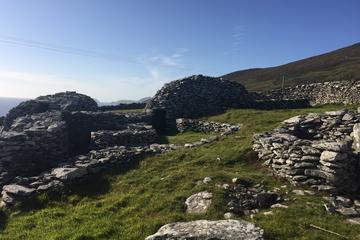
Private Tour of The Dingle Peninsula
About the author:
Ken McGoogan is the author of How The Scots Invented Canada
Photographs are by Sheena Fraser McGoogan.
 by Jane Parlane
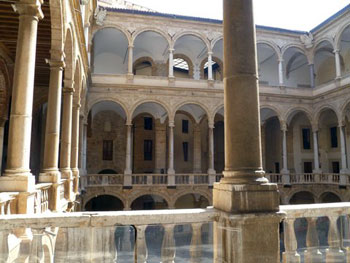 The bus back dropped us at the Piazza Indipendenza, the site of one of Europe’s most beautiful castles. The Royal Palace of Palermo, dating from the ninth century for many centuries housed Sicily’s rulers and even today it’s the seat of regional government. Local politicians are lucky enough to govern from such an architectural gem with its beautiful mosaics, painted roof and marble walls.
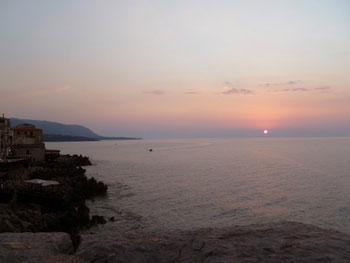 In our rental car it was an easy one-hour drive east to Cefalu, originally a fishing port. Now it’s an attractive cobblestoned tourist town with a sandy beach – not completely lined with recliners. Our accommodation was in an old stone house just a minute from the cathedral and main square. It was easy to find a restaurant table overlooking the sea and over a chilled Sicilian wine watch the bright pink sunset explode while families paraded past.
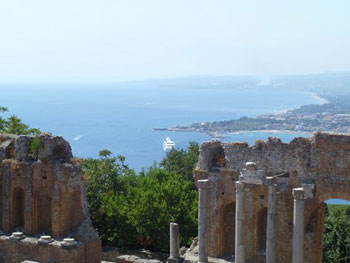 Taormina has many bars where you can sip a Marsala or Campari martini and just people watch. Most evenings you’ll see Sicilians decked out in their finery strutting the streets. Alternatively book an opera or concert at the Ancient Theatre dating from Greek and Roman times – sadly the opera was cancelled during our stay. But the swordfish at a trattoria washed down by a local wine and tiramisu to follow eased the pain.
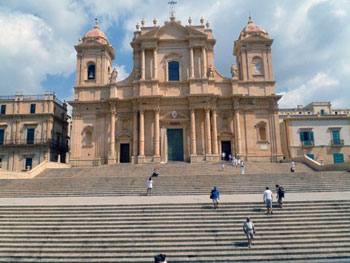 It was an easy day trip the next day to the ancient limestone towns of Modica, Ragusa and Noto, the latter famously rebuilt in 18th century in the baroque style after an earthquake destroyed the town in 1693.
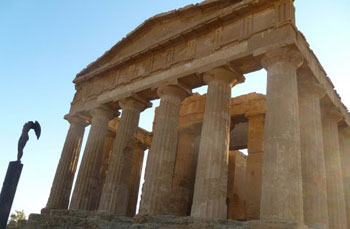 Our final destination for the day was Agrigento, famous for its Valley of the Temples. It was exhilarating to look out of our hotel window and see Greek temples standing there. This once ancient city, Akragus, was dominated by seven great Doric Greek temples built in the sixth and seventh centuries BC. Today several are still wonderfully preserved making the area one of the world’s most important archeological sites. It’s easy to spend two hours with a guide wandering the site, especially in late afternoon when the sun lights up the temples. A bonus for us was the spectacular exhibition by world-renowned Polish sculptor Igor Mitoraj cleverly placed among the ancient structures.
 It was an easy drive on the autoroute to catch our flight from Palermo airport the next morning – just over an hour.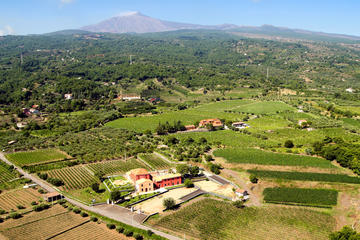
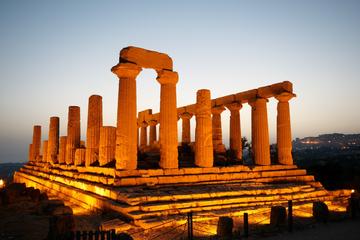
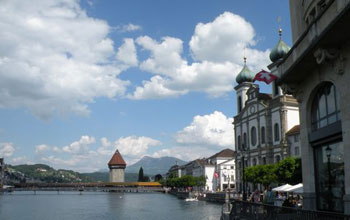
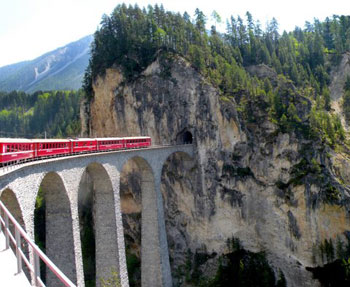
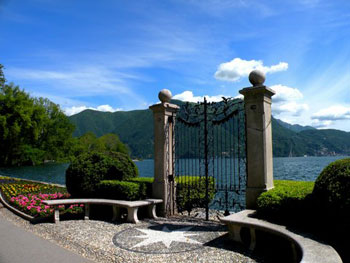 My wife Annie and I are enjoying an eye-opening Alpine sojourn as guests of dear old friends, Margit and Andres, health care professionals who live in Graubuenden but have stayed with us in Canada several times. When not having to work, they drive us around, and we make side trips on our own by train. We had expected beautiful mountain scenery, postcard-perfect towns and a prosperous land of clean efficiency, where the predominant German and French-speaking populations get along. But we had never imagined the full diversity of the rich Swiss cultural tapestry, the quirky and endearing coexistence of the traditional and modern, and the way history is cherished and kept alive.
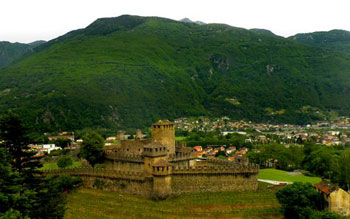
 She takes us to three impressive 13th to 15th century castles that dominate Bellinzona, built by the dukes of Milan to command a strategic river valley and to tax trade along the passes leading northward. Montebello castle, high on a slope, hosts an annual medieval festival, with jousting, period costumes, and roast pig eaten without cutlery from wooden bowls.
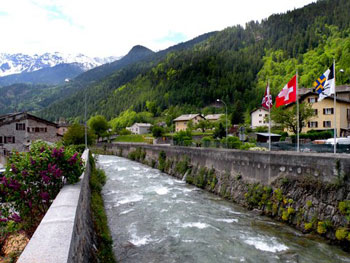 Our destination is Poschiavo, an enchanting village in another isolated Italian-speaking region that is part of Graubuenden itself. We stay at the historic Albrici hotel, built in the 17th century and run for 150 years by the same family. The 10 bedrooms feature antique furniture but no phones, TV or other electronics. We dine outside on the cobblestone piazza, which is bracketed by two ancient churches. The owner recommends some regional main dishes. I enjoy flavourful buckwheat noodles in a creamy sauce, garnished with a skewer of endive and slices of salami. Annie savours the tasty spinach dumplings (gnocchi) with melted cheese, similarly garnished.
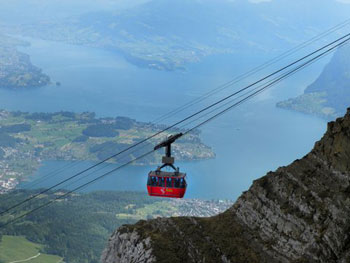 Even the larger central Swiss cities offer an intriguing mix of old and new. In Zurich, our hotel abuts the beautifully maintained old town. Its narrow streets are lined with medieval towers and intersect at ornate fountains featuring sculptures. We indulge in sweets at an elegant 19th century pastry shop but also take the funicular up to see the renowned technical institute just above, where Albert Einstein got his doctorate. In Lucerne, we walk the massive old city walls and cross the landmark 14th century covered bridge. But we also ride a spectacular cog railway (the world’s steepest) up 2,132 metre Mt. Pilatus, where an ultra-modern hotel adjoins a much older one, and watch a paraglider lift off and drift away on the thermals.
 Even within the Swiss-German majority population, we discover, there are minority subcultures. Our friend Andres turns out to be a Walser, the proud member of an alpine tribe that numbers about 20,000 in Switzerland and has sizable communities in neighbouring Italy, Liechtenstein and Austria as well. They trace their history back to the south-central canton of Wallis and an outward migration that began in the 13th century. Historians debate whether the cause was overpopulation, or feudal politics, or possibly the plague. Those who moved northeastward into Graubuenden and beyond were attracted by empty high-elevation lands to settle and privileges offered to them by feudal lords in exchange for doing military service, notably patrolling and controlling the crucial mountain passes.

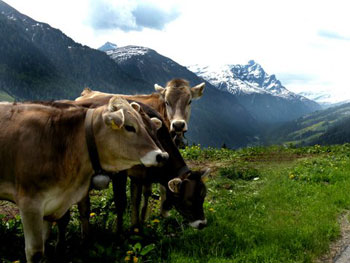
 Andres regales us with stories of his upbringing in the 1960s and 1970s on a subsistence farm high in the Praettigau Valley, just east of Graubuenden’s charming capital city of Chur, where he now works. Like his neighbours, his family had only a few cows, which he helped to feed and milk in winter; in summer they were moved up to higher grazing pastures. A few men from the hamlet tended everyone’s cows, milking them collectively and making cheese every day. The cheese was brought down in autumn and divided up, a festive event that remains an annual celebration. Each family also had a vegetable garden and perhaps a pig, chickens and rabbits. Yet they eked out a livelihood. Andres hiked, or sledded in winter, down to school in the larger village below. He and Margit drive us up switchback roads to a scenic Walser village, Tenna, with a population of around 100 overlooking the Safien valley. There is a two-room school, a cheese-making shop, and a church dating to 1524. The gravestones record only a handful of family names, generation after generation. Houses have huge stacks of firewood and tiny outbuildings that are actually ovens for baking bread. Cows and sheep graze nearby; in May, they have not yet been moved to higher slopes. The weather is sunny and warm, perfect for lunch on an outdoor hotel terrace. We try the barley soup, grilled mushrooms on bread, and local hard cider. Andres greets an elderly couple, who immediately recognize his dialect. You must be from Praettigau, they say, and they are too. They even knew his late parents, but have retired to this distant, yet also Walser, village.
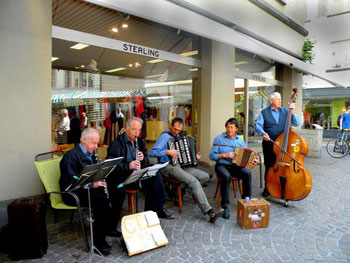
 Another evening, Margit and Andres take us to a concert at a pub high in the Praettigau valley, where Andres grew up, in a village with stunning Alpine architecture where one of his sisters now lives. He is the only one of five siblings who has left the valley, although he has not moved very far. Between songs, the band tells jokes in Walser German. Andres laughs along, but Margit, who was raised in Germany and is totally familiar with mainstream Swiss German, can hardly make out a word. But if we were expecting Tirolean um-pa-pa tunes, we were mistaken. The popular local trio—they have performed 1000 times over 20 years—treats us to to an eclectic display of world music: klezmer, gypsy, tango, blues, Celtic, on a bevy of instruments. Andres’ sister tells us that she is leaving in the morning for a cycling trip in Ireland. Everyone is from the valley, but they all seem well educated and most speak remarkably good English. This is 21st century Switzerland. They may be locals, but they are by no means yokels.
 . Koppel provides a personal tour of that vast ocean and presents the latest findings in archaeology, genetics and carbon dating. Mystery Islands is now available at www.uspbookcentre.com and soon on Amazon.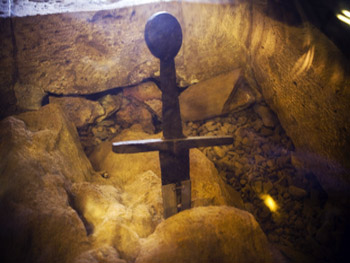
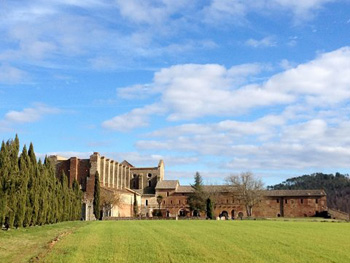 Cistercian monks built the round chapel of Montesiepi around the “cross” in the stone. The domed roof is built of concentric circles of alternating white stone and terracotta and frescos by Sienese painter Ambrogio Lorenzetti decorate the walls. It has been claimed that the chapel itself is a “book in stone” hiding the location of The Holy Grail.

 Italian scholars claim that Galgano’s Sword in The Stone precedes Arthurian legends and the original story may well be Italian. The first stories of King Arthur appear decades after Galgano’s canonization, in a poem by Burgundian poet Robert de Bron. It has been suggested tales of The Round Table may have been inspired by the round chapel and the name Galgano was altered to become Gawain. Claims that the Italian sword was a fake, made to echo Celtic legends of King Arthur, have been recently disproved. The skeletal arms in the chapel have been carbon-dated to the 12th Century, and metal dating research in 2001, by the University of Siena, indicates the Italian sword has medieval origins. Could it be that the stories of King Arthur are really based on Italian history?
 Every summer the company Opera Festival Firenze holds classical music concerts and operas in this splendid setting. Performed annually, a spine-tingling rendition of “Carmina Burana “ under the Tuscan stars, is unforgettable. Other favourites include Vivaldi’s ”Four Seasons, “Swan Lake” and “La Traviata.”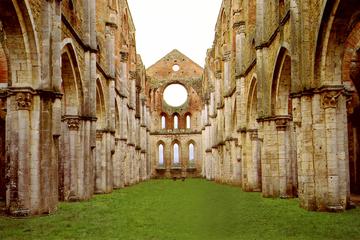
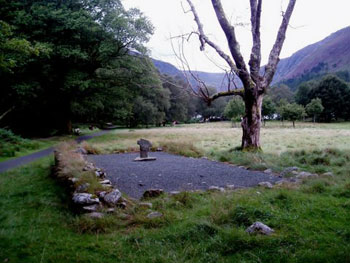
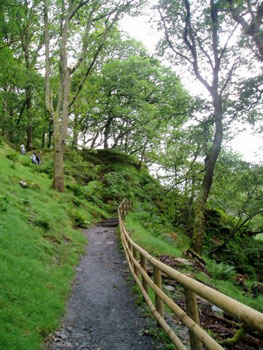 Stuck in Glendalough, I grabbed a quick late lunch from a local food cart and set out for a late-afternoon five-mile hike on Miner’s Road. This route took me by the two lakes toward the ruins of an 18th century mining village that closed down in 1965. Rows of purple heather greeted me with pine trees serving as an umbrella to shade me from the sun. Finally I got to sample paradise almost all by myself.

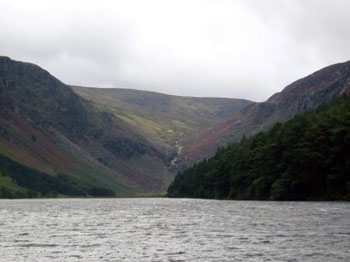 The next morning stopped by the Glendalough Visitors Centre where I bought a
 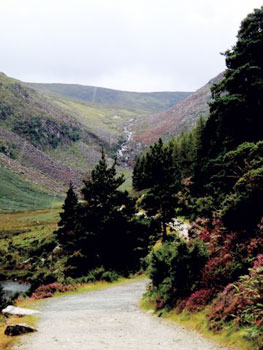 After I climbed down, I stopped by a shack located at the foot of Upper Lake for a quick snack and then set off on the Green Road Walk. This flat mile long trail that meandered around the oak woodlands and then continued to the edge of Lower Lake. Along the way, I passed by the outskirts of Monastic City where I saw more busloads of tourists, most of whom seemed more intent on taking photographs of stones than actually walking on Kevin’s soil. Hopefully some of them will leave the city for the hills and have their own encounter with Kevin.