by Marc Latham
I once described Lisbon-Sintra’s Pena Palace as a ‘Disney castle resting in an environmentalist’s dream’ but after visiting Mont-St-Michel on the northern French coast this year I wasn’t surprised to read that it has actually inspired Disney movie castles. However, if the Pena Palace is a verdant vision, Mont-St-Michel is a marine masterpiece.
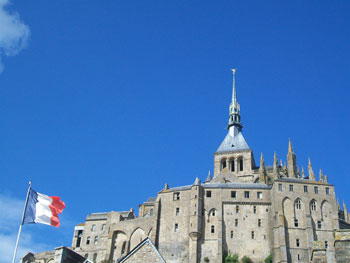
 The ancient abbey rises out of sea and silt like the most triangular of mountains, seemingly balanced precariously on its rock without an inch of land wasted; and is big enough to be seen from the edge of its bay, over thirty kilometres (twenty miles) away. After I reached its public-access summit half way through my week-long holiday in France, Mont-St-Michel became the peak of my visit in more ways than one; a week that had started unplanned, and turned into an enjoyable trip down memory lane as well as one full of new sights.
Looking for a short-holiday destination, Dinard was the cheapest flight available from my local Leeds-Bradford airport, but I’d never heard of it. So I looked it up, and read it was a town in Brittany, on the northern coast of Europe; neighbouring the historic port of Saint-Malo, which I did know. I also knew that Mont-Saint-Michel was nearby; a face of France I’d wanted to view since first seeing its Gothic visage.
It was also twenty-five years since I hitch-hiked through France at the start of my travels: then, I’d traveled just south of Brittany and Normandy from Paris to Bordeaux. So I booked the flight, and on an early-September Saturday I flew over my past life to the aquamarine seas, golden sand and stately villas of northern France’s Emerald Coast. After flying over Wales, where I grew up, we left the south coast of England and flew over the Channel Islands. It was the first time I’d seen my birthplace of Jersey since leaving as a young child, about forty-four years before.
 I relived some of my traveling past by hiking about 10km from the airport to my hotel, on the southern edge of Saint-Malo. The local bus service does not cater for the airport. I crossed the Rance estuary below Saint-Servan, which was called Aleth when a Welsh monk called Maclow became its bishop in the 6th century. It was from Maclow that a new community to the north took its name; Saint-Malo has since incorporated Saint-Servan within its city boundaries. Brittany still has a Celtic identity.
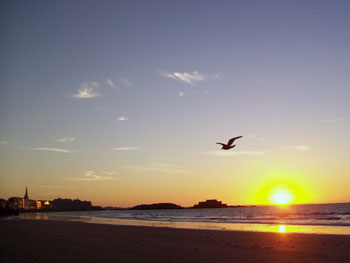
Seeing an Aldi supermarket along the way inspired another trip down memory lane. After booking into my hotel I returned to the Aldi; bought beer, bread and brie; and consumed them under a tree. Cars whizzed around the natural traffic island, but they were only reminders of my past; I didn’t have to think about getting a lift in the morning. The sun was more important to my immediate future, and I closely watched it slowly set through the overhanging branches and leaves; swallowing an evening’s thoughts into the tummy of tomorrow.
 The next day I moved to Saint-Malo’s only hostel, which is ideally situated only two blocks from the Grand Plage: two miles of beach between the walled old town and the district of Parame. There hadn’t been any room at the hostel on the Saturday night. I spent the next couple of days getting to know the landmarks and beaches of Saint-Malo.
Saint-Malo’s walled old town looks more impressive the closer you get, and its visual impact is increased by forts and islands stretching out from its north-west corner to the horizon. Saint-Malo was itself an island before being linked to the mainland by a causeway. Its wall, which is seven metres thick in places, dates from the 14th century. Malouins had a fearsome reputation for pirating passing ships, and in 1590 not only declared Saint-Malo independent of France, but also from Brittany. Independence lasted four years.
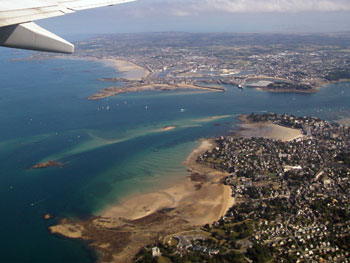
 At low tide you can walk out to Fort National, Île du Grand Bé and Fort du Petit Bé. The former was built during the reign of Louis XIV in the late 17th century, and was named Fort Royale until the French Revolution a century later. It is open to visitors during the summer. Malouin writer Chateaubriand, cited as the founder of French Romanticism, is buried on Île du Grand Bé; a hilltop cross marks the site, and views stretching for miles to the western edge of the bay explain its Romantic reason.
Returning to the city wall, there are a couple of small beaches on the western front. Steps lead up into the narrow cobbled streets of historic Saint-Malo. More steps rise to the Bastion de la Hollande, where a statue of Saint-Malo’s most renowned sailor points out to sea. Jacques Cartier sailed to the Americas in 1534, and is probably the man most responsible for Canada now being known as Canada. ‘Canada’ derives from an Iroquoian word for village or settlement; Cartier heard the word after asking directions, and then adapted it for the whole region. Cartier sailed as far as modern Montreal in search of a north-west passage to Asia, and claimed ‘Canada’ for the French.
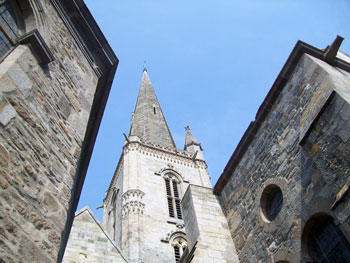 The cathedral is a central landmark and highlight, rising high above streets full of gift and clothes shops; crepe and seafood restaurants. Museums, a twentieth-century war memorial, and a central park are also of interest within the city walls; and regular plaques tell the historical significance of streets and buildings. Exiting the walls to the south, corsair sailing ships in the harbour are another reminder of the past.
Getting itchy feet, I did a circular 20 kilometer hike to Cancale and back on the fourth day, crossing the peninsula to the east on the D355 road, walking along the coast on the D276 and D76, and returning west on the D155. Mont-Saint-Michel’s silhouette was visible from the edge of the bay, about 30km away as the crow flies. The sea shone green in the sun, justifying the coast’s Emerald moniker.
 I took the coach from Saint-Malo to Mont-St-Michel at 9.15 the next morning. It is the only bus on that route, and a 20 Euros return ticket is required. The journey takes 75 minutes, and with the return leaving at 15.45 you have about five hours at the Mont. You cross from Brittany to Normandy on the journey.
A chapel was first built on the island then known as Mont Tombe in the eighth century. Legend says the Archangel Michel appeared before Bishop Aubert of Avranches and ordered its building; Avranches is a town on the eastern edge of the bay. Mont-Saint-Michel has survived fires and blockades over the centuries, with rebuilding and renovations increasing the size of the abbey to its present splendour.
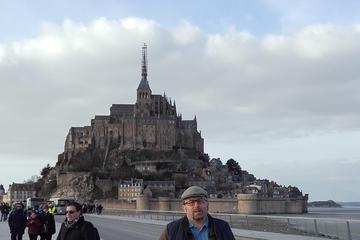
 There were grey skies when we arrived, but the view was still spectacular. I walked up the narrow winding streets crammed with shops and tourists to the abbey gift shop, where you buy a ticket to enter the abbey and highest tier possible. On the ascent, the causeway linking the Mont with the mainland stretches out to the south, between the grey silt of low tide sea and the green vegetation of natural land; dividing the bay arcing to the east and west. To the north there is only the abbey towering above you, crowned by a golden Saint Michel statue.
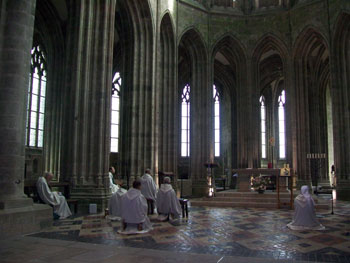
After the gift shop, the last few flights of steps are indoors, before you emerge onto the western terrace, with the cathedral towering above you, and the north visible once again. People walking along the estuary silt looked ant-sized, and the bright emerald sea lining the horizon appeared incredibly distant. Upon entering the cathedral, I saw that a communion open to the public was soon starting, so I stayed for the hour-long service. After a monk rang the bells at midday, seven monks and nuns sang and spoke sweetly and serenely.
Then I slowly made my way down through the living-quarters of the abbey: great halls, narrowing chimneys, giant wheels, cavernous stores and colourful gardens all connected by spiraling steps. It seemed like no time at all before I stumbled into the back of the gift shop, surprised at the sudden end to my abbey experience.
Emerging once again onto the abbey hill, clear skies provided a contrasting view to the morning. The biggest difference was the Saint-Michel statue, which now gleamed in the sun against the blue background. I made the most of the time I had left, taking as much as I could in, before returning to the bus with five minutes to spare.


Private Full-Day Tour of Mont-Saint-Michel
If You Go:
Marc stayed at the F1 hotel, where the rooms were €35 per night for 1-3 people (double and single beds) and the Patrick Varangot hostel, where dorm beds and breakfast were €21 per person.
About the author:
Marc Latham traveled to all the populated continents during his twenties, and studied during his thirties, including a BA in History. He now lives in Leeds, and is trying to become a full-time writer from the www.greenygrey.co.uk website. Marc has several published and self-published books available on Amazon.
All photos are by Marc Latham.
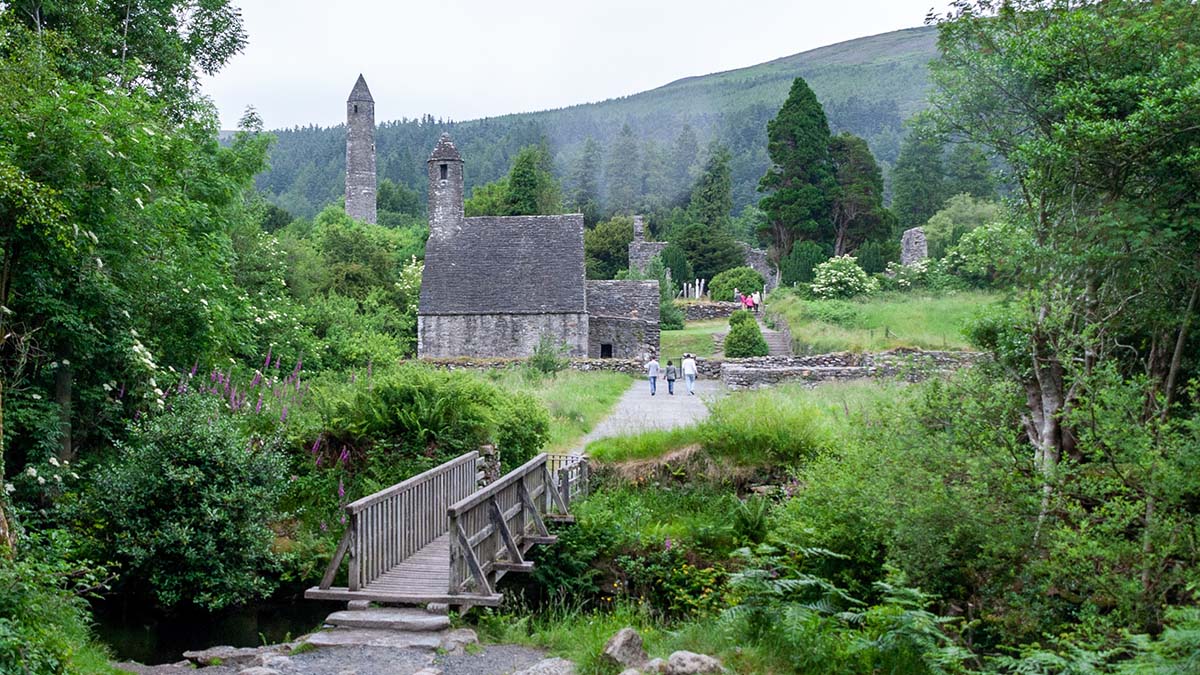
 It is a sunny spring morning, perfect for a trip to Glendalough, an ancient “monastic city” set in a surround of Wicklow Mountains National Park, about an hour south of Dublin. Our local guide keeps us alert on the bus ride, pointing out the flora and fauna–the beauty of the yellow gorse which in other non-flowering seasons gets pelted with words such as weed, invasive, and noxious, the blossoming white thorn hedges, shades of green in the long vistas. As we zoom past farms and real estate signs, she chats about the state of the nation in this time of recession. “People cannot sell their properties; their mortgages are worth more than their houses. There is no longer a construction industry.”
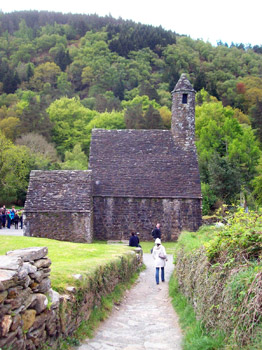 But the Roman church had crossed the choppy waters of the Irish Sea. Representatives had been dispatched from Rome in the 400s and the escaped slave Patrick had returned as a missionary in that same century. Glendalough was established in the early 500s by Coemgen (Caoimhin), St. Kevin. His Gaelic name means “fair-begotten.” Does it refer to his royal Irish birth or to his good looks? As a child, Kevin was tutored by Petroc of Cornwall, a Welsh-born Irish-educated saint. Kevin lived and studied with the monks and was eventually ordained himself.
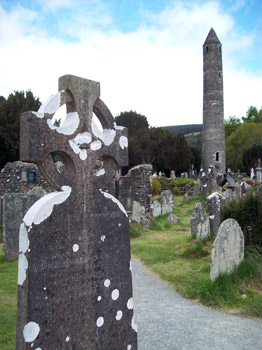
 What compels me to forgo another day in Dublin for this side trip into the country? Being neither Irish nor Catholic nor even very religious, what can explain my interest in, my attraction to, this site? I have been to one of these ancient monasteries before–to Clonmacnoise on the River Shannon. Is it nostalgia, for that much earlier life-changing visit? It was from the friend who guided me to Clonmacnoise that I learned how to pronounce Glendalough. Glen da lock (loch). Not loo; it does not rhyme with slough, as I had incorrectly assumed that first time. Glenn da locha, the valley of the two lakes. The two communities were connected in the sixth century, by the friendship of Ceiran and Kevin. Both locations feature thirty-metre-tall round towers, thought to have been used like beacons, for navigating, as bell towers to signal distress, as safe storage for valuables such as psalters and illuminated manuscripts, and as places of refuge during times of attack. The monasteries include hermit cells, probably the only constructs that either saint actually touched. St. Kevin’s is a cave above the lake. The chapel, St. Kevin’s Kitchen, the rest of the existing ruins, date from between the ninth and twelfth centuries.
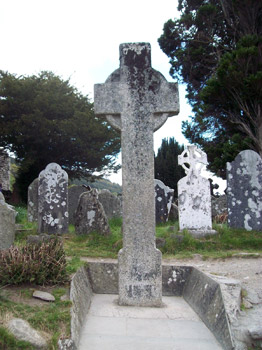
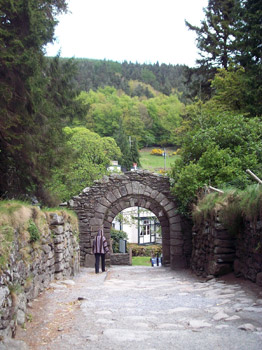 Both monasteries contain a collection of ruined buildings with designations such as cathedral, church, chapel, along with a profusion of Celtic crosses and gravestones. Here those who found a community while living are surrounded still in a community of the dead. Both sites have high crosses–the Cross of the Scriptures at Clonmacnoise and St. Kevin’s Cross at Glendalough, and evidently, a second high cross, the Market Cross, in the visitor centre.

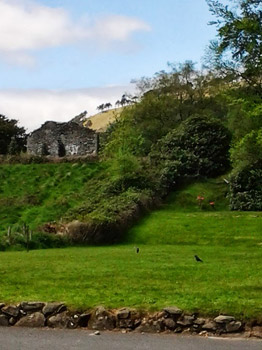 Just outside the double-arched gateway is a midway of tents and caravans. Linen tea towels, woolen “jumpers,” potato scones, postcards. Today the market of souvenir and food vendors does not even make me think of the temple and the moneylenders. After all, everyone has to eat, and it is a recession, and loaves and fishes no longer magically appear.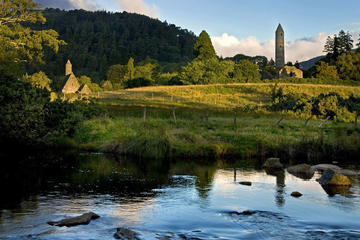


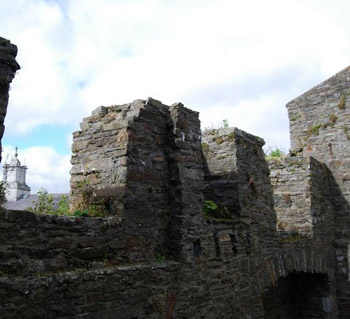
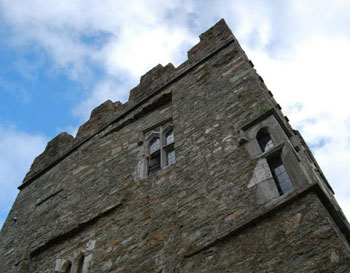 When the castle was built, Kinsale was a busy port, doing much trade with the Continent, and King Henry VII had granted Maurice Fitzgerald, Earl of Desmond the right to impose a levy on incoming cargoes … especially wine! For this reason, Desmond Castle had the alternative name of the Custom House. The Desmonds rebelled against the Crown in the late 16th Century, so lost this right, along with their lands. Shortly afterwards, the castle figured in what was to become known as the Nine Years War.

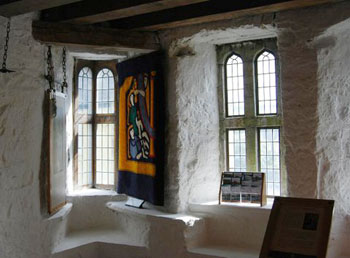 In the 17th and 18th Centuries, the castle was used as a prison for Spanish and French PoWs during a succession of Continental wars. It even housed a few American prisoners from the War of Independence. In between wars, it was used to house ‘home grown’ felons, until the 1840s, when it became a Famine Relief Centre and a workhouse, then used for various military purposes until it fell into disuse.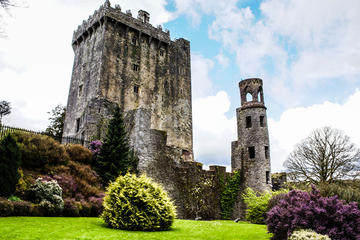
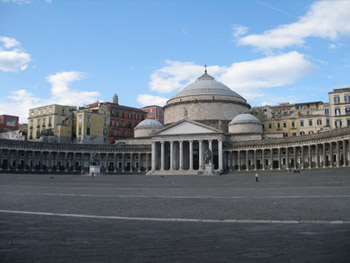 Leave the theatre and cross the Piazza del Plebicito to the Church of San Francesco di Paola. Its design is based on that of the Pantheon in Rome. At 53 meters in height, the dome is 10 meters higher than its Roman counterpart. While the San Francesco oculus is covered, the Pantheon’s is not. The white marble church interior features thirty two Corinthian columns circling the perimeter and an altar inlaid with lapis lazuli and precious stones.
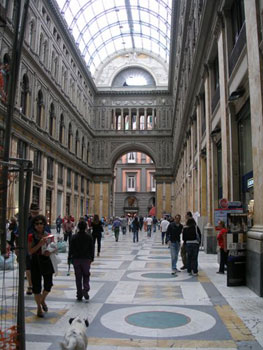 Returning to the Piazza del Plebicito, cross the Via San Carlo to the 19th century Galleria Umberto I. The refined galleria is an octagonal structure, enclosed under a glass and iron dome. Stylish shops and businesses fill this indoor mall.
 After lunch, ride the Funicalare Centrale back down to the bottom and follow Via Toledo through the heart of old Napoli – the Spaccanapoli district. Naples earns its reputation from these chaotic, unkept streets. Common sights include laundry hanging from balconies above the colorful shops and street vendors hawking goods with their operatic voices and theatrical gestures. Enjoy some window shopping as you walk between tightly parked cars and dodge oncoming vespas on your way to the National Museum of Archeology.

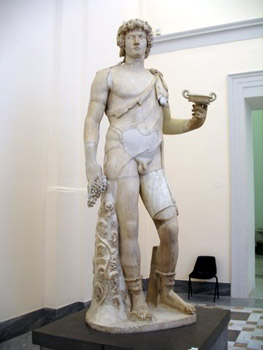 After passing your afternoon at the museum, continue your tour at the 14th century Gothic Duomo. Displayed within the Chapel of San Gennaro, a silver reliquary bust of the saint holds his skull and two vials of his congealed blood. Tradition holds that if this blood fails to liquefy on each of three festival days during the year (the first Saturday in May, September 19 and December 16), disaster will strike the city. Remember that Mount Vesuvius is a short distance from Naples.
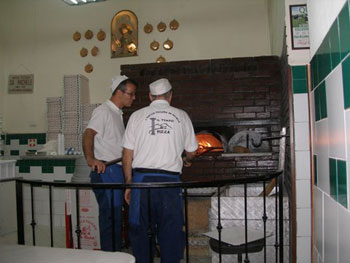 Dinner time is likely upon you as you walk back to the train station. And this is your opportunity to enjoy original Neapolitan pizza. At the train station, board the R2 bus and experience a genuine Neapolitan traffic jam as you ride to the first stop on the route. Exit the bus and walk through the maze to L’Antica Pizzeria da Michele.