by Lindsay Nieminen
Amman, Jordan’s capital city and home to over 4 million of the country’s 9 million people, is characterized by ancient Roman ruins and modernity’s coffeehouses! A city of contrasts, with its ancient origins on display in the heart of the city and among the city’s hilly terrain. Yet, it is no stranger to modern convinces with Samsung stores littered among the narrow winding streets and fast food franchises situated next to typical Jordanian eats.
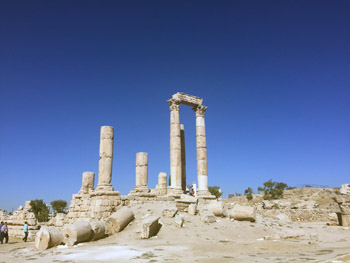
We started our first morning in Jordan, with a trip the Amman’s highest hill, Jebel al-Qalia, to visit the Citadel. Atop Jebel al-Qalia lies the massive remains of the Hercules temple, built during the reign of Marcus Aurelius in the second century A.D., and the fist of Hercules, the only remaining piece of the estimated 13 meter statue erected at the site, its shattered pieces long since pillaged. There is evidence that the Jebel al-Qalia has been occupied since about 1800 BC due to its strategic location. From the top of the hill, you can see the the Roman Theatre in downtown Amman, cut into the side of a mountain, likely to protect many of the 6000 spectators it could hold, from the sun. Built in the 2nd century A.D. it is an impressive remnant and the most popular attraction in Amman for tourists.
When I say tourists, do not think that you will be among hundreds of onlookers when you explore Amman. The first thing I said to our guide, Awad was “Where are all the people?”


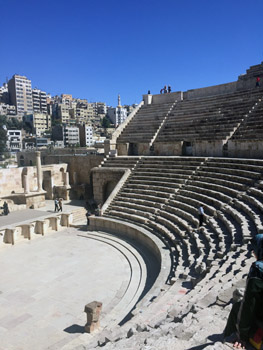 In Amman, You will not find thousands of tourists dotted like ants among the relics like you would see in Rome. You may encounter another tour group or other visitors, but for the most part, both the Amman Citadel and the Amman Roman Theatre were quite empty in the morning when we visited them. Tourism in Jordan is suffering due to the instability in the region. But despite the negative media coverage on the Middle East and the two million refugees camped near Jordan’s Northern border, we felt completely safe the entire time in Jordan.
After visiting the theatre, we wandered through the open air markets, with sellers hawking their goods to passers by. The boys were wide-eyed with the commotion of buyers and sellers, with the “Welcome to Jordan,” flashy smiles, and the auctioneer style chants, as sellers compete to gain attention (and well, to make as much noise as possible). It was a busy place, as Jordanians bought fresh fruits, veggies and other wares to take home. While Amman has built modern malls in recent years, and does boast a grocery store to two (one was even a Safeway), a lot of food is still bought from traditional markets or roadside stands.
Navigating Amman’s winding, narrow roads and hilly terrain makes it not a very walkable city. I would suggest you plan your day in advance if you do not have a car and driver. A quick look at the Nymphaeum, a partially preserved Roman public fountain which is currently being restored should be part of your day if time allows. Built in the second century A.D., it was believed this public bath contained a 600 square meter (6450 square feet) pool.
There are plenty of cheap eats in Amman, the local fast-food “shwarma” will cost around 2 JD (just under USD3.00) and consists of delicious slices of lamb or chicken sliced from a revolving spit. We stopped at a local shop after 12 but had to wait for it to open. Some shops seem to set their own hours while others will close briefly for prayer, and reopen after returning from the local mosque.
While we did not get a chance to visit the Jordan Museum, it will be a stop when we return. Home to Jordan’s share of the Dead Sea scrolls, as well 8000 year old statues, this international standard museum should not be missed in Amman. You will be able to see Amman’s Egyptian heritage, as the city was once known as Philadelphia, after the ruler Philadelphus (283-246 BC). It was also one of the cities of the Roman Decapolis, before becoming part of the Empire around 30 B.C. The museum will help you get a feel of Amman’s long and storied history.
In more recent history, Amman has been influenced by Arabs and Jews fleeing the 1948 Palestine War and more recently by refugees from Syria. In the three areas of the city where the Palestinian camps were built are still known as the “Palestinian Refugee Camps” despite the array of buildings, shops and schools. Only in name, do they bear any resemblance to their original purpose.
Since 2011 Syrian’s fleeing their native country have moved into Amman and other Jordanian cities. The influx of refugees has seen an increase in rents and food prices in Amman. Where rent was once JD250 (USD350), it is now JD400 (USD 565) and the price of food staples has increased as well. Jordanians are now seeing less money in their pockets as wages have not increased at anything close to the rate of inflation on rent and goods. In a country where half of the population is under 25, King Abdullah II feels his country is in dire straits. Unemployment is skyrocketing, and the schools and healthcare system are under extreme pressure. Jordan is a country historically known for its welcoming nature, but in a country where resources such as water are limited, the Syrian refugee crisis is putting pressure on this friendly country.
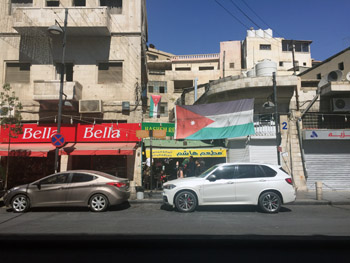 After wandering the winding streets of downtown Amman, a visit to the famous Hashem Restaurant in Amman is a must for any foodie. And to be honest, everyone should visit. Open since 1952, this open air restaurant is a favourite of King Abdullah II and almost every dignitary or celebrity that passes through Amman will find their way to Hashem. It does have indoor seating, but literally wedged between two building, most of the patrons spill into the patio and enjoy their meal outdoors. Their legendary falafel and hummus, combined with their cheap prices make it a favourite for locals as well as tourists. If you arrive right at dinner time, expect it to be busy. try and pick a non-peak hour to visit if possible.
Before visiting Jordan I was conscious of their conservative values. Despite being officially a muslim country, there is a large Christian population as well. Women are not required to wear head scarves, nor is it recommended. The Christian women do not cover their head, so unless you are Muslim, I do not suggest it (unless of course you are visiting religious centre such as temples). As a women, wearing conservative shorts will not garner you unwanted attention, but you will stick out of the crowd. People in Jordan do not dress the same as we do in North America. You could walk the streets of Amman wearing a tank top, or Lululemon style workout gear, but you will honestly look silly. It just screams tourist. I suggest some comfortable pants, I found myself in jeans often, with sandals and a t-shirt. Long sleeves are not necessary, a short sleeve t-shirt will be fine. Cotton and flowing fabrics will help keep you cool in the hot temperatures.


 We traveled to Jordan in the fall of 2016. The current security risk from Government of Canada Travel Advice and Advisories indicated to “exercise a high degree of caution” but noted that there was no nationwide advisory, but to avoid traveling within 5 Kilometers of either the Syrian or Iraqi borders. Honestly, we could not have felt safer. I expected a high military presence, but while there was an abundance of security, it was not what i was expecting. I pictured heavily armed, camo wearing soldiers, and honestly saw 1 person with an automatic weapon on our entire 7 day visit. Before visiting I was not even sure if armed escorts would be common in the country.
There are different levels of police, from traffic police littered on the streets and highways, often attempting to direct the traffic at busy intersections. There is the regular police, who are doing regular police duties. The gendarmerie, who perform national security for the country (we mostly encountered them unarmed, in casual uniforms, as more of an event type security role), as well as the army. Coming from Canada, we are not accustomed to seeing heavily armed forces, Jordan felt just like home. there was no intimidation from the police or security.
 Major hotels in Jordan have metal detectors and bag scanners, which the locals are accustomed to, and it gives an extra sense of security to visiting guests. i did not find this caused me or my family any worry. In fact, the kids were (for once) happy to carry our bags and run them through the scanner. The doormen were always friendly and happy to show the boys pictures of their scanned bags.
In fact, everywhere we went, we encountered welcoming friendly people. Most Jordanians speak impeccable English, on account of their education and English being taught in the schools. Each person we met, whether it be a coffee shop or a restaurant, wanted to know where we were from, offered a sincere “Welcome to Jordan” and proceeded to give the kids handshakes and welcomes and interacted with them directly! The kids, while a little shy at first, were happy for the attention and picked up on the attention quite quickly.
Finishing off the day in Amman found us wandering Rainbow street as we stopped for an ice cream. Still full from Hashem’s eats, we made our way back to our hotel with our guide and driver.
Full-Day Amman City Tour and the Dead Sea from Amman
If You Go:
Most visitors to Amman, spend a day or two to visit the city before heading to the Dead Sea, Jerash, Petra or Wadi Rum. Many day trips are popular from Amman and I would recommend at least three days to explore Petra, Wadi Rum and visit Aqaba.

Lindsay is a wife, a mom to two little boys, a soccer player, a freelance writer, a photography enthusiast, a lifetime traveler and a lover of learning. She resides in a suburb of Vancouver when not jet-setting abroad, and is constantly exploring new ways to enjoy every minute she can with her family, and the pressures of living in our fast-paced society. Lindsay is the Editor and Founder of Carpe Diem OUR Way, a member of the BC Association of Travel Writers and a regular contributor to Urban Baby and Toddler Magazine.

All photos copyright Lindsay Nieminen:
Amman’s Citadel – Hercules Temple
Amman’s Roman Theatre
Hashem Restaurant
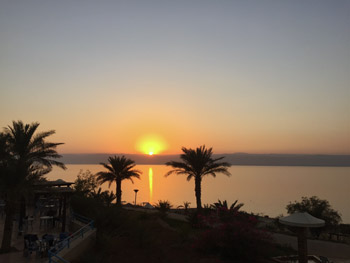
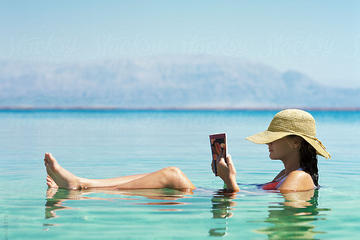
Dead Sea
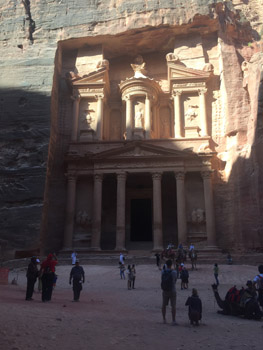
Petra
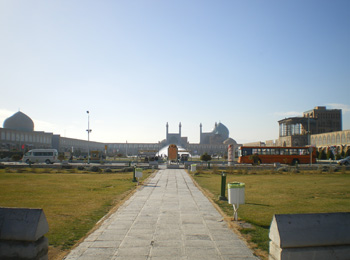
 It was early in the morning when I first walked into Nagh-e-Jahan square. It was a national holiday so people from all over the country had flocked to Isfahan. For me this meant the only available space in a hotel was little more than the floor of a converted underground storage room. Thoughts of such cramped accommodation made me happy to now be standing in one of the world’s largest squares. A huge open space, enclosed by covered arcades on each side is home to three of the high points of Persian, and world, architecture, the Imam(Shah) and Shekh Lotfollah mosques and the Ali Qapu palace.
 Getting up off the grass I walked toward the largest of Nagh-e-Jahan’s monuments, the Imam(Shah) mosque. Every inch of the sizeable structure is covered in blue and turquoise tiles, a speciality of Persian architecture. The mosque’s massive but intricately detailed gateway interrupts the plain brickwork of the surrounding arcades. The central arch alone climbs up to 27m with the two flanking minarets continuing further to reach 42m. Inscriptions in white Arabic script against a deep blue background frame central entrance. The rest of the space is filled with floral and geometric patterns in a mix of lighter colours. The level of detail is such that no corner, edge, or spot is left unadorned. This level of detail continues inside with over 400,000 painted tiles covering the arcades, halls and gateways of this extensive mosque complex. If the mosques of Nagh-e-Jahan square are the crowning glories of the Shah’s building programme then the domes are certainly the glittering jewels.

 The architects of the Safavid period (AD1501-1736) covered both the interior and the exterior of their domes in coloured tiles with colourful and impressive results. The Imam mosque is topped by an unblemished turquoise dome which fades paler and paler as the sun hits it. On the inside, yellow and cream floral patterns grow in circles against the blue background until this mass of individual details culminates in one central point at the top of the dome. Starring up into this pattern I could start to see that this wasn’t all about making something simply beautiful, these thousands of tiles were arranged to make a point. That the decorating pattern flows up, or flows down, from one central point was not just an aesthetic choice, it symbolises the climb up to heaven. The decoration of the mosque, like all art, is there to help people think of things beyond themselves.
 Perhaps not surprisingly there was more of a preference here for yellows and golds which are lit up by the sunlight flowing in through a series of windows. It says a lot that scholarly opinion suggests the Shekh Lotfollah is on a higher artistic level than even the Imam mosque. More effort and expense were put into this building and, while it is the smaller of the two, it is more embellished than its popular neighbour. The religious ideas motivating the decorations are again visible as I look up at the roof of the prayer hall. Circular patterns ascend in ordered rows to culminate at the top of the dome to inspire the visitor to contemplate the one centre.

 The building programme of Shah Abbas also left a significant legacy spanning the river Zayendah. Numerous monumental bridges cross the wide stretch of water at Isfahan, some with foundations going back over a thousand years, but the longest is the Si-o-seh pol. During the day it is a long flat place to stroll along and combinations well with the grassy banks of the river to become an ideal place to rest in the afternoon. Covered niches line the sides of the bridge giving people dozens of semi-hidden spots to sit quietly looking out over the river. With evening the promenading crowds increase as do the numbers of river birds that flock over head.
 About the author:
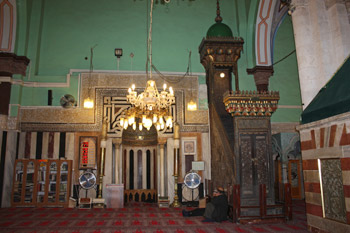 Hebron is the final resting place of the Patriarchs Abraham, Isaac and Jacob and their respective wives Sarah, Rebekah and Leah. Abraham purchased the Cave of Machpelah for use as a family tomb from Ephron the Hittite for 400 silver Shekels (Genesis 23:17). This cave is the second holiest site in Judaism.
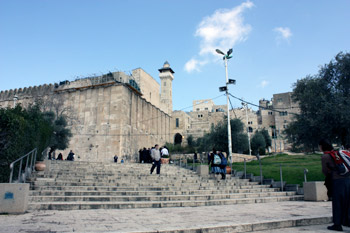 The Tomb of the Patriarchs is the centre of ongoing conflict between Palestinians and Jews. The site is maintained under tight security and segregated into both a mosque and a synagogue.
 Proceed past the minbar and then turn right to walk down the aisle between Isaac’s cenotaph and the wall. Before you enter the next room, look down to your right and find a decorative grate set upon a white marble slab shaped like a flower blossom. This grate covers a shaft leading down to the Cave of the Patriarchs below. A candle burns under the grate but nothing from the interior of the cave is visible. No one has entered this cave since the time of the Crusades.
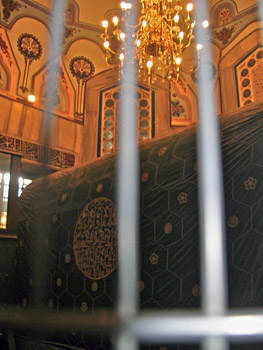 Exiting the prayer hall, locate Abraham’s cenotaph (Genesis 23:1-20) on your right. This is the most elaborately decorated monument in the complex. The cloth covering the cenotaph is divided into hexagonal sections, each with a gold embroidered flower blossom at its centre. Abraham’s monument is set within an opening in the wall that separates the mosque from the synagogue next door so that both Muslims and Jews can view it and yet remain segregated from each other.
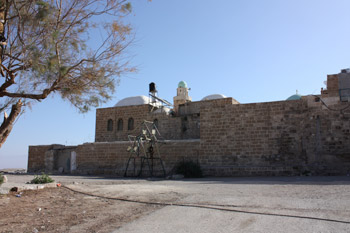 En route to Jericho, you pass by An Nabi Musa, a former caravanserai where Muslim travelers could rest for the night as they traveled to Mecca for the Hajj. The caravanserai houses a mosque dating to 1269 CE which was built by the Mamluk Sultan Baybers. Inside the mosque you find a second room containing a cenotaph covered in a silky green cloth embroidered with gold Arabic script. Muslims believe that this is the final resting place of Moses whose bones were removed from Mount Nebo in neighbouring Jordan by Saladin. Jews and Christians believe that Moses still rests on Mount Nebo to this day (Deuteronomy 34: 5-6).
 After a few minutes we continued on to Tell es-Sultan, the site of ancient Jericho. Just thinking about this city conjures up images of Israelites marching, the sound of trumpets and walls falling down (Joshua 6:1-21). What you find is a 15 metre high mound (“Tell” in Arabic) of earth covering approximately 2.5 hectares. Archeologists have sliced trenches deep into this mound and uncovered 23 successive settlements built atop each other. The oldest layer dates back to 8000 BCE. A number of signs highlight the structures found within each trench.
 The slope of one of the “Tell” layers dating to the Middle Bronze Age (1650-1550 BCE) was fortified by an earthen embankment with a mud brick wall at its summit. A large retaining wall at the base of the embankment was constructed from Cyclopean stones. This Cyclopean wall also supported a second mud brick wall at a height of 8 meters. This second mud brick wall, believed to have been about 70 centimeters thick, was uncovered in a collapsed state, possibly having been leveled by an earthquake. The nearby Jordan Valley is known to have a fault line running through it and earthquakes have been recorded at various times in history.
 After the late Bronze Age, the importance of the Tell site as a city declined significantly. Five centuries before Jesus, a new site for the city had already been established approximately 1.6 km southeast of the present-day mound.
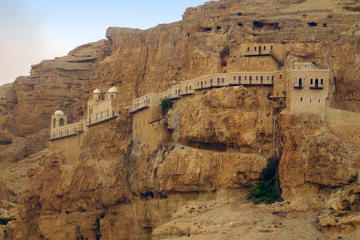
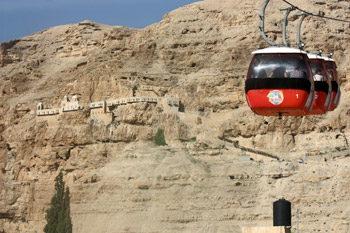 Exiting the archeological site, walk a short distance to the cable car and ride it up to the Monastery of Temptation set on the side of a nearby mountain. Administered by the Greek Orthodox Church, this monastery is situated on the traditional site where Jesus fasted for 40 days in the wilderness while being tempted by Satan (Matthew 4:1-11, Luke 4:1-13 and Mark 1:12-13).
 Inside the monastery, you pass down a long hallway that is open to the sky. This hallway runs along the sheer rock face where several caves have been hollowed out. The outer wall is a row of doors that open into rooms that have been cantilevered from the cliff.
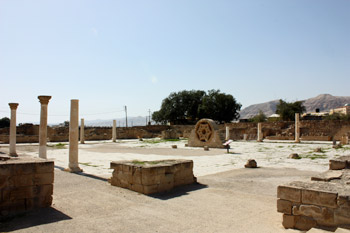 After descending by cable car, your next destination is Hisham’s Palace which was built by Caliph Hisham Bin Abdul Malik (724-743 CE) but never completed. The construction site was later leveled by an earthquake in 749 CE. Several layers of limestone blocks define all that remains of a once two-story building that served as a winter palace. The rooms of the palace were set around an inner portico and each corner of the structure had a cylindrical tower. A large hexagonal limestone star, cut from a single block of limestone, is believed to be all that remains of an upper window from this palace.
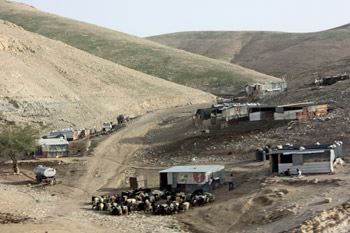 Just north of the palace you find the remains of a bath complex. The reception room features a beautiful mosaic on the floor depicting the “Tree of Life”. Three gazelles graze at the bottom of the fruit tree and a lion is ready to pounce on one of them. The bathing rooms, set along the northern wall of the bath house, were heated by hypocausts.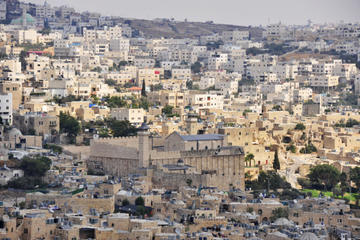
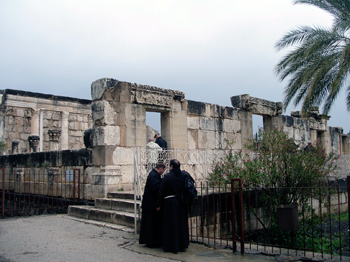
 Jesus settled in the ancient fishing village of Capernaum after having left Nazareth (Matthew 1:13, 9:1, Mark 2:1). Entering this archeological site today, you are greeted by a statue of St. Peter set just inside the “not-so-pearly” gates. Looking around, you may be surprised that the site before you is from the Byzantine Period and that nothing remains from the time of Jesus.
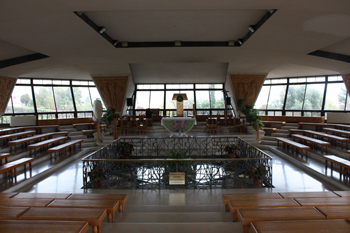 The octagonal shaped Catholic Church is beautiful in its own right. The brightly lit room features eight wooden carvings depicting the life of Jesus lining the periphery. Your eyes are drawn to the altar with the panoramic view of the Sea of Galilee behind it. From here, it is easy to imagine fishermen in their boats casting their nets into the lake.
 Constructed in 1933 on a rocky base at the shore of the Sea of Galilee by the Franciscans, this modest grey stone chapel is not the first church constructed on site. You can still see the remains of walls from an earlier church built in the 4th century CE on three sides of the building.
 The focal point of this church is the brown limestone outcrop that seemingly serves as a barrier between the congregation and the altar. According to tradition Jesus laid out a meal of bread and fish for his disciples upon this rock known as the Mensa Christi. You can easily imagine a number of tired fishermen coming ashore after a long night in their boat and finding a warm meal waiting for them, prepared by a man who had risen from the dead.

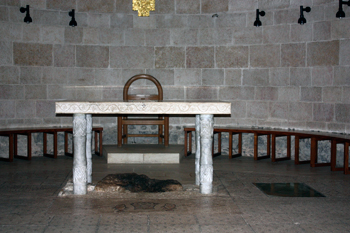 The focal point of this church with its basic interior is the dark brown limestone rock located beneath the simple stone altar. The faithful believe that this 0.6 square meter (5.4 square foot) stone was used by Jesus as a table when performing the miracle. History records that pilgrims have chipped away pieces of this stone over time.
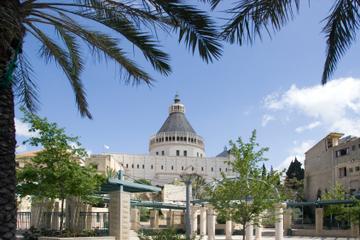
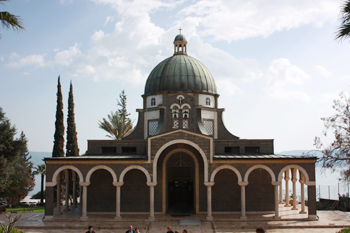 The Catholic Church on site, built in 1937, is set on the traditional site of Jesus’ Sermon on the Mount (Luke 6:20-22, Matthew 5:1-5). While there is no proof that the sermon actually occurred here, pilgrims have been drawn to this site since the 4th century CE, as evidenced by the ruins of a small church just down the hill from the present house of worship.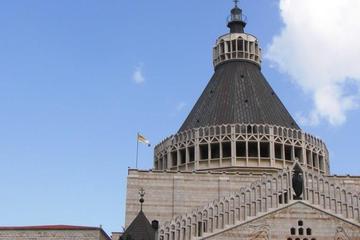
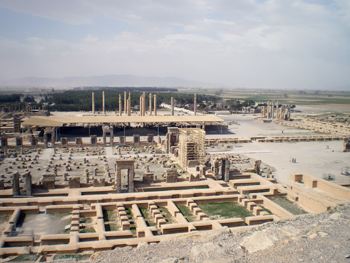
 It takes about an hour by car to cross the 70 kilometers of straight desert road to get to Takht-e-Jamshid, Persepolis. A little way outside the site are the rock-cut tombs of Naksh-e-Rustam. High up on a flat rock face the idealised figures of several Achaemenid kings glare out from a set of royal tombs. Cut so high that they were only accessible with ropes, I have to crane my neck and strain my eyes to make out the images of several Persian kings, the builders of Persepolis. Below the tombs the later Sassanian dynasty also left a vivid reminder. In this image the Iranian king Shapur I, sits tall astride his war-horse whilst in front a Roman emperor bends a knee and begs the king for mercy. All these thousands of years later the tombs and images still retain their main purpose of demonstrating the power of the Persian kings.
 Over two thousand years ago people trekked into the Southern Iranian desert bearing tribute to the mighty Persian Empire whose king sat enthroned in the courtyards and spacious halls of Persepolis. This gave the grand city its reputation as the most hated in the world and ultimately caused its fiery destruction by Alexander the Great. It never recovered from this destruction and the hollowed out shade of the city was left abandoned to the desert for centuries.
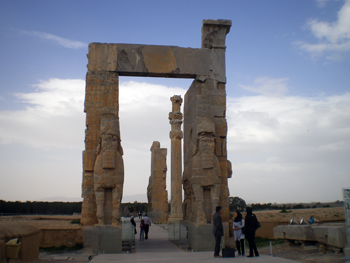 Once in the site, I came first to the impressive Gate of All Nations. The name referring to the subjects of the empire who would have had to pass through here. Above me loomed two huge human headed winged lions, their eroded bodies incised with the vertical and horizontal lines of three different languages which proclaim Xerxes I as their builder. The grand courtyard these beasts guard having long since vanished their intimidating bulk at least offers some protective shade. A little further on a finely carved capital of two bull’s heads lays flat on the ground. Unlike much else here they look fresh, pristine, as if just carved out of gleaming marble. It’s difficult to imagine that their huge weight could once have been hauled up to top a slender column.
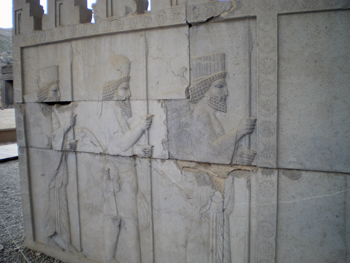
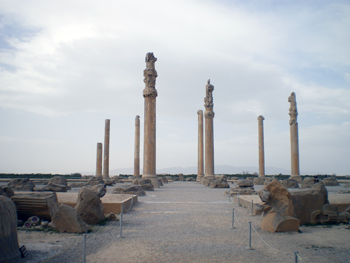 One of the finest surviving elements of the site is the grand staircase which led to the Apadana Palace. The sides of the stairs contain some of the best surviving sculpture. It was here that the subject peoples would have to come bearing tribute. At the bottom of the staircase a lion grapples fiercely with a fleeing bull. This common piece of Persian iconography is still striking today. Climbing the staircase I was accompanied by the subject peoples. Greeks, Egyptians, Scythians, Afghans and a myriad others all processing up the steps to the palace at the top. The steps are cut deliberately shallow so you have to slow your pace and walk carefully before entering the presence of the King.
 The fighting animals, strong soldiers and exotic subjects which lined the walls and the sheer opulence of the place must have made entering Persepolis an intimidating experience. Many from beyond Persia would only have come to Persepolis under compulsion. It is not surprising then that it was such a feared and hated place, the object of vengeful dreams for many people, despite its beauty. Once Alexander the Great defeated Persia and captured the city he had it burnt to the ground before leaving. As the architectural symbol of the Persian Empire, Alexander reckoned he could not leave it standing. The fire would have quickly rose and engulfed the wooden beams of the roof and brought them crashing down. Traces of this fiery end can still be seen across the site which was never rebuilt.