Travel Thru History

Historical and cultural travel experiences

  • Home
  • Airfare Deals
  • Get Travel Insurance
  • Writers Guidelines

Italy: Bologna is for Dreamers

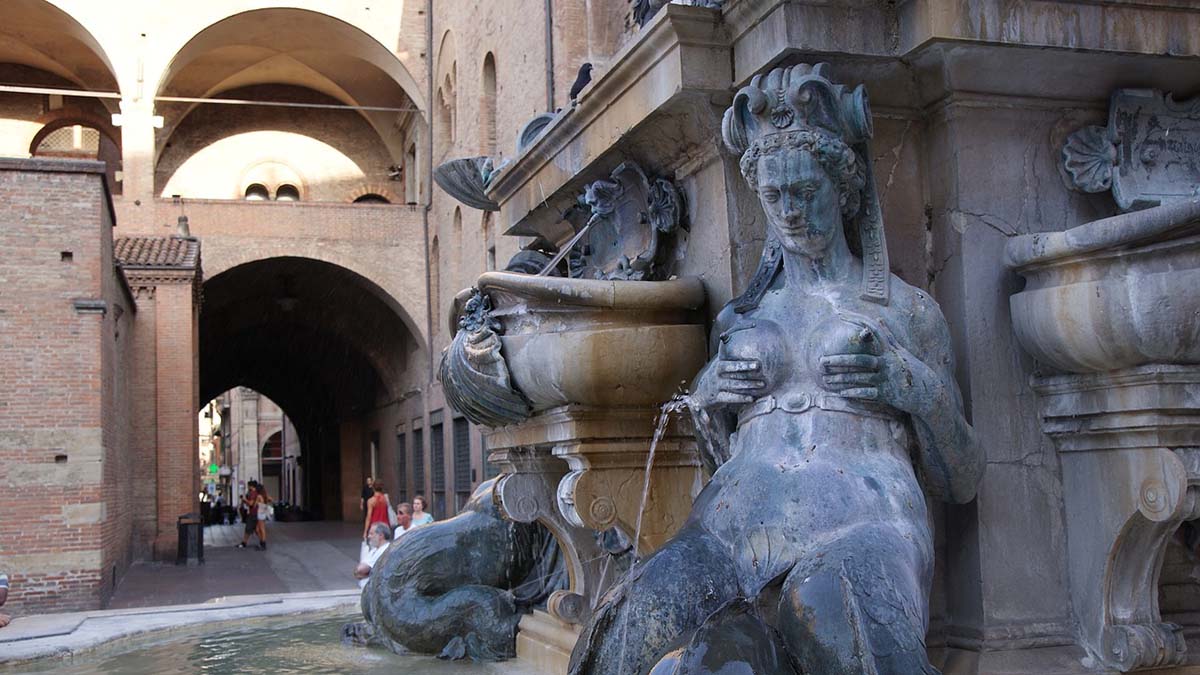
Fountain of Nepture in Bologna

by Sonu Purhar

I arrive in Bologna exhausted and cranky. My finger aches from snapping thousands of cheesy photos; my money belt is considerably lighter from having exchanged my euros for cheap souvenirs that will probably end up in a future garage sale back home. My quixotic Italian trip has been marred by an explosion of tourist lures in cities that throb with culture yet somehow can’t resist selling plastic mini-sculptures of James Dean-esque Davids and pillboxes shaped like gondoliers.

But then there is Bologna.

One of the last big cities left in Italy that refuses to cater to the influx of tourists, Bologna packs as much culture into its winding vias and shady piazzas as its more popular cousins, Rome and Florence. As soon as I step out of the train station, I’m swept along with the thrumming crowd through medieval, sun-washed streets. There is a potent feeling of opportunity that hangs in the air, a vibrancy and excitement for life that radiates from the young residents of this college community.
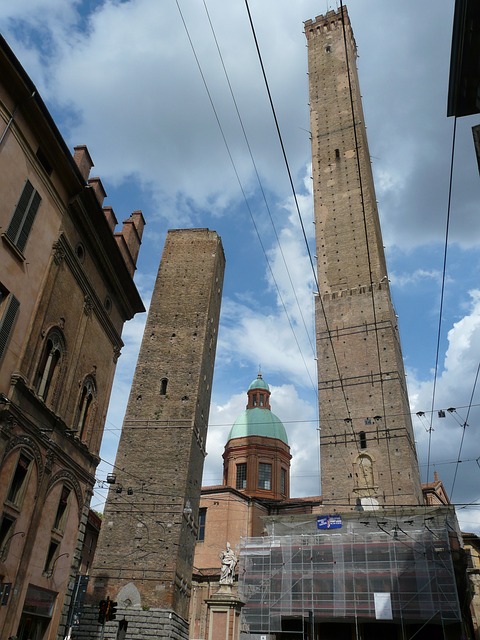
Due Torri, two towers of BolognaI’ve come to Bologna to wander. I disengage from the crowd and stroll up the broad Via Rizzoli, one of the town’s main arteries. As I casually check out the shops and trattorias crowding the broad roadsides, I catch a glimpse of tall structures in the distance. Rounding a corner, I stop short, awed. Massive towers thrust imposingly from the road ahead of me, a ghostly replication of New York’s fated Twin Towers. But these are no financial hotspots: they are the famed Due Torri, 12th-century structures that soar to heights of 97 and 47 metres. They lean slightly toward each other, like hesitant lovers, putting Pisa’s lone edifice to shame.

Further ahead, I emerge into a sprawling city square, resplendent under the beaming sun, with a fountain in the centre that’s attracting much attention from hooting boys and giggling girls. Drawing closer, I see that a statue of Neptune presides over the fountain, smiling saucily as jets of water arc from her breasts. Several teenagers are perched on her, frozen in naughty poses as cameras flash from all angles. I suspect this has been a favourite pastime of teenaged boys since the statue’s creation more than 440 years ago.

It seems that a soundtrack follows me as I pass through the city: in nearly every piazza, troupes of musicians entertain espresso-sipping crowds. Paying homage to Bologna’s zest for the arts – the town was named a UNESCO City of Music in 2006 – I make a brief detour through the Accadeia Filarmonica, and scan with heady excitement the displays of preserved music sheets written by Mozart, Verdi and Beethoven. Pamphlets in the music institute’s lobby advertise this year’s Bologna Festival, during which the city is blitzed with classical concerts, dances and theatre shows. Even now, months before the festival begins, I can’t turn a corner without bumping into a music club or concert hall. What with the throngs of college-aged Bolognians that converge on every street corner, I can see why the city has attained a reputation for being the city for nightlife and cultural pleasures.

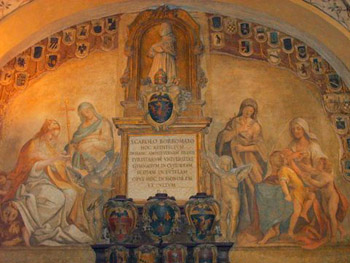
coats of arms at University of BolognaDespite Bologna’s many cultural distractions, I manage to reach my prime destination, the University of Bologna – Europe’s oldest university. Over 900 years ago, the school churned out scholars like Dante, Petrarca and Boccacio, and now I’m about to enter the same halls and sit in the same classrooms.

Unlike in many North American college towns, the school isn’t segregated from the rest of the city but built directly in its bustling centre. I’m drawn to the elaborate coats of arms painted on the walls, hundreds of them running along each corridor: family crests of past graduates. Trawling the school’s labyrinthine halls, I discover a dusty library filled with ancient texts sealed under heavy glass, and centuries-old maps and globes. I find a small classroom and slip inside. On the ceiling are faded paintings of the zodiac signs. I find my sign, Aquarius, and take a seat beneath the symbol, gazing at the empty rows of benches and pretending that I’m waiting for my Lit class with Boccaccio to begin.
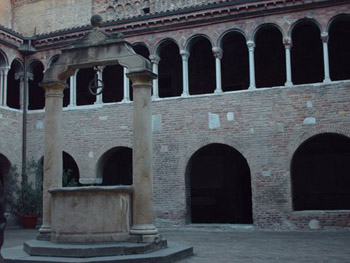
stone bench where Dante satBut the best part of my visit is when I stumble upon a small, leafy courtyard. Stopping to sit on a cool stone bench, I open my guidebook and scan it idly, wondering what other treasures the school has to offer. Then I stop cold at a jarring sentence. My eyes drift up to the well directly in front of me, and my heart quickens. I’m sitting in the exact spot where Dante penned The Divine Comedy.

My rear end is touching the same surface that Dante’s rear end touched! I think wildly.

And that moment is what sums up Bologna for me: A treasure trove of culture, bursting with hidden gems that only a wanderer – a dreamer – could possibly find, or appreciate.

If You Go:

Music lovers won’t want to miss Bologna’s internationally renowned Music Festival, usually held from May to June. www.bolognamusicfestival.it

Take your pick from the many cafes and bars that line Piazza Maggiore, a pedestrian square that lies in the oldest part of the city. Enjoy an espresso or wine while taking in the Renaissance-era buildings, enthusiastic street performers and up-and-coming musicians.

And don’t forget to pay a visit to the Fountain of Neptune [TOP PHOTO]. Built in 1566, this fun landmark is located in the piazza adjacent to Maggiore.

The University of Bologna is located on Via Zamboni, in the heart of Bologna’s bustling modern quarter.

The Due Torre are located in Piazza di Porta Ravegnana. After taking in the gravity-defying behemoths, stroll the nearby mansion-studded Via Strada Maggiore and soak in one of Bologna’s most opulent areas.

Bologna is a culinary capital of Italy, which means it’s virtually impossible not to find a great eatery. Try the elegant Ristorante al Pappagallo (notable former guests include Einstein and Hitchcock) and family-owned I Carracci, which offers some of the best wine in the region.

Bologna Tours Now Available:

Private Tour: Wine Tasting in Bologna
Musical Bologna Walking Tour with a Private Guide
Private Tour: Brothels and Bordellos of Bologna
Private Tour: Classical Bologna Walking Tour

Photo credits:
Bologna Neptune fountain by tomek999 from Pixabay
Bologna two towers by eternaltravel from Pixabay
All other photos are by Sonu Purhar,

About the author:
Sonu Purhar has been published in several magazines, including Westworld and Abroad View, as well as on various travel websites. She has backpacked through Europe and amassed a lengthy list of travel destinations and experiences – but despite her love for Italian culture, French couture and Spanish queimada, her favourite place in the world will always be Disneyland.

Tagged With: Bologna attractions, Italy travel Filed Under: Europe Travel

“Do-It-Yourself” Angels and Demons Tour of Rome

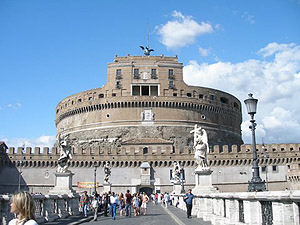
Castel sant’angelo, Rome

Italy

by Troy Herrick

The success of the movie Angels & Demons has had a major impact on sightseeing in Rome. A number of companies now advertise an Angels and Demons Tour to some but not all of the settings depicted in the movie. Unfortunately for the budget traveler, the cost usually exceeds €50 per person.
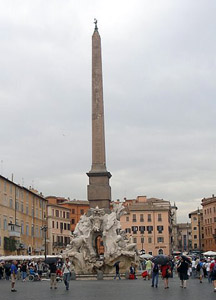
Fontana dei Quattro Fiumi fountain Piazza Navona Rome, ItalyAlternatively, you can take the two-day “do-it-yourself” tour outlined below and visit all of the movie locations. You will not visit sites in the same order as Robert Langdon and Vittoria Vetra but you will enjoy more time at each location.

As long as you don’t mind some walking, you will pay less than the price of a commercial tour. Costs will be limited to subway travel as needed and admission to three sites – the Vatican Museum, the excavations under St. Peter’s Basilica and Castel Sant’Angelo.

Day One – St. Peter’s Basilica, St. Peter’s Square and the Vatican Museum

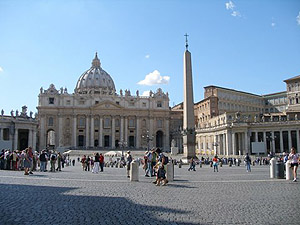
St Peter's BasilicaDay One of your quest along “the Path of Illumination” begins with St. Peter’s Basilica. Inside Christendom’s largest church, you feel small and insignificant. You are surrounded by larger-than-life statues and mosaics; dwarfed by Gianlorenzo Bernini’s massive bronze baldachin sheltering the high altar.

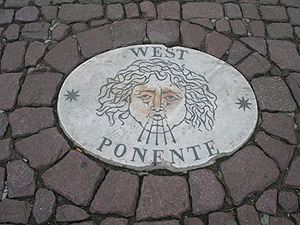
A stairwell in front of the high altar leads down into the Papal crypt. While you are not permitted down these stairs, the landing where the Camerlengo set himself ablaze in the movie is clearly visible. Also in the landing you see St. Peter’s icon peering out from a window. His tomb, which you will see on Day 2, is hidden behind that wall. Next, walk to the Egyptian Obelisk at the center of St. Peter’s Square. Bernini encircled this obelisk with a series of white elliptical bas reliefs. The “West Ponente” is an angel blowing air. The air points to the “the Path of Illumination – air”. Langdon found the dying second cardinal in St. Peter’s Square.

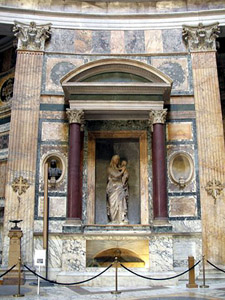
Altar of Our Lady of the Rock, PantheonDo not follow “the Path of Illumination” however. Instead, pass the remainder of your day at the Vatican Museum. The priceless museum collections are so extensive that one day is not enough time to really appreciate everything. Therefore divide your time according to your interest then find your way through the Egyptian Museum, New Wing (classical art), Etruscan Museum, Tapestry Gallery, Map Gallery, Borja Apartments etc. Some highlights include Greek statues, Renaissance paintings, an Egyptian mummy, an Etruscan chariot and early maps.

The Sistine Chapel, near the end of the tour, is the star of the Vatican Museum. The chapel is adorned with biblical scenes by Michelangelo, Botticelli and a number of lesser-known Renaissance artists. Michelangelo’s ceiling frescoes surpass everything except his “Last Judgement” behind the altar. As in the movie, the College of Cardinals meets for conclave inside the Sistine Chapel.

Most people are exhausted after completing the Vatican Museum. As such, you may wish to relax for the remainder of the day and start fresh tomorrow.

 Day 2: Old Rome and the Excavations below St. Peter’s Basilica
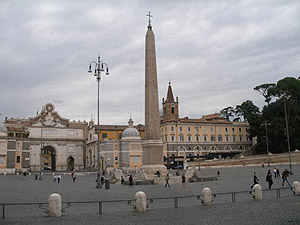
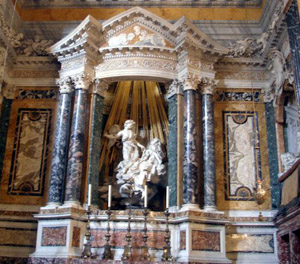
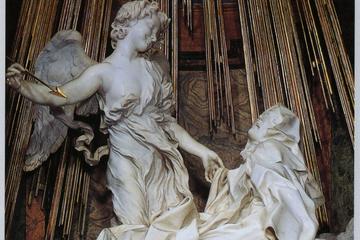
Piazza del Popolo, RomeDay 2 begins with a subway trip to the early 17th century Church of Santa Maria della Vittoria. This church features Bernini’s white marble statue of “the Ecstasy of St. Theresa” to the left of the altar. Theresa is “on fire”. She has a powerful yet erotic expression on her face as the angel stands poised to pierce her heart with a golden arrow. The arrow points in the direction of “the Path of Illumination – fire” in the movie. Langdon found the third cardinal engulfed in flames inside this church.

The mid-15th century Church of Santa Maria del Popolo is your next stop. Here Bernini’s white marble statue of “Habakkuk and the Angel” is found just outside the Chigi Chapel. Unfortunately it was covered for renovation at the time of my visit. Habakkuk was a minor prophet who predicted the destruction of the earth. The angel’s finger points in the direction of “the Path of Illumination – earth” in the movie.

Roma San Pietro railway stationLook for the skeleton on the manhole-like cupermiento. This disc hides the entrance to the demon’s hole (crypt) in the movie. Langdon found the body of first cardinal in the crypt.

History records that this church was constructed atop the Mausoleum of the Domizii where the infamous Roman Emperor Nero was entombed. Is the cupermiento a hidden entrance to such a mausoleum? No one was available to answer this question.

Return to St. Peter’s and visit the excavations (Scavi in Italian). You pass through what was once an outdoor cemetery lost for almost 1700 years. The Roman Emperor Constantine had the summit of Vatican Hill levelled in order to construct the first St. Peter’s. Rather than removing rock and dirt, a retaining wall was erected and soil was added as filler. Thus ancient pagan and Christian tombs were buried under tons of earth plus the basilica itself. This necropolis remained undisturbed until the early 1940s when the site was excavated by order of Pope Pius XII.

Bernini's Ecstasy of St. TeresaDuring the tour, your guide will point out St. Peter’s 2nd century funerary monument where his bones are clearly visible. In the movie, the canister of antimatter was situated nearby.

The necropolis tour concludes at the Papal Crypt. Here you find yourself surrounded by the sarcophagi of many but not all of the Popes. Among these tombs is that of Pope John Paul II. The marble floor on which you stand was once the nave of Constantine’s basilica. In the movie, Vetra and the Camerlengo violate the sarcophagus of the recently deceased Pope Celestine V and confirm that he was poisoned.

After the Papal Crypt, proceed to the far end of St. Peter’s Square opposite the basilica. Exit where the two colonnades converge and walk approximately five blocks to Castel Sant’Angelo. The statue of an angel adorns the roof of this fortified cylindrical structure.

Before entering, locate the aqueduct-like Il Passetto de Borgo. The corridor inside was the Pope’s secret escape route from the Vatican to Castel Sant’Angelo in times of trouble. While Langdon and Vetra found their way inside, you will not be so lucky. The passage is closed to the public.

Castel Sant’AngeloCastel Sant’Angelo, the last existing church of the Illuminati in the movie, was originally constructed as a mausoleum for the Roman Emperor Hadrian. Centuries later it was converted to a Papal sanctuary. The originally furnished apartments may be visited.

Papal Castel Sant’Angelo also served as a prison. In the movie, the assassin held the four cardinals within its cells.

As you exit Castel Sant’Angelo, cross the Tiber River using the nearby Ponte Sant’Angelo and walk to the Piazza Navona. The piazza features Bernini’s “Fountain of the Four Rivers”. This fountain is an allegorical representation of the four known continents in the 17th century – the Ganges (Asia), the Danube (Europe), the Rio de la Plata (the Americas) and the Nile (Africa). An Egyptian obelisk is incorporated into the fountain. A dove at the pinnacle faces “the Pathway of Illumination – water”. This dove represents the Angel of Peace in the movie. Langdon rescued the fourth cardinal (Baggio) from this fountain.

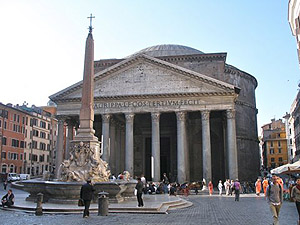
PantheonYour final stop is the nearby Pantheon. This Roman temple, now the Basilica of Santa Maria dei Martiri, remained almost unaltered from ancient times. The only exception was the removal of a bronze frieze by order of Pope Urban VIII. The bronze was used to cast the baldachin in St. Peter’s and the cannons at Castel Sant’Angelo.

Inside Langdon and Vetra searched for Raphael’s tomb. “The Madonna of the Stone” marks the artist’s grave which is located at 10 o’clock when you enter the rotunda. The oculus in the roof is your only source of light inside the Pantheon. Langdon mistook the oculus for the demon’s hole.

The “do-it-yourself” Angels and Demons Tour concludes when you leave the Pantheon. The nearest subway station is approximately eight blocks away (Metro Line A – Barberini Station). From there you can travel to other tourist attractions not related to the movie.


Hire a Guide for Angels and Demons Rome Tour:

Rome Angels and Demons Half-Day Tour
Rome: Angels and Demons Tour Half-Day Semi-Private

Semi-Private Walking Tour: Angels and Demons

If You Do It Yourself:

You will enjoy your tour along “the Path of Illumination” more if you review the movie and then mark each site on a map of Rome and a schematic map of the subway system for your later use.

Dress conservatively when you visit any of the holy sites above. Men should wear long pants. Women should wear garments that cover the shoulders and extend below the knees. Vatican staff strictly enforces these clothing requirements.

Reserve your tickets to the Vatican Museum at least three months in advance at www.rome-museum.com.

Vatican City is five blocks from Ottaviano Station (Metro Line A). The best time to tour St. Peter’s Basilica is 7 a.m. when few people are around. The best day to visit is Monday when most other tourist destinations in Rome are closed.

Keep your Vatican Museum ticket as it also admits you to the Lateran Palace at the Basilica of St. John Lateran (Metro Line A – San Giovanni Station). The ticket is valid for five days. The Lateran Palace is open most weekday mornings.

Reserve your tickets to the excavations (Scavi) below St. Peter’s Basilica three months in advance at http://www.scavi.va/content/scavi/en/ufficio-scavi.html

If you are unable to obtain tickets to the Scavi, you can still enjoy a virtual tour at http://www.vatican.va.

Entry into the Papal Crypt is free and not part of the Scavi Tour.

The Church of Santa Maria della Vittoria is approximately one block from Repubblica Station (Metro Line A) at Via XX Settembre. This church is likely to be closed for several hours each day. Do not confuse this church with the Church of Santa Maria delle Angeli which is closer to the metro station.

The Church of Santa Maria del Popolo is near Flaminio Station (Metro Line A). It is also likely to be closed for several hours each day.

If your visit to Rome is three days or more, consider purchasing the Roma Pass www.romapass.it. This three-day pass provides you with free admission to the first two sites and then discounted admissions to other sites. Castel Sant’Angelo is included among the list of sites along with the Roman Forum/Colosseum (Metro Line B – Colosseo Station). Combine these two sites with three days of unlimited subway/bus travel and the pass pays for itself.

About the author:
Troy Herrick, a freelance travel writer, has traveled extensively in North America, the Caribbean, Europe and parts of South America. His articles have appeared in Live Life Travel, International Living, Offbeat Travel and Travels Thru History Magazines. He also penned the travel planning e-book entitled ”Turn Your Dream Vacation into Reality: A Game Plan for Seeing the World the Way You Want to See It”, available at www.thebudgettravelstore.com and based on his own travel experiences over the years. Plan your vacation at his Budget Travel Store and his PlanADreamTrip.com sites.

Photo credits:
First Castel Sant’Angelo photo by neufal54 from Pixabay
All other photos are by Diane Gagnon.

Tagged With: Angels and Demons, Italy travel Filed Under: Europe Travel

Death and Dolce in Italy’s Dolomites

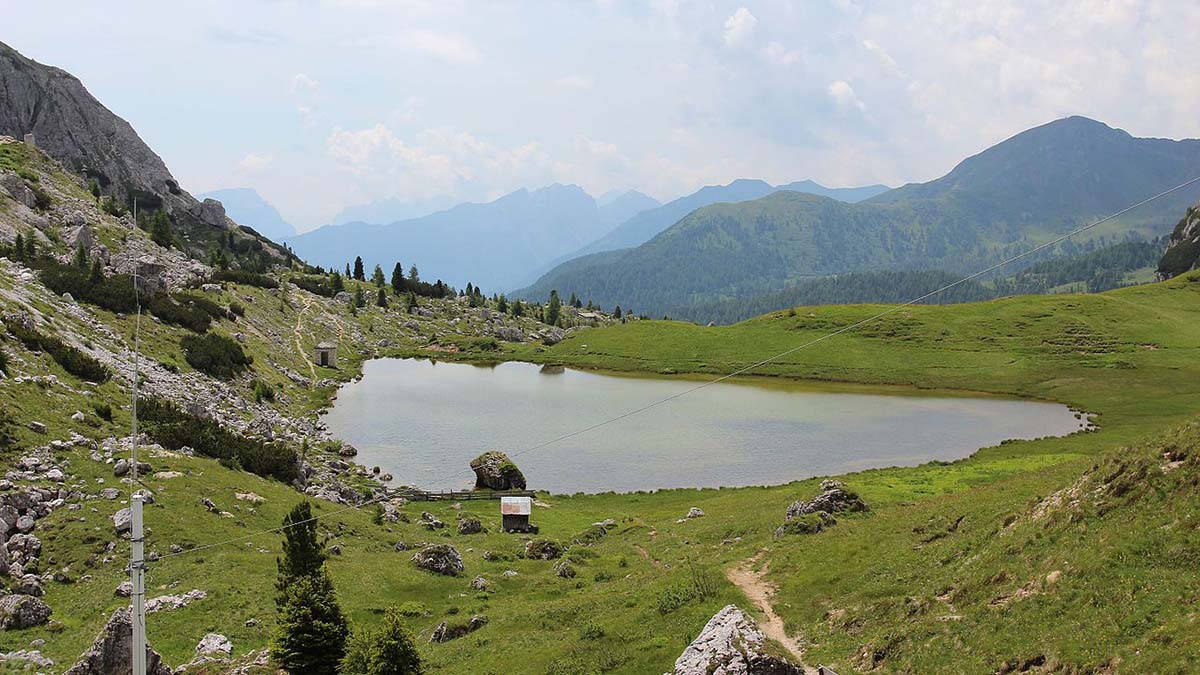
Lake Valparola

by Marc Latham

Before I ascended into the Dolomites, if somebody mentioned Great War (World War One) stalemates I would only have thought of the Somme, Ypres and other mud and blood filled fields of northern Europe; if someone talked about Great War weather-induced injuries I would presume they were referring to trench-foot; and if they recounted the horrors of Great War winters my mind would visualise soldiers crawling through freezing rain or knee-deep in stagnant water.

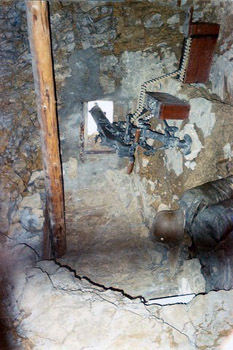
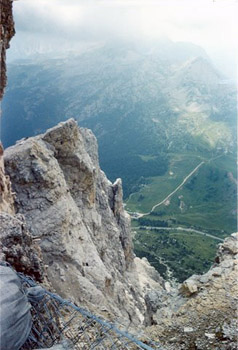
Yet here I was, in a cramped machine-gun post 8,000 feet up on Lagazuoi in the Italian Dolomites, where ninety years previously the Austrians had defended their Alps front line against Italians who had joined the war on the side of the Entente Powers (led by Britain and Commonwealth countries, Russia and France) against the Central Powers (mainly Germany and Austria-Hungary). The gun was pointed across at what had then been Italian positions; they only seemed a stone-throw away, although there was a hundred foot drop in-between.

Lagazuoi could be enjoyed in the summer sun, but temperatures were still cool to say the least, and in winter it can drop to -30c (-22f); so in the trenches of the Dolomites it was blizzards and frostbite that were the main weather concerns for the Italian and Austrian troops fighting doggedly in the tunnels and peaks of the southern Alps.

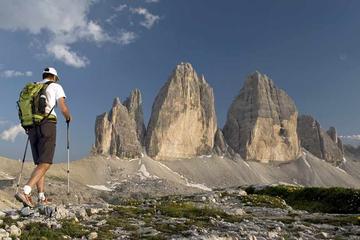
The Dolomites were formed 200 million years ago out of the primeval ocean, and the highest peaks now reach 12,000 feet. They take their name from French mineralogist, Déodat de Dolomieu (1750-1801), who discovered and defined the unique composition of the stone which gives it a lighter colour than most mountains.

I had travelled up to the Dolomites from Reggio Emilia with a local friend I’d met in Africa seven years before. Reggio is the main town in the Emilia-Romagna region of northern Italy, and is a bastion of socialism in a country divided between politically polarised regions; streets are named after left-wing legends such as Lenin, Marx and Che Guevara, and there is a statue in the town celebrating the partisans who fought against Mussolini in World War Two.

We travelled north by train, via Bologna and Verona to Brunico. The Bologna train had been packed with people heading to the coast at Rimini; I’d apparently picked an inconvenient time to visit Italy, as the country largely shuts down in August for a national holiday.
Sun-kissed vineyards and farmland provided the vista until Verona, and then mountains began to dominate the horizon after that; many featured majestic medieval castles that offer clues to the region’s importance as a trading route, and the wealth and prestige it has brought. The temperature had been about 40c (110f) in Reggio, but as we started winding up into the Alpine landscape temperature figures halved and there was more cloud.

When we arrived in Brunico it looked and sounded as if we’d crossed into another country: red and white flags abound, the architecture is typical of the central Alps, and German is the primary language as it is in Austria. This is because the region, South Tyrol, was Austrian until the Italian push into the Dolomites during the Great War. As part of the 1915 treaty that brought neutral Italy into the war it was agreed that they should have some Austro-Hungarian regions after the conflict. Although parts of the treaty could not be kept, South Tyrol did become Italian in 1919.

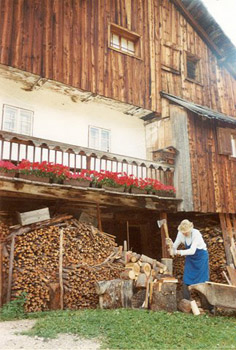
From Brunico we took a comfortable bus along country roads that provided great views of lush green valleys and high mountain peaks to the village of Pedraces in the Badia valley for a couple of Euros. We stayed at the Pension Armalia, which was clean and friendly, although the staff didn’t speak English; luckily, my friend provided translation and did all the organising. Breakfast and dinner were included in the price, and provided enough for the day; they were not used to catering for vegetarians so it was mostly egg and cheese dishes for me, but they were always nice and filling.

On the first day we bused it into the bigger village of La Villa, where there is a good tourist office. It was there that I first saw the leaflet for the mountain-top Great War Museum: it looked intriguing and declared itself unique. Three days of hiking amongst impressive peaks and Sound of the Music style meadows later it was time to take a trip back in time to the Great War.

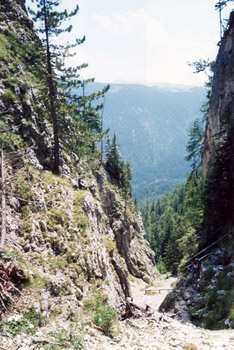
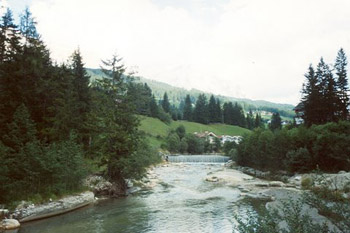
We took a bus into La Villa again at about 9am, and then another bus to the ski lift station at the Falzarego Pass. The second bus journey took us to the end of the mountain range that framed one flank of the valley, and when I realised where we were going I was overjoyed; I’d wondered what lay beyond the high natural wall that dominated that side of the panorama, and now I was about to find out. As we wound our way through mountains, forests and Lake Valparola to the 6000 feet Falzarego there were magnificent views down the valley all the way to Pedraces.

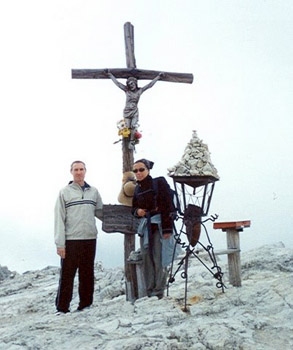
The ski-lift carried us up an additional 2000 feet in altitude, and combined with the wind chill from being on top of an exposed peak it made a noticeable difference to the temperature. I didn’t think there would be much natural life at that altitude, and was therefore surprised to see a flock of birds fly high above us before turning en-masse and heading back down towards the valley below. We made our way over to one of the many crosses that appear on prominent peaks across the mountains in the region, and could see a couple of small lakes further into the range; mountains dominated the horizon for as far as the eye could see.

Leaving the exposed peak and passing the 360 degree reception centre we started to view the open air museum as we descended on a steep and narrow path. The path seems to be the one used during the Great War, as the preserved living quarters and positions of the Austrian troops defending the Lagazuoi Peak are accessible from it as you walk.

The soldiers spent two winters guarding the rock in the freezing cold, and it was easy to imagine how relieved the soldiers must have been to escape a third. There were separate quarters for the officers and men, with neither looking comfortable; the only preferential benefits for the officers seemed to be a little more room and a desk. The machine-gun post was claustrophobic and cold, and if you add on the freezing temperatures of winter and being fired at by snipers and heavy artillery then it must have been quite close to what I’d imagine hell would be like if it did ever freeze over.

After leaving Lagazuoi we made our way down a track at the bottom of no-man’s-land; looking back up at the Austrian positions we could view them almost as the Italians must have done. All of a sudden the Austrian experience didn’t seem quite as bad, as I’d have preferred to be looking and firing down than up. However, the Italians did have the advantage of launching surprise attacks at the Austrians by tunnelling into the mountain.

The closest I came to relating to the sound of explosions that had disrupted the harmony of the Dolomites ninety years before was being awoken one night by the loudest thunderstorm I’ve ever heard. Before that I’d been thinking how easy it looked to just hike up one of the beautiful peaks. Like war, mountains can look easier to survive than in reality; and when you combine them together, they can provide one of the toughest tests of all.


Private daily Tour: The most beautiful Trekking in the Dolomites

If You Go:

Collett’s: Classic Walking Holiday in the Italian Dolomites
For accommodation: Your Holiday Dolomites
For transport information: Discover the Dolomites
Art and culture in the Dolomites

About the author:
After spending his twenties travelling the world, Marc Latham studied history and communications studies at university, and graduated with a PhD in 2005. He has since been building a freelance writing career from the www.greenygrey.co.uk website, and has had several articles published. This month, Booklocker is set to publish an ebook memoir about his first travel around Europe and the Middle-East, including time spent amongst the 1980s Worker-Traveller communities that nomadically followed the seasonal work.
Contact: marc@greenygrey.co.uk – www.greenygrey.co.uk/blog

Photo credits:
Lake Valparola by: Steinsplitter / CC BY-SA
All other photos are by Marc Latham.

Tagged With: Dolomites, Italy travel Filed Under: Europe Travel

Venice, Italy and the World’s First Ghetto

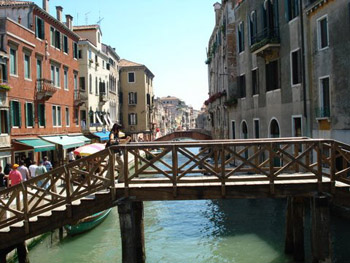
Jewish ghetto, Venice

A Visit to Judaism’s Historic Past

by Lindsay Soberano

Traveling in Europe, from Spain to Germany there are remnants of lost civilizations with little signs of current Jewish life. Of course there are exceptions, but they just do not seem to balance out the wealth of synagogues that have been turned into museums or churches. However, when I arrived in Italy, I discovered a pulse of Jewish life.

Ironically, it was in the first European ghetto, formed in Venice on March 29, 1516, where I felt that Judaism was the most vibrant. Once home to approximately 5,000 Jews (circa 1630), the ghetto now inhabits 500. There is a kosher restaurant, bakeries, five synagogues and a Museum of Jewish Art (Museo Ebraico), which opened in 1955. Not to mention a yeshiva, several Jewish shops, a book publisher, a Jewish old-aged home and an ancient Jewish cemetery.

Campo di Ghetto Nuovo, VeniceThe New Ghetto (Campo di Ghetto Nuovo) dates back from 1516, the Old Ghetto (Ghetto Vecchio) dates back from 1541 and the Newest Ghetto was added in 1633. The first inhabitants were central European Jews and southern Italian Jews. But the Jews of the Venice Ghetto came from various cultures, as evident through the five synagogues: one each for the German, Italian, Spanish and Levantine communities, and a fifth (the Canton School), which some think may have been French and others suggest may have been German. But no matter what country, social class or culture one came from, a Jew was a Jew, and that meant they were all subject to the same vetoes.

During the day Jews could not frequent far from today’s train station. Men were forced to wear a yellow circle stitched on the left shoulder of their cloaks, while women were forced to wear a yellow scarf. At night they had to return to the Ghetto where guards (paid for by Jews) patrolled the locked entrances. Restrictions were placed on Jewish economic activities as well: they were confined to peddling, money lending or medicine.
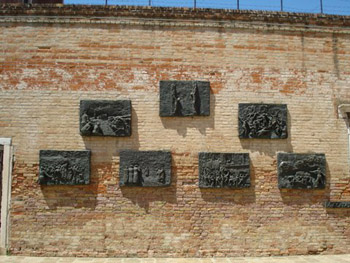
Holocaust memorial in Jewish ghetto, VeniceThe oppression of Venetian Jews began to ease in the 18th and 19th century: in 1797 the gates of the Ghetto were opened, due to the fact that revolutionary France conceded equal rights to Jews; in 1782 Joseph II of Habsburg issued the Edict of Toleration; and in 1848 King Carlo Alberto proclaimed it in his statute.

But the 20th century would tell a very different story. Before the Second World War there were approximately 15,00 Jews in the Ghetto; however, about 200 Jews were deported to concentration camps—only eight returned. Today there is a plaque in the New Ghetto commemorating the Jews who perished.

Venice and the Jewish Ghetto attract over 300,000 Jewish tourists a year. Tours of the Ghetto and the five synagogues are available year-round at the Jewish Museum. While there are five synagogues, only two are utilized: the Spanish School (built in the second half of the 16th century) and the Levantine school (1538) are the only two operational synagogues, with the former being used in the summer because it is the largest, and the latter in the winter because it is the only synagogue with heating. The Spanish School is perhaps the only one in the world to have functioned uninterruptedly from its foundation until the present day. The Levantine School is said to be the most characteristic synagogue in Venice. Since the last century it has housed a small study and prayer hall, the Luzzatto School or Yeshivah.

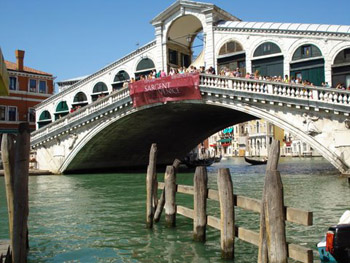
Rialto bridge, VeniceThe German School is the oldest synagogue (1529); but like the Canton School and the Italian School, it is only used for special events. The Italian School is simpler than the other synagogues. It was the last synagogue to be built (1575) by the Jews belonging to the Italian nation, which was the poorest and smallest population. The Canton School (1531-32) is one of the most beautiful and treasured synagogues. From the outside it can be identified by its eccentric wooden dome, which rises on an octagonal drum. Although I did not attend a service in a Venetian synagogue, I did attend one at the Lungotevere Cenci in Rome, which is by far the most beautiful shul I have ever seen.

Of course Jewish history and architecture are not the only things that make visiting Venice and enlivening experience. The artisan shops, the labyrinth of streets and narrow passageways, gondola rides, Piazza San Marco and Campo San Polo square all have a charm of their own. And one can’t forget some of the gondoliers who push their luck when saying: “Kiss the gondolier under the bridge.”

If You Go:

Jewish Ghetto of Venice website

Sacred Destinations: Jewish Ghetto, Venice

Venice Tours Now Available:

Venice Jewish Ghetto small group tour with GELATO tasting
Jewish Ghetto and Cannaregio Food Tour with Dinner in Venice
Venice Private Tour of Cannaregio and Jewish Ghetto

About the author:
Lindsay Soberano-Wilson holds a Bachelors of Arts degree in English and Creative Writing from Concordia University and a Masters of Arts degree in English from the University of Toronto. Her poetry, fiction, and non-fiction have been published in various Canadian publications, such as The Jewish Tribune, The Canadian Jewish News, Quills Canadian Poetry Magazine, Running with Scissors, Canadian Woman Studies Journal, and Yalla Journal. She teaches high school English and Drama in Toronto.

Photo Credits:
All photos are by W. Ruth Kozak.

Tagged With: Italy travel, Venice ghetto Filed Under: Europe Travel

Tuscany: Discovering the Joy of Living More Simply

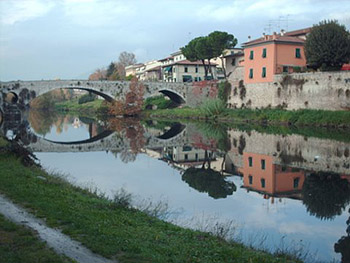
bridge over river in Prato, Tuscany

Prato, Italy

by Sonu Purhar

I hear the merry ping of a horn behind me and automatically step aside; my short stay here has already schooled me in small-town road etiquette. A moment later, a woman on a bicycle glides leisurely past. Several pedestrians wave to her and she squeezes her bell again in a cheery greeting. It strikes me that aside from the bicycle horn, the only sound I hear on this small street in Tuscany is the foreign chatter of a content population. It is as if the harsh industrial world of machinery, pollution, and environmental distress has been left at the town border.

Thanks to a school exchange program, I spent three months living in the small town of Prato in northern Italy, just a short train ride from Florence. My time there opened my eyes to a completely different way of life. The Italian residents taught me to experience the world through the eyes of a culture that places much more value on simple pleasures than our North American traditions dictate. I learned that the relaxed, laid-back mannerism that Europe is famous for is more than just a stereotype; it is an ingrained lifestyle, much as our lifestyle at home consists of clogging our event calendars and seeking the latest technological toys. Only lately have we begun to recognize how destructive our habits are, not only to our own wellness but to that of our planet. Ever since returning to Canada and noticing the stark contrasts between the Italian culture and our own, I have come to strongly believe that emulating the practices of our Italian counterparts can help us offset the growing crises of global warming and environmental destruction, if only we are willing to embrace a simpler way of life.

The Italians’ endearingly simplistic lifestyle not only promotes a less stressful existence, but also advocates the preservation of resources that are fast becoming depleted in this era of excessive consumption. Italy has one of the lowest levels of energy consumption in Europe, and for good reason: many sections of the country, especially smaller towns like Prato, suffer from a faltering economy. These populations are forced to practice conservation just to afford the daily cost of living. Residents of towns like Prato have thus created a lifestyle that encourages environmental sustainability, a practice that North Americans have forgotten.

view over city of Prato, ItalyOne of the most visible differences I noticed in Italy is that most towns hardly ever see traffic; in some areas cars are forbidden, but in most, using alternate means of transportation is a personal choice. This can be contrasted to North America, where an increase in automobile production has led to higher levels of traffic and congestion in both urban and rural districts. This in turn has contributed to the growing pollution that is ripping through our ozone layer. City and town residents in Italy prefer the less environmentally destructive means of walking and bicycling. Many also use scooters, which emit less gas than cars. Furthermore, when traveling within the country, Italians rely heavily on TrenItalia, the highly efficient public railway system that serves as the major form of transportation throughout the country.

As previously mentioned, many regions of Italy are economically disadvantaged in comparison to our own relatively rich nation. The residents of these sectors do not have money or energy to waste. In these regions, Italians make do by conserving their water, heat, and other resources. For example, instead of using washers and dryers, many households hand-wash clothes and dry them in the Tuscan sun, a practice that was initially hard for me to adapt to! Rather than using water-wasting dishwashers, residents wash and dry dishes by hand. Italian kitchens are strikingly void of the collection of microwaves, coffeemakers, and other energy-consuming kitchen appliances that clutter the average North American home; in fact, many households make do with only a stove for their cooking.

Prato residents on sidewalk outside bankItalian leisure looks much different from the constant stimulation we depend on at home. In Prato, for instance, there was no electronics store. I learned that most of the residents do not own the energy-wasting computers, Playstations, or big-screen televisions that North Americans rely on for entertainment. Instead, leisure time in Prato is based solely on human interaction. Every weekend, a traditional “block party” took place in the town center. This consisted of what seemed like the entire population of Prato converging in the streets, where the residents would mingle, eat at outdoor cafés, and amble through town. The purpose of downtime in Italy is to experience the basic pleasure of reconnecting with family members and friends, rather than pursuing the superficial gratifications that North Americans seek from movie houses, clubs, and theme parks, all of which use enormous amounts of electricity and produce gallons of environmental toxins.

One of the most prevailing stereotypes of Italians is that they love their food. This is absolutely correct, and with good reason: Italian food is among the most delicious of world cuisines. However, despite the dominant tradition that mealtime has become in Italian culture, the residents do not waste their food. Supermercatos do not sell items in bulk; the containers and boxes of products that these markets stock are much smaller than those found in North American superstores, which encourages consumers to buy only what they need. This is not only economical for residents, but also reduces the amount of waste products and ensures that food resources are preserved rather than squandered. The same is true for restaurants: unlike the massive portion sizes that are the standard at North American eateries, Italian trachiattoras serve just enough to satisfy the appetite. Furthermore, chefs concentrate on the creation of individual dishes rather than relying on mass production. Only the best ingredients are used, which means food is of higher quality and less is needed to achieve the same tantalizing results.

St. Stephen's Cathedral, PratoSince my return to Canada, I have found myself almost unconsciously incorporating the customs I observed in Italy into my own daily activities. For example, I rely on my car less, choosing instead to walk or take public transportation. Not only does this cut down on pollution and the overuse of fossil fuels, but I pay less for gas and get more exercise as a result. I have also made an active attempt to reduce my energy consumption. Although I do own computers and multiple household appliances like the average North American, I make sure everything is switched off when not in use. I also check that heating and lights are off when no one is home. Similarly, ever since I returned from Italy I have started washing my dishes by hand rather than using the dishwasher. I have also encouraged my family to use our washer/dryer less often, and would suggest that others switch to energy-saving machines as we have. Finally, I no longer buy in bulk while grocery shopping but select only what I know I will need, especially when choosing foods that are easily perishable and will therefore rot quickly, like produce. I am convinced that if enough people follow this practice, the amount of food products that are consumed will diminish, therefore allowing more of these goods to be shipped to poorer countries where food is less abundant.

Ultimately, my trip to Italy not only enlightened me to the customs of a once-foreign culture, but also opened my eyes to our own traditions. It is now clear to me that we have become so used to our practices that we no longer acknowledge their harmful effects on our environment. Admittedly, Italy is by no means the ideal prototype for environmental protection: its rate of automobile usage, for example, has been steadily increasing in recent years. Smaller towns like Prato might be models of resource conservation, but bigger cities, especially with the onslaught of tourism, are catering to both the population and outsiders’ needs by introducing more time-saving, and often energy-wasting, products and practices. It is unfeasible to hope that major cities in North America will become more like Prato when Italy’s own big cities are diverging from this ideal. However, the traditional lifestyles that we observe in our friends abroad can educate us on minor changes that we can incorporate at home in hopes of globalizing a sustainable economy and ultimately preserving the resources of the planet each one of us calls home.

If You Go:

Getting there: The easiest way to reach Prato from the nearest big city, Florence, is by train. There are two stops, Prato Centrale and Prato Porta Serraglio. The former stop is just minutes from the town’s Duomo.

Accommodations: Residence Manassei. Located in the heart of the small town, the residence boasts eleven rooms, complete with reasonably spacious kitchens. Don’t forget to catch the sunset from the rooftop; if you time it right, the tinkling melody of the church chimes will set the scene.

Dining Out: Baghino on Via dell’Accademia – moderately priced authentic and delicious Italian food.

Shopping: Don’t miss the weekly Monday morning market in Mercato Nuovo – the square is packed with vendors selling clothes, produce, and yummy Italian treats.

Sweet Treats: A visit to Prato is not complete without a stop at Gelateria Il Longotto – truly the best gelato in Italy. Also visit Antonio Mattei: the small store sells the famous biscotti de Prato. Take it to go and enjoy it with an espresso.

Tuscany Tours Now Available:

Food Tasting Tour – Gastronomic & Wine Experience in Chianti (Tuscany)
Tuscany Hiking Tour from Siena Including Wine Tasting
Florence, Tuscany and Umbria Luxury Tour

About the author:
Sonu Purhar recently graduated from Simon Fraser University. The semester she spent studying in Italy and traveling around Western Europe inspired her to write two travel articles, both of which have been published on separate travel websites. She has written several non-travel articles and is currently working on (many) writing projects. Contact: spurhar@sfu.ca

Photo credits:
All photos are by Sonu Purhar.

Tagged With: Italy travel, Prato, Tuscany Filed Under: Europe Travel

  • « Previous Page
  • 1
  • …
  • 8
  • 9
  • 10
  • 11
  • Next Page »

MORE TRAVEL STORIES:

The Rise of Cultural Tourism and Smarter Flight Booking Strategies

Naples, a Gift of Time

Texas: Exploring O. Henry’s Austin

Easter Island’s Collapse

Framing Your Travel Photos: Avoid These 4 Mistakes

Lover’s Spat With Rome

Hiking the Samaria Gorge

Time Travel in Colorado: 10 Historic Places You Can Still Visit in 2025


SEARCH

DESTINATIONS

  • Africa Travel
  • Antarctica travel
  • Asia Travel
  • Australia travel
  • Caribbean Travel
  • Central America Travel
  • Europe Travel
  • Middle East Travel
  • North America Travel
  • Oceania Travel
  • South America Travel
  • Travel History
  • Travel News
  • UK Travel
  • Uncategorized
  • World Travel
facebook
Best Travel Blogs - OnToplist.com

Copyright © 2026 Cedar Cottage Marketing | About Us | Contact | Privacy Policy | Terms & Conditions | Copyright Notice | Log in